YEAR IN REVIEW: “Neda wanted freedom and freedom for all”

“Neda wanted freedom and freedom for all”

(Translation provided by Huffington Post readers.)

Caspian Makan, Neda Agha-Setan‘s fiancee, was interviewed by BBC Persia, noting that Neda would have turned 27 this year. “Neda’s goal was not Mousavi or Ahmadinejad, it was her country and was important for her to fight for this goal. She had said many times that if she had lost her life or been shot in the heart, which indeed what happened, it was important for her to continue in this path,” he said.

Considering her young age she has taught a lesson to us all.

About the day of the incident, Mr. Makan said: “When the clashes were occurring, Neda was far away from the demonstrations, she was in one of the side alleys near Amir Abad. Thirsty and tired or being cooped up for about an hour in the car in heavy traffic with her music instructor, she finally gets out of the car and, based on the pictures sent in by the people, armed forces in civilian clothes and the Basiji targeted and shot her in the heart.”

“It was over in a matter of minutes, the Shariati Hospital was nearby, the people around her tried to bring her to the emergency room by car, but before that could even happen she died in her instructor’s arms.”

Mr. Makan added: “We got her body back finally yesterday with some diffculties. Of course, her body was not at the Tehran Coroner but at a one outside of Tehran. The medical examiners
wanted parts of her body, including a portion of her femoral bone but the chief medical examiner would not say why and no explanations were ever given.”

“Finally the family consented just so they could get her body back as soon as possible, since just this issue could have resulted in delaying the reception of the body. We buried the body in a small area in the Zahra Cemetery in the late afternoon of 31 Khordad [June 21]. Also, they had brought in other people who had been killed in the protests so it seemed that the whole event was scheduled to be such.”

About payment for releasing the remains, Mr. Makan had this to say: “No specific amount has been paid at this time, although hospitals, clinics, surgeons and medical examiners have been ordered by the Iranian security services, based on various orders, not to list ‘bullet wound’ as the cause of death on the death certificate in order to prevent the families from filing international complaints in the future. I haven’t seen the release notice of Neda’s remains yet, but I will obtain it from her father in the coming days.”

Mr. Makan regarding government ban of memorial service for Neda Agha Setan said: “We were going to hold her memorial Monday 1st of Tir [June 22] at 2:30 PM at a mosque at Sharyati street north of Seyed Khandan. But Basijis and mosque officials refused our request for her memorial service so to avoid further public confrontation and instability. They knew that Neda was an died innocently, and people in Iran and the international community are informed of that fact. So they decided to avoid a situation where a mass rally would take place. In any way, we do not have permission for a memorial service for now.”

However, many eye witnesses told BBC Persia that a large gathering took place with the intention of performing a memorial service at Al Reza Mosque at Nilofar square in Tehran. But the security forces intervened by throwing people out of the mosque and intervening with the service.

Mr. Makan also commented on fake pictures of videos claiming to be Neda at various sites:”I was looking at some sites including ‘iReport’. There was a picture of a young woman with green signs from previous calm demonstrations and had claimed it was Neda before being shot. These pictures have no relation to the event. It seems that Mr. Mousavi’s supporters are trying to portray Neda as one of his supporters. This is not so. Neda was incredibly close to me and she was never supportive of either two groups. Neda wanted freedom and freedom for all.”

BBC Farsi tried to contact Neda Agha-Sultan’s other family members but was told by a close relative of hers that, for reasons of their own, the Agha Sultan family could grant an interview.


Facebooktwittermail

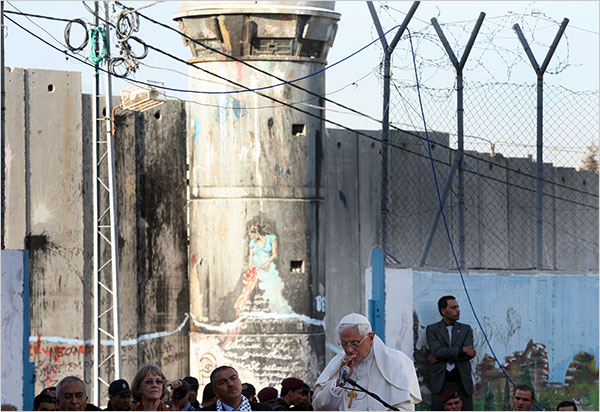
YEAR IN REVIEW: The Pope in the Palestinian prison camp

YEAR IN REVIEW: The Pope in the Palestinian prison camp

Has this image appeared widely in the media? I don’t honestly know, but I’ll assume it hasn’t. So the next question would be: why not?


(Source: The New York Times)

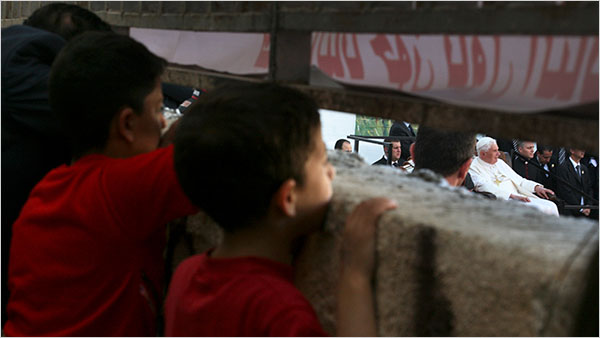
The New York Times ran an article with the headline: “In Bethlehem, Pope laments Israeli wall“. The perfect place to use the image above — the one their own photographer had provided. Right?

Wrong. Instead, they went with a poetic Getty image: little children peaking over a little wall. How enchanting!

Facebooktwittermail

YEAR IN REVIEW: Thank G-d for the IDF!

YEAR IN REVIEW: Gaza probe shows IDF among world’s most moral armies

The Israel Defense Forces announced on Wednesday that an internal investigation has determined that no civilians were purposefully harmed by IDF troops during Operation Cast Lead in the Gaza Strip.

Following the release of the investigation results, Defense Minister Ehud Barak said that the army’s willingness to probe itself “once again proves that the IDF is one of the most moral armies in the world.

“The IDF is not afraid to investigate itself and in that, proves that its operations are ethical,” said Barak. The defense minister added that he has “complete faith in the IDF, from the chief of staff to the last of the combat soldiers.” [continued…]

Editor’s Comment — Oh my! And to think that cynics like me could have judged the IDF so harshly. What better time could there be to watch again this rousing anthem and wonderful tribute to the most moral army in the world: Don’t mess with the IDF.

Facebooktwittermail

YEAR IN REVIEW: We want the land, not the people

YEAR IN REVIEW: Uzi Arad: “It is territory we want to preserve, but populations we want to rid ourselves of”

When Hillary Clinton met Benjamin Netanyahu in Jerusalem during her recent visit to Israel, her party was dismayed to see Uzi Arad at the next Israeli prime minister’s side. Arad’s involvement in the “AIPAC case” has resulted in him being barred from entry into the US. Joseph Fitsanakis continues the story:

As soon as Secretary Clinton and her advisers realized Arad was standing next to Netanyahu in the meeting room, they tried to discreetly avoid diplomatic complications by requesting that “only three participants from each side stay in the meeting”. It was an indirect way of requesting that Mr Arad leave the room. But the US delegation was stunned when Israel’s Prime Minister-Designate kept the former Mosad agent present, choosing instead to kick out Israel’s Ambassador to the United States, Sallai Meridor. Clinton’s delegation did not say a word about the Netanyahu’s diplomatic slap-in-the-face, hoping the incident would not make headlines. Ambassador Meridor was not so sensitive about the affair. He was so put off that he announced his resignation soon afterwards.

Netanyahu’s office later explained that Arad’s presence was required in the meeting “because of the Iranian issue.”

Arad is an advocate of “maximum deterrence” towards Iran and has said Israel should threaten to strike ‘everything and anything of value.’ He has said Israel should threaten to hit the Iranian leadership and their holiest sites and that they should hit everything together. This comes from the man tipped to become Netanyahu’s national security adviser.

Arad also recently made the following remarks about the Palestinians. During an interview on Israel National News TV (Arutz Sheva is a media network based in the West Bank and is seen as the voice of the Jewish settler movement), Arad was asked whether the time has come to abandon the two-state solution. This is how he responded:

I don’t think that one has to go that far because at the end of the day, I don’t think the majority of Israelis want to see themselves responsible for the Palestinians. We do not want to control the Palestinian population. It’s unnecessary. What we do want is to care for our borders, for the Jewish settlements and for areas which are unpopulated and to have our security interests served well. But also to take under our responsibility these populations which, believe me, are not the most productive on earth, would become a burden. We want to relieve ourselves of the burden of the Palestinian populations – not territories. It is territory we want to preserve, but populations we want to rid ourselves of.

Facebooktwittermail

YEAR IN REVIEW: “… the settlements will never go, and yet almost everyone likes to pretend otherwise…”

YEAR IN REVIEW: Fictions on the ground

Israel needs “settlements.” They are intrinsic to the image it has long sought to convey to overseas admirers and fund-raisers: a struggling little country securing its rightful place in a hostile environment by the hard moral work of land clearance, irrigation, agrarian self-sufficiency, industrious productivity, legitimate self-defense and the building of Jewish communities. But this neo-collectivist frontier narrative rings false in modern, high-tech Israel. And so the settler myth has been transposed somewhere else — to the Palestinian lands seized in war in 1967 and occupied illegally ever since.

It is thus not by chance that the international press is encouraged to speak and write of Jewish “settlers” and “settlements” in the West Bank. But this image is profoundly misleading. The largest of these controversial communities in geographic terms is Maale Adumim. It has a population in excess of 35,000, demographically comparable to Montclair, N.J., or Winchester, England. What is most striking, however, about Maale Adumim is its territorial extent. This “settlement” comprises more than 30 square miles — making it one and a half times the size of Manhattan and nearly half as big as the borough and city of Manchester, England. Some “settlement.”

There are about 120 official Israeli settlements in the occupied territories of the West Bank. In addition, there are “unofficial” settlements whose number is estimated variously from 80 to 100. Under international law, there is no difference between these two categories; both are contraventions of Article 47 of the Fourth Geneva Convention, which explicitly prohibits the annexation of land consequent to the use of force, a principle re-stated in Article 2(4) of the United Nations Charter. [continued…]

Facebooktwittermail

GAZA UPDATE

Gaza: the war of words

Gaza aid convoy to take longer route after hold-up in Egypt

he aid convoy, stranded in Aqaba, Jordan, for five days, on its way to the Gaza Strip, turns back to Syria after Cairo’s refusal to let it cross through its territory.

Members of the convoy, led by British MP George Galloway, were hoping to reach a solution through Turkish mediation and enter Gaza through the Red Sea port of Nuweiba, the most direct route.

“After talks between the Turkish government’s envoy and the Egyptian consulate in Aqaba, we agreed to go to Syria,” Zaher Birawi, spokesman for the convoy, told Agence France-Presse.

“We have told the Egyptians that we were not trying to challenge them and urged them to help us, but they refused,” Birawi said. [continued…]

Editor’s CommentToday’s Zaman says: “Turkish Prime Minister Recep Tayyip Erdoğan said he supports the convoy and urged Egypt to allow the Turkish deputies to enter.” And the Viva Palestina Twitter feed adds: “Seems Turkish pressure means convoy will move to Syria (maybe on the road tonight) and Turkey will fund a chartered ship from Syria for ALL.”

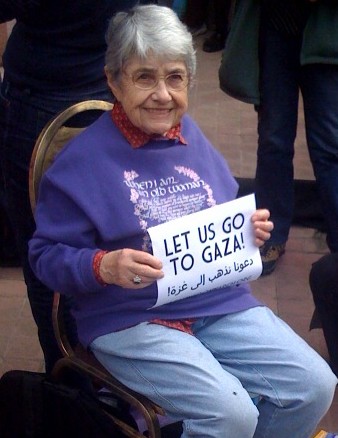
85 year old Holocaust survivor Hedy Epstein begins hunger strike to open Gaza borders

Hedy Epstein, the 85 year old Holocaust survivor and peace activist, announced that she will begin a hunger strike today as a response to the Egyptian government’s refusal to allow the Gaza Freedom March participants into Gaza.

Ms. Epstein was part of a delegation with participants from 43 countries that were to join Palestinians in a non-violent march from Northern Gaza towards the Erez border with Israel calling for the end of the illegal siege. Egypt is preventing the marchers from leaving Cairo, forcing them to search for alternative ways to make their voices heard.

Ms. Epstein will remain outside the UN building at the World Trade Center (Cairo) – 1191 Cornish al-Nil, throughout today, accompanied by other hunger strikers. “It is important to let the besieged Gazan people know they are not alone. I want to tell the people I meet in Gaza that I am a representative of many people in my city and in other places in the US who are outraged at what the US, Israeli and European governments are doing to the Palestinians and that our numbers are growing,” Epstein said. [continued…]
(Photo credit: Ali Abunimah)

Freedom marching in circles while winding our way to Gaza

Yesterday we joined the people of Gaza, the people of all of Palestine, and allies around the world in remembering the anniversary of the inhuman and illegal Israeli attacks that stole the lives of more than 1,400 mothers, fathers, daughters, and sons last December and January. And, in a manner far too appropriately suited to remembering an unfathomably vicious massacre and the preposterous silence of the American and Egyptian governments, we freedom marched in circles throughout the streets of Cairo.

The Egyptian government has revoked the contracts for the buses that would take us one step closer on our journey to Gaza and has forbidden us from leaving Cairo. Military police have torn down our small hand-written cards tied to the Kasr al Nil Bridge, following the Israelis’ lead in trying to disappear the names and numbers of Gaza’s martyrs. Candles meant to float along the Nile in remembrance are still in their boxes, their hundreds of distributors never permitted to board the feluccas (river boats) waiting just beyond overwhelming security forces. We regroup, circle again, and find another path to remembering and reminding, another way through the many checkpoints and the impossible border ahead. [continued…]

A man-made humanitarian disaster

One year after the Zionist entity’s savage assault on the besieged refugee population of the Gaza Strip, a group of 16 international human rights and aid groups released a report documenting the wretched conditions under which the people of Gaza are inexplicably left to suffer.

We hear much of this suffering, but all too often it’s just an afterthought in the heat of political discussion. And for those who have never gone through such conditions, it will be impossible to understand the comprehensive breadth of the restrictions placed upon every facet of daily life in Gaza.

I hardly ever read these reports in full, usually just perusing the conclusions, but reading the detailed facts and figures mentioned in this one (entitled ‘Failing Gaza: No rebuilding, no recovery, no more excuses‘) really drives home the extent of the oppression. [continued…]

One year since Gaza war: no access by the numbers

Despite the fact that a year has passed since the start of the Gaza military operation, the damage caused by three weeks of war and the near total closure preceding it has yet to be repaired. The reason: Israel’s ongoing policy blocking goods from entering the Gaza Strip, including a near total ban on reconstruction materials. [continued…]

Facebooktwittermail

YEAR IN REVIEW: VIVA PALESTINA!

YEAR IN REVIEW: Viva Palestina shows the power of the people

While governments have repeatedly demonstrated their indifference, incompetence, and apparent impotence when it comes to responding to the plight of the population in Gaza, a bunch of ordinary folk under the banner “Viva Palestina” have shown what amazing things can be accomplished, when goodwill, imagination, daring and tenacity come together.

Viva Palestina — a lifeline from Britain to Gaza — shows the power of the people.

In Sharm el-Sheikh a week ago, world leaders delivered empty promises. Today, Viva Palestina delivered the goods!

Marwa Awad and Muhammed Eta from Al Arabiya tell the story:

Crossing continents, covering thousands of miles and opening borders long closed are just a few of the feats an emergency relief convoy trekking from London to Gaza made over the past three weeks before arriving at Egypt’s Rafah border Sunday to break a crippling siege and deliver much needed aid to Palestinians in Gaza.

Viva Palestina, a British relief convoy headed by British Parliamentarian George Galloway and planned by hundreds of British volunteers, rolled into Rafah to deliver aid to thousands of destitute Palestinians in Gaza after crossing a 8000-kilometre route from London through France, Spain, Morocco, Algeria, Tunisia, Libya, and finally entering Egypt through the Libyan Egyptian border on Thursday after which the convoy drove along the coast to reach the city of al-Arish, 40 km away from Rafah.

“A lifeline from Britain to Gaza,” is the motto of Viva Palestina, which started out with 110 trucks from London but was doubled in Libya after the Gaddafi Foundation for Charity and Development donated 100 trucks laden with aid.

The convoy, which was over 1.8 miles long when it rolled into Egypt through the Sallum border between Libya and Egypt Thursday, was camped at the city of al-Arish and will enter Gaza through the Rafah border Monday after several border negotiations between Galloway and the Egyptian authorities in Rafah on Sunday.

“It’s a caravan of 500 kind hearts,” Talat Ali Shah, convoy group leader told AlArabiya.net. “The convoy was received by a jubilant crowd, ready to help and encourage us on,” he added. The convoy set out on Feb. 14 from London.

The convoy included a British fire engine, 12 ambulances, and many trucks full of medicine, food, clothes and toys for children, given by the various communities in Britain and the Gaddafi Foundation.

“Gifts from all over the world”

George Galloway, who is a peace advocate and staunch supporter of the Palestinian cause, organized the convoy in response to the humanitarian crisis Israel unleashed on Gaza for 22-days that left the impoverished Strip in ruins while killing 1300 and wounding 5000.

Galloway a “friend of the Arabs”

The Egyptian government’s ruling National Democratic Party in charge of the convoy’s passage through the Egyptian borders expressed gratitude for Galloway’s efforts.

“We know the value of Galloway as a peace advocate and we welcome him as a known friend of the Arabs,” Ali al-Din al-Hilal from the NDP told AlArabiya.net.

Likewise, Galloway thanked the Egyptian government for facilitating the convoy’s safe passage, acknowledging Egypt’s commitment to the Palestinian cause.

“The warm welcome of the people here and their concern for Palestine is overwhelming. Egypt has given so much for Palestine over the last 60 years. Many soldiers have died for Palestine and we acknowledge this commitment,” Galloway said at the press conference.

He added that Viva Palestina is a message to the world that Britain is “not the enemy of the Muslims,” and that while Tony Blair does not represent the people of Britain, Viva Palestina does.

“From Ireland to Gaza”

“In the past 35 years I have entered Palestine many times but I was never as happy as I am this time,” Galloway said in a press conference upon arrival.

Politics of the convoy’s passage

After negotiations with the Egyptian border authorities, aid brought by the Viva Palestina convoy will be split into medical and non-medical category.
While trucks carrying medical aid are to enter through the Rafah border, the rest of the non-medical goods is to enter from Awja, a border crossing controlled by Israel and lies 43 miles away from Rafah.

“The convoy goods will split in order to allow medical aid through Rafah border and the rest will pass through Awja,” General Muhammed Shusha, governor of north Sinai, told AlArabiya.net.

However, all Viva Palestina convoy members including leaders Galloway and Sabbah al-Mokhtar will enter Gaza through the Egyptian border with Gaza.

“Under no circumstance will members of Viva Palestina convoy coordinate with Israel,” Mokhtar told AlArabiya.net. “We shall all gain safe passage into Gaza from the Egyptian/Gaza border tomorrow as agreed upon with the Egyptian border authorities,” he said.

The Egyptian Red Crescent and other U.N. relief organizations such as the World Health Organization and Oxfam will be responsible for transferring non-medical goods through Awja border.

Egyptian border designate the Rafah border for medical aid supplies while all other types of aid enter Gaza through the Awja broder which Israel overlooks.

Yvonne Ridley, award winning journalist who accompanied the convoy, reported that Israel pressured Egypt to divert the convoy to go through Israeli borders.

“Israel is putting huge pressure on Egypt to force the convoy which is now doubled in size, a British-Libyan venture, through Israeli territory,” she said at the conference.

Expectations that the massive Viva Palestina aid convoy will roll in full through the Rafah border continue despite Israel’s diplomatic pressure to force the non-medical part of the convoy to drive through the Israeli controlled Egyptian border of Awja, a route George Galloway and the convoy say is not an option.

Despite these challenges, the convoy has kept its spirits high in anticipation of relieving the hardships of thousands of Palestinians.

“Gaza has broken into many British homes and has touched many British hearts,” Hussein said. “Our experience in this journey of hope makes us feel that we are the luckiest people. Bur our happiness will be complete, when we cross into Gaza and console the children, men and women who have suffered for so long.”

A message of hope from the “streets of Britain”

Bringing together volunteers from different ethnicities and religions, Viva Palestina hopes to bring aid to 1.5 million residents in Gaza who still subsist under a 19-month crippling siege Israel refuses to ease almost one month after its all-out assault.

“The material we are carrying is only a drop in the ocean but the goodwill of volunteers and the people from the countries we have passed through is tremendous,” Mokhtar, one of the leading members of Viva Palestina involved in negotiations with border officials, told AlArabiya.net.

“This convoy is extremely diverse consisting of men, women, Muslims and non Muslims from across England,” he added.

“We truly care and we’ve driven across continents to prove it,” is the message 500 ordinary volunteers plan to deliver to Gazans, according to the Viva Palestina website.

“This is a movement of the streets,” Galloway told AlArabiya.net.

Such a movement wrought unexpected results as Algeria and Morocco opened the border between them for the first time in 15 years since 1994— something which Condoleezza Rice failed to do—to allow the convoy through in clear testament to people power outdoing politics.

“It surely signifies the goodness of human nature and the strength of the will of the people that can overtake any odds,” Iftikhar Hussein, 25-year-old high school teacher from Birmingham told AlArabiya.net.

Galloway added that the volunteers are self-funded. “Each person travelling on the convoy is a self-financed British volunteer. The vehicles will be left with the people of Gaza; volunteers will fly home to the U.K. Thousands of pounds cash has been fundraised [for the people of Gaza]”

“They come from different walks of life. With us are doctors, accountants, house wives, and students,” Mokhtar said.

Viva Palestina is supported by the Stop the War Coalition, the Respect the Anglo-Arab Organisation, several British trade unions and a large number of Muslim organisations.

The American media has completely ignored this story and the British press hasn’t done much better. The story only became “newsworthy” when some of the vehicles were pelted with stones and defaced in El-Arish which lies about 40km away from Rafah. Vehicles had also been daubed with anti-Hamas slogans. That’s a shame, but it’s really just a side note in an amazing story that shows the power of the human spirit.

Just a few hours ago, the goal was accomplished: the convoy crossed into Gaza!

Viva Palestina!

Facebooktwittermail

Gaza ceasefire in jeopardy as six Palestinians are shot

Gaza ceasefire in jeopardy as six Palestinians are shot

Israeli troops yesterday shot dead six Palestinians in two separate incidents, as evidence emerged that an increasingly fragile ceasefire between armed groups loyal to President Mahmoud Abbas’s Fatah movement and Israel appeared to be in danger of breaking down.

The shootings, the most serious violence in months, came a day before today’s first anniversary of the outbreak of Israel’s war against Gaza in which almost 1,400 Palestinians died – and as allegations have emerged from Israeli human rights campaigners who opposed the war that they are facing concerted attempts to silence them.

Three of the Palestinians were killed in an airstrike just inside the Gaza border. According to Israeli officials they had been scouting the area for a possible infiltration operation, but according to Hamas officials and medics they had been searching for scrap metal to salvage.

More serious in its implications, however, was the shooting dead of three members of Fatah’s armed wing – the al-Aqsa Martyrs’ Brigades – in a raid on the northern West Bank city of Nablus, apparently in retaliation for the shooting of an Israeli driving near the settlement at Shavei Shomron. Relatives who witnessed the Nablus shootings said soldiers fired at two of the men without warning. An Israeli army spokesman, Major Peter Lerner, said troops fired after the three men failed to respond to calls to surrender. [continued…]

Editor’s Comment — To be an Israeli soldier is to be able to murder with impunity. It’s as simple as that.

The reporting on the murder of three members of the Al Aqsa Martyrs Brigades is quite extraordinary. An Israeli commander is quoted saying: “we have the responsibility to act against whoever executed the attack [in which a Jewish settler was murdered on Thursday] and settle the score with them.”

Ynet reported: “The defense establishment is investigating why the three, who are considered fairly mature, decided to execute the attack themselves, and why they acted so shortly after being released from the Israeli prison.”

Suspects can be arrested and put on trial, but if settling scores is the name of the game then we’re not talking about suspects — we’re talking about targets for killing.

Haaretz reported: “According to B’Tselem, in two of the three cases the troops behaved as if they were preparing for an execution, not an arrest. Relatives and eyewitnesses told B’Tselem that the two were unarmed and did not attempt to flee, and that the soldiers weren’t trying to stop them, but rather shot them from close range once their identity was revealed. There were no witnesses to the shooting of the third man.”

Then we have what might be called the torturers’ defense: look, we didn’t suffer a scratch — proof that we were exercising restraint.

A senior IDF officer told Ynet: “The fact that no soldier was injured in the incident shows that we did not act too aggressively and that everything was done properly despite the extremely complex and dangerous mission.”

Meanwhile, Israel awaits Hamas’ response to the prisoner exchange offer for securing the release of Gilad Shalit… and a bomb goes off in Beirut killing two Hamas members.

Is Mossad trying to block the deal?

Facebooktwittermail

GAZA UPDATE

The Children of Gaza share their experiences of “Cast Lead”

Viva Palestina convoy held up in Jordan

Gaza aid convoy members prepare for hunger strike

Members of the Viva Palestina international aid convoy to Gaza will begin a hunger strike at 11.25am local time tomorrow (27th) in protest at the Egyptian government’s refusal to allow the convoy entry onto its soil.
Diplomatic negotiations are also taking place between the Turkish and Egyptian governments over the convoy’s entry to Egypt. IHH, Turkey’s main humanitarian aid agency, has 63 vehicles travelling on the convoy. [continued…]

Lift the siege on Gaza!

A massive mobilization between December 27, 2009 and January 1, 2010 with candlelight vigils, concerts, marches, demonstrations, art installations and movie screenings will assemble all over the world to send a clear message to world leaders: end the siege on Gaza.

To tackle the blockade against Gaza, grassroots activists are moving quickly and acting in unison for an absolutley crucial time. Dec. 27 will mark one year since the Israeli attack and invasion of the Gaza Strip. Although the Israeli tanks have left, the complete closure of the borders continues.

In order to unite the public to influence public leaders behind the Gaza Freedom March goals, solidarity action organizers harnessed the power of the internet to coordinate a global week of actions. There will be actions at many places around the world: France, United Kingdom, Turkey, Ireland, Germany, Spain, United States, Afghanistan, Australia, Belgium, Switzerland, Sweden, Jordan, Canada, Israel/Palestine, Poland, Denmark, and Greece. [continued…]

Gaza Freedom Marchers: 38 detained by Egypt

Egyptian security forces detained 38 participants of the Gaza Freedom March from a hotel in Al-Arish on Sunday at noon, according to a statement issued by the event’s organizers.

“Egyptian security forces detained a group of 30 internationals in their hotel in el-Arish and another group of 8 at the bus station. They also broke up a memorial action commemorating the Cast Lead massacre at the Kasr al Nil Bridge,” the statement asserted. [continued…]

Police detain 16 Israeli leftists on Gaza border

Police detained 16 left-wing activists as they were trying to cross into Gaza on Sunday to mark the one year anniversary of Operation Cast Lead.

Chief Superintendent Shimon Nahmani, commander of the Sderot police station, said the leftists held a rally without prior authorization. [continued…]

Hezbollah chief asks Egypt to stop Gaza border wall

Hezbollah leader Sayyed Hassan Nasrallah on Sunday called on Egypt to stop building a steel wall along the Gaza border that could obstruct tunnels which provide a lifeline for the blockaded enclave.

Nasrallah told a crowd of tens of thousands of Lebanese Shi’ite Muslim marking the Ashura religious ceremony that Egypt should be condemned if it does not halt the wall building. [continued…]

A year later, Gaza and Israel both under siege

A year after the Israeli attack on Gaza, a scorecard of “winners and losers” suggests that nobody won anything, but Israel has probably suffered political losses that it could not have envisioned when it decided to invade Gaza. I count seven main aims that Israel had in mind when it launched its war a year ago and tightened its siege of Gaza; one of them was achievable without a war, and the six others have not been achieved, or have turned things to Hamas’ and the Palestinians’ favor. [continued…]

Cast Lead 2

This week hundreds of thousands gathered in the Gaza Strip for a demonstration in support of Hamas. Judging from the photos, there were between 200 and 400 thousand. Considering that there are about 1.5 million inhabitants in the Strip, most of them children, that was quite an impressive turnout – especially in view of the misery caused by the Israeli blockade that has continued throughout the year and the ruined homes that could not be rebuilt. Those who believed that the pressure on the population would cause an uprising against the Hamas government have been proved wrong.

History buffs were not surprised. When attacked by a foreign foe, every people unites behind its leaders, whoever they are. Pity that our politicians and generals don’t read books.

Our commentators portray the inhabitants of Gaza as “looking with longing at the flourishing shops of Ramallah”. These commentators also derive hope from public opinion polls that purport to show that the popularity of Hamas in the West Bank is declining. If so, why is Fatah afraid of conducting elections, even after all Hamas activists there have been thrown into prison?

It seems that most of the people in the Gaza Strip are more or less satisfied with the functioning of the Hamas government. In spite of the misery of their lives, they may also be proud of its steadfastness There is order in the streets, crime and drugs are decreasing. Hamas is trying cautiously to promote a religious agenda in daily life, and it seems that the public does not mind.

The main aim of the operation has failed completely. [continued…]

Such brutal folly – but now prepare for Cast Lead II

There were no winners in the Gaza war that Israel launched a year ago today, but no shortage of losers. And failure to address its underlying causes – the economic siege through which Israel, Egypt and the US hope to force Hamas from power, and that organisation’s ability to respond by firing rockets into Israel – means that far from anyone learning the lessons of the brutal folly that was Operation Cast Lead, a repeat may be imminent. [continued…]

European Israel-advocacy group files suit against Goldstone report in Belgium

As Netanyahu and other Israeli leaders act to remove Israel from the international criminal justice system, some Israelis and their supporters in Europe are fighting back. The following was published in Yedioth Aharonoth on December 24, 2009.

Yesterday the pro-Israel lobby, the European Initiative, submitted in Belgium a lawsuit of a kind never filed before. The prospective defendants are the entire Hamas leadership; the plaintiffs are people with Belgian citizenship who live in the Gaza periphery communities and who have been targeted by dozens of rockets in the past number of years.

In the aftermath of the wave of lawsuits that were filed by pro-Palestinian organizations in the past number of years in Europe to have top Israeli officials arrested, yesterday a legal counter-assault was staged. Following six months of preparatory work, yesterday the pro-Israel lobby lodged an itemized legal complaint to the Belgian Federal Prosecutor’s Office with the demand that the top Hamas leadership in Gaza and Damascus be prosecuted for war crimes and crimes against humanity. The suit, incidentally, is based on the Goldstone Report, as well as on reports by B’Tselem and Amnesty International.

Not only does the suit explicitly accept the principle of international jurisdiction over criminal offenses committed in the context of the Israeli-Palestinian conflict, it is based on reporting by NGOs whose integrity is frequently attacked by the Government of Israel. The most surprising component of this development is, however, the endorsement of the validity of the Goldstone Report. [continued…]

Facebooktwittermail

YEAR IN REVIEW: Barbarianism unmasked

YEAR IN REVIEW: Barbarianism unmasked

The conceit of every autocratic leader is that power fits comfortably upon his shoulders. Even if he has not been chosen directly by his people, his right to rule reflects a natural order.

The World Economic Forum at Davos, with all its trappings of civility and reflective sophistication, embodies the same conceit. This is the forum of world governance that repeatedly unwittingly exposes the chasm dividing the world from its leaders.

Yesterday’s session, “Gaza: the case for Middle East peace,” was a pivotal moment in political discourse between the West and the rest of the world. The self-righteous hubris of an enraged Israeli president collided with the outrage of those who refused to ignore his bloodied hands.

To fully understand what happened, watch the one-hour eight-minute discussion. (For readers who want to fast forward to the part where Shimon Peres starts venting his rage, drag the play marker across to 45 minutes 50 seconds.)

“Why did they fire at us? What did they want? We didn’t occupy. There was never a day of starvation in Gaza. By the way, Israel is the supplier of water daily to Gaza. Israel is the supplier of fuel to Gaza.”

Right now, the press has much less interest in exposing Peres’ lies than it has in the headline-grabbing moment — the point at which Turkish prime minister Recep Tayyip Erdogan left the stage in reaction to the insulting behavior of the Washington Post‘s David Ignatius.

The real story — the story that an obsequious press corps has chosen to under-report — was a tirade from Shimon Peres that should rank on a par with Nikita Kruschev’s outburst at the United Nations in 1960 when he pounded his shoe in protest.

Never has the word “peace” been spewed out with such venom as when Peres thundered, “Our aim is peace, not war.”

Yet in response, the bias of opinion inside the hall was quickly exposed. Even though fellow panels members were visibly shocked by the Israeli’s unfettered anger, once Peres had finished his verbal assault on anyone who might dispute Israel’s version of reality, he instantly received a warm round of applause.

Up to that moment, it seems possible that Erdogan might have been willing to allow a potentially impartial audience to form its own judgment, but since Peres’s outburst had not only repeatedly been directed with utter contempt at Turkey’s prime minister but apparently received broad approval among the Davos elite, he felt compelled to respond.

David Igantius reluctantly acquiesced, giving him one minute — but Erdogan exceeded his time. The moderator with taps on the prime minister’s shoulder insisted that, “with apologies, we really do need to get people to dinner.”

Turkey is currently in a position to play a vital, perhaps indispensable role in Middle East peace mediation but a columnist for the Washington Post takes it upon himself to cut short the prime minister’s remarks because the illustrious Davos crowd will be late for dinner!

Had Peres not been given the central seat and had he been sitting right next to Ignatius and had he exceeded his time, would the hack from Washington have had the audacity to try and shut up Israel’s president? It’s hardly likely. Ignatius would have shown due respect to a man whose authority he would never dream of questioning.

Erdogan’s choice to walk off the stage was simply a refusal to accept an insult. As a result he received a hero’s welcome on his return to Turkey.

Beyond the passion of the moment, the incident exposes the hypocrisy that is embedded in the West’s view of the rest of the world.

If Hugo Chavez, or Muammar al-Gaddafi, or Mahmoud Ahmadinejad or any other non-Western leader had spoken with the vulgarity, deceitfulness and rage that Shimon Peres displayed, the universal response would have been that this was unbecoming and unacceptable behavior for a political leader on a world stage.

The conceit of Western civilization (within which Israel sees itself embedded and by which Israel is treated as a full participant) is that it has nothing to learn from the dignity of others.

As the self-appointed custodians of civilization we fail to see the degree to which dignity is something we often lack, while so many of those we look down upon regard respectful, dignified behavior as a fundamental mark of humanity. Commensurate with the loss of our dignity has been the rise of our arrogance.

If Israel wants to understand why it is currently viewed with contempt by so much of the world, it should not only consider the misery it has inflicted on millions of Palestinians; it should also consider why it takes pride in having as its preeminent emissary a man who acts like a thug.

Facebooktwittermail

YEAR IN REVIEW: The peace process is irreversibly over

YEAR IN REVIEW: The peace process is irreversibly over

If you did not see it already, watch Bob Simon’s report (below), “Is Peace Out Of Reach?” from last night’s edition of 60 Minutes. In the history of American reporting on the Palestinian-Israeli conflict, this is an exceptional piece of journalism. But don’t just watch it — share it by email, embed it on your web site and do whatever else you can to enlighten other Americans who at this time understand so little about the core issues behind the conflict. (The following video is preceded by a 30-second commercial.)


Watch CBS Videos Online

As President Obama’s Middle East Envoy for Peace, George Mitchell, makes his way to the region this week, he should keep in mind a statement that Osama Hamdan, Hamas’s representative in Lebanon, made in a speech in Beirut yesterday. Hamdan said, “the peace process is irreversibly over.”

This bears repeating:

…the peace process is irreversibly over.

There are commentators who will say that this statement is an expression of intransigence and belligerence coming from a resistance movement dedicated to the destruction of Israel.

Far from it — it is merely a statement of fact. Indeed, it is an assessment of an objective reality that is remarkably lacking in venom.

Just suppose that we were at a juncture where 1,300 Israelis had just been brutally killed, 5,000 were wounded, many in a grave condition, 20,000 houses had been destroyed and tens of thousands were now homeless.

Suppose in such a situation Israel’s leaders were to declare that the peace process was irreversibly over, we would now be commenting on their remarkable composure. We would marvel that they would bother making a political statement and not simply a blood-curdling cry of vengeance.

Hamas on the other hand, in spite of the devastation of Gaza, is still committed to politics.

The political imperative of the moment is one of clarification. Hamas sees that Palestinian unity and a Palestinian national movement cannot be built on an illusory foundation.

Meanwhile, Tzipi Livni claims that the carnage in Gaza has advanced the peace process. This is an Orwellian, obscene, and outrageous insult to common sense. It displays a sociopathic view of human suffering.

But it also serves as a reminder and confirmation that Osama Hamdan is right: the peace process is irreversibly over.

If this is a conclusion which can commonly be agreed upon, where do we go from here? Is this not a conclusion that will feed utter despair or a justification for endless conflict?

I believe not.

Political change can only gain traction when it is rooted in objective reality. We can only advance from the conditions we actually inhabit.

For several years now the peace process has floundered because of a glaring contradiction between Israel’s stated aim — a two-state solution — and its actions, which consistently advanced in the opposite direction.

By its own choice, Israel has abandoned the goal of a two-state solution. The so-called peace process has provided the water and the sustenance that has allowed the occupation to flourish.

America has been the enabler. It has provided a stage upon which a pantomime of peace could be performed. It has quite effectively silenced those who would disrupt the performance and insisted that we all silently enjoy a show whose tedious enactment perpetually held out the promise of a happy ending.

“When Israel supports a solution of two states for two people, the pressure won’t be on Israel,” Tzipi Livni correctly observed over the weekend.

George Mitchell’s duty, the duty of the international community and of all Palestinian leaders, is to say: the game is up, the show is over. The charade has gone on for long enough. Israel has stated its position on the ground. It’s words have proved to be of no consequence.

Given the realities and ignoring the empty declarations, where does Israel want to go from here?

  • Democracy: a one-state solution in which Jews and Palestinians have equal rights;
  • Ethnic cleansing: a state that solidifies its Jewish identity by purging itself of every non-Jewish element; or
  • Apartheid: the explicit formalization of what is already a practical reality.

These, as Bob Simons correctly observers, are Israel’s choices. America can no longer serve as Israel’s shield in its efforts to conceal a painful reality.

Facebooktwittermail

YEAR IN REVIEW: ISRAEL’S LEADERS ARE NOT SIMPLY WAR CRIMINALS; THEY ARE FOOLS

YEAR IN REVIEW: Israel’s leaders are not simply war criminals; they are fools

I was brought up as an orthodox Jew and a Zionist. On a shelf in our kitchen, there was a tin box for the Jewish National Fund, into which we put coins to help the pioneers building a Jewish presence in Palestine.

I first went to Israel in 1961 and I have been there since more times than I can count. I had family in Israel and have friends in Israel. One of them fought in the wars of 1956, 1967 and 1973 and was wounded in two of them. The tie clip that I am wearing is made from a campaign decoration awarded to him, which he presented to me.

I have known most of the Prime Ministers of Israel, starting with the founding Prime Minister David Ben-Gurion. Golda Meir was my friend, as was Yigal Allon, Deputy Prime Minister, who, as a general, won the Negev for Israel in the 1948 war of independence.

My parents came to Britain as refugees from Poland. Most of their families were subsequently murdered by the Nazis in the Holocaust. My grandmother was ill in bed when the Nazis came to her home town of Staszow. A German soldier shot her dead in her bed.

My grandmother did not die to provide cover for Israeli soldiers murdering Palestinian grandmothers in Gaza. The current Israeli Government ruthlessly and cynically exploit the continuing guilt among gentiles over the slaughter of Jews in the holocaust as justification for their murder of Palestinians. The implication is that Jewish lives are precious, but the lives of Palestinians do not count.

On Sky News a few days ago, the spokeswoman for the Israeli army, Major Leibovich, was asked about the Israeli killing of, at that time, 800 Palestinians—the total is now 1,000. She replied instantly that

    “500 of them were militants.”

That was the reply of a Nazi. I suppose that the Jews fighting for their lives in the Warsaw ghetto could have been dismissed as militants.

The Israeli Foreign Minister Tzipi Livni asserts that her Government will have no dealings with Hamas, because they are terrorists. Tzipi Livni’s father was Eitan Livni, chief operations officer of the terrorist Irgun Zvai Leumi, who organised the blowing-up of the King David hotel in Jerusalem, in which 91 victims were killed, including four Jews.

Israel was born out of Jewish terrorism. Jewish terrorists hanged two British sergeants and booby-trapped their corpses. Irgun, together with the terrorist Stern gang, massacred 254 Palestinians in 1948 in the village of Deir Yassin. Today, the current Israeli Government indicate that they would be willing, in circumstances acceptable to them, to negotiate with the Palestinian President Abbas of Fatah. It is too late for that. They could have negotiated with Fatah’s previous leader, Yasser Arafat, who was a friend of mine. Instead, they besieged him in a bunker in Ramallah, where I visited him. Because of the failings of Fatah since Arafat’s death, Hamas won the Palestinian election in 2006. Hamas is a deeply nasty organisation, but it was democratically elected, and it is the only game in town. The boycotting of Hamas, including by our Government, has been a culpable error, from which dreadful consequences have followed.

The great Israeli Foreign Minister Abba Eban, with whom I campaigned for peace on many platforms, said:

    “You make peace by talking to your enemies.”

However many Palestinians the Israelis murder in Gaza, they cannot solve this existential problem by military means. Whenever and however the fighting ends, there will still be 1.5 million Palestinians in Gaza and 2.5 million more on the West Bank. They are treated like dirt by the Israelis, with hundreds of road blocks and with the ghastly denizens of the illegal Jewish settlements harassing them as well. The time will come, not so long from now, when they will outnumber the Jewish population in Israel.

It is time for our Government to make clear to the Israeli Government that their conduct and policies are unacceptable, and to impose a total arms ban on Israel. It is time for peace, but real peace, not the solution by conquest which is the Israelis’ real goal but which it is impossible for them to achieve. They are not simply war criminals; they are fools.

Sir Gerald Kaufman has been a Member of Parliament since 1970 and when the Labour Party was in the oppostion served as Shadow Environment Secretary, (1980-1983), Shadow Home Secretary (1983-1987) and Shadow Foreign Secretary (1987-1992). Since 1992 he has been one of the Labour Party’s most influential back-benchers.

Facebooktwittermail

YEAR IN REVIEW: The consequences of moral paralysis

YEAR IN REVIEW: Israel (and a world that looks the other way) is in the grip of a moral paralysis

“We had no choice,” has become Israel’s national mantra.
But to say “we had no choice,” is to say our actions are not the fruit of our intentions. We are now the instrument of the will of others. Hamas made us do this.

There would be more moral clarity in simply declaring that Israel is a mighty power that has no compunction about the effects of its ruthless efforts to crush its enemies.

Instead, Israel wants to have it both ways: to demonstrate its might even while portraying itself as a helpless victim.

From Avi Shlaim we learn that this moral two-step actually has a name in Hebrew: bokhim ve-yorim. It means “crying and shooting.”

As always, mighty Israel claims to be the victim of Palestinian aggression but the sheer asymmetry of power between the two sides leaves little room for doubt as to who is the real victim. This is indeed a conflict between David and Goliath but the Biblical image has been inverted – a small and defenceless Palestinian David faces a heavily armed, merciless and overbearing Israeli Goliath. The resort to brute military force is accompanied, as always, by the shrill rhetoric of victimhood and a farrago of self-pity overlaid with self-righteousness. In Hebrew this is known as the syndrome of bokhim ve-yorim, “crying and shooting”.

In one of the latest examples of Israel’s abnigation of responsibility for its own actions, we learn that several children have spent the last few days starving as they huddle next to the bodies of their dead mothers. The Washington Post reports:

The International Committee of the Red Cross said Thursday that it had found at least 15 bodies and several children — emaciated but alive — in a row of shattered houses in the Gaza Strip and accused the Israeli military of preventing ambulances from reaching the site for four days.

Red Cross officials said rescue crews had received specific reports of casualties in the houses and had been trying since Saturday to send ambulances to the area, located in Zaytoun, a neighborhood south of Gaza City. They said the Israeli military did not grant permission until Wednesday afternoon.

In an unusual public statement issued by its Geneva headquarters, the Red Cross called the episode “unacceptable” and said the Israeli military had “failed to meet its obligation under international humanitarian law to care for and evacuate the wounded.”

When rescue workers from the Red Cross and the Palestinian Red Crescent arrived at the site, they found 12 corpses lying on mattresses in one home, along with four young children lying next to their dead mothers, the Red Cross said. The children were too weak to stand and were rushed to a hospital, the agency said.

This is what happens when a military force, its commanders, its government and the population cheering on this war believes that it has “no choice.”

This is the twilight zone of moral paralysis in which evil takes on the disguise of “necessity.”

Facebooktwittermail

YEAR IN REVIEW: Avi Shlaim puts the Gaza catastrophe in its historical context

YEAR IN REVIEW: How Israel brought Gaza to the brink of humanitarian catastrophe

The only way to make sense of Israel’s senseless war in Gaza is through understanding the historical context. Establishing the state of Israel in May 1948 involved a monumental injustice to the Palestinians. British officials bitterly resented American partisanship on behalf of the infant state. On 2 June 1948, Sir John Troutbeck wrote to the foreign secretary, Ernest Bevin, that the Americans were responsible for the creation of a gangster state headed by “an utterly unscrupulous set of leaders”. I used to think that this judgment was too harsh but Israel’s vicious assault on the people of Gaza, and the Bush administration’s complicity in this assault, have reopened the question.

I write as someone who served loyally in the Israeli army in the mid-1960s and who has never questioned the legitimacy of the state of Israel within its pre-1967 borders. What I utterly reject is the Zionist colonial project beyond the Green Line. The Israeli occupation of the West Bank and the Gaza Strip in the aftermath of the June 1967 war had very little to do with security and everything to do with territorial expansionism. The aim was to establish Greater Israel through permanent political, economic and military control over the Palestinian territories. And the result has been one of the most prolonged and brutal military occupations of modern times.

Four decades of Israeli control did incalculable damage to the economy of the Gaza Strip. With a large population of 1948 refugees crammed into a tiny strip of land, with no infrastructure or natural resources, Gaza’s prospects were never bright. Gaza, however, is not simply a case of economic under-development but a uniquely cruel case of deliberate de-development. To use the Biblical phrase, Israel turned the people of Gaza into the hewers of wood and the drawers of water, into a source of cheap labour and a captive market for Israeli goods. The development of local industry was actively impeded so as to make it impossible for the Palestinians to end their subordination to Israel and to establish the economic underpinnings essential for real political independence.

Gaza is a classic case of colonial exploitation in the post-colonial era. Jewish settlements in occupied territories are immoral, illegal and an insurmountable obstacle to peace. They are at once the instrument of exploitation and the symbol of the hated occupation. In Gaza, the Jewish settlers numbered only 8,000 in 2005 compared with 1.4 million local residents. Yet the settlers controlled 25% of the territory, 40% of the arable land and the lion’s share of the scarce water resources. Cheek by jowl with these foreign intruders, the majority of the local population lived in abject poverty and unimaginable misery. Eighty per cent of them still subsist on less than $2 a day. The living conditions in the strip remain an affront to civilised values, a powerful precipitant to resistance and a fertile breeding ground for political extremism.

In August 2005 a Likud government headed by Ariel Sharon staged a unilateral Israeli pullout from Gaza, withdrawing all 8,000 settlers and destroying the houses and farms they had left behind. Hamas, the Islamic resistance movement, conducted an effective campaign to drive the Israelis out of Gaza. The withdrawal was a humiliation for the Israeli Defence Forces. To the world, Sharon presented the withdrawal from Gaza as a contribution to peace based on a two-state solution. But in the year after, another 12,000 Israelis settled on the West Bank, further reducing the scope for an independent Palestinian state. Land-grabbing and peace-making are simply incompatible. Israel had a choice and it chose land over peace. [continued…]

Facebooktwittermail

GAZA UPDATE

Viva Palestina convoy blocked from entering Egypt

Deserts, delays and Christmas cheer

Once more, kind hosts among the Palestinian community in Amman provided food and hotel accommodation for us, as well as a full programme of rallies and press conferences. Many of our hosts invited volunteers to their houses, where they enjoyed home-cooked food and convivial company.

By now, the convoy had become a major news story (in some cases the lead story) across the Middle East. The Turkish president even appeared on Syrian TV asking Egypt to facilitate its smooth passage.

Sadly, however, this appeal seems to have fallen on deaf ears. Despite Viva Palestina’s organisers spending months trying to coordinate and cooperate with the Egyptian authorities regarding the convoy’s passage from the Red Sea to Rafah (only half a day’s drive), at the last minute, the Egyptian consulate in Aqaba announced that all aid for Gaza must either be handed over to UNWRA, travel through Israel, or be approved by Israel (!) before coming to Rafah, and that therefore we would not be allowed to land at Nuweiba.

In a meeting with the convoy volunteers on Christmas morning, George Galloway pointed out that if we thought UNWRA was up to the job, we could have simply written them a cheque months ago! He also reiterated that we had no intention of asking Israel for its permission to deliver aid to a sovereign people via a third, also sovereign, country. He begged the Egypian authorities to change their minds, emphasising that on Sunday 27 December, the anniversary of the bombardment of Gaza, the world’s attention should be on Israel and its war crimes, not on Egypt, a fellow Arab nation. [continued…]

What would Jesus do in Gaza?

Maybe it seems beside the point, even on the eve of Christmas, to ask ourselves what would Jesus do in the Holy Land today. The narrow confines of Gaza, Jerusalem, Judea, and Samaria are places where God’s love was long ago supplanted by war for land and ill will among men. It has been a year now since the bloody and fruitless Israeli effort to crush Hamas in what amounts to a massive prison for a million people. Peacemakers in the Middle East are rarely blessed, and often reviled; just ask special envoy George Mitchell. And the truth rarely sets anyone free, as proved most recently by the fact-filled United Nations report by South African Judge Richard Goldstone, which was dissed by Washington and dismissed by Israel.

But given that it’s Barack Obama who’s president of the United States, the Jesus question has a relevance today it wouldn’t have had even a year ago. No, Obama is not the messiah. I’m not saying that. But Obama actually uses the word love in a way that Jesus would have understood. So while the question of what Christ might do in today’s Holy Land is hypothetical, the question of what Obama will do is not. And some of his most cherished ideas about peace, love, and understanding could be put to the test Dec. 31 when activists are hoping to stage a massive Gaza Freedom March. [continued…]

Open letter to President Mubarak from the Gaza Freedom March

Dear President Mubarak;

We, representing 1,362 individuals from 43 countries arriving in Cairo to participate in the Gaza Freedom March, are pleading to the Egyptians and your reputation for hospitality.

We are peacemakers. We have not come to Egypt to create trouble or cause conflict. On the contrary. We have come because we believe that all people — including the Palestinians of Gaza — should have access to the resources they need to live in dignity. We have gathered in Egypt because we believed that you would welcome and support our noble goal and help us reach Gaza through your land.

As individuals who believe in justice and human rights, we have spent our hard-earned, and sometimes scarce, resources to buy plane tickets, book hotel rooms and secure transportation only to stand in solidarity with the Palestinians of Gaza living under a crushing Israeli blockade.

We are doctors, lawyers, students, academics, poets and musicians. We are young and old. We are Muslims, Christians, Jews, Buddhists and secular. We represent civil society groups in many countries who coordinated this large project with the civil society in Gaza. [continued…]

What is the aim of the Gaza Freedom March?

As the days of December 2009 draw in, two events which each have a role to play in world peace draw closer. The first is on the 27th and is commemorating the start of the 22 day attacks on Gaza, an operation which targeted unarmed civilians, schools, hospitals, journalists and emergency staff. The second, The Gaza Freedom March will take place on the 31st. The Gaza Freedom March is a historic moment, the magnitude of which has not been seen in Palestine since 1967. Chiseled on the lessons learnt from South Africa’ struggle for liberation against apartheid and from Gandhi’ Satyagraha approach during the campaign for India’ independence, the Gaza Freedom March is walking in the same shoes.

In order to find out more about the Gaza Freedom March I met up with Dr. Haidar Eid, a member of the Steering Committee for the March in Gaza. [continued…]

Trend #GAZA instructions

[SUNDAY‘S THE #GAZA TREND DAY.]

Only 2 days to go before our attempt at trending #GAZA on twitter to raise global awareness on commemorating one year since the massive Israeli assault and siege. You can read the initial post here. Here are some updates and instructions I thought would be useful for all of us involved in the campaign:

How does a topic trend on twitter and why is that important?

At every given time, twitter lists a number of “trending,” i.e. popular topics being discussed frequently by a large number of people. These topics get a lot of needed attention – especially if we know they are otherwise going to be ignored by mainstream mass media. With all the odds against the Gaza Freedom March and Viva Palestina, we need to make sure that we are reporting the news of what’s happening with their campaigns, as well as reminding the world of the one-year commemoration. Topics trend on twitter when a large number of people mention it frequently over a substantial period of time. It also depends on the percentage of tweets, the hour, how active the twit-o-sphere is, etc. Based on a little research I did today, here’s how we can get it done: [continued…]

Inside Story – The world has failed Gaza

‘They planted hatred in our hearts’

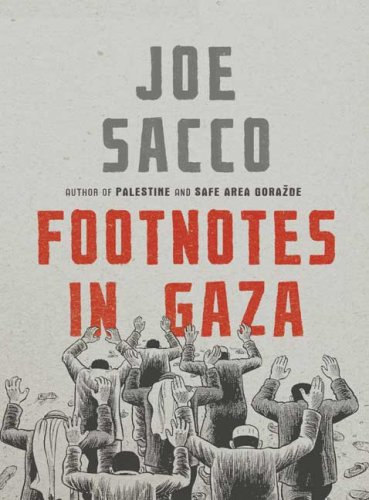
Joe Sacco’s gripping, important book about two long-forgotten mass killings of Palestinians in Gaza stands out as one of the few contemporary works on the Israeli-Palestinian struggle likely to outlive the era in which they were written.

Sacco will find readers for “Footnotes in Gaza” far into the future because of the unique format and style of his comic-book narrative. He stands alone as a reporter-cartoonist because his ability to tell a story through his art is combined with investigative reporting of the highest quality.

His subject in this case is two massacres that happened more than half a century ago, stirred up little international attention and were forgotten outside the immediate circle of the victims. The killings took place during the Suez crisis of 1956, when the Israeli Army swept into the Gaza Strip, the great majority of whose inhabitants were Palestinian refugees. According to figures from the United Nations, 275 Palestinians were killed in the town of Khan Younis at the southern end of the strip on Nov. 3, and 111 died in Rafah, a few miles away on the Egyptian border, during a Nov. 12 operation by Israeli troops. Israel insisted that the Palestinians were killed when Israeli forces were still facing armed resistance. The Palestinians said all resistance had ceased by then. [continued…]

Facebooktwittermail

YEAR IN REVIEW: Israeli propaganda campaign downplays the success of the truce

YEAR IN REVIEW: Israeli propaganda campaign downplays the success of the truce

(UPDATE: Since the graphs appearing below have been removed from the Israeli Ministry of Foreign Affairs (MFA) website, some readers might have doubts about there authenticity. However, Jeffrey Goldberg who blogs at the Atlantic, has kindly alerted me to the source that the MFA continues to cite for its statistics on rocket fire from Gaza in 2008. The graphs I reproduced can be found in that document.

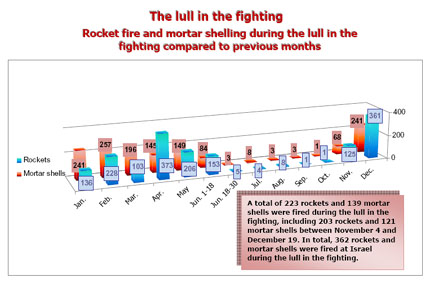
Goldberg writes: “Israel’s Ministry of Foreign Affairs cites this report [PDF] that claims that 362 rockets and mortars were fired into Israel from Gaza into Israel during what the report calls the ‘lull’ in the fighting. I think it’s fair to say that, though the numbers of rocket and mortar attacks dropped off dramatically during the ceasefire, there were, indeed, attacks.”

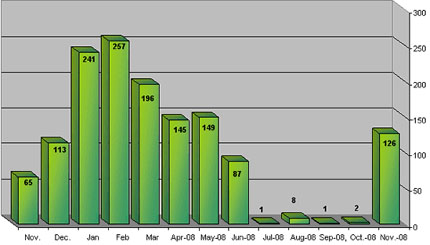
What Goldberg fails to point out is that of these 362 rockets and mortars fired, 324 were launched after Israel broke the ceasefire on November 4, 2008. During the period in which the ceasefire was being maintained by both Hamas and Israel from June 18 until November 4, there were a total of 38 fired. This averages 8.5 rocket and mortar attacks per month. As far as I am aware, none of these were conducted by Hamas and the level of attacks can be seen as a measure of the effectiveness (not absolute) with which Hamas was able to reign in other militant groups such as Islamic Jihad.)
_____

For four months, from Summer into Fall, the truce between Israel and Hamas was a stunning success. Indeed, if Israel doubted Hamas’ ability or willingness to engage in a truce, the Jewish state would have had no reason to request that the truce be extended as its expiration approached and passed in late December.

But now is a time of war and not only is talk of a truce being ruled out by the authors of this war but history is being re-written in order to degrade the value of a ceasefire. The memory of a period of recent calm that was the most durable peace that the residents of southern Israel have experienced in recent years must now be erased.

The Israeli government’s own graphical representation of the calm told the story in terms that even a child could understand. This is the graph that the Israel Ministry of Foreign Affairs displayed on its web site demonstrating that from July to October, rocket fire, if not reduced to a perfect zero, came stunningly close. From an average of 179 rockets per month in the preceding period of 2008, the number fell to just three per month:

Now that the Israeli propaganda machine is revved up to full throttle, the image of an effective truce no longer suits the Israeli government’s purposes. Instead it has become more convenient to try and hide the numbers — with numbers! The foreign ministry has thus removed the simple graph shown above and replaced it with this:

In the earlier image, graph blocks dramatically portrayed the rise and fall in rocket fire rates. In the revised image, blocks of equal size (containing numbers) are used to obscure the graph. The effect, clearly intended, is to try and portray the lull as really nothing more than a minor undulation in a period of unremitting attacks.

The message Israel now wants to sell is that the truce never really worked. Instead of acknowledging that the truce effectively collapsed when Israel launched Operation “Double Challenge” on November 5, the rocket fire that followed that Israeli raid is being used to obscure the fact that rocket fire had effectively been curtailed up to that point.*

On the IDF Spokesman web site, a post on rocket statistics simply omits the part of the record that Israel now finds inconvenient to acknowledge:

  • Between Hamas’ takeover and the start of the Tahadiya (State of Calm), (June 14, 2007 – June 16, 2008), there was an average of over 361 attacks per month—an increase of an additional 350%.
  • On Nov. 4 – 5, Israel launched Operation “Double Challenge”, targeting a tunnel Hamas was building as part of a plan to kidnap Israeli soldiers.
  • From the end of Operation “Double Challenge” until the end of the Tahadiya, (Nov. 4 – Dec. 19, 2008) a period of only a month and a half, there were 170 mortars, 255 Qassams, and 5 Grads fired upon Israel’s civilian population centers.
  • Since the end of the Tahadiya (Dec. 19, 2009) until the beginning of Operation “Cast Lead,” (Dec. 27, 2008) a period of little more than a week, there were approximately 300 mortars and rockets fired onto Israel.
  • Since the begining of Operation “Cast Lead”, there have been an additional 500 launches, 284 of which have been verified as rockets (both Qassams and Grads), and 113 as mortars.

Was four months of calm really worthless? Given that it became the precursor to war, the answer now apparently is yes.

But it didn’t have to turn out this way. The effectiveness with which Hamas enforced a truce should have provided the impetus for Israel to lift its economic siege of Gaza.

Instead, we are once again witness to Israel’s seemingly insatiable appetite for war, even while it never tires of professing its love of peace.

* Should anyone doubt that the Israeli raid (official declarations about Israel’s commitment to the truce notwithstanding) constituted a unilateral breach of the truce, consider what Israel and the world’s response would have been in the event that the raid had been launched from Gaza. Hamas gunmen conducted a raid inside Israeli territory, killing six Israeli soldiers.

That wouldn’t have been described as a breakdown in the truce; it would have been regarded as an act of war.

Facebooktwittermail

YEAR IN REVIEW: ‘We went into Gaza and God went into Gaza with us’

YEAR IN REVIEW: ‘We went into Gaza and God went into Gaza with us’

“After the Second Lebanon War, we learned some very valuable lessons. We learned that we had been living in an imaginary world and that the most dangerous type of war is the one that you call peace. We learned that we are not in fact in a ‘peace process’ at all. We are at war.

“Today the question is still asked, ‘But how do we WIN?’ And that is another question coming directly from a Western mindset. There is no such thing as winning in this new kind of war. The war is ongoing, with periods of more violence and periods of less violence, during which the enemy regroups and plans his next attack. When we feel the enemy is getting strong, we must be prepared to make preemptive strikes, hard and fast at key targets, with viciousness, as the enemy would do to us. Only then can we acquire, not peace, but sustained periods of relative calm.” — Ariel Siegelman

From Lebanon to Gaza: a new kind of war

The Gaza experience was very different from the Lebanon War and even those of us who were there are trying to fully understand why. Lebanon was a wake-up call for Israelis and was the result of many years of foolish thinking. Since the so-called “Middle East Peace Process” began in the early 1990s with the Oslo Accords, many Palestinian children were raised on ideals of jihad (holy war) and hatred of Israel and the West, while Israeli children were generally taught that “peace is on the horizon”. A euphoric and asinine attitude persisted on the Israeli street throughout the 1990s, leading to the problems that we experienced in Lebanon. The Israeli political echelons and the upper ranks of the army had not established any real plans for entering Lebanon because they wanted to believe that, just like Jordan and Egypt, we had another border about which we could begin to relax. The Israeli public wanted to believe that we really were getting closer to peace. Not only was the army unprepared on a tactical level, but, since the threat was largely marginalized, the equipment that was available to reservists during the Second Lebanon War was far from adequate. Furthermore, the reservists themselves were generally psychologically and physically unprepared for war. They had lived for at least six years—since Israel pulled out of southern Lebanon in 2000—in a bubble of “peace”. In 2004, the army had claimed that we would never go back to Lebanon.

A New Kind of War

After the Second Lebanon War, we learned some very valuable lessons. We learned that we had been living in an imaginary world and that the most dangerous type of war is the one that you call peace. We learned that we are not in fact in a “peace process” at all. We are at war. On their own accord, many reservists began formidable fitness programs. The army invested in state-of-the-art equipment for us. We began planning for possible wars and attacks that might occur at any or all of our borders. And the whole army became much more serious about training again. The debacle of Lebanon set the stage for the success of Gaza. If there is one thing that Israelis are good at, it is taking lessons from their losses and being creative on the battlefield.

The Israel Defense Force (IDF) developed a different mentality toward Gaza. Lebanon, before the war, was very quiet and even boring, giving the perception that it was not a threat. Gaza, on the other hand, was always considered a hot zone. Certainly since Lebanon, we were told that “it [was] not a matter of IF, it [was] a matter of WHEN.” As Special Forces operators we were often crossing into the Strip and we knew the enemy. Now, after the Gaza war, the world has developed a perception that Hamas is not nearly on the level of Hezbollah. That in itself shows how successful we were—and lucky. Hamas is NOT a ragtag group of thugs. They are a vicious, well-trained, well-supplied, motivated, and creative fighting force. They are an unconventional army, no less capable than Hezbollah. The difference between Lebanon and Gaza is simply how Israel adapted to the enemy. Lebanon reminded each individual soldier that he has to be a warrior. It reminded the army that good intelligence and well thought out plans with realistic goals are key elements to the solution. It reminded the home front that we are still in a “war process” and it reminded the government that ego has no place in war and that politicians who are incompetent at military actions should step aside and allow those who know to take charge.

A new kind of enemy has become formidable over the last ten years. Western armies can look to Lebanon and Gaza to gain lessons for operating against this enemy. Even now, the Western concept of warfare is quite conventional, prompting us to think that if we can capture territory, and certainly if we can neutralize the enemy’s leadership, we will win. And we are confused when, no matter how well we do on the battlefield, the enemy continues and even increases its attacks. What we have not yet come to grips with is that the enemy is not playing by our rules. The new war is unconventional and is motivated by ideology. The enemy cannot hope to match Western technology, so he operates in a way to make the technology relatively meaningless. He simply refuses to meet the conventional army on the battlefield. The Western army invades enemy lands with almost no resistance, even captures the enemy’s leadership, developing the erroneous conception that victory has been achieved. Only then do the conventional soldiers begin being blown up by an enemy that cannot be identified or differentiated from the civilian population. The conventional soldier has no idea of how to operate in this environment because he is looking for a uniformed foe. A nine year-old child with a bomb does not fit the Western model of “combatant” and takes soldiers by surprise. The conquest of territory by a Western army only brings new targets closer to the terrorist so that he does not need to travel as far to blow up Western targets. It does not serve to bring the enemy to his knees. Likewise, Middle Eastern societies are tribal in nature and are fiercely proud of their ideology. They will not play chess with a conventional army, accepting defeat simply because their king is captured or their territory is occupied.

Lebanon: What NOT to do

Lebanon is a perfect example of the wrong way to confront the problems that the West faces in this new kind of war. The challenges that US forces face in Iraq are comparable. Let’s forget about the lack of Israeli leadership in 2006 and simply analyze the strategy. Israeli soldiers understood that the goals upon entering Lebanon were to destroy Hezbollah and end rocket attacks from the northern border. These goals were difficult to achieve and set Israel up for failure. Hezbollah, like any terrorist movement, is an ideology, and unless you are willing to kill everyone, an ideology cannot be toppled through military conquest. There only had to be one vigilant team left alive who held to its creed for Israel to fail in achieving its goals. Likewise, the moment that one rocket hit Israel from Lebanon after it withdrew to its own borders, Hezbollah would be victorious. Israel fell into the age-old trap that has caused much larger and seemingly stronger armies to be defeated by their unconventional foes: a poor evaluation of the enemy. It made no difference how much destruction Lebanon incurred or how many men Hezbollah lost. Perception is the deciding factor in this new kind of war. Hezbollah came out of the war appearing strong and, therefore, gained the respect of the world. Once the Israeli army entered from the south, the only real strategy for achieving its elusive goals was to reach the Litani River with ground forces, sweeping through Lebanese villages and towns. The Western military model had the Israelis convinced that by moving from one line on the map to another, all of the territory in between would be “conquered”. In the unconventional model, every moment that the army was moving forward, they provided ample targets to Hezbollah, who were attacking while retreating. They did not have to hold territory and they did not need to kill or injure huge numbers of Israeli soldiers. They only had to instill fear in the conventional force, a sense of hopelessness in the Israeli home front, and frustration in the military ranks. There are no front lines or rear lines in the new kind of war; the enemy will hit you from behind just as quickly (if not more quickly) as he will hit you from the front, and if you understand how the enemy operates, you can combat his ability to achieve his objectives.

Gaza: The Learning Curve

The lessons of Lebanon were immediately put into practice in preparing for the next conflict. The Special Forces (SF) were always very adept at urban warfare tactics, and during missions in the West Bank we operated ferociously, pulling missions almost every night. This combat experience produced a very high level of operational knowledge which trickled down through army doctrine for how to deal with our enemies. The regular army, and certainly the reserves, were lacking in their fighting skills in general until after Lebanon. In 2006, army leadership put new policies into action. The army supplied new gear to almost all combat units. Reservists had never seen such good equipment and their duty stopped being a vacation and became intensified training. The construction of an urban warfare training facility was completed in the desert, at about the same time that the Second Lebanon War was being fought. This facility is, perhaps, the most advanced urban warfare training facility in the world. It is built like the other facilities that we use, just much bigger. It resembles a real Arab city with Middle Eastern architecture, complete with mosques, schools, hospitals, large multi-story buildings, streets, squares, alleys, and vehicles. This offered the first opportunity for large scale training that allowed us to practice the concert of war, with SF, regular infantry, tanks, and artillery all operating together as a symphony. There is a strict training rotation that has all combat units drilling open-field combat techniques and urban warfare every few months. For almost three years, there were no illusions; we knew that we were training for Gaza. Unlike Lebanon, we knew that when we entered Gaza, the military goals and the execution of the missions in order to reach those goals would be methodical and well-prepared.

The IDF entered Gaza with realistic goals—significantly reduce Hamas’ ability to inflict damage on Israel and Israeli targets. We were told specifically that our goal was NOT to topple Hamas and was NOT to destroy all of its capabilities. Those goals would have been too difficult to achieve and would have set us up for defeat and a blow to the morale of the army and the nation. Likewise, the tactics would be unconventional. We were not to think in terms of conquest and holding territory. Concepts of front and rear lines had no place in this war. We were to frustrate and attack at the morale of the enemy, fighting much like he would fight us. The only rule was, don’t fight by the rules. The IDF went in, simply to wreak havoc on Hamas without getting into any situations that could afford our enemies the opportunity to achieve anything that would resemble a victory. We were to keep them at arm’s length, not attempt to engage them in combat, and use anything within our means to destroy them. And when Israel decided the desired perception had been reached (because perception is everything in these kinds of conflicts), we pulled out. Unlike Hezbollah, Hamas came out of this conflict without the world taking them very seriously. Even though Hamas was still shooting missiles into Israel, in a desperate attempt to save face, its capabilities had been seriously reduced and Israel had achieved its goals.

A New Kind of Success

It is not good training, technology, or strategy that makes bullets miss their targets or causes your eye to notice a trip-wire. For those experiences, I have to thank the Big Guy upstairs. He and I became very close during those cold nights. With all of our training and preparation, we were still afraid to go into Gaza. We knew the enemy and we had lost men even in the last year to their ambushes. When we were entering the Strip, we were fully prepared for high casualties. In Gaza they were waiting for us; they were looking for a fight. There were snipers, teams that were waiting to ambush us with anti-tank rockets, Improvised Explosive Devices (IEDs), booby traps, and mortars falling around us.

The successes that we saw in Gaza resulted from a combination of an appropriate response to the new kind of enemy, a healthy Israeli attitude that fiercely guarded its men and its right to stop intolerable attacks against its people, and protection from the Almighty, which some people call “luck”. I saw an attitude that I have been waiting to see for a long time from a nation that has too often apologized for every move that it makes. Today the question is still asked, “But how do we WIN?” And that is another question coming directly from a Western mindset. There is no such thing as winning in this new kind of war. The war is ongoing, with periods of more violence and periods of less violence, during which the enemy regroups and plans his next attack. When we feel the enemy is getting strong, we must be prepared to make preemptive strikes, hard and fast at key targets, with viciousness, as the enemy would do to us. Only then can we acquire, not peace, but sustained periods of relative calm.

Ariel Siegelman is Vice President of Security Training for The Draco Group, a service provider in advanced security and training. He served in the Israel Defense Force, Special Forces, as a counter terror operative, counter terror sniper and counter terror instructor, and remains active in these capacities in the Reserves. He can be reached at ariel@thedracogroup.com

This article originally appeared on The Colloquium, a US Army Combined Arms Center blog, March, 2009.

Facebooktwittermail