Blackwater’s secret war in Pakistan

Blackwater’s secret war in Pakistan

At a covert forward operating base run by the US Joint Special Operations Command (JSOC) in the Pakistani port city of Karachi, members of an elite division of Blackwater are at the center of a secret program in which they plan targeted assassinations of suspected Taliban and Al Qaeda operatives, “snatch and grabs” of high-value targets and other sensitive action inside and outside Pakistan, an investigation by The Nation has found. The Blackwater operatives also assist in gathering intelligence and help direct a secret US military drone bombing campaign that runs parallel to the well-documented CIA predator strikes, according to a well-placed source within the US military intelligence apparatus.

The source, who has worked on covert US military programs for years, including in Afghanistan and Pakistan, has direct knowledge of Blackwater’s involvement. He spoke to The Nation on condition of anonymity because the program is classified. The source said that the program is so “compartmentalized” that senior figures within the Obama administration and the US military chain of command may not be aware of its existence. [continued…]

Facebooktwittermail

UK role in torture of British citizens in Pakistan condemned

UK role in torture of British citizens in Pakistan condemned

Britain’s role in the torture of its own citizens in Pakistan is condemned today by one of the world’s leading human rights organisations as being cruel, counter-productive and in clear breach of international law.

In a damning report, published after an investigation spanning more than a year, Human Rights Watch (HRW) says the government finds itself in a “legally, morally and politically invidious position” through complicity in torture, and warns its moral legitimacy could be undermined.

The report by the New York-based NGO – entitled Cruel Britannia: British Complicity in the Torture and Ill-treatment of Terror Suspects in Pakistan – corroborates many of the findings of the Guardian’s own investigation into the mistreatment of people held during British-led counter-terrorism operations. [continued…]

Will Miliband address torture evidence?

Today sees the release by Human Rights Watch (HRW) of a searing exposé of the evidence against the British government of its complicity in the torture of people held in Pakistan suspected of terrorism. The report, Cruel Britannia, is based on evidence collected by Ali Dayan Hasan, a senior HRW researcher who interviewed not only suspects and their lawyers but also members of the Pakistani ISI agency who were involved in the torture. It corroborates and provides further detail for the investigative reporting on torture of the Guardian’s Ian Cobain, who recently won the Paul Foot award.

Human Rights Watch, a US-based organisation, has an excellent reputation for independence and fair-minded monitoring. The allegations that British security services knew about torture in Pakistan, took advantage of it and even encouraged it, must be taken very seriously.

The report analyses in some detail the “far from decisive” response of the UK government so far to these and other allegations. Foreign secretary David Miliband and others repeat a mantra that the UK government does not condone torture, but they have refused to investigate the allegations or to publish guidance to officials. Written instructions to security services interrogating suspects in Afghanistan after 9/11 disclosed earlier this year – while saying they should not be seen to “condone” torture – also made it clear that the UK government sanctions a blind eye. The instructions claimed (with dubious legality, let alone morality) that there was no obligation to intervene even when interrogators are aware of torture. [continued…]

Facebooktwittermail

Obama plans to send 34,000 more troops to Afghanistan

Obama plans to send 34,000 more troops to Afghanistan

President Barack Obama met Monday evening with his national security team to finalize a plan to dispatch some 34,000 additional U.S. troops over the next year to what he’s called “a war of necessity” in Afghanistan, U.S. officials told McClatchy.

Obama is expected to announce his long-awaited decision on Dec. 1, followed by meetings on Capitol Hill aimed at winning congressional support amid opposition by some Democrats who are worried about the strain on the U.S. Treasury and whether Afghanistan has become a quagmire, the officials said.

The U.S. officials all spoke on condition of anonymity because they weren’t authorized to discuss the issue publicly and because, one official said, the White House is incensed by leaks on its Afghanistan policy that didn’t originate in the White House. [continued…]

We can’t buy peace in Afghanistan

So now we know the secret weapon of the the new western plan to pacify Afghanistan: cash. As President Obama prepares to announce the expected dispatch of tens of thousands more troops to America’s eight-year-old war and occupation, US and British commanders on the ground have already begun to fund and equip Afghan militias to help fight the Taliban.

The idea behind the homely sounding Community Defence Initiative is to buy off disaffected fighters and create loyal tribal auxiliaries to support Nato occupation forces and the Afghan government. It’s the other leg of US General McChrystal’s plan for a military surge to turn round the deepening crisis of the Afghan war – and is directly modelled on the US surge of 2007 in Iraq.

That combined a large increase in US troop numbers with the creation of American-funded “awakening councils” out of parts of Iraq’s Sunni-based resistance who had come into conflict with al-Qaida. It led to an initial increase in violence and American deaths, followed by a sharp decrease in both thereafter. [continued…]

Why they hate us (I): on military occupation

One of the many barriers to developing a saner U.S. foreign policy is our collective failure to appreciate why military occupations generate so much hatred, resentment, and resistance, and why we should therefore go to enormous lengths to avoid getting mired in them. Costly occupations are an activity you hope your adversaries undertake, especially in areas of little intrinsic strategic value. We blundered into Somalia in the early 1990s without realizing that we weren’t welcome; we invaded Iraq thinking we would be greeted as liberators, and we still don’t fully understand why many Afghans resent our presence and why some are driven to take up arms against us.

The American experience is hardly unique: Britain’s occupation of Iraq after World War I triggered fierce opposition, and British forces in Mandate Palestine eventually faced armed resistance from both Arab and Zionist groups. French rule in Algeria, Syria, Lebanon, and Indochina spawned several violent resistance movements, and Russia has fought Chechen insurgents in the 19th, 20th and 21st centuries. The Shiite population of southern Lebanon initially welcomed Israel’s invasion in 1982, but the IDF behaved badly and stayed too long, which led directly to the formation of Hezbollah. Israelis were also surprised by the first intifida in 1987, having mistakenly assumed that their occupation of the West Bank was benevolent and that the Palestinians there would be content to be governed by the IDF forever. [continued…]

Facebooktwittermail

Iraq’s January elections face near certain delay

Iraq’s January elections face near certain delay

Iraq’s tortuous effort to hold its parliamentary election on schedule in January collapsed Monday, raising the prospect of a political and constitutional crisis next year as the United States begins withdrawing the majority of its combat troops.

After two days of divisive sessions and failed talks, Parliament disregarded a veto by one of the country’s vice presidents and approved new amendments that the vice president promptly indicated he would veto as well.

The moves deepened a crisis that had fleetingly seemed resolved after months of wrangling over how to set up the vote, widely seen as a barometer of Iraq’s progress toward democracy. [continued…]

British colonel’s scathing attack on ‘arrogant, bureaucratic’ Americans

Colonel J.K.Tanner: “We experienced real difficulty in dealing with the American military and civilian organisations who, partly through arrogance and partly through bureaucracy, dictate that there is only one way: the American way. As far as the Iraqis were concerned, here was a nation who could put people on the moon but who could not, or would not, fix the electricity supply. You need to have money in order to make things happen, to buy protection from the looters, to smooth out tribal problems and to have immediate and visible effect and we did not have that. Despite our so-called ‘special relationship’ I reckon that we were treated no differently to the Portugese…

“I realise now that I am a European, not an American. We managed to get on better militarily and administratively with our European partners and indeed at times with the Arabs than with the Americans. Europeans chat to each other whereas dialogue is alien to the US military.

“They need to reintroduce dialogue as a tool of command because, although it is easy to speak to Americans face-to-face and understand each other completely, dealing with them corporately is akin to dealing with a group of Martians.” [continued…]

Facebooktwittermail

Iran expanding effort to stifle the opposition

Iran expanding effort to stifle the opposition

After last summer’s disputed presidential election, Iran’s government relied largely on brute force — beatings, arrests and show trials — to stifle the country’s embattled opposition movement.

Now, stung by the force and persistence of the protests, the government appears to be starting a far more ambitious effort to discredit its opponents and re-educate Iran’s mostly young and restive population. In recent weeks, the government has announced a variety of new ideological offensives.

It is implanting 6,000 Basij militia centers in elementary schools across Iran to promote the ideals of the Islamic Revolution, and it has created a new police unit to sweep the Internet for dissident voices. A company affiliated with the Revolutionary Guards acquired a majority share in the nation’s telecommunications monopoly this year, giving the Guards de facto control of Iran’s land lines, Internet providers and two cellphone companies. And in the spring, the Revolutionary Guards plan to open a news agency with print, photo and television elements.

The government calls it “soft war,” and Iran’s leaders often seem to take it more seriously than a real military confrontation. It is rooted in an old accusation: that Iran’s domestic ills are the result of Western cultural subversion and call for an equally vigorous response. The extent of the new campaign underscores just how badly Iran’s clerical and military elite were shaken by the protests, which set off the worst internal dissent since the country’s 1979 Islamic Revolution. [continued…]

Facebooktwittermail

Charges detail road to terror for 20 in U.S.

Charges detail road to terror for 20 in U.S.

Federal officials on Monday unsealed terrorism-related charges against men they say were key actors in a recruitment effort that led roughly 20 young Americans to join a violent insurgent group in Somalia with ties to Al Qaeda.

With eight new suspects charged Monday, the authorities have implicated 14 people in the case, one of the most extensive domestic terrorism investigations since the Sept. 11 attacks. Some of them have been arrested; others are at large, including several believed to be still fighting with the Somali group, Al Shabab.

The case represents the largest group of American citizens suspected of joining an extremist movement affiliated with Al Qaeda, senior officials said. Many of the recruits had come to America as young refugees fleeing a brutal civil war, only to settle in a gang-ridden enclave of Minneapolis. [continued…]

Editor’s Comment“one of the most extensive domestic terrorism investigations since the Sept. 11 attacks” — “the largest group of American citizens suspected of joining an extremist movement affiliated with Al Qaeda”…

Wow! This has to be a landmark event in the war on terrorism! The high-fives must really have been thrown around at the FBI after cracking open a major operation like this. Not another embarrassing headline like this one from a few months ago: “FBI ‘lured dimwits’ into terror plot.”

Except… “Domestic terrorism investigations” seems like a bit of a stretch. The closest this report gets to suggesting that any of these young Somali Americans were intent on engaging in an act of domestic terrorism is to say: “Law enforcement officials are concerned that the recruits, who hold American passports, could be commissioned to return to the United States to carry out attacks here, though so far there is no evidence of such plots.”

Al Shabab might be labeled a terrorist organization and it might have ties to al Qaeda, but make no mistake: it is fighting a real war with conventional war-ambitions — the conquest of territory. Al Shabab wants to control Somalia. It’s hard to imagine how sponsoring acts of terrorism elsewhere would further that strategic goal.

Should we be concerned that American kids are being enticed into a desperate and bloody conflict far away? Certainly.

But maybe that concern should not be restricted to the fate of kids at risk in Minneapolis. Maybe it should also include kids in New York and elsewhere who are being recruited to serve in the Israeli Defense Force.

Facebooktwittermail

Why Iran’s opposition movement muddles nuclear talks

Why Iran’s opposition movement muddles nuclear talks

After more than five months of going it alone, Iran’s opposition Green Movement is reaching out to the United States for help. Via public and private channels, the Obama Administration has received several appeals in recent weeks to take a stronger stand against human-rights abuses in Iran, avoid military action and impose more aggressive and rapid-fire sanctions against the Revolutionary Guards and its vast business interests.

The opposition’s outreach comes as the Administration weighs the next move in its diplomatic effort to resolve the nuclear standoff with Iran. Tehran has effectively rebuffed a confidence-building deal that would ship out the bulk of Iran’s enriched-uranium stockpile to be converted into fuel rods for a medical-research reactor — which would also have added about a year to the time frame within which Iran could weaponize nuclear material. The deal would have offered more time for longer-term diplomatic negotiations. As a result, President Obama has begun trying to rally international support for a new round of sanctions. (See pictures of people around the world protesting Iran’s election.)

Washington has struggled since the disputed June 12 presidential election to figure out how to engage the regime without undermining the opposition. Now it has begun to hear answers from the Green Movement itself. [continued…]


Watch CBS News Videos Online

Iran’s death penalty is seen as a political tactic

A flurry of executions and death sentences in Iran has raised concern that the government is using judicially sanctioned killing to intimidate the political opposition and quell pockets of ethnic unrest around the nation, human rights groups and Iran experts said.

In Iran, where there is precedent for executions to surge in the wake of a crisis, human rights groups said there was mounting evidence that the trend had emerged in response to the political tumult that followed the June presidential election. This month, a fifth person connected to the protests was sentenced to death.

In at least one instance, a Kurdish activist was hanged after the government added a new charge, raising concerns that cases with political overtones were drawing more serious penalties.

In the short period between the disputed June election and the inauguration of President Mahmoud Ahmadinejad in August, 115 people were executed, according to statistics compiled by human rights groups from Iranian news agencies. Though the executions mostly involved violent criminals and drug dealers, the number and pace of the killings appeared to be sending a message to the opposition, said human rights groups and Iran experts. [continued…]

Facebooktwittermail

Iraq report: Secret papers reveal Blair’s blunders and concealment

Iraq report: Secret papers reveal Blair’s blunders and concealment

On the eve of the Chilcot inquiry into Britain’s involvement in the 2003 invasion and its aftermath, The Sunday Telegraph has obtained hundreds of pages of secret Government reports on “lessons learnt” which shed new light on “significant shortcomings” at all levels.

They include full transcripts of extraordinarily frank classified interviews in which British Army commanders vent their frustration and anger with ministers and Whitehall officials.

The reports disclose that:

Tony Blair, the former prime minister, misled MPs and the public throughout 2002 when he claimed that Britain’s objective was “disarmament, not regime change” and that there had been no planning for military action. In fact, British military planning for a full invasion and regime change began in February 2002.

The need to conceal this from Parliament and all but “very small numbers” of officials “constrained” the planning process. The result was a “rushed”operation “lacking in coherence and resources” which caused “significant risk” to troops and “critical failure” in the post-war period.

Operations were so under-resourced that some troops went into action with only five bullets each. Others had to deploy to war on civilian airlines, taking their equipment as hand luggage. Some troops had weapons confiscated by airport security.

Commanders reported that the Army’s main radio system “tended to drop out at around noon each day because of the heat”. One described the supply chain as “absolutely appalling”, saying: “I know for a fact that there was one container full of skis in the desert.” [continued…]

Facebooktwittermail

Gideon Levy on Israel’s addiction

Gideon Levy on Israel’s addiction

Gaza militant groups agree to stop firing rockets into Israel

Hamas has won an agreement from other militant groups in Gaza to halt rocket fire into Israel for the first time in almost a year, asboth sides indicated progress on a deal to release a captured Israeli soldier.

The agreement, announced , appears to be an attempt by the Palestinian Islamist movement to prevent another descent into fighting at a time when reconstruction has barely begun almost 12 months after the devastating conflict with Israel.

It also reflected more progress in secretly mediated talks to release Gilad Shalit, the soldier captured more than three years ago, in exchange for the return of hundreds of Palestinian prisoners. [continued…]

Gaza water unfit for human consumption: Palestinians

Water in the Gaza Strip is so salty that it is unfit for human consumption, a Palestinian official in charge of water supplies inside the besieged coastal territory said on Saturday.

“The water is no longer fit for human consumption, with analysis and international studies showing that just 10 percent of water in the Gaza Strip is usable… threatening the lives of Palestinians,” Munzir Shiblak warned.

He called in a statement for “the necessary measures to be taken to end the problem of salinity in Gaza water supplies, a problem that is getting worse.” [continued…]

Obama must deal with important questions of the Mideast conflict

For 41 years, Washington turned a blind eye. It protested a bit, scolded a bit, and mostly made do with periodically stating that its policy has not changed – it still opposes settlements in the territories and does not recognize the annexation of East Jerusalem or the Golan Heights. Suddenly, it gave us a resounding slap, but one of the frustrating kind that misses the cheek and flies through empty air. Because the American demand that we freeze construction in the settlements, that “strong message” containing a threat, has become a personal duel between Prime Minister Benjamin Netanyahu and U.S. President Barack Obama, in place of a clear policy presented by the latter.

Obama will win, of course. He can set a meeting with Netanyahu late at night, not answer the prime minister’s phone calls, warn him from the Great Wall of China and even order his officials to give Israel’s requests the cold shoulder. Obama already has managed to garner international support for his demand that Israel freeze settlement construction, even in Jerusalem, and American public opinion is on his side. If Obama wants to undermine Israel’s trust in the United States, or to prove to Netanyahu who is stronger, he does not have to work hard.

The American demand is proper, even if it is very late and unusually aggressive. However, its lack of context is infuriating. Freezing settlements is not a policy. Its entire purpose is to give Mahmoud Abbas, the resigning Palestinian Authority president, a reason to get back to negotiations. But negotiations cannot be a final goal, just as freezing settlements cannot be considered the ultimate achievement. What then? Is Abbas doomed to be a constant negotiator in endless negotiations? Does Washington have a plan for continuing negotiations? Continue reading

Facebooktwittermail

US pours millions into anti-Taliban militias in Afghanistan

US pours millions into anti-Taliban militias in Afghanistan

U.S. special forces are supporting anti-Taliban militias in at least 14 areas of Afghanistan as part of a secretive programme that experts warn could fuel long-term instability in the country.

The Community Defence Initiative (CDI) is enthusiastically backed by Stanley McChrystal, the US general commanding Nato forces in Afghanistan, but details about the programme have been held back from non-US alliance members who are likely to strongly protest.

The attempt to create what one official described as “pockets of tribal resistance” to the Taliban involves US special forces embedding themselves with armed groups and even disgruntled insurgents who are then given training and support.

In return for stabilising their local area the militia helps to win development aid for their local communities, although they will not receive arms, a US official said.

Special forces will be able to access money from a US military fund to pay for the projects. The hope is that the militias supplement the Nato and Afghan forces fighting the Taliban. But the prospect of re-empowering militias after billions of international dollars were spent after the US-led invasion in 2001 to disarm illegally armed groups alarms many experts. [continued…]

Obama’s Afghanistan dilemma

The sum we are already spending annually on Afghanistan is greater than its gross domestic product. Are there nonmilitary ways we could deploy that sum which would advance our goals as efficaciously? Would even forty thousand additional troops suffice for anything resembling the ambitious nation-building program that General Stanley McChrystal, the top military commander in Afghanistan, has proposed? (Counterinsurgency theory suggests that it would take more than ten times that many; would forty—or ten, or twenty—thousand be only a first installment?) Any counterinsurgency campaign, we’re told, requires a very long commitment. Is the voluntary association of democracies called NATO, organized to deter war more than to wage it, capable of sustaining a twenty or thirty years’ war? For that matter, does the United States—a decentralized populist democracy struggling with economic decline and political gridlock—have that capacity? And what about Pakistan?

The President has come under heavy criticism for taking the time to ponder the imponderables. “The urgent necessity,” a respected Washington columnist wrote the other day, “is to make a decision—whether or not it is right.” Really? Does the columnist suppose that a country unable to find the patience for weeks (even months) of thinking could summon the stamina for years (even decades) of killing and dying? What Obama seems to have discovered is that this is no longer the war that began eight years ago. That war was an act of retribution and prevention. But now who are we punishing? What are we preventing? The old narrative is broken. [continued…]

Militants could be invited to Afghan “Jirga”

Afghan President Hamid Karzai could invite militants to attend a “Loya Jirga,” or grand council meeting, aiming to seek peace and reconciliation with the Taliban, a spokesman said on Sunday.

The plans signal a more public effort to engage with militants during Karzai’s second term as leader, measures that Washington has encouraged in its counter-insurgency strategy.

Afghanistan’s constitution recognizes the Loya Jirga — Pashtu for grand assembly — as “the highest manifestation of the will of the people of Afghanistan.” [continued…]

Escaping Taliban may widen war as Pakistan pays cost

Taliban fleeing a Pakistani offensive are regrouping in the country’s northwest, threatening to spread and prolong a conflict that has strained the nation’s economy and may hamper efforts to attract foreign investment.

While Pakistan says its month-old offensive in South Waziristan has destroyed the largest Taliban sanctuary, some militants are falling back to Orakzai, a mountain region less than 16 kilometers (10 miles) south of Peshawar, the capital of North West Frontier Province, said Talat Masood, an independent military analyst in Islamabad.

Rising violence in the region last year prompted London- based Tullow Oil Plc to give up operational control of drilling operations near Orakzai. A wider conflict may make it harder to attract companies like Mol Nyrt., Hungary’s largest oil refiner, which this month started natural gas production in the province. [continued…]

Facebooktwittermail

Survey of Pakistan’s young predicts ‘disaster’ if their needs aren’t addressed

Survey of Pakistan’s young predicts ‘disaster’ if their needs aren’t addressed

Pakistan will face a “demographic disaster” if it does not address the needs of its young generation, the largest in the country’s history, whose views reflect a deep disillusionment with government and democracy, according to a report released here on Saturday.

The report, commissioned by the British Council and conducted by the Nielsen research company, drew a picture of a deeply frustrated young generation that feels abandoned by its government and despondent about its future.

An overwhelming majority of young Pakistanis say their country is headed in the wrong direction, the report said, and only 1 in 10 has confidence in the government. Most see themselves as Muslim first and Pakistani second, and they are now entering a work force in which the lion’s share cannot find jobs, a potentially volatile situation if the government cannot address its concerns.

“This is a real wake-up call for the international community,” said David Steven, a fellow at the Center for International Cooperation at New York University, who was an adviser on the report. “You could get rapid social and economic change. But the other route will lead to a nightmare that would unfold over 20 to 30 years.” [continued…]

Facebooktwittermail

Kahane tribute may damage peace talks

Kahane tribute may damage peace talks

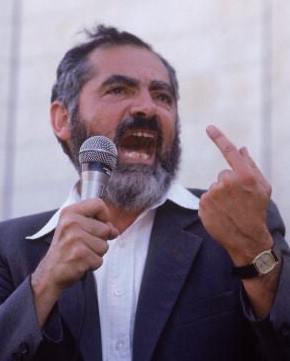
A plan by right-wing legislators in Israel to commemorate the anniversary this month of the death of Meir Kahane, whose banned anti-Arab movement is classified as a terrorist organisation, risks further damaging the prospects for talks between Israel and the Palestinians, US officials have warned.
A move to stage the commemoration in Israel’s parliament, the Knesset, is being led by Michael Ben-Ari, who was elected this year and is the first self-declared former member of Kahane’s party, Kach, to become a legislator since the movement was banned 15 years ago.

The US Embassy, in Tel Aviv, has sent a series of e-mails to Reuven Rivlin, the parliamentary speaker, asking that he intervene to block the event.

According to US officials, pressure is being exerted on behalf of George Mitchell, the US president Barack Obama’s envoy to the region, who is concerned that it will add to his troubles as Israeli and Palestinian leaders clash over a possible move by the Palestinians to issue a unilateral declaration of statehood.

Some Israeli legislators have warned that Mr Ben-Ari and his supporters are gaining a stronger foothold in parliament, in an indication of the country’s increasing lurch rightwards.

“Ben-Ari and the advisers he has brought with him are unabashed representatives for Kach and Kahane’s ideas,” said Ahmed Tibi, an Arab legislator and the deputy speaker. “What we have is in effect a terrorist cell in the parliament.” [continued…]

Editor’s Comment — Beyond the fact that Rabbi Meir Kahane was bad for Israel’s international image and that he fomented hostility between Jews and Palestinians, Kahane no doubt antagonized moderate Zionists by unmasking the contradictions implicit in the notion of a Jewish democratic state.

The following videos contain a CBS 60 Minutes report on Kahane from 1984. (The second part of the report is followed by a song eulogizing Kahane. Whoever put this on YouTube is clearly a shameless Kahanist.)

Kahane was describing the “demographic threat” facing Israel well before that phrase and that concept was lent a veneer of political respectability by becoming the fact that, for Zionists, makes the realization of a two-state solution an imperative.

Interestingly, back in 1984, an American journalist — Mike Wallace — had no problem asserting on national television that Israel’s claim to be democratic would require accepting the possibility that Palestinians might at some point become the majority.

Wallace, in the setup for the interview clip says: “Kahane asks his Jewish opponents how they would react to an Arab majority in Israel?”

Rabbi Meir Kahane: In theory, do they [the Palestinians] have a right to be the majority? Yes or no? They [Kahane’s opponents] can’t answer that. They cannot answer that question.

Wallace: If Israel is a democratic state, then obviously they [the Palestinians] obviously do [have a right to be in the majority].

Kahane: Right. But if it’s a Zionist state then obviously they don’t.

Wallace: But you’re the one who finds it impossible to accept both Zionism and democracy in the same state.

Kahane: Anyone does, because Zionism — the very definition of it is: the creation of a Jewish state — and in fact, Israel is defined in its declaration of independence as the “Jewish” state. You think that that makes Arabs feel happy. You think that Arabs rush into the streets on Independence Day in Israel to celebrate their defeat.

I think that only liberals have such contempt for Arabs that they believe you can buy an Arab’s national pride by raising his living standards. Not by bread alone does an Arab live.

Because I respect the Arab, I want to throw him out.

Later in the 60 Minutes report, Kahane is shown outside city of Umm al-Fahm, the second largest Palestinian city within Israel, saying in reference to some of its residents who are protesting his presence: “I want to make it clear to those dogs that are standing there, there is no such thing as an Arab village in the state of Israel.”

Facebooktwittermail

Mourning uprooted olive trees in West Bank villages

Mourning uprooted olive trees in West Bank villages

The old tractor sputtered up the hill, its engine seemingly about to expire, but its big wheels bumping across the rocky terrain. We stood in the back, swaying wildly, holding on for dear life. On the hilltop loomed the big antenna of the settlement of Yitzhar, whose houses lay on the other side of the hill. The very knowledge of their presence inspired dread. It was a glorious sunny day, the spectacular valley sprawling below. The houses of the Palestinian village of Burin lie in this valley, which lies between two hills: on one stands Yitzhar; on the other, Har Bracha, outside Nablus.

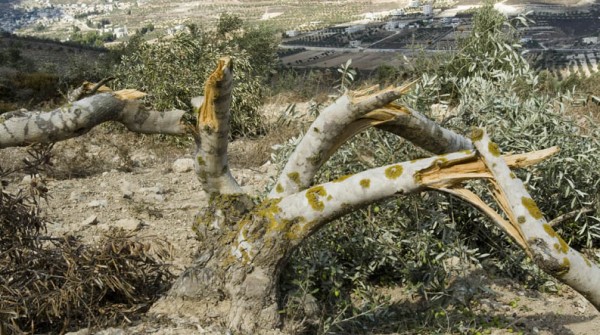
Burin is caught between a rock and hard place, between Har Bracha and Yitzhar. We have visited Burin often, most recently after settlers burned down some of its homes. Settlers once stole a horse from a villager, torched fields, demolished a home in the village and uprooted olive trees. We have frequently documented the uprooting of olive trees: Less than a month ago, in this space, we told the story of the beautiful vineyard belonging to the agriculture teacher Mohammed Abu Awad from the village of Mureir, whose 300 trees were felled by intruders – probably from the illegal outpost of Adei Ad – using buzz saws. Continue reading

Facebooktwittermail

J Street seeks to undermine BDS

J Street seeks to undermine BDS

We’ve been following J Street’s attempts to counteract the growing BDS movement. First there was its aborted release of a public letter criticizing the Toronto Declaration. Then there was the workshop at its student conference called “Reckoning with the Radical Left on Campus: Alternatives to Boycotts and Divestments.” The workshop didn’t go quite as planned either as many students who attended actually offered their support for divestment campaigns targeting the Israeli occupation. You would think these two initial missteps would lead J Street to reconsider which way the wind is blowing. Nope.

J Street is now working to undermine the National Campus Boycott, Divestment, Sanctions Conference that will be held this weekend at Hampshire College. The conference is being called to build “a coordinated national BDS campaign,” and J Street seems to feel threatened by this. Yesterday the organization sent the following email out to its student wing: [continued…]

Editor’s Comment — Strip a J Street statement of all its marketing filler and its use of slogans as a substitute for argumentation and you end up with nothing much at all.

In this case though, there is one important piece of news: “[The] Boycott, Divestment, and Sanctions (BDS) movement against Israel movement… is spreading like wild fire on campuses across the country…”

This is a major grassroots movement but J Street has the hubris and naivety to imagine it can co-opt and steer in the “right” direction. In the process J Street is increasingly coming to look like nothing more than the liberal wing of the Israel lobby.

Facebooktwittermail

For the Palestinians, all roads now lead to the UN

For the Palestinians, all roads now lead to the UN

It is hard to take seriously the threat by the Palestinian president Mahmoud Abbas to declare a Palestinian state in the West Bank and Gaza and demand recognition by the UN Security Council.

The cool response from the US and the European Union made clear that no such recognition would be forthcoming; and, as Hamas asked, what is the point of unilaterally declaring a state while those territories remain ultimately under Israeli control? Yasser Arafat already did that, in 1988.

Mr Abbas, of course, is a desperate man, because the strategy on which he has staked his political career – negotiating a two-state solution to the conflict with Israel under US auspices – is dead. The Obama administration was the last, best hope of the Palestinians for a change of course by America to deliver a credible peace. Mr Obama has been a massive disappointment, lacking either the will or the ability to compel Israel to do anything it doesn’t want to. [continued…]

‘Fatah officials warn of third Palestinian intifada’

atah had made a strategic decision to declare a third intifada against Israel, movement officials told Nazereth-based newspaper Hadith Anas, citing the failed peace talks as the reason for their resolution.

The newspaper report quoted Fatah Central Committee members as saying that the movement wished to implement a decision made during its sixth convention, which assembled last August in the West Bank city of Bethlehem.

One of the movement’s top officials interviewed by Hadith Anas said the third intifada will have a widespread popular base, adding, however, that unlike the previous popular struggle against Israel, which was sparked in September 2000, the movement will not endorse an armed struggle or the use of firearms. Continue reading

Facebooktwittermail

Hasan had intensified contact with cleric

Hasan had intensified contact with cleric

In the months before the deadly shootings at Fort Hood, Army Maj. Nidal M. Hasan intensified his communications with a radical Yemeni American cleric and began to discuss surreptitious financial transfers and other steps that could translate his thoughts into action, according to two sources briefed on a collection of secret e-mails between the two.

The e-mails were obtained by an FBI-led task force in San Diego between late last year and June but were not forwarded to the military, according to government and congressional sources. Some were sent to the FBI’s Washington field office, triggering an assessment into whether they raised national security concerns, but those intercepted later were not, the sources said.

Hasan’s contacts with extremist imam Anwar al-Aulaqi began as religious queries but took on a more specific and concrete tone before he moved to Texas, where he allegedly unleashed the Nov. 5 attack that killed 13 people and wounded nearly three dozen, said the sources who were briefed on the e-mails, speaking on the condition of anonymity because the case is sensitive and unfolding. One of those sources said the two discussed in “cryptic and coded exchanges” the transfer of money overseas in ways that would not attract law enforcement attention. [continued…]

Editor’s Comment — Finally, the real “terrorism” smoking gun: the money trail!

Problem is, in this case the trail seems to have been heading in the wrong direction: Hasan was sending the money — not receiving it. His choice for questionable donations is certainly not going to count in his favor but neither is it going to provide particularly compelling evidence of intent.

Facebooktwittermail

Three key lessons from Obama’s China tour

Three key lessons from Obama’s China tour

Russia may be engaged in a geopolitical chess game with the U.S. aimed at recovering from the demise of its great power status, but China is different. It pushes back against U.S. initiatives only when those are deemed inimical to its national interests. Iran is a good example. Beijing’s heavy investment in and reliance on Iran’s energy sector make it extremely averse to serious sanctions or strategies that create political turmoil in Tehran. While insisting on compliance with the non-proliferation regime, Beijing does not believe Iran represents an imminent nuclear weapons threat. And its response to North Korea going nuclear suggests that a nuclear armed Iran is something it could live with.

Obama went to China arguing that its emergence as a major power gives it greater responsibility, as a partner to the U.S., in helping run the world and tackle such global challenges as climate change and Iran. Indeed, there was a collective shudder in Europe’s corridors of power at the idea of global leadership being concentrated in a “G2” partnership between Washington and Beijing. They needn’t have worried. China’s response to Obama could be read as: “Running the world is your gig, we’re focused on running our own country, and ensuring security in our immediate neighborhood. We want harmonious relations with you, but don’t expect us to do anything that we deem harmful to our national interests.” That means no serious sanctions against Iran, regardless of what deals are struck between Washington and Moscow, because China’s national interests require growing Iran’s energy exports. [continued…]

Facebooktwittermail

Cleric wields religion to challenge Iran’s theocracy

Cleric wields religion to challenge Iran’s theocracy

For years, Grand Ayatollah Hossein Ali Montazeri criticized Iran’s supreme leader and argued that the country was not the Islamic democracy it claimed to be, but his words seemed to fall on deaf ears. Now many Iranians, including some former government leaders, are listening.

Ayatollah Montazeri has emerged as the spiritual leader of the opposition, an adversary the state has been unable to silence or jail because of his religious credentials and seminal role in the founding of the republic.

He is widely regarded as the most knowledgeable religious scholar in Iran and once expected to become the country’s supreme leader until a falling-out with Ayatollah Ruhollah Khomeini, the leader of the 1979 revolution and Iran’s supreme leader until his death in 1989.

Now, as the Iranian government has cracked down to suppress the protests that erupted after the presidential election in June and devastated the reform movement, Ayatollah Montazeri uses religion to attack the government’s legitimacy.

“We have many intellectuals who criticize this regime from the democratic point of view,” said Mehdi Khalaji, a former seminary student in Qum and now a senior fellow at the Washington Institute for Near East Policy. “He criticizes this regime purely from a religious point of view, and this is very hurtful. The regime wants to say, ‘If I am not democratic enough that doesn’t matter, I am Islamic.’

“He says it is not an Islamic government.” [continued…]

Facebooktwittermail