The powerful speaker of Iran’s parliament Saturday derided a Western-backed proposal to transfer the bulk of the country’s enriched-uranium stockpile abroad as a trick meant to rob Iran of its nuclear fuel.
“My guess is that the Americans have made a secret deal with certain countries to take [low-]enriched uranium away from us under the pretext of providing nuclear fuel,” Ali Larijani, who is close to supreme leader Ayatollah Ali Khamenei, told the Iranian Students News Agency. “We hope Iranian officials will pay due attention to this issue.”
Larijani, who once served as Iran’s chief nuclear negotiator, is the highest-ranking official to explicitly question the plan, which would push Iran’s enriched-uranium stockpile below the threshold necessary to make a single nuclear bomb. [continued…]
For the second time in two months, synchronized suicide car bombings struck at the heart of the Iraqi government, severely damaging the Justice Ministry and Provincial Council complexes in Baghdad on Sunday, killing at least 132 people and raising fresh questions about the government’s ability to secure its most vital operations.
The bombers apparently passed through multiple security checkpoints before detonating their vehicles within a minute of each other, leaving the dead and more than 520 wounded strewn across a busy downtown district. Blast walls had been moved back off the road from in front of both buildings in recent weeks.
It was the deadliest coordinated attack in Iraq since the summer of 2007 and happened just blocks from where car bombers killed at least 122 people at the Foreign and Finance ministries this August. [continued…]
Pakistan’s offensive in the Taliban stronghold of South Waziristan has met with significant resistance from insurgents, who have retaken one large town, targeted military vehicles with roadside bombs and held off the army’s attack helicopters with antiaircraft fire, U.S. military analysts said Friday.
The heavy fighting has slowed the advance of an estimated 36,000 to 40,000 Pakistani troops into the heart of the contested tribal region bordering Afghanistan, according to a detailed briefing on the week-old ground operation by researchers at the American Enterprise Institute (AEI), a Washington think tank. Meanwhile, the report said, insurgents continue to coordinate suicide bombings and assassinations outside Waziristan.
But the large government force, aided by U.S. drone strikes and intelligence, outnumbers the insurgents and is expected to maintain its methodical, three-pronged push in an attempt to capture key territory held by the umbrella group Tehrik-e-Taliban Pakistan in the tribal stronghold of slain insurgent leader Baitullah Mehsud. [continued…]
RICHARD GOLDSTONE: As I say, I accept the right of Israel, absolutely, to defend itself. But let me give you an example. Assuming the United States fighting Taliban, started bombing the whole food infrastructure of the people in the area where Taliban are- plowing up fields, bombing food factories, I don’t believe that this would be accepted as legitimate by the people of the United States.
BILL MOYERS: Do we need to change the rules of war in fighting terrorism?
RICHARD GOLDSTONE: Not at all, and you know, it struck me when I heard that Prime Minister Netanyahu suggested that the law of war needs to be changed. It seems to me to contain an implicit acceptance that they broke the law that now is, and that’s why it needs to be changed. [continued…]
The crisis in Israeli-Turkish relationship could deteriorate to the point of a breakup, former US ambassador to Israel Martin Indyk said on Wednesday.
In an interview with The Jerusalem Post, Indyk, currently the Brookings Institute’s vice president for foreign policy, said that the “three brakes” that had prevented Turkey under the Islamic-rooted AK party from drifting toward the Arab world and away from Israel were the Turkish military, its business class, and the “peace process.”
Each of these brakes has been loosened over the last two years – the military has been pushed back into the barracks and no longer has influence over government policy as it once did; the business class is feeling considerable heat from the government and is in no position to stand up and say that ties with Israel are economically important; and the peace process – both with Syria and the Palestinians – is nonexistent, he said.
“I think that it is serious because it is like a car with an accelerator and no brake,” said Indyk, who participated this week in President Shimon Peres’s Israeli Presidential Conference in Jerusalem, arriving directly from meetings in Istanbul.
“I think it is a serious deterioration in the relationship, and it could lead to a breakup. It’s not like it hasn’t happened before. Israel lost a relationship with the whole of Africa, and had to rebuild it. It could happen,” he said. [continued…]
Turkey plans to carry out its $3.5 billion natural gas development plans in Iran, Turkish Energy Minister Taner Yildiz said on Wednesday.
“The issue would be discussed during Prime Minister Tayyip Recep Erdogan’s upcoming trip to Tehran,” Reuters reported.
The Turkish and Iranian governments agreed in July 2007 that Turkish Petroleum Corporation (TPAO) would produce 20.4 billion cubic meters (bcm) of natural gas annually from three development phases of Iran’s South Pars gas field, but the deal has been delayed. [continued…]
A suicide bomber attacked a suspected nuclear-weapons site Friday in Pakistan, raising fears about the security of the nuclear arsenal, while two other terrorist blasts made it another bloody day in the country’s struggle against extremism.
Increasingly daring and sophisticated attacks by terrorists allied with al Qaida on some of Pakistan’s most sensitive and best-protected installations have led to warnings that extremists could damage a nuclear facility or seize nuclear material.
Pakistan’s nuclear sites are mostly in the northwest of the country, close to the capital, Islamabad, to keep them away from the border with archenemy India, but that places them close to Pakistani Taliban extremists, who are massed in the northwest. Al Qaida has made clear its ambitions to get hold of a nuclear bomb or knowledge of nuclear technology. Several other sites associated with Pakistan’s nuclear weapons have been hit previously. [continued…]
iven the deeply disingenuous press conference on Tuesday in which world leaders congratulated Hamid Karzai for agreeing to obey the law he has sworn to uphold, the question of whether a second round of elections will be more credible than the first is largely irrelevant.
Chances are there will not be a second round; weather and logistics could easily combine to torpedo the effort, and the challenger Dr. Abdullah Abdullah has already hinted that he is open to talks “if winter should make a second round impossible.”
A runoff is in no one’s interests. The Afghan people are tired and disgusted, and no second round is going to redeem the democratic process in their eyes. The turnout is likely be miniscule – under 20 percent – making any talk of government legitimacy more than a little absurd. [continued…]
Gaza Strip ruling Islamic Hamas movement rejected on Friday the decree of Palestinian President Mahmoud Abbas, who called on the Palestinians to go for general elections on Jan. 24, 2010.
In a written statement sent to reporters, Hamas movement considered Abbas’ decree “a destructive strike” to all the efforts to achieve an inter-Palestinian reconciliation, adding “the decree is a rejected step.”
Meanwhile, Gaza-based Hamas leader Ismail Radwan told Xinhua in an interview that holding the Palestinian elections without a national agreement of accordance “is a response to the American instructions.” [continued…]
A short midlevel cleric, with a neat white beard and a clergyman’s calm bearing, Mehdi Karroubi has watched from his home in Tehran in recent months as his aides have been arrested, his offices raided, his newspaper shut down. He himself has been threatened with arrest and, indirectly, the death penalty.
His response: bring it on.
Once a second-tier opposition figure operating in the shadow of Mir Hussein Moussavi, his fellow challenger in Iran’s discredited presidential election in June, Mr. Karroubi has emerged in recent months as the last and most defiant opponent of the country’s leadership.
The authorities have dismissed as fabrications his accusations of official corruption, voting fraud and the torture and rape of detained protesters. A former confidant of Ayatollah Ruhollah Khomeini and a longtime conservative politician, he has lately been accused by the government of fomenting unrest and aiding Iran’s foreign enemies. [continued…]
Judge Richard Goldstone told Al Jazeera on Thursday that he is still waiting for the U.S. to back up its claim that his report on the war in Gaza has a number of flaws.
“The Obama administration joined our recommendation calling for full and good-faith investigations, both in Israel and in Gaza, but said that the report was flawed,” Goldstone told Al Jazeera.
The UN commission chairman said that if Washington points out the flaws, he would be ready to respond. “I have yet to hear from the Obama administration what the flaws in the report that they have identified are. I would be happy to respond to them, if and when I know what they are,” he said.
Israel has been dealing one blow after another to the rest of the world. While China has still not recovered from Foreign Minister Avigdor Lieberman’s absence from the reception at its Tel Aviv embassy – a serious punishment for China’s support for the Goldstone report – France is licking its wounds after Prime Minister Benjamin Netanyahu “vetoed” a visit by the French foreign minister to Gaza. And Israel has dealt another blow: Its ambassador in Washington, Michael Oren, will boycott the conference next week of the new Israel lobby J Street.
China, France and J Street will somehow get by despite these boycotts, Turkey will also recover from the great vacationers’ revolt, and we can expect that even the Swedes and Norwegians will recover from Israel’s loud reprimands. But a country that attacks and boycotts everyone who does not exactly agree with its official positions will become isolated, forsaken and detestable: North Korea of today or Albania of yesterday. It’s actually quite strange for Israel to use this weapon, as it is about to turn into the victim of boycotts itself.
Israel strikes and strikes again. It strikes its enemies, and now it strikes out at its friends who dare not fall exactly in line with its official policies. The J Street case is a particularly serious example. This Jewish organization rose in America along with Barack Obama. Its members want a fair and peace-seeking Israel.
That’s their sin, and their punishment is a boycott. [continued…]
President Peres on Wednesday harshly condemned the Goldstone report and told the U.S. envoy to the United Nations, Susan Rice that, “It is outrageous that a respected institution like the United Nations provides a platform to spread lies and stories about Israel.”
The Goldstone report accuses Israel Defense Forces and Palestinian militants of war crimes and possible crimes against humanity during their Dec. 27-Jan. 18 conflict in the Gaza Strip.
The report also calls on the UN Security Council to refer the matter to the International Criminal Court at The Hague, which could prosecute Israeli officials for war crimes.
“The United Nations provides a stage for Ahmmadinejad, who threatens to annihilate Israel, and lets him stand judge,” continued Peres. “This is nothing short of ridiculous.”
Rice promised that the United States will continue to stand by Israel as a loyal friend in the fight against the Goldstone report. [continued…]
The United States and a number of important EU countries are pressing Israel to establish an independent commission of inquiry into the findings of the Goldstone report on last winter’s Gaza offensive.
British Prime Minister Gordon Brown and French President Nicholas Sarkozy, for example, have written a letter on the subject to Prime Minister Benjamin Netanyahu, and messages have been sent through diplomatic channels, in phone calls and in Netanyahu’s meetings with senior American and European officials, said a senior official in Jerusalem.
Netanyahu has yet to take a stance in debates in the cabinet and security cabinet on the issue, let alone decide on the matter. No decision is expected in the next few days, according to a source in the Prime Minister’s Bureau.
The main supporters of establishing a commission are Deputy Prime Minister Dan Meridor and Attorney General Menachem Mazuz, while the main opponents are Defense Minister Ehud Barak and Deputy Prime Minister Eli Yishai. [continued…]
Hamas authorities in the Gaza Strip should promptly implement the recommendations of the Goldstone report on Gaza by conducting credible investigations into serious laws-of-war violations by Palestinian forces, Human Rights Watch said in a letter sent October 20, 2009, to Prime Minister Ismail Haniya.
The United Nations Fact-Finding Mission on the Gaza Conflict, led by Justice Richard Goldstone, called on Hamas and Israel to investigate within six months alleged violations of the laws of war by their respective forces. The report said that Palestinian rocket attacks against Israeli population centers should be investigated as war crimes. The UN Human Rights Council voted on October 16 to endorse the recommendations of the Gaza report. [continued…]
Human Rights Watch was saddened to read in The New York Times on October 20, 2009 that its founding chair, Robert L. Bernstein, feels he must “join the critics” of our work on Israel. We fundamentally disagree with Mr. Bernstein’s views.
Human Rights Watch does not believe that the human rights records of “closed” societies are the only ones deserving scrutiny. If that were the case, we would not work on US abuses in Guantanamo Bay, police abuse in Brazil, the “untouchables” in India, or migrants in South Africa. “Open” societies and democracies commit human rights abuses, too, and Human Rights Watch has an important role to play in documenting those abuses and pressing for their end.
Human Rights Watch does not devote more time and energy to Israel than to other countries in the region, or in the world. We’ve produced more than 1,700 reports, letters, news releases, and other commentaries on the Middle East and North Africa since January 2000, and the vast majority of these were about countries other than Israel. Furthermore, our Middle East division is only one of 16 research programs at Human Rights Watch. The work on Israel is a tiny fraction of Human Rights Watch’s work as a whole.
It is not the case that Human Rights Watch had “no access to the battlefield” after the Israeli operation in Gaza in January 2009. Although the Israeli government denied us access, our researchers entered Gaza via the border with Egypt and conducted extensive interviews with victims, eyewitnesses, United Nations officials, local authorities, and others. As in war zones around the world, we also visited attack sites, analyzed ballistics evidence, photographed wounds, and examined autopsy and other medical reports.
Mr. Bernstein brought his concerns about our work on Israel to a full meeting of the Human Rights Watch Board of Directors in April. The board unanimously rejected his view that Human Rights Watch should report only on closed societies, and expressed its full support for the organization’s work.
Human Rights Watch stands fully behind the work we have done on Israel and around the world. [continued…]
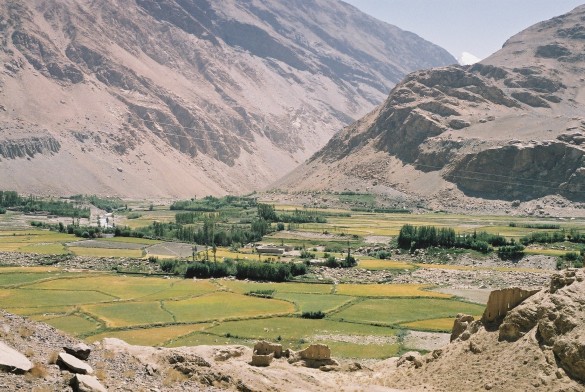
The Afghanistan that Lindsey Graham, Joseph Lieberman, John McCain and seemingly countless other politicians have been visiting at taxpayer expense recently might as well be on Mars, so different is it, apparently, from the Afghanistan that Jean-Claude Muller, special councilor for international cultural matters to Luxemburg’s prime minister, Jean-Claude Juncker, and I visited just this past month.
As professional linguists, we were ostensively doing linguistic field work in Afghanistan’s Wakhan Corridor (we are researching a book provisionally entitled “The Tongues of the Taliban: How They Get Their Intelligence”). We funded the expenditure ourselves, and as linguistic researchers have no particular political axes to grind.
The Wakhan Corridor is that strange-looking panhandle in far northeastern Afghanistan that is strategically sandwiched between Tajikistan to the north and Pakistan’s awesomely snow-bound Hindu Kush to the south and that also abuts briefly and precariously on China. It is a demilitarized-zone creation of the 19th century Great Game that was viciously played out between Imperial Russia and the British Empire. It is an arbitrary creation and therefore geographically reflects the roots of many of modern Afghanistan’s current ills.
We entered Afghanistan from Tajikistan by walking unescorted across the no-man’s land at the Oxus River border station at Eshkashem. We were dressed as civilians and carried our own packs: no vehicles, no flak jackets, no body guards, just plain folks. We were, however, accompanied by our impressive guide and translator, whom we shall simply call Mr. T., a Tajik native of Khorug and a speaker of Tajik and Russian (he spent four years studying film at the academy in Moscow and, like all other Tajiks in his age group, served in the Russian army), as well as Dard; but his native language is Shugni, which is also widely spoken across the Oxus from Khorug in Afghanistan, as is Tajik: there are as many Tajiks (four and a half million) in Afghanistan as in Tajikistan. Then, too, Mr. T. had spent eleven years in Afghanistan working for Focus.
We were following the same route through the corridor that Marco Polo took just over seven centuries ago. We stayed with locals (so-called ‘homestays’); sometimes with major landholders, once with a highly respected local “pasha” and once in a hostel supported by the Aga Khan Foundation, but also often enough with people of very, very modest circumstances (the country’s per capita GDP is currently about $60.00). In every situation, the boundless hospitality and cordiality were overwhelming. Just as you initially begin to think the US ought to have left this godforsaken place yesterday, it’s finally the people that bind your heartstrings to it.
Clearly, we had all the advantages over “official” visitors pointed out by Joseph Kearns Goodwin in his “Afghanistan’s Other Front” and then some: not only could we move about freely as civilians in an ordinary van with an Afghan driver and thus be far less “likely to intimidate and more likely to elicit candor” than highly marked official visitors, the very advantages Goodwin stresses, but we also had one-on-one conversational access and abilities, something our military and politicians have woefully lacked for decades.
The Wakhan Corridor is a heady ethnic and linguistic mix coupled with profound religious differences: Ismailis fervently loyal to the Aga Khan, the 49th Imam, who saved them from certain starvation during the civil war in Tajikistan; Shiites; covert Buddhists; remnants of pre-Islamic paganism reminiscent of that in Ladakh and Nepal; and even vestiges of Zoroastrianism. And this corridor is what all of Afghanistan might have been and might still hope to be: safe and pleasant, even if initially dirt poor, with no evidence of a Taliban or al Qaeda and devoid of the corruption and rampant system of bribes that plagues the rest of the country. Then, too, we saw no poppies in the Wakhan Corridor, and we walked many fields.
Despite such diversity in the Wakhan Corridor, there was a unanimous belief that the Afghan government is simply an outrageous band of crooks on the take and that Hamid Karzai is chief among them. This disgust cut across all linguistic, age and belief groups. It was barely below the surface of any discussion, as was the question of when the “foreigners” would leave. There was no blaming the Russians, nor even our guide, Mr. T., who, as a Tajik, was clearly from the “wrong” side when talk turned to the Soviet era. The wreckage of that period is plain to see: discarded tank turrets decorate many of Eshkashem’s street corners. Most significantly, while there was a firm awareness of local pride of place, there was no patriotic fervor for an Afghanistan, seemingly a very alien concept for many.
The answer to the the questions of what to do about the rampant corruption on the one hand and the Taliban/al Qaeda on the other hand that plague Afghanistan … and the answer to these questions is clearly not more boots on the ground (just ask the Russians about that one … with an estimated cost of some $82 billion and the loss of their empire; though you can’t very well ask the 16,500 British troops slaughtered at the Khyber Pass in just one engagement in 1842, and the Brits didn’t get the message until the disastrous Third Anglo-Afghan War in 1919) or elaborate training programs (Anti-bribing 101?) or monitoring all those police checkpoints where palms are greased, lies within the Wakhan Corridor itself and just across the Oxus River in Tajikistan’s Autonomous Gorno-Badakhshan Region, still known by its Soviet abbreviation GBAO.
The GBAO is just as culturally and linguistically heterogeneous as the Wakhan Corridor, if not more so. But once you leave the bribe-free GBAO, for which a separate visa is required in addition to that for entering Tajikistan, the police checkpoints and corruption start all over again: drivers from the GBAO are routinely racially profiled by Dushanbe’s traffic cops and required to hand over bribes. Once I convinced our Kyrgyz driver to trade his skull cap for my baseball cap, we started being waved past Dushanbe’s checkpoints.
In the end, it was Tajikistan’s disastrous civil war that raged for five years from 1992 until 1997 and that claimed more than 60,000 lives and uprooted more than a million refugees that left the GBAO independent, proud, united and with a clear and collective vision for a future, a vision that finally sees prosperity within its grasp from increased tourism and from providing a trade corridor for neighboring China; the Pamirs are set to become the hub of a new Silk Road, and, get this, it is the Chinese who are building the road system (lamentably with their prisoners, of which they have millions, who receive only food and lodging for their efforts).
For us as a nation, it should be abundantly clear that once people gain their independence and couple that independence with a sense of collective purpose and goals, then peace and (bribeless) prosperity usually follow.
Afghanistan per se is a fictitious socio-political unit that, by and large, was engendered in the wake of the 19th century’s Great Game; any resemblance to Iraq is real. As we see it, given the successes of the Wakhan Corridor and the GBAO, an effective solution to current woes would be to convert Afghanistan into a federation of largely autonomous “cantons” divided along ethno-linguistic lines (and even those of religious persuasion) and then encourage cross-border communication and cooperation between and among related groups; so, for example, between Tajiks on both sides of the Oxus River divide, between Belochis on both sides of the Afghan-Iran border, and so on.
We should also look for creative and novel non-military solutions such as replacing poppy cultivation with saffron cultivation (virtually economically equivalent crops), encouraging local handicraft co-operatives, whether operated by women or not (as has been successfully done in the GBAO), building rural schools along the lines of Greg Mortenson, engaging a variety of non-military players such as His Highness the Aga Khan in socio-political decision making, and so on. And we should largely absent ourselves to let Afghan diversity flourish once again. Going blindly down the same paths of militant aggression as did the Russians and British will surely once again end in ever greater disasters, even more so when we have so clearly failed at cultural understanding and linguistic communication.
Dr. Thomas L. Markey, Tucson, Arizona
Dr. Jean-Claude Muller, Institut archéologique du Luxembourg
When five days pour forth a lead story on the way “a coordinated assault” of the Taliban and Al Qaeda in Pakistan has caused a grave risk to American interests; a lead about the serious counter-offensive mounted by Pakistan; a flash suitable for any date but run as a lead concerning the heroin trade of the Taliban (“Vast Network Reaps Millions from Drugs”); the launching of a serial memoir by a reporter “Held Captive by the Taliban,” which will extend to five parts; a flattering stoic-soldier profile of General McChrystal in the Times Magazine; a Pakistan follow-up suggesting that Pakistan’s army’s now fights well but is “meeting strong resistance” from the Taliban and cannot win without help; a sequence of three stories by different hands, tracing with approval the acquiescence of President Hamid Karzai in calls for a run-off (the very agreement the administration made a precondition for expanded American commitment); two op-eds over three days by military men not of the highest rank, urging escalation; and a reckless “scoop,” filled sparsely with random and often anonymous interviews regarding the supposed discontents within the armed forces at the length of the administration’s pause — when all this is the fruit of five days’ harvest at the Times, the conclusion draws itself. The New York Times wants a large escalation in Afghanistan. The paper has been made nervous by signs that the president may not make the big push for a bigger war; and they are showing what the rest of his time in office will be like if he does not cooperate. [continued…]
The White House logic that a decision on sending further troops would have to wait for the election debacle to be resolved is faulty, however. And Defense Secretary Robert Gates was among those willing to point that out. “We’re not just going to sit on our hands, waiting for the outcome of this election and for the emergence of a government in Kabul,” Gates said Tuesday. “The outcome of the elections and the problems with the elections have complicated the situation for us. But the reality is, it’s not going to be complicated one day and simple the next.”
Indeed, for purposes of creating a representative government as the foundation of U.S. counterinsurgency strategy, the key flaw of Afghanistan’s August election was not the widespread ballot fraud; it was the fact that almost 3 out of 4 voters didn’t show up at the polls because of the Taliban security threat. So, while a runoff election might satisfy the fraud complaints, it won’t make the resulting government much more representative unless millions more voters show up at the polls this time. But the deteriorating security situation and limits of the appeal of both candidates give little reason to expect that the rerun would see a voter surge; turnout in a runoff, if anything, could be even lower.
What’s more, despite the findings of the electoral commission, there’s widespread doubt in Kabul over whether a runoff vote will actually proceed. A power-sharing deal between Karzai and Abdullah is considered the much more likely outcome. But in reality, the manner in which the electoral stalemate is resolved doesn’t substantially alter the basic choice facing Obama: either send tens of thousands more U.S. troops, which U.S. commander General Stan McChrystal says are necessary simply to halt the Taliban’s advance, or draw down to a policing operation against al-Qaeda and abandon the goal of defeating the Taliban. [continued…]
Every military counter-insurgency strategy hits up against the probability that it will, in time, create more enemies than it kills. So you blow up a suspected Taliban site and kill two of their commanders – but you also kill 98 women and children, whose families are from that day determined to kill your men and drive them out of their country. Those aren’t hypothetical numbers. They come from Lt. Col. David Kilcullen, who was General Petraeus’ counter-insurgency advisor in Iraq. He says that US aerial attacks on the Afghan-Pakistan border have killed 14 al-Qa’ida leaders, at the expense of more than 700 civilian lives. He says: “That’s a hit rate of 2 per cent on 98 per cent collateral. It’s not moral.” It explains the apparent paradox that broke the US in Vietnam: the more “bad guys” you kill, the more you have to kill.
There is an even bigger danger than this. General Petraeus’s strategy is to drive the Taliban out of Afghanistan. When he succeeds, they run to Pakistan – where the nuclear bombs are.
To justify these risks, the proponents of the escalation need highly persuasive arguments to show how their strategy slashed other risks so dramatically that it outweighed these dangers. It’s not inconceivable – but I found that, in fact, the case they give for escalating the war, or for continuing the occupation, is based on three premises that turn to Afghan dust on inspection. [continued…]
After nine suicide attacks in just eleven days that killed 160 people, including many from the security forces, the Pakistan army has finally started its long awaited offensive in South Waziristan where the Pakistani Taliban are based. The success of the offensive, against the backdrop of a serious civil-military division in Pakistan and unresolved debate in Washington, could be critical for the fate of Pakistan which is financially broke and politically paralyzed.
The army and the civilian government are once more at odds over policy towards the US and India, the insurgency in Baluchistan, and how to deal with militant Punjabi groups who are linked to the Taliban. Moreover, still unresolved and now an issue of growing international concern, is the sanctuary being given to Afghan Taliban in Pakistan.
Dozens of soldiers and police officers have been killed in suicide attacks from October 5 to 15 that included an embarrassing 22 hour siege of the army headquarters in Rawalpindi and the deaths of eight soldiers and three simultaneous attacks on police training camps and intelligence offices in Lahore. The spate of attacks could have been designed to prevent or delay the expected army offensive on its stronghold, but they also aimed to topple the government, impose an Islamic state, and, if possible, get hold of Pakistan’s nuclear weapons. [continued…]
Israel’s Prime Minister Benjamin Netanyahu instructed his government on Tuesday to draw up proposals to amend the international laws of war after a damning UN report on its war in Gaza.
The security cabinet did not, however, discuss calls made by ministers for an internal investigation into the 22-day offensive at the turn of the year that killed some 1,400 Palestinians and 13 Israelis, an official told AFP.
“The prime minister instructed the relevant government bodies to examine a worldwide campaign to amend the international laws of war to adapt them to the spread of global terrorism,” his office said in a statement.
Israel was dealt a heavy diplomatic blow with the adoption by the UN Human Rights Council of the report that accused both Israel and the Hamas rulers of the Gaza Strip of war crimes.
Israel’s closest allies, the United States, Britain and France urged it to investigate war crime allegations raised by the fact-finding missions headed by Richard Goldstone, a former international war crimes prosecutor.
Defence Minister Ehud Barak backed Netanyahu’s call for a diplomatic campaign, saying that Israel should propose changes in the international laws of war “in order to facilitate the war on terrorism,” an official quoted him as saying. [continued…]
Which way for Hamas? By Nicolas Pelham, Max Rodenbeck, New York Review of Books, October 6, 2009
Whereas in 2008 Hamas brashly punched a hole through Egypt’s border defenses, unleashing an embarrassing stampede of Palestinians into Egyptian shops, Interior Minister [Fathi] Hamad says Hamas now “coordinates fully” with Gaza’s sole Arab neighbor. Hamas even poses as a guardian of Egypt’s national security, not least by killing al-Qaeda’s self-proclaimed preachers and other adherents in Gaza. “Our task now is governance, to consolidate stability rather than continue resistance,” says Hamad.
Yet a day after speaking these soothing words, the interior minister offered a very different political horizon. Between towering bodyguards from Hamas’s armed wing, the Qassam Brigades, he delivered an apocalyptic address to a summoned assembly of clan elders. It was angels that chased Israel’s army from Gaza in last winter’s war, he thundered, adding with a numerological flourish that whereas Israel beat twenty-two Arab nations, Gaza’s Islamic resistance had routed the enemy in just twenty-two days. The Jewish state, he concluded, would disappear in 2022.
Such reverses in rhetoric reveal a movement struggling to reconcile two competing audiences: the “international community,” which calls for Hamas to be more moderate, and a core constituency that grows suspicious at any sign it might be selling out. Much as Communist regimes tacked “Democratic” to their names to disguise totalitarianism, Hamas officials use the word “resistance” to hide the waning of their armed struggle. The culture minister, when he attends theatrical productions, speaks of Resistance Culture. The minister of economy hails recent openings of cafés and restaurants as triumphs of the Resistance Economy. “As long as we don’t raise our hands in surrender and continue to struggle, that’s resistance,” he said.
Hamas has failed to achieve the prime requisite for a more normal life: ending the siege. [continued…]
Iran turned up the heat on Pakistan on Tuesday, saying the group accused of carrying out a suicide bombing that killed top commanders of the elite Revolutionary Guards is based on its territory.
Islamabad strongly denied the allegations, saying the attack was an attempt to “spoil ties” with Iran.
Foreign Minister Manouchehr Mottaki said members of the group accused of mounting Sunday’s attack in southeastern Sistan-Baluchestan province regularly criss-cross the frontier with Pakistan. [continued…]
According to a Tehran University political science author who wishes to remain anonymous, the Pishin attackers had multiple objectives. “First, they wanted to prevent a crucial unity meeting between Shi’ites and Sunnis in Sistan-Balochistan. Second, they wanted to exacerbate tension between the central government and the Balochi minority. Third, they wanted to cause new tensions between Iran and Pakistan, whose government is backed by the US and Saudi Arabia. Fourth, they timed their attacks with the critical nuclear meeting in Vienna to thwart any agreement on Iran’s proposal for nuclear fuel for the reactor in Tehran.”
There is a widespread belief in Tehran that the Pishin attack, especially as it claimed the lives of five IRGC commanders, could not possibly have taken place without the knowledge, and perhaps complicity, of Western and/or Israeli intelligence.
This sentiment is apparently shared by Russia, in light of the quick response by Russian President Dmitry Medvedev, who sent his condolences together with a firm message that Russia was prepared to cooperate with Iran against terrorism. This was in sharp contrast to the silence of US President Barack Obama.
“Iran is now baited into security tensions with nuclear-armed Pakistan and that simply strengthens the hands of the hardliners in Iran who believe that Iran needs a nuclear shield,” the same Tehran professor told the author. [continued…]
Approximately 2,000 strong, Jundallah claims to represent the Sunni Balochi struggle against the centralizing power of Tehran. Nonsense: pan-Balochi aspirations actually are better represented by other Balochi nationalist groups, such as the Balochistan Liberation Army (BLA) in Pakistan. Jundallah for its part does not threaten Islamabad; it is an ultra-sectarian, anti-Shi’ite outfit immersed in the intolerant Deobandi interpretation of Islam.
Jundallah has its headquarters in Karachi and bases in both Balochistans. It does have a firm connection to the South Waziristan tribal areas; it has been connected to the hardcore Sunni and viscerally anti-Shi’ite Lashkar-e-Jhangvi; and is definitely tactically connected to al-Qaeda, “talking” if not to the historic leadership ensconced, in theory, in South Waziristan, at least to the “new generation” al-Qaeda.
It was Jundallah that, last December, perpetrated the first suicide bombing ever in Iran, after spending a few years basically practicing sabotage, kidnapping officials and killing border guards. In May, only three weeks before the Iranian presidential election, Jundallah raised the stakes with an attack on the top mosque in Zahedan, the largest city in the southern part of Sistan-Balochistan.
Islamabad – as always when it comes to anything regarding Balochistan – is perplexed. It never knew how to deal with Balochi separatist movements in the first place – apart from iron-clad repression. But as far as Jundallah is concerned, Islamabad did try, it handed over Rigi’s brother, Abdul Hamid, to Tehran, branding Jundallah as a “terrorist organization”, and always protesting its innocence of the outfit’s designs. [continued…]
In an apparent shift from the Bush administration’s efforts to foster regime change in Iran by financing opposition groups, the Obama White House has all but dismantled the Iran Democracy Fund.
While the move has been criticised by neo-conservatives in the US, it has been welcomed by Iranian human rights and pro-democracy activists.
The controversial program was initiated by the Bush administration in an effort to topple the clerical regime in Tehran by financing Iranian NGOs.
While heralded by some in Washington, reactions in Iran to the program were overwhelmingly negative. [continued…]
An Iranian-American scholar who was jailed during the protests following Iran’s disputed presidential election has been sentenced to at least 12 years on charges of acting against national security, Iranian state media reported Tuesday.
Kian Tajbaksh, a sociologist and urban planner with a doctorate from Columbia, was arrested July 9 and testified during a mass trial of opposition supporters in August.
American officials have repeatedly called on Tehran to release Mr. Tajbaksh, who was the only American citizen included in the mass show trials that followed Iran’s postelection unrest. He spent four months in prison in 2007 on charges of endangering national security. [continued…]
This website or its third-party tools use cookies, which are necessary to its functioning. By closing this banner, you agree to the use of cookies.





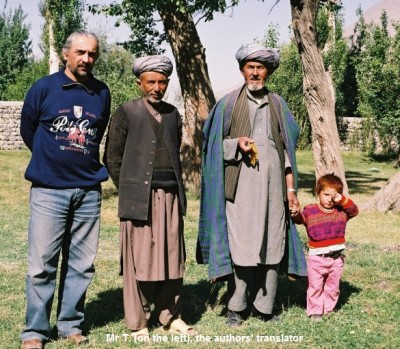 We entered Afghanistan from Tajikistan by walking unescorted across the no-man’s land at the Oxus River border station at Eshkashem. We were dressed as civilians and carried our own packs: no vehicles, no flak jackets, no body guards, just plain folks. We were, however, accompanied by our impressive guide and translator, whom we shall simply call Mr. T., a Tajik native of Khorug and a speaker of Tajik and Russian (he spent four years studying film at the academy in Moscow and, like all other Tajiks in his age group, served in the Russian army), as well as Dard; but his native language is Shugni, which is also widely spoken across the Oxus from Khorug in Afghanistan, as is Tajik: there are as many Tajiks (four and a half million) in Afghanistan as in Tajikistan. Then, too, Mr. T. had spent eleven years in Afghanistan working for Focus.
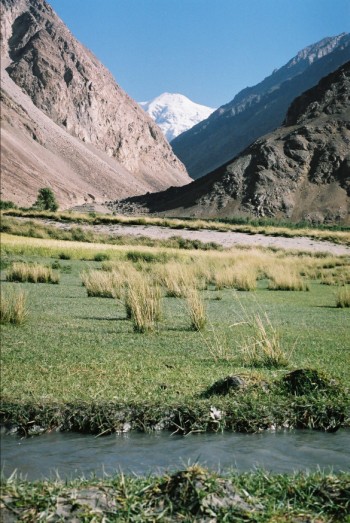 Despite such diversity in the Wakhan Corridor, there was a unanimous belief that the Afghan government is simply an outrageous band of crooks on the take and that Hamid Karzai is chief among them. This disgust cut across all linguistic, age and belief groups. It was barely below the surface of any discussion, as was the question of when the “foreigners” would leave. There was no blaming the Russians, nor even our guide, Mr. T., who, as a Tajik, was clearly from the “wrong” side when talk turned to the Soviet era. The wreckage of that period is plain to see: discarded tank turrets decorate many of Eshkashem’s street corners. Most significantly, while there was a firm awareness of local pride of place, there was no patriotic fervor for an Afghanistan, seemingly a very alien concept for many.