From a secret division at its North Carolina headquarters, the company formerly known as Blackwater has assumed a role in Washington’s most important counterterrorism program: the use of remotely piloted drones to kill Al Qaeda’s leaders, according to government officials and current and former employees.
The division’s operations are carried out at hidden bases in Pakistan and Afghanistan, where the company’s contractors assemble and load Hellfire missiles and 500-pound laser-guided bombs on remotely piloted Predator aircraft, work previously performed by employees of the Central Intelligence Agency. They also provide security at the covert bases, the officials said.
The role of the company in the Predator program highlights the degree to which the C.I.A. now depends on outside contractors to perform some of the agency’s most important assignments. And it illustrates the resilience of Blackwater, now known as Xe (pronounced Zee) Services, though most people in and outside the company still refer to it as Blackwater. It has grown through government work, even as it attracted criticism and allegations of brutality in Iraq. [continued…]
The Justice Department recently questioned military defense attorneys at Guantanamo Bay about whether photographs of CIA personnel, including covert officers, were unlawfully provided to detainees charged with organizing the Sept. 11, 2001, attacks, according to sources familiar with the investigation.
Investigators are looking into allegations that laws protecting classified information were breached when three lawyers showed their clients the photographs, the sources said. The lawyers were apparently attempting to identify CIA officers and contractors involved in the agency’s interrogation of al-Qaeda suspects in facilities outside the United States, where the agency employed harsh techniques.
If detainees at the U.S. military prison in Cuba are tried, either in federal court or by a military commission, defense lawyers are expected to attempt to call CIA personnel to testify. [continued…]
No one has taken responsibility for the horrendous bombs that shattered the foreign and finance ministries in Baghdad and took more than a hundred lives yesterday but the finger must point to Sunni Arab radicals. The foreign ministry is run by Hoshyar Zebari, a prominent Kurdish politician, while the finance ministry is in the hands of the Shia hardliner Bayan Jabr, who represents the Islamic Supreme Council of Iraq and infuriated Sunnis during his previous post as interior minister. He was moved from that post after death squads operating directly or indirectly under cover of the ministry were revealed four years ago to have held and tortured hundreds of Sunnis. That brutality helped to start the sectarian revenge killings that so disfigured Iraq in 2006 and 2007.
The bombings may therefore have been meant in part as a Sunni Arab warning to the Kurds. Tensions and armed clashes between Kurds and Arabs are the biggest danger currently facing Iraq. Until now they have centred on the disputed city of Kirkuk as well as the land surrounding Mosul in the northwest, which Kurds also claim. Bombings in Kirkuk and Mosul have been frequent in recent months. Yesterday’s blast in Baghdad could be a way of showing Kurds that their positions in Baghdad are also vulnerable and that Sunni Arabs can hit them in the capital.
But they are also a warning to Shia hardliners, and by extension the whole of prime minister Nouri al-Maliki’s Shia-dominated Iraqi government, that its policies are still not giving Sunnis a fair share of power. The disbandment of the Sunni Arab militias known as the Awakening movement, which successfully confronted al-Qaida in Iraq in 2007 has angered many Sunnis who felt they deserved more in gratitude and reward. It took courage for Iraqi Sunnis to challenge al-Qaida, and this should have been recognised by Shia leaders. Instead, the government has been slow to honour promises to take former Awakening members into the national army and police. [continued…]
Tom Ridge, the first secretary of homeland security, asserts in a new book that he was pressured by top advisers to President George W. Bush to raise the national threat level just before the 2004 election in what he suspected was an effort to influence the vote.
After Osama bin Laden released a threatening videotape four days before the election, Attorney General John Ashcroft and Defense Secretary Donald H. Rumsfeld pushed Mr. Ridge to elevate the public threat posture but he refused, according to the book. Mr. Ridge calls it a “dramatic and inconceivable” event that “proved most troublesome” and reinforced his decision to resign.
The provocative allegation provides fresh ammunition for critics who have accused the Bush administration of politicizing national security. Mr. Bush and his Democratic challenger, Senator John Kerry of Massachusetts, were locked in a tight race heading into that final weekend, and some analysts concluded that even without a higher threat level, the bin Laden tape helped the president win re-election by reminding voters of the danger of Al Qaeda. [continued…]
Among all adults, 51 percent now say the war is not worth fighting, up six percentage points since last month and 10 since March. Less than half, 47 percent, say the war is worth its costs. Those strongly opposed (41 percent) outweigh strong proponents (31 percent).
Opposition to the Iraq war reached similar levels in the summer of 2004 and grew further through the 2006 midterm elections, becoming issue No. 1 in many congressional races that year.
By the time support for that conflict had fallen below 50 percent, disapproval of President George W. Bush’s handling of it had climbed to 55 percent, in contrast to the solid overall approval of the way Obama is dealing with Afghanistan.
But there are warning signs for the president.
Among liberals, his rating on handling the war, which he calls one of “necessity,” has fallen swiftly, with strong approval dropping by 20 points. Nearly two-thirds of liberals stand against a troop increase, as do about six in 10 Democrats. [continued…]
Afghanistan’s presidential election has long been viewed by U.S. officials as a key to conferring legitimacy on the Afghan government, but Afghan President Hamid Karzai and his powerful warlord allies have planned to commit large-scale electoral fraud that could have the opposite effect.
Two U.S.-financed polls published during the past week showed support for Karzai falls well short of the 51 percent of the vote necessary to avoid a runoff election. A poll by Glevum Associates showed Karzai at 36 percent, and a survey by the International Republican Institute had him at 44 percent of the vote.
Those polls suggest that Karzai might have to pad his legitimate vote total by much as 40 percent to be certain of being elected in the first round.
But Karzai has been laying the groundwork for just such a contingency for many months. By all accounts, he has forged political alliances with leading Afghan warlords who control informal militias and tribal networks in the provinces to carry out a vote fraud scheme accounting for a very large proportion of the votes. [continued…]
Taliban threats scared voters and dampened turnout in the militant south Thursday as Afghans voted for president for the second time ever. Insurgents killed 26 Afghans in scattered attacks, but officials said militants failed to disrupt the vote.
After 10 hours of voting, including a last-minute, one-hour extension, election workers began to count millions of ballots. Initial results weren’t expected for several days.
A top election official told The Associated Press he thinks 40 to 50 percent of the country’s 15 million registered voters cast ballots — a turnout that would be far lower than the 70 percent who cast ballots for president in 2004. [continued…]
Experts laugh at claims by Afghan officialdom that all 17 million names on the electoral roll are legitimate.
An election official confided to the Dutch analyst Martine van Bijlert, of the respected Afghanistan Analysts Network, that up to 3 million of the names were fake.
”It’s ridiculous,” one diplomat said. ”You can see the process being put in place – with those numbers you don’t need big tricks.” [continued…]
Shirjan and Agha Mansour talked about how Taliban rule worked. They were enough in control of the territory to levy their own income tax, called ushur, which is fixed at 10%, and issued receipts for payments rendered.
“They collect 10% tax on all income, even from the government fields,” said Agha Mansour. “So if you grow 100kg of wheat you pay 10kg and they give you a receipt and never charge extra or more.”
Shirjan added: “At least they are honest. They don’t take bribes like the government officials do.”
The taxes are deposited with a Taliban “banker”, who uses the money to run his shop and in return supplies the Taliban with food and other necessities.
Then Shirjan repeated an argument that can be heard all over Afghanistan.
“If you take your case to a government court it will take you four to five years to finish because the longer the case goes the more bribes you pay. So the officials don’t want you to finish. Whereas if you take your case to the Taliban court they will give a judgment in one day and according to God’s ruling. So the people go to the Taliban.” [continued…]
The Taliban is winning the war in Afghanistan, a fact even the top US commander in the country reluctantly concedes. Offering a glimpse of the strategic assessment he was originally scheduled to deliver earlier this month, General Stanley McChrystal warned that American casualties were likely to keep rising, and said the US must deploy more troops to the south and east of the country.
The Taliban inflicted 76 casualties on coalition forces across Afghanistan in July. In Helmand, a historically restive province in the south, there is no safe area, and every day rockets fall on Lashkar Gah, the regional capital. Whatever tactical advances an increased American presence might win, the ultimate political objectives for which the US deployed its troops here are growing more distant. President Hamid Karzai is expected to lead in first-round elections later this week, but among Pashtuns in the south, attitudes toward Kabul and the international coalition are only growing more sour. Few tribes enjoy workable relations with the government – essentially only the Zirak tribes in Kandahar. Meanwhile, opinion polls in Britain and the US show the public has serious doubts about the meaning and direction of the war. [continued…]
… our leaders in Washington, apparently, are not yet sick and tired of war in Afghanistan. For almost a year, Western officials have been conceding that the war will not end without a political solution that involves negotiations with insurgents. But, these officials say, the West isn’t ready yet to make a deal. “Reconciliation is important, but not now,” one Western diplomat told the New York Times. “It’s not going to happen until the insurgency is weaker and the government is stronger.”
So, there’s going to be a deal with insurgents; that’s a foregone conclusion. The question that remains is how many more people will die before that happens – and whether, from the point of view of the interests of the majority of Afghans and the majority of Americans, the deal we can get 5 or 10 years from now is likely to be so much better than the deal we could get in the next year as to justify the deaths that will be the guaranteed result of postponing meaningful negotiations. [continued…]
Boycott Israel By Neve Gordon, Los Angeles Times, August 20, 2009
Israeli newspapers this summer are filled with angry articles about the push for an international boycott of Israel. Films have been withdrawn from Israeli film festivals, Leonard Cohen is under fire around the world for his decision to perform in Tel Aviv, and Oxfam has severed ties with a celebrity spokesperson, a British actress who also endorses cosmetics produced in the occupied territories. Clearly, the campaign to use the kind of tactics that helped put an end to the practice of apartheid in South Africa is gaining many followers around the world.
Not surprisingly, many Israelis — even peaceniks — aren’t signing on. A global boycott can’t help but contain echoes of anti-Semitism. It also brings up questions of a double standard (why not boycott China for its egregious violations of human rights?) and the seemingly contradictory position of approving a boycott of one’s own nation.
It is indeed not a simple matter for me as an Israeli citizen to call on foreign governments, regional authorities, international social movements, faith-based organizations, unions and citizens to suspend cooperation with Israel. But today, as I watch my two boys playing in the yard, I am convinced that it is the only way that Israel can be saved from itself. [continued…]
The Central Intelligence Agency in 2004 hired outside contractors from the private security contractor Blackwater USA as part of a secret program to locate and assassinate top operatives of Al Qaeda, according to current and former government officials.
Executives from Blackwater, which has generated controversy because of its aggressive tactics in Iraq, helped the spy agency with planning, training and surveillance. The C.I.A. spent several million dollars on the program, which did not successfully capture or kill any terrorist suspects.
The fact that the C.I.A. used an outside company for the program was a major reason that Leon E. Panetta, the C.I.A.’s director, became alarmed and called an emergency meeting in June to tell Congress that the agency had withheld details of the program for seven years, the officials said.
It is unclear whether the C.I.A. had planned to use the contractors to actually capture or kill Qaeda operatives, or just to help with training and surveillance in the program. American spy agencies have in recent years outsourced some highly controversial work, including the interrogation of prisoners. But government officials said that bringing outsiders into a program with lethal authority raised deep concerns about accountability in covert operations.
Officials said the C.I.A. did not have a formal contract with Blackwater for this program but instead had individual agreements with top company officials, including the founder, Erik D. Prince, a politically connected former member of the Navy Seals and the heir to a family fortune. Blackwater’s work on the program actually ended years before Mr. Panetta took over the agency, after senior C.I.A. officials themselves questioned the wisdom of using outsiders in a targeted killing program.
Blackwater, which has changed its name, most recently to Xe Services, and is based in North Carolina, in recent years has received millions of dollars in government contracts, growing so large that the Bush administration said it was a necessary part of its war operation in Iraq. [continued…]
In a ruling that threw into doubt one of the government’s main counterterrorism tools, a federal judge said the Treasury Department acted unconstitutionally three years ago when it froze the assets of an Ohio charity suspected of aiding terrorists.
The ruling challenged a key tactic used by the government under an emergency executive order signed by President George W. Bush two weeks after the Sept. 11 attacks. If upheld, the ruling could severely undercut the government’s authority and ultimately require it to get a warrant and submit to court review in moving against charities.
In the last eight years, the Treasury Department has used its broadened authority to freeze tens of millions of dollars in assets held by eight charities within the United States and hundreds of other groups and individuals outside this country, all without warrants and court approval.
The ruling was issued late Tuesday by James G. Carr, the chief federal judge in northern Ohio. Judge Carr set a hearing in September to determine how to correct what he said were constitutional flaws in the government’s case. [continued…]
President Mahmoud Ahmadinejad of Iran, facing a persistent opposition movement and rivals in his own conservative camp, submitted a list of proposed cabinet members Wednesday that would shore up his inner circle of loyalists and remove all the ministers who criticized him during a political confrontation last month.
The list of nominees, reported by Iran’s state news agency, must still be approved by Parliament in a vote of confidence later this month. There are signs that some of Mr. Ahmadinejad’s choices will face resistance from lawmakers, who have been warning him for weeks to pick people on the basis of competence and not loyalty.
At the same time, Mr. Ahmadinejad’s ambitions for greater control over Iran’s complex power structure appeared to suffer a setback on Wednesday when the new chief of Iran’s judiciary, Sadeq Larijani, promoted one of the president’s critics to the powerful position of national prosecutor general. Gholam-Hussein Mohseni-Ejei, whom the president dismissed as intelligence minister last month after a bitter dispute, will become the nation’s top prosecutor, Mehr News reported.
Mr. Larijani also replaced other top judiciary officials, including the hard-line Tehran prosecutor Saeed Mortazavi, replacing them with staunch conservatives who are not necessarily Ahmadinejad allies, Mehr reported.
Mr. Ahmadinejad submitted his new cabinet list just before the legal deadline, apparently in an effort to minimize the time legislators would have to review it. But the Parliament speaker, Ali Larijani, one of the president’s most prominent rivals (and a brother of Sadeq Larijani), postponed the Parliament session to vote on the nominees after it became clear that Mr. Ahmadinejad intended to push his announcement to the last moment. [continued…]
Using Israel Defense Forces soldiers to enforce law among the Jewish population in the territories, especially during the evacuation of illegal outposts, might lead soldiers and even commanders to refuse orders, the commander of the Judea and Samaria division, Brig. Gen. Noam Tibon wrote three months ago in a memo.
The memo, distributed to commanders of units operating in the West Bank, states every unit might have a “bottom third of soldiers and commanders with difficulties,” who would require “individual follow-up and conversations.”
The memo calls on battalion and company commanders to draw “clear red lines” regarding refusing orders. Until orders are refused, commanders should treat soldiers with sensitivity, but once an order is refused, unambiguous action should be taken, the memo states.
It instructs commanders to postpone setting a date for a court-martial, so that it won’t become “an opportunity for a media provocation.” Continue reading →
For five months, Israeli Prime Minister Binyamin Netanyahu has been fending off U.S. pressure to halt the expansion of West Bank settlements. Now he is reaping dividends for his defiance.
Although Israeli leaders have historically been reluctant to publicly break with the United States for fear of paying a price in domestic support, polls show that Netanyahu’s strategy is working. And that means that after months of diplomacy, the quick breakthrough that President Obama had hoped would restart peace talks has instead turned into a familiar stalemate.
Arab states largely have rebuffed Obama’s request for an overture to Israel until the settlement issue is resolved — a stand that Egyptian President Hosni Mubarak emphasized in a meeting with Obama on Tuesday — and the Palestinians have said a settlement freeze is a precondition for resuming negotiations. Meanwhile, the Israeli public seems to have rallied around Netanyahu’s refusal to halt all settlement construction, a backlash that intensified when the Obama administration made clear that it wanted Israel to stop building Jewish homes in some parts of Jerusalem as well as in the occupied West Bank. [continued…]
President Obama said Tuesday that the Middle East peace process was in a “rut,” and prodded Egyptian President Hosni Mubarak to help break an Arab-Israeli standoff that has frustrated the administration’s effort to restart talks.
“If all sides are willing to move off of the rut that we’re in currently, then I think there is an extraordinary opportunity to make real progress,” Obama said in an appearance with Mubarak at the White House. “But we’re not there yet.” [continued…]
The 2009 presidential election is only a day away and Afghans are basking in the global media spotlight. The Taliban are staging spectacular attacks, aware that the violence will make international headlines and provide them with free publicity. Campaigners are driving up and down the country in vehicles covered in posters, wooing the population with the promise of a better future. Free lunches, a rare concept in Afghanistan, have become the rule these days as campaigners feed the poor in the hope of getting votes in return for pilau rice. The poor, in turn, should be forgiven for wishing every day were campaign day. Such charity, after all, is a rarity in the Islamic Republic of Afghanistan.
Democracy is apparently working small wonders in Afghanistan. Local newspapers quote the Qur’an as evidence that there is no contradiction between Islam and the principles of democracy. Presidential candidates invoke early Muslim history to show that the rule of the people is rooted in Muslim tradition. Debate instead of violence; citizenship instead of clientelism; nationhood instead of tribalism; all are recurrent phrases in articles revealing the desires of progressive Afghans for their country. The second presidential debate, aired live on national TV, included Hamid Karzai and was broadly interpreted as a sign that democracy is slowly taking root in Afghanistan. The cost of the election process: $221m. Democracy doesn’t come cheap but in a country where humans are forced to live in caves for want of a roof over their heads, the electoral pomp can seem morally questionable. [continued…]
His newspaper was shut down Monday, and generals and hard-line clerics have called for him to be put on trial. Yet defeated Iranian presidential candidate Mehdi Karroubi says opposition to the government is growing by the day.
The white-turbaned Shiite cleric, who has held several senior government positions since the 1979 Islamic revolution, said in an interview Tuesday that President Mahmoud Ahmadinejad, along with the clerics and Revolutionary Guard commanders who support him, will be defeated by what he describes as a burgeoning movement of ordinary people, ayatollahs and lawmakers.
“In the streets, in the bazaars, at weddings and in mosques, everywhere you can hear people complaining about what has happened” since Ahmadinejad’s disputed reelection June 12, Karroubi said. “This belief is growing at an extraordinary pace. Yes, people might be more cautious, since the situation in our country is dangerous, but their thoughts, their ideas have not changed.” [continued…]
The opposition leader Mir Hussein Moussavi on Tuesday accused “establishment agents” of raping and torturing prisoners, adding a prominent voice to critics who had made the charge and openly defying hard-liners who had denounced the claims as slander.
“Those who committed the crimes were establishment agents,” Mr. Moussavi said in a statement posted on his Web site.
He said “the use of force and money” could not silence the accusations, but only a “quick, open and precise investigation of complaints by detained protesters and their families.” [continued…]
Obama administration officials have pledged to talk to world leaders no matter their views. On Tuesday, they showed that the offer extends to Islamists who spend the day denouncing America from the street corners.
U.S. envoy Richard C. Holbrooke met with Liaqat Baloch, a leader of Pakistan’s Jamaat-i-Islami party. About an hour later, as the bearded scholar prepared to depart for an anti-American rally across town, the veteran diplomat said that despite their disagreements, the meeting had begun “a very useful dialogue.”
Pakistan is eager for U.S. aid, but many people are wary of U.S. intentions. Jamaat-i-Islami has limited leverage in the government, but it is one of the most influential Pakistani Islamist parties, and its anti-American views are widely shared, U.S. officials say. [continued…]
The Obama administration and Damascus tentatively agreed to establish a tripartite committee, with Baghdad, to better monitor the Syrian-Iraqi border as the Pentagon draws down American troops from Iraq in coming months, said senior U.S. officials.
The proposed three-way border-control assessments could boost Iraqi security and patch one of the region’s most volatile fault lines. The initiative was made by a team of U.S. Central Command officers and their Syrian counterparts last week in Damascus.
The pact awaits the green light from Baghdad, which expressed frustration at being excluded from the U.S.-Syrian talks, saying they violated Iraqi sovereignty on security matters.
Iraqi Prime Minister Nouri al-Maliki met Syrian President Bashar Assad in Damascus on Tuesday. A statement issued late in the day by the Iraqi prime minister’s office in Baghdad said only that the two sides “discussed the expansion of the Iraqi and Syrian cooperation” in border control. [continued…]
Later this year, 21-year-old Ephraim Khantsis will pack a couple of suitcases, say good-bye to his mother, leave his home in Brooklyn, and move to Israel. On arrival in Jerusalem he will enroll in a yeshiva, or religious school, that is popular with Americans. After a few months he will make his way north, to a place this young American feels is his true home: the Jewish settlement of Kfar Tapuach.
Perched on a hill just off Route 60, the main north-south road in the occupied West Bank, Kfar Tapuach is known as a particularly hard-line community. Home to about 600 people, the settlement has a history of welcoming American immigrants whose beliefs and acts raise alarms among Israeli intelligence agencies, leading them to monitor it as a haven for suspected terrorists.
Khantsis, who is in the process of applying for Israeli citizenship, will fit right in. Like the assassinated Brooklyn-born rabbi Meir Kahane, the man some in Kfar Tapuach consider their spiritual leader, Khantsis believes that all Arabs and Palestinians should be forcibly removed from territory controlled by Israel, including the West Bank.
“It’s the most humane way to solve the situation,” Khantsis—who has just graduated from Stony Brook University, on Long Island, with a degree in computer science—says, sipping a soda in an Israeli-run kosher pizzeria in Bensonhurst, Brooklyn, this past June. He acknowledges that he is advocating ethnic cleansing. Continue reading →
US presidential contender Mike Huckabee said Tuesday there should be no Palestinian state in the West Bank and endorsed Israeli settlements there, sharply disagreeing with Washington and much of the world.
A three-day tour of Israel, hosted by a far-right group of religious nationalists, is taking Huckabee to some of the most contentious hotspots in the Israeli-Palestinian conflict including a West Bank settlement outpost that even Israel’s hard-line government considers illegal and an east Jerusalem housing project that the Obama administration has demanded be halted.[continued…]
Israel has quietly stopped approving new building projects in the West Bank while publicly still refusing U.S. demands for a formal settlement freeze, officials, peace activists and settlers said Tuesday.
Prime Minister Benjamin Netanyahu’s office denied there was any agreement among senior ministers to freeze new construction. But settlement watchdog Peace Now said no new building had been approved since Netanyahu took office in March.
President Barack Obama’s administration has been prodding Israel to shelve all settlement construction on land Palestinians want for a future state, a demand Israel has said it cannot accept. The issue has grown into a rare public disagreement between the two close allies.
However, several government officials said Tuesday that Israel has decided to temporarily stop green-lighting new projects because of the international pressure.
The move falls short of the U.S. demand because it doesn’t amount to a full freeze — projects approved in the past are still being built, and groups tracking settlements say the pace of construction in the settlements has not slowed. [continued…]
Despite pressure from right-wing ministers, the housing minister has yet to issue one building tender in the settlements, including in the large settlement blocs, since Netanyahu has taken office. This has been confirmed by Prime Minister Netanyahu’s office. The ministry also did not issue new tenders in the final days of Olmert’s administration. The right-wing and the haredi sector have expressed their disappointment over this quiet policy.
Right-wing ministers claim that this policy has been forced upon Israel and undermines the country’s sovereignty in areas over which there should not be any dispute.
Habayit Hayehudi Chairman Daniel Hershkowitz attacked the settlement freeze policy: “The State of Israel is not a satellite of the US. We have a strategic alliance and close friendly relations with the Americans, but it is a two-way alliance. They need us, too, and we must stand our ground, even more so since the Palestinians show their true face anew each and every time proving that theirs is not a face of peace. As long as this remains the situation in the Middle East, the Americans must halt their pressure on the settlement and not prevent natural growth just as we do not get involved in building in Arizona. The natural growth in Judea and Samaria and the building in the settlement blocs and Jerusalem are a red line that must not be crossed.” [continued…]
American Friends of Ateret Cohanim, a nonprofit organization that sends millions of shekels worth of donations to Israel every year for clearly political purposes, such as buying Arab properties in East Jerusalem, is registered in the United States as an organization that funds educational institutes in Israel.
The U.S. tax code enables nonprofits to receive tax-exempt status if they engage in educational, charitable, religious or scientific activity. However, such organizations are forbidden to engage in any political activity. The latter is broadly defined as any action, even the promotion of certain ideas, that could have a political impact.
Financing land purchases in East Jerusalem would, therefore, seem to violate the organization’s tax-exempt status. Continue reading →
When peace-loving Israeli liberals present their conflict with Palestinians in neutral, symmetrical terms – admitting that there are extremists on both sides who reject peace – one should ask a simple question: what goes on in the Middle East when nothing is happening there at the direct politico-military level (ie, when there are no tensions, attacks or negotiations)? What goes on is the slow work of taking the land from the Palestinians on the West Bank: the gradual strangling of the Palestinian economy, the parcelling up of their land, the building of new settlements, the pressure on Palestinian farmers to make them abandon their land (which goes from crop-burning and religious desecration to targeted killings) – all this supported by a Kafkaesque network of legal regulations.
Saree Makdisi, in Palestine Inside Out: An Everyday Occupation, describes how, although the Israeli occupation of the West Bank is ultimately enforced by the armed forces, it is an “occupation by bureaucracy”: it works primarily through application forms, title deeds, residency papers and other permits. It is this micro-management of the daily life that does the job of securing slow but steady Israeli expansion: one has to ask for a permit in order to leave with one’s family, to farm one’s own land, to dig a well, or to go to work, to school, or to hospital. One by one, Palestinians born in Jerusalem are thus stripped of the right to live there, prevented from earning a living, denied housing permits, etc.
Palestinians often use the problematic cliché of the Gaza strip as “the greatest concentration camp in the world”. However, in the past year, this designation has come dangerously close to truth. This is the fundamental reality that makes all abstract “prayers for peace” obscene and hypocritical. The state of Israel is clearly engaged in a slow, invisible process, ignored by the media; one day, the world will awake and discover that there is no more Palestinian West Bank, that the land is Palestinian-frei, and that we must accept the fact. The map of the Palestinian West Bank already looks like a fragmented archipelago. [continued…]
No people mourn better than the Jewish people. For seven days after death, the family sits shiva, a vigil at home for loved ones to comfort one another and reflect on the life lost. During the following year and then beyond, the stages of mourning develop to allow next of kin to continue their lives while still remembering who is gone from them.
The process is successful for Jews, but it is failing the Jewish state. Six decades since the gravest of their tragedies, Jews have collectively yet to find a sustainable way of moving on without forgetting the Holocaust. The inability to do so poses dire consequences for Israel and the possibility for peace.
For Israel, the Holocaust didn’t end in 1945, but reconstituted itself in the country’s political and social cultures. It’s no accident that Yad Vashem, Israel’s Holocaust museum, is physically connected to Har Hertzl, Israel’s national cemetery. The symbolism hits you over the head: Israel was born out of the Holocaust, and the price to protect the Jewish people from another one is steep. There is truth in that, but also danger. Binding too tightly the slaughter of Jewish civilians by Nazis and the deaths of Israeli soldiers by Arabs turns every threat to Israel into another Holocaust. [continued…]
This website or its third-party tools use cookies, which are necessary to its functioning. By closing this banner, you agree to the use of cookies.




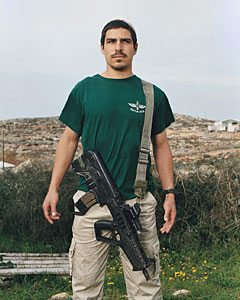 ater this year, 21-year-old Ephraim Khantsis will pack a couple of suitcases, say good-bye to his mother, leave his home in Brooklyn, and move to Israel. On arrival in Jerusalem he will enroll in a yeshiva, or religious school, that is popular with Americans. After a few months he will make his way north, to a place this young American feels is his true home: the Jewish settlement of Kfar Tapuach.