Worries about a Kurdish-Arab conflict move to fore in Iraq

Worries about a Kurdish-Arab conflict move to fore in Iraq

Louis Khno is a city councilman whose city is beyond his control. In his barricaded streets are militiamen — in baseball caps and jeans, wielding Kalashnikov rifles, with the safeties switched off. They answer to someone else. Leaders of his police force give their loyalty to their ethnic brethren — be they Kurd or Arab. Clergy in the town pledge themselves to the former. Khno and his colleagues to the latter.

“We’re far from the conflict, but now we’ve become the heart of the conflict between Kurds and Arabs,” Khno said. “We’re now stuck in between them.”

Khno called the town “the line of engagement,” one stop along an amorphous frontier in northern Iraq shaped by contested history, geography and authority. Dividing the Kurdish autonomous region from the rest of the country, that frontier represents the most combustible fault line in Iraq today, where Arab and Kurd forces may have come to blows last month along hills of harvested wheat. Kurdish officials suggest that another confrontation is inevitable, with halfhearted negotiations already stalled, and U.S. officials acknowledge that only their intervention has prevented bloodshed.

Since 2003, when U.S. forces barreled into Baghdad, toppling Saddam Hussein, inspiring a Shiite revival and unleashing a Sunni insurgency that drew on a communal sense of siege, the war in Iraq has been in large part a sectarian conflict that pitted Sunni Arab against Shiite Arab. That war has subsided, even if bitterness remains.

For months, there were fears that the sectarian battle might reignite, as the United States withdrew its combat forces. Today, that looks less likely. Rather, U.S. officials say, the biggest threat to Iraq in the years ahead is the ethnic conflict, Kurds in the north against the Arab-dominated government in Baghdad, a still-unresolved struggle that has helped shape Iraq’s history since the British inherited the land after World War I. [continued…]

Now it’s a census that could rip Iraq apart

When Iraqis were drafting their Constitution in 2005, the parties could not agree on who would control Kirkuk, the prized oil capital of the north. They couldn’t even agree on who lived in Kirkuk, which is claimed by the region’s Kurds, but also by its Turkmen minority and Sunni Arabs. For that matter, they couldn’t even agree on where Kirkuk was — in Tamim, Erbil, or Sulaimaniya Province.

So the Iraqis punted, inserting Article 140, a clause that called for a national census, followed by a referendum on the status of Kirkuk, all to be held by the end of 2007. What followed were a succession of delays, against a backdrop of sectarian violence and warnings that Kirkuk could blow apart the Shiite-Kurdish alliance that has governed Iraq since the Americans invaded.

Massoud Barzani, president of the Kurdish regional government, warned two years ago that if “Article 140 is not implemented, then there will be a real civil war.” He’s still waiting.

But so is the threat of civil war, which lurked quietly in the polling places this weekend as residents of Iraq’s Kurdish-dominated areas voted for their regional president and Parliament. Until the status of Kirkuk is clear, nobody really knows how much power those regional officials can wield within the national government, or even whether the Kurds will want to remain part of Iraq. [continued…]


Facebooktwittermail

Assiya Rafiq stands up for women in Pakistan

Not a victim, but a hero

(An update from Nicholas Kristof, July 28.)

After being kidnapped at the age of 16 by a group of thugs and enduring a year of rapes and beatings, Assiya Rafiq was delivered to the police and thought her problems were over.

Then, she said, four police officers took turns raping her.

The next step for Assiya was obvious: She should commit suicide. That’s the customary escape in rural Pakistan for a raped woman, as the only way to cleanse the disgrace to her entire family.

Instead, Assiya summoned the unimaginable courage to go public and fight back. She is seeking to prosecute both her kidnappers and the police, despite threats against her and her younger sisters. This is a kid who left me awed and biting my lip; this isn’t a tale of victimization but of valor, empowerment and uncommon heroism. [continued…]

Facebooktwittermail

Cleric who negotiated Taliban-Pakistan peace deal is arrested

Cleric who negotiated Taliban-Pakistan peace deal is arrested

Pakistani police on Sunday arrested Sufi Mohammed, the Taliban-aligned cleric responsible for brokering a controversial peace deal between Swat Valley militants and the government this year. That deal eventually broke down, leading to the ongoing military offensive against Taliban fighters.

Mohammed is the father-in-law of Maulana Qazi Fazlullah, the Taliban leader who fought Pakistani troops for two years before wresting control of the Swat Valley, once a tourist mecca.

Mohammed negotiated a peace deal with the government in February that called for Fazlullah’s fighters to lay down their arms in exchange for the imposition of Sharia, or Islamic law, in the region. In the spring, Taliban militants in Swat reneged on the truce and moved into the neighboring district of Buner, just 60 miles from the nation’s capital, Islamabad.

Fazlullah’s actions prompted Pakistani leaders to mount an all-out assault on militants in Swat and surrounding regions, a move that forced the exodus of nearly 2 million civilians from the conflict zone. [continued…]

Facebooktwittermail

Iran’s revolution has a vacancy at the top

Iran’s revolution has a vacancy at the top

On June 15, five of my relatives — the oldest 65, the youngest 22 — spent four hours traveling across Tehran’s sprawling metropolis to reach a demonstration against the country’s election result. They first crammed into a creaky Iranian-made car, rode part of the way in a dilapidated bus and walked the final three miles. They strode quietly north along with an estimated 2 million others, hopeful that their show of peaceful force would convince the government to annul the election. The next day, the authorities began viciously attacking demonstrators. They dispatched plainclothes henchmen with pistols in their pockets to shoot randomly at civilians. Dissent, Iranians learned, could cost them their lives.
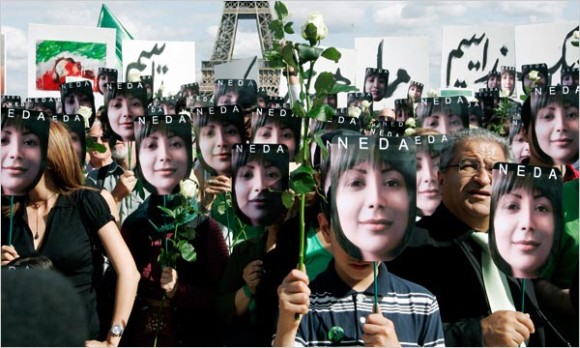
Immediately after the election, such protests evoked the grand marches of the 1979 Islamic revolution. But the scale of the dissent soon diminished. Clearly, the state’s vicious tactics were partly to blame. But Iranians were not simply terrorized into staying at home. Rather, there was no leader inspiring them to take to the streets — and put their lives at risk. The friends and relatives I have spoken to remain outraged over the fraudulent election. But they also remain perplexed by the opposition leaders. Many hailed from the regime’s old-guard elite, and it was unclear how much they would be willing to challenge the Islamic system.

No one had an answer to this central question: For whom, exactly, would ordinary Iranians be willing to put themselves in danger? What sort of leadership is required to make violence worth it? [continued…]

Iran’s opposition calls crackdown ‘immoral’

The leaders of Iran’s opposition movement sent an open letter of protest to the country’s highest religious authorities on Saturday, complaining that the state had used “illegal, immoral and irreligious methods” in the crackdown following last month’s disputed presidential election and calling for the release of hundreds of people arrested since.

The letter came a day after the funeral of a young protester with links to Iran’s political elite, whose father told a senior military commander that the youth had been beaten after his arrest, held incommunicado and allowed to die of an infection. The funeral drew senior figures, including conservative members of Parliament and a representative from the office of Iran’s supreme leader, Ayatollah Ali Khamenei.

The open letter was the latest sign of the opposition movement’s continuing defiance, despite stern warnings by leading clerics to drop the issue and an enormous police presence that has largely scuttled street protests for the past week. It followed a similar call eight days ago by former President Ali Akbar Hashemi Rafsanjani to release the detainees. [continued…]

Facebooktwittermail

Iran ready to strike Israel’s nuclear sites

Iran ready to strike Israel’s nuclear sites

Iran issued a blunt warning to Israel on Saturday that it will launch missile strikes on Israel’s nuclear facilities in the event that the Islamic republic is attacked by the Jewish state. The threat from the head of Iran’s Revolutionary Guard came after a test of Israel’s Arrow missile defence system on Wednesday was reported to have been a ‘resounding failure’.

Inside Iran’s political establishment, President Mahmoud Ahmadinejad after being forced to yield to pressure from the Supreme Leader, Ayatollah Khamenei, who opposed his choice of Esfandiar Rahim Mashai as first vice president, has instead appointed the controversial candidate as his new adviser and head of the presidential office. [continued…]

Facebooktwittermail

Painting Obama as an enemy will hurt Israel badly

Painting Obama as an enemy will hurt Israel badly

In light of the public brawling between Prime Minister Benjamin Netanyahu and U.S. President Barack Obama, we can expect to start seeing graffiti saying things like “America, get out,” “Obama is an Arab” and “Neither a broker nor honest.”

In the new Israeli debate, America is slowly beginning to be perceived as an enemy – and the dispute is going personal: Our prime minister versus their president. Yesterday, he simply demanded that Israel adopt the two-state solution, then called for a freeze on construction in the settlements (without agreeing to settle for “only” the completion of projects already underway), and now he wants to divide Jerusalem. Not Netanyahu – Obama. [continued…]

Facebooktwittermail

Iraq veterans find Afghan enemy even bolder

Iraq veterans find Afghan enemy even bolder

In three combat tours in Anbar Province, Marine Sgt. Jacob Tambunga fought the deadliest insurgents in Iraq.

But he says he never encountered an enemy as tenacious as what he saw immediately after arriving at this outpost in Helmand Province in Afghanistan. In his first days here in late June, he fought through three ambushes, each lasting as long as the most sustained fight he saw in Anbar.

Like other Anbar veterans here, Sergeant Tambunga was surprised to discover guerrillas who, if not as lethal, were bolder than those he fought in Iraq.

“They are two totally different worlds,” said Sergeant Tambunga, a squad leader in Company C, First Battalion, Fifth Marines.

“In Iraq, they’d hit you and run,” he said. “But these guys stick around and maneuver on you.”

They also have a keen sense of when to fight and when the odds against them are too great. Three weeks ago, the American military mounted a 4,000-man Marine offensive in Helmand — the largest since President Obama’s troop increase — and so far in many places, American commanders say, they have encountered less resistance than expected.

Yet it is also clear to many Marines and villagers here that Taliban fighters made a calculated decision: to retreat and regroup to fight where and when they choose. And in the view of troops here who fought intensely in the weeks before the offensive began, fierce battles probably lie ahead if they are to clear the Taliban from sanctuaries so far untouched. [continued…]

Facebooktwittermail

High turnout in Iraqi Kurds’ elections

High turnout in Iraqi Kurds’ elections

Voters in Iraq’s semiautonomous Kurdistan region cast their ballots on Saturday in local presidential and parliamentary elections as a hunger for political reform clashed with a desire to maintain stability.

Turnout was high — 78.5 percent according to the Electoral Commission — and voting was extended by an hour to accommodate the crowds.

Preliminary results were not expected until Sunday, but by Saturday night an opposition party was already charging fraud and the governing coalition was claiming a regionwide lead.

There was little doubt here that the governing coalition would maintain its ironclad grip on this region of 4.5 million people. Many Kurds credit the regional government for the relative security and prosperity the region enjoys compared with the rest of Iraq. [continued…]

Facebooktwittermail

American forged own path into Al Qaeda

American forged own path into Al Qaeda

Bryant Neal Vinas’ unlikely odyssey from Long Island, N.Y., to Al Qaeda’s innermost circle of commanders in Pakistan was achieved without any help in the U.S. from the well-oiled “jihadist pipeline” that has guided so many militants from Europe and other countries — a fact that is cause for concern, current and former U.S. counter-terrorism officials said.

His case, which became public last week, showed that a U.S. convert to Islam bent on waging holy war could — without much difficulty — rely largely on friends and acquaintances to find his own way into the shadowy terrorist networks.

Current and former intelligence officials said that although they were able to at least partly track Vinas, they fear that the informal network of militants in Pakistan that he tapped into is widespread and below the radar of U.S. intelligence gathering.

Juan Zarate, the former deputy national security advisor for combating terrorism in the Bush administration, said that the Vinas case illustrated how difficult it was to follow young men who become radicalized and make their way to militant camps in Pakistan, as well as Afghanistan, Iraq and Somalia. [continued…]

Facebooktwittermail

Opponent says Jane Harman represents Israel, not California

Opponent says Jane Harman represents Israel, not California

Democrat Marcy Winograd (left) is primarying Congresswoman Jane Harman in California. Winograd ran in 2006 and got 38 percent, she says. And Winograd, who is Jewish, is making the race all about the special relationship with Israel. Like, she’s having a reading of My Name Is Rachel Corrie in LA in August.

And she is accusing Harman of dual loyalty. Remember that when some opponent accused Rahm Emanuel of dual loyalty a few years back in Chicago, he got crushed, accused of anti-Semitism. A legitimate question, when Emanuel had run off to serve as a civilian at an Israeli base during the Gulf War. [continued…]

Facebooktwittermail

The Cheney plan to deploy the U.S. military on U.S. soil

Bush weighed using military in arrests

Top Bush administration officials in 2002 debated testing the Constitution by sending American troops into the suburbs of Buffalo to arrest a group of men suspected of plotting with Al Qaeda, according to former administration officials.

Some of the advisers to President George W. Bush, including Vice President Dick Cheney, argued that a president had the power to use the military on domestic soil to sweep up the terrorism suspects, who came to be known as the Lackawanna Six, and declare them enemy combatants.[…]

Former officials said the 2002 debate arose partly from Justice Department concerns that there might not be enough evidence to arrest and successfully prosecute the suspects in Lackawanna. Mr. Cheney, the officials said, had argued that the administration would need a lower threshold of evidence to declare them enemy combatants and keep them in military custody. [continued…]

The Cheney plan to deploy the U.S. military on U.S. soil

This new report today from The New York Times’ Mark Mazzetti and David Johnston reveals an entirely unsurprising though still important event: in 2002, Dick Cheney and David Addington urged that U.S. military troops be used to arrest and detain American citizens, inside the U.S., who were suspected of involvement with Al Qaeda. That was done pursuant to a previously released DOJ memo (.pdf) authored by John Yoo and Robert Delahunty, addressed to Alberto Gonzales, dated October 23, 2001, and chillingly entitled “Authority for Use of Military Force to Combat Terrorist Activities Within the U.S.” That Memo had concluded that the President had authority to deploy the U.S. military against American citizens on U.S. soil. Far worse, it asserted that in exercising that power, the President could not bound either by Congressional statutes prohibiting such use (such as the Posse Comitatus Act) or even by the Constitution’s Fourth Amendment, which — the Memo concluded — was “inapplicable” to what it called “domestic military operations.”

Though it received very little press attention, it is not hyperbole to observe that this October 23 Memo was one of the most significant events in American politics in the last several decades, because it explicitly declared the U.S. Constitution — the Bill of Rights — inoperative inside the U.S., as applied to U.S. citizens. [continued…]

The alarming record of the FBI’s informant in the Bronx bomb plot

Last month, police and the FBI arrested four Newburgh men on charges that they had plotted to bomb synagogues in the Riverdale neighborhood of the Bronx and fire a missile at a military jet.

Mayor Michael Bloomberg and Police Commissioner Ray Kelly held press conferences at the synagogues to reassure New Yorkers about their safety. During Kelly’s remarks, it was startling to hear the commissioner refer to al-Qaeda by name, if only to say that the four purported home-grown terrorists had no ties to Osama Bin Laden’s organization.

As more details emerged, however, the less the four defendants sounded like men with the skills to plan a sophisticated terror plot. They were small-time crooks, felons with long criminal records whose previous activities revolved around smoking marijuana and playing video games. One defendant, Laguerre Payen, was arrested in a crack house surrounded by bottles of his own urine; his lawyer describes him as “mildly retarded.”

It seemed fairly astounding that, for a full calendar year, such a group could remain interested in and plan anything more complex than a backyard barbecue, let alone a multipronged paramilitary assault, as the indictment against them alleged. [continued…]

Facebooktwittermail

Ahmadinejad bows to Khamenei on first vice president

Ahmadinejad bows to Khamenei on first vice president

This issue of President Mahmoud Ahmadinejad’s appointment of Esfandiyar Rahim-Masha’i as his first vice president came to a head on Friday. Rahim-Masha’i, the father of Ahmadinejad’s daughter-in-law, had offended the hard liners last year by saying Iranians are friends of the Israeli people (as opposed to the ‘Zionist regime.’)

Ahmadinejad was presumably, by his appointment of Rahim-Masha’i, trying to signal three things.

1. He is not just a puppet of the hard liners, or even of Khamenei (Ahmadinejad portrays himself as a populist standing up to the fat cats and elites on behalf of the little person, a message he could hardly keep on point if he is just a hired gun of . . . the elite).

2. Ahmadinejad is tolerant of Iranian liberals. Rahim-Masha’i has been accused of favoring religious pluralism (saying that all the great religions are true) and of declaring that “Islamism” is outmoded and its era over with (thus he is accused of being a ‘post-Islamist’ in Asaf Bayat’s terminology). The appointment may have aimed at mollifying some of the reformists?

3. Ahmadinejad is not the crackpot on the question of Israel that his opponents in the presidential race, such as Mir Hossein Mousavi, had painted him.

Of course, if those were his goals, they were unlikely to be achieved in this way, and now the whole thing has in any case come undone. [continued…]

Iran’s top cleric pushes Ahmadinejad on aide

Questions surround the Mashaei controversy.

Some analysts have said hard-liners oppose him because of friendly comments he made last year about Israel. Others say he is a member of a secretive sect, the Hojjatieh, which has a messianic worldview so extreme that the Islamic Republic’s founder, Ayatollah Ruhollah Khomeini, had outlawed it. A video posted online shows Mashaei making a speech in line with Hojjatieh philosophy.

According to Islamic Republic News Agency reports, Ahmadinejad has described Mashaei as a “pious man who is a devotee of Imam Mahdi,” a Shiite saint whose return is awaited by believers.

Several weeks before the June 12 presidential election, Rezai said Ahmadinejad was “surrounded by dangerous individuals” pushing the country toward a precipice. Many considered that to be a jab at the messianic bent of some in his inner circle.

Others describe Mashaei, born in 1960 in the Caspian Sea town of Ramsar, as an opportunist who has parlayed his longtime friendship with Ahmadinejad, an in-law, into a position of power.

Several sources say the two men met in the 1980s while serving in the Revolutionary Guard. Mashaei cultivated strong ties to the intelligence and propaganda divisions of the Revolutionary Guard, as well as the Ministry of Intelligence and Security, where he served in the 1990s. In 2004, Ahmadinejad named him to a position within the Tehran municipality.

Publicly, conservatives say they despise Mashaei for his comments about Israel. He was quoted by the semiofficial Fars news agency as saying in a July interview last year that, despite the conflict between the governments, “Iran is friends with the American and Israeli people. No nation in the world is our enemy.”

He has since strenuously disavowed the comments.

On Friday, a news website quoted Tehran Mayor Mohammed Baqer Qalibaf as accusing Mashaei and his wife of supporting the Mujahedin Khalq, an outlawed Iranian exile group that seeks to overthrow the government and that the United States considers a terrorist group.

Qalibaf said Mashaei’s wife is a former member of the group and the two met in prison, where he was her interrogator. A source close to the Mashaei family confirmed that, saying that she had been sentenced to hang when he proposed to marry her to save her from the gallows. [continued…]

Facebooktwittermail

Deadly clash underscores rift over interpretation of U.S.-Iraq deal

Deadly clash underscores rift over interpretation of U.S.-Iraq deal

When insurgents attacked an American convoy with AK-47 rounds and a couple of grenades on a dusty highway in a Baghdad suburb this week, U.S. soldiers returned fire, chased the suspects through narrow alleyways and raided houses.

Tuesday’s clash killed two Iraqi adults and a 14-year-old and wounded four people, including two children.

When the shooting subsided, another confrontation began. A senior Iraqi army commander who arrived at the scene concluded that the Americans had fired indiscriminately at civilians and ordered his men to take the U.S. soldiers into custody. The U.S. military said the soldiers had acted in self-defense and had sought to avoid civilian casualties; U.S. commanders at the scene persuaded the Iraqis to back down.

The incident, apparently the first time a senior Iraqi commander has sought to detain U.S. soldiers, signals a potential escalation of tensions between U.S. and Iraqi forces trying to find a new equilibrium as Iraq assumes more responsibility for its security. [continued…]

Iraq presses U.S. on pact with Sunnis in Turkey

Iraq’s government said Thursday that it was demanding explanations from the United States and Turkey about a protocol signed this year between an American official and a representative of a group of Iraqi Sunni insurgents in Istanbul as a precursor to negotiations between the two sides.

The Iraqi government said in a statement that the protocol amounts to “an interference in Iraq’s internal political affairs” and that it was expecting “clear explanations” from American and Turkish officials at the embassies in Baghdad.

Contacts between the American government and Iraqi insurgent groups are nothing new, and the most recent ones have occurred with the coordination of an Iraqi government reconciliation unit attached to Prime Minister Nuri Kamal al-Maliki’s office. The goal is to get insurgents to renounce violence and embrace the political process.

But the release of the document of the protocol appears to be an attempt to embarrass the United States and show how deeply involved it remains in Iraq’s affairs. It also underscores just how hostile Mr. Maliki’s Shiite-led government remains to any serious engagement with Sunni insurgents, especially those suspected of having links to Saddam Hussein’s former ruling Baath Party. [continued…]

Facebooktwittermail

Fatah’s leadership crisis deepens

Fatah’s leadership crisis deepens

Fifty years ago, a small group of Palestinian teachers and engineers living in Kuwait founded a secretive movement aimed at liberating those portions of previously British-ruled Palestine that became the State of Israel in 1948.

The group they founded, Fatah, went on to dominate the entire Palestinian political scene. In 1969 it took over the Palestinian Liberation Organisation (PLO), which had been founded by the Arab states – as a counter to Fatah – a few years earlier.

In 1993, it was Fatah/PLO head Yasser Arafat who signed the ‘Oslo Accord’ with Israel; and the following year Arafat became president of the Palestinian Authority (PA) established in occupied Ramallah.

But for several years, Fatah has been in crisis, and now that crisis is coming to a sharp head. Arafat’s successor, Mahmoud Abbas, is planning to convene a meeting of Fatah’s policymaking General Conference Aug. 4. By insisting on holding it in occupied Bethlehem – which will enable Israel’s security forces to completely control who attends and who does not – he has helped split the group’s historic leadership down the middle. [continued…]

Facebooktwittermail

How the Bush administration tried to cover up mass murder

How the Bush administration tried to cover up mass murder


AfghanMassGrave.org

Dr. Jennifer Leaning, Nathaniel Raymond and Dr. Nizam Peerwani of Physicians for Human Rights discuss with Terry Gross their investigation of the alleged massacre of hundreds or possibly thousands of Taliban and Al Qaeda prisoners at Dasht-i-Leili in Afghanistan in December 2001.

Nathaniel Raymond [Physicians for Human Rights]: Our consuming fear from day one, Terry, was that any evidence there was going to be removed and/or destroyed. We were also deeply concerned about witnesses who had spoken to journalists such as Newsweek, to the United Nations and to others and now sadly we know two things: One, we know that there is clear evidence — our forensic team documented [this] in 2008 — of tampering at the site. And we also have satellite imagery which shows that in 2006, less than a month approximately after we filed a Freedom of Information Act request in US federal court, there is one large hole present at the site and what appears to be a hydrolic excavator and a truck digging what becomes the second large trench that our forensic team found in 2008. But for me, and I want to make this very clear, the great tragedy in this case has been the loss of the witnesses.

We now know through State Department documents we received through Freedom of Information Act request that at least four witnesses — innocent men who were bulldozer drivers and truck drivers — have been tortured, killed and disappeared.

Terry Gross: Nathaniel, your Freedom of Information Act files related to the mass grave — your request was made in June of 2006 — and I know you had a lot of trouble getting the Freedom of Information files, although you finally got them. What kind of trouble did you have?

NR: Well, the trouble that Physicians for Human Rights had was the Bush administration did not want to release any documents and so with the help of Ropes and Gray, a law firm in Washington, we were able to pressure them to release the documents and we started receiving them in 2008 and what we found was frankly jaw dropping.

In a November 2002 State Department intelligence report there was a body count and it was from a three-letter redacted intelligence source, which means we couldn’t see who was reporting it, but whoever was reporting it was identified by three letters [editor’s wild guess: possibly a combination of the letters “C”, “I” and “A”]. And this three-letter source said at least 1,500 to as many as 2,000 had died as part of the massacre.

And what we also learned, which was very hard for us at Physicians for Human Rights to see, is that the US government had confirmation that at least four witnesses had been tortured, killed and/or disappeared.

TG: What does it say to you that within these Freedom of Information Act files there was a source, whose name was redacted, who actually gave an estimated body count in this mass grave?

NR: Speaking with former Bush administration officials, that source was an agency. And we still do not have confirmation about what US intelligence agency that was, but it was absolutely outrageous. The fact that the US government would be saying there was no grounds for a US investigation, no grounds for security of the site, no grounds for protection of witnesses, but they had a body count for years, and they had clear evidence that people — innocent bystanders in this case — were being killed and they did nothing. [continued…]

Afghan massacre: the convoy of death (video)

Facebooktwittermail

What Israel needs to know about Sharia

What Israel needs to know about Sharia

We argue that engagement with Hamas is essential, and possible. To understand how, it is necessary to take into account that many of Hamas’s statements and actions are governed and limited by its understanding of Islamic religious law (sharia), a comprehensive code relevant to all aspects of life for believing Muslims, very much including politics. We maintain that Hamas cannot be understood without understanding the sharia background of many of its policies.

By its reading of sharia (a reading it shares with the Muslim mainstream), Israel’s establishment is illegitimate and unjust, and its recognition by Muslims is forbidden. Thus far, the Muslim states that have recognized Israel, including Egypt, Jordan and Turkey, have made a political decision to do so, one not grounded in Islamic law. Similarly, the Arab Peace Initiative — which offered full recognition of Israel by all 19 remaining Arab states in return for Israel’s withdrawal to the 1967 boundaries and an “agreed-upon” settlement of the Palestinian refugees — is a political, not sharia-justified, compromise.

Hamas maintains that accepting Israel’s legitimacy necessarily renounces the Palestinian narrative, which defines Palestine as Arab and Muslim, in contrast to the Jewish narrative, which defines the Land of Israel as Jewish by God’s promise, by legal right, and by history. Can these two worldviews be reconciled? Absolutely not. Can Hamas and Israel co­exist peacefully? We believe they can. Reconciliation is much harder than coexistence. [continued…]

Hamas shifts from rockets to public relations

Mr. Taha and others say that the military has replaced field commanders and restructured itself as it learns lessons from the war. The decision to suspend the use of the short-range Qassam rockets that for years have flown into Israel, often dozens a day, has been partly the result of popular pressure. Increasingly, people here are questioning the value of the rockets, not because they hit civilians but because they are seen as relatively ineffective.

“What did the rockets do for us? Nothing,” Mona Abdelaziz, a 36-year-old lawyer, said in a typical street interview here.

How long Hamas will hold its fire and whether it will obtain longer-range missiles — which it says it is seeking — remain unclear. But the shift in policy is evident. In June, a total of two rockets were fired from Gaza, according to the Israeli military, one of the lowest monthly tallies since the firing began in 2002.

In that tactical sense, the war was a victory for Israel and a loss for Hamas. But in the field of public opinion, Hamas took the upper hand. Its leaders have noted the international condemnation of Israel over allegations of disproportionate force, a perception they hope to continue to use to their advantage. Suspending the rocket fire could also serve that goal.

“We are not terrorists but resistance fighters, and we want to explain our reality to the outside world,” Osama Alisawi, the minister of culture, said during a break from the two-day conference. “We want the writers and intellectuals of the world to come and see how people are suffering on a daily basis.” [continued…]

Facebooktwittermail

White House sends A-Team to Israel to try to overcome settlements impasse, talk Iran

White House sends A-Team to Israel to try to overcome settlements impasse, talk Iran

A flurry of upcoming meetings between senior U.S. and Israeli officials suggest that Washington is determined to try to overcome the current impasse. Defense Secretary Robert Gates arrives in Israel Monday for talks with Israeli Defense Minister Ehud Barak and other leaders. Aides declined to discuss the secretary’s agenda at all except to confirm the trip.

Mitchell too is headed back to Israel Sunday, after visits today in Abu Dhabi, and Damascus tomrrow, and before going on to Egypt and Bahrain. One notes that Mitchell’s and Gates’s trips might overlap, and that both have Defense Minister Barak as one chief interlocutor.

National Security Advisor Gen. James. L. Jones also confirmed to Foreign Policy that he plans to lead a separate multiagency team that reportedly includes officials from the Treasury Department, CIA, as well as NSC Senior Director for the Central Region Dennis Ross to Israel for meetings next Wednesday with Israeli national security advisor Uzi Arad and others. Iran is expected to be the major focus of these talks, which are separate from the Gates’ trip, a U.S. defense official said. Some Iran watchers believe if Iran hasn’t responded to the offer for talks by September, that the process for organizing a tougher sanctions regime targeting Iran will begin to get underway at the U.N. General Assembly in September and subsequent G-20 meeting in Pittsburgh, although administration and outside sources have indicated Russia is not likely to support such measures until after the end of the year. [continued…]

An Economist debate: This house believes that Barack Obama’s America is now an honest broker between the Israelis and the Arabs

Daniel Levy: “Brokering real progress on Israel-Palestine is now more readily understood as being in the US national interest. An especially compelling case can also now be made on why a two-state solution is urgent for Israel and its future as a democracy, and there are new progressive dynamics in America’s Jewish community and in online political organising that support this trend.

“Against this backdrop, Mr Obama is staking out that role of the honest-enough broker. His administration has made public its disagreement with Israel’s settlement policy, unequivocally calling for a full freeze. US relations with Syria have been upgraded. The president has made a point of reaching out to the Arab and Muslim worlds, notably in his Cairo speech, and has done so respectfully, eschewing the arrogant and lecturing tone of his predecessor. Obama has conveyed his determination to realise a two-state solution, just last week telling American Jewish leaders that he would be ‘evenhanded’, having honest conversations with and putting pressure on both the Israeli and Arab sides.” [continued…]

U.S., Israel abort missile test

Israeli and U.S. military officials this week aborted a test of a missile-defense shield under development by the two countries, raising questions about the reliability of Israel’s defenses against a potential Iranian attack.

The news, which military officials were careful not to characterize as a failure of the Israeli missile-defense program, comes amid heightened tensions in the Middle East over the strengthening of Iranian hawks loyal to Iranian President Mahmoud Ahmadinejad.

Mr. Ahmadinejad’s recent electoral victory has fueled renewed debate in Washington and European capitals about whether to rely on continued diplomacy to curb what the U.S. and Israel see as Iran’s intention to build nuclear weapons. Iran says its nuclear program is for peaceful purposes. [continued…]

Israeli warships’ passage through Suez Canal causes a stir

There’s no sneaking a warship through the Suez Canal, so it’s best to sail through and remain coy.

Israel has done just that. At least two of its missile-class Saar 5 warships and a Dolphin submarine have sailed through the canal in recent weeks, prompting conjecture about Israel’s intentions. Possible scenarios include the sending of a message to Iran about Israeli military might and giving the impression that Israel and Egypt, which controls the Suez, are closely cooperating against regional security threats.

The Israeli government has said little about why the vessels were on missions that took them through the Suez, but they come as Israel has grown insistent on stopping Iran’s nuclear program. That fits in with Prime Minister Benjamin Netanyahu’s attempts to link the resolution of the Israeli-Palestinian conflict with agreements from Arab states to help Israel counter Iran. [continued…]

Facebooktwittermail

Iranian opposition figure’s brother in detention

Iranian opposition figure’s brother in detention

The wife of the Iranian opposition leader Mir Hussein Moussavi spoke out forcefully on Thursday against the recent publication of accusations against her imprisoned brother, saying the accusations were false and amounted to a new effort by Iran’s hard-line leadership to discredit the opposition movement.

Mr. Moussavi’s wife, Zahra Rahnavard, is a well-known figure in Iran who played an important role in his campaign before the disputed June 12 election. She made her statement on Thursday after a hard-line lawmaker accused her brother in print of helping orchestrate the post-election rallies and riots. The brother, Shahpour Kazemi, was arrested a month ago, and the Iranian authorities are reported to be preparing to broadcast videotaped confessions by some people detained in the unrest.

“I am announcing that if they force a confession out of Mr. Kazemi or publish a hundred pages of accusations against him, neither I nor the people of Iran will believe it,” Ms. Rahnavard said, in comments published on Mr. Moussavi’s Web site. [continued…]

Facebooktwittermail