NEWS & OPINION: Re-Baathification; Basra’s ‘misery gangs’ murdering women

Iraq eases curb for former officials of Hussein’s party

The Iraqi Parliament passed a bill on Saturday that would allow some former officials from Saddam Hussein’s party to fill government positions but would impose a strict ban on others. The legislation is the first of the major so-called political benchmark measures to pass after months of American pressure for progress.

The measure, which is expected to be approved as a law by the presidential council, was described by its backers as opening the door for the reinstatement of thousands of low-level Baath Party members barred from office after the 2003 invasion. Since then, the Bush administration has urged the Iraqi government to reintegrate many officials in order to help mend the deep rifts between Sunni Arabs who used to control the government under Mr. Hussein and the Shiites who now dominate politics here.

However, it was unclear on Saturday how far the legislation would go toward soothing Sunni Arabs, because serious disagreements emerged in the hours after the vote about how much the law would actually do.

While the measure would reinstate many former Baathists, some political leaders said it would also force thousands of other former party members out of current government jobs and into retirement — especially in the security forces, where American military officials have worked hard to increase the role of Sunnis. One member of Iraq’s current de-Baathification committee said the law could even push 7,000 active Interior Ministry employees into retirement. [complete article]

Who is killing the women of Basra?

In Basra, Iraq’s second largest city, 2008 was ushered in with an announcement of the 2007 death toll of women targeted by Islamist militias. City officials reported on December 31 that 133 women were killed and mutilated last year, their bodies dumped in trash bins with notes warning others against “violating Islamic teachings…” But ambulance drivers who are hired to troll the city streets in the early mornings to collect the bodies confirm what most residents believe: the actual numbers are much higher.

The killers’ leaflets are not very original. They usually accuse the women of being prostitutes or adulterers. But those murdered are more likely to be doctors, professors, or journalists. We know this because activists from the Organization of Women’s Freedom in Iraq (OWFI) have taken on the gruesome task of visiting city morgues to try and determine the scale and pattern of the killings. According to OWFI, most of the women who have been murdered “are PhD holders, professionals, activists, and office workers.”

Their crime is not “promiscuity,” but rather opposition to the transformation of Iraq into an Islamist state. That bloody transition has been the main political trend under US occupation. It’s no secret who is killing the women of Basra. Shiite political forces empowered by the US invasion have been terrorizing women there since 2003. Within weeks of the invasion, these groups established “Propagation of Virtue and Prevention of Vice” squads, which many Iraqis refer to simply as “misery gangs.” They began by patrolling the streets, harassing and sometimes beating women who did not dress or behave to their liking. Coalition forces did nothing to stop them, and soon the militias escalated their violence to torturing and assassinating anyone who they saw as an obstacle to turning Iraq into an Islamist state. [complete article]


Facebooktwittermail

OPINION: Foreign policy after Bush

Cornered in square one

… the next president will not be starting from an international position similar to the one Bush inherited no matter how successful the administration is in undoing the damage of its failed policies. A once internationally weak and democratizing Russia has become an autocratic and provocative petro-state. China’s economy is more than twice the size of what it was in 2000, and its global influence has correspondingly risen. And a new generation of jihadists, no less committed to violence, is eager to continue the anti-America campaign.

The GOP candidates who would build on Bush’s old approach to foreign policy clearly don’t get how the world has changed. But neither do Democrats who stress reversing what Bush has done. No one should feel vindicated by the Bush administration’s reversals, because defining the future of U.S. foreign policy in terms of the past would be as big a mistake for the next president as it was for Bush.

When you are a great power, a lost decade does not simply leave you back where you started. It leaves you far behind. Our presidential candidates had better plan to do more than simply reboot the system and start over, as though the clock had stopped in January 2001. [complete article]

Facebooktwittermail

REVIEW: They Knew They Were Right: The Rise of the Neocons

Fathers and sons

To be neoconservative is to bear almost daily witness to the resurrection of Adolf Hitler. “Truly Hitlerian,” the Washington Post columnist Charles Krauthammer pronounced Saddam Hussein’s saber-rattling before Iraq invaded Kuwait. Three days after the 9/11 attacks, Paul Wolfowitz, then deputy defense secretary, opined that Osama bin Laden and his Al Qaeda followers “misread our system as one that’s weak, that can’t take casualties. … Hitler made that mistake.” Norman Podhoretz, the former editor of Commentary, said of the Iranian president Mahmoud Ahmadinejad last spring, “Like Hitler, he is a revolutionary whose objective is to overturn the going international system.” In the same month, the defense analyst Richard Perle mused on whether it had been “a correct reading” of the Palestinian leader Yasir Arafat “to believe that business could be done with him that would produce a result? I don’t think so. These are the difficult decisions. Diplomacy with Hitler. Chamberlain went to Munich, presumably on the theory that you talk to your enemies and not to your friends, and what did it produce?”

Just about the only place the neoconservative movement can’t locate Hitler is Nazi Germany. As late as 1944, the founding-neocon-to-be, Irving Kristol, publicly dismissed the “near hysterical insistence upon the pressing military danger,” Jacob Heilbrunn reports in his new book, “They Knew They Were Right: The Rise of the Neocons.” While the Nazis herded Jews into the gas chambers, Kristol, then a 24-year-old Trotskyist, held fast to his conviction that the Allies were no different from the Axis in their imperialism. Kristol took this view because he was “indulging in an abstract crusade for a better world.” [complete article]

Facebooktwittermail

IDEAS: The science of the moral sense

The moral instinct

Two features of reality point any rational, self-preserving social agent in a moral direction. And they could provide a benchmark for determining when the judgments of our moral sense are aligned with morality itself.

One is the prevalence of nonzero-sum games. In many arenas of life, two parties are objectively better off if they both act in a nonselfish way than if each of them acts selfishly. You and I are both better off if we share our surpluses, rescue each other’s children in danger and refrain from shooting at each other, compared with hoarding our surpluses while they rot, letting the other’s child drown while we file our nails or feuding like the Hatfields and McCoys. Granted, I might be a bit better off if I acted selfishly at your expense and you played the sucker, but the same is true for you with me, so if each of us tried for these advantages, we’d both end up worse off. Any neutral observer, and you and I if we could talk it over rationally, would have to conclude that the state we should aim for is the one in which we both are unselfish. These spreadsheet projections are not quirks of brain wiring, nor are they dictated by a supernatural power; they are in the nature of things.

The other external support for morality is a feature of rationality itself: that it cannot depend on the egocentric vantage point of the reasoner. If I appeal to you to do anything that affects me — to get off my foot, or tell me the time or not run me over with your car — then I can’t do it in a way that privileges my interests over yours (say, retaining my right to run you over with my car) if I want you to take me seriously. Unless I am Galactic Overlord, I have to state my case in a way that would force me to treat you in kind. I can’t act as if my interests are special just because I’m me and you’re not, any more than I can persuade you that the spot I am standing on is a special place in the universe just because I happen to be standing on it. [complete article]

Facebooktwittermail

IDEAS: We think not just with our brains, but with our bodies

Don’t just stand there, think

When you read something confusing, or work a crossword puzzle, or try to remember where you put your keys, what do you do with your body? Do you sit? Do you stand? Do you pace? Do you do anything with your hands? Do you move your eyes in a particular pattern?

How you answer questions like these, it turns out, may determine how long it will take for you to decipher what you’re reading, solve your puzzle, or get your keys back.

The brain is often envisioned as something like a computer, and the body as its all-purpose tool. But a growing body of new research suggests that something more collaborative is going on – that we think not just with our brains, but with our bodies. A series of studies, the latest published in November, has shown that children can solve math problems better if they are told to use their hands while thinking. Another recent study suggested that stage actors remember their lines better when they are moving. And in one study published last year, subjects asked to move their eyes in a specific pattern while puzzling through a brainteaser were twice as likely to solve it.

The term most often used to describe this new model of mind is “embodied cognition,” and its champions believe it will open up entire new avenues for understanding – and enhancing – the abilities of the human mind. [complete article]

Facebooktwittermail

NEWS & EDITOR’S COMMENT: The unraveling of Israel’s nuclear ambiguity

CIA reveals: We said in 1974 that Israel had nuclear weapons

The Central Intelligence Agency, backed by bodies including the State Department’s Bureau of Intelligence and Research and the Defense Intelligence Agency, determined in August 1974 that Israel had nuclear “weapons in being,” a “small number” of which it “produced and stockpiled.”

Israel was also suspected of providing nuclear materials, equipment or technology to Iran, South Africa and other then-friendly countries.

This top secret document, consigned to the CIA’s vaults for almost 32 years, was suddenly released to the public this week, during U.S. President George W. Bush’s visit to Israel and on the eve of his trip to the Persian Gulf. [complete article]

Editor’s Comment — For several decades, Israel has adopted a position of so-called “nuclear ambiguity,” asserting that it would not be the first state to introduce atomic weapons to the Middle East. The United States has colluded in allowing this claim to rest unchallenged — even though it is widely understood that Israel does in fact possess a nuclear arsenal estimated to range from 70 to 400 warheads.

The first indications that the United States’ position might change occurred during Robert Gates’ confirmation hearings in which he included Israel among the nuclear states that surround Iran. Documents released by the Nixon Library a few weeks ago confirm that in 1969, Henry Kissinger warned President Nixon about Israel’s nuclear capabilities and that the “Israelis, who are one of the few peoples whose survival is genuinely threatened, are probably more likely than almost any other country to actually use their nuclear weapons.” A year ago, Ehud Olmert provoked a storm of criticism inside Israel by being the first Israeli prime minister to make reference to Israel’s nuclear arsenal.

It seems to be a matter of time (months or even weeks?) before Israel decides to unambiguously come out of the nuclear closet. If this happens, the nuclear equation changes across the whole region. Will it trigger a Middle East nuclear arms race? Will it help empower those who argue that the only effective way of challenging Iran’s nuclear program is through turning the whole region into a nuclear-weapon-free zone? Or will the United States attempt to contrive a policy that claims that Israel has a unique “right” to possess nuclear weapons and exempt itself from international treaties?

Facebooktwittermail

NEWS, OPINION & EDITOR’S COMMENT: Unscrambling Iranian-U.S. communications

What to make of the Iranian videotape

Iran has now aired a video of the incident in the Straits of Hormuz on Sunday, and according to the wire services (AP, AFP, Reuters) the video stresses routine and not confrontation.

As I said yesterday, the Iranians on Sunday wanted to send a not-so-subtle message to their Persian Gulf neighbors that they could disrupt the flow of oil and that any U.S.-Iranian confrontation would hurt the pocketbooks of the ruling sheiks. Now, by issuing a video that seems to call into question the authenticity of the Pentagon videotape, Iran seeks a bigger victory with international public opinion.

At this point, Washington has two choices: It can release every shred of intelligence and information it has in an attempt to show how the Iranians are lying. Or it can let the matter drop and focus instead averting these types of incidents in the future. If it chooses the latter, it may find that Iran is a more willing partner than it appears. What Tehran is saying, after all, is quite similar to what the U.S. Navy is saying. [complete article]

Editor’s Comment — Let’s suppose that the Pentagon had never released its own video (the one to which it added an audio track) — that it had simply issued a statement describing the Hormuz incident — and that the Iranian video that has now been broadcast came under critical scrutiny. Suppose the Pentagon then announced that after having analysed the Iranian videotape, they had determined that the audio came from a different source than the images. Would the Pentagon refrain from describing this as a “fabrication”? Almost certainly not — and neither would many news editors in the U.S. media be reluctant to run headlines referring to the “Fabricated Iranian Video.”

Official version of naval incident starts to unravel

Despite the official and media portrayal of the incident in the Strait of Hormuz early Monday morning as a serious threat to US ships from Iranian speedboats that nearly resulted in a “battle at sea,” new information over the past three days suggests that the incident did not involve such a threat and that no US commander was on the verge of firing at the Iranian boats.

The new information that appears to contradict the original version of the incident includes the revelation that US officials spliced the audio recording of an alleged Iranian threat onto to a videotape of the incident. That suggests that the threatening message may not have come in immediately after the initial warning to Iranian boats from a US warship, as it appears to do on the video. [complete article]

Forging ties with Iran

There is widespread feeling overseas that the consequences of the judgment that Tehran has suspended its nuclear weapons program should be positive, not punitive. To be sure, the Islamic Republic still has nuclear ambitions, and its expanded uranium enrichment capacity is certainly worrisome. Nonetheless, dialogue and diplomacy are still the best means of mitigating the Iranian challenge. And despite President Mahmoud Ahmadinejad’s odious rhetoric and the reckless behavior of Iranian speedboats, there is reason to believe that Tehran may be open to such an approach.

While some have depicted Iran as a rash, militant state imbued with messianic fervor, the clerical state today is an unexceptional opportunistic power seeking to exert preponderance in its immediate neighborhood. Gone are the heady revolutionary days when Iran viewed projection of influence as necessitating the subversion of the incumbent Arab regimes. [complete article]

See also, Iran shows its own video of vessels’ encounter in Gulf (NYT) and US protests Iran harassment of US ships (AP).

Facebooktwittermail

NEWS, ANALYSIS & OPINION: The unraveling of the War on Terrorism

The West has not just repressed democracy. It has aided terror

The Pakistani senator gazed at the headline in despair. It read: “US weighs new covert push in Pakistan”. Washington was authorising “enhanced CIA activity” in the country while US Democratic candidates declared they were all ready “to launch unilateral military strikes in [Pakistan] if they detected an imminent threat”. Hillary Clinton wanted “joint US-UK oversight” of Pakistan’s nuclear weapons. In a country where anti-Americanism is almost a religion, said the senator, this is “an answer to a Taliban prayer”.

I am convinced that those whom the gods wish to destroy they first curse with foreign policy. For the third time in 20 years, the west is meddling with the world’s sixth most populous state. It did so to promote the Afghan mujahideen against the Russians in the 1980s, then to attack al-Qaida after 9/11, and now to “guard” Pakistan’s bombs against a fantastical al-Qaida seizure. Needless to say, the sole beneficiaries are the Taliban and the forces of disorder. [complete article]

Pakistan warns US not to enter northwest

President Pervez Musharraf warned that U.S. troops would be regarded as invaders if they crossed into Pakistan’s border region with Afghanistan in the hunt for al-Qaida or Taliban militants, according to an interview published Friday. [complete article]

Pakistan takes a step backwards

At a time when Pakistan’s national decision-making institutions are suspicious of international plans to make the country’s nuclear program controversial, there is serious consideration for repositioning the country’s foreign policy as neutral in the United States-led “war on terror”.

This would mean non-interference in the restive tribal areas on the border with Afghanistan. These are virtually autonomous areas where Taliban and al-Qaeda militants have established bases and vital supply lines into Afghanistan.

Such a move would have devastating effects on the North Atlantic Treaty Organization’s (NATO) efforts to control the ever-growing insurgency in Afghanistan.

Following a meeting of the Pakistan corps commanders headed by the new chief of army staff, General Ashfaq Kiani, a press release said there would be a review of the situation in the tribal areas and, instead of citing any plans for military operations there against militants, the release said the military’s decisions would be based on “the wishes of the nation”. [complete article]

See also, Bomb kills at least 23 in Pakistan (NYT) and Baitullah Mehsud – the Taliban’s new leader in Pakistan (Jamestown Foundation).

Facebooktwittermail

NEWS & EDITOR’S COMMENT: Counting the dead

New estimate of violent deaths among Iraqis – 151,000

A new survey estimates that 151,000 Iraqis died from violence in the three years following the U.S.-led invasion of the country. Roughly 9 out of 10 of those deaths were a consequence of U.S. military operations, insurgent attacks and sectarian warfare.

The survey, conducted by the Iraqi government and the World Health Organization, also found a 60 percent increase in nonviolent deaths — from such causes as childhood infections and kidney failure — during the period. The results, which will be published in the New England Journal of Medicine at the end of the month, are the latest of several widely divergent and controversial estimates of mortality attributed to the Iraq war.

The three-year toll of violent deaths calculated in the survey is one-quarter the size of that found in a smaller survey by Iraqi and Johns Hopkins University researchers published in the journal Lancet in 2006. [complete article]

Editor’s Comment — The Washington Post‘s attention focuses on the fact that this number is lower than some other estimates. Another way of stating the number is to say that 151,000 people (and many more) are now dead as a result of the foreign policy that the U.S. government crafted in response to the deaths of 2,974 people on September 11, 2001. Or to put it another way: for every individual who lost his or her life on 9/11, another 50 people have died as a result. Or to put it yet another way, 50 non-Americans are supposedly worth less than one American.

U.S. bombs Iraqi insurgent hideouts

American bombers and fighter aircraft dropped 40,000 pounds of bombs on suspected militant hide-outs, storehouses and defensive positions in the southern outskirts of Baghdad on Thursday, the United States military said.

In one of the largest airstrikes in recent months, two B-1 and four F-16 aircraft dropped 38 bombs within 10 minutes near the Latifiya district south of Baghdad, the military said. The airstrikes were accompanied by a large Iraqi and American ground assault.

The air attack was part of a nationwide joint offensive that includes a continuing sweep in Diyala Province, north of Baghdad, and raids Thursday in Salahuddin Province, northwest of the capital, between Samarra and Ramadi. [complete article]

See also, Blast kills 6 as troops hunt Iraqi insurgents (WP).

For U.S., the goal is now ‘Iraqi solutions’

In the year since President Bush announced he was changing course in Iraq with a troop “surge” and a new strategy, U.S. military and diplomatic officials have begun their own quiet policy shift. After countless unsuccessful efforts to push Iraqis toward various political, economic and security goals, they have decided to let the Iraqis figure some things out themselves.

From Gen. David H. Petraeus and Ambassador Ryan C. Crocker to Army privates and aid workers, officials are expressing their willingness to stand back and help Iraqis develop their own answers. “We try to come up with Iraqi solutions for Iraqi problems,” said Stephen Fakan, the leader of a provincial reconstruction team with U.S. troops in Fallujah.

In many cases — particularly on the political front — Iraqi solutions bear little resemblance to the ambitious goals for 2007 that Bush laid out in his speech to the nation last Jan. 10. “To give every Iraqi citizen a stake in the country’s economy, Iraq will pass legislation to share oil revenues among all Iraqis,” he pledged. “Iraqis plan to hold provincial elections later this year . . . the government will reform de-Baathification laws, and establish a fair process for considering amendments to Iraq’s constitution.” [complete article]

Facebooktwittermail

NEWS: The torture tapes cover-up

Ex-CIA aide won’t testify on tapes without immunity

A lawyer for Jose A. Rodriguez Jr., the former Central Intelligence Agency official who in 2005 ordered the destruction of videotapes of harsh interrogations of prisoners at a secret site overseas, has told Congress that Mr. Rodriguez will not testify about the tapes without a grant of immunity, a person familiar with the discussions said Wednesday.

The House Intelligence Committee has scheduled a closed hearing on the tapes’ destruction for next Wednesday, and John A. Rizzo, the C.I.A.’s acting general counsel, has agreed to testify.

The committee issued a subpoena last month for Mr. Rodriguez’s testimony. Since then, the Justice Department has opened a criminal investigation into the tapes’ destruction. Mr. Rodriguez’s lawyer, Robert S. Bennett, wrote to the committee last week, saying that in light of the investigation he would not allow Mr. Rodriguez to offer testimony that might subsequently be used against him, according to the person familiar with the discussions, who would not speak for attribution because of their confidential nature.

The immunity demand creates a quandary for the House committee, which rejected a request from Attorney General Michael B. Mukasey to postpone the Congressional inquiry. An offer of immunity for Mr. Rodriguez’s testimony could make prosecuting him difficult or impossible, legal experts say. [complete article]

Facebooktwittermail

ANALYSIS: Pumping up the Iranian threat

Degrees of confidence on U.S.-Iran naval incident

The list of those who are less than fully confident in the Pentagon’s video/audio mashup of aggressive maneuvers by Iranian boats near American warships in the Strait of Hormuz now includes the Pentagon itself.

Unnamed Pentagon officials said on Wednesday that the threatening voice heard in the audio clip, which was released on Monday night with a disclaimer that it was recorded separately from the video images and merged with them later, is not directly traceable to the Iranian military.

That undercuts one of the most menacing elements from the Pentagon’s assertion that Iranian forces threatened the Navy ships: The voice on the radio saying, “I am coming to you. … You will explode after … minutes.” [complete article]

Captain Ahab and the Islamic whale

Filling a major void in the post-Cold War milieu, the “rogue” Iran plays a vital role for the US’s military-industrial complex that thrives on lucrative arms sales to the conservative oil sheikhs of the Persian Gulf, ostensibly threatened by the “hegemonic” and nuclear ambitious Iran.

But, whereas the capitalist logic of arms sales dictates heating up the furnace of Iran-bashing, on the other hand, certain geopolitical realities, eg, in Iraq and Afghanistan, spell out a diametrically different logic of action. This is reflected in the bilateral US-Iran dialogue on Iraq’s security; a fourth round of talks has been put on hold because of Bush’s trip and his stern anti-Iran agenda. This includes pressuring Gulf Cooperation Council (GCC)states such as the UAE to curtail their financial transactions with Iran, in tandem with US-led sanctions on the regime over its nuclear program.

While it remains to be seen if the UAE and other GCC states will appease the lame-duck president, who may be wishing a final grand adventure before he leaves office, what is already clear, and disturbing, is the White House’s persistent failure to impose even a modicum of pressure on Israel. Talking peace and acting war against Palestinians, Israel’s contradictory approach has augmented the US’s image problem in the Middle East. And, short of any major concession to the Palestinians, that approach is likely to receive a major boost from Washington now that Bush has set foot in Israel. [complete article]

Facebooktwittermail

NEWS & EDITOR’S COMMENT: Bush — tough as Bambi in challenging Israel

Differing opinions fail to dent Israel’s love affair with Bush

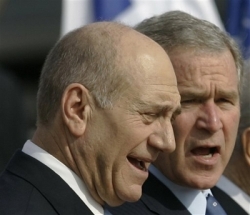
The Israeli Prime Minister, Ehud Olmert, declared last night that Israel reserved the right to expand existing Jewish settlements in Arab East Jerusalem and in parts of the West Bank that it hopes to retain in any final peace deal.

bush-olmert.jpgIn terms which appeared to defy earlier sharp criticism by the US Secretary of State, Condoleezza Rice, Mr Olmert made it clear in front of President George Bush that he regarded such expansion as outside the “moratorium” he has promised on new settlement building. His declaration came as the US President, on his first visit in office to Israel, used some of his strongest language yet in demanding the dismantling of separate settlement outposts which are illegal even under Israeli law. Mr Bush said at a joint news conference last night: “We have been talking about it for four years – illegal outposts. They ought to go.”

Mr Olmert did not demur from that and repeatedly emphasised that Israel was very serious about advancing a negotiating process over the coming year. Mr Bush said the resumption of formal negotiations between Mr Olmert and the Palestinian President, Mahmoud Abbas, presented a historic moment, a historic opportunity. [complete article]

Gaffe overshadows Bush visit

“You’ll be happy to know, my whole motorcade of a mere 45 cars was able to make it through without being stopped,” Bush said after being asked about the 30-minute journey from Jerusalem and Ramallah.

“I’m not so exactly sure that’s what happens to the average person.”

Bush was forced to travel by car to meet Mahmoud Abbas, the Palestinian president, in the West Bank after his helicopter was grounded by bad weather.

The journey took him through an Israeli security checkpoint and within sight of the separation barrier.

Bush said that he could understand why Palestinians were “frustrated” by the checkpoints, but they were necessary to “create a sense of security for Israel”. [complete article]

Editor’s Comment — If Americans had to live under the same kind of stranglehold as do Palestinians in the West Bank, there would be more than 800,000 roadblocks across this country. To speak of “frustration” wouldn’t even hint at the level of anger ordinary people would feel at this extraordinary curtailment of freedom.

For Bush to joke about not getting stopped at an Israeli checkpoint shows a staggering degree of insensitivity — though it will hardly surprise or shock the average Palestinian.

Ramallah demo brands Bush ‘war criminal’

Angry demonstrators in the West Bank town of Ramallah branded US President George W. Bush a “war criminal” on Thursday as locals said he would do nothing for the plight of the Palestinians.

Security forces, out in force to ensure the security of the American leader on his first trip to the occupied Palestinian territory, used batons and tear gas as they charged around 200 demonstrators who were chanting “Bush, war criminal!” and “Bush out!”.

While their leader Mahmud Abbas gave Bush a red carpet welcome on the second day of his Middle East tour, ordinary Palestinians were dismisssive. [complete article]

Bush predicts Mideast peace treaty before he leaves White House

President Bush today predicted that a Mideast peace treaty would be completed by the time he leaves office, but undercut that optimism with harsh criticism of Hamas militants who control part of the land that could form an eventual independent Palestine.

Bush said he’s convinced that both Israeli and Palestinian leaders understand “the importance of democratic states living side by side” in peace, and noted that he has a one-year deadline for progress on his watch. He named Lt. Gen. William Fraser III, assistant to the Chairman of the Joint Chiefs of Staff, to monitor steps that both sides are making on the peace process, a U.S. official told The Associated Press. [complete article]

See also, From Palestinians, harsh view of Bush (NYT).

Facebooktwittermail

OPINION & EDITOR’S COMMENT: If the GWOT were gone

The $100 barrel of oil vs. the Global War on Terror

Opinion polls indicate that, in this electoral season, terrorism is no longer at, or even near, the top of the American agenda of worries. Right now, it tends to fall far down lists of “the most important issue to face this country” (though significantly higher among Republicans than Democrats or independents). Nonetheless, don’t for a second think that the subject isn’t lodged deep in national consciousness. When asked recently by the pollsters of CNN/Opinion Research Corporation: “How worried are you that you or someone in your family will become a victim of terrorism,” a striking 39% of Americans were either “very worried” or “somewhat worried”; another 33% registered as “not too worried.” These figures might seem reasonable in New York City, but nationally? As the Democratic debate Saturday indicated, the politics of security and fear have been deeply implanted in our midst, as well as in media and political consciousness. Even candidates who proclaim themselves against “the politics of fear” (and many don’t) are repeatedly forced to take care of fear’s rhetorical business.

Imagining how a new president and a new administration might begin to make their way out of this mindset, out of a preoccupation guaranteed to solve no problems and exacerbate many, is almost as hard as imagining a world without al-Qaeda. After all, this particular obsession has been built into our institutions, from Guantanamo to the Department of Homeland Security. It’s had the time to sink its roots into fertile soil; it now has its own industries, lobbying groups, profit centers. Unbuilding it will be a formidable task indeed. Here, then — a year early — is a Bush legacy that no new president is likely to reverse soon.

Ask yourself honestly: Can you imagine a future America without a Department of Homeland Security? Can you imagine a new administration ending the global lockdown that has become synonymous with Americanism?

The Bush administration will go, but the job it’s done on us won’t. That is the sad truth of our presidential campaign moment. [complete article]

Editor’s Comment — That we acquire “the wisdom of insecurity” is one of our needs in these times. In the current populist rhetoric, fear is being contrasted with hope. But along with hope we also need courage. To be courageous is to take risks and see the limits of security. Whether the Bush legacy is so entrenched that it cannot be reversed by the next president will have a great deal to do with who puts the next president into office. This is what makes this election in so many ways, a generational watershed. The young see in risk, opportunity, while for the older generation, there, lurks danger. Yet like it or not, the older generation eventually has no choice but to resign itself to the fact that those it deems too inexperienced will necessarily be the ones who shape the future.

Why we both love and hate America

Immediately after the 9/11 attacks against the United States, President George W. Bush and many other perplexed, angry and often ignorant Americans asked a question: “Why do they hate us?” Then they made a statement: “You’re either with us or against us.” This week, those Americans who are actually interested in answering the question and exploring the validity of the statement have a very good opportunity to grasp precisely why most people around the world admire the US but also detest many aspects of its foreign policy. This revelatory moment comprises two simultaneous events this week: the competitive American party primaries, and Bush’s journey to the Middle East. The contrast between the two events is substantial, and very revealing of the best and worst of American political culture. [complete article]

Facebooktwittermail

NEWS, ANALYSIS, OPINION & EDITOR’S COMMENT: Bush’s trip notes

Bush’s last throw against Iran

The leitmotif of Bush’s high-profile tour of the Middle East is unmistakably Iran. But Washington’s Iran policy lies in tatters and it has no choice but to ratchet up anti-Iran rhetoric, though it realizes there are no takers in the Middle East for such rhetoric of fire and brimstone. The danger now is that Tehran may choose to hunker down and prefer to deal with the next US administration.

Tehran once heeded back-channel pleas from Ronald Reagan’s campaign managers not to negotiate the hostage crisis with the Carter administration in its final months in the White House so that Reagan could claim the credit for the denouement. Bush is certainly better placed than Carter insofar as presidential hopefuls such as Barack Obama and Mike Huckabee would never do such a Reaganite thing on him.

Actually, the danger to the Bush legacy comes from faraway places. Continued delay in constructively engaging Iran will only open the gateway wider for the international community to encroach into a region that until four years ago used to be the exclusive strategic preserve of the US. China is already wading deep into the region, and Russia too. The S-300 missiles from Russia are a sign that US dominance of the Middle East is in serious jeopardy. [complete article]

See also, Bush calls Iran ‘threat to world peace’ (CNN).

Israeli leaders greet Bush with warning for Iran

President Bush began an eight-day Middle East peace mission Wednesday as Israeli leaders warned him and the world not to forget about the regional threat that Iran poses.

Standing on the airport tarmac with Bush looking on shortly after his arrival, Israeli President Shimon Peres relegated peace talks with the Palestinians to secondary status and issued a warning to Iran.

“We take your advice not to underestimate the Iranian threat,” Peres said.

“Iran should not underestimate our resolve for self-defense.” [complete article]

Talking to Iran?

Shortly before Christmas, over dinner in his palace, one of the ruling sheiks of the United Arab Emirates told this reporter he had not been at all surprised by the release of the National Intelligence Estimate that said Iran had suspended its nuclear weapons program back in 2003.

“We were warned by Rafsanjani to expect a very big, very surprising announcement out of Washington,” the sheik said. “He knew it was coming.”

Akbar Hashemi Rafsanjani, former president of Iran and chairman of the country’s Assembly of Experts, also chairs the special council that mediates between the ayatollahs and the Parliament whenever there is a dispute. Derisively nicknamed “Akbar Shah” by his enemies, he is also the head of what is widely reckoned to be Iran’s richest family. Born into a prosperous family of pistachio farmers, he is the link between the ayatollahs, politics and the business community.

Seen as something of a moderate by Iranian standards, Rafsanjani is believed in the Gulf states to have long maintained his own back channels to Washington — hence his supposed advance knowledge of the NIE. [complete article]

Editor’s Comment — As an indication of the importance of President Bush’s trip to the Middle East, his press secretary, Dana Perino, is blogging the trip — though being too diffident to use the actual term “blog”, the White House is modestly calling her record, Trip Notes. Since she’s only two days into this bold new communications venture, I should perhaps refrain from passing judgment, but I was hoping to be able to find at least one — just one — memorable line. The best I could find was this: “As we descended into Tel Aviv, many of us looked out the window to see a country that some of us have only seen in pictures.” Perino was one of the many, but was she also one of the some? I guess divulging whether she’s been to Israel before or how many of her trip mates are on a return trip would be way too personal.

In light of the focus of the current trip, Perino might want embellish her “notes” a bit and see if she can make them at least as interesting as Mahmoud Ahmadinejad’s blog. Here’s a recent entry of his:

To read or to write, that is the question!‎ 2007/11/18
In the Name of Almighty God-the All-Knowing, the Most Lovingly ‎Compassionate

Since my last post on the blog, a few months have passed. But this doesn’t ‎mean that I have not been keeping my promise of spending fifteen minutes per week ‎on it. As a matter of fact, I have spent more than the allocated time on the blog. The ‎magnitude of the reception and acclamation from the viewers was beyond ‎expectations. So I had to decide how to spend the limited time that I have allocated ‎for the blog; should I write new notes or respect those viewers who kindly and ‎generously have shared their thoughts and opinions with me and sent messages and read ‎their numerous received messages. ‎

‎***‎

As you know, the purpose of running this blog is to have a direct and mutual ‎contact and communication with the viewers and even though I have received many ‎messages from the viewers to update the blog and write new notes, I preferred to write ‎less and spend more time on reading the viewers’ messages – and not let this ‎communication tool become just a one-way medium.‎

‎***‎

I personally have read those messages that are considered to be short. I even ‎have read those messages that have started with a sentence like “I know that the ‎president is not going to read this message, but….” ‎

Also some of my trusted students have shortened the long messages for me ‎and have prepared a statistical report regarding all of the messages which I have read ‎and studied those too. God willing, a portion of the overall analysis of the messages ‎and its interesting results will be posted on the blog in the future.‎

‎***‎

I am apologetic to those who have been waiting for my new posts, but ‎fortunately overall, the analysis of the messages has got to a point that I can start ‎writing here again. ‎

I would like to use this opportunity and ask those of you who intend to send ‎me messages through blog, to make it as brief as you can. Thank you.
Written by Mahmoud Ahmadinejad at 23:24

Now if the White House really wants to push the envelope and follow Ahmadinejad’s lead, the Trip Notes from the Middle East should include at least one entry from the president and also be open to comments. On Ahmadinejad’s blog, comments are not as strictly moderated as one might expect, such as the comment from one “John Jacobs” from the United States: “I hate you. you are retarted. that simple mentally retarted.” The remarks of an irate pastry chef?

Facebooktwittermail

OPINION: Push to oust Maliki

A surge against Maliki

A new movement to oust Iraqi Prime Minister Nouri al-Maliki is gathering force in Baghdad. And although the United States is counseling against this change of government, a senior U.S. official in the Iraqi capital says it’s a moment of “breakthrough or breakdown” for Maliki’s regime.

The new push against Maliki comes from Kurdish leaders, who, U.S. and Iraqi sources told me, sent him an ultimatum in late December. “The letter was clear in saying we are concerned about the direction of policies in Baghdad,” said a senior Kurdish official. He described the Dec. 21 letter as “a sincere effort from the Kurdish parties to help the government reform — or else.”

The Kurds are upset that Maliki hasn’t delivered on promises they say he made to them last summer, when he was trying to stave off an earlier attempted putsch. Maliki pledged then that his government would pass an oil law and a regional-powers law, and that it would conduct a referendum on the future of Kirkuk. None of these promises has been fulfilled, and the Kurds are angry.

The strongest anti-Maliki voice is Massoud Barzani, the dominant political leader in Kurdistan. Barzani agreed to back Maliki last summer after a personal telephone call from President Bush. Now, fuming about Turkish attacks across the border last month and the delay on Kirkuk, Barzani is on the warpath. [complete article]

Facebooktwittermail

NEWS: Diyala attack too big to be secret

U.S. attack in Iraq is no surprise to many insurgents

With extraordinary secrecy, and even an information blackout aimed at most of their Iraqi Army comrades, American troops began a major offensive on Tuesday to drive Sunni insurgents from strongholds in Diyala Province. But many insurgents still managed to flee the first villages the Americans went into, showing just how difficult it is to trap the elusive militants.

Because at least half the insurgents escaped before an offensive last June, American planners deliberately kept most Iraqi units in the dark before this one, a tactic that suggests they cannot fully trust the allies who are supposed to pick up more of the fighting as American troops scale back their presence this year.

The militants may have been tipped by leaks or by the visible movements of troops and machinery that precede any operation. [complete article]

Facebooktwittermail

NEWS: With fewer threats from U.S., Ahmadinejad gets weaker

Ahmadinejad’s defender keeps his distance

A rift is emerging between President Mahmoud Ahmadinejad and Iran’s supreme religious leader, Ayatollah Ali Khamenei, suggesting that the president no longer enjoys the ayatollah’s full backing, as he did in the years after his election in 2005.

In the past, when Mr. Ahmadinejad was attacked by his political opponents, criticisms were usually silenced by Ayatollah Khamenei, who has the final word on state matters and regularly endorsed the president in public speeches. But that public support has been conspicuously absent in recent months.

There are numerous possible reasons for Mr. Ahmadinejad’s loss of support, but analysts here all point to one overriding factor: the United States National Intelligence Estimate last month, which said Iran had suspended its nuclear weapons program in 2003 in response to international pressure. The intelligence estimate sharply reduced the threat of a military strike against Iran, allowing the Iranian authorities to focus on domestic issues, with important parliamentary elections looming in March.

“Now that Iran is not under the threat of a military attack, all contradictions within the establishment are surfacing,” said Saeed Leylaz, an economic and political analyst. “The biggest mistake that Americans have constantly made toward Iran was adopting radical approaches which provided the ground for radicals in the country to take control.” [complete article]

Facebooktwittermail

NEWS & OPINION: The American-Iranian communication gap

Dire straits

Just what were the Iranians up to Sunday, when five small Iranian gunboats reportedly came within a couple hundred yards of three U.S. Navy vessels, dropping “box-like objects” (naval mines?) in their path, while threatening messages were transmitted over the radio?

Was it a rogue operation? Were the Iranians seeking to undermine President Bush’s upcoming trip to the region? Testing U.S. reactions? Preparing for a future attack? Vice Adm. Kevin Cosgriff, commander of the U.S. Naval Forces Central Command, couldn’t say when briefing reporters yesterday, because the Navy honestly doesn’t know.

The 30-minute incident was far from the most serious altercation between U.S. and Iran in recent history. But, as long as there’s no dialogue between the two countries, even innocuous interactions can quickly become dangerous. [complete article]

Iranian boats press US ships

In a conference call with Pentagon reporters, Vice Admiral Kevin Cosgriff, commander of the US Fifth Fleet, said the transmissions were to the effect that the “US ships would explode” – sparking fears of a repeat of the suicide bombing of the USS Cole off the coast of Yemen in 2000 that killed 17 US sailors.

But Roughead said it was unclear whether the radio warning came from Iranian vessels or from shore along the Straits of Hormuz, a narrow, 34-mile opening into the Persian Gulf, through which an estimated 40 percent of the world’s oil supply is shipped. Sunday’s incident occurred at 8 a.m. local time when the three American vessels were entering the Persian Gulf through the straits.

“In that part of the Gulf, who was saying what [is] sometimes very difficult to determine,” Roughead said. [complete article]

See also, Bush assails Iran for naval confrontation (NYT).

Facebooktwittermail