NEWS & ANALYSIS: Busharraf

Pakistanis growing frustrated with U.S.

Inside call centers and in high school social studies classes, at vegetable markets and in book bazaars, Pakistanis from different walks of life here say that ever since President Pervez Musharraf imposed emergency rule two weeks ago, he’s been the most unpopular figure in the country. But running a close second, many say, is his ally: President Bush.

“We used to love America. Give me Tom Cruise and a vacation in Florida any day,” said Parveen Aslam, 30, who like many Pakistanis has relatives in the United States. “But why isn’t the U.S. standing up for Pakistan when we need it most? Is America even listening to us? We are calling them Busharraf now. They are the same man.”

While many Pakistanis lament that the Bush administration is involved in their country’s politics, they also see the United States as the only force strong enough to do what they say is necessary to temper the crisis: pressure the military-led government to restore the constitution, release thousands of political prisoners and lift restrictions on the news media. [complete article]

Militants gain despite decree by Musharraf

Gen. Pervez Musharraf, the Pakistani president, says he instituted emergency rule for the extra powers it would give him to push back the militants who have carved out a mini-state in Pakistan’s tribal areas.

But in the last several days, the militants have extended their reach, capturing more territory in Pakistan’s settled areas and chasing away frightened policemen, local government officials said.

As inconspicuous as it might be in a nation of 160 million people, the takeover of the small Alpuri district headquarters this week was considered a particular embarrassment for General Musharraf. It showed how the militants could still thumb their noses at the Pakistani Army.

In fact, local officials and Western diplomats said, there is little evidence that the 12-day-old emergency decree has increased the government’s leverage in fighting the militants, or that General Musharraf has used the decree to take any extraordinary steps to combat them. [complete article]

Benazir vs. Musharraf is Punch vs. Judy

Musharraf didn’t declare emergency rule because he feared Bhutto’s challenge; he declared emergency rule because the Supreme Court was about to rule that he was not, in fact, legitimately the president of Pakistan, because he violated the constitution by standing for the presidency while in command of the military. And the reason Bhutto appeared to hesitate when it happened was obvious: She has as much to fear from the independent judiciary in Pakistan as Musharraf does. The same judges threatening to strip Musharraf of the presidency had also warned that the amnesty extended by him to Bhutto — absolving her of numerous corruption charges — was also illegal. (And, for good measure, the same judges had also ruled that Nawaz Sharif’s expulsion was illegal.) The last thing Bhutto needs is the rule of law and an independent judiciary in Pakistan, for that would pull the rug out from her deal with Musharraf, put her back in court, and bring her fiercest political rival back into the picture at a moment when she is increasingly vulnerable, politically, by virtue of her alliance with the U.S.

House arrest, if anything, gives Benazir political cover for avoiding the streets. Better for Bhutto to sit out whatever turmoil will come in the weeks ahead, cultivating an image of martyrdom ahead of the elections that Musharraf promises for January (although a Musharraf promise and a dollar will buy you a cup of chai at Pak Punjab on Houston Street). Remember, Bhutto’s party may be the largest single party in Pakistan, but its ceiling is about 30% of the vote. If the Washington-brokered deal is to work, Musharraf, too, needs Bhutto’s popularity to be boosted.

Proxies always have independent agendas; if they didn’t, well, they wouldn’t be proxies. So, the U.S. struggles to get Musharraf to do its bidding — because he has a far keener sense of the requirements of his own survival in a dangerous part of the world, and also of Pakistan’s strategic interests, than do his U.S. interlocutors. And Musharraf struggles to control the Taliban in the same way. The Taliban, remember, was literally created by Pakistan’s Inter Service Intelligence in the early 1990s, as a proxy force to take charge in Afghanistan and end the chaos there by establishing a monopoly of force in the hands of a Pakistan ally. This was a continuation of the U.S.-Saudi-Pakistan policy in the 1980s of using Pakistan as a sanctuary from which to train and recruit jihadis to fight the Soviets in Afghanistan, and also of Pakistan’s pursuit of its own interest to counter the power in Afghanistan of warlords allied with its key regional rivals, India and Iran — i.e. the forces grouped in the Northern Alliance. [complete article]

Students hand Khan to police

Iran Khan, one of the last remaining independent political voices at liberty in Pakistan, was attacked by hardline Islamic students yesterday and handed over to police.

With the former prime minister Benazir Bhutto under house arrest and thousands of activists and lawyers in prison, the only political force left free in the country is the religious Right. General Pervez Musharraf’s regime has not moved concertedly against the mullahs, who have always been close to the army.

Mr Khan made his first public appearance yesterday since going into hiding when the emergency was declared on 3 November. Police had sealed off all entrances to Punjab University in Lahore, where he had announced that he would address students.

Somehow he made it through the cordon, appearing suddenly just after midday, where hundreds of students had gathered, chanting slogans against the regime. He was immediately hoisted on to people’s shoulders, raising his fist in the air, amid scenes of jubilation.

But events turned nasty very quickly as the “beards” – students belonging to the feared Islami Jamiat Talba – moved in. The crowd was pushed towards a nearby building. Mr Khan was bundled inside and the gates were locked. Some claimed that he was punched repeatedly. The entrance was guarded by Jamiat students. [complete article]

See also, Imran Khan’s kin, party workers arrested (Zee News) and Musharraf swears in caretaker government (AP).


Facebooktwittermail

NEWS & ANALYSIS: Iran’s nuclear progress report

U.S. dismisses nuclear report on Iran

The much-anticipated report on Iran by the head of International Atomic Energy Agency (IAEA) that was released this week confirms “substantial progress” in Iran’s cooperation with the agency and the steady resolution of disputed issues and, yet, the US government has reacted swiftly by belittling Iran’s cooperation and maintaining its aggressive push for a new round of United Nations sanctions on Iran.

By arguing that “selective cooperation is not enough”, to paraphrase the US’s envoy to the IAEA, Gregory Schulte, the US now hopes that the report’s other finding, that Iran has not suspended the enrichment-related activities as demanded by the UN, will suffice to persuade the other permanent members of the UN Security Council, chiefly Russia and China, to endorse tougher Iran sanctions.

But, this may not be so easy in light of the depth and scope of Iran’s genuine cooperation, the IAEA’s confirmation of consistency of new Iranian information with their own independent investigations, and the sheer absence of any evidence of nuclear weapons proliferation in Iran. [complete article]

U.N. debate looms over Iran sanctions

A report by the U.N.’s atomic watchdog agency released Thursday sets the stage for renewed debate in the Security Council over whether Iran should face tougher sanctions because of its nuclear program.

The United States, France and Britain said the report shows that Iran’s nuclear technology was advancing while the agency’s knowledge and oversight of it was diminishing. And the three pushed for more penalties against Tehran.

China and Russia, however, argued that harsher sanctions would derail what the agency called Iran’s “substantial progress” on answering questions about its nuclear past. [complete article]

Iran nuke in “18 months”? Unlikely

For the better part of a year, the New York Times has been screaming bloody murder about Iran’s nuclear program – specifically, about the Ayatollahs’ nerds putting a few thousands centrifuges into action. The latest cause for panic: a new report from the International Atomic Energy Agency, which “confirmed for the first time that Iran has now crossed the major milestone of putting 3,000 centrifuges into operation, a tenfold increase from just a year ago. In theory, that means that Iran could produce enough uranium to make a nuclear weapon within a year to 18 months.”

Yeah, in theory.

But the thing is, it’s hard to run those centrifuges non-stop. [complete article]

Israel braces for Iran bomb despite vow to prevent

Israel is quietly preparing for the possibility of a nuclear-armed Iran despite public pledges to deny its arch-foe the means to pose an “existential threat”, Israeli political and defence sources said on Thursday.

They said Prime Minister Ehud Olmert has instructed cabinet officials to draft proposals on how Israel, whose security strategy is widely assumed to hinge on having the Middle East’s only atomic arsenal, might deal with losing this monopoly. [complete article]

Facebooktwittermail

NEWS: Al-Qaeda cell tried to assassinate Nasrallah

Report: Al-Qaeda planned hit on Hizbullah chief

An al-Qaeda cell tried to assassinate Hizbullah Secretary-General Sheikh Hassan Nasrallah last summer, the Lebanese, Arab-language newspaper As-Safir reported Thursday.

According to the report, the Lebanese security services are currently conducting a vast investigation into al-Qaeda’s activities in Lebanon. Several al-Qaeda cell members have been arrested, and have admitted – among other things – to firing Katyusha rockets at Israel on several occasions.

The cells are also investigated in connection with a conspiracy to attack UNIFIL forces in southern Lebanon. The attack, which failed to materialize, was meant to look link the Hizbullah’s handiwork, deterioration further the fragile relations between the two.

Lebanese security services, said As-Safir, have uncovered three al-Qaeda cells operating in southern Lebanon. Search and seizure operation in the region further uncovered some 150 pounds of cyanide and other chemicals used to make explosive devices; several hundred pounds of explosive, said the report, have already been shipped back to Iraq. [complete article]

Facebooktwittermail

OPINION: A candidate for the world

Obama in orbit

Little that is certain can be said about the U.S. election a year from now, but one certainty is this: about 6.3 billion people will not be voting even if they will be affected by the outcome.

That’s the approximate world population outside the United States. If nothing else, President Bush has reminded them that it’s hard to get out of the way of U.S. power. The wielding of it, as in Iraq, has whirlwind effects. The withholding of it, as on the environment, has a huge impact.

No wonder the view is increasingly heard that everyone merits a ballot on Nov. 4, 2008.

That won’t happen, of course. Even the most open-armed multilateralist is not ready for hanging chads in Chad. But the broader point of the give-us-a-vote itch must be taken: the global community is ever more linked. American exceptionalism, as practiced by Bush, has created a longing for new American engagement.

Renewal is about policy; it’s also about symbolism. Which brings us to Barack Hussein Obama, the Democratic candidate with a Kenyan father, a Kansan mother, an Indonesian stepfather, a childhood in Hawaii and Indonesia and impressionable experience of the Muslim world.

If the globe can’t vote next November, it can find itself in Obama. Troubled by the violent chasm between the West and the Islamic world? Obama seems to bridge it. Disturbed by the gulf between rich and poor that globalization spurs? Obama, the African-American, gets it: the South Side of Chicago is the South Side of the world. [complete article]

Facebooktwittermail

NEWS, ANALYSIS & OPINION: America’s hidden war toll; Muslims Scholars Assn. shut down; strategic drift

America suffers an epidemic of suicides among traumatised army veterans

More American military veterans have been committing suicide than US soldiers have been dying in Iraq, it was claimed yesterday.

At least 6,256 US veterans took their lives in 2005, at an average of 17 a day, according to figures broadcast last night. Former servicemen are more than twice as likely than the rest of the population to commit suicide.

Such statistics compare to the total of 3,863 American military deaths in Iraq since the invasion in 2003 – an average of 2.4 a day, according to the website ICasualties.org.

The rate of suicides among veterans prompted claims that the US was suffering from a “mental health epidemic” – often linked to post-traumatic stress. [complete article]

Hard-line Iraqi clerics group shut down

A government-sponsored Sunni religious foundation Wednesday closed the main office of the influential Muslim Scholars Assn., a group of Sunni clerics suspected of ties to insurgents.

The clerics’ group, most of whose senior leaders left the country in the last year, protested the move in what amounted to the latest example of the split among Sunni Arabs between those aligned with and opposed to U.S. forces. [complete article]

Shiite politics in Iraq: The role of the Supreme Council

Often misidentified in Western media as “the largest Shiite party” in Iraq, SCIRI – the Supreme Council for the Islamic Revolution in Iraq (Al-Majlis al-‘Aala li al-Thawra al-Islamiya fi-l-Iraq) – is certainly one of the most powerful. Its defining characteristics are a strong organisation, whose leadership hails from one of Najaf’s leading families, the Hakims; a surprising political pragmatism in light of profound sectarian inclinations; and a somewhat incongruous dual alliance with the U.S. and Iran. Since its founding a quarter century ago, it has followed a trajectory from Iranian proxy militia to Iraqi governing party, whose leader, Abd-al-Aziz al-Hakim, has been courted and feted by the Bush White House. Today, it is engaged in a fierce competition with its main Shiite rival, the movement led by Muqtada al-Sadr, which may well determine Iraq’s future. To help shape the party into a more responsible actor, the U.S. should stop using it as a privileged instrument in its fight against the Sadrists but press it to cut ties with its more sectarian elements and practices. [complete article]

Strategic drift

With apparent disregard for the opinion of the American people, the debate over whether the large U.S. military presence in Iraq threatens our national security has been put on hold. Both political parties seem resigned to allowing the Bush administration to run out the clock on its Iraq strategy and bequeath this quagmire to the next president. The result is best described as strategic drift, and stopping it won’t be easy.

President Bush claims that his strategy is having some success, but toward what end? He argued that the surge would provide the political breathing space needed to achieve a unified, peaceful Iraq. But its successes, which Bush says come from a reduction of casualties in certain areas, have been accompanied by massive sectarian cleansing. The surge has not moved us closer to national reconciliation. [complete article]

U.S. links drop in Iraq attacks to Iran

Iran appears to be honoring an informal pledge to try to halt the smuggling of explosives and other weapons into Iraq, contributing to a decline in bombings by more than half since March, a senior U.S. general told reporters Thursday.

“We have not seen any recent evidence that weapons continue to come across the border into Iraq,” Maj. Gen. James Simmons said. [complete article]

Facebooktwittermail

NEWS, ANALYSIS & OPINION: The road from Washington to Karachi to nuclear anarchy

Are you with us… or against us?

The journey to the martial law just imposed on Pakistan by its self-appointed president, the dictator Pervez Musharraf, began in Washington on September 11, 2001. On that day, it so happened, Pakistan’s intelligence chief, Lt. General Mahmood Ahmed, was in town. He was summoned forthwith to meet with Deputy Secretary of State Richard Armitage, who gave him perhaps the earliest preview of the global Bush doctrine then in its formative stages, telling him, “You are either one hundred percent with us or one hundred percent against us.”

The next day, the administration, dictating to the dictator, presented seven demands that a Pakistan that wished to be “with us” must meet. These concentrated on gaining its cooperation in assailing Afghanistan’s Taliban regime, which had long been nurtured by the Pakistani intelligence services in Afghanistan and had, of course, harbored Osama Bin Laden and his al-Qaeda training camps. Conspicuously missing was any requirement to rein in the activities of Mr. A.Q. Khan, the “father” of Pakistan’s nuclear arms, who, with the knowledge of Washington, had been clandestinely hawking the country’s nuclear-bomb technology around the Middle East and North Asia for some years. [complete article]

U.S. is looking past Musharraf in case he falls

Almost two weeks into Pakistan’s political crisis, Bush administration officials are losing faith that the Pakistani president, Gen. Pervez Musharraf, can survive in office and have begun discussing what might come next, according to senior administration officials.

In meetings on Wednesday, officials at the White House, State Department and the Pentagon huddled to decide what message Deputy Secretary of State John D. Negroponte would deliver to General Musharraf — and perhaps more important, to Pakistan’s generals — when he arrives in Islamabad on Friday.

Administration officials say they still hope that Mr. Negroponte can salvage the fractured arranged marriage between General Musharraf and former Prime Minister Benazir Bhutto. But in Pakistan, foreign diplomats and aides to both leaders said the chances of a deal between the leaders were evaporating 11 days after General Musharraf declared de facto martial law. [complete article]

Musharraf foe is detained in Pakistan

The opposition politician Imran Khan emerged from hiding today to the cheers of hundreds of students at a protest demonstration against Pakistan’s president, Gen. Pervez Musharraf, at a university here and was quickly seized by hard-line students and turned over to the police, witnesses said.

In another development, Benazir Bhutto has started to rally opposition parties into a coordinated movement against General Musharraf, her party spokeswoman, Sherry Rehman, said in an interview today.

Ms. Bhutto, a former prime minister who has been placed under house arrest in Lahore, has contacted the main opposition parties and has received a favorable response, Ms. Rehman said. ”She wants a one-point agenda — the restoration of democracy,” Ms. Rehman said. [complete article]

For Musharraf, quitting army may end support

On any given day during the last eight years, President Pervez Musharraf was most likely to be found not at the ornate presidential compound in the capital, but here in this garrison city: at his desk at army headquarters, clad in familiar camouflage fatigues, greeted everywhere with the crisp salutes and studied deference accorded a four-star general.

Now, a farewell to arms appears inevitable, if not imminent.

Under a timetable he pledged to before he put his country under de facto martial law, the general was supposed to have stepped down as military chief today, before being sworn in for a new presidential term. Despite enormous domestic and international pressure, Musharraf will almost certainly not do so. [complete article]

Facebooktwittermail

OPINION: The astronomical and unconscionable costs of the Iraq war

The (White) House of Shame

It’s been three years since President George W. Bush experienced what he called his “accountability moment,” i.e., his re-election. And it’s a year now since American voters sent a Democratic majority to the House and Senate on the delusional assumption they’d hold this administration responsible for what it’s done to the United States and the world. We know how that hasn’t happened.

So why would the folks in the Bush White House be the least bit perturbed by publicity about the mind-boggling long-term costs of the war in Iraq that they rushed to wage? I don’t think they are, and I wouldn’t expect them to be. This is an administration that admits no guilt and knows no shame, and in that it is a perfect reflection of what America and Americans look like to the rest of the world. [complete article]

Facebooktwittermail

NEWS & EDITOR’S COMMENT: Not a counterintelligence case?

How big a role did disgraced CIA officer have?

There’s new information about the young Lebanese woman who pleaded guilty Tuesday to charges she lied about her background to get jobs at the Federal Bureau of Investigation and Central Intelligence Agency.

Current and former intelligence officials tell NBC News that Nada Nadim Prouty had a much bigger role than officials at the FBI and CIA first acknowledged. In fact, Prouty was assigned to the CIA’s most sensitive post, Baghdad, and participated in the debriefings of high-ranking al-Qaida detainees.

A former colleague called Prouty “among the best and the brightest” CIA officers in Baghdad. She was so exceptional, agree officials of both agencies, the CIA recruited her from the FBI to work for the agency’s clandestine service at Langley, Va., in June 2003. She then went to Iraq for the agency to work with the U.S. military on the debriefings. [complete article]

Editor’s Comment — Sometimes the press can’t resist jumping on a narrative that seems irresistable even if it might not be true. If this is really a tale of intelligence intrigue on a par with the best ones from the Cold War, how come Nada Nadim Prouty is merely facing charges of violating immigration laws and making unauthorized computer searches? No doubt there are and should be strict regulations preventing government officials accessing classified records for personal reasons, but the Hezbollah angle on this story sounds utterly contrived. Somehow, I don’t imagine that Prouty truly stands out as a disgraced CIA officer if the main thing she is guilty of is using the privileges provided by her position just to look for information about her own relatives.

Facebooktwittermail

NEWS, ANALYSIS & OPINION: The problem with militias

U.S. forces accused of shooting Sunni allies

Members of a Sunni Muslim group that was formed with American backing to fight Sunni militants charged Wednesday that a lengthy U.S. air and ground attack killed at least seven of its fighters.

Mansour abd Salem, one of the leaders of the Sunni Awakening council in Taji, north of Baghdad, charged in a television interview that U.S. forces had “deliberately” killed members of the group in a “hideous” assault.

The U.S. military said that the operations targeted armed “associates of senior al Qaida in Iraq leaders,” killed 25 suspected terrorists and detained 21 suspects.

Meanwhile in Baghdad, the U.S.-backed Iraqi government seized the offices and shut down the radio station of the Association of Muslim Scholars, a major Sunni group that’s voiced support for al Qaida. In a television interview, the group’s leader, Sheik Harith al Thari, who’s now in Jordan, once said that, “We are from al Qaida and al Qaida are from us.” [complete article]

The problem with militias

Everywhere you go in Iraq, there’s victory. The commander of U.S. forces in Baghdad, Maj. Gen. Joseph Fil, told reporters last Wednesday that he had wiped al-Qaeda in Iraq out of the city. Stability in Iraq is “within sight, but not yet within touch,” he said. And while categorical statements about progress have come back to haunt U.S. officials, commanders are evincing more certainty about the possibilities of success than they would ever have dared prior to Gen. David Petraeus’ September testimony. Prime Minister Nouri al-Maliki has gone even further, proclaiming “victory against terrorist groups and militias.” It’s pretty bewildering, even for those who’ve seen some recent reasons for cautious optimism.

Perhaps the only voice of caution over the last two weeks has been Ambassador Ryan Crocker. When last Crocker drew attention, it was during his shared testimony with Petraeus, in which he showed a surprising eagerness to lie about the pace with which sectarian reconciliation had advanced. These days, he’s warning of a looming danger — militias taking over the mechanics of running Iraq. Using the military’s acronym for Moqtada al-Sadr’s Mahdi Army, Crocker recently mused, “We have seen JAM Militant transform into JAM Incorporated. They may not be shooting at us or Iraqi soldiers, but [they are] controlling gas stations, real estate, trade and services. … That is a major challenge to the state.”

Right Crocker is. But if he recognized how his observation undermined his colleagues’ declarations of victory, he didn’t show it. Consider the case of the newest militias on the block — the so-called Concerned Local Citizens, a mostly Sunni collection of ex-insurgents and rejections that’s responsible for much of the spring in the steps of U.S. officials. The CLCs represent the U.S.’ first attempt at actually creating Iraqi militias, and U.S. officials are enthusiastic about the effort. Few seem to have noticed that everything Crocker says about the “major challenge” posed by the militias applies to U.S.-friendly militias as much as it does to U.S.-opposed militias. And yet, these new militias are, in large part, the basis for the success that U.S. and Iraqi officials are claiming. [complete article]

Muqtada moves to stop a Sunni ‘surge’

The world is seemingly too busy these days to mind the day-to-day news coming out of Iraq – much to the pleasure of Prime Minister Nuri al-Maliki. With the spotlight off him, Maliki gave an interview to the Saudi television channel al-Arabiyya, in which he asserted that “There is no civil war in Iraq.” He added, “We don’t have a militia problem in Iraq anymore.” He wrapped up by noting that Iran does not have a decision-making influence on the Prime Minister’s Office in Baghdad.

Maliki knew that he was, to put it politely, not telling the truth. In addition to spreading false public relations about his administration’s effectiveness in combating terrorism, the Iraqi premier was also doing something very important. He was reconciling with the Mahdi Army of Muqtada al-Sadr. Or at least, he was trying to find common ground with his former allies, recently turned enemies. Muqtada quit the government this year.

This week, Muqtada called for a renewal of his truce with both American forces and those of the Iraqi government. It is a gesture of goodwill towards Maliki. Another six months of peace and quiet from the Mahdi Army, giving the prime minister more room to concentrate on other pressing issues, like the looming war between Turkey and Kurdish rebels in northern Iraq. [complete article]

F.B.I. says guards killed 14 Iraqis without cause

Federal agents investigating the Sept. 16 episode in which Blackwater security personnel shot and killed 17 Iraqi civilians have found that at least 14 of the shootings were unjustified and violated deadly-force rules in effect for security contractors in Iraq, according to civilian and military officials briefed on the case.

The F.B.I. investigation into the shootings in Baghdad is still under way, but the findings, which indicate that the company’s employees recklessly used lethal force, are already under review by the Justice Department.

Prosecutors have yet to decide whether to seek indictments, and some officials have expressed pessimism that adequate criminal laws exist to enable them to charge any Blackwater employee with criminal wrongdoing. Spokesmen for the Justice Department and the F.B.I. declined to discuss the matter. [complete article]

Iraqis wasting an opportunity, U.S. officers say

Senior military commanders here now portray the intransigence of Iraq’s Shiite-dominated government as the key threat facing the U.S. effort in Iraq, rather than al-Qaeda terrorists, Sunni insurgents or Iranian-backed militias.

In more than a dozen interviews, U.S. military officials expressed growing concern over the Iraqi government’s failure to capitalize on sharp declines in attacks against U.S. troops and Iraqi civilians. A window of opportunity has opened for the government to reach out to its former foes, said Army Lt. Gen. Raymond T. Odierno, the commander of day-to-day U.S. military operations in Iraq, but “it’s unclear how long that window is going to be open.” [complete article]

Facebooktwittermail

NEWS: Iran’s internal divisions widen

Former Iran negotiator charged with spying for UK

Iran’s former chief nuclear negotiator, Hossein Mousavian, has been charged with passing classified information to the British embassy, the Iranian intelligence minister has revealed.

The decision to make the charges public could be a further sign that the radical Iranian President, Mahmoud Ahmadinejad, is consolidating his hold over the country’s nuclear policy. A deepening split has become apparent within the normally secretive leadership, which is facing increased international pressure to halt its uranium enrichment programme.

Ayatollah Ali Khamenei, the country’s supreme leader, remains in charge of nuclear policy but Mr Ahmadinejad appears to be increasingly influential.

The Foreign Office had no comment yesterday on the comments by the intelligence minister, Gholam Hossein Mohseni Ejehi, who told the official news agency that Mr Mousavian’s crime “from the viewpoint of the Intelligence Ministry is obvious and provable”. [complete article]

Gloves come off as Iran moderates battle Ahmadinejad

Iran’s moderates are intensifying criticism of hardline President Mahmoud Ahmadinejad, landing their first blows in a bitter political fight ahead of elections next year.

The moderate heavyweights Mohammad Khatami and Akbar Hashemi Rafsanjani have been unusually explicit in their criticism of Ahmadinejad’s economic policies and his analysis of the threat posed by the United States.

Ahmadinejad has shot back using language colourful even by his standards, warning he would expose “traitors” in the nuclear standoff and accusing critics of “being less intelligent than a goat”.

The sharp rhetoric is the upshot of concerns over the mounting international crisis over the Iranian nuclear programme and a sign of the proximity of legislative elections on March 14. [complete article]

Facebooktwittermail

OPINION: Israel prevents the two-state solution

Who wants a Jewish state

Foreign Minister Tzipi Livni has been speaking enthusiastically about “two states, two nations” ever since her conversion from the Greater Israel ideology. She can easily convince people why Israel must have a right of return only for Jews, while an independent Palestine would grant the same right only to Palestinians.

Like Prime Minister Ehud Olmert, Livni has realized belatedly that this is the only way two democratic nation states could survive. This simple, rational idea could have been implemented easily had not Israel’s leaders rejected it for generations – for 40 years the border line has been obstructed by settlement building.

Now on the eve of the Annapolis conference, Israel has suddenly come up with the absurd demand that the Palestinians recognize Israel as a Jewish state – after Israel’s own leaders have done everything in their power to sabotage it.

It is easy to speak about a Jewish state, but difficult to find the political courage required to do what it takes: Settlements scattered in the heart of the Palestinian population make it impossible to separate between Israel and Palestine along a plausible and viable border. With each passing day and each passing year, every settlement expansion, every outpost and every road built to reach it disrupt the chance to separate the two nations. [complete article]

Facebooktwittermail

NEWS: Abbas calls for overthrow of Hamas

Abbas calls for Hamas overthrow in Gaza

Palestinian President Mahmoud Abbas on Thursday called for the overthrow of Gaza’s Islamic Hamas rulers, his first explicit call that they be removed.

“We have to bring down this bunch that took over Gaza with armed force, and is abusing the sufferings and pains of our people,” Abbas said in a speech in Ramallah.

The Palestinian leader, who has set up a separate government in the West Bank, previously had not gone beyond demanding that Hamas apologize for overrunning Gaza and reverse the takeover. [complete article]

Facebooktwittermail

NEWS: The media’s role in promoting Islamophobia

Study shows ‘demonisation’ of Muslims

A “torrent” of negative stories has been revealed by a study of the portrayal of Muslims and Islam in the media, according to a report published yesterday.

Research into one week’s news coverage showed that 91% of articles in national newspapers about Muslims were negative. The London mayor, Ken Livingstone, who commissioned the study, said the findings were a “damning indictment” of the media and urged editors and programme makers to review the way they portray Muslims.

“The overall picture presented by the media is that Islam is profoundly different from and a threat to the west,” he said. “There is a scale of imbalance which no fair-minded person would think is right.” Only 4% of the 352 articles studied were positive, he said.

Livingstone said the findings showed a “hostile and scaremongering attitude” towards Islam and likened the coverage to the way the left was attacked by national newspapers in the early 1980s. “The charge is that there are virtually no positive or balanced images of Islam being portrayed,” he said. “I think there is a demonisation of Islam going on which damages community relations and creates alarm among Muslims.” [complete article]

Facebooktwittermail

NEWS: CIA taped interrogations

CIA admits to recording interrogations of top al Qaida captives

The CIA has three video and audio recordings of interrogations of senior al Qaida captives but misled federal judges about the evidence during the case against terrorist Zacarias Moussaoui, federal prosecutors revealed in a Nov. 9 court filing that was made public Tuesday.

The disclosure is unlikely to undo Moussaoui’s conviction because the agency said the material on the tapes doesn’t pertain to his case.

However, the disclosure that the government taped some interrogations of high-value detainees could invite fresh scrutiny of the CIA’s treatment of so-called “enemy combatants” who were held at secret prisons or U.S. bases overseas.

John Radsan, a former CIA assistant general counsel who teaches at the William Mitchell College of Law in St. Paul, Minn., called the revelation of the tapes “huge” news.

“So far, there has been great mystery about what was actually done to the high-value detainees,” he said. “A videotape is worth a thousand words.” [complete article]

Facebooktwittermail

FEATURE: Dowd’s split with Bush

Bush strategist looks back in sadness

Matthew Dowd knows sorrow and loss. He has been divorced twice. A daughter died two months after she was born. And then there is the added heartbreak — a word he uses — of his split with President Bush.

Dowd, 46, is one of the nation’s leading political strategists, a onetime Democrat who switched sides to help put Bush in the White House, then win a second term. He spent years shaping and promoting Bush’s policies — policies that Dowd now views with a mixture of anguish and contempt.

He began expressing his disillusionment, tentatively at first, at a UC Berkeley conference in January. Since then, he has grown more forceful.

On the administration’s response to the Sept. 11 attacks: “I asked, ‘Why aren’t we doing bonds, war bonds? Why aren’t we asking the country to do something instead of just . . . go shopping and get back on airplanes?’ ” [complete article]

Facebooktwittermail

OPINION: The West’s silence on Egypt’s assault on human rights

Behind closed doors

The justice systems in Britain and the US may not be perfect. But viewed from Egypt, the jurisprudence and transparency that attend the vast majority of trials there are very much to be envied.

In Cairo today, some 40 leading members of the Muslim Brotherhood are facing a secret military tribunal. Thirty sessions have been held so far, while all journalists, reporters and domestic or international human rights observers have been denied access. These members of the country’s most powerful political opposition – which holds about a fifth of the seats in Egypt’s parliament – stand before this tribunal despite civilian courts acquitting them four times of all charges brought by the notorious state security prosecutor, describing them as “fabricated, groundless, and politically motivated”.

They are standing before the tribunal despite a court ruling that found the president’s decision to transfer them to a military tribunal “unconstitutional”, on the basis that they are civilian opposition leaders who should be tried by civilian courts. The treatment of these representatives of the region’s largest Islamist movement, which advocates a moderate, peaceful approach, has been roundly condemned by international human rights organisations, including Amnesty International and Human Rights Watch. [complete article]

Facebooktwittermail

NEWS: LAPD ditches Muslim map plan

LAPD’s Muslim mapping plan killed

The LAPD on Wednesday abruptly scrapped a program to map the city’s Muslim population, a major retreat for a department that said the system was needed to identify potential hotbeds of extremism.

The reversal comes after a week of protests from Muslim groups and civil libertarians, who equated the mapping with religious profiling. Others questioned whether it was possible for the LAPD to accurately map the city’s far-flung Muslim community.

Los Angeles Police Department Deputy Chief Michael P. Downing said Wednesday that in the wake of the protests, officials would drop the mapping aspect of the plan but continue their efforts to reach out to the Muslim community. Downing and other police officials plan to outline the new strategy to Muslim American activists at a meeting today. [complete article]

Facebooktwittermail

EDITORIAL & ANALYSIS: Negroponte – the messenger without a message

Negroponte goes to schmooze with the indispensable General

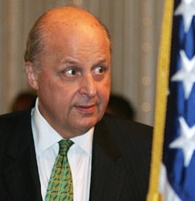
negroponte.jpgSo, Deputy Secretary of State, John Negroponte, is rushing off to Islamabad (via Africa). Having last week told Congress that the Bush administration regards General Musharraf as “indispensable,” Negroponte is now going to say what?

Several times today the New York Times has insisted on referring to Negroponte as an “envoy” even though at the White House press gaggle this morning, press secretary Dana Perino made it clear that the administration wants to dampen expectations that anything of consequence may follow from the Negroponte-Musharraf tête-à-tête:

MS. PERINO: I think that description was a little bit too strong in terms of “envoy.” Deputy Secretary Negroponte will be traveling there later in the week. I believe that’s who they were referring to [as an “envoy”].

Q But why is “envoy” too strong?

MS. PERINO: Well, he’s not going in terms of — he’s not going in a different capacity than what he is, which is the Deputy Secretary of State.

Later in the day, State Department spokesman Tom Casey was at pains to “deal with some of the other stories that were out there today that seemed to talk about some kind of special envoy or talk of him as a special envoy to Pakistan.” He was eager to impress upon those most obstinate members of the press who were still referring to him as an envoy that Negroponte is not an envoy.

Here’s where he cut to the chase after being asked whether Deputy Secretary Negroponte would be taking any special letter or any kind of message from Secretary Rice or President Bush other than to repeat what has already been said. “No, I think you’ll expect him to, again, deliver the same kind of message that we’ve already talked about publicly before. I’m not aware,” Casey said, “of him carrying any kind of special proposals or letters or things like that.”

So there we have it. Negroponte is not an envoy because he doesn’t have anything to say that hasn’t already been said before.

Will he have any time for sightseeing? Pick up any souvenirs? Maybe join in one of those festive get-togethers that all the lawyers are having.

I do have one suggestion though: He might want to consider compressing his Africa schedule by a few days. Otherwise, by the time he shows up in Islamabad, the General might be too busy to have the Deputy Secretary of State over for tea and scones.

His bridges burned, Musharraf has nowhere to turn

With pressure mounting on him at home and from abroad, the chances that General Pervez Musharraf will survive politically are looking increasingly bleak.

The prospects of a power-sharing deal with the opposition leader Benazir Bhutto that would have enabled Musharraf to cling on to power as president are diminishing rapidly. The more pressure Musharraf is applying on Bhutto, the more she is pushing back.

Today, as she was put under house arrest for the second time in five days, the opposition leader moved closer to a clean break with Musharraf.

For the first time, Bhutto called on him to resign as president altogether, adding for good measure that she could never serve in a government under him. Anyone associated with the general, she said, “gets contaminated”. [complete article]

Miscalculations

Musharraf’s miscalculations were abetted by the United States, which until recently all but ignored the political aspects of counterinsurgency in Pashtun territory. The Bush Administration, distracted by the war in Iraq, and conditioned by its long dependence on Pakistan’s Army, outsourced its Pakistan policy to Musharraf and bankrolled his narrow, increasingly self-defeating strategies. Of the approximately ten billion dollars in overt funds delivered to Pakistan since September 11th, for example, less than a hundred million has gone toward education, an issue about which Musharraf has spoken often but done very little.

The Pakistani Army’s intermittent attempts to suppress the Pashtun Islamists have failed, and these reversals have recently produced stresses within the military not witnessed since the country broke in half, in 1971: the humiliating surrender and capture of hundreds of Pakistani soldiers and local Pashtun paramilitaries, which have led to prisoner exchanges with the Taliban; reports of desertion and mutiny; and a succession of demoralizing battlefield defeats. About fifteen per cent of Pakistan’s Army officers are Pashtun, and the danger of revolt or division among them is deepening. [complete article]

See also, Musharraf’s army losing ground in insurgent areas (WP) and The answer in Pakistan (Thomas R. Pickering, Carla Hills and Morton Abramowitz).

Facebooktwittermail