NEWS & EDITOR’S COMMENT: Pinpointing what?

Photographs said to show Israeli target inside Syria

Independent experts have pinpointed what they believe to be the Euphrates River site in Syria that was bombed by Israel last month, and satellite imagery of the area shows buildings under construction roughly similar in design to a North Korean reactor capable of producing nuclear material for one bomb a year, the experts say.

Photographs of the site taken before the secret Sept. 6 airstrike depict an isolated compound that includes a tall, boxy structure similar to the type of building used to house a gas-graphite reactor. They also show what could have been a pumping station used to supply cooling water for a reactor, say experts David Albright and Paul Brannan of the Institute for Science and International Security (ISIS).

U.S. and international experts and officials familiar with the site, who were shown the photographs yesterday, said there was a strong and credible possibility that they depict the remote compound that was attacked. Israeli officials and the White House declined to comment. [complete article]

Editor’s Comment — There is now a “strong and credible possibility” that satellite photographs reveal the target of Israel’s strike on Syria. Which is to say, the photographs reveal where Israel hit — not what Israel hit.

It’s thus curious that with mantra-like repetition we keep on being told that the site in Syria resembled a “North Korea-style reactor.” No such thing exists. There is no North Korean style of nuclear reactor. All the North Koreans did was make use of the declassified design of the Magnox reactor first used in the UK at Calder Hall — it’s a design that has been publicly available for 50 years! It involves the use of unrefined uranium, there is no containment dome; gas — not water — is the coolant. The facility is housed in non-descript industrial buildings which means it’s almost impossible for satellite imagery to provide hard evidence that such buildings would have been designed to contain a reactor. Such evidence would have to be gathered by IAEA inspectors on the ground and since Syria — unlike Israel — is a signatory of the Non-Proliferation Treaty, Syria would presumably be legally required to provide inspectors access to the site. Rather than push for the evidence to be exposed, Israel preferred to destroy it.

Israel, we are being led to assume, has a greater interest in disregarding international law than in demonstrating to its allies and the rest of the world that Syria might have been engaged in developing a clandestine weapons program. Given that Israel clearly has complete contempt for world opinion, why should the world not with equal contempt dismiss Israel’s fears?


Facebooktwittermail

NEWS: Adminstration of torture

General claims Bush gave ‘marching orders’ on aggressive interrogation at Guantanamo

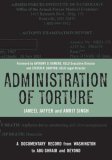
More than 100,000 pages of newly released government documents demonstrate how US military interrogators “abused, tortured or killed” scores of prisoners rounded up since Sept. 11, 2001, including some who were not even suspected of having terrorist ties, according to a just-published book.

amazon-administrationoftorture.jpgIn Administration of Torture, two American Civil Liberties Union attorneys detail the findings of a years-long investigation and court battle with the administration that resulted in the release of massive amounts of data on prisoner treatment and the deaths of US-held prisoners.

“[T]he documents show unambiguously that the administration has adopted some of the methods of the most tyrannical regimes,” write Jameel Jaffer and Amrit Singh. “Documents from Guantanamo describe prisoners shackled in excruciating ‘stress positions,’ held in freezing-cold cells, forcibly stripped, hooded, terrorized with military dogs, and deprived of human contact for months.” [complete article]

Facebooktwittermail

NEWS: Iran’s policy of nuclear ambiguity

Iran has new nuclear negotiator, but similar stance

Iran’s new chief nuclear negotiator made his international debut in Rome on Tuesday, to a chorus of unusually blunt criticism by politicians in Tehran that the departure of his predecessor was unwise.

Saeed Jalili, the negotiator, met with the European Union foreign policy chief, Javier Solana, who has been asked by the United States, Russia, China, Britain, France and Germany to find a formula to persuade Iran to suspend key nuclear activities.

Curiously, at Mr. Jalili’s side was Ali Larijani, his predecessor, who took the lead in the closed-door talks and in remarks afterward to reporters.

Mr. Solana described the talks as “constructive,” and Mr. Larijani called them “good.” But there was no movement on the one issue that matters, said participants in the meeting who spoke under normal diplomatic rules: Iran’s refusal to suspend uranium enrichment as required by the United Nations Security Council. [complete article]

Facebooktwittermail

NEWS & EDITOR’S COMMENT: The ambiguous missile threat

Administration diverges on missile defense

President Bush said yesterday that a missile defense system is urgently needed in Europe to guard against a possible attack on U.S. allies by Iran, while Defense Secretary Robert M. Gates suggested that the United States could delay activating such a system until there is “definitive proof” of such a threat.

The seemingly contrasting messages came as the Bush administration grappled with continuing Russian protests over Washington’s plan to deploy elements of a missile defense system in Eastern Europe. The Kremlin considers the program a potential threat to its own nuclear deterrent and has sought to play down any threat from Iran. [complete article]

Editor’s Comment — It’s always struck me as odd and transparently contradictory for the Bush administration to push the line that missile defense is essential for protection against Iran and at the same time to assert that Iran will never be allowed to develop nuclear weapons. But it now sounds like Gates is trying to inject an element of rationality into the equation — no doubt Bush and Cheney will regard his suggestion — that their policies should be commanded by reason — as an act of subordination.

Facebooktwittermail

NEWS & EDITOR’S COMMENT: Divide and rule might fail

Fresh violence feared if peace talks collapse

Palestinians are warning that the failure of a coming Middle East peace conference, convened by the US, could undermine chances of a two-state solution and may threaten a return to violence.

Ehud Olmert, Israel’s prime minister, reiterated after talks with Gordon Brown in London yesterday that the conference, scheduled for Annapolis, Maryland, next month, would focus on core issues rather than detailed negotiations, fuelling fears that it carries unacceptably high risks.

“We can live without a conference but we can’t live with a conference that fails,” said a close adviser to the Palestinian president and Fatah leader, Mahmoud Abbas. “It will be good not just for Hamas, but for al-Qaida too.” Hamas, the Islamist movement in control of the Gaza Strip, says the conference is an American-Israeli trap. [complete article]

Editor’s Comment — The catastrophe that Fatah and its Israeli and American lukewarm friends really fear is that if Annapolis comes to nothing — as it surely will — then Fatah will have to bow to the inevitable: it will have to talk to Hamas. In other words, the fear is not of renewed violence; it is of the reconcilliation of Palestinian divisions.

Facebooktwittermail

OPINION & EDITOR’S COMMENT: The unwritten contract requiring the American media to bow before the Israel lobby

The Israel lobby targets Haaretz

When Haaretz was just published in Israel, CAMERA didn’t care about its statements about the occupation and the destruction of Palestinian hopes and dreams and olive trees. “This all happened in Hebrew… causing little outward impact..”

Outward impact. She means: now Haaretz is affecting U.S. opinion and foreign policy. The most important statement Levin made was that she gets the brushoff from Amos Schocken, the Haaretz publisher, but with the American media, “there is an unwritten contract between them and us.” (Verbatim transcript to come later, when I have a little time…) An unwritten contract: to be fair to Israel, to print CAMERA members’ letters, to pick up the phone.

Isn’t that amazing and scandalous? Levin is explaining why there is a free debate in Israel and not here. Because of the lobby and its “unwritten contract.” [complete article]

Editor’s Comment — There’s another name for this “unwritten contract” between the U.S. media and the Israel lobby: cowardice and self-interest. Journalists and editors would rather be gelded than jeopardize their professional advancement. In the contest between the dollar and the truth, the dollar always wins.

Facebooktwittermail

OPINION: Why the U.S. government is losing its war on Islam

Anti-terrorism on trial

The government’s failure in the Holy Land case suggests that the administrative processes for designating groups as terrorist organizations are flawed. The president has asserted the power to designate any organization or individual he chooses, here or abroad, without formal charges, a trial or hearing of any kind; without a statement of reasons; and on the basis of secret evidence. While full-scale criminal protections are not necessary, surely groups should be afforded a meaningful opportunity to defend themselves before they are shut down.

We’ve seen this kind of regime before. In the McCarthy era, the government, working behind closed doors, created lists of “subversive organizations” and then held individuals responsible for any association with such groups, often using secret evidence to support its charges. Such actions invited abuse, harmed innocents and infringed on the very rights the government claimed to be protecting. As the Supreme Court said in a 1967 decision belatedly declaring unconstitutional the “guilt by association” tactics of the McCarthy period: “It would indeed be ironic if, in the name of national defense, we would sanction the subversion of one of those liberties — the freedom of association — which makes the defense of the Nation worthwhile.” The administration seems to have forgotten that lesson; American juries, thankfully, still remember. [complete article]

Facebooktwittermail

NEWS: U.S. officials upbraid Kurds for failing to halt guerrillas

U.S. officials upbraid Kurds for failing to halt guerrillas

In unusual criticism, United States officials on Tuesday upbraided Kurdish leaders in northern Iraq for failing to curb the Kurdish guerrillas who operate unchecked in the autonomous region and use it as a safe haven for ambushes inside Turkey.

Those raids, which the Turkish authorities say have killed at least 42 people in the past month, have led the Turks to threaten an invasion into Iraq. Turkish armored vehicles continued to rumble into position on Tuesday along the mountainous border.

Until now, American officials have focused their public comments on delicately warning the Turks not to invade Iraq. But that changed on Tuesday when the State Department’s senior Iraq adviser, David M. Satterfield, laid some blame at the door of Kurdish leaders, who have been the staunchest supporters of the American military occupation of Iraq. [complete article]

Facebooktwittermail

NEWS: Use of contractors by State Dept. has soared

Use of contractors by State Dept. has soared

Over the past four years, the amount of money the State Department pays to private security and law enforcement contractors has soared to nearly $4 billion a year from $1 billion, administration officials said Tuesday, but they said that the department had added few new officials to oversee the contracts.

It was the first time that the administration had outlined the ballooning scope of the contracts, and it provided a new indication of how the State Department’s efforts to monitor private companies had not kept pace. Auditors and outside exerts say the results have been vast cost overruns, poor contract performance and, in some cases, violence that has so far gone unpunished.

A vast majority of the money goes to companies like DynCorp International and Blackwater USA to protect diplomats overseas, train foreign police forces and assist in drug eradication programs. There are only 17 contract compliance officers at the State Department’s management bureau overseeing spending of the billions of dollars on these programs, officials said. [complete article]

Facebooktwittermail

OPINION: “I’m tired of being branded a terrorist: tired that a human life lost in my county is no loss at all.”

To be a journalist in Iraq

“To be a journalist in violence-ridden Iraq today, ladies and gentlemen, is not a matter lightly undertaken. Every path is strewn with danger, every checkpoint, every question a direct threat.

“Every interview we conduct may be our last. So much is happening in Iraq. So much that is questionable. So much that we, as journalists, try to fathom and portray to the people who care to know.

“In every society there is good and bad. Laws regulate the conduct of the society. My country is now lawless. Innocent blood is shed every day, seemingly without purpose. Hundreds of thousands have been killed for seemingly no reason. It is our responsibility to do our utmost to acquire the answers, to dig them up with our bare hands if we must.

“But that knowledge comes at a dear price, for since the war started, four and half years ago, an average of about one reporter and media assistant killed every week is something we have to live with.” [complete article]

Facebooktwittermail

ANALYSIS: U.S. forced into ‘Plan B’ for Pakistan

U.S. forced into ‘Plan B’ for Pakistan

Beyond the horrific body count of about 140 people dead and hundreds injured, the major political casualty of last week’s bomb attack in Karachi is likely to be the United States-brokered plan to unite President General Pervez Musharraf and former premier Benazir Bhutto in a marriage of convenience.

And while debate swirls in Pakistan over the possible perpetrators of the attack, the biggest winner could be the powerful Maulana Fazlur Rehman, leader of the opposition six-party religious alliance, the Muttahida Majlis-e-Amal (MMA).

The bomb attack during a homecoming procession for Bhutto, who has been in exile for seven years, has caused grave doubts in Washington over Bhutto’s ability to deliver in the “war on terror” and to support Musharraf’s falling political fortunes. [complete article]

Facebooktwittermail

OPINION & EDITOR’S COMMENT: In defense of hate

Defending Islamofascism

The attempt by David Horowitz and his allies to launch “Islamofascism Awareness Week” on American campuses has been met with a variety of responses. One of these is a challenge to the validity of the term itself. It’s quite the done thing, in liberal academic circles, to sneer at any comparison between fascist and jihadist ideology. People like Tony Judt write to me to say, in effect, that it’s ahistorical and simplistic to do so. And in some media circles, another kind of reluctance applies: Alan Colmes thinks that one shouldn’t use the word Islamic even to designate jihad, because to do so is to risk incriminating an entire religion. He and others don’t want to tag Islam even in its most extreme form with a word as hideous as fascism. Finally, I have seen and heard it argued that the term is unfair or prejudiced because it isn’t applied to any other religion. [complete article]

Editor’s Comment — The word “Islamofascism,” is not a conceptual tool of discrimination. It does not circumscribe a phenomenon and thereby shine light upon and bring clarity to our understanding of the world. Hitchens implicity admits as much by focusing all his attention on what he sees as the suitability of the second half of the formulation — fascism — and nothing on how “Islamo” fits. Google, on the other hand, makes it perfectly clear how the prefix “Islamo” fits — almost exclusively as a lead in to fascism/ist. By this self-fulfilling coupling, the term Islamofascism displays itself as a purely political tool used to twist perceptions and bolster support for reckless policies.

When Hitchens speaks up in defense of the word Islamofascism, he should recognize that the use of this term has nothing to do with semantics and everything to do with the promotion of fear and hatred.

During my current trip to the UK, I met a young family from Syria. After their recent arrival and within a few hours of entering the country, a British child exclaimed in their direction, “I hate terrorists.” The object of this child’s hatred was the meekest looking couple cradling a bonneted six-month old baby. They had rudely been informed what it means to be visibly Muslim in a nation that has loudly and repeatedly been warned about the Islamofascist threat. Christopher Hitchens, Tony Blair, David Horowitz, Norman Podhoretz, and George Bush — these are among the prominent voices that have been watering the seeds of fear, suspicion and hatred inside those who see, in the Muslims they encounter, the face of terrorism.

“Islamofascism” is Islamophobia. It is the anti-Semiticism of our era.

Facebooktwittermail

NEWS & EDITOR’S COMMENT: Another defeat in the war on Islam

U.S. prosecution of Muslim group ends in mistrial

A federal judge declared a mistrial on Monday in what was widely seen as the government’s flagship terrorism-financing case after prosecutors failed to persuade a jury to convict five leaders of a Muslim charity on any charges, or even to reach a verdict on many of the 197 counts.

The case, involving the Holy Land Foundation for Relief and Development and five of its backers, is the government’s largest and most complex legal effort to shut down what it contends is American financing for terrorist organizations in the Middle East.

President Bush announced he was freezing the charity’s assets in December 2001, saying that the radical Islamic group Hamas had “obtained much of the money it pays for murder abroad right here in the United States.”

But at the trial, the government did not accuse the foundation, which was based in a Dallas suburb, of paying directly for suicide bombings. Instead, the prosecution said, the foundation supported terrorism by sending more than $12 million to charitable groups, known as zakat committees, which build hospitals and feed the poor. [complete article]

Editor’s Comment — This is a vindication for the principle that democracy depends on the separation of powers. Those in the executive branch of government who obviously feel more comfortable with a totalitarian concentration of power will however be disappointed that most of the jury reached the “wrong” verdict and that in doing so they may have been influenced by a former American consul general in Jerusalem. That the defendents would regard this as having been “an Israeli trial tried on American soil,” is not surprising, yet when a jury member says of the trial, “it seems political to me,” noting that the prosecution’s key witness was paid by the Israeli government to testify, it seems reasonable to ask, who is our government working for? And when what had been the largest Muslim charity in the United States gets put on trial there seems little reason to wonder why so many Muslims, and others, see the war on terrorism as a war on Islam.

Facebooktwittermail

ANALYSIS: The faultlines in Iranian power

Iran rocks its nuclear boat

Various commentators, especially in Europe and the United States, have been quick in interpreting Larijani’s resignation as a “bad omen” reflecting a triumph for hardliners led by Ahmadinejad. But that is simplistic and ignores a more complex reality in the Iran’s state affairs. The quest for greater centralization of nuclear decision-making has met a contradictory response in, on the one hand, the move for more direct input by Khamenei, and, on the other hand, a parallel effort by Ahmadinejad to gain greater control of decision-making.

Regarding the former, in the aftermath of Russian President Vladimir Putin’s recent Tehran visit, where he submitted a nuclear proposal not to his equal, Ahmadinejad, but rather to Khamenei [1] , thus belittling Iran’s president, Khamenei has reportedly held a meeting with all top officials of the regime and informed them for the first time that an American military attack on Iran is “a possibility” that “should be taken seriously”.

Khamenei has reportedly promised Putin to “study and consider” his proposal. Confusingly, though, while Larijani has announced that Putin did pass on a proposal for resolving the nuclear standoff, Ahmadinejad has insisted that Putin did not present any such proposal and limited himself to the expansion of bilateral and multilateral relations. [complete article]

Facebooktwittermail

NEWS: U.S. tax dollars at work

2 reports assail State Dept. role in Iraq security

A pair of new reports have delivered sharply critical judgments about the State Department’s performance in overseeing work done by the private companies that the government relies on increasingly in Iraq and Afghanistan to carry out delicate security work and other missions.

A State Department review of its own security practices in Iraq assails the department for poor coordination, communication, oversight and accountability involving armed security companies like Blackwater USA, according to people who have been briefed on the report. In addition to Blackwater, the State Department’s two other security contractors in Iraq are DynCorp International and Triple Canopy.

At the same time, a government audit expected to be released Tuesday says that records documenting the work of DynCorp, the State Department’s largest contractor, are in such disarray that the department cannot say “specifically what it received” for most of the $1.2 billion it has paid the company since 2004 to train the police officers in Iraq. [complete article]

Bush’s request for wars increases to $196 billion

President Bush asked Congress on Monday to approve $196 billion to pay for the wars in Iraq and Afghanistan and other national security programs, setting the stage for a new confrontation with Democrats over the administration’s handling of Iraq.

Mr. Bush’s request increased the amount of the proposed spending by $46 billion over the $150 billion already requested this year. Much of the added spending would pay for new armored vehicles designed to withstand attacks by mines and roadside bombs, and a rise in operational costs because of the increase in the force in Iraq, now at more than 160,000 troops. [complete article]

Facebooktwittermail

NEWS: Kurds fighting on two fronts

In Iraq, conflict on a second Kurdish front

Deadly raids into Turkey by Kurdish militants holed up in northern Iraq are the focus of urgent diplomacy, with Turkey threatening invasion of Iraq and the United States begging for restraint while expressing solidarity with Turkish anger.

Yet out of the public eye, a chillingly similar battle has been under way on the Iraqi border with Iran. Kurdish guerrillas ambush and kill Iranian forces and retreat to their hide-outs in Iraq. The Americans offer Iran little sympathy. Tehran even says Washington aids the Iranian guerrillas, a charge the United States denies. True or not, that conflict, like the Turkish one, has explosive potential. [complete article]

Bush administration urges Iraqi Kurds to help end raids into Turkey

Scrambling to forestall a threatened Turkish retaliatory attack in northern Iraq, the Bush administration pressed Iraq’s Kurdish leaders on Monday to rein in the Kurdish group whose raids into Turkey have heightened tensions along the border.

But American officials acknowledged that neither the United States nor Iraq had done much recently to constrain the Kurdish group, known as the Kurdish Workers’ Party, or the P.K.K. Current and former Bush administration officials said a special envoy appointed by the Bush administration in 2006, Gen. Joseph W. Ralston, who had retired from the military after serving as NATO’s supreme allied commander, had recently stepped down in frustration over Iraqi and American inaction.

The United States lists the P.K.K. as a terrorist organization, but American military commanders in Baghdad have long resisted calls by Turkey to devote American military resources to going after the group in mountainous northern Iraq. The commanders say they have barely enough troops to deal with the insurgency in Iraq, so using them to contain the P.K.K. has never been a serious option. [complete article]

Facebooktwittermail

NEWS: Bin Laden calls for unity among insurgents

New audiotape from Osama Bin Laden urges Iraqi insurgents to put aside divisions and unite

Osama bin Laden has scolded his al-Qaida followers in Iraq and other insurgents, saying they have “been lax” for failing to overcome fanatical tribal loyalties and unite in the fight against U.S. troops.

The message of his new audiotape reflected the growing disarray among Iraq’s Sunni Arab insurgents and bin Laden’s client group in the country, both of which are facing heavy U.S. military pressure and an uprising among Sunni tribesmen.

In the brief tape played Monday on Al-Jazeera television, the terrorist leader urged militants to “beware of division … The Muslim world is waiting for you to gather under one banner.” [complete article]

Facebooktwittermail

NEWS: Sadr calls for restraint

Mahdi Army chief calls for restraint

Anti-American Shiite cleric Muqtada al-Sadr on Monday urged his Mahdi Army militiamen to refrain from harming or killing fellow Iraqis on the pretext of self-defense.

In what appeared to be a call on Iraqi forces to stop cooperating with the U.S. military, al-Sadr said Iraq’s army and police must not kill Iraqis in the joint U.S.-Iraqi security campaign launched more than eight ago.

It was not clear what prompted al-Sadr’s short statement, which was issued a day after the U.S. military said it had killed 49 suspected militants during a dawn operation in Baghdad’s Shiite Sadr City enclave, a Mahdi Aramy stronghold, to capture an Iranian-linked militia chief. The wanted individual was not captured. [complete article]

Facebooktwittermail