
Did the Trump transition team conspire with Russia to undermine U.S. sanctions?

As the primary beneficiary of Russian interference in the U.S. presidential election, it stands to reason that Donald Trump would not want to punish his benefactor, Vladimir Putin. For that reason, we might expect that when President Obama imposed the most recent round of sanctions on Russia in retaliation for the attack on American democracy, Trump would want to reassure his patron that sanctions relief is close at hand. Moreover, for this reassurance to have the greatest value it would need to be conveyed before Russia gave the standard tit-for-tat response to having dozens of diplomats expelled.

That’s probably why David Ignatius raised these questions on Thursday:

According to a senior U.S. government official, [Retired Lt. Gen. Michael T.] Flynn [Trump’s choice for national security adviser] phoned Russian Ambassador Sergey Kislyak several times on Dec. 29, the day the Obama administration announced the expulsion of 35 Russian officials as well as other measures in retaliation for the hacking. What did Flynn say, and did it undercut the U.S. sanctions? The Logan Act (though never enforced) bars U.S. citizens from correspondence intending to influence a foreign government about “disputes” with the United States. Was its spirit violated?

The Associated Press now reports: President-elect Donald Trump’s national security adviser and Russia’s ambassador to the U.S. have been in frequent contact in recent weeks, including on the day the Obama administration hit Moscow with sanctions in retaliation for election-related hacking, a senior U.S. official says.

After initially denying that Michael Flynn and Ambassador Sergey Kislyak spoke Dec. 29, a Trump official said late Friday that the transition team was aware of one call on the day President Barack Obama imposed sanctions.

It’s not unusual for incoming administrations to have discussions with foreign governments before taking office. But repeated contacts just as Obama imposed sanctions would raise questions about whether Trump’s team discussed — or even helped shape — Russia’s response.

Russian President Vladimir Putin unexpectedly did not retaliate against the U.S. for the move, a decision Trump quickly praised.

More broadly, Flynn’s contact with the Russian ambassador suggests the incoming administration has already begun to lay the groundwork for its promised closer relationship with Moscow. That effort appears to be moving ahead, even as many in Washington, including Republicans, have expressed outrage over intelligence officials’ assessment that Putin launched a hacking operation aimed at meddling in the U.S. election to benefit Trump.

In an interview published Friday evening by The Wall Street Journal, Trump said he might do away with Obama’s sanctions if Russia works with the U.S. on battling terrorists and achieving other goals.

“If Russia is really helping us, why would anybody have sanctions?” he asked. [Continue reading…]

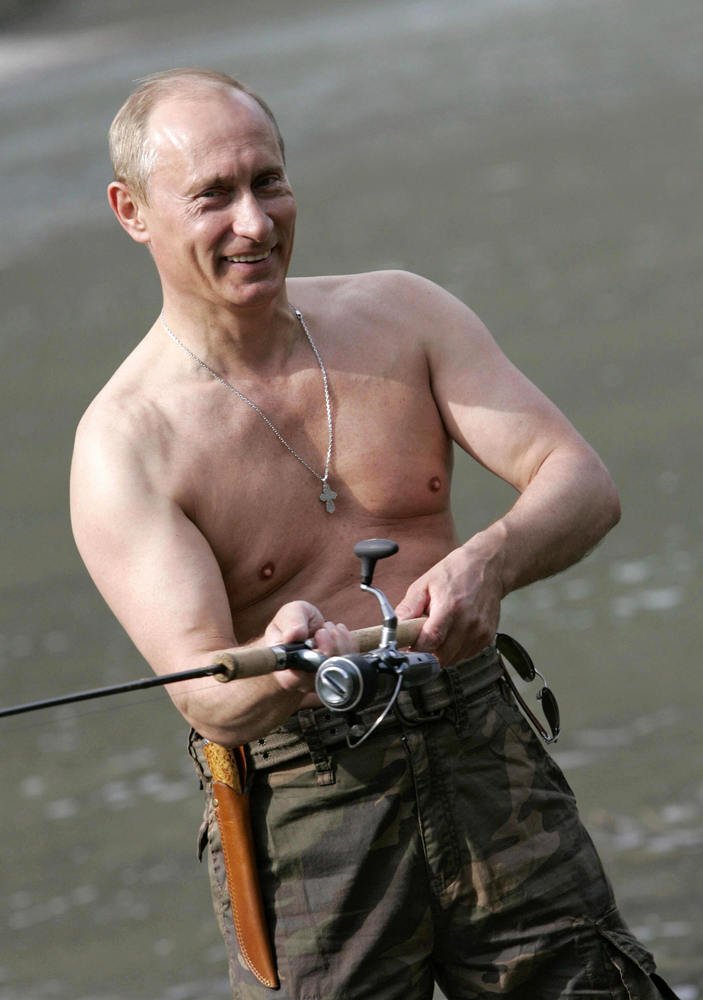
Putin helps Trump and Trump helps Putin — but no one should be in any doubt about who is the dominant partner in this bromance: it’s the one who’s rather proud of showing off his body; not the one who lives in fear of the day he might show up naked on the nightly news.
Facebooktwittermail

The Trump dossier and the FBI cover-up

The Independent reports: Christopher Steele, the former MI6 agent who investigated Donald Trump’s alleged Kremlin links, was so worried by what he was discovering that at the end he was working without pay, The Independent has learned.

Mr Steele also decided to pass on information to both British and American intelligence officials after concluding that such material should not just be in the hands of political opponents of Mr Trump, who had hired his services, but was a matter of national security for both countries.

However, say security sources, Mr Steele became increasingly frustrated that the FBI was failing to take action on the intelligence from others as well as him. He came to believe there was a cover-up, that a cabal within the Bureau blocked a thorough inquiry into Mr Trump, focusing instead on the investigation into Hillary Clinton’s emails. [Continue reading…]

The Guardian reports: Embattled FBI director James Comey has refused to clarify whether his organization is investigating Donald Trump’s ties to Russia in a closed briefing on Friday for members of Congress, angering legislators who recall his high-profile interjections about Hillary Clinton during the 2016 presidential campaign, the Guardian has learned.

Comey’s lack of candor in a classified setting, intended to brief members on the intelligence agencies’ assessment that Russia interfered in the election to benefit Trump, follows a public rebuff this week to senators seeking clarification.

In that earlier hearing, Comey said he would “never comment” on a potential FBI investigation “in an open forum like this”, raising expectations among some attendees of Friday’s briefing that Comey would put the issue to rest in a classified setting.

But according to sources attending the closed-door Friday morning meeting, that was not the case. As such, frustration with Comey was bipartisan and heated, adding to intense pressure on the director of the FBI, whose conduct in the 2016 election itself is now being investigated by an independent US justice department watchdog.

One source in the meeting said Comey would not answer “basic questions” about the FBI’s current investigative activities. The FBI chief was grilled “over and over again”, according to the source, about his standards for acknowledging FBI investigations, with legislators repeatedly bringing up Comey’s dramatic public confirmation that the bureau was revisiting classification issues with Hillary Clinton’s private email server days before the election, as well as his summer press conference announcing that he would not seek indictment. [Continue reading…]

Facebooktwittermail

Intelligence Committee will investigate possible Russia-Trump links

Politico reports: Senate Intelligence Chairman Richard Burr (R-N.C.) said late Friday that his committee will investigate possible contacts between Donald Trump’s campaign and Russia, reversing himself one day after telling reporters that the issue would be outside of his panel’s ongoing probe into Moscow’s election-disruption efforts.

Burr and the intelligence panel’s top Democrat, Virginia Sen. Mark Warner, said in a joint statement that the committee’s probe would touch on “intelligence regarding links between Russia and individuals associated with political campaigns” as well as Russian cyberattacks and other election meddling outlined in an intelligence report released last week.

The committee will use “subpoenas if necessary” to secure testimony from Obama administration officials as well as Trump’s team, Burr and Warner said.

The bipartisan Senate announcement came hours after several House Democrats aired their frustrations with FBI Director James Comey following a classified briefing on Russian election disruption. The Democrats were livid that Comey refused to confirm whether he is conducting an inquiry into potential Trump ties to Russia — a question that he publicly declined to answer earlier this week. [Continue reading…]

Facebooktwittermail

South China Sea: China media warn U.S. over ‘confrontation’

BBC News reports: Blocking China from islands it has built in contested waters would lead to “devastating confrontation”, Chinese state media have warned.

The angry response came after secretary of state nominee Rex Tillerson said the US should deny Beijing access to new islands in the South China Sea.

Two state-run papers carry editorials strongly criticising his comments.

The hawkish Global Times tabloid warned that any such action would lead to “a large-scale war”.

Beijing has been building artificial islands on reefs in waters also claimed by other nations. Images published late last year show military defences on some islands, a think-tank says.

Speaking at his confirmation hearing on Wednesday, Mr Tillerson likened China’s island-building to Russia’s annexation of Crimea from Ukraine.

“We’re going to have to send China a clear signal that first, the island-building stops and second, your access to those islands also is not going to be allowed.” [Continue reading…]

Facebooktwittermail

Trump’s Cabinet nominees keep contradicting him

The Washington Post reports: Donald Trump’s Cabinet nominees, in their first round of confirmation hearings on Capitol Hill, have one after another contradicted the president-elect on key issues, promising to trim back or disregard some of the signature promises on which he campaigned.

A fresh set of examples came Thursday, the third day of hearings.

Retired Marine Corps Gen. James Mattis, Trump’s nominee to be defense secretary, told the Senate Armed Services Committee that the United States must honor the “imperfect ­arms-control agreement” with Iran that Trump has vowed to dismantle because “when America gives her word, we have to live up to it and work with our allies.”

He also took a more adversarial stance than Trump has toward Russian President Vladi­mir Putin and cited Moscow as one of the nation’s top threats.

“I’ve never found a better guide for the way ahead than studying the histories. Since [the 1945 meeting of world powers at] Yalta, we have a long list of times we’ve tried to engage positively with Russia. We have a relatively short list of successes in that regard,” Mattis said. “I think right now, the most important thing is that we recognize the reality of what we deal with [in] Mr. Putin and we recognize that he is trying to break the North Atlantic alliance.”

At a witness table in another Senate hearing room, Rep. Mike Pompeo (R-Kan.), whom Trump picked to head the CIA, assured the Intelligence Committee that he would “absolutely not” use brutal interrogation tactics on terrorism suspects in contravention of the law, even if ordered to do so by a president who campaigned on a promise to reinstate the use of such measures.

Trump indicated in a tweet Friday morning that he is unconcerned about the contradictions. “All of my Cabinet nominee are looking good and doing a great job,” Trump wrote. “I want them to be themselves and express their own thoughts, not mine!”

The discordant notes that Cabinet nominees have struck as they have been questioned by senators suggest that a reality check may lie ahead for Trump.

It may be that the grandiosity and disregard for convention that got Trump elected were inevitably bound for a collision with the practical and legal limitations of governing. [Continue reading…]

Facebooktwittermail

U.S. intel sources warn Israel against sharing secrets with Trump administration

Ynet reports: Donald Trump’s upcoming inauguration as the next president of the United States is causing Israeli intelligence officials to lose sleep as well. Discussions held in closed forums recently raised fears of a leakage of Israeli intelligence top-classified information, clandestine modus oprandi and sources, which have been exposed to the American intelligence community over the past 15 years, to Russia – and from there to Iran.

The cause of concern are the suspicions of unreported ties between the president-elect or his associates and the Kremlin, whose agents are also associated with intelligence officials in Tehran.

These fears, which began upon Trump’s election, grew stronger following a meeting held recently between Israeli and American intelligence officials (the date of the meeting is not mentioned to protect the sources of the report). During the meeting, according to the Israelis who participated in it, their American colleagues voiced despair over Trump’s election, as he often lashes out at the American intelligence community. The American officials also told the Israelis that the National Security Agency (NSA) had “highly credible information” that Russia’s intelligence agencies, the FSB and GRU, were responsible for hacking the Democratic Party (DNC) servers during the elections and leaking sensitive information to WikiLeaks, which hurt Democratic presidential candidate Hillary Clinton.

The American officials further added that they believed Russia President Vladimir Putin had “leverages of pressure” over Trump – but did not elaborate. They were apparently referring to what was published Wednesday about embarrassing information collected by the Russian intelligence in a bid to blackmail the president-elect.

The Americans implied that their Israeli colleagues should “be careful” as of January 20, Trump’s inauguration date, when transferring intelligence information to the White House and to the National Security Council (NSC), which is subject to the president. According to the Israelis who were present in the meeting, the Americans recommended that until it is made clear that Trump is not inappropriately connected to Russia and is not being extorted – Israel should avoid revealing sensitive sources to administration officials for fear the information would reach the Iranians. [Continue reading…]

Facebooktwittermail

Obama hoped to transform the world. It transformed him

Adam Shatz writes: At his final news conference as president, Mr. Obama expressed anguish over the fall of Aleppo, but insisted that his Syria policy had been guided by his sense of “what’s the right thing to do for America.”

It may well have been; American lives were spared. But noninterference created a vacuum that autocrats like President Vladimir V. Putin of Russia and Recep Tayyip Erdogan of Turkey were happy to fill. What’s more, Mr. Obama’s understanding of American interests in Syria was more restrictively drawn than one might have expected from a man so worldly, someone who had always stressed the interdependence of the global community and the moral burdens of “what it means to share this world in the 21st century.” Who governs Syria may not be a core American interest, but the country’s apocalyptic splintering is another matter. The effect of Mr. Obama’s caution, as much as Moscow’s belligerent resolve, was to help prolong the war.

The consequences of Syria’s disintegration have spread far beyond its borders. Not only has the crisis placed dangerous strains on neighboring states, but it has emboldened the far right in Europe, which has played on fears about Islam and terrorism in its campaign against immigration and the European Union. Nor has the United States been unscathed by what Mr. Obama recently called the “tug of tribalism”: Donald J. Trump owes his election to it. Mr. Trump is an open admirer of tribal politicians like Mr. Putin, Mr. Erdogan and Prime Minister Benjamin Netanyahu of Israel, not least because they remind him of himself with their love of the mob, contempt for liberal elites and penchant for conspiracy theory.

In his 2009 speech in Cairo, Mr. Obama imagined Muslim and Western democrats working together in partnership, overcoming borders imposed by war, prejudice and mistrust for the sake of a common future. Instead, the very prospect of a common future, of global interdependence, has been jeopardized by the emergence of an illiberal world of tribes without flags. Despite the best of intentions, and for all his fine words, Mr. Obama became one of the midwives of this dangerous and angry new world, where his enlightened cosmopolitanism increasingly looks like an anachronism. [Continue reading…]

Facebooktwittermail

In Paris, the world will try one more time to solve the Israel-Palestinian conflict

The Washington Post reports: Poor, belittled Palestinian President Mahmoud Abbas has pulled off a remarkable feat.

On Sunday, top diplomats from as many as 70 nations are gathering in Paris to show their support for the creation of a Palestinian state.

Abbas hasn’t won his people a sovereign nation. Not even close.

But with all the challenges facing the world, the international community has accepted the invitation of French President François Hollande to come together again and urge Abbas and Israeli Prime Minister Benjamin Netanyahu to hammer out a two-state solution to the decades-long conflict. [Continue reading…]

Facebooktwittermail

Cyprus fears Russia could wreck reunification

Politico reports: As Cypriot leaders tussle with Greece, Turkey and the U.K. over the most delicate parts of an agreement to reunify the island, there’s a growing fear that Russia could spoil a deal.

That’s because the Kremlin has little to gain from the end of a four-decade split between Greek and Turkish Cypriots.

A peace deal would ease tensions between the European Union and Turkey, open the way to formal cooperation between the EU and NATO (blocked because Turkey and Cyprus don’t officially recognize each other), give Turkey a new source of natural gas imports and hand Brussels a diplomatic success story after a series of blows last year.

None of those advance Russia’s interests.

The fear on the Greek Cypriot side is that Moscow is using social and mass media, as well as ties to fringe nationalist political parties and the Greek Orthodox Church, to undermine the settlement talks. [Continue reading…]

Facebooktwittermail

Russia moves to decriminalize domestic violence

Politico reports: A bill that seeks to downgrade domestic violence from a criminal to an administrative offense passed its first reading on Wednesday in the duma, Russia’s lower house of parliament.

A total of 368 lawmakers voted in favor of the bill, with one “no” and one abstention.

Under the proposed rule, the charge of “battery within the family,” currently a criminal offense, would become an administrative one, with a fine, community service or a brief prison term levied against perpetrators. Criminal charges would still be laid if the offense is committed two or more times in one year. [Continue reading…]

Facebooktwittermail

Frank Rich on BuzzFeed’s decision to publish the Trump dossier

In an interview with Alex Carp, Frank Rich said: Next to the staggering list of press failures that have marked Trump’s rise to the presidency, this seems small potatoes. BuzzFeed did frame what it published as being both unconfirmed and redolent with errors. The “dossier” may well prove to be utter trash (if entertaining trash), and the only slender justification for publishing it is that it fleshes out a true news break by CNN, that both Obama and Trump had been told of this salacious report’s existence by American intelligence agencies, who also have not verified it. But is BuzzFeed’s sin worse than CNN having put Trump henchman Corey Lewandowski on its election-year payroll? Or than the Times repeatedly giving major home-page play to data suggesting that Hillary Clinton had a close to 100 percent chance of victory right up to Election Day? You could argue that that latter stunt actually suppressed Democratic turnout in the presidential race; the BuzzFeed stunt changed nothing unless you count the impressive number of jokes it has prompted, on Twitter and beyond, around the phenomenon of #GoldenShower. It is not a bright spot in BuzzFeed’s history, but the ruckus it has generated seems disproportionate, a reflection of how much Trump has put the press on the defensive over a bruising 18 months.

What most seems to upset press critics about BuzzFeed’s action — understandably — is that Trump seized on it to paint the entire press Establishment, including CNN, as purveyors of “fake news.” That is an outrage, but if Trump hadn’t found this pretext, he would have found another opening soon enough. There is, of course, no bigger purveyor of fake news than Trump himself, unless it’s his comrade in alt-right propaganda, Stephen Bannon. Trump’s entire campaign was spawned by trafficking in conspiracy theories, whether about President Obama or Mexican immigrants or imaginary Muslims cheering 9/11 in New Jersey. His effort to play the virtuous defender of journalistic ethics is as ludicrous as his presenting himself as the greatest, most respectful champion of America’s women. He is determined to bully, destabilize, and discredit the press. But those who buy his preposterous self-righteous pose are so imprisoned by the alternative reality of Trump anyway that they might as well be Scientologists — nothing short of an intervention will return them to the real world. These are the same people who think that Trump’s display of piles of manila envelopes at his press conference actually told us something about his business ethics. If I may briefly embrace Trumpism by being both vulgar and politically incorrect, let me say that people who fall for his bullshit are idiots. Even if the dossier BuzzFeed published is found to be mostly true, they’ll still believe it’s fake news because it doesn’t match the fake news they are imbibing every day. [Continue reading…]

The strange thing about all this soul searching on whether BuzzFeed stepped over some sacred line is the demonstrable fact that the press is and never has confined itself to publishing verified facts. It is wholly legitimate to publish information which might turn out to be untrue or inaccurate if the reporting is done in good faith. Journalists repeatedly lean on “analysts” as sources of conjecture and opinion and they do so — hopefully — on the basis that facts so often call out for interpretation and the interpretations provided are credible.

The decision to publish the Trump dossier seems — at least to me — to be no different from the intelligence community’s decision to summarize its contents for briefings given to Obama and Trump: it merits attention, both presidential and public, because of its credibility.

If the strongest arguments that Donald Trump can make to challenge the dossier’s credibility are his claims to be a man who exercises great caution when out in the world and who is also a self-described germophobe, I’d say we have even more reason to wonder what kinds of recordings the Kremlin might have with which it can blackmail the next president.

“You better be careful, or you’ll be watching yourself on nightly television,” Trump warned on Wednesday — to which he should have added, “or listening to yourself bragging about grabbing pussy.”

We know what Trump says and we also know some of what he’s done. As yet, we don’t know what he did in Russia — but it’s way too soon to dismiss stories of golden showers and videotapes as fake news.

Facebooktwittermail

Trump dossier: The more that is revealed about the source, the more his credibility grows

The Guardian reports: At his press briefing on Wednesday, the president-elect dared the world’s media to scrutinise the 35 pages of claims, before throwing down a challenge – where’s the proof? Nobody had any. Case closed.

But in the rush to trample all over the dossier and its contents, one key question remained. Why had America’s intelligence agencies felt it necessary to provide a compendium of the claims to Barack Obama and Trump himself?

And the answer to that lies in the credibility of its apparent author, the ex-MI6 officer Christopher Steele, the quality of the sources he has, and the quality of the people who were prepared to vouch for him. In all these respects, the 53-year-old is in credit.

On Thursday night, as the former spy was in hiding, having fled his home in the south-east of England, former colleagues rallied to defend him. One described him as “very credible” – a sober, cautious and meticulous professional with a formidable record.

The former Foreign Office official, who has known Steele for 25 years and considers him a friend, said: “The idea his work is fake or a cowboy operation is false – completely untrue. Chris is an experienced and highly regarded professional. He’s not the sort of person who will simply pass on gossip.”

The official added: “If he puts something in a report, he believes there’s sufficient credibility in it for it to be worth considering. Chris is a very straight guy. He could not have survived in the job he was in if he had been prone to flights of fancy or doing things in an ill-considered way.”

That is the way the CIA and the FBI, not to mention the British government, regarded him, too. It’s not hard to see why.

A Cambridge graduate, Steele was one of the more eminent Russia specialists for the Secret Intelligence Service (MI6). The Guardian understands that he focused on Soviet affairs after joining the agency, and spent two years living in Moscow in the early 1990s.

This was a period when Russia and the breakup of the eastern bloc were still the prime focus for Britain’s intelligence agencies, and a successful spell in the region was a good way to get on.

By all accounts, that’s exactly what Steele did. And his interest in Russia did not diminish as he continued to rise up the ranks, a friend and contemporary of Alex Younger – now head of MI6.

Over a career that spanned more than 20 years, Steele performed a series of roles, but always appeared to be drawn back to Russia; he was, sources say, head of MI6’s Russia desk. When the agency was plunged into panic over the poisoning of its agent Alexander Litvinenko in 2006, the then chief, Sir John Scarlett, needed a trusted senior officer to plot a way through the minefield ahead – so he turned to Steele. It was Steele, sources say, who correctly and quickly realised that Litvinenko’s death was a Russian state “hit”. [Continue reading…]

The Independent adds: The official’s work had involved the former Soviet Union and Warsaw Pact countries during the Cold War and he had maintained contacts since in Russia and eastern Europe while working as a security consultant. Importantly, he is well known to the American agencies and, according to senior sources, they felt the official had enough credibility to be taken seriously.

One matter that appear to buttress this credibility was a report he supplied five months ago claiming that figures in Mr Trump’s campaign team had agreed to a Russian request to try and dilute election focus on its intervention in Ukraine. Four days later Mr Trump stated that he would recognise Moscow’s annexation of Crimea. A month later officials involved in his campaign asked the Republican Party’s election platform to remove a pledge for military assistance to the Ukrainian government against separatist rebels in the east of the country. [Continue reading…]

Facebooktwittermail

How Putin played the far left

Casey Michel writes: In the aftermath of the U.S. intelligence community’s recent report on the Russian-directed hacking of the Democratic National Committee, it’s easy but misleading to conclude that the Russian government’s propaganda strategy lies solely in advancing the careers of conservative Republicans in the United States. Backing Donald Trump’s candidacy, via steady leaks of stolen communiques to organizations like WikiLeaks, was but one prong of the Kremlin’s assault on American liberal democracy. Part of its campaign to vilify Hillary Clinton involved catering to her rivals on the far-left and pushing any number of crankish conspiracy theories that appeal as much to “anti-imperialists” as to neo-Nazis.

There’s nothing new in that, really.

Moscow’s attempts to cultivate America’s far-left long predate the presidency of Vladimir Putin. The Kremlin, according to available evidence, donated more funds per capita to the U.S. Communist Party than any other communist claque during the Soviet period, when Moscow’s intelligence operations against the “main adversary” involved recruiting agents of influence and spies of a progressive background who were sympathetic to the Soviet cause. But the past 18 months have seen a noted spike in information warfare aimed at gulling the Bernie Bros and Occupy-besotted alternative media set, which saw Clinton as more of a political danger than it did Trump.

Perhaps the starkest case in point is Green Party presidential candidate Jill Stein and her constituency. In December 2015, the Kremlin feted Stein by inviting her to the gala celebrating the 10-year anniversary of Kremlin-funded propaganda network RT. Over a year later, it remains unclear who paid for Stein’s trip to Moscow and her accommodations there. Her campaign ignored multiple questions on this score. We do know, however, that Stein sat at the same table as both Putin and Lt. Gen. Mike Flynn, Trump’s soon-to-be national security adviser. She further spoke at an RT-sponsored panel, using her presence to criticize the U.S.’s “disastrous militarism.” Afterward, straddling Moscow’s Red Square, Stein described the panel as “inspiring,” going on to claim that Putin, whom she painted as a political novice, told her he “agree[d]” with her “on many issues.”

Stein presents herself as a champion of the underclass and the environment, and an opponent of the surveillance state and corporate media, and yet she seemed to take pleasure in her marriage of true minds with a kleptocratic intelligence officer who levels forests and arrests or kills critical journalists and invades foreign countries. Their true commonality, of course, is that both Putin and Stein are dogged opponents of U.S. foreign policy. [Continue reading…]

Facebooktwittermail

Trump lies about phone conversation with Clapper

On Wednesday evening Director of National Intelligence James Clapper issued a statement saying:

This evening, I had the opportunity to speak with President-elect Donald Trump to discuss recent media reports about our briefing last Friday. I expressed my profound dismay at the leaks that have been appearing in the press, and we both agreed that they are extremely corrosive and damaging to our national security.

We also discussed the private security company document, which was widely circulated in recent months among the media, members of Congress and Congressional staff even before the IC became aware of it. I emphasized that this document is not a U.S. Intelligence Community product and that I do not believe the leaks came from within the IC. The IC has not made any judgment that the information in this document is reliable, and we did not rely upon it in any way for our conclusions. However, part of our obligation is to ensure that policymakers are provided with the fullest possible picture of any matters that might affect national security.

The following morning, Trump tweeted:


When I say Trump lied about the conversation, I’m giving him the benefit of the doubt.

The alternative is that the next president has such an impaired capacity to take in information that conflicts with his presuppostions/prejudices/agenda that he is functionally deaf — that he literally only hears what he wants to hear.

As I said, I’ll give him the benefit of the doubt — I think he’s just a liar.

Facebooktwittermail

How state-sponsored blackmail works in Russia

Julia Ioffe writes: In January 1999, Prosecutor General Yury Skuratov was summoned to the Kremlin by then-President Boris Yeltsin’s chief of staff, who showed him a videotape of “a man who looked like” Skuratov frolicking in bed with two prostitutes. Then he asked Skuratov to resign, even though the prosecutor was in the middle of investigating Yeltsin’s administration for taking bribes from a Swiss firm trying to secure lucrative contracts for Kremlin renovations. It was a grainy tape and Skuratov would later say it was fake, but he submitted his resignation nonetheless.

What happened next was one of the most decisive battles in determining who would replace Yeltsin when his second presidential term expired in 2000. Skuratov’s resignation had to be confirmed by the Federation Council, the upper chamber of the Russian parliament — back when it had not yet become a Kremlin rubber stamp. The Federation Council balked and asked Skuratov to testify, but the day before he appeared on the floor, RTR TV ran the tape on its evening news, calling the segment “Three in a Bed.” When the Federation Council continued to resist the Kremlin, and Skuratov tried to go back to work as if nothing happened, the tape was played on TV again, this time on the program of the notorious media hit man Sergei Dorenko. Allowing children to see the tape, Dorenko said, would make it harder for parents to raise them patriotically; this was, after all, the prosecutor general of the Russian Federation, “not Mick Jagger, who can run around the beach with a naked behind.”

The tape is rumored to have been delivered personally to the head of RTR by “a man who looked like the head of the FSB,” who at the time was none other than Vladimir Putin.

Soon afterward, on April 7, 1999, Putin went on TV himself to claim the tape authentic — that the “man who looked like” Skuratov was indeed Skuratov — and called not only for Skuratov’s resignation, but for a more robust criminal investigation.

All this is noteworthy not only because this was one of Putin’s key steps toward the presidential throne, but because this dark and convoluted chapter of contemporary Russian history is also, however amazingly, now relevant reading for understanding contemporary American history. Now that Buzzfeed has released a dossier compiled by a private intelligence company, with unverified allegations that the FSB has a video of Donald Trump with prostitutes in the Moscow Ritz Carlton in 2013, America has entered uniquely Russian territory. (I should add that I, like many other journalists, was approached over the summer with the story of the prostitutes and could not verify it.)

In any case, welcome to the world of kompromat, America. [Continue reading…]

Facebooktwittermail

Trump says he has ‘nothing to do with Russia.’ The past 30 years show otherwise

The Washington Post reports: Trump first visited Moscow in 1987 in an effort to make real estate deals. As he told it in a Playboy interview, two Russian fighter planes accompanied his jet to the airport, and he had insisted on having two Russian colonels fly with him. He stayed at the National Hotel, overlooking the Kremlin, and said that the Soviets wanted him to build two luxury hotels.The Soviet ambassador had visited Trump in New York City and said his daughter had “adored” Trump Tower and suggested a Moscow version, according to a Newsweek account of the visit published at the time. Trump visited a number of potential sites around Moscow.

Trump said he told Soviet officials that he did not know how to arrange financing because the government owned the land. Trump said he was told: “No problem, Mr. Trump. We will work out lease arrangements.”

Trump said he responded, “I want ownership, not leases.” The Soviets said they would create a committee of seven government representatives and three Trump associates to resolve problems.

Trump said in the 1990 interview that he was “very unimpressed” with the Soviet system, which he called “a disaster.” “What you will see there soon is a revolution,” he added. He said his “problem” with then-Soviet leader Mikhail Gorbachev was that he was “not a firm enough hand.”

Trump did not wind up making a deal, but he soon tried again.

In 1996, Trump sought to build luxury condominiums in Moscow, but the deal never happened. Trump tried again in 2005, signing a deal for a possible Trump building in a converted pencil factory, but this also failed to materialize.

The Trumps were undaunted. Donald Trump Jr. traveled to Russia six times in an 18-month period, starting around 2006, to try to make deals. His father seemed convinced it would happen.

“Russia is one of the hottest places in the world for investment,” the senior Trump said in 2007. “We will be in Moscow at some point.” [Continue reading…]

Facebooktwittermail
