Bloomberg reported on December 30: China, the world’s biggest clean energy investor, plans to increase wind and solar power capacity by more than 21 percent next year as it works to reduce greenhouse gas emissions by cutting its reliance on coal.
The nation is targeting at least 20 gigawatts of new wind power installations and 15 gigawatts of additional photovoltaic capacity next year, the National Energy Administration said in a statement on Tuesday.
China has pledged to peak carbon emissions around 2030, by which time it aims to derive 20 percent of the energy it uses from clean sources. China will also stop approving new coal mines in the next three years, the Xinhua News Agency reported Tuesday, citing National Energy Administration head Nur Bekri.
The world’s biggest producer of carbon emissions is expected at the end of this year to have a total of 120 gigawatts of wind power, 43 gigawatts of solar, and 320 gigawatts of hydro power, the NEA said. To accommodate the clean energy additions, China will promote the construction of electricity networks, the agency said.[Continue reading…]
Why wealth hasn’t brought health: The body isn’t built to be an exclusive neighborhood

Matt Ridley writes: As Stewart Brand acutely says, most of the things that dominate the news are not really new: love, scandal, crime, and war come round again and again. Only science and invention deliver truly new stuff, like double helixes and search engines. In this respect, the new news from recent science that most intrigues me is that we may have a way to explain why certain diseases are getting worse as we get richer. We are defeating infectious diseases, slowing or managing many diseases of ageing like heart disease and cancer, but we are faced with a growing epidemic of allergy, auto-immunity, and things like autism. Some of it is due to more diagnosis, some of it is no doubt hypochondria, but there does seem to be a real increase in these kinds of problems.
Take hay fever. It is plainly a modern disease, far more common in urban, middle-class people than it used to be in peasants in the past, or still is in subsistence farmers in Africa today. There’s really good timeline data on this, chronicling the appearance of allergies as civilization advances, province by province or village by village. And there’s really good evidence that what causes this is the suppression of parasites. You can see this happen in eastern Europe and in Africa in real time: get rid of worms and a few years later children start getting hay fever. Moises Velasquez-Manoff chronicles this in glorious detail in his fine book An Epidemic of Absence.
This makes perfect sense. In the arms race with parasites, immune systems evolved to “expect” to be down-regulated by parasites, so they over-react in their absence. A good balance is reached when parasites try down-regulating the immune system, but it turns rogue when there are no parasites. [Continue reading…]
Nina Jablonski writes: The taxonomic diversity and census of our resident bacteria are more than just subjects of scientific curiosity; they matter greatly to our health. The normal bacteria on our skin, for instance, are essential to maintaining the integrity of the skin’s barrier functions. Many diseases, from psoriasis to obesity, inflammatory bowel disease, some cancers, and even cardiovascular disease, are associated with shifts in our microbiota.
While it’s too early to tell if the changing bacteria are the cause or the result of these problems, the discovery of robust associations between bacterial profiles and disease states opens the door for new treatments and targeted preventive measures. The body’s microbiota also affects and is affected by the body’s epigenome, the chemical factors influencing gene expression. Thus, the bugs on us and in us are controlling the normal action of genes in the cells of our bodies, and changes in the proportions or overall numbers of bacterial affect how our cells work and respond to stress.
Let’s stop thinking about our bodies as temples of sinew and cerebrum, and instead as evolving and sloshing ecosystems full of bacteria, which are regulating our health in more ways than we could ever imagine. As we learn more about our single-celled companions in the coming years, we will take probiotics for curing acute and chronic diseases, we’ll undertake affirmative action to maintain diversity of our gut microflora as we age, and we’ll receive prescriptions for increasingly narrow-spectrum antibiotics to exterminate only the nastiest of the nasties when we have a serious acute infection. Hand sanitizers and colon cleansing will probably be with us for some time, but it’s best just to get used to it now: Bugs R us. [Continue reading…]
Music: Nirali Kartik — ‘Maru Bihag’
The story behind the ‘spontaneous’ torching of the Saudi embassy in Tehran
IranWire reports: Following the execution of Shia cleric Sheikh Nimr al-Nimr in Saudi Arabia on Saturday, January 2, a one-line notice appeared on an Iranian website called Officers of the Soft War. Posted at 5:00 PM, it read, “At 15:00 on Sunday all gather in front of the Al-Zion Stable in Tehran.” The “Al-Zion Stable” was the site’s pejorative term for the Saudi embassy.
The website is an important news and propaganda site for hardline supporters of Iran’s political system. The notice followed its publication of pictures of protests that led to an attack on the Saudi consulate in Mashhad.
But according to another Iranian site, the Tasnim News Agency, some protesters had already gathered in front of the Saudi embassy in Tehran by the time the notice went online. They were calling the Saudi royal family “jackals of the Zionists.”
Iran’s Diplomatic Police, who are responsible for protecting diplomatic missions, ended that round of protests. Some of them began to paint over the anti-Saudi graffiti on the embassy walls. Pictures show that by 5:00 PM, at least three layers of Diplomatic Police were protecting the embassy.
But five hours later, the embassy was deserted. It seems embassy staff had predicted that another attack was on its way. But the Diplomatic Police either had no inkling of this, or did not want to show that it knew what would happen next.
At 10:00 PM demonstrators launched a new attack.
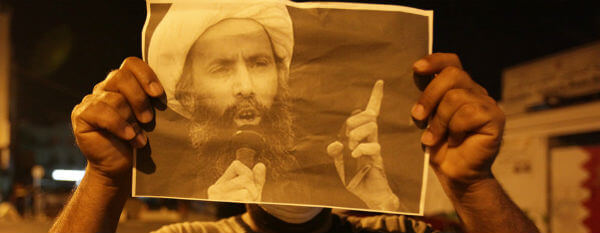
Most of the protesters were young, and many carried posters of al-Nimr, one of 47 men executed by the Saudi government on Saturday. Some were armed with stones or bows and arrows, and had covered their faces with Arabic keffiyehs—patterned cloths often associated with Palestinian protestors.
Members of the crowd then set the embassy alight with Molotov cocktails. Photographs from the scene show no shortage of the Diplomatic Police, but one policeman was quoted on social media saying, “we have been told not to obstruct them too much.” [Continue reading…]
The New York Times adds: “What group here in Iran benefits politically from storming an embassy?” a former member of the Iranian National Security Council, Aziz Shahmohammadi, asked rhetorically. He was suggesting that the answer lay with the hard-liners — a loose alliance of clerics, ideologues and military commanders. “Such people are even against foreign soccer coaches to train our teams.”
The embassy attack played into their agenda of opposition to President Rouhani, whom Mr. Shahmohammadi said was clearly blindsided by the riot.
“For them, this might lead to electoral gains, an example that Iran is better off isolated. But they are missing the big picture here: We need and want peace and calm,” he said.
The act of cutting ties seems a simple one, but the consequences can be far-reaching. “We are moving increasingly towards conflict,” Mr. Shahmohammadi said.
“This is bad for the entire region — in Syria, in Yemen, and to a lesser extent in Lebanon and Iraq as well,” he added. “Cutting ties is fanning the flames in a region already on fire.” [Continue reading…]
How the Saudis’ fear of ISIS may have been behind the decision to execute Sheikh Nimr al-Nimr

Nibras Kazimi writes: Far more than al-Qaeda, the Islamic State has focused on the danger posed by Saudi Shias to ‘Sunnidom’ and had castigated the House of Saud as de facto protectors of the Shia.
Al-Nimr was specifically mentioned in a speech made by the Nejd (Central Saudi Arabia) ‘Province’ of the Islamic State in October 2015. The unidentified speaker alleged that al-Nimr was spearheading the secession of the eastern section of Saudi Arabia, where a large minority of Shias reside. According to the speaker, the House of Saud are in collusion with foreign plans to weaken Sunnis by allowing the Shias to break off and create a pro-Iran satellite state.
This rhetorical tussle between the Saudis and IS bears the element of taunting, with the latter asserting that the royals had lost their ‘virility’.
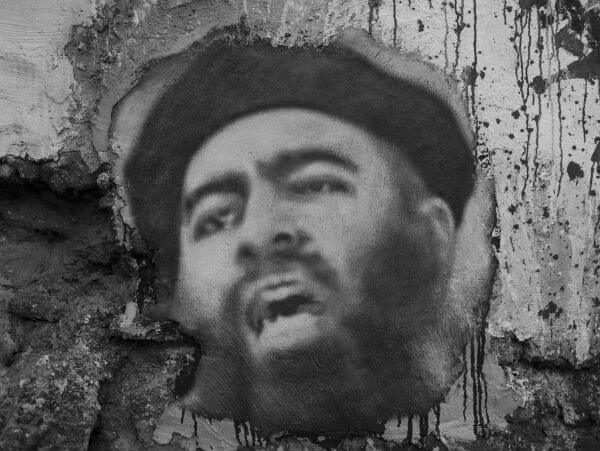
‘Caliph’ al-Baghdadi makes this point clear in his May 2015 audio speech when speaking about the Saudi military campaign against the Houthis in Yemen, what the Saudis call the ‘Storm of Decisiveness’:
“For it is only a ‘storm of delusion’ after the fires of the [Shias] had lapped at their thrones and their encroachment has reached our people in the Arabian Peninsula, which will lead lay Muslims to find refuge in the Islamic State because it is their defender, and this terrifies the [House of Saud] and the rulers of the Arabian Peninsula and shakes their bastions and that is the secret of their alleged ‘storm’ and, God willing, it shall be the [cause of their] demise. For the [House of Saud] and the rulers of the Arabian Peninsula are not people of warfare, and they do not have the patience for it, and they are people of luxury and frivolity, and people of drunkenness and dancing and banquets, who have acquiesced to the protection afforded to them by the Jews and Crusaders..”
This sort of taunting is not new to the Saudis. Nor is their counter reaction to prove their anti-Shia credentials from time to time. What is different nowadays is the scale of it, and the degree to which both sides are willing to go. [Continue reading…]
The danger in Saudi Arabia’s ongoing sectarian and anti-Iranian incitement is that it is uncontrollable
Toby Craig Jones writes: After the 2003 invasion of Iraq unleashed a new wave of Sunni-Shiite tension across the Middle East, Riyadh started to shift course. But in 2011, as the Arab world exploded in popular protests, the Saudi government cemented its commitment to sectarian confrontation. The Shiite majority population in neighboring Bahrain rose up against the Sunni-dominated monarchy. The Shiite minority in Saudi Arabia also took to the streets, protesting for political reform.
Invoking Iran and Shiites as a terrifying menace, Saudi rulers framed everything from domestic protests to intervention in Yemen in sectarian terms and in the process sought not only to demonize a minority group, but also to undermine the appeal of political reform and protest.
Sheikh Nimr had a long history of challenging the Saudi ruling family, but it was his post-2011 activism that led to his execution. After speaking defiantly about anti-Shiite discrimination, he was chased and arrested by Saudi police in July 2012. The police who apprehended him claimed that he had fired on them. Officially, Sheikh Nimr was executed for sedition and other charges. More likely, he was executed for being critical of power. He was not a liberal, but he gave voice to the kinds of criticisms the Saudi royals fear most and tolerate least.
Still, Sheikh Nimr’s execution was more important for what it communicated to the kingdom’s domestic allies and to potential future dissidents. The emergence of anti-Shiite sentiment over the past decade has not only been used to stamp out efforts by the Shiite minority to gain more political rights. In quashing calls for democracy originating from the Shiite community, Riyadh has also undermined broader demands for political reform by casting protesters as un-Islamic. Many Sunni reformers who cooperated with Shiites in the past have since stopped.
The Saudi authorities have good reason to be concerned about new calls for reform. About a week before Sheikh Nimr’s execution, the kingdom announced that it was facing an almost $100 billion deficit for its 2016 national budget. Declining oil revenues may soon force the kingdom to slash spending on social welfare programs, subsidized water, gasoline and jobs — the very social contract that informally binds ruler and ruled in Saudi Arabia. The killing of a prominent member of a loathed religious minority deflects attention from impending economic pressure.
The danger in Saudi Arabia’s ongoing sectarian and anti-Iranian incitement — of which Sheikh Nimr’s execution is just one part — is that it is uncontrollable. As is clear in Syria, Iraq and even further afield, sectarian hostility has taken on a life beyond what the kingdom’s architects are able to manage. [Continue reading…]
Can the U.S. avoid taking sides in the Saudi-Iran conflict?
Trita Parsi writes: from the U.S. perspective, Saudi Arabia’s destabilizing activities are a vindication of the nuclear deal it struck with Iran in 2015. One critical benefit of that deal, left unstated by Obama administration officials, is that it helped reduce U.S. dependency on Saudi Arabia.
By resolving the nuclear standoff and getting back on talking terms with Iran, Washington increased its options in the region.
As Admiral Mike Mullen wrote in Politico last year in regards to the benefits of the nuclear deal: “It would also more fairly rebalance American influence. We need to re-examine all of the relationships we enjoy in the region, relationships primarily with Sunni-dominated nations. Detente with Iran might better balance our efforts across the sectarian divide.”
Mindful of the deliberate manner Saudi Arabia is driving matters towards a crisis in the region – partly motivated by a desire to trap the United States in Riyadh’s own enmity with Iran – Washington is clearly better off being able to play a balancing role between Saudi and Iran rather than being obligated to fully support Saudi Arabia’s regional escapades. [Continue reading…]
Laura Rozen reports: Saudi Arabia, in carrying out the execution and severing relations with Iran, may have been trying to send messages to both domestic and international audiences about its resolve against what Riyadh perceives as Iranian expansionism in the region, but it may have miscalculated how the messages would be received, [Philip Gordon, former Obama White House top Middle East adviser] said.
“It is a sign of insecurity,” Gordon, now a senior fellow at the Council on Foreign Relations, said. “I do worry that it is a miscalculation.”
“One of the things the Saudis worry about is that people [including in the US administration] come to the conclusion that Iran, while we have problems with it, could be a partner … [and] we should start working with them,” he said. “With this, the Saudis are saying, that won’t work — choose sides.” [Continue reading…]
Will Hassan Khomeini shape the future of Iran?

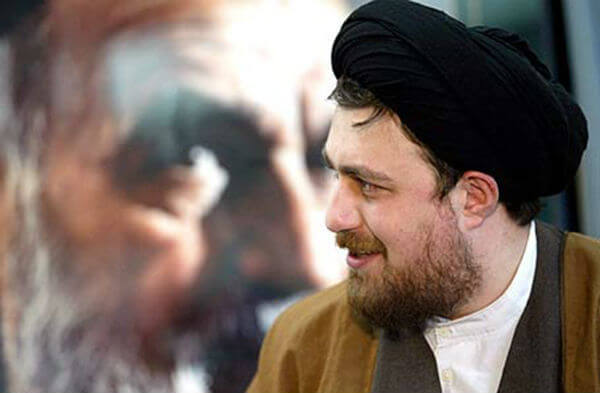
A special correspondent for Foreign Policy reports: Hassan Khomeini, the best-known grandson of Ayatollah Ruhollah Khomeini, registered on Dec. 18 as a candidate in next year’s elections for the Assembly of Experts. The 88-member committee is charged with selecting Iran’s next supreme leader when the incumbent, Ayatollah Ali Khamenei, who is 76 years old and is said to be ailing, dies. The young Khomeini is the first member of his family to seek public office since the death in 1989 of his feted grandfather, who founded the Islamic Republic and served as its first supreme leader. The only question is whether the 43-year-old will be allowed to embark on a path that could eventually lead to the very top of Iran’s complex power structure.
Hassan was born in Qom, the center of religious education in Iran, and home to the country’s clerical political establishment. Hassan’s father, Ahmad, was involved only peripherally in government, having played an influential role in assisting his own father after the long-exiled ayatollah’s triumphant return to Tehran in February 1979. Had he not died of a heart attack in 1995, Ahmad might have preceded his son’s entry to electoral politics.
But now it is Hassan who is moving to center stage.
Having studied and taught in Qom, his main job has been running the mausoleum in Tehran where his father and grandfather are interred, considered a hallowed task by many in Iran. He first started stirring notice in political circles in 2008, when he implicitly criticized Iran’s new political and military elite, which has filled its pockets even while preaching loyalty to the revolution’s founder and the Iranian people.
The IRGC, established by the first supreme leader to protect Iran from foreign and domestic threats, proved its worth during the Iran-Iraq war — but has since earned the enmity of many Iranians by engaging in widespread cronyism and throwing its weight behind the most hard-line figures in the Islamic Republic.
“Those who claim to be loyal to Imam Khomeini should follow his order that the military must stay out of politics,” the younger Khomeini said in an explosive speech when the IRGC was flexing its muscles in 2008 by supporting then-President Mahmoud Ahmadinejad. Khomeini met with reformists before the election the following year and then spoke out in support of the movement’s two defeated candidates, Mir-Hossein Mousavi and Mehdi Karroubi, who claimed the presidential ballot was rigged.
Keeping such company earned Khomeini some credit among moderates. He also shunned Ahmadinejad’s inauguration ceremony, depriving the event of the legitimacy of his family’s endorsement.
Supporters have long wanted Khomeini to enter the public arena. He is markedly younger than the current crop of top Iranian politicians and has already shown something of a youthful, common touch: He’s known to be a fan of Iran’s soccer league and has appeared as a guest on a popular television fanzine. On the show, he said he thought he could have had a career in the game if his grandfather had not ordered him to deepen his religious studies when he was 21 years old.
Khomeini’s 18-year-old son, Ahmad, is another asset. He has 188,000 followers on Instagram, which unlike Facebook or Twitter is not blocked in Iran and offers his father a unique platform to connect with young voters. The Instagram feed provides an insight into the societal change that Khamenei shows no willingness to acknowledge: Photos show Ahmad in Nike sports clothes at a time when Khamenei says American brands should be banned. Yet the teenager is also reverent toward his ancestors, posting pictures of his great-grandfather (who famously branded America “the Great Satan”) and he has taken part in religious ceremonies himself, seamlessly inhabiting both the old and new Iran. [Continue reading…]
Five reasons so many Iranians want to run in February’s elections
Ali Omidi writes: Speculation is that if the Guardian Council approves the candidacies of Khomeini, Rafsanjani and Rouhani, this trio will be able to change the conservative face of the Assembly of Experts. Meanwhile, in the case of parliament, it appears certain that its current conservative face is about to change.
Mindful of the above, the surge in the number of registered candidates can be traced to five main motivating factors.
First is the absence of institutionalized political parties in Iran. The main and most important reason for the surge in the number of candidate registrations is that there are no real political parties in Iran. Although various political societies and factions are active and officially registered, they have been unable, for a variety of reasons, to assume an active role in society similar to that of political parties in Western Europe or North America. As long as political parties are not institutionalized in the political system of a country, each individual can be considered competent on his own. Moreover, since the norm of having political parties does not exist in Iran, some only put forth candidacies because they like the idea of going to the Ministry of Interior to register and getting the related media attention. In addition, considering the rate of unemployment and economic decline in Iran, certain educated but jobless individuals believe that becoming a member of parliament is an opportunity to gain access to better economic and political opportunities.
Second is the Reformists’ strategy. Supporters of the Rouhani administration, including Reformists, have adopted the strategy of introducing a lot of candidates in the hopes that if their leading figures are disqualified, lesser-known Reformists will be given the chance to run for parliament and pursue the Reformist agenda. This strategy is useful for mobilizing people in order to change the political makeup of parliament and the Assembly of Experts, both of which are currently dominated by non-Reformists. Prominent Reformists can of course wield more influence and be more effective compared to second- or third-rate colleagues. However, the Reformists are not going to give up easily. They are hoping to at least increase the political cost for the conservatives if the Guardian Council engages in mass disqualifications of registered candidates. [Continue reading…]
Shahir Shahidsaless writes: The outcome-determinative nature of the elections was recently discussed by Ahmad Khatami, a leading conservative figure and the cleric who leads Tehran’s Friday prayer.
Khatami once remarked that because “Ayatollah Khamenei is currently 74 years old and will be 82 in the next eight years some are thinking that the fifth [meaning next] Assembly of Experts may have to decide on the next leader”. Also speaking to reporters on 21 December, the moderate Rafsanjani said that in these elections “our nation is getting ready for determining their fate for years to come”.
In the past three decades, there have been at the public level cordial relations between Rafsanjani and Supreme Leader Khamenei. However, the two men have represented two competing schools of thought.
In Rafsanjani’s eyes “there is no expediency above people’s opinion”. He argues that “attracting their [the people’s] satisfaction” is essential “for the longevity and stability of the country”. He once remarked that “without people, even a godly government will not sustain and will not get anywhere”. [Continue reading…]
European sympathies lean toward Iran in conflict with Saudi Arabia
The New York Times reports: In the days since Saudi Arabia inflamed tensions with Iran by executing 47 people, including a Shiite cleric, European observers have been quick to condemn the action, reflecting broader concern across the Continent about Saudi policy and its role in the tumult rolling through the Middle East.
Opposition in Europe to the death penalty — and harsh corporal punishment, including the flogging of a Saudi blogger who has become something of a cause célèbre in Europe — is just one element of the criticism of the Saudi monarchy. Even as European governments continue to view Saudi Arabia as a vital if problematic stabilizing force in the region, as well as a rich market for European arms and other products, European opinion has grown increasingly critical of Saudi support and financing for Wahhabist and Salafist preachers who have contributed to the Sunni extremist ideology that has fueled Al Qaeda and the Islamic State.
In addition, the European Union and six major world powers reached a deal in Vienna over the summer to contain Iran’s nuclear program, and Iran is seen as essential to ending the five-year-old civil war in Syria, which has fueled a surge of migrants to the Continent, the highest number since World War II.
So for many Europeans, Iran — long a pariah because of its anti-Western rhetoric and its nuclear program — has suddenly become, at least in comparison with Saudi Arabia, an object of sympathy. [Continue reading…]
Video: Iran-Saudi Arabia tensions explained by Roula Khalaf
Saudi dissident cleric also said Iran’s ally, Bashar al-Assad, deserved to be overthrown

The Washington Post reports: Had Saudi Arabia not sentenced Sheik Nimr Baqr al-Nimr to death, it is unlikely his name would have resonated much beyond the Shiite communities of Saudi Arabia and Bahrain, where he helped inspire anti-government protests by disgruntled Shiites in 2011.
As it was, he became synonymous among Shiites across the region with the oppression of Shiite minorities in the Sunni Arab Gulf, and his execution on Saturday put him at the heart of the most dangerous rupture between Saudi Arabia and Iran in decades.
Forgotten in the furor over the trashing of the Saudi Embassy in Tehran and the subsequent rupture of diplomatic relations by Riyadh is Nimr himself, an enigmatic figure onto whom both sides in the regional conflict have projected their dueling visions.
“He would not have reached this level of prominence if the Saudis hadn’t turned him into a martyr by executing him,” said Mohamad Bazzi, a professor at New York University who is writing a book about the Saudi-Iranian rivalry.
Exactly who Nimr was and what he stood for remain something of a mystery, Bazzi said.
To the Saudis, he was as much of a terrorist as any of the al-Qaeda operatives executed the same day, a traitor who had incited violence and called repeatedly for the overthrow of the Saudi royal family.
His execution was every bit as justified as the killing by U.S. Navy SEALs of Osama bin Laden, a Saudi citizen, said Abdullah al-Shammari, a Saudi political analyst. “Osama bin Laden didn’t kill Americans with his own hand, but his role was to incite people to commit terrorism,” he said.
Iran has cast Nimr as a martyr who died for his faith at the hands of a tyrannical and illegitimate Sunni regime, an heir to the legacy of a long line of martyrs to the Shiite cause.
To his followers, he was an inspiration, a man who articulated their demands for a fairer society and in some instances marched alongside them in their protests. He insulted the royal family in language few Saudis would dare to use, saying in one sermon that he hoped that a Saudi prince who had recently died “will be eaten by worms and suffer the torment of hell in his grave.”
In his own words, according to the available records of his sermons and the few interviews he gave, he was an ardent and uncompromising advocate of the rights of the downtrodden, wherever they might be. Defying the sectarian straitjacket into which he has been cast by the uproar that followed his death, he identified Iran’s ally, Syrian President Bashar al-Assad, as being among the tyrants worthy of being overthrown. He favored peaceful protests — “the roar of the word against authorities rather than weapons,” according to an interview he gave to the BBC in 2011 — but did not explicitly rule out violence as a means of defeating tyranny.
He also defined Shiites as intrinsically more peaceful than Sunnis, telling U.S. diplomats in Riyadh that Shiites, “even more than Sunnis, are natural allies for America,” according to a 2008 diplomatic cable from the WikiLeaks website. [Continue reading…]

‘Children are eating leaves off the trees’: The nightmare of the siege of Madaya, Syria
Vice News reports: In the early hours of Sunday morning, a pregnant woman and her daughter tried to sneak out of Madaya, a mountain village perched in the snow-capped peaks of southwestern Syria.
As they reached the southern edge of town, someone tripped over a landmine, and the loud blast alerted a nearby Hezbollah checkpoint of their escape. The fighters opened fire, and between the explosion and the barrage, both mother and daughter died.
Desperate escape attempts like this one — which was reported by the UK-based Syrian Observatory for Human Rights, and confirmed to VICE News by local residents — have become more and more common in Madaya, a village of 40,000 that’s been under siege since July by a combination of Syrian forces loyal to President Bashar al-Assad and his ally, the Lebanese militia Hezbollah.
In the past month alone, 31 residents have died from starvation, or in attempts to run the Hezbollah-manned blockade that encircles the town. A report compiled by the Syrian-American Medical Society and made available to VICE News found that a kilogram (two pounds)of flour now retails for around $100, while the average Syrian makes less than $200 each month.
“I had strawberry leaves for dinner today,” Rajai, a 26-year old English and math teacher in Madaya, told VICE News by phone, asking that his name be withheld for security reasons. “I haven’t had a real meal in three months.” Since the siege began in July, he’s lost 50 pounds. “Kids are eating leaves off the trees, and the very old and very young are dying,” he said.
As the death toll mounted in December, residents of Madaya began posting desperate pleas on social media, along with disturbing images, reminiscent of Nazi concentration camps. [Continue reading…]
Even while claiming it was uncertain, the oil industry designed its infrastructure to withstand the effects of climate change
The Los Angeles Times reports: A few weeks before seminal climate change talks in Kyoto back in 1997, Mobil Oil took out a bluntly worded advertisement in the New York Times and Washington Post.
“Let’s face it: The science of climate change is too uncertain to mandate a plan of action that could plunge economies into turmoil,” the ad said. “Scientists cannot predict with certainty if temperatures will increase, by how much and where changes will occur.”
One year earlier, though, engineers at Mobil Oil were concerned enough about climate change to design and build a collection of exploration and production facilities along the Nova Scotia coast that made structural allowances for rising temperatures and sea levels.
“An estimated rise in water level, due to global warming, of 0.5 meters may be assumed” for the 25-year life of the Sable gas field project, Mobil engineers wrote in their design specifications. The project, owned jointly by Mobil, Shell and Imperial Oil (a Canadian subsidiary of Exxon), went online in 1999; it is expected to close in 2017.
The United States has never ratified the 1997 Kyoto Protocol to reduce greenhouse emissions.
A joint investigation by the Columbia University Graduate School of Journalism’s Energy and Environmental Reporting Project and the Los Angeles Times earlier detailed how one company, Exxon, made a strategic decision in the late 1980s to publicly emphasize doubt and uncertainty regarding climate change science even as its internal research embraced the growing scientific consensus.
An examination of oil industry records and interviews with current and former executives shows that Exxon’s two-pronged strategy was widespread within the industry during the 1990s and early 2000s.
As many of the world’s major oil companies — including Exxon, Mobil and Shell — joined a multimillion-dollar industry effort to stave off new regulations to address climate change, they were quietly safeguarding billion-dollar infrastructure projects from rising sea levels, warming temperatures and increasing storm severity. [Continue reading…]
Gun stocks are soaring as Obama proposes new gun control measures

Quartz reports: Another gun control measure, another rally for gun stocks.
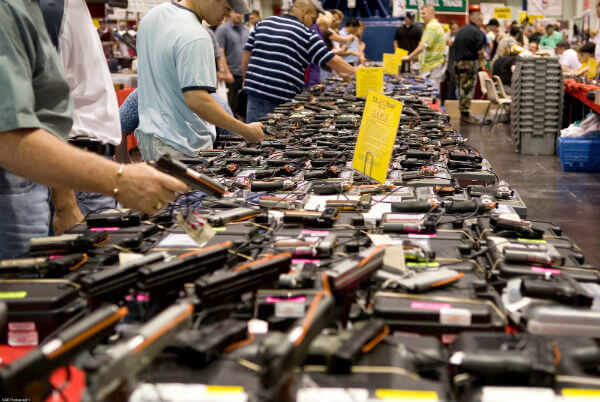
As US president Barack Obama spoke about his proposal to further regulate firearms, shares of Smith & Wesson climbed more than 10% in midday trading today (Jan. 5), while Sturm, Ruger & Co. moved up 7%.Although most Americans don’t own guns and want more gun control, a minority who do own guns end up buying more of them when they feel that stricter regulation — or even just the threat of it — is coming down the pike. And that’s what is set to happen now that Obama, after being repeatedly frustrated by Congress, has chosen to pursue the issue unilaterally with executive action that would: [Continue reading…]
Mapping the Earth from the surface to the core
Steve LeVine writes: This was the defining tension underlying the half-century-long study of the supercontinents: That, unlike in other fields that deal in the very old, the scientists had no time machine. Astronomers, by looking through telescopes at galaxies billions of light years away, are transported back to the early universe. Paleontologists, by stumbling on ancient fossils, can look directly at remnants of prehistoric life. But no instrument or evidence had ever similarly teleported their paleogeologist comrades back to the age of supercontinents.
Instead, paleogeologists painstakingly pieced together their theories using disparate fragments of clues, mainly from the magnetic signatures in old rocks. At first, to give their field a face, they translated these clues into cut-out shapes on paper or in Adobe Illustrator, and strung them together into mosaic-like animations still found today on Google.
But while pretty good as far as they went, most such depictions were faulty in important ways. Among the unavoidable imperfections was their typical reliance on a “flat Earth,” two-dimensional illustrations that distorted the appearance and movement of the continents. In addition, they provided plate movements, but ignored the inextricable system that penetrates thousands of miles into the bowels of the Earth, linked all the way to the core. [Continue reading…]
Music: Arif Lohar & Meesha Shafi — ‘Alif Allah Chambey Di Booty’
The politics animating Sunni-Shia sectarian conflict
Nader Hashemi writes: The response by most Arab regimes, principally those of the GCC, to the Arab Spring is revealing. It serves to highlight the salience of authoritarianism over theology in understanding the dynamics of Sunni-Shi‘i relations today. Fearing that the demand for political change would sweep across the Arab world and destabilize their own societies, several of these regimes relied on a strategy of exploiting sectarianism to deflect demands for democratization. The response from these governments can be situated within the framework of Joel Migdal’s thesis [discussed earlier in this article] on the nature of “weak states” and the “strategies of survival” that shape their politics.
In writing about the House of Saud’s reaction to the Arab Spring, Madawi al-Rasheed observes that:
Sectarianism became a Saudi pre-emptive counter-revolutionary strategy that exaggerates religious difference and hatred and prevents the development of national non-sectarian politics. Through religious discourse and practices, sectarianism in the Saudi context involves not only politicizing religious differences, but also creating a rift between the majority Sunnis and the Shia minority.
This was made easier when only Shi‘as in the Eastern province came out to demonstrate during the Arab Spring, while similar protests in the rest of Saudi Arabia failed to materialize. The specter of an Iranian Shi‘i/Savafid threat was invoked, and the usual Wahhabi court (Ulema) were given air time to issue fatwas against public demonstrations and to warn people of the wrath of God that would fall upon those who defied their rulers. The security forces were then brought in as backup to restore order via the usual tactics of repression that are common in non-democratic regimes.
Al-Rasheed, however, notes that it is wrong to characterize relations between the Saudi regime and its Shi‘i population as a one-way street that relies exclusively on repression. The House of Saud “deploys multiple strategies when it comes to its religious minorities and their leadership,” she observes. “Wholesale systematic discrimination against the Shia may be a characteristic of one particular historical moment, but this can be reversed. A political situation may require alternatives to repression. Sometimes repression is combined with co-optation and even promotion of minority interests and rights.”
For example, when ISIS bombed Shi‘i worshippers on two occasions in May 2015, the Saudi regime strongly condemned the attacks and vowed to hunt down the perpetrators. Expressions of solidarity with the Shi‘a soon followed and were widely disseminated on official state media. Summarizing this strategy, al-Rasheed concludes that:
It is important to note that there is no regular and predictable strategy deployed by Saudi authoritarianism against the Shia. Each historical moment requires a particular response towards this community, ranging from straightforward repression to co-optation and concession. The Arab Spring and its potential impact on the country pushed the regime to reinvigorate sectarian discourse against the Shia in order to renew the loyalty of the Sunni majority.