



The Guardian reports: When Russia launched an air campaign to support Bashar al-Assad, it was banking on a ground force of Syrian troops to finish what its warplanes started.
However, more than 12 weeks later, Syria’s army and the large numbers of Shia militias that back it have made few meaningful gains on the ground. Meanwhile, Moscow’s jets have added a new layer of carnage, reportedly killing at least 600 Syrian citizens, including 70 in Idlib on Sunday.
In Syria’s north and in opposition-held parts of the cities of Hama and Damascus, the destruction wrought on civilian infrastructure and population centres over the past fortnight is more intense than at any point in almost five years of war, residents of the communities and observers outside Syria say.
Meanwhile, the US has claimed that a once-broad gap with Russia over how to end the war has been narrowing, with both sides last week championing a peace process that aims to defuse a conflict that has killed at least 250,000 people and left Syria in ruins.
On the ground in rebel areas, there is little faith in the process. “Where are these reasonable Russians that Kerry claims are starting to see the light?” said a doctor in an Idlib hospital who was treating casualties, referring to the US secretary of state, John Kerry. “Bashar’s jets never bombed us like the Russians do. Isis never hunted us down like this.”
Damage from airstrikes is intensifying, but the Syrian ground forces are showing few signs of being able to use this to their advantage. With opposition anti-tank rockets taking a heavy toll on regime armour between Hama and Latakia, conscription of military-age males is stepping up across government-held parts of the country in an attempt to boost national forces. [Continue reading…]
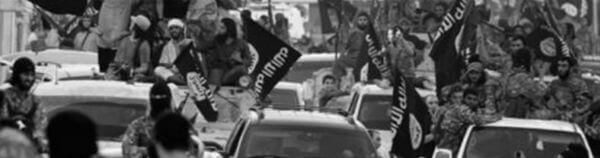
C.J. Chivers writes: Mr. Aboud, in his mid-30s, is an exile from Sarmin, where he had lived most of his adult life. Past associates refer to him as either an ISIS wali or emir, titles conveying authority or military power that the Islamic State bestows on governors and its middle rank.
They note that he did not simply drift to ISIS; he has had a relationship with the original underground Sunni insurgents in Iraq’s Anbar Province, part of the crucible where ISIS formed, reaching back more than a decade.
Mr. Aboud and one of his brothers fought American forces there in 2004 and 2005, several townspeople said. Some suggested that the pair returned to Syria as a sleeper cell tied to Al Qaeda in Iraq, which was founded by Abu Musab al-Zarqawi and after his death in 2006 eventually became ISIS.
In the nearly year and a half since Mr. Aboud publicly joined the Islamic State, taking with him most of his fighters and many powerful weapons, he has been credited with, or blamed for, a sprawling mix of battlefield action and crime. Those who know him contend he led the capture of Palmyra, the town and ancient heritage site that ISIS defiled.
For all of Mr. Aboud’s activity, however, his story suggests limits to advancement within the group, which analysts say to a large degree remains led by Iraqis, including many connected to the dismantled Baathist regime of Saddam Hussein.
Hassan al-Dugheim, a rebel cleric who said he had observed Mr. Aboud since 2011, said his tactical skill and ruthlessness were beyond question. He bluntly added, however, that he considered Mr. Aboud stupid, and that the Islamic State had found in him a man who could be flattered, bought, then used.
“Syrians are for fighting,” he said, and those who had joined ISIS recently faced a glass ceiling inside. “They are like animals to be ridden, like a horse or a mule.” [Continue reading…]

The Washington Post reports: The recent terrorist attacks in Paris have brought into sharper focus the rise of a new breed of jihadists, one that blurs the line between organized crime and Islamist extremism, using skills honed in lawbreaking in the service of violent radicalism.
The Islamic State is constructing an army of loyalists from Europe that includes an increasing number of street toughs and ex-cons as the nature of radicalization evolves in the era of its self-proclaimed caliphate. Rather than leave behind lives of crime, some adherents are using their illicit talents to finance recruiting rings and travel costs for foreign fighters even as their backgrounds give them potentially easier access to cash and weapons, posing a new kind of challenge to European authorities.
Before he became the notorious ringleader of last month’s terrorist attacks in Paris, for instance, Abdelhamid Abaaoud, 28, was linked to a den of radicalized thieves led by a man nicknamed “Santa Claus.”
The gang — including young men who would go on to fight in Syria and Iraq — robbed tourists and shoplifted, forming a petty-crime operation in the service of the Islamic State, authorities say. [Continue reading…]
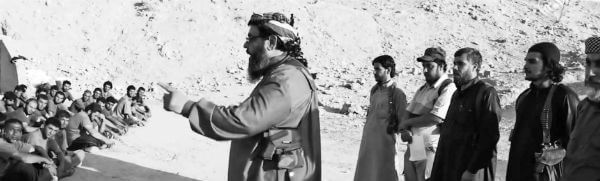
Mustafa Akyol writes: The recent massacres in Paris and San Bernardino, Calif., demonstrated, once again, the so-called Islamic State’s ability to win over disaffected Muslims. Using a mixture of textual literalism and self-righteous certainty, the extremist group is able to persuade young men and women from Pakistan to Belgium to pledge allegiance to it and commit violence in its name.
This is why the Islamic State’s religious ideology needs to be taken seriously. While it’s wrong to claim that the group’s thinking represents mainstream Islam, as Islamophobes so often do, it’s also wrong to pretend that the Islamic State has “nothing to do with Islam,” as many Islamophobia-wary Muslims like to say. Indeed, jihadist leaders are steeped in Islamic thought and teachings, even if they use their knowledge to perverse and brutal ends.
A good place to start understanding the Islamic State’s doctrine is by reading Dabiq, the digital English-language magazine that the group puts out every month. One of the most striking pieces I have seen in it was an 18-page article in March titled “Irja’: The Most Dangerous Bid’ah,” or heresy.
Unless you have some knowledge of medieval Islamic theology you probably have no idea what irja means. The word translates literally as “postponing.” It was a theological principle put forward by some Muslim scholars during the very first century of Islam. At the time, the Muslim world was going through a major civil war, as proto-Sunnis and proto-Shiites fought for power, and a third group called Khawarij (dissenters) were excommunicating and slaughtering both sides. In the face of this bloody chaos, the proponents of irja said that the burning question of who is a true Muslim should be “postponed” until the afterlife. Even a Muslim who abandoned all religious practice and committed many sins, they reasoned, could not be denounced as an “apostate.” Faith was a matter of the heart, something only God — not other human beings — could evaluate. [Continue reading…]

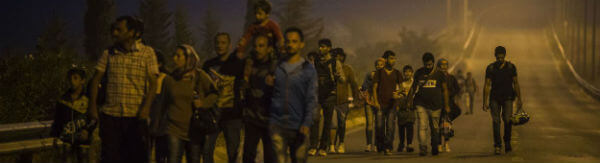
Jenny Erpenbeck writes: I recently read that criminality is on the rise in German towns that have accepted refugees. But it’s not the refugees who are responsible for this crime wave: Germans in these towns have been committing arson, damaging property and attacking refugees. In other words, Germans have been making their own worst fears come true. Often the fear of loss leads to the very loss we fear – a principle that holds true not only for jealous lovers but also, it seems, for those who turn to violence out of fear that the refugees will cost them their safety and peace.
The refugees haven’t even all been registered yet, but already they raise questions about who we are. Some Germans can imagine what it means to lose everything – hence their empathy; some can imagine what it means to lose everything – hence their fear.
We no longer have a universal frame of reference. Angela Merkel’s declaration that refugees are fundamentally deserving of protection – hers was the only declaration of its kind in Europe – has two main sticking points in her own country. First, there’s the free-market logic according to which the German government will prohibit neither the export of weapons by German companies to warring nations nor the ruthless exploitation of resources under corrupt systems in Africa, Asia and eastern Europe.
And then there’s the ever-growing violence, both verbal and physical, from part of the German population: those who would like to see their country walled off with barbed wire – as is happening in Hungary – or, failing that, to at least have the Berlin government refuse to accept even the ridiculously low numbers of refugees mandated by the European Union – as Poland and the UK have done.
But which “European values” are best upheld with barbed wire and fences, regulations, harassment and attacks? Liberté, égalité, fraternité? Or is this mainly about our own survival? In eastern Germany, you can once again hear people chanting Wir sind das Volk (“We are the people”). In 1989 that sentence opened a border; now it’s being used to close a border, to insulate this finally unified Volk from the newcomers, who lack any unity since they are fleeing so many different wars. Are other countries’ wars our responsibility? That’s a question you hear a lot these days. But no one wants to hear the answer. [Continue reading…]

The Washington Post reports: Making friends is no easy task for modern white nationalists.
In an era of gay marriage and a black president, more than a half-century after the Civil Rights Act of 1964 became law, separatists can’t exactly swan dive into conversations with strangers about the white-power cause.
But Rachel Pendergraft — the national organizer for the Knights Party, a standard-bearer for the Ku Klux Klan — told The Washington Post that the KKK, for one, has a new conversation starter at its disposal.
You might call it a “Trump card.”
It involves, say, walking into a coffee shop or sitting on a train while carrying a newspaper with a Donald Trump headline. The Republican presidential candidate, Pendergraft told The Post, has become a great outreach tool, providing separatists with an easy way to start a conversation about issues that are important to the dying white supremacist movement. [Continue reading…]
BBC News reports: A group of Kenyan Muslims travelling on a bus ambushed by Islamist gunmen protected Christian passengers by refusing to be split into groups, according to eyewitnesses.
They told the militants “to kill them together or leave them alone”, a local governor told Kenyan media.
At least two people were killed in the attack, near the north-eastern village of El Wak on the Somali border.
The Somali based al-Shabab group is the main suspect for the attack. [Continue reading…]
According to Hezbollah’s Al-Manar, Samir Qantar, a Lebanese commander who had become a high-profile figure in the group, was killed by an Israeli airstrike in Damascus on Saturday.
Israeli officials welcomed the news but did not confirm responsibility for the attack.
While Hezbollah had no hesitation in accusing Israel, as Raed Omari notes, Syrian officials have been more circumspect:
Remarkably enough, the Syrian account of the incident resembled to a greater degree that of Israel – no confirmation and no refuting.
But the Syrian statements on Qantar’s killing were worded with a heavy Russian military presence in the background and they were inseparable from new political developments on Syria and the new international coalitions in the making.
It can’t be that the Israelis launched an airstrike on Syria now without coordination with their Russian allies who now control Syria’s airspace. And if the Syrians confirmed that Israeli jets killed Qantar, then they would appear as either having prior knowledge of the plan or have no sovereignty over their country.
Who actually killed the 54-year-old Qantar? In my opinion, Israel is a likely perpetrator but the question is how its jets flew over Syria now without being spotted by the Russian satellites and space power. The Russian silence on the incident is also worth-noting.
Meanwhile, a Syrian rebel group has released a statement claiming that they were responsible for Qantar’s death.
The New York Times quotes a Druze militia group that said the building which was targeted had been hit by “four long-range missiles.”
An Israeli columnist quotes “Western sources” claiming that Qantar was a “ticking bomb.”
The sources said Kuntar had recently not been working on behalf of Hezbollah, but rather acting with increasing independence alongside pro-Assad militias in Syria.
The attack in Damascus comes at a moment when, according to Israeli sources, “Iran has withdrawn most of the Revolutionary Guards fighters it deployed to Syria three months ago.”
Assuming that this was indeed an Israeli airstrike, it appears to have not only been aimed at an individual, but also intended to send some additional messages: that Israel is not unduly constrained by Russia’s air operations in Syria and that the Hezbollah fighters propping up the Assad regime are more expendable than their Iranian counterparts.
Creede Newton writes:
Regardless of who fired the missile, Sayed Hassan Nasrallah, the secretary-general of Hezbollah, has already made his decision: this was Israel. Now, the question is, how will Nasrallah respond to another high-level assassination?
Some think Hezbollah’s falling popularity with the Sunni majority in the Middle East due to its meddling in the Syrian conflict could use a boost, and a conflict with Israel would help.
Others say Hezbollah is stretched, and a war with the powerful Israeli military is the last thing the Shia group needs.
Nicholas Blanford writes:
The current situation mirrors the immediate aftermath of an Israeli pilotless drone strike on 18 January in the Golan that killed Jihad Mughniyeh — son of former Hezbollah military commander Imad Mughniyeh — an Iranian general and five other Hezbollah fighters. Hezbollah struck back 10 days later with an anti-tank missile ambush against an Israeli army convoy at the foot of the Shebaa Farms hills, killing an officer and a soldier.
Following the ambush, Hezbollah Secretary General Hassan Nasrallah said in a speech that the rules of engagement that had defined the tit-for-tat conflict between Hezbollah and Israel were over.
“From now on, if any Hezbollah resistance cadre or youth is killed in a treacherous manner, we will hold Israel responsible and it will then be our right to respond at any place and at any time and in the manner we deem appropriate,” he said.
Nasrallah is due to speak Monday night and will probably reaffirm that commitment, which will ensure a state of tension along Israel’s northern border in the coming days.
The concept of reciprocity is a cornerstone of Hezbollah’s defense strategy against Israel, which may offer a clue as to the party’s response to Kuntar’s assassination. In the years following the 2006 War, Nasrallah has articulated on several occasions Hezbollah’s strategy of retaliating in kind for Israeli actions against Lebanon in a future conflict — if Israel bombs Beirut, Hezbollah bombs Tel Aviv; if Israel blockades Lebanese ports, Hezbollah will blockade Israeli ports with its long-range anti-ship missiles; if Israel invades Lebanon, Hezbollah will invade Galilee.
Even on a tactical level, Hezbollah has sought to achieve reciprocity against Israel. In October 2014, Hezbollah mounted a roadside bomb ambush in the Shebaa Farms that wounded two Israeli soldiers in response to the death a month earlier of a party military technician who died when a booby-trapped Israeli wire-tapping device exploded.
The January anti-tank missile attack against the Israeli convoy in the Shebaa Farms also sought to echo Israel’s deadly drone missile strike in the Golan 10 days earlier.
“They killed us in broad daylight, we killed them in broad daylight… They hit two of our vehicles, we hit two of their vehicles,” Nasrallah said at the time.
The Hill reports: A respected former career diplomat who served under the Obama administration doubts the U.S. can achieve a political resolution of the war in Syria without taking more dramatic measures — particularly imposing no-fly zones.
Retired Amb. Ryan Crocker, who President Obama picked as ambassador to Afghanistan in 2011, predicts the negotiations will go “nowhere” as long as Syrian President Bashar Assad, who is backed by Russia, believes he will prevail in the five-year civil war.
“I have the highest regard for Secretary Kerry, but this effort at a political negotiation is going to go nowhere because the Russians, the Iranians and Bashar Al-Assad think they’re on a roll — why should they negotiate?” Crocker said earlier this week at a breakfast in Washington.
The Obama administration has long insisted that Assad must leave in order for there to be peace in Syria, but the president seemed to soften his tone Friday during his last press conference of the year.In contrast to his 2011 declaration that “Assad must go,” the president said Friday that “I think that Assad is going to have to leave.” [Continue reading…]
Kyle Orton writes: Turkey concluded its biggest investigation to date into Islamic State (IS) operatives on its territory on Friday, and blacklisted sixty-seven people. This provides a good moment to review what Turkey’s role has been in the rise of IS, especially amid the escalating accusations from Russia that Turkey is significantly responsible for financing IS. The reality is that while Turkish policy has, by commission and omission, made IS stronger than it would otherwise have been, so has Russia’s policy—and Russia’s policy was far more cynical than Turkey’s, deliberately intended empower extremists to discredit the rebellion against Bashar al-Assad. Turkey’s focus on bringing down Assad and Ankara’s fear of Kurdish autonomy led it into these policies and now—having seemingly found the will to act to uproot IS’s infrastructure on Turkish territory—there is the problem of actually doing so, when IS can (and has) struck inside Turkey. The concerns about these external funding mechanisms for IS, while doubtless important, obscure the larger problem: IS’s revenue is overwhelmingly drawn from the areas it controls and only removing those areas of control can deny IS its funds.
Turkey shot down a Russian jet on November 24, the first time since 1952 a NATO member had brought down a Russian military aircraft. Ankara claimed that its airspace had been violated and numerous requests to withdraw were ignored. The Russian plane landed in northern Syria: one pilot, Oleg Peshkov, was killed in the descent by the Turkoman rebels of Alwiya al-Ashar (The Tenth Brigade) and one, Konstantin Murakhtin, was later rescued. In the wake of this, Moscow took retribution with economic sanctions against Turkey, including limiting tourism and banning charter flights to Turkey and also trade in certain foodstuffs.
Russia’s ruler, Vladimir Putin, then raised the stakes on November 30 by accusing Turkey of perpetrating the shoot-down in order to protect IS, with which the Turkish government has commercial interests, notably oil, but also weapons. Moscow subsequently accused the Turkish President Recep Tayyip Erdogan of being a personal profiteer from the criminal trade in oil with IS. The reality is quite otherwise, of course. As David Butter of Chatham House put it, given Turkey’s reliance on Russia for energy, “if oil was a consideration for the Turkish authorities … it would have had good reason to hold fire.” [Continue reading…]
Al Jazeera reports: As cold, late-autumn rain poured down on the Gaza Strip last month, Yousef al-Najjar watched as his makeshift home sunk deeper into the mud, its thin laminate floors cracking.
Intended as a temporary solution for residents made homeless by Israel’s 2014 war on Gaza, the static caravans of Khuzaa – a cluster of around 70 tin-sheet homes on the town’s outskirts, paid for by donor nations such as Qatar and the United Arab Emirates – are scarcely equipped for another winter. Najjar fears that cold temperatures and increased rainfall will make the homes unliveable.
“We live in a horrible situation,” Najjar, a 47-year-old father of three, told Al Jazeera. “This area of Khuzaa is lower than the rest. When it rains, the water settles here.”
“The [caravans] aren’t insulated, and over time, they have shifted,” he added. “The outside air comes in, then it gets hotter or colder depending on the season. We are provided heaters, but they aren’t effective. Last year, we tried to build fires inside the caravan, but we stopped. We know it’s not safe. What if we fell asleep and it caught fire?” [Continue reading…]
Yezid Sayigh writes: On November 29, 2015, Egyptian President Abdel Fattah el-Sisi amended the powers of the Armed Forces Land Projects Agency, which was set up by presidential decree in 1981 to manage the sale of real estate no longer in use by the armed forces. The latest amendment now additionally empowers the agency to engage in commercial activity “to develop its resources, for which purpose it may form companies in all their guises, whether on its own or jointly with national and foreign capital.”
At first glance, Sisi’s Presidential Decree 446 of 2015 on military land and proceeds merely confirms and continues the expansionary trend of the Egyptian military’s involvement in the civilian economy since he took power in July 2013. Over the past two years, the Egyptian Armed Forces (EAF) have taken on the management role for a number of mega-projects, including construction of a second Suez Canal and plans for over one million new housing units and a new administrative capital. This is part of a broad trend that, according to a study by Shana Marshall published by the Carnegie Middle East Center in April 2015, has made the EAF “the primary gatekeeper for the Egyptian economy” since 2013, if not earlier. [Continue reading…]
By Daria Kuss, Nottingham Trent University
A prisoner was in the US was recently released after 44 years of incarceration for the attempted murder of a police officer. Emerging onto the streets of New York City, Otis Johnson, now 69, found himself bewildered by the world before him. Seeing people apparently talking to themselves on the street, futuristic headphones dangling from their ears, reminded him of CIA agents. People barely paid attention to their surroundings, and instead studied their smartphones while crossing the street, engrossed in their own personal bubbles.
Technology had delivered Johnson a massive culture shock, the shock of a world where technology has quickly changed the way we live and the way we relate to one another.
In 2013 Sherry Turkle, a clinical psychologist and esteemed professor at the prestigious Massachusetts Institute of Technology, wrote Alone Together, in which she questioned the extent to which social media is bringing people together. Following decades of research on the profound impact of modern technology on human relationships, Turkle concluded that with the omnipresence of technology “we’re moving from conversation to connection”.
Connection, it seems, denotes a very different quality of social interaction in comparison to conversation, as it refers to continuous streams of little titbits of information, such as those neatly packaged into 140 characters on Twitter.
Conversation, on the other hand, refers to listening and empathic understanding, actively attending to another person, rather than fleetingly commenting on their status updates online while simultaneously talking on the phone, doing the laundry, or preparing the children’s dinner.


John Wendle reports: Kemal Ali ran a successful well-digging business for farmers in northern Syria for 30 years. He had everything he needed for the job: a heavy driver to pound pipe into the ground, a battered but reliable truck to carry his machinery, a willing crew of young men to do the grunt work. More than that, he had a sharp sense of where to dig as well as trusted contacts in local government on whom he could count to look the other way if he bent the rules. Then things changed. In the winter of 2006–2007, the water table began sinking like never before.
Ali had a problem. “Before the drought I would have to dig 60 or 70 meters to find water,” he recalls. “Then I had to dig 100 to 200 meters. Then, when the drought hit very strongly, I had to dig 500 meters. The deepest I ever had to dig was 700 meters. The water kept dropping and dropping.” From that winter through 2010, Syria suffered its most devastating drought on record. Ali’s business disappeared. He tried to find work but could not. Social uprisings in the country began to escalate. He was almost killed by crossfire. Now Ali sits in a wheelchair at a camp for wounded and ill refugees on the Greek island of Lesbos.
Climatologists say Syria is a grim preview of what could be in store for the larger Middle East, the Mediterranean and other parts of the world. The drought, they maintain, was exacerbated by climate change. The Fertile Crescent — the birthplace of agriculture some 12,000 years ago — is drying out. Syria’s drought has destroyed crops, killed livestock and displaced as many as 1.5 million Syrian farmers. In the process, it touched off the social turmoil that burst into civil war, according to a study published in March in Proceedings of the National Academy of Sciences USA. A dozen farmers and former business owners like Ali with whom I recently spoke at camps for Syrian refugees say that’s exactly what happened. [Continue reading…]
