How pro-Kremlin tweeps are framing the Syrian debate

RFE/RL reports: Support among Russians for military intervention in Syria has more than doubled, to 31 percent in early October from 14 percent in September, according to independent pollster Levada Center.

The increase comes with coverage of air strikes filling Russian state airwaves, press, and the Internet, and social-media salvoes fired from both sides of the debate.

On social networks like Twitter, expressions of support for Moscow’s air raids appear to fit into three distinct categories: perceived cultural and historical affinities between Syria and Russia; purported Western helplessness in the face of the continuing Syrian crisis; and the conflation of any armed forces opposing Syrian President Bashar al-Assad’s regime under the “terrorist” banner. [Continue reading…]

Facebooktwittermail

Losing control in the Caucasus

Politico reports: Nagorno-Karabakh, the former Soviet Union’s oldest and most dangerous conflict, is waking up again. The 1994 ceasefire between Armenia and Azerbaijan is under severe strain. Where there was occasional sniper fire two years ago, mortars are now being fired. Rockets are raining down on the Armenia-Azerbaijan border and the ceasefire line east of Karabakh itself. There have been around a dozen casualties in the last week.

It is still premature to talk about a return to the kind of full-scale war that raged here for three years in the 1990s. But the leaders in both Baku and Yerevan are digging themselves into warlike positions that they will find hard to give up.

This is not about the “hand of Russia” — although Russia’s behavior is not helping. The danger of the Caucasus is that no one is fully in charge and that Karabakh is becoming another link in a chain of disorder stretching from Ukraine to Syria, in which Russia meddles but is not fully in charge. [Continue reading…]

Facebooktwittermail

A peace prize for Tunisia and lessons for everyone else

Rami G Khouri writes: On Oct. 9, Tunisian National Dialogue Quartet was awarded the Nobel Peace Prize for shepherding the only successful transition to democracy in the Arab world since uprisings began in the region in 2010. The quartet’s importance goes far beyond its pivotal role in brokering a democratic transition in 2013 and 2014: It can provide important lessons for other Arab countries as well as foreign powers that remain perplexed about how to respond to continuing Arab struggles for freedom, dignity and democracy.

The quartet’s composition was the crucial starting point of its successes. It consisted of the country’s largest labor union (UGTT), its employers’ federation (UTICA), its lawyers’ association and the Tunisian Human Rights Association. The first two represented Tunisian workers and business owners, critical poles of the economy; the lawyers and human rights activists represented the rule of law, constitutionalism and citizen rights in the pluralistic democracy that would replace the old dictatorship.

These four organizations had the moral authority and political credibility required to achieve constitutional democracy, but they also took three practical steps to enable their success. They made regular compromises among those in authority, including rotating power and voluntarily relinquishing the premiership; ensured that major decisions reflected inclusive consultations among all political actors and the public; and patiently phased in all major steps toward their democracy. [Continue reading…]

Facebooktwittermail

Iran lawmakers vote to implement nuclear deal

The New York Times reports: Iran’s parliament voted Tuesday to support implementing a landmark nuclear deal struck with world powers despite hard-line attempts to derail the bill, suggesting the historic accord will be carried out.

The bill will be reviewed by Iran’s 12-member Guardian Council, a group of senior clerics who could return it to lawmakers for further discussion. However, Iran’s Supreme Leader Ayatollah Ali Khamenei, who has the final say on key policies, has said it is up to the 290-seat parliament to approve or reject the deal.

Signaling the nuclear deal’s likely success, a spokesman for moderate President Hassan Rouhani’s administration welcomed the parliament’s vote and called it a “historic decision.”

“Members of parliament made a well-considered decision today showing they have a good understanding of the country’s situation,” Mohammad Bagher Nobakht said. “We hope to see acceleration in progress and development of the country from now on.”

The European Union’s foreign policy chief Federica Mogherini, who helped facilitate the nuclear talks, also praised the vote as “good news” in a message on Twitter.

In the parliamentary session carried live by state radio, 161 lawmakers voted for implementing the nuclear deal, while 59 voted against it and 13 abstained. Another 17 did not vote at all, while 40 lawmakers did not attend the session.

A preliminary parliamentary vote Sunday saw 139 lawmakers out of the 253 present support the outline of the bill. But despite getting more support Tuesday, hard-liners still tried to disrupt the parliament’s session, shouting that Khamenei himself did not support the bill while trying to raise numerous proposals on its details. [Continue reading…]

The Wall Street Journal reports: Tensions between the U.S. and Iran, rather than easing as a result of July’s nuclear accord, are increasing over a wide spectrum of issues tied to the broader Middle East security landscape and to domestic Iranian politics, current and former U.S. officials say.

Just in the past two days, Iran has test-fired a ballistic missile and announced the conviction of American journalist Jason Rezaian, fueling suspicions the historic nuclear agreement has allowed Tehran’s Islamist clerics to step up their long-held anti-U.S. agenda.

Washington’s closest Mideast allies, particularly Israel and Saudi Arabia, are more broadly concerned about Iran’s ability to use the diplomatic cover provided by the nuclear accord—and the promised release of tens of billions of dollars of frozen oil revenues—to strengthen its regional position and that of its allies. [Continue reading…]

Reuters reports: Iran’s Supreme Leader Ayatollah Ali Khamenei on Wednesday banned any further negotiations between Iran and the United States, putting the brakes on moderates hoping to end Iran’s isolation after reaching a nuclear deal with world powers in July.

Khamenei, the highest authority in the Islamic Republic, already said last month there would be no more talks with the United States after the nuclear deal, but has not previously declared an outright ban. [Continue reading…]

The New York Times reports: The Washington Post said on Monday that its correspondent Jason Rezaian, who has been jailed for 14 months in Iran on espionage charges, had been convicted after a trial that ended two months ago.

While the conviction could not be independently confirmed — a spokesman for the Iranian judiciary said on Sunday that a verdict had been handed down, but he did not disclose specifics — Iran appeared to be moving on Monday to position Mr. Rezaian’s case as part of a broader effort to get the release of Iranians detained in the United States.

On Monday, a state television news channel accused Mr. Rezaian, a dual American-Iranian citizen, of providing information to the United States about individuals and companies who were helping Iran circumvent international economic sanctions.

Iranian leaders, including President Hassan Rouhani, have raised the idea of a prisoner swap, suggesting that Mr. Rezaian, 39, could be exchanged for people who Tehran says are being held by or on the orders of the United States for violating sanctions. [Continue reading…]

Facebooktwittermail

Peace process over, it’s Year Zero for Israelis and Palestinians

Lisa Goldman writes: A month from now, Israel will mark 20 years since the assassination of Yitzhak Rabin, the prime minister who signed the Oslo Accord. The night he was shot by a Jewish nationalist, Yigal Amir, Rabin appeared onstage at a peace rally in Tel Aviv, where he joined singer Miri Aloni, delivering an off-key and embarrassed rendition of the famous 1960s anti-war song “Shir LaShalom” (“Song to Peace”). A blood-spattered leaflet bearing the song’s lyrics was found in his suit pocket and became an enduring metaphor for the tragedy.

Worse was to come: Thousands of Palestinians and hundreds of Israelis have been killed in the two decades of violence that followed — a cycle once again on the uptick. Today Aloni makes her living as a busker. Twice a week, she cradles her guitar on a stool outside Tel Aviv’s squalid Carmel Market and performs her golden oldies for spare change, yelling at people who try to take her photograph. Thus the fortunes of what was once known as Israel’s peace camp.

Two decades after Rabin’s assassination, the occupation that was supposed to be ended by the Oslo process has been deepened and widened. The physical restrictions under which Palestinians live are far more onerous today than they were in 1987, when the first intifada broke out. Back then, Palestinian residents of the West Bank and East Jerusalem could still travel freely throughout the territory between the Mediterranean Sea and the Jordan River. And there were several hundred thousand fewer settlers living in those occupied territories. Still, back then Palestinians were also jailed for involvement in any kind of political activity, even for waving a Palestinian flag. And, as today, those living under occupation had no democratic rights in the state that ruled over them and were denied civil liberties. One difference, of course, is that today there’s a willing Palestinian participant in that repression, in the form of the Palestinian Authority’s security services. [Continue reading…]

Facebooktwittermail

Sheldon Adelson warms to Marco Rubio

Politico reports: Sheldon Adelson, one of the Republican Party’s most sought-after contributors, is leaning increasingly toward supporting Marco Rubio — and the Florida senator is racing to win the backing of other uncommitted megadonors who have the potential to direct tens of millions of dollars his way and alter the contours of the Republican primary fight.

Last week, during a campaign swing through Las Vegas, Rubio held a meeting in Adelson’s offices at the Venetian Las Vegas, one of a number of five-star luxury casinos the billionaire mogul owns around the world. Adelson, seated at the head of his conference table, heaped praise on Rubio’s performance while he discussed the dynamics of the 2016 race. Those briefed on the meeting described it as short but said it had an air of importance, with the two joined by Rubio’s campaign manager, Terry Sullivan, and a pair of senior Adelson advisers, Rob Goldstein and Patrick Dumont.

Those close to Adelson — who spent more than $100 million on Republican candidates and causes during the 2012 campaign and has been aggressively courted by most would-be Republican nominees — stressed that the 82-year-old gambling magnate had made no final decision on whom he’d support but said that momentum had strongly shifted to the Florida senator. A formal endorsement, they said, could come as soon as the end of the month — and with it, the potential for a multimillion dollar contribution. With a net worth of $25.7 billion, according to Forbes, Adelson can afford to spend freely. [Continue reading…]

Facebooktwittermail

Oil unlikely to ever be fully exploited because of climate concerns, says BP

The Guardian reports: The world’s oil resources are unlikely to ever be fully exploited, BP has admitted, due to international concern about climate change.

The statement, by the group’s chief economist, is the clearest acknowledgement yet by a major fossil fuel company that some coal, oil and gas will have to remain in the ground if dangerous global warming is to be avoided.

“Oil is not likely to be exhausted,” said Spencer Dale in a speech in London. Dale, who chief economist at the Bank of England until 2014, said: “What has changed in recent years is the growing recognition [of] concerns about carbon emissions and climate change.”

Scientists have warned that most existing fossil fuel reserves must stay in the ground to avoid catastrophic global warming and Dale accepted this explicitly. [Continue reading…]

Facebooktwittermail

If you’re not paranoid, you’re crazy

Walter Kirn writes: I knew we’d bought walnuts at the store that week, and I wanted to add some to my oatmeal. I called to my wife and asked her where she’d put them. She was washing her face in the bathroom, running the faucet, and must not have heard me—she didn’t answer. I found the bag of nuts without her help and stirred a handful into my bowl. My phone was charging on the counter. Bored, I picked it up to check the app that wirelessly grabs data from the fitness band I’d started wearing a month earlier. I saw that I’d slept for almost eight hours the night before but had gotten a mere two hours of “deep sleep.” I saw that I’d reached exactly 30 percent of my day’s goal of 13,000 steps. And then I noticed a message in a small window reserved for miscellaneous health tips. “Walnuts,” it read. It told me to eat more walnuts.

It was probably a coincidence, a fluke. Still, it caused me to glance down at my wristband and then at my phone, a brand-new model with many unknown, untested capabilities. Had my phone picked up my words through its mic and somehow relayed them to my wristband, which then signaled the app?

The devices spoke to each other behind my back—I’d known they would when I “paired” them—but suddenly I was wary of their relationship. Who else did they talk to, and about what? And what happened to their conversations? Were they temporarily archived, promptly scrubbed, or forever incorporated into the “cloud,” that ghostly entity with the too-disarming name?

It was the winter of 2013, and these “walnut moments” had been multiplying—jarring little nudges from beyond that occurred whenever I went online. One night the previous summer, I’d driven to meet a friend at an art gallery in Hollywood, my first visit to a gallery in years. The next morning, in my inbox, several spam e-mails urged me to invest in art. That was an easy one to figure out: I’d typed the name of the gallery into Google Maps. Another simple one to trace was the stream of invitations to drug and alcohol rehab centers that I’d been getting ever since I’d consulted an online calendar of Los Angeles–area Alcoholics Anonymous meetings. Since membership in AA is supposed to be confidential, these e‑mails irked me. Their presumptuous, heart-to-heart tone bugged me too. Was I tired of my misery and hopelessness? Hadn’t I caused my loved ones enough pain? [Continue reading…]

Facebooktwittermail

Russia doubles number of daily airstrikes in Syria as rebels intensify their attacks

The New York Times reports: Russian warplanes are carrying out more airstrikes in support of Syrian government ground troops as rebels are firing more American antitank weapons, deepening the impression that a proxy war between the United States and Russia is joining the list of interlocking conflicts in Syria.

Russia doubled the number of its airstrikes over the weekend to more than 60 a day, Russian state news media said, helping government troops take two villages on Monday.

Videos posted online by pro-Russian outlets, from an area above the village of Tal Skayk, in Hama Province, showed Syrian troops and allied militias watching as heavy barrages sent smoke towering from clusters of houses, while a narrator enthusiastically described progress in fighting “terrorists.”

At the same time, the handful of insurgent groups that received covert assistance from the United States have intensified their use of TOW antitank guided missiles, posting more than two dozen videos in the past few days of the missiles weaving over open fields before hitting their targets. [Continue reading…]

The Washington Post reports: It is unclear whether the TOWs will be able to change the course of the war, as did the Stinger antiaircraft missiles introduced in the 1980s by the CIA in Afghanistan, where they were used by the mujahideen to shoot down Russian helicopters and paralyze the Soviet army.

Now that the Russians have introduced more intensive and heavier airstrikes and, for the first time, combat helicopters have been seen in videos strafing villages in the Hama area, the TOW missiles may only be able to slow, but not block, government advances.

The rebels have appealed for the delivery of Stinger missiles or their equivalents to counter the new threat from the air, but U.S. officials say that is unlikely. The Obama administration has repeatedly vetoed past requests from the rebels, as well as their Turkish and Saudi allies, for the delivery of antiaircraft missiles, out of concerns that they could fall into extremist hands.

But the TOW missile program is already in progress, and all the indications are that it will continue. Saudi Arabia, the chief supplier, has pledged a “military” response to the Russian incursion, and rebel commanders say they have been assured more will arrive imminently.

Under the terms of the program, the missiles are delivered in limited quantities, and the rebel groups must return the used canisters to secure more, to avoid stockpiling or resale.

The supplies of the missiles, manufactured by Raytheon, are sourced mainly from stocks owned by the Saudi government, which purchased 13,795 of them in 2013, for expected delivery this year, according to Defense Department documents informing Congress of the sale. Because end-user agreements require that the buyer inform the United States of their ultimate destination, U.S. approval is implicit, said [Oubai ] Shahbandar, a former Pentagon adviser. [Continue reading…]

Facebooktwittermail

Ankara bombs: Turkey is being torn apart by bad leaders and bad neighbours

By Alpaslan Ozerdem, Coventry University

It had already been a deadly summer of political instability in Turkey. And now this. Another bloody massacre – this time at the hand of twin bomb attacks on a peace rally in Ankara, which have killed at least 97 people.

It is the worst terror attack in Turkey’s history, and the culmination of a dreadful wave of violence. In just a few months, hundreds of civilians, Turkish security personnel and PKK members have been killed. Barely a single day passes in Turkey nowadays without some incident of lethal political violence.

Freedom from fear is the very basic principle of human security, which should be protected by any state that wants a true sense of legitimacy over its population and territory. In Turkey, that freedom is under enormous pressure from all sorts of internal and external forces.

Continue reading

Facebooktwittermail

Turkey bombs PKK after Ankara’s deadly blasts as unrest persists

Bloomberg reports: Turkey’s military said it killed dozens of Kurdish separatists hours after explosions in Ankara left at least 97 people dead, making good on the government’s vow to continue attacking the group even after it was reported to have declared a unilateral cease-fire.
Thirty-five members of the Kurdistan Workers’ Party, or PKK, were killed when fighter jets targeted their bases in northern Iraq, state-run Anadolu news agency reported on Sunday. Another 14 died in airstrikes in Turkey’s largely Kurdish Diyarbakir province, the military said in a statement. Two soldiers and a policeman were killed in the operations, Hurriyet newspaper reported, while clashes broke out between police and protesters in Turkish cities.
The violence leaves Turkey in the throes of deepening domestic unrest three weeks before a general election. Authorities have said the carnage in Ankara, for which no one claimed responsibility, could be the work of Islamic State militants who are battling allies of the PKK in Syria. Police are analyzing DNA samples from the families of 16 suspects, according to Hurriyet. [Continue reading…]

Facebooktwittermail

ISIS suicide bombers suspected in the Ankara attack

The Daily Beast reports: The so-called Islamic State has emerged as the main suspect behind the deadliest bomb attack in Turkish history, which killed almost 100 people in the capital Ankara on Saturday. Analysts say the incident shows that the conflict in neighboring Syria is destabilizing Turkey, a crucial U.S. ally and NATO member in the Middle East.

There has been no official statement by police or the government blaming ISIS jihadists for the twin suicide attack on a peace rally in Ankara. But the official Anadolu news agency quoted police sources as saying the bombs used in Ankara— packs of TNT fortified with metal balls for increased destructive effect— were similar to the one a suspected ISIS suicide bomber used in an attack in the town of Suruc on July 20 that killed more than 30 people.

Several Turkish newspapers also reported that one of the two suicide bombers, Yunus Emre Alagoz, 25, was the brother of Suruc bomber Seyh Abdurrahman Alagoz. The other Ankara bomber was a woman, news reports said. The Alagoz brothers allegedly traveled to Syria last year to join ISIS and received bomb-making training before returning to Turkey. [Continue reading…]

Facebooktwittermail

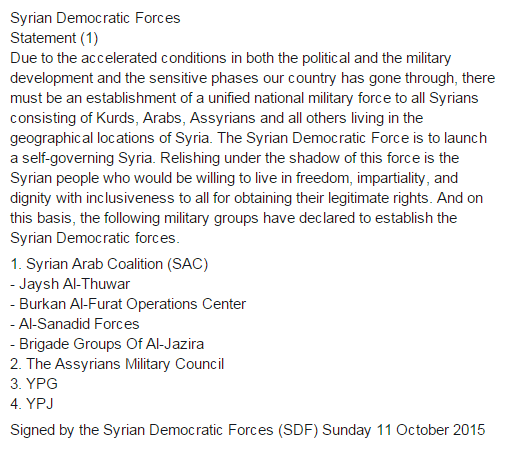
New Syrian alliance unites Kurds, Arabs, and Assyrians

Reuters reports: A Kurdish militia that has been fighting Islamic State in Syria with help from U.S.-led air strikes has joined forces with Arab groups in an alliance announced on Monday that may be a prelude to an attack on the jihadists’ base of operations in Raqqa.

The alliance calling itself the Democratic Forces of Syria includes the Kurdish YPG militia and Syrian Arab groups, some of which fought alongside it in a campaign that drove Islamic State from wide areas of northern Syria earlier this year.

The Arab groups in the new alliance are operating under the name “The Syrian Arab Coalition” – a grouping which U.S. officials have said would receive support under a new U.S. strategy aimed at fighting Islamic State in Syria.

A U.S. military official has told Reuters that the Syrian Arab Coalition would push down towards Raqqa, Islamic State’s de facto capital, while staying east of the Euphrates river. [Continue reading…]

A statement issued yesterday by the Syrian Democratic Forces says:

sdfstatement

Facebooktwittermail

Syria: New Russian-made cluster munition reported

Human Rights Watch: An advanced type of Russian cluster munition was used in an airstrike southwest of Aleppo on October 4, 2015, Human Rights Watch said today. The use of the weapon near the village of Kafr Halab raises grave concerns that Russia is either using cluster munitions in Syria or providing the Syrian air force with new types of cluster munitions to use.

New photographs and videos also suggest renewed use of air-dropped cluster munitions as well as ground-fired Russian-made cluster munition rockets as part of the joint Russian-Syrian offensive in northern Syria.

“It’s disturbing that yet another type of cluster munition is being used in Syria given the harm they cause to civilians for years to come,” said Nadim Houry, deputy Middle East director at Human Rights Watch. “Neither Russia nor Syria should use cluster munitions, and both should join the international ban without delay.” [Continue reading…]

Last month, Human Rights Watch researcher, Ole Solvang, wrote about Saudi Arabia’s use of cluster bombs in Yemen: Cluster munitions were used in Yemen in past wars and now Saudi Arabia and members of its coalition are dropping bombs and launching rockets with this indiscriminate weapon on populated areas.

The U.S. is providing logistical and intelligence support for the coalition, and if it is providing targeting assistance for cluster munition strikes, it could be complicit in resulting laws-of-war violations. What’s more, the evidence we found of cluster rocket use just a few weeks ago showed that they were manufactured by U.S. companies. U.S. officials have expressed concern at the use of cluster munitions by Syria, South Sudan, Ukraine, and Sudan yet when it comes to the use of cluster munitions by the coalition in Yemen, the U.S. has been silent. [Continue reading…]

Facebooktwittermail

Shiites in Iraq hail ‘Sheikh Putin’

The New York Times reports: One of the most popular Facebook posts in Iraq’s Shiite heartland is a Photoshopped image of President Vladimir V. Putin of Russia dressed in the robe of a southern tribal sheikh.

It was the American-led invasion in 2003 that toppled Saddam Hussein and empowered Iraq’s long-repressed Shiite majority. The United States also took the lead more than a year ago to assemble a coalition to conduct airstrikes in Syria and Iraq against the Sunni militants of the Islamic State.

But with the struggle against the Islamic State largely stalemated, it is the naked display of Russian military power in neighboring Syria, as well as the leadership of “Sheikh Putin,” that is being applauded by residents of this Shiite power center. Russian planes continued to hit targets in Syria on Sunday, the Russian Defense Ministry said.

“What the people in the street care about is how to get Daesh out of Iraq,” Ibrahim Bahr al-Ulum, a member of Iraq’s Parliament, said, using an Arabic name for the Islamic State, also known as ISIS or ISIL. “Now they feel Russia is more serious than the United States.” [Continue reading…]

Facebooktwittermail

Israel still holds all the cards

Noam Sheizaf writes: Over the past decade the Palestinian Authority took upon itself the role of Israel’s operations contractor of the occupation, with an understanding that quiet in the West Bank would create the requisite conditions for progress in peace talks with Israel. That’s what the Palestinians have always been promised, at least — if the violence stops, we’ll talk and you’ll get your state.

But it’s now clear that the dynamic is the exact opposite. The calm on the ground made Israelis believe that they can enjoy peace and prosperity without ending the occupation. The tragic paradox is that it was the intifadas that led to Israeli concessions (Oslo, the Gaza Disengagement), while the peaceful years resulted in more hardline Israeli positions and the expansion of settlements. In weeks like this one, it is sad to recall the commotion Netanyahu raised with his demands that the Palestinians recognize Israel as a “Jewish state,” and not just as “The State of Israel,” as if Israel needs Abbas to define its identity. Be sure that if Abbas had recognized Israel as a Jewish state, Netanyahu would have invented something new to demand. Anything in order to not reach an agreement.

When the PLO leadership understood that it wasn’t going to get anywhere with Israel, it took a gamble by seeking international pressure — first from the United states and then from Europe. The thing is, Washington will never seriously pressure Israel. If one compares America’s commitment to the Iran deal to its flaccid approach to the Palestinian issue, things come into focus rather quickly. The Iran deal was a matter of American interests for the Obama administration. The Israeli-Palestinian conflict was little more than an irritation.

Dramatic developments in the Arab world, particularly in Syria, are the final nails in the coffin of Palestine’s international strategy. Syria has gone from an Iranian-Turkish-Saudi proxy war to an American-Russian one, with massive consequences for the entire region and beyond — and as if that weren’t enough, the Americans are now worried about the stability of Jordan. Under these conditions, Israel’s strategy of strengthening and maintaining the status quo in the occupied territories suddenly seams reasonable to the United States. [Continue reading…]

Facebooktwittermail

Masked soldiers and mass division will define the next intifada

Joseph Dana writes: After months of violence between Israel and the Palestinians, most observers can barely contain their views on whether this is the start of the third Palestinian intifada. In the past few days, Israel has arrested hundreds of Palestinians in the West Bank and East Jerusalem, a Palestinian woman blew herself up near an Israeli settlement, injuring one police officer, and the Israeli air force fired missiles into the Gaza Strip, killing a 30-year-old pregnant woman and her two-year-old daughter.

It is still too early to call this cycle of violence an intifada but the direction of events on the ground doesn’t bode well for an immediate cessation of fighting. Regardless of the outcome, there are several salient aspects to this latest uptick of unrest that will have a lasting effect on the conflict as a whole.

Mahmoud Abbas’s Palestinian Authority, under the Oslo Accords, has proven itself to be an effective enforcer of Israeli security and occupation, even better than the Israeli military or Shin Bet. For several years, the PA security forces have routinely crushed any form of Palestinian dissent towards Israel or the Palestinian leadership in Ramallah. Without the PA keeping a lid on Palestinians, there would have been a third intifada months ago. [Continue reading…]

Facebooktwittermail