The Washington Post: The Obama administration is urging lawmakers to pass a bipartisan bill that would end the National Security Agency’s mass collection of Americans’ phone records, an effort that has been boosted by a federal appeals court’s ruling last week that the program was unlawful.
The White House’s support for the USA Freedom Act, which preserves the government’s ability to obtain more limited amounts of records, comes as the House is expected to pass it on Wednesday. That sets up a showdown in the Senate, where Majority Leader Mitch McConnell (R-Ky.) is backing another bill that would maintain the NSA program of mass collection and renew it through 2020.
The attorney general and the director of national intelligence are expected to issue soon a letter of support for the USA Freedom Act, saying that they do not think it will undermine national security while its proposed reforms will enhance Americans’ privacy.
Big drop in share of Americans calling themselves Christian
The New York Times reports: The Christian share of adults in the United States has declined sharply since 2007, affecting nearly all major Christian traditions and denominations, and crossing age, race and region, according to an extensive survey by the Pew Research Center.
Seventy-one percent of American adults were Christian in 2014, the lowest estimate from any sizable survey to date, and a decline of 5 million adults and 8 percentage points since a similar Pew survey in 2007.
The Christian share of the population has been declining for decades, but the pace rivals or even exceeds that of the country’s most significant demographic trends, like the growing Hispanic population. It is not confined to the coasts, the cities, the young or the other liberal and more secular groups where one might expect it, either.
“The decline is taking place in every region of the country, including the Bible Belt,” said Alan Cooperman, the director of religion research at the Pew Research Center and the lead editor of the report. [Continue reading…]
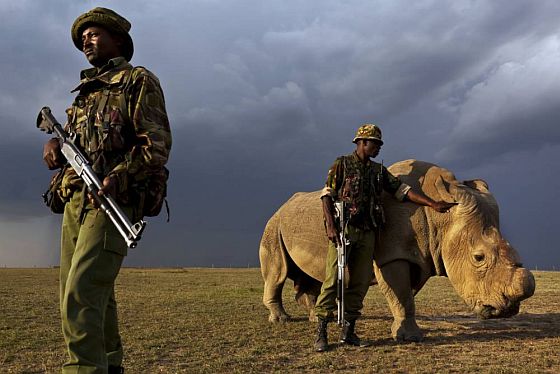
A picture of loneliness: You are looking at the last male northern white rhino

Jonathan Jones writes: What is it like to look at the very last of something? To contemplate the passing of a unique wonder that will soon vanish from the face of the earth? You are seeing it. Sudan is the last male northern white rhino on the planet. If he does not mate successfully soon with one of two female northern white rhinos at Ol Pejeta conservancy, there will be no more of their kind, male or female, born anywhere. And it seems a slim chance, as Sudan is getting old at 42 and breeding efforts have so far failed. Apart from these three animals there are only two other northern white rhinos in the world, both in zoos, both female.
It seems an image of human tenderness that Sudan is lovingly guarded by armed men who stand vigilantly and caringly with him. But of course it is an image of brutality. Even at this last desperate stage in the fate of the northern white rhino, poachers would kill Sudan if they could and hack off his horn to sell it on the Asian medicine market.
Sudan doesn’t know how precious he is. His eye is a sad black dot in his massive wrinkled face as he wanders the reserve with his guards. His head is a marvellous thing. It is a majestic rectangle of strong bone and leathery flesh, a head that expresses pure strength. How terrible that such a mighty head can in reality be so vulnerable. It is lowered melancholically beneath the sinister sky, as if weighed down by fate. This is the noble head of an old warrior, his armour battered, his appetite for struggle fading. [Continue reading…]
The world beyond your head
Matthew Crawford, author of The World Beyond Your Head, talks to Ian Tuttle.
Crawford: Only by excluding all the things that grab at our attention are we able to immerse ourselves in something worthwhile, and vice versa: When you become absorbed in something that is intrinsically interesting, that burden of self-regulation is greatly reduced.
Tuttle: To the present-day consequences. The first, and perhaps most obvious, consequence is a moral one, which you address in your harrowing chapter on machine gambling: “If we have no robust and demanding picture of what a good life would look like, then we are unable to articulate any detailed criticism of the particular sort of falling away from a good life that something like machine gambling represents.” To modern ears that sentence sounds alarmingly paternalistic. Is the notion of “the good life” possible in our age? Or is it fundamentally at odds with our political and/or philosophical commitments?
Crawford: Once you start digging into the chilling details of machine gambling, and of other industries such as mobile gaming apps that emulate the business model of “addiction by design” through behaviorist conditioning, you may indeed start to feel a little paternalistic — if we can grant that it is the role of a pater to make scoundrels feel unwelcome in the town.
According to the prevailing notion, freedom manifests as “preference-satisfying behavior.” About the preferences themselves we are to maintain a principled silence, out of deference to the autonomy of the individual. They are said to express the authentic core of the self, and are for that reason unavailable for rational scrutiny. But this logic would seem to break down when our preferences are the object of massive social engineering, conducted not by government “nudgers” but by those who want to monetize our attention.
My point in that passage is that liberal/libertarian agnosticism about the human good disarms the critical faculties we need even just to see certain developments in the culture and economy. Any substantive notion of what a good life requires will be contestable. But such a contest is ruled out if we dogmatically insist that even to raise questions about the good life is to identify oneself as a would-be theocrat. To Capital, our democratic squeamishness – our egalitarian pride in being “nonjudgmental” — smells like opportunity. Commercial forces step into the void of cultural authority, where liberals and libertarians fear to tread. And so we get a massive expansion of an activity — machine gambling — that leaves people compromised and degraded, as well as broke. And by the way, Vegas is no longer controlled by the mob. It’s gone corporate.
And this gets back to what I was saying earlier, about how our thinking is captured by obsolete polemics from hundreds of years ago. Subjectivism — the idea that what makes something good is how I feel about it — was pushed most aggressively by Thomas Hobbes, as a remedy for civil and religious war: Everyone should chill the hell out. Live and let live. It made sense at the time. This required discrediting all those who claim to know what is best. But Hobbes went further, denying the very possibility of having a better or worse understanding of such things as virtue and vice. In our time, this same posture of value skepticism lays the public square bare to a culture industry that is not at all shy about sculpting souls – through manufactured experiences, engineered to appeal to our most reliable impulses. That’s how one can achieve economies of scale. The result is a massification of the individual. [Continue reading…]
Music: Wes Montgomery — ‘Four On Six’
Pakistanis knew where bin Laden was, say U.S. sources
NBC News reports: Two intelligence sources tell NBC News that the year before the U.S. raid that killed Osama bin Laden, a “walk in” asset from Pakistani intelligence told the CIA where the most wanted man in the world was hiding – and these two sources plus a third say that the Pakistani government knew where bin Laden was hiding all along.
The U.S. government has always characterized the heroic raid by Seal Team Six that killed bin Laden as a unilateral U.S. operation, and has maintained that the CIA found him by tracking couriers to his walled complex in Abbottabad, Pakistan.
The new revelations do not necessarily cast doubt on the overall narrative that the White House began circulating within hours of the May 2011 operation. The official story about how bin Laden was found was constructed in a way that protected the identity and existence of the asset, who also knew who inside the Pakistani government was aware of the Pakistani intelligence agency’s operation to hide bin Laden, according to a special operations officer with prior knowledge of the bin Laden mission. The official story focused on a long hunt for bin Laden’s presumed courier, Ahmed al-Kuwaiti.
While NBC News has long been pursuing leads about a “walk in” and about what Pakistani intelligence knew, both assertions were made public in a London Review of Books article by investigative reporter Seymour Hersh. Hersh’s story, published over the weekend, raises numerous questions about the White House account of the SEAL operation. It has been strongly disputed both on and off the record by the Obama administration and current and former national security officials. [Continue reading…]
Blogger accuses Seymour Hersh of ‘plagiarism’ for bin Laden raid story
Politico: In the day following the publication of Seymour Hersh’s scandalous alternative account of the 2011 raid that killed Osama bin Laden, the prize-winning investigative journalist has been pilloried as a fabulist, a fool, and even a fibber.
But one national security expert has a new insult to throw into the mix: plagiarist.
R.J. Hillhouse, a national security blogger and former college professor, wrote on her blog, “The Spy Who Billed Me” that she had accused the Obama administration of fabricating accounts of its raid that killed Osama bin Laden back in August 2011. Hersh’s story, published in the London Review of Books on Sunday, is “either plagiarism or unoriginal,” wrote Hillhouse.
The blog post Hillhouse is referring to dates back to August 7, 2011, only a few months after Osama bin Laden’s death. In it Hillhouse wrote, like Hersh, that the informant who led the CIA to bin Laden was a walk-in seeking financial compensation, that Pakistani officials were keeping bin Laden under house arrest with Saudi financial support, and that Pakistani officials had cooperated with the clandestine U.S. operation that killed him. [Continue reading…]
The many problems with Seymour Hersh’s latest conspiracy theory
Max Fisher writes: On Sunday, the legendary investigative journalist Seymour Hersh finally released a story that he has been rumored to have been working on for years: the truth about the killing of Osama bin Laden. According to Hersh’s 10,000-word story in the London Review of Books, the official history of bin Laden’s death — in which the US tracked him to a compound in Abbottabad, Pakistan; killed him in a secret raid that infuriated Pakistan; and then buried him at sea — is a lie.
Hersh’s story is amazing to read, alleging a vast American-Pakistani conspiracy to stage the raid and even to fake high-level diplomatic incidents as a sort of cover. But his allegations are largely supported only by two sources, neither of whom has direct knowledge of what happened, both of whom are retired, and one of whom is anonymous. The story is riven with internal contradictions and inconsistencies.
The story simply does not hold up to scrutiny — and, sadly, is in line with Hersh’s recent turn away from the investigative reporting that made him famous into unsubstantiated conspiracy theories.
A decade ago, Hersh was one of the most respected investigative journalists on the planet, having broken major stories from the 1969 My Lai massacre to the 2004 Abu Ghraib scandal. But more recently, his reports have become less and less credible. He’s claimed that much of the US special forces is controlled by secret members of Opus Dei, that the US military flew Iranian terrorists to Nevada for training, and that the 2014 chemical weapons attack in Syria was a “false flag” staged by the government of Turkey. Those reports have had little proof and, rather than being borne out by subsequent investigations, have been either unsubstantiated or outright debunked. A close reading of Hersh’s bin Laden story suggests it is likely to suffer the same fate. [Continue reading…]
Has ISIS lost its head?
The Daily Beast reports: Abu Bakr al-Baghdadi, the Islamic State’s leader, has been moved from Iraq to the Syrian city of Raqqa, the terror army’s de facto capital, amid tight security two months after sustaining serious shrapnel wounds leaving his spine damaged and his left leg immobile, say jihadist defectors.
He is said to be mentally alert and able to issue orders, but his physical injuries are now prompting the so-called Islamic State’s governing Shura Council to make a final decision on a temporary stand-in leader who can move back and forth between front-lines in Syria and Iraq and is able to handle day-to-day leadership in the self-declared caliphate.
That leader will be, in effect, under al-Baghdadi, a super deputy to the caliph — in Arabic, na’ib al-malik, or viceroy. According to Islamic State defectors debriefed by opposition activists in neighboring Turkey, the election will pit two Iraqis and a Syrian against each other — all well-known figures within the terror army’s top leadership.
These sources say nine doctors to treat the infirm al-Baghdadi were also taken to Raqqa, including a senior physician from Mosul’s general hospital, but the entire al-Baghdadi caravan of attending medics, aides and body guards was split into separate convoys to avoid attracting attention from U.S. satellite surveillance and inviting a coalition airstrike or drone attack. At least one doctor didn’t know who his patient was when he arrived in Raqqa and was ordered brusquely to stop asking questions about the man’s identity. [Continue reading…]
Assad fires an intel chief
The Daily Beast reports: The sacking of yet another Syrian intelligence chief has raised suspicions that President Bashar al-Assad’s inner circle is fraying under the pressure of recent battlefield losses to the rebels. Disputes over the out-sized role Iran is playing to prop up the beleaguered Damascus regime are thought to be central to these internal disputes.
Ali Mamlouk, the head of the country’s National Security Bureau, and considered a trusted security adviser to the Assad family since the 1970s, has been accused of plotting a coup and placed under house arrest, according to a report today in Britain’s Daily Telegraph. In the past few weeks two other spy chiefs have been removed or killed.
In April, Rustum Ghazaleh, head of the Political Security Directorate, died in hospital after he was beaten up on the orders of General Rafiq Shehadeh, his counterpart in military intelligence, who was in turn sacked. The two argued ]over the increasing power of Iranian advisers in Damascus. [Continue reading…]
Saudi forces and Houthis trade heavy fire along border
Al Jazeera reports: Yemen’s Houthi fighters and Saudi Arabian forces have traded heavy artillery and rocket fire in border areas, residents say, a day before a proposed ceasefire.
The Houthis said they fired Katyusha rockets and mortars on the Saudi cities of Jizan and Najran on Monday, after the Saudis hit Saada and Hajjah provinces with more than 150 rockets, the Reuters news agency reported.
Saudi Arabia’s civil defence department said that one Saudi person was killed in the shelling in Najran, which it said targeted a school and residence adjacent to a military post. [Continue reading…]
Yemen: Coalition blocking desperately needed fuel
Human Rights Watch: The Saudi Arabia-led coalition’s blockade of Yemen is keeping out fuel needed for the Yemeni population’s survival in violation of the laws of war. Yemen is in urgent need of fuel to power generators for hospitals overwhelmed with wounded from the fighting and to pump water to civilian residences.
The 10-country coalition, which has United States logistics and intelligence support, should urgently implement measures for the rapid processing of oil tankers to allow the safe, secure, and speedy distribution of fuel supplies to the civilian population. The Houthis and other armed groups controlling port areas should permit the safe transfer of fuel to hospitals and other civilian entities. Fuel should be allowed to go through whether or not a proposed ceasefire takes effect.
“The rising civilian casualties from the fighting could become dwarfed by the harm caused to civilians by the coalition blockade on fuel, if it continues,” said Joe Stork, deputy Middle East and North Africa director. “It is unclear how much longer Yemen’s remaining hospitals have before the lights go out.” [Continue reading…]
Hamas cracks down on Salafists in Gaza Strip
Asmaa al-Ghoul writes: The confrontation between the Salafist jihadist movement and Hamas-led security services in the Gaza Strip has returned to the surface following a two-year truce between the two sides.
Strong tensions returned after security services arrested Salafist Sheikh Adnan Mayt, a prominent Salafist jihadist activist, April 6. This was followed by the arrest of other Salafists and raids of their homes, an April 29 statement by Ansar al-Dawla al-Islamiya (Arabic for “supporters of the Islamic State”) said.
The arrests increased following the two roadside bomb blasts that detonated in the Gaza Strip on April 18, which the Interior Ministry described as “primitive.” One of the blasts exploded near the outer wall of the UNRWA headquarters, and the other went off near the UNRWA general prosecutor’s office. A third explosion took place a day earlier near the Abu Mazen roundabout in western Gaza. [Continue reading…]
Talking death (and life) with a sheikh
Carla Power writes: During my year studying the Quran with Sheikh Akram Nadwi, an Islamic scholar born in India and based in Oxford, England, our conversations ranged from Jesus to jihad, from sex to the fires of hell. Trying to map where my secular feminist worldview met his conservative Islamic one, and where our two worldviews diverged, we found death both divided and united us. When my father passed away in Mexico, the sheikh comforted me by reciting a poem by a famous Pakistani poet about losing a parent. And when my mother and his died within days of one another — mine in St. Louis, his in rural Uttar Pradesh — we grieved together, too, finding common ground in Jewish and Muslim traditions.
But his view of death and mine also divided us. The Sheikh’s fear and awe of God meant he kept the specter of death close, the way other men carry their keys. No matter how much he respected me, he was certain of one thing: if I didn’t accept Muhammad as a prophet, I would face the fires of hell. As a Muslim, he saw this as certain. As my friend, he hoped I would come to Islam, and step back from the threat of hell-fire.
The tea arrived, and prayer time was in an hour, so I decided to seize the moment. “Sheikh, so what do you think is going to happen to me? Do you think I can be a good person but still not submit? Am I still going to hell?”
Never had a fire-and-brimstone message been delivered more gently.
“The thing basically is,” the Sheikh said evenly, “in the way of the Quran, people have no salvation until they believe there is no one to worship except Allah. If people are good without that, there could be some reward for them in this world, but it’s not real salvation.”
His kindness prevented him from saying “you,” or from mentioning the manacles and flames. He smiled and observed that it was difficult to accept when one has been on the wrong path. “The problem actually is, Carla, we don’t want it, but it’s always better for people to correct themselves before it is too late. Even people who correct themselves one hour before death, it’s fine.” He continued, “Belief in God — every good starts from that. Then after that, people can get better and better. The basic level is to believe properly.”
We sat for a second in silence.
“And you’ve never had any doubts?” I ventured.
“Sometimes, I really feel very frightened.” The Sheikh hesitated. “For myself. There is no guarantee that you will die a believer. It could be that someone who thinks they are a believer is actually an unbeliever. Everything depends on God. Nothing is certain.”
This uncertainty, not of God but of himself, felt reassuringly familiar. Secularists often assume that the faithful have the comfort of certainty. But the Sheikh’s humility wouldn’t allow him to trust in his own piety. Every time he prays, he adds a prayer asking God, once again, to let him die a believer. [Continue reading…]

Election may set U.K. on path to a split, isolation
The Washington Post reports: After unexpected political charisma and cunning propelled him to another term as Britain’s prime minister, David Cameron will now need every ounce of those skills to avoid going down in history with an altogether different title: founding father of Little England.
A result that maintained the status quo at 10 Downing Street masked the dramatic transformations roiling Britain, ones that threaten to leave this country more isolated than at any time in its modern history.
Thursday’s election may become just the first in a trilogy of rapid-fire votes that set this island adrift from Europe, divide it in half along ancient lines of national identity and ultimately leave behind a rump state of ever-diminishing value to its American allies.
“Yesterday was V-E Day, when the United Kingdom was celebrating its finest hour. Seventy years later, it could be contemplating the beginning of its end in its current form,” said David Torrance, a British political analyst and author. “The next five years will be a twin debate about two unions — the European Union and the United Kingdom.”
The questions of whether Britain stays whole and whether it remains in Europe are deeply entangled, with the outcome of one expected to heavily influence the other. [Continue reading…]
Democracy doesn’t stop at the election – and Britain’s is broken
By Colin Crouch, University of Warwick
It’s only after an election is over that real politics begins. The polls themselves are designed to preserve almost perfect equality among citizens in the electoral process.
But that’s just the formal side of democracy. Election campaigns have become almost liturgical, heavily choreographed events. And what takes place during the rest of the five years is the informal side – a much rougher affair, with no gestures towards equality at all.
The contrast between the two parts of politics has been stretched to breaking point as campaigns become ever more artificial, while inequalities of wealth and income grow more extreme and play an ever greater political role.
That rising inequality is creating economic and social problems is now widely understood, but there’s been far less discussion of the threats it poses to democracy. The issue really comes into focus when we recognise these differences between the formal and informal sides of democracy, and the very different ways in which they treat inequality.
In the electoral process, we quite rightly insist on important principles of perfect equality. We stick to one citizen, one vote and punish those who try to cheat, hold the parties’ broadcast presentations to strict fairness rules, ban party materials from polling stations, and closely limit individual candidates’ spending.
But democracy isn’t just about voting. It’s about campaigning, discussing, lobbying and imposing pressure – things that go on all the time, not just during elections. This is the informal part of the political system, and if it did not exist we could hardly say we lived in a democracy.
The problem is that these parts of our democracy offer no guarantee at all of equality among citizens.
MIT: ‘Massive’ solar expansion critical for climate
Climate Central: A “massive” global expansion of solar power — possibly enough to supply about a third or more of the world’s electricity — may be necessary by 2050 to reduce the impacts of fossil fuels on the climate, according to a report published by MIT this week.
Solar’s efficiency and abundance make it the clean energy source best suited to cut greenhouse gas emissions. But for it to make a big enough climate difference, the amount of solar power generation capacity on U.S. soil would have to increase from today’s 20 gigawatts to up to 400 gigawatts, or enough to provide power to 80 million homes, Robert Stoner, deputy director of the MIT Energy Initiative and a co-author of the report, said.
The study says that may not happen in the U.S. unless solar industry-supported funding and incentives are almost completely re-imagined. The solar industry currently supports keeping those incentives in place.
Those changes would include scrapping state renewable power generation standards for utilities and directly subsidizing solar power generation in lieu of tax credits, according to the report, “The Future of Solar Energy.” As new ways of funding solar power are being worked out, new technology needs to be developed for solar energy storage, smarter power grid management and new kinds of solar panels that use more abundant raw materials that would help keep solar panel prices low, the study suggests. [Continue reading…]
Sea level rise accelerated over the past two decades, research finds
The Guardian reports: Sea level rise sped up over the last two decades rather than slowing down as previously thought, according to new research.
Records from tide gauges and satellites have shown sea level rise slowing slightly over the past 20 years. But as the ice sheets of West Antarctica and Greenland shed ever more water into the ocean, climate models show it should be doing the opposite.
“The thing that was really puzzling us was that the last decade of sea level rise was marginally slower, ever so subtly slower, than the decade before it,” said Dr Christopher Watson from the University of Tasmania who led the new study.
Watson’s team found that the record of sea level rise during the early 1990s was too high. The error gave the illusion of the rate of sea level rise decreasing by 0.058 mm/year 2 between 1993 and 2014 , when in reality it accelerated by between 0.041 and 0.058 mm/year 2 . This brings the records into line with the modelling of the UN’s climate science body, the Intergovernmental Panel on Climate Change (IPCC). [Continue reading…]