Mohammed Emwazi triable in British courts for war crimes, say prosecutors

The Guardian reports: Prosecutors and detectives have been working on building a criminal case against Mohammed Emwazi, 26, for potential offences of war crimes and multiple counts of murder, the Guardian has learned.

The the Islamic State militant dubbed “Jihadi John” has featured in seven propaganda videos claiming responsibility for the beheadings of hostages from Britain, the US and other countries.

The Crown Prosecution Service on Friday confirmed it is working with detectives from Scotland Yard’s counter-terrorism command to prosecute Emwazi over the videos and other suspected crimes if he ever comes within Britain’s jurisdiction.

A former top prosecutor said Emwazi’s crimes would be triable in British courts if committed overseas in territory seized by Isis in Syria during the civil war there.

A CPS spokesperson said: “We are liaising with the MPS [Metropolitan Police Service] Counter Terrorism Command (SO15) on their assessment of the content of videos that have been posted online that appear to show the murder of hostages.”

Lord MacDonald QC, the former director of public prosecutions, said the fact the offences took place in Syria would not prohibit a prosecution in a British court: “Since Victorian times it has been a criminal offence for British citizens to commit murder anywhere.” [Continue reading…]

Facebooktwittermail

Öcalan calls on PKK to convene conference on laying down arms

Today’s Zaman reports: The jailed leader of the Kurdistan Workers’ Party (pkk) calls on the outlawed group to convene a conference in spring on laying down its arms, the pro-Kurdish Peoples’ Democratic Party (hdp) announced on Saturday, in a landmark step towards ending the PKK’s 30-year-old armed campaign.

“I invite the PKK to convene an extraordinary congress in spring months to make the strategic and historic decision on the basis of ending the armed struggle,” HDP’s Sırrı Süreyya Önder quoted Öcalan as saying at a joint news conference with Deputy Prime Minister Yalçın Akdoğan and Interior Minister Efkan Ala in İstanbul. Two other HDP lawmakers, Pervin Buldan and İdris Balüken, also attended the conference, which followed a 45-minute meeting between the HDP delegation and Akdoğan and Ala.

“We call on all democratic parties to support this democratic solution,” Önder said, asserting that Turkey is “closer than ever to peace.”

“We have reached an important point in the settlement process,” Akdoğan told the same conference. He said the democratic progression will gather momentum once arms are left aside. [Continue reading…]

Facebooktwittermail

Israel lobbies U.S. Congress for extra cash

Bloomberg reports: For the second consecutive year, Israeli officials have asked the U.S. Congress to add more than $300 million to President Barack Obama’s budget request for their nation’s missile-defense programs.

The $317 million wish list that Israeli’s missile defense chief gave lawmakers this month is in addition to the $158 million the Pentagon proposed for the fiscal year that starts Oct. 1. The Israeli request would provide first-time production funds for two programs — David’s Sling and Arrow-3.

Israel’s latest lobbying on Capitol Hill, instead of through the White House and Pentagon, comes at a low point in political relations between the U.S. and Israel over Prime Minister Benjamin Netanyahu’s planned speech to Congress on March 3 to derail what he calls an emerging “bad deal” by the Obama administration to curb Iran’s nuclear program.

Yair Ramati, the director of Israel’s missile defense organization, visited lawmakers and aides to the congressional defense committees on Feb. 2 and 3 to outline the case for more money and thank them for past assistance, according to people familiar with the meetings who asked not to be identified describing the private discussions. Obama’s proposed budget was released on Feb. 2.

The U.S. provides funds for Israel’s missile defenses — including the Iron Dome interceptors that have gained fame for fending off Hamas rockets from Gaza — separately from the $3.1 billion a year given to Israel in “foreign military financing” to buy weapons through the budget for the State Department and foreign operations. [Continue reading…]

Facebooktwittermail

U.S. rethinks plan to retake Mosul

The Wall Street Journal reports: The U.S. military is considering a months-long campaign of airstrikes to squeeze Islamic State fighters in Mosul before inserting Iraqi ground forces to retake the city, officials said Friday.

The on-the-ground fight to retake Mosul isn’t likely to start until the fall at the earliest, after an intensified air campaign to target Islamic State leaders and cut off supply lines in and around the city, the officials said.

The emerging plan is at odds with a briefing by a U.S. military’s Central Command official in February in which he said the U.S. and Iraq were looking at starting a campaign to liberate Mosul, Iraq’s second-largest city, by April or May.

Afterward, Iraqi and American officials cast doubt on the likely readiness of Iraqi forces.

U.S. military officials now say they believe that Iraqi’s best military units are many months away from being in a position to successfully conduct such an operation. Those forces haven’t yet begun their training at the bases set up by American military officers in Iraq.

“When we feel that the Iraqi forces are ready to go and win decisively, we will go and advise the Iraqis to begin the operation,” a military official said. [Continue reading…]

Facebooktwittermail

How to rewild our language of landscape

Robert Macfarlane writes: Eight years ago, in the coastal township of Shawbost on the Outer Hebridean island of Lewis, I was given an extraordinary document. It was entitled “Some Lewis Moorland Terms: A Peat Glossary”, and it listed Gaelic words and phrases for aspects of the tawny moorland that fills Lewis’s interior. Reading the glossary, I was amazed by the compressive elegance of its lexis, and its capacity for fine discrimination: a caochan, for instance, is “a slender moor-stream obscured by vegetation such that it is virtually hidden from sight”, while a feadan is “a small stream running from a moorland loch”, and a fèith is “a fine vein-like watercourse running through peat, often dry in the summer”. Other terms were striking for their visual poetry: rionnach maoim means “the shadows cast on the moorland by clouds moving across the sky on a bright and windy day”; èit refers to “the practice of placing quartz stones in streams so that they sparkle in moonlight and thereby attract salmon to them in the late summer and autumn”, and teine biorach is “the flame or will-o’-the-wisp that runs on top of heather when the moor burns during the summer”.

The “Peat Glossary” set my head a-whirr with wonder-words. It ran to several pages and more than 120 terms – and as that modest “Some” in its title acknowledged, it was incomplete. “There’s so much language to be added to it,” one of its compilers, Anne Campbell, told me. “It represents only three villages’ worth of words. I have a friend from South Uist who said her grandmother would add dozens to it. Every village in the upper islands would have its different phrases to contribute.” I thought of Norman MacCaig’s great Hebridean poem “By the Graveyard, Luskentyre”, where he imagines creating a dictionary out of the language of Donnie, a lobster fisherman from the Isle of Harris. It would be an impossible book, MacCaig concluded:

A volume thick as the height of the Clisham,

A volume big as the whole of Harris,

A volume beyond the wit of scholars.

The same summer I was on Lewis, a new edition of the Oxford Junior Dictionary was published. A sharp-eyed reader noticed that there had been a culling of words concerning nature. Under pressure, Oxford University Press revealed a list of the entries it no longer felt to be relevant to a modern-day childhood. The deletions included acorn, adder, ash, beech, bluebell, buttercup, catkin, conker, cowslip, cygnet, dandelion, fern, hazel, heather, heron, ivy, kingfisher, lark, mistletoe, nectar, newt, otter, pasture and willow. The words taking their places in the new edition included attachment, block-graph, blog, broadband, bullet-point, celebrity, chatroom, committee, cut-and-paste, MP3 player and voice-mail. As I had been entranced by the language preserved in the prose‑poem of the “Peat Glossary”, so I was dismayed by the language that had fallen (been pushed) from the dictionary. For blackberry, read Blackberry.

I have long been fascinated by the relations of language and landscape – by the power of strong style and single words to shape our senses of place. And it has become a habit, while travelling in Britain and Ireland, to note down place words as I encounter them: terms for particular aspects of terrain, elements, light and creaturely life, or resonant place names. I’ve scribbled these words in the backs of notebooks, or jotted them down on scraps of paper. Usually, I’ve gleaned them singly from conversations, maps or books. Now and then I’ve hit buried treasure in the form of vernacular word-lists or remarkable people – troves that have held gleaming handfuls of coinages, like the Lewisian “Peat Glossary”.

Not long after returning from Lewis, and spurred on by the Oxford deletions, I resolved to put my word-collecting on a more active footing, and to build up my own glossaries of place words. It seemed to me then that although we have fabulous compendia of flora, fauna and insects (Richard Mabey’s Flora Britannica and Mark Cocker’s Birds Britannica chief among them), we lack a Terra Britannica, as it were: a gathering of terms for the land and its weathers – terms used by crofters, fishermen, farmers, sailors, scientists, miners, climbers, soldiers, shepherds, poets, walkers and unrecorded others for whom particularised ways of describing place have been vital to everyday practice and perception. It seemed, too, that it might be worth assembling some of this terrifically fine-grained vocabulary – and releasing it back into imaginative circulation, as a way to rewild our language. I wanted to answer Norman MacCaig’s entreaty in his Luskentyre poem: “Scholars, I plead with you, / Where are your dictionaries of the wind … ?” [Continue reading…]

Facebooktwittermail

Darwin learned more about evolution from plants than Galapagos Finches

Henry Nicholls writes: When the HMS Beagle dropped anchor on San Cristobal, the easternmost island in the Galapagos archipelago, in September 1835, the ship’s naturalist Charles Darwin eagerly went ashore to gather samples of the insects, birds, reptiles, and plants living there. At first, he didn’t think much of the arid landscape, which appeared to be “covered by stunted, sun-burnt brushwood…as leafless as our trees during winter” But this did not put him off. By the time the Beagle left these islands some five weeks later, he had amassed a spectacular collection of Galapagos plants.

It is fortunate that he took such trouble. Most popular narratives of Darwin and the Galapagos concentrate on the far more celebrated finches or the giant tortoises. Yet when he finally published On the Origin of Species almost 25 years later, Darwin made no mention of these creatures. In his discussion of the Galapagos, he dwelt almost exclusively on the islands’ plants.

By the early 19th century, there was increasing interest in what we now refer to as biogeography, the study of the distribution of species around the globe. Many people still imagined that God had been involved in the creation of species, putting fully formed versions down on Earth that continued to reproduce themselves, dispersing from a divine “center of creation” to occupy their current habitats. To explain how the plants and animals reached far-flung places such as the isolated Galapagos, several naturalists imagined that there had to have been land bridges, long-since subsided, that had once connected them to a continent. But in the wake of the Beagle voyage, the collection of Galapagos plants suggested an alternate scenario.

Even if there had once been a land bridge to the islands, it could not account for the fact that half of the plant species Darwin collected were unique to the Galapagos, and that most of them were particular to just one island. “I never dreamed that islands, about fifty or sixty miles apart, and most of them in sight of each other, formed of precisely the same rocks, placed under a quite similar climate, rising to a nearly equal height, would have been differently tenanted,” wrote Darwin in his Journal of Researches. His observations could be best explained if species were not fixed in nature but somehow changed as the seeds traveled to different locations. [Continue reading…]

Facebooktwittermail

The big melt: Antarctica’s retreating ice may re-shape Earth

The Associated Press reports: From the ground in this extreme northern part of Antarctica, spectacularly white and blinding ice seems to extend forever. What can’t be seen is the battle raging thousands of feet (hundreds of meters) below to re-shape Earth.

Water is eating away at the Antarctic ice, melting it where it hits the oceans. As the ice sheets slowly thaw, water pours into the sea — 130 billion tons of ice (118 billion metric tons) per year for the past decade, according to NASA satellite calculations. That’s the weight of more than 356,000 Empire State Buildings, enough ice melt to fill more than 1.3 million Olympic swimming pools. And the melting is accelerating.

In the worst case scenario, Antarctica’s melt could push sea levels up 10 feet (3 meters) worldwide in a century or two, recurving heavily populated coastlines.

Parts of Antarctica are melting so rapidly it has become “ground zero of global climate change without a doubt,” said Harvard geophysicist Jerry Mitrovica. [Continue reading…]

Facebooktwittermail

ISIS may not be a global threat, but neither is it a problem with a ready solution

The New York Times reports: The reports are like something out of a distant era of ancient conquests: entire villages emptied, with hundreds taken prisoner, others kept as slaves; the destruction of irreplaceable works of art; a tax on religious minorities, payable in gold.

A rampage reminiscent of Tamerlane or Genghis Khan, perhaps, but in reality, according to reports by residents, activist groups and the assailants themselves, a description of the modus operandi of the Islamic State’s self-declared caliphate this week. The militants have prosecuted a relentless campaign in Iraq and Syria against what have historically been religiously and ethnically diverse areas with traces of civilizations dating to ancient Mesopotamia.

The latest to face the militants’ onslaught are the Assyrian Christians of northeastern Syria, one of the world’s oldest Christian communities, some speaking a modern version of Aramaic, the language of Jesus.

Assyrian leaders have counted 287 people taken captive, including 30 children and several dozen women, along with civilian men and fighters from Christian militias, said Dawoud Dawoud, an Assyrian political activist who had just toured the area, in the vicinity of the Syrian city of Qamishli. Thirty villages had been emptied, he said. [Continue reading…]

In the aftermath of the war in Iraq, some Americans, perceiving echoes of the government-fueled national hysteria that followed 9/11, now regard the attention being given to ISIS as disproportionate to the size of the threat.

A few days ago, one commentator described ISIS as: “A nasty nuisance, which has killed thousands in the Middle East, but a nuisance nonetheless.”

If one subscribes to the Steven Pinker view of the world, then how bad the current situation is, just comes down to numbers.

Fewer people have been killed by ISIS than by barrel bombs dropped by the Assad regime in Syria, or were killed during the U.S.-led invasion and occupation of Iraq.

The threat to humanity posed by climate change, far exceeds all other global threats, including what can arguably be called a minor threat from ISIS.

But if an issue is defined as not rising above the threshold of being a nuisance, solely based on numbers, then since between 1882 and 1968 only 3,446 blacks were lynched in America, should the racial violence occurring during that chapter in this country’s history be described as having been no more than a nasty nuisance?

The very fact that we view lynching as emblematic of a chapter in history, illustrates the fact that significance can never be reduced to numbers.

In France, the death toll from the Charlie Hebdo shootings was little more than the average number of fatalities that occur every day on France’s roads.

Since statistically, the French face little more risk from terrorism than they face from traffic accidents, does that mean the French government should devote the same amount of time and resources to addressing road safety as they do to tackling terrorism?

Again, this doesn’t just come down to numbers. For one thing, there’s no reason to view road safety as a problem that risks escalating. Neither is there reason to imagine that individuals or groups of people have a specific interest in making the roads more dangerous. Road safety is an issue that gains ongoing and appropriate attention from every relevant constituency from central government to local government, town planners to school teachers, and vehicle manufacturers to medics.

The fact that it is the type of issue that generally gets effectively addressed, is the very reason it is largely ignored in political and popular discourse.

Conversely, while it’s easy to say that ISIS presents a problem that needs “to be dealt with,” the very fact that it remains unclear what mechanisms might be effective in tackling this problem, is one of the main reasons ISIS continues to grab the headlines.

ISIS might not represent an unstoppable force and yet its campaign of violence has proved very difficult to contain.

Politicians glibly talk about the strategy for defeating ISIS, yet no one has made a convincing case that such a strategy has been found.

Some observers believe that each time another ISIS headline appears, the group has simply been served up the attention it craves, but to dismiss this as a group of attention-seekers is to gravely misjudge ISIS’s ambitions.

A year ago, before ISIS had become a household name but after it taken over Fallujah, President Obama wanted to downplay its significance in what became an infamous dismissal — he said they were just “a jayvee team.”

In those early months of 2014, ISIS used America’s inattention to its full advantage.

Whether showered with or starved of attention, ISIS pursues its goals because they have less concern about how they are perceived by Americans, or for that matter the rest of the world, than we might imagine.

The issue now is less about the quantity of attention ISIS garners that it is about the quality of that attention.

When viewed through the paradigm of the war on terrorism, it’s natural and appropriate to point to that neocon project’s manifold failures. We might also see this as the latest manifestation in a problem that cannot wholly be solved. In other words, that we need to learn how to live with what can be regarded as a manageable amount of terrorism.

But maybe we are being distracted by the category of terrorism itself.

In spite of the fact that ISIS has engaged in what are generally viewed as some of the most grotesque acts of terrorism ever carried out, it differs from all other terrorist groups in at least two fundamental ways:

  • It has spawned a mass movement, and
  • It has captured and now governs large tracts of territory.

While there was recent furious debate about whether ISIS should be called Islamic, there has been little discussion about its claim to have created a state.

That claim is treated as too preposterous as to merit consideration — the so-called Islamic State is surely destined to implode.

And yet that hasn’t happened and it isn’t about to happen. Neither is this a state that stands any chance of being recognized by any other, but nor does it seek such recognition. On the contrary, the recognition it seeks is from all those who reject the legitimacy of nation states — and this constituency is large and growing.

Facebooktwittermail

ISIS executioner, Mohammed Emwazi, was under watch by British intelligence

The New York Times reports: Mr. Emwazi was called “Jihadi John” by the foreign hostages he guarded, a number of whom he apparently beheaded in widely circulated videos. He was first identified on Thursday by The Washington Post website, and his name was confirmed by a senior British security official. The official said that the British government had identified Mr. Emwazi some time ago but had not disclosed his name for operational reasons. The identification was also confirmed in Washington by a senior United States military intelligence official.

Information is still vague about Mr. Emwazi, with Britain officially refusing to confirm that he is indeed “Jihadi John” because of what are described as continuing operations.

But Mr. Emwazi appears in 2011 court documents, obtained by the BBC, as a member of a network of extremists who funneled funds, equipment and recruits “from the United Kingdom to Somalia to undertake terrorism-related activity.”

Mr. Emwazi is alleged to be part of a group from West and North London, sometimes known as “the North London Boys,” with links to the Somalia-based terrorist group Al Shabab, organized by an individual who had returned to London in February 2007 and whose name was redacted in court documents.

Another person associated with that group was Bilal al-Berjawi, who was born in Lebanon but brought to West London as a baby. He fought in Somalia and rose through the ranks of Al Shabab and Al Qaeda in Africa before being killed in a drone strike in January 2012, according to Raffaello Pantucci, also a fellow at the Royal United Services Institute.

Mr. Berjawi traveled to Kenya in February 2009, telling his family he was heading for a safari; he and a friend were detained in Nairobi and shipped back to London, but made it to Somalia in October that year.

The neighborhood group “is a tight community and it’s very probable that they knew each other and were part of the same crew,” Mr. Pantucci said.

So it is likely that Mr. Emwazi’s own safari a few months later in May, from Britain to Germany to Tanzania, using the name of Muhammad ibn Muazzam, set off alarms with the British security services, and that he had started on the road to radicalism even before his encounter with MI5 in 2009. [Continue reading…]

Facebooktwittermail

American blogger, Avijit Roy, hacked to death by opponents of free speech

The New York Times reports from Dhaka, Bangladesh: A Bangladeshi-American blogger known for his antipathy to religion was hacked to death on the street in this capital city by two assailants wielding machetes, the police said on Friday.

The victim, Avijit Roy, who the local news media said was about 40, was leaving a book fair with his wife on Thursday evening when his attackers approached him from behind, according to the police. His wife, Rafida Ahmed, suffered a blow to the head and was in critical condition in a Dhaka hospital, said Sirajul Islam, an officer at the Shahbag police station, where Mr. Roy’s father reported the assault.

The police have not named any suspects.

Mr. Roy, an American citizen, was a prolific writer on secularism and condemned religious extremism, particularly through his blog, Mukto-Mona, which is Bengali for Free Mind. He also wrote on the website of the Center for Inquiry, an organization based in the United States dedicated to humanist thinking and critiques of religion.

In a recent article, Mr. Roy described the release of his 2014 book, “Bishawer Virus,” Bengali for “The Virus of Faith.”

“The death threats started flowing to my email inbox on a regular basis” after the book came out, he wrote. One extremist, he wrote, “issued death threats to me through his numerous Facebook statuses.” In one of those threats he said the extremist wrote: “Avijit Roy lives in America and so, it is not possible to kill him right now. But he will be murdered when he comes back.” [Continue reading…]

Facebooktwittermail

The contradiction between the secular and fundamentalist roots of ISIS is more apparent than real

ISIS: Inside the Army of Terror, by Hassan Hassan and Michael Weiss — a Chatham House review: Despite its declaration of a new ‘caliphate’ based on jihadist principles, much of the senior leadership Islamic State is actually made up of Saddam-era Baath Party members.

A study of the origins and make-up of Islamic State characterizes the jihadist group as a ‘spectral hold-over’ of the old regime.
‘Most of its top decision-makers served either in Saddam Hussein’s military or security services. In a sense, ‘secular’ Baathism has returned to Iraq under the guise of Islamic fundamentalism.’

The authors, Syrian researcher Hassan Hassan, who hails from the town of Albu Kamal on the Iraqi border, and the American journalist Michael Weiss, write that this contradiction between secular and fundamentalist is more apparent than real.

Despite the secular origins of the Baath party, Saddam Hussein used it to preserve the dominance of Iraq’s Sunni Muslims – only 20 per cent of the population – and repress the majority Shia. In the declining years of his rule Saddam Hussein adopted an overtly religious path, in the hope of co-opting the Sunni Muslim leadership. In fact, Saddam lost control of his so-called Islamic Faith Campaign and many Baath Party members fell under the spell of the imams. [Continue reading…]

Facebooktwittermail

Libya’s revolution and its aftermath

Nicolas Pelham writes: As in the time of Qaddafi, words and reality in postrevolutionary Libya often seem to inhabit separate spheres. Twenty minutes before landing in Tripoli, women returning from Egypt drape their highlighted hair and designer jeans in black cloth. The women at passport control have gone, and the man in charge of immigration is the one with the bushiest beard. Inside the city, Muslim iconoclasts are purging the capital of its colonial-era images. Soon after capturing the capital in August, they fired a shell through the belly of the Bride of the Sea, a sculpture of a bare-breasted mermaid entwined with a tender gazelle, which since Italian times had served as a backdrop for wedding photos. And last month they stole the sculpture itself. Herati only got it back because the thieves could be traced by the cameras Qaddafi hid in the capital’s roadside trees. For now, though, he says, it is safer for it to remain under wraps.

Other monuments in the capital are disappearing too. The three tombs of Ottoman mystics that graced the entrance of the eighteenth-century Ahmed Pasha Qaramanli mosque at the entrance of the souk have been smashed, and replaced with an already overgrown patch of grass. Islamists have snapped off the antique Koranic inscriptions in the souk’s other old mosques, lest believers be led astray into polytheism by venerating the ornaments instead of God alone.

Libya Dawn’s officials blame the attacks on the local followers of a Saudi scholar, Rabi’ al-Mudkhali. He works, says an official, with Saudi intelligence, seeking to tarnish the name of Islamist groups that do not follow Saudi’s puritanical doctrines or more importantly their politics. Others suggest that acolytes of Caliph Abu Bakr al-Baghdadi’s Islamic State, or ISIS, are finding a foothold thanks to Libya Dawn’s relaxed approach to Islamic extremists. I failed to find evidence of the Islamic State cadres that had been reported in Tripoli, but cafés frequented by couples have been torched and embassies car-bombed. A couple of days after I left Tripoli, a gunman shot dead an unveiled woman driving home near the city center. Lest anyone be tempted to investigate, in mid-November Libya Dawn raided the National Commission for Human Rights, seized its database, and padlocked its doors. [Continue reading…]

Facebooktwittermail

Boehner’s campaign rally for Netanyahu

Jeffrey Goldberg writes: It would be reassuring—sort of—to believe that Benjamin Netanyahu decided to set the U.S.-Israel relationship on fire mainly because he fears that President Obama is selling out Israel. But Netanyahu’s speech to Congress on March 3—a speech arranged without Obama’s knowledge by Israeli Ambassador Ron Dermer and by Obama’s chief Republican rival, House Speaker John Boehner—is motivated by another powerful fear: the fear of unemployment. The message Bibi is preparing to deliver on Tuesday (a “statesmanlike message,” according to an official close to him) has as its actual target not Congress but, instead, Israeli voters who need reminding, in Netanyahu’s view, that he is the only leader strong enough to face down both the genocidal regime in Tehran and the Israel-loathing regime in Washington. (Make no mistake: Netanyahu sees Obama as an actual adversary. If only all of Israel’s adversaries would veto U.N. Security Council resolutions hostile to Israel…)

Bibi is facing an existential threat to his career, and Boehner is staging for him the ultimate campaign rally, 6,000 miles away from home. People I’ve spoken with in Israel who have a sophisticated understanding of current campaign dynamics—the Israeli election is set for March 17—say that a well-delivered, well-received speech (standing ovations in Congress seem very impressive unless you know better) could gain Netanyahu two or three extra seats in the Knesset, which might be what he needs to retain his job. [Continue reading…]

Facebooktwittermail

How one community is kicking the Koch brothers’ harmful black dust out of their neighborhood

Joseph Erbentraut reports: It’s not easy to take on a wealthy, multi-national corporation and win. Especially for residents of Chicago’s struggling southeast side.

But that’s exactly what’s happening on the banks of the Calumet River, where the steel plants that used to give residents of a mostly Hispanic neighborhood access to a middle-class lifestyle were replaced, nearly two years ago, with black dust called petroleum coke (“petcoke”) piled five or six stories tall.

The piles of petcoke — a byproduct of the oil refining process — belong to KCBX Terminals, owned by the conservative billionaire Koch Brothers. The piles have been roiling area residents ever since the black dust of mostly carbon and sulfur began blowing into the backyards, playgrounds and neighborhood parks. It blackens skies and leaves behind a sticky residue, raising concerns about aggravated asthma and other health issues.

A small but energetic coalition of residents have stepped up to fight the blight, holding protests and marches, educating their neighbors about the issue and pressuring elected officials. They’ve made incredible progress in a relatively short time. [Continue reading…]

Facebooktwittermail

DNA contains no information

Regan Penaluna writes: When we talk about genes, we often use expressions inherited from a few influential geneticists and evolutionary biologists, including Francis Crick, James Watson, and Richard Dawkins. These expressions depict DNA as a kind of code telling bodies how to form. We speak about genes similarly to how we speak about language, as symbolic and imbued with meaning. There is “gene-editing,” and there are “translation tables” for decoding sequences of nucleic acid. When DNA replicates, it is said to “transcribe” itself. We speak about a message — such as, build a tiger! or construct a female! — being communicated between microscopic materials. But this view of DNA has come with a price, argue some thinkers. It is philosophically misguided, they say, and has even led to scientific blunders. Scratch the surface of this idea, and below you’ll find a key contradiction.

Since the earliest days of molecular biology, scientists describe genetic material to be unlike all other biological material, because it supposedly carries something that more workaday molecules don’t: information. In a 1958 paper, Crick presented his ideas on the importance of proteins for inheritance, and said that they were composed of energy, matter, and information. Watson called DNA the “repository” of information.

Less than a decade later, George Williams, an influential evolutionary biologist, elaborated on this idea. He described genes to have a special status distinct from DNA, and to be the message that the DNA delivers. In a later work, he likened genes to ideas contained in books. A book can be destroyed, but the story inside is not identical to the physical book. “The same information can be recorded by a variety of patterns in many different kinds of material. A message is always coded in some medium, but the medium is really not the message.” In his book The Blind Watchmaker, Dawkins gives perhaps the most forthright description of this view: “airborne willow seeds… are, literally, spreading instructions for making themselves… It is raining instructions out there; it’s raining programs; it’s raining tree-growing, fluff-spreading, algorithms. That is not a metaphor, it is the plain truth. It couldn’t be any plainer if it were raining floppy discs.”

But do genes truly contain information in the same sense as words, books, or floppy discs? It depends on what we mean by information. If it’s the meaning represented by the words, books, or floppy disks, then no. Many philosophers agree that this kind of semantic information requires communication: an agent to create the message and another to interpret it. “Genes don’t carry semantic information, though. They weren’t made as part of an act of communication. So genes don’t literally represent anything, as people sometimes say,” explains Peter Godfrey-Smith, a professor of philosophy at CUNY. [Continue reading…]

Facebooktwittermail

ISIS ‘Jihadi John’ named as Mohammed Emwazi, portrayed as victim of UK counter-terrorism policies

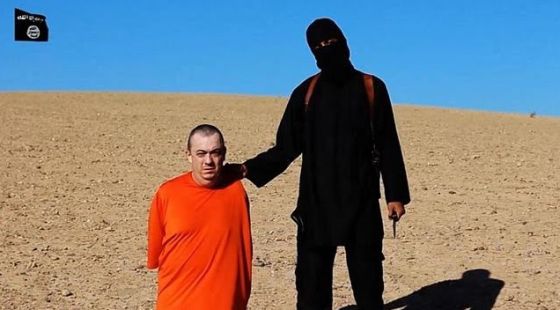
British aid worker, Alan Henning, and his executioner, alleged to be British jihadist, Mohammed Emwazi.

British aid worker, Alan Henning, and his executioner, alleged to be British jihadist, Mohammed Emwazi.

The Washington Post reports: The world knows him as “Jihadi John,” the masked man with a British accent who has beheaded several hostages held by the Islamic State and who taunts audiences in videos circulated widely online.

But his real name, according to friends and others familiar with his case, is Mohammed Emwazi, a Briton from a well-to-do family who grew up in West London and graduated from college with a degree in computer programming. He is believed to have traveled to Syria around 2012 and to have later joined the Islamic State, the group whose barbarity he has come to symbolize.

“I have no doubt that Mohammed is Jihadi John,” said one of Emwazi’s close friends who identified him in an interview with The Washington Post. “He was like a brother to me. . . . I am sure it is him.”

A representative of a British human rights group who had been in contact with Emwazi before he left for Syria also said he believed Emwazi was Jihadi John, a moniker given to him by some of the hostages he once held.

“There was an extremely strong resemblance,” Asim Qureshi, research director at the rights group, CAGE, said after watching one of the videos. “This is making me feel fairly certain that this is the same person.” [Continue reading…]

Qureshi, in a statement on the CAGE website, portrays Emwazi as a victim of British counter-terrorism policies:

This case should trigger thinking about British domestic and foreign policy. What risk assessments, if any, have been made about British counter-terrorism policy and the key part it plays in radicalising individuals? How have the security services been allowed to get away with abusing British citizens without redress? Why are the long-standing grievances over Western interventions in the Muslim world been ignored?

Propagandists have a habit of becoming the most devout believers in their own narrative, but I think it requires a particularly distorted mindset to portray Emwazi, given his alleged actions, as a victim.

In a press conference today, Qureshi described Emwazi as a “kind” and “gentle” young man.

In a video released today, Qureshi says: “The questions shouldn’t be about Jihadi John but they should be about what role our security services have played in alienating people in this society and turning them away from being able to find solutions to the problems they have.”

Moazzam Begg, CAGE’s director of outreach and a former detainee at Guantánamo, can also reasonably argue that he has been a victim of Britain’s counter-terrorism policy and what some see as its over-zealous security services.

Given Qureshi’s reasoning, are we to imagine that Begg or anyone else finding themselves in a similar position might be just as likely to follow in Emwazi’s footsteps and become another of ISIS’s executioners?

In fact, Begg has no illusions about ISIS: “You have no idea how dangerous these people are,” he wrote on Facebook in early 2014.

He also wrote:

“I saw muhajireen (foreigners), locked in cages, by Allah worse, than my Guantanamo cell.

“They beat people to make them confess…just like the Arab regimes, there is no difference.

“I have been to many places, Bosnia, Afghan… but never seen this kind of fitnah [turmoil] and such dangerous extremism and readiness for takfeer [excommunication].

“Syrians on the ground have started to hate foreigners because of them.

“ISIS have even detained and killed aid workers…brothers from UK who have taken convoys [have] been looted by ISIS, guns shoved in faces of brothers who have crossed Europe to bring aid.

“And what’s the basis of detaining the non-Muslim aid worker [Alan Henning] who came in as a guest of Muslims, under their protection? They’ve probably murdered him too, just like many Muslims they’ve done that to.”

The world is full of people who for multitudes of justifiable reasons regard themselves as victims, yet this doesn’t absolve them of responsibility for their own actions.

The Guardian adds: “Jihadi John” is one of a trio of Britons who held hostage Spanish, French, Danish, British and US nationals. The hostages were captured in northern Syria, some in Idlib province, others in Aleppo and a third group in and around Raqqa province, which has since become the main Syrian stronghold of Isis.

The jihadi cell that spawned Isis was initially strong in Idlib province, having taken root there in the summer of 2012. From there it spread to Aleppo, where hostages that had been captured at that point were held in one of two locations – under the eye hospital in the centre of the city or in a factory deep in an industrial zone on its northern outskirts.

By February last year, all the hostages, including Briton John Cantlie, who is one of two remaining western hostages, were moved to Raqqa.

It was in Raqqa that the hostages first became aware of the status that Emwazi had developed among Isis. One former hostage described him as “cold, sadistic and merciless”.

Facebooktwittermail
