Ukraine crisis: The strategic importance of Slavyansk

RUSI Analysis: The Ukrainian military operation that began this morning (2 May) in Slavyansk seems to have been directed against a lesser problem for the Kiev government than anything that has happened recently in Donetsk, Luhansk or Kharkiv. But there are hard strategic reasons why this small city has become the new focus of the Ukrainian crisis over recent days. It is at the centre of an escalating game of deterrence that both Kiev and Moscow are playing against each other.

In the event of a conventional Russian military invasion of the territories of eastern Ukraine it is highly unlikely that Kiev’s troops could do more than buy a certain amount of time. In any direct military confrontation Ukrainian forces would lose. That does not mean, however, that the government in Kiev is without any military cards to play.

Kiev knows that it has a strategic reserve of Kalashnikov assault rifles and other light weapons stored in Ukraine as a mobilisation reserve dating back to Soviet times. It has hinted quietly but strongly in back channels between Ukrainian and Russian military establishments that it might be prepared to open this strategic reserve of weapons to an eastern Ukrainian population prepared to resist any Russian military incursions. Since the stockpile consists of up to five million weapons, the prospect would be a nightmare for Russian military planners if they realistically prepared to move into eastern areas of Ukraine. The prospect of civil war and an anti-Russian insurgency on an unprecedented scale with unpredictable consequences represents a real – if extremely dangerous – bargaining chip for Kiev. [Continue reading…]

Facebooktwittermail

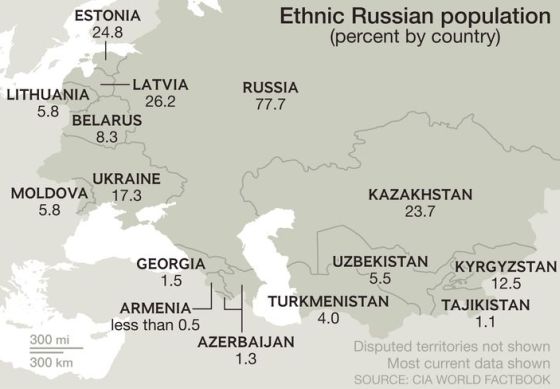
Ethnic Russians: Pretext for Putin’s Ukraine invasion?

ethnic-russians

National Geographic: It’s been more than 20 years since the disintegration of the U.S.S.R., but the effect of that breakup on its people remains a daily reality for many. Almost overnight, some 25 million ethnic Russians became a diaspora. By 2003, about eight million of them were reabsorbed by Russia. About half of that number came from Central Asia, where relations between Russians and the indigenous Turkic nationalities were often strained.

Relations have also been fraught with difficulty in the Baltic countries where ethnic Russians have been particularly vocal about feeling disenfranchised after independence. About one-third of ethnic Russians living in Latvia are considered “non-citizens” and not allowed certain rights, including the right to vote or hold office. The country has been reprimanded by the UN for failing to encourage integration, yet, at the same time, intermarriage between ethnic Latvians and Russians has increased after independence despite official tensions. Intermarriage has long been common between ethnic Russians and Ukrainians as well — yet another factor that could complicate identity issues as parts of Ukraine vote on whether to secede.

Are there other post-Soviet countries with large Russian populations that could soon face the kind of upheaval that Crimea and eastern Ukraine are experiencing? Historian [Alexei] Miller says the answer doesn’t just lie in where you can find ethnic Russians on a map — but also on whether the Kremlin might benefit from becoming entangled in yet another crisis.

“What Putin is doing in Ukraine is not caused by the wish to save Russians but by geo-strategic motives,” Miller says, adding that Russia’s motivations may be much like those of the U.S. when it says it is fighting for democracy—in countries that happen to have oil riches. The question other former republics must ask, he says, is, “Do we really treat Russians fairly enough, and does Putin have enough important strategic interests in our country to use discrimination of Russians as an instrument of his involvement?”

Facebooktwittermail

How Putin has turned organized crime into a tool of statecraft and war

Mark Galeotti writes: When U.S. Secretary of State John Kerry accused Russia of trying to impose its will through the “barrel of a gun and the force of a mob,” he could just as well have said “the force of the mob.” After all, this is the new model of asymmetric conflict in which Moscow is using myriad covert, third-party, and deniable agents to extend its power. Among them are local gangsters, both petty and powerful, who are providing everything from local political allies to street muscle. In the process, Moscow is demonstrating the extent to which organized crime can be used as a tool of statecraft and war.

Although Russian state agents clearly are working in eastern Ukraine, from Spetsnaz special forces to intelligence officers, the exact number is hard to define. In any case, it is undeniable that the overwhelming majority of the camouflaged gunmen seizing buildings, blocking roads, and skirmishing with loyalist forces are either locals — including defectors from the notorious Berkut special police — or else irregular Russian volunteers who have been allowed or encouraged to cross the border and join the conflict.

Some in the new generation of local paramilitary commanders — warlords, we’d call them in other settings — appear to be gangsters who have spotted an opportunity to convert underworld might into upperworld power. The infamous Russian lieutenant colonel who appeared to introduce the Horlivka police to their new commander in mid-April was later identified as a local criminal, for example. More seriously, a closer look at some of the figures emerging as power brokers in the Russian-dominated east reveals distinctly dubious ties.

To a large extent this reflects the endemic criminalization of the Ukrainian state under successive leaders. Like Russia, Ukraine experienced a massive upsurge in organized crime in the 1990s, when new political and economic systems were being created at a time of catastrophically weak state control. Overt gangsterism in the streets was matched by the rise of a new elite who often blended political, economic, and criminal enterprises. Unlike Russia, though, there was no subsequent reassertion of the primacy of the state, something that did not so much eliminate organized crime as house-train it, bringing it back under the dominance of the political elite.

As a result, Ukraine headed into this current crisis already undermined and interpenetrated by criminal structures closely linked to cabals of corrupt officials and business oligarchs. However, a particular problem is the extent to which many local gangs — and not just in the Russian-speaking east — are connected with Russian organized crime networks. In Crimea, not only was the new premier, Sergei Aksyonov, allegedly a mobster nicknamed “Goblin” in the 1990s (he has denied this, but the one time he tried challenging the claim in court, his case was dismissed), but the new political elite is drawn largely from the former one, richly seeded with known and identified criminals. [Continue reading…]

Facebooktwittermail

U.S. sanctions on Russia have so far had little tangible effect

The New York Times reports: As it tries to punish Moscow for its intervention in Ukraine, the White House asserts that the sanctions it has imposed have had a “significant impact” on Russia’s economy, but their real effect so far, according to economic specialists, appears to be more psychological than tangible.

White House officials have pointed to the fall of the Russian ruble and Moscow stock markets as evidence of the success they have had in pressuring the Kremlin. Yet the ruble and Russian markets fell before President Obama began imposing sanctions. Today, in fact, both the ruble and the markets are slightly stronger than they were before the first sanctions were announced.

Russia’s economic downturn predated any action by the United States or Europe and, to some extent, predated the Ukraine crisis. Specialists said the volatility surrounding Ukraine has clearly aggravated Russia’s economic problems by sapping international confidence, punishing its credit standing and increasing investor wariness, but it is not clear how much of that stems specifically from the sanctions. [Continue reading…]

The Wall Street Journal reports: Angela Merkel is carrying a clear message from Germany’s business lobby to the White House: No more sanctions.

Several of the biggest names in German business — including chemical giant BASF, engineering group Siemens AG, Volkswagen AG, Adidas AG and Deutsche Bank AG — have made their opposition to broader economic sanctions against Russia clear in recent weeks, both in public and in private. (Read the latest updates on the crisis in Ukraine.)

As a result, Germany’s position on additional, tougher sanctions is unlikely to shift, barring a dramatic escalation of the conflict in Ukraine — a message Ms. Merkel is expected to deliver to President Barack Obama when they meet in Washington on Friday, officials in Berlin say. [Continue reading…]

Facebooktwittermail

NATO official: Russia now an adversary

The Associated Press reports: After two decades of trying to build a partnership with Russia, NATO now feels compelled to start treating Moscow as an adversary, the alliance’s second-ranking official said Thursday.

“Clearly the Russians have declared NATO as an adversary, so we have to begin to view Russia no longer as a partner but as more of an adversary than a partner,” said Alexander Vershbow, the deputy secretary-general of NATO.

In a question-and-answer session with a small group of reporters, Vershbow said Russia’s annexation of Crimea and its apparent manipulation of unrest in eastern Ukraine have fundamentally changed the NATO-Russia relationship.

“In central Europe, clearly we have two different visions of what European security should be like,” Vershbow, a former U.S. diplomat and onetime Pentagon official, said. “We still would defend the sovereignty and freedom of choice of Russia’s neighbors, and Russia clearly is trying to re-impose hegemony and limit their sovereignty under the guise of a defense of the Russian world.” [Continue reading…]

Facebooktwittermail

Former U.S. officials detect shift in Israel on Iran nuclear deal

Laura Rozen reports: Israel increasingly expects that a nuclear deal between Iran and six world powers will be reached, and has raised concerns with U.S. interlocutors about monitoring and enforcement of the deal, former American officials and Iran policy experts involved in recent discussions with the Israelis tell Al-Monitor.

While Israel’s official position remains that the only acceptable Iran nuclear deal would be “zero, zero, zero,” — meaning no centrifuges, domestic uranium enrichment or plutonium, or the facilities to produce them — former American officials and experts involved in recent consultations with the Israelis detect that Israel’s position on the matter has shifted as the prospect of a deal being reached has increased. Israeli officials are now focusing on concerns of what happens if a deal is reached, how can monitoring and verification be sufficient to detect if there is a violation, and how would such violations of an agreement be deterred or punished, at a time when Israel assesses U.S. credibility as weakened on the world stage, including because of events in Ukraine and Syria.

Most Israeli officials and experts “seem to understand that ‘zero, zero, zero’ is not going to happen,” a member of a US group of experts and former senior officials recently in Israel for consultations, speaking not for attribution, told Al-Monitor in an interview this week. They seem “to understand that there is a need for a domestic, indigenous civil nuclear program….for the Iranians to” deal with their domestic opposition. [Continue reading…]

Facebooktwittermail

Israel can never justify the denial of Palestinian freedom

Gershon Baskin writes: John Kerry said the “A word” and was then forced to apologize.

I don’t have to apologize.

I repeat Kerry’s exact words and believe in every single one of them: “A unitary state winds up either being an apartheid state with second-class citizens – or it ends up being a state that destroys the capacity of Israel to be a Jewish state.”

If the two-state solution is dead, as it seems it might be, Israel will become a unitary state with two populations, one with privileges and political rights and the other living in Bantustans, surrounded, isolated from each other, with no real control over their lives, denied their political rights. If Israel does not end its occupation over the Palestinian people, sooner, not later, Israel will become a new form of apartheid.

No, not apartheid like South Africa was, but a new type of political discrimination, forced separation, with separate legal systems, separate roads and more. One society will be the masters and the other the servants. To a large extent this already describes the reality. We already have a unitary state reality, and it has existed for 46 years. With no real hope for political change that will bring about the end of the Israeli occupation over the Palestinian people, this can no longer be thought of as a temporary situation over disputed territories. With annexation or without it, Israel is and has been in full control over the territories for the past 46 years. [Continue reading…]

Facebooktwittermail

Kerry’s ‘apartheid’ gambit a bigger deal in U.S. than in Israel

Gershom Gorenberg writes: On Monday morning, “Apartheid” was the first word in the headline of the editorial at the top of page 2 in Israel’s Ha’aretz daily. The newspaper’s editorial page is an old-fashioned grey mass of type, the print equivalent of the low monotonous growl of an aging foreign policy commentator on public radio. But Ha’aretz wasn’t growling about U.S. Secretary of State John Kerry’s leaked warning, published late Sunday night, that unless Israel reaches a two-state agreement, it risks becoming “an apartheid state.”

Rather, the editorial was about the planning bodies that allow Israeli settlement construction and block Palestinian building in Area C, the part of the West Bank where Israel rather than the Palestinian Authority runs day-to-day affairs. The paper urged Israel’s Supreme Court to rule against the discrimination.

From this we learn two things: First, intentionally or not, whoever leaked Kerry’s comments to a meeting of the Trilateral Commission on Friday did so with timing that guaranteed a muted coverage in Israel. Saturday night on the American East Coast was Sunday morning in Israel. The day’s ink-on-paper newspapers were already printed and lying on doorsteps. And since Monday was Israel’s’ memorial day for the Holocaust, the up-to-the-second media, online and on the air, were devoted entirely to painful memories and the political uses or misuses of them. On talk radio, talk about Kerry would have to wait.

The second lesson is that “apartheid” is a strong but not shocking word within Israel’s own political conversation. [Continue reading…]

Facebooktwittermail

Neanderthals were not less intelligent than modern humans, scientists find

The Guardian reports: Scientists have concluded that Neanderthals were not the primitive dimwits they are commonly portrayed to have been.

The view of Neanderthals as club-wielding brutes is one of the most enduring stereotypes in science, but researchers who trawled the archaeological evidence say the image has no basis whatsoever.

They said scientists had fuelled the impression of Neanderthals being less than gifted in scores of theories that purport to explain why they died out while supposedly superior modern humans survived.

Wil Roebroeks at Leiden University in the Netherlands said: “The connotation is generally negative. For instance, after incidents with the Dutch Ajax football hooligans about a week ago, one Dutch newspaper piece pleaded to make football stadiums off-limits for such ‘Neanderthals’.”

The Neanderthals are believed to have lived between roughly 350,000 and 40,000 years ago, their populations spreading from Portugal in the west to the Altai mountains in central Asia in the east. They vanished from the fossil record when modern humans arrived in Europe.

The reasons for the demise of the Neanderthals have long been debated in the scientific community, but many explanations assume that modern humans had a cognitive edge that manifested itself in more cooperative hunting, better weaponry and innovation, a broader diet, or other major advantages.

Roebroeks and his colleague, Dr Paola Villa at the University of Colorado Museum in Boulder, trawled through the archaeological records to look for evidence of modern human superiority that underpinned nearly a dozen theories about the Neanderthals’ demise and found that none of them stood up.

“The explanations make good stories, but the only problem is that there is no archaeology to back them up,” said Roebroeks.

Villa said part of the misunderstanding had arisen because researchers compared Neanderthals with their successors, the modern humans who lived in the Upper Palaeolithic, rather than the humans who lived at the same time. That is like saying people in the 19th century were less intelligent than those in the 21st because they didn’t have laptops and space travel.

“The evidence for cognitive inferiority is simply not there,” said Villa. “What we are saying is that the conventional view of Neanderthals is not true.” The study is published in the journal Plos One. [Continue reading…]

It’s always worth remembering that modernity as it is lived (rather than as it is written about) is nothing more than a name for the present — that point which stands right on the edge of an unknown future. In this sense all humans and other hominids have lived in a modern condition and their innovations have been defined by what was contemporary.

If comparisons can usefully be made between humans and their closest kin at different points in history, rather than judge them on the basis of the artifacts they have created, a more interesting question is how well each has been attuned to the environment that supports them.

That attunement probably cannot be scientifically quantified since in part it would have to be measured through attributes that might leave no physical traces — such as knowledge about the medicinal properties of plants.

Since the arc of human progress has largely been defined by our increasing ability to cut ourselves off from the world in which we live, in terms of environmental attunement, the human of today is less advanced than a Neanderthal.

Facebooktwittermail

Peter Van Buren: Regime change in America

The old words are on the rebound, the ones that went out in the last century when the very idea of a Gilded Age, and the plutocrats and oligarchy of wealth that went with it, left the scene in the Great Depression.  Now, those three classic terms that were never to return (or so it once seemed) are back in our vocabularies.  They’ve been green-lighted by society.  (If they’re not on SAT tests in the coming years, I’ll eat my top hat.)

Of course, an inequality gap has been widening into an abyss for decades now, but when it comes to the present boom in old-fashioned words that once went with being really, really, obscenely wealthy and powerful, give the Occupy movement of 2011 credit.  After all, they were the ones who took what should already have been on everyone’s lips — the raging inequality in American society — out of the closet and made it part of the national conversation.  1%!  99%!

Now, the stats on national and global inequality are everyday fare (and looking worse all the time).  Meanwhile, the book of a French (French!) economist about how the U.S. is leading the way when it comes to inequality and possibly creating the basis for a future… yes!… oligarchy of inherited wealth is on the bestseller list and the talk of the town.  And if that weren’t enough, a new study out of Princeton University suggests that, as Talking Points Memo put it, “Over the past few decades America’s political system has slowly transformed from a democracy into an oligarchy, where wealthy elites wield most power.”  As the two authors of the study write, “The central point that emerges from our research is that economic elites and organized groups representing business interests have substantial independent impacts on U.S. government policy, while mass-based interest groups and average citizens have little or no independent influence.”

In an America where, when it comes to the political system, the Supreme Court has now granted the dollar the full right to speak its mind, and ever more of those dollars can be found in the pockets of… well, not to put a fine point on it, plutocrats, we need a new (that is, old) vocabulary to fit our changing circumstances.

In all of this, one thing missing has been the classic American observer, the keen reporter setting out on the road to catch the new look of a land in pain and misery.  Today, TomDispatch aims to remedy that.  Peter Van Buren, former State Department whistleblower and author of a new book on American inequality, Ghosts of Tom Joad: A Story of the #99Percent, has been traveling the ever-expanding, ever-rustier Rust Belt taking the temperature of a land with a significant fever. Here’s his account. Tom Engelhardt 

This land isn’t your land, this land is their land
An empire in decline (city by city, town by town)
By Peter Van Buren

As America’s new economy starts to look more like the old economy of the Great Depression, the divide between rich and poor, those who have made it and those who never will, seems to grow ever starker. I know. I’ve seen it firsthand.

Once upon a time, I worked as a State Department officer, helping to carry out the occupation of Iraq, where Washington’s goal was regime change. It was there that, in a way, I had my first taste of the life of the 1%. Unlike most Iraqis, I had more food and amenities than I could squander, nearly unlimited funds to spend as I wished (as long as the spending supported us one-percenters), and plenty of U.S. Army muscle around to keep the other 99% at bay. However, my subsequent whistleblowing about State Department waste and mismanagement in Iraq ended my 24-year career abroad and, after a two-decade absence, deposited me back in “the homeland.”

I returned to America to find another sort of regime change underway, only I wasn’t among the 1% for this one. Instead, I ended up working in the new minimum-wage economy and saw firsthand what a life of lousy pay and barely adequate food benefits adds up to. For the version of regime change that found me working in a big box store, no cruise missiles had been deployed and there had been no shock-and-awe demonstrations. Nonetheless, the cumulative effects of years of deindustrialization, declining salaries, absent benefits, and weakened unions, along with a rise in meth and alcohol abuse, a broad-based loss of good jobs, and soaring inequality seemed similar enough to me. The destruction of a way of life in the service of the goals of the 1%, whether in Iraq or at home, was hard to miss. Still, I had the urge to see more. Unlike in Iraq, where my movements were limited, here at home I could hit the road, so I set off for a look at some of America’s iconic places as part of the research for my book, Ghosts of Tom Joad.

Here, then, are snapshots of four of the spots I visited in an empire in decline, places you might pass through if you wanted to know where we’ve been, where we are now, and (heaven help us) where we’re going.

Continue reading

Facebooktwittermail

Pro-Ukrainians worry their views are being lost in focus on pro-Russia protests

McClatchy reports: Katarina Butko smiled Monday evening as she looked at what she’d organized: a line of 15 cars decorated with the yellow and blue flag of Ukraine. They were seconds away from leaving on a motoring campaign around town, “to wake the sleeping pro-Ukrainian people.”

The idea was simple: Polls consistently show that residents of this region of southeastern Ukraine bordering Russia overwhelmingly believe in a united Ukraine. But a small, loud and violent minority has grabbed international headlines and scared residents into hiding their beliefs.

The driving, honking tour was scheduled to last an hour. It had to be abandoned about 30 minutes later, though, when pro-Russian separatists, some wearing masks, some not, some stumbling from drink, attacked the caravan with baseball bats and more. Butko’s car was put out of service when a Molotov cocktail smashed the front window.

But a later rally attracted what Ukrainian media reported to be 5,000 people, a reflection of a reality that many here believe the international media misses by focusing on the violence with which such gatherings have ended.

“There really aren’t many active pro-Russians around Donetsk these days,” said Yuri Temirov, vice dean of international relations at Donetsk National University. “But those few are very aggressive. The aggressive pro-Ukrainian side tends to focus more on petitions and legal frameworks for ending the crisis here. This doesn’t make for very exciting newscasts.” [Continue reading…]

Facebooktwittermail

Donetsk referendum wording mentions neither Ukraine nor Russia

McClatchy reports: Having lived through a month of pro-Russian separatists storming and seizing government buildings to raise the Russian flag, Donetsk residents will be asked May 11 to answer a single question in a hastily organized referendum.

That question, according to a government official who said he was present at a meeting Tuesday where the wording was agreed on: “Do you support the creation of the Donetsk People’s Republic?”

What would a “yes” vote actually mean? Officials admit they aren’t sure. In fact, one noted that more than a desire to join Russia, or be a separate nation, the vote is an attempt to persuade the central government in Kiev to listen to this populous, industrial region. Regional council member Nikolai Zagoruiko said that if the central government would agree to two long-standing demands, the vote might never have to happen.

“If they would agree to make Russian a second official language of Ukraine — so that everyone can understand the state documents they must read and sign — and agree to give Donetsk more local control over the taxes we collect to send to Kiev, so that we can make this a better place to live, we would probably be satisfied,” he said. “In fact, if they did those two things, I’m sure the referendum could be postponed, and eventually forgotten about.” [Continue reading…]

Facebooktwittermail

Why does the press help pro-Russian thugs?

Jamie Dettmer writes: Talking with pro-Russian separatist gunmen is like living a Ukrainian version of the Western movie Appaloosa, where the judge sits listening to the testimony of hired hands providing alibis for the ranch owner who’s murdered the sheriff. The testimonies here are word for word the same, providing an alibi, it would seem, for Russian President Vladimir Putin: “I am not a separatist,” say the hired hands. “I want a federation; the ouster of [Russian-friendly] President Viktor Yanukovych was a crime; I am here to protect ethnic Russians from fascists and to protect our language.” If they varied their lines, they would be more believable.

But then what is happening in eastern Ukraine is more about theater, albeit with deadly consequences, than anything else. And the audience — the international media — sits watching the play and filming and tweeting the performance. And whoever is behind this understands the appetite.

That became clear at the weekend when the media meekly colluded in the play trotted out for their consumption that day: the parade by pro-Russian separatists in Slovyansk of the kidnapped members of a military mission of the Organization for Security and Cooperation (OSCE). In a statement today Germany’s foreign minister, Frank-Walter Steinmeier, said that displaying the captives was an affront that is “revolting and blatantly hurts the dignity of the victims.”

Worryingly, no Western reporter covering the press conference sought to discover before the event whether the OSCE team members were participating voluntarily or were being coerced, which is standard media practice before interviewing captives or prisoners of war. [Continue reading…]

Facebooktwittermail

Ukraine says militants now control the east

The New York Times reports: It is by now a well-established pattern. Armed, masked men in their 20s to 40s storm a public building of high symbolic value in a city somewhere in eastern Ukraine, evict anyone still there, seize weapons and ammunition, throw up barricades and proclaim themselves the rulers of a “people’s republic.” It is not clear who is in charge or how the militias are organized.

Through such tactics, a few thousand pro-Russian militants have seized buildings in about a dozen cities, effectively establishing control over much of an industrial region of about 6.5 million nestled against the Russian border.

Day by day, in the areas surrounding the cities of Donetsk and Luhansk, pro-Russian forces have defied all efforts by the central government to re-establish its authority, and on Wednesday, Ukraine’s acting president conceded what had long been obvious: The government’s police and security officials had lost control. [Continue reading…]

Facebooktwittermail

Antibiotic resistance poses a global threat

Nature: The ‘post-antibiotic’ era is near, according to a report released today by the World Health Organization (WHO). The decreasing effectiveness of antibiotics and other antimicrobial agents is a global problem, and a surveillance system should be established to monitor it, the group says.

There is nothing hopeful in the WHO’s report, which pulls together data from 129 member states to show extensive resistance to antimicrobial agents in every region of the world. Overuse of antibiotics in agriculture — to promote livestock growth — and in hospitals quickly leads to proliferation of drug-resistant bacteria, which then spread via human travel and poor sanitation practices.

“A post-antibiotic era — in which common infections and minor injuries can kill — far from being an apocalyptic fantasy, is instead a very real possibility for the twenty-first century,” writes Keiji Fukuda, WHO assistant director-general for health security, in a foreword to the report.

Perhaps the most worrying trend is the spread of resistance to carbapenems, the ‘antibiotics of last resort’, says Timothy Walsh, a medical microbiologist at Cardiff University, UK, who was an adviser for the report. “That’s taken us by surprise,” he says. “All of us are rather like rabbits in front of the headlights in how quickly this has taken off.” [Continue reading…]

Facebooktwittermail

Humanitarian aid situation in Syria deteriorating, United Nations warns

The Washington Post reports: A U.N. Security Council resolution that passed with great fanfare nearly two months ago has done little to facilitate the shipment of humanitarian aid to a quarter of a million Syrians under siege in their country’s civil war, the top U.N. aid official said Wednesday.

“Far from getting better, the situation is getting worse,” Valerie Amos, the undersecretary for humanitarian affairs, said after briefing the council. “All parties” in Syria are guilty of violating “the most fundamental human rights” of civilians and disregarding “the basic tenets of international law,” she said.

The situation is particularly severe in Aleppo, where a U.N. team was unable over the past week to get aid to civilians cut off from assistance since the government began a military campaign in the fall to retake rebel-held areas. [Continue reading…]

Facebooktwittermail