



“Russia is the only country in the world realistically capable of turning the United States into radioactive ash,” TV anchor Dmitry Kiselyov said on his weekly news show on state-controlled Rossiya 1 television on Sunday evening.
Kiselyov isn’t a household name in the U.S. but to describe him as Russia’s Glenn Beck would be a major understatement. Having been appointed by President Putin as head of the official Russian government-owned international news agency Rossiya Segodnya (Russia Today) which has 2,300 employees, Kiselyov is now one of the most prominent figures in Russian state media.
Kiselyov said that the creation of the new media entity was necessary to redress what he called an unfair international perception of Russia.
“The creation of a fair attitude toward Russia as an important country with good intentions – this is the mission of the new structure that I will be heading up,” he said in December.
The Associated Press reported in December:
When Ukrainians flooded the streets last week to protest their president’s shelving of a treaty with the European Union, Kiselyov lambasted Sweden and Poland, accusing them of encouraging massive protests in Kiev to take revenge for military defeats by czarist Russia centuries ago.
Kiselyov, who earned his degree in Scandinavian literature, rolled a clip of a Swedish children’s program called “Poop and Pee,” designed to teach children about their bodily functions. After the clip finished rolling, Kiselyov turned to the camera to suggest that this was the kind of European decadence awaiting Ukraine, if it signed a deal with the EU.
In Sweden there is “the radical growth of child abortions, early sex — the norm is nine years old, and at age 12 there is already child impotency,” he said after the clip rolled.
That reportage gained him few friends in Ukraine, where one man bounded over to hand “an Oscar for the nonsense and lies” of Dmitry Kiselyov to the state television correspondent standing on Kiev’s main square. He was brusquely pushed out of the shot before finishing his speech.
Kiselyov has also proven an avid attack dog on the issue of homosexuality, as international criticism over a Russian law banning gay “propaganda” reached a fever pitch this summer. The TV anchor said that homosexuals’ hearts should be buried or burned, and that gays should be banned from donating blood or organs, which were “unsuitable for the prolongation of anyone’s life.”
In Kiselyov’s comments last night, he highlighted the existence of the Soviet-built system of nuclear retaliation known as Perimeter which still exists and if ever activated would launch a devastating nuclear attack on the United States through commands controlled by artificial intelligence.
(Before anyone here starts writing some inane comment about why Russia has a right to destroy the U.S. if it has already been destroyed by the U.S., pause for second and think about what it means to have computer-controlled nuclear weapons. That opens up whole new nightmarish vistas in the domains of cyberwarfare, faulty algorithms, and the inadequate maintenance of aging systems. Personally, I have little confidence in human-controlled nuclear arsenals and even less in those that can be unleashed automatically.)
The system was reported on by Nicholas Thompson in 2009:
Valery Yarynich glances nervously over his shoulder. Clad in a brown leather jacket, the 72-year-old former Soviet colonel is hunkered in the back of the dimly lit Iron Gate restaurant in Washington, DC. It’s March 2009 — the Berlin Wall came down two decades ago — but the lean and fit Yarynich is as jumpy as an informant dodging the KGB. He begins to whisper, quietly but firmly.
“The Perimeter system is very, very nice,” he says. “We remove unique responsibility from high politicians and the military.” He looks around again.
Yarynich is talking about Russia’s doomsday machine. That’s right, an actual doomsday device — a real, functioning version of the ultimate weapon, always presumed to exist only as a fantasy of apocalypse-obsessed science fiction writers and paranoid über-hawks. The thing that historian Lewis Mumford called “the central symbol of this scientifically organized nightmare of mass extermination.” Turns out Yarynich, a 30-year veteran of the Soviet Strategic Rocket Forces and Soviet General Staff, helped build one.
The point of the system, he explains, was to guarantee an automatic Soviet response to an American nuclear strike. Even if the US crippled the USSR with a surprise attack, the Soviets could still hit back. It wouldn’t matter if the US blew up the Kremlin, took out the defense ministry, severed the communications network, and killed everyone with stars on their shoulders. Ground-based sensors would detect that a devastating blow had been struck and a counterattack would be launched.
The technical name was Perimeter, but some called it Mertvaya Ruka, or Dead Hand. It was built 25 years ago and remained a closely guarded secret. With the demise of the USSR, word of the system did leak out, but few people seemed to notice. In fact, though Yarynich and a former Minuteman launch officer named Bruce Blair have been writing about Perimeter since 1993 in numerous books and newspaper articles, its existence has not penetrated the public mind or the corridors of power. The Russians still won’t discuss it, and Americans at the highest levels — including former top officials at the State Department and White House — say they’ve never heard of it. When I recently told former CIA director James Woolsey that the USSR had built a doomsday device, his eyes grew cold. “I hope to God the Soviets were more sensible than that.” They weren’t.
The system remains so shrouded that Yarynich worries his continued openness puts him in danger. He might have a point: One Soviet official who spoke with Americans about the system died in a mysterious fall down a staircase. But Yarynich takes the risk. He believes the world needs to know about Dead Hand. Because, after all, it is still in place. [Continue reading…]
Voter turnout in Sevastopol, Crimea, yesterday was a whopping 123%! It’s hard to understand why the referendum fell short of 100% support for joining Russia when there were so many “surplus” votes floating around.
But seriously, given that Tartars, who make up slightly more than 10% of the population were expected to boycott the vote, and a portion of the rest of Crimea’s pro-Ukrainian population probably did likewise, this “landslide” clearly had the assistance of Russian bulldozers.
What the outcome might have been of a free and fair (even though unconstitutional) vote with real choices for or against secession, we’ll never know.
@JSaryuszWolski 385,462ppl registered in #Sevastopol & 474,137ppl voted yesterday,which means123%votes |PR #Crimea pic.twitter.com/xAU51RqN5r
— Ruthen (@RutheniaRus) March 17, 2014
The Associated Press reports: Final results of the referendum in Crimea show that 97 percent of voters have supported leaving Ukraine to join Russia, the head of the referendum election commission said Monday.
Mikhail Malyshev told a televised news conference that the final tally from Sunday’s vote was 96.8 percent in favor of splitting from Ukraine. He also said that the commission has not registered a single complaint about the vote.
The referendum was widely condemned by Western leaders who were planning to discuss economic sanctions to punish Russia on Monday. Ukraine’s new government in Kiev called the referendum a “circus” directed at gunpoint by Moscow.
But Valery Ryazantsev, head of Russia’s observer mission in Crimea and a lawmaker from the upper house of the Russian parliament, said Monday that the results are beyond dispute. He told the Interfax news agency that there are “absolutely no reasons to consider the vote results illegitimate.” [Continue reading…]
Sergei Guriev writes: Russia’s response to events in Ukraine has exceeded the worst expectations of those who were already questioning whether Putin is, as German Chancellor Angela Merkel put it, “in touch with reality.” The move to annex Crimea has reversed any soft-power benefit that Putin might have gained from the Sochi Olympics and the pardons he granted (as recently as December) to imprisoned opponents like Mikhail Khodorkovsky and the members of Pussy Riot.
The sacrifice of these gains suggests that the Crimea adventure was not part of long-considered plan. On the contrary, since the crisis began, Russia’s leaders have repeatedly contradicted their previous statements, backtracked, reversed decisions, and denied easily verifiable facts. All of this indicates that Russian political leaders have no strategy and do not foresee the consequences of their decisions. Even the Kremlin’s own supporters acknowledge that Putin “is improvising.”
It is also clear that the decisions to violate international law, despite the risk of economic isolation, were made in an ad hoc fashion by Putin’s innermost circle. For example, Valentina Matviyenko, the chairwoman of the Federation Council (the parliament’s upper house), announced that Russia would not send troops to Ukraine – just two days before she and the Council voted unanimously to authorize Putin to do precisely that. And Matviyenko is one of the 12 permanent members of Russia’s National Security Council, the supreme decision-making authority on such matters.
Regardless of whether the Kremlin is irrational or simply uninformed, its policy in Crimea sends an unmistakable signal to investors: Russia’s political leaders are impossible to predict. [Continue reading…]

The New York Times reports: The United States, working in coordination with Europe, imposed a new round of sanctions on prominent Russian officials on Monday as the showdown over Ukraine reached a new stage of confrontation between East and West.
President Obama signed an executive order freezing the assets and banning visas for a number of Russians deemed to be responsible for the seizing of Crimea or otherwise interfering in Ukrainian sovereignty. Among those targeted were several officials in President Vladimir V. Putin’s inner circle, and the White House threatened to go after more if Russia did not back down.
“We have fashioned these sanctions to impose costs on named individuals who wield influence in the Russian government and those responsible for the deteriorating situation in Ukraine,” the White House said in a statement. “We stand ready to use these authorities in a direct and targeted fashion as events warrant.”
In a conference call briefing reporters, a senior administration official who was not permitted to be named under the ground rules said, “These are by far the most comprehensive sanctions applied to Russia since the end of the Cold War — far and away so.” [Continue reading…]

The New York Times reports: Fairfax County, Va., and McDowell County, W.Va., are separated by 350 miles, about a half-day’s drive. Traveling west from Fairfax County, the gated communities and bland architecture of military contractors give way to exurbs, then to farmland and eventually to McDowell’s coal mines and the forested slopes of the Appalachians. Perhaps the greatest distance between the two counties is this: Fairfax is a place of the haves, and McDowell of the have-nots. Just outside of Washington, fat government contracts and a growing technology sector buoy the median household income in Fairfax County up to $107,000, one of the highest in the nation. McDowell, with the decline of coal, has little in the way of industry. Unemployment is high. Drug abuse is rampant. Median household income is about one-fifth that of Fairfax.
One of the starkest consequences of that divide is seen in the life expectancies of the people there. Residents of Fairfax County are among the longest-lived in the country: Men have an average life expectancy of 82 years and women, 85, about the same as in Sweden. In McDowell, the averages are 64 and 73, about the same as in Iraq. [Continue reading…]

It’s a measure of how common these crimes have become, and how conventional the hackers’ approach in this case, that Target was prepared for such an attack. Six months earlier the company began installing a $1.6 million malware detection tool made by the computer security firm FireEye, whose customers also include the CIA and the Pentagon. Target had a team of security specialists in Bangalore to monitor its computers around the clock. If Bangalore noticed anything suspicious, Target’s security operations center in Minneapolis would be notified.
On Saturday, Nov. 30, the hackers had set their traps and had just one thing to do before starting the attack: plan the data’s escape route. As they uploaded exfiltration malware to move stolen credit card numbers — first to staging points spread around the U.S. to cover their tracks, then into their computers in Russia — FireEye spotted them. Bangalore got an alert and flagged the security team in Minneapolis. And then …
Nothing happened.
For some reason, Minneapolis didn’t react to the sirens. Bloomberg Businessweek spoke to more than 10 former Target employees familiar with the company’s data security operation, as well as eight people with specific knowledge of the hack and its aftermath, including former employees, security researchers, and law enforcement officials. The story they tell is of an alert system, installed to protect the bond between retailer and customer, that worked beautifully. But then, Target stood by as 40 million credit card numbers — and 70 million addresses, phone numbers, and other pieces of personal information — gushed out of its mainframes. [Continue reading…]

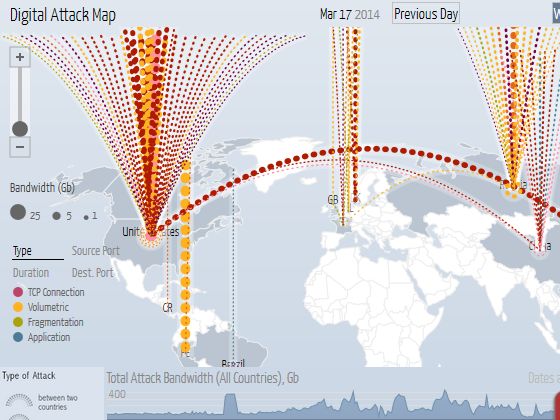
More information at Digital Attack Map, a live data visualization of DDoS attacks around the globe, built through a collaboration between Google Ideas and Arbor Networks.

Christian Science Monitor reports: As high-level international talks in Vienna over Iran’s nuclear program edged closer to a deal last fall, something curious happened – massive cyber-attacks that had hammered Wall Street bank websites repeatedly for about a year slowed to a near stop.
While banking industry officials were relieved, others wondered why those Iran-linked “distributed denial of service” attacks that had so regularly flooded bank websites with bogus Internet traffic were shut off like a faucet. One likely reason, say US experts on cyber-conflict: to reduce friction, at least temporarily, at the Vienna nuclear talks.
Yet, even as the “distributed denial of service” attacks abated for apparently diplomatic reasons, overall Iranian cyber-spying on US military and energy corporation networks has surged, these experts say.
Iran was fingered last fall, for instance, for infiltrating the US Navy Marine Corps Intranet. It then took the Navy nearly four months to root out the Iranian hackers infesting its largest unclassified computer network, the Wall Street Journal reported in February.
This litany of Iranian activity is evidence, say experts, that after years as a cyber also-ran, Iran is morphing swiftly into a major threat in the rapidly evolving era of cyber-conflict. [Continue reading…]

More often than ever, the administration censored government files or outright denied access to them last year under the U.S. Freedom of Information Act, cited more legal exceptions it said justified withholding materials and refused a record number of times to turn over files quickly that might be especially newsworthy, according to a new analysis of federal data by The Associated Press.
Most agencies also took longer to answer records requests.
The government’s own figures from 99 federal agencies covering six years show that halfway through its second term, the administration has made few meaningful improvements in the way it releases records. In category after category — except for reducing numbers of old requests and a slight increase in how often it waived copying fees — the government’s efforts to be more open about its activities last year were their worst since President Barack Obama took office.
In a year of intense public interest over the National Security Agency’s surveillance programs, the government cited national security to withhold information a record 8,496 times — a 57 percent increase over a year earlier and more than double Obama’s first year, when it cited that reason 3,658 times. The Defense Department, including the NSA, and the CIA accounted for nearly all those. The Agriculture Department’s Farm Service Agency cited national security six times, the Environmental Protection Agency did twice and the National Park Service once.
And five years after Obama directed agencies to less frequently invoke a “deliberative process” exception to withhold materials describing decision-making behind the scenes, the government did it anyway, a record 81,752 times. [Continue reading…]

“I told the Security Council that Syria cannot be placed on a back burner,” Brahimi told the UN General Assembly yesterday, according to a transcript. “A crisis of this magnitude needs the full attention of this organization.”
With the Security Council set to take up a resolution today on Russia’s move into Ukraine, Brahimi sought to underscore the continuing human and economic costs of Syria’s civil war, which entered its fourth year this week with more than 130,000 people killed. He said more than 300 Syrians flee their homes every hour. [Continue reading…]

Officers and analysts in the Iran operations division, which coordinates spying on Iran and its nuclear program, were informed at a meeting last week at CIA headquarters in Langley, Va., of the decision to suspend Jonathan Bank, a veteran officer and member of the senior intelligence service.
Three former officials said the Iran operations division was in open rebellion to Bank’s management style, with several key employees demanding transfers.
“Iran is one of most important targets, and the place was not functioning,” one of the former officials said.
In 2010, Bank was pulled out as CIA station chief in Islamabad after newspapers in Pakistan, India, England and elsewhere published his name in connection with a court case, and the agency said he had received death threats. U.S. officials believe Pakistan’s intelligence service leaked the name in a dispute over CIA drone attacks in the country’s tribal belt.
Bank, now 46, previously served at CIA stations in the Balkans, Moscow and Baghdad, former agency officials said. He also was a top assistant to James Pavitt, who from 1999 to 2004 headed the CIA’s operations arm, now known as the National Clandestine Service.
The former CIA officials spoke on condition of anonymity to discuss a personnel matter. Bank is technically undercover, but his name has been public since the 2010 incident. He did not respond to email messages requesting comment. [Continue reading…]

The operation to take control of the Morning Glory came a week after Libya failed to prevent the tanker from leaving the rebel-controlled eastern port of Es Sider loaded with an estimated $20m cargo, in a crisis that has brought the country to the brink of civil war.
“The Morning Glory is carrying a cargo of oil owned by the Libyan government’s National Oil Company,” said Pentagon spokesman John Kirby. “The ship and its cargo were illicitly obtained from the Libyan port of Es Sider.”
There were no casualties in the operation, which took place in international waters off the coast of Cyprus late on Sunday night. The raid was authorised by the US president, Barack Obama, after receiving a request for assistance from Tripoli. The Seals boarded the 21,000-tonne tanker using helicopters and fast boats from a warship, the USS Roosevelt.
The Pentagon said a US navy crew was now piloting the tanker towards an unnamed Libyan port where it will be handed to government control. [Continue reading…]

In 1969, I was working as a (not very good) printer at an “underground” print shop in Boston. There was, in fact, nothing faintly underground about it, but in what was then called “the movement,” it was a romantic label — and use it we did. I had an older co-worker there who had played an early role in launching the movement politics that became such a part of the era. He paid me next to no mind and yet his presence intimidated me greatly. He was, as they said at the time, “close” to PL, or the Progressive Labor Party, which was a hardline lefty outfit of the moment. One day, out of the blue, he invited me to dinner. I was surprised, to say the least, but took it as an unexpected stamp of approval and accepted with alacrity, experiencing a wave of gratitude that, being a guy, it was impossible to express.
On the appointed night, I arrived at his place where he and his girlfriend, also close to PL, welcomed me to the table. In the middle of dinner, however, they got into a fight. Suddenly, it was as if I weren’t there at all. As it turned out, they were arguing about the latest PL edict, a call to members to “build bridges” to co-workers, the category into which I obviously fell. The question, it seemed, was which of several categories of fellow worker I fell into. They ranged — at this great distance I can’t remember the exact descriptive details — from the equivalent of simpleton liberal dolt to equally insulting labels somewhat more to the revolutionary left. After the meal, I slunk out into the night.
That, I suspect, was as close as I got to being a “revolutionary.” In the generally exhilarating years we now call the Sixties, by which we tend to mean the period from perhaps 1965 to 1973, it often seemed as if an abyss had opened at your feet and the most reasonable as well as thrilling thing to do, even if you were a somewhat timid and polite boy of the 1950s, was simply jump in. At an individual level in the America of that moment, the experience was, I suppose, revolutionary. Certainly, in those years it wasn’t hard to bump into every shade and grade of self-proclaimed revolutionary or revolutionary group. Still, as Lewis Lapham makes clear today, and as I learned at that dinner table, revolution was then in the eye of the beholder, an easy enough label to throw around even if, looking back, the real revolutions of the moment weren’t on the left but on the right and, as Lapham points out, also in fields that ranged from advertising to surveillance — and aimed not at liberating but controlling us all.
In those years, Lapham, as you’ll soon find out, was having far better dinners than I at far better establishments. A half century later, he’s made “revolution” the topic of the Spring issue of his remarkable magazine, Lapham’s Quarterly, and so the focus of his latest essay at TomDispatch. (You can subscribe to the Quarterly by clicking here.) As ever, this website thanks the editors of that journal for allowing us to offer an exclusive look at Lapham’s introduction to the new issue. Tom Engelhardt
Crowd control
Political revolt and the accumulation of more
By Lewis H. Lapham[This essay will appear in “Revolution,” the Spring 2014 issue of Lapham’s Quarterly. This slightly adapted version is posted at TomDispatch.com with the kind permission of that magazine.]
In case of rain, the revolution will take place in the hall.
— Erwin ChargaffFor the last several years, the word “revolution” has been hanging around backstage on the national television talk-show circuit waiting for somebody, anybody — visionary poet, unemployed automobile worker, late-night comedian — to cue its appearance on camera. I picture the word sitting alone in the green room with the bottled water and a banana, armed with press clippings of its once-upon-a-time star turns in America’s political theater (tie-dyed and brassiere-less on the barricades of the 1960s countercultural insurrection, short-haired and seersucker smug behind the desks of the 1980s Reagan Risorgimento), asking itself why it’s not being brought into the segment between the German and the Japanese car commercials.
Surely even the teleprompter must know that it is the beast in the belly of the news reports, more of them every day in print and en blog, about income inequality, class conflict, the American police state. Why then does nobody have any use for it except in the form of the adjective, revolutionary, unveiling a new cellphone app or a new shade of lipstick?
I can think of several reasons, among them the cautionary tale told by the round-the-clock media footage of dead revolutionaries in Syria, Egypt, and Tunisia, also the certain knowledge that anything anybody says (on camera or off, to a hotel clerk, a Facebook friend, or an ATM) will be monitored for security purposes. Even so, the stockpiling of so much careful silence among people who like to imagine themselves on the same page with Patrick Henry — “Give me liberty, or give me death” — raises the question as to what has become of the American spirit of rebellion. Where have all the flowers gone, and what, if anything, is anybody willing to risk in the struggle for “Freedom Now,” “Power to the People,” “Change We Can Believe In”?

“Russia is the only country in the world realistically capable of turning the United States into radioactive ash,” anchor Dmitry Kiselyov said on his weekly news show on state-controlled Rossiya 1 television.
Kiselyov made the comment to support his argument that the United States and President Barack Obama were living in fear of Russia led by President Vladimir Putin amid the Ukraine crisis.
His programme was broadcast as the first exit polls were being published showing an overwhelming majority of Crimeans voting to leave Ukraine and join Russia.
He stood in his studio in front of a gigantic image of a mushroom cloud produced after a nuclear attack, with the words “into radioactive ash”.
“Americans themselves consider Putin to be a stronger leader than Obama,” he added, pointing to opinion polls which then popped up on the screen.
“Why is Obama phoning Putin all the time and talking to him for hours on end?” he asked.
Kiselyov has earned a reputation as one of Russia’s most provocative television news hosts, in particularly with his often blatantly homophobic remarks.
But he is also hugely influential with his weekly news show broadcast at Sunday evening prime time.
Putin last year appointed Kiselyov head of the new Russia Today news agency that is to replace the soon to be liquidated RIA Novosti news agency with the aim of better promoting Russia’s official position. [Continue reading…]

“I am afraid that I am interested in a cold war with the West,” said Mr. Prokhanov, 76, in a lull between interviews on state-controlled television and radio. “I was very patient. I waited for 20 years. I did everything I could so that this war would begin. I worked day and night.”
Mr. Prokhanov is an attack dog whose career has risen, fallen and risen again with the fortunes of hard-liners in the Kremlin. And it is a measure of the conservative pivot that has taken place in Moscow in Vladimir V. Putin’s third presidential term that Mr. Prokhanov and a cadre of like-minded thinkers — a kind of “who’s who of conspiratorial anti-Americanism,” as one scholar put it — have found themselves thrust into the mainstream.
For centuries, Russian history has been driven by a struggle between ideas, as reformers and revanchists wrestled over the country’s future. Mr. Putin keeps a distance from the ideological entrepreneurs clustered around the Kremlin, leaving his influences a matter of speculation.
But it became clear last week, as the United States threatened to cut off Russian corporations from the Western financial system, that influential members of the president’s inner circle view isolation from the West as a good thing for Russia, the strain of thought advanced by Mr. Prokhanov and his fellow travelers. Some in Mr. Putin’s camp see the confrontation as an opportunity to make the diplomatic turn toward China that they have long advocated, said Sergei A. Karaganov, a dean of the faculty of international relations at the Higher School of Economics in Moscow.
“This whole episode is going to change the rules of the game,” Mr. Karaganov said of Crimea, which is holding a referendum on secession on Sunday. “Confrontation with the West is welcomed by all too many here, to cleanse the elite, to organize the nation.” [Continue reading…]

No one would dare to say France for the French, America is all-American, Germany is a German state or Italy is a Catholic one. Anyone who did so wouldn’t be considered credible. These countries are democracies of all their citizens; their character is determined by the components of the entire population. Living in each are minorities, their numbers growing in this era of globalization and migration. No one speaks of a nation-state, of a state of one religion, of one racial group.
But this kind of talk is fashionable in Israel. It’s legitimate and even Zionist: a Jewish state. Only in Israel are individual rights and the character of the state determined by origin, like having a Jewish great-grandmother. The hell with members of minority groups – most of whom were born here.
This kind of talk has also become a basic condition for the negotiations with the Palestinians. It’s just a cheap excuse, of course – one more obstacle on the road to reaching a peace agreement, heaven forfend. But the disease’s malignant symptoms are deeply encoded in Israel’s DNA.
Israel is returning to the ghetto, building its own neo-ghetto with its own two hands. Welcome to the Israel Ghetto; it built the walls and fences that surround it long ago, and the mental and cultural walls are on the way. What was done to the Jews for generations, the Jews are now doing to themselves: judging people by their ancestors and withdrawing into a ghetto-state whose nature will be determined by its degree of purity. [Continue reading…]

In Washington, budget cuts have left the nation’s research complex reeling. Labs are closing. Scientists are being laid off. Projects are being put on the shelf, especially in the risky, freewheeling realm of basic research. Yet from Silicon Valley to Wall Street, science philanthropy is hot, as many of the richest Americans seek to reinvent themselves as patrons of social progress through science research.
The result is a new calculus of influence and priorities that the scientific community views with a mix of gratitude and trepidation.
“For better or worse,” said Steven A. Edwards, a policy analyst at the American Association for the Advancement of Science, “the practice of science in the 21st century is becoming shaped less by national priorities or by peer-review groups and more by the particular preferences of individuals with huge amounts of money.”
They have mounted a private war on disease, with new protocols that break down walls between academia and industry to turn basic discoveries into effective treatments. They have rekindled traditions of scientific exploration by financing hunts for dinosaur bones and giant sea creatures. They are even beginning to challenge Washington in the costly game of big science, with innovative ships, undersea craft and giant telescopes — as well as the first private mission to deep space.
The new philanthropists represent the breadth of American business, people like Michael R. Bloomberg, the former New York mayor (and founder of the media company that bears his name), James Simons (hedge funds) and David H. Koch (oil and chemicals), among hundreds of wealthy donors. Especially prominent, though, are some of the boldest-face names of the tech world, among them Bill Gates (Microsoft), Eric E. Schmidt (Google) and Lawrence J. Ellison (Oracle).
This is philanthropy in the age of the new economy — financed with its outsize riches, practiced according to its individualistic, entrepreneurial creed. The donors are impatient with the deliberate, and often politicized, pace of public science, they say, and willing to take risks that government cannot or simply will not consider.
Yet that personal setting of priorities is precisely what troubles some in the science establishment. Many of the patrons, they say, are ignoring basic research — the kind that investigates the riddles of nature and has produced centuries of breakthroughs, even whole industries — for a jumble of popular, feel-good fields like environmental studies and space exploration.
As the power of philanthropic science has grown, so has the pitch, and the edge, of the debate. Nature, a family of leading science journals, has published a number of wary editorials, one warning that while “we applaud and fully support the injection of more private money into science,” the financing could also “skew research” toward fields more trendy than central.
“Physics isn’t sexy,” William H. Press, a White House science adviser, said in an interview. “But everybody looks at the sky.”
Fundamentally at stake, the critics say, is the social contract that cultivates science for the common good. They worry that the philanthropic billions tend to enrich elite universities at the expense of poor ones, while undermining political support for federally sponsored research and its efforts to foster a greater diversity of opportunity — geographic, economic, racial — among the nation’s scientific investigators.
Historically, disease research has been particularly prone to unequal attention along racial and economic lines. A look at major initiatives suggests that the philanthropists’ war on disease risks widening that gap, as a number of the campaigns, driven by personal adversity, target illnesses that predominantly afflict white people — like cystic fibrosis, melanoma and ovarian cancer. [Continue reading…]
