Compare the NSA’s Facebook malware denial to its own secret documents

f13-iconRyan Gallagher writes: On Wednesday, Glenn Greenwald and I revealed new details about the National Security Agency’s efforts to radically expand its ability to hack into computers and networks across the world. The story has received a lot of attention, and one detail in particular has sparked controversy: specifically, that the NSA secretly pretended to be a fake Facebook server in order to covertly infect targets with malware “implants” used for surveillance.

This revelation apparently infuriated Facebook founder Mark Zuckerberg so much that he got on the phone to President Barack Obama to complain about it. “I’ve been so confused and frustrated by the repeated reports of the behavior of the US government,” Zuckerberg wrote in a blog post Thursday. “When our engineers work tirelessly to improve security, we imagine we’re protecting you against criminals, not our own government.”

That wasn’t all. Wired ran a piece saying that the NSA’s widespread use of its malware tools “acts as implicit permission to others, both nation-state and criminal.” Slate noted that the NSA’s hacking platform appears to be “becoming a bit more like the un-targeted dragnets everyone has been so upset about.” Meanwhile, Ars Technica wrote that the surveillance technology we exposed “poses a risk to the entire Internet.”

In response, the NSA has attempted to quell the backlash by putting out a public statement dismissing what it called “inaccurate” media reports. The agency denied that it was “impersonating U.S. social media or other websites” and said that it had not “infected millions of computers around the world with malware.” The statement follows a trend that has repeatedly been seen in the aftermath of major disclosures from documents turned over by NSA whistleblower Edward Snowden, in which the NSA or one of its implicated allies issues a carefully worded non-denial denial that on the face of it seems to refute an allegation but on closer inspection does not refute it at all. [Continue reading…]


Facebooktwittermail

Putin wins in Russia only by escalating his war rhetoric

o13-iconMasha Gessen writes: Vladimir Putin has won. In Russia, support for his war in Ukraine is overwhelming. And his approval rating has finally recovered after falling drastically in December 2011, when the Russian protest movement erupted.

Putin claimed reelection to his third term as president in March 2012, as mass demonstrations were taking place in cities and towns across Russia. Official tallies said he won with 63 percent of the vote, but independent exit polls suggested he captured about 50 percent — hardly a show of overwhelming support for a virtually unopposed candidate (none of the four opponents he handpicked for the ballot had campaigned).

After the election, Putin began cracking down on opponents while mobilizing his shrinking constituency against an imaginary enemy: strong, dangerous, Western and, apparently, homosexual. Laws were passed restricting public assembly and the activities of nongovernmental organizations; about three dozen people of various political and social stripes were jailed for protesting.

The crackdown proved effective: When the risks of demonstrating became extremely high and the benefits apparently nonexistent, the number of protests and protesters dwindled; the loose leadership structure of the 2011-12 protest movement dissolved in a haze of mutual recriminations.

As for the mobilization effort, the results were mixed: Putin’s approval rating, as measured by the Levada Center, Russia’s only independent polling organization, bounced back soon after his reelection but sank again and then plateaued. The high approvals that he enjoyed in his first decade at the helm, around 70 percent, were a distant memory. [Continue reading…]

For many of those observers who view Putin as having been pushed into a corner by Western governments who recklessly and foolishly hijacked Ukrainian politics, the Russian president is a cool realist acting in Russia’s national interests, doing what any responsible leader would do.

One of the multiple problems with this interpretation of what is currently unfolding is that it discounts the effects of the psychological imperatives to which Putin is now strapped.

A full-scale invasion of Ukraine might seem irrational now that Crimea is already fully under Russian control — 93% of voters are reported to have supported Crimea becoming part of Russia. But Putin’s next choices may be shaped much less by his assessment of Russia’s geopolitical interests than they are by the image of a strong leader around which he has drummed up so much popular support. He has been stacking up more and more reasons to continue his military advance, leaving less and less room to climb down without appearing to have lost his courage.

Facebooktwittermail

Ukraine’s fallen statues of Lenin are not just a rejection of Russia

o13-iconSrećko Horvat writes: A spectre is haunting Europe – the spectre of Lenin.

Back in 2011 Ukraine was preparing to host Euro 2012. The government decided to release a promotional video titled Switch On Ukraine. Among the sites shown in the video was Liberty Square in the north-eastern city of Kharkiv. But something was missing. When the sun rose over the square, instead of an 8.5 metre-high statue of Lenin there was only an empty plinth. Someone had digitally erased the politically problematic icon.

In 2013 another statue of Lenin, this time in Kiev’s central plaza – once known as October Revolution Square and now known as Euromaidan – was smashed by angry protesters using sledgehammers. Many have correctly identified this as the key point in Ukraine’s political crisis. According to one estimate, of the nearly 1,500 Lenin memorials across Ukraine, protesters have destroyed around 100 of them, from Poltava to Chernihiv, from Zhytomyr to Khmelnytskyi.

This is nothing new of course. During the very beginning of the violent dissolution of Yugoslavia, I remember vividly how communist and anti-fascist monuments were torn down by nationalists who believed that democracy had finally arrived. Some urinated on them, others blew them up. In the period from 1990 to 2000 at least 3,000 monuments were torn down in Croatia alone.

Is the monument mayhem in Ukraine any different? It is: last week, residents of Kharkiv – the same town where the symbolic erasure of Lenin started in 2011 – installed barricades around the statue of Lenin after fending off an attack by Euromaidan revolutionaries. Even if the protesters weren’t defending the image of Lenin so much as exhibiting their attachment to Putin this is a remarkable state of affairs.

To return to the former Yugoslavia for the moment: according to the last statistics from the World Bank, the unemployment rate among young people in Bosnia and Herzegovina is 57.9%. This ex-Yugoslav state is not yet part of the European Union, but is already approaching Greece’s 60% rate. The newest member of the EU, neighbouring Croatia, is third in the union when it comes to youth unemployment, at 52%.

So this is what we got by getting rid of communism and entering the EU. [Continue reading…]

Facebooktwittermail

Syria and the Arab affliction of family rule

o13-iconRami G Khouri writes: Perplexity and despair seem to be the two sentiments that most often define people’s attitudes to the mayhem in Syria.

The fighting by an expanding range of Syrians, backed by a regional and global web of supporters, has reached barbaric proportions in some cases, with civilians largely paying the price.

Refugee and displaced persons flows continue to grow and now account for some 6 million people. While efforts to find a diplomatic breakthrough continue and most interventions by outside forces are focused on providing humanitarian aid to the millions of Syrians in need, a wider web of Arab, Middle Eastern and global actors pump in money and guns to keep the Syrian war going.

Nobody knows what to do and more and more voices are calling for external military intervention to protect civilians or even to topple Bashar Assad’s regime. The impact of the war on neighboring countries is reaching unsustainable levels, especially Jordan and Lebanon. To their credit, the neighbors have kept their borders open to fleeing Syrians, even though these host countries are finding it more and more difficult to absorb any more refugees due to the pressure on their own social infrastructure, such as housing, water, education, and medical care. The host countries have received financial assistance either directly or through the United Nations and other international organizations, but it is well below what is needed.

Perhaps one reason why Arab host countries such as Lebanon, Jordan and Iraq keep their borders open is that these countries have all experienced the pain of conflicts that sent many of their own citizens fleeing for shelter in neighboring lands. So we should keep in mind that what is happening in Syria, terrible as it is, should not be seen as an aberration in modern Arab history, but rather represents perhaps the culminating chaos of that history. Syria once referred to itself as “the throbbing heart of Arabism.” That might be an appropriate description in retrospect, because the country’s destruction and implosion today very much mirror those deviant tendencies that have defined the configuration and behavior of so many Arab countries.

Some time in the 1970s, the majority of Arab states left behind their nationalist development aspirations and instead settled into a pattern of conduct that has culminated in the ghastly situation in Syria. The single most debilitating reality of modern Arab history has been the tendency of Arab countries to be ruled by single families that rely on vast security networks to maintain their rule. Single family rule is bad enough; military-security-police states are equally bad. Put them together and you get the core weakness of the modern Arab state system that has seen country after country suffer the scourge of internal war, mass suffering and significant refugee flows. [Continue reading…]

Facebooktwittermail

On third anniversary of Syrian rebellion, Assad is steadily winning the war

a13-iconThe Washington Post reports: Three years into the revolt against his rule, Syrian President Bashar al-Assad is in a stronger position than ever before to quell the rebellion against his rule by Syrians who rose up to challenge his hold on power, first with peaceful protests and later with arms.

Aided by the steadfast support of his allies and the deepening disarray of his foes, Assad is pressing ahead with plans to be reelected to a third seven-year term this summer while sustaining intense military pressure intended to crush his opponents.

The strategy is not new, but in recent months it has started to yield tangible progress in the form of slow but steady gains on several key fronts on the battlefield that call into question long-held perceptions of a stalemate.

Most notably, the government has pushed the rebels back or squeezed them into isolated pockets in large swathes of the territory surrounding Damascus, diminishing prospects that the opposition will soon be in a position to seriously threaten the capital or topple the regime.

For those who joined the effort to unseat Assad three years ago, flush with the fervor of the Arab Spring protests sweeping the region, the realization that the rebellion is faltering is “deeply depressing,” said Abu Emad, a student activist who has watched as the government has steadily crushed the armed rebellion in his hometown of Homs, once regarded as the epicenter of the revolt. [Continue reading…]

Facebooktwittermail

Obama’s duty is to defend the Constitution, not the CIA

Steve Coll writes: In the vestibule of Room 211 of the Hart Senate Office Building, just to the north of the Capitol, a cop guards an inner door that requires a numerical code to open it. The room, where the staff of the Senate Select Committee on Intelligence sits, is called a “skiff,” for “sensitive compartmented information facility.” Last week, Senator Dianne Feinstein, the committee’s chair, described secret documents that are now apparently stored in the office. She did so publicly, during a remarkable jeremiad on the Senate floor, which was part “Homeland” treatment, part grand-jury instruction. She recounted several years of maneuvering between the committee staff and the C.I.A., before announcing “grave concerns” that agency officers had broken the law and violated the Constitution during a struggle over the documents.

Feinstein called them the Panetta Review, in reference to the former C.I.A. director Leon Panetta, who left the agency in 2011. The documents were prepared by C.I.A. officers, and although their contents are secret, their subject matter is clear and vitally important: the true history of the brutal interrogation of about a hundred Al Qaeda leaders and suspects at offshore C.I.A. “black sites” between roughly 2002 and 2006, on orders of the Bush Administration. The interrogations included the use of “enhanced interrogation techniques,” such as waterboarding, which constituted torture in the judgment of the Red Cross and many other authorities. Feinstein suggested that the Panetta Review may illuminate still disputed issues; namely, whether the program produced significant intelligence, whether the C.I.A. lied to Congress about it, and how cruel and degrading the black sites really were.

Barack Obama ended the program on his second day in office, in 2009, denouncing it as torture. Yet he also signalled that he would not hold the C.I.A. or its career officers accountable for the past. Moreover, he decided to advance the C.I.A.’s role in counterterrorism, which complicated the options for examining the interrogation program. The C.I.A.’s Counterterrorism Center ran the sites. It also managed the agency’s drone program and the hunt for Osama bin Laden. Obama called its officers into action, ordering drone strikes in Pakistan and encouraging the agency to finally find bin Laden, which it did, in 2011. For the President to have investigated some of the same personnel for past complicity in torture would have been awkward. [Continue reading…]

Facebooktwittermail

Internet administration to shift from U.S. to global stage

n13-iconPolitico reports: The U.S. Commerce Department is relinquishing its hold over the group that manages the Internet’s architecture amid pressure to globalize its functions in the wake of reports about NSA surveillance.

The National Telecommunications & Information Administration, a Commerce Department agency, said Friday it is transitioning the function to the “global Internet community.” The decision marks a dramatic change. Since the Internet’s inception, the United States has played a leading role in the management of critical back-end Web work, including management of .com and other domain names. The Internet Corporation for Assigned Names and Numbers (ICANN) has performed those functions under U.S. Commerce contract since 2000.
Continue Reading

The United States will give up its oversight role when the current contract with ICANN expires in fall 2015, NTIA Administrator Larry Strickling said. He set out a series of four principles required for the transition, including that ICANN maintain the openness of the Internet. Some U.S. officials and businesses have expressed fears about the United Nations, or governments like Russia and China, taking over control of the Web.

“We will not accept a proposal that replaces the NTIA role with a government-led or an intergovernmental solution,” Strickling said in a conference call.

ICANN, a Los Angeles-based nonprofit, has been pushing to transform itself into a global organization without U.S. oversight. European Union officials have strongly backed the globalization campaign, which has picked up steam in the wake of Edward Snowden’s leaks about the NSA’s sprawling surveillance programs. [Continue reading…]

Facebooktwittermail

Will Russia risk an all-out invasion of Ukraine?

a13-iconAndrew S Bowen writes: In September 2013, Russia unnerved the Baltic States and several NATO countries by holding military exercises on the borders of Lithuania, Latvia, Estonia, Poland, and in the Kaliningrad enclave that involved an estimated 70,000 troops. Earlier, in April, the Russian Air Force had practiced mock bombing runs near Swedish air space. The unease caused by these events — along with many others, including the resumption of a Russian Naval task force in the Mediterranean and international flights of strategic bombers — was considerable, prompting many analysts to remark on the Russian military’s resurgent confidence and capability. It was confidence and capability born of a massive modernizatsiia program designed to remedy the inadequacies exposed by the 2008 war with Georgia, and to create a modern, professional military capable of protecting Russia’s status as a great power.

Today, Russia is flexing that newfound military might in Crimea and on its eastern border with Ukraine, where it is massing troops and carrying out a series of military exercises. As the clock ticks down toward a referendum on secession for the Black Sea peninsula, fear is mounting about a full-scale invasion of the Ukrainian heartland — this time, involving Russian troops with insignias on their uniforms. But as analysts speculate about Moscow’s intentions, the question that led most observers to discount the possibility of a Russian takeover of Crimea remains unanswered: To what end?

The most likely answer is that the Crimean invasion — and the current military exercises along the Ukrainian border — is intended to signal to the new government in Kiev that Russia’s interests are not to be ignored. In that case, they would represent a continuation of Russia’s efforts to negate any incipient relationship between Ukraine and the EU that would threaten Moscow’s influence in the region. As my colleague and FP columnist Michael Weiss notes, “That’s why the Kremlin has created a shadow EU known as the Customs Union, which includes Russia, Belarus and Kazakhstan, and whose sole mission seems to be keeping ex-satellites from being lured into Brussels’ orbit.” [Continue reading…]

Facebooktwittermail

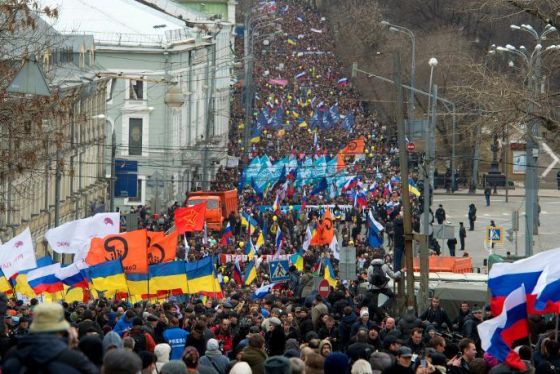
50,000 rally in Moscow against Putin’s intervention in Ukraine

moscow-antiwar

AFP reports: Around 50,000 people rallied in central Moscow Saturday in protest at Russia’s intervention in Ukraine, a day before the Crimean peninsula votes on switching to Kremlin rule.

Waving both Ukrainian and Russian flags and shouting slogans heard during the anti-government protests in Kiev, the demonstrators urged Russian President Vladimir Putin to pull troops back from a Cold War-style confrontation.

Marchers carried placards reading “Putin, get out of Ukraine” and others comparing Russia’s move on Crimea with the Nazi annexation of the Sudetenland as Europe rushed headlong into World War II.

Many of the protesters adopted the chants and slogans of Ukraine’s popular uprising that ousted President Viktor Yanukovych last month.

University professor Yelena Orlova, 47, whose sign read “Ukraine is a sovereign state”, said she did not expect the rally would change her government’s position, but believed it was her duty to speak out.

“I don’t agree with the policy of Putin,” she told AFP. “I am against the annexation of Crimea. I think Russia should respect the borders of Ukraine.” [Continue reading…]

Facebooktwittermail

Which march would you join?

A reader here just left a comment complaining about my “frothing support for the heathens who took Kiev by force,” and said, “I wish the people of Crimea the best and hope the vote tomorrow goes for separation from the u.s. / e.u.”

I can only imagine what kind of Manichean worldview lurks behind the reference to “heathens,” but the general sentiment here seems to one that is not uncommon among stalwart critics of American power. It seems to work like this:

If a prominent political leader antagonizes the U.S. and its European allies (I refer of course to the well-known demons de jour: Fidel Castro, Slobodan Milošević, Hugo Chávez, Mahmoud Ahmadinejad, Muammar Gaddafi, Bashar al-Assad, Vladimir Putin) and that individual is then vilified in the media, the mere fact that this person is being targeted in this way is taken as a sign that he must be doing something right. He symbolizes the rejection of Western hegemony and is conferred honorary membership to a select group of über-rebels who have the courage take a dramatic stand defying Western imperialism.

I am not immune to experiencing this sentiment, since power needs to be poked in the eye occasionally, yet that doesn’t mean that we should ignore the failings of those who are doing the poking.

But that’s what all too often happens when criticism of the US/the West becomes an obsession: it makes authoritarian rule become excusable.

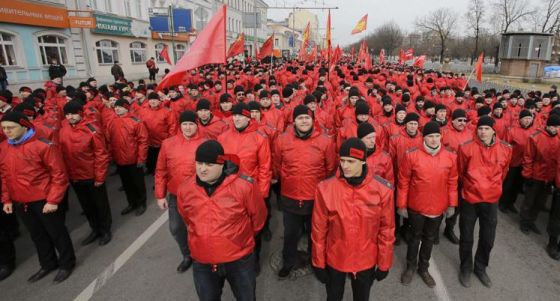
To anyone who thinks that tomorrow the people of Crimea are about to release themselves from the stifling grip of European influence in exchange for a warm embrace from Russia, I simply ask: who do you imagine you would have felt more comfortable marching alongside in Moscow today?

The disciplined young men in the “Brotherhood and Civil Resistance March,” or with activists like Ilya Yashin who have the guts to say: “We are patriots and Putin is Russia’s enemy”?

Brotherhood-and-Civil-Resistance

Reuters: “The pro-Russian patriotic procession was held to express support to Russian speakers living in Crimea and Ukraine and protest against the policies conducted by new Ukrainian authorities, according to organisers.”

Facebooktwittermail

Russia preparing for full-scale invasion of Ukraine

n13-iconThe Interpreter: Russia now has a massive force of tanks, troops, artillery, aircraft, and naval forces in position to potentially invade mainland Ukraine from Crimea in the south, but also from positions east and north of Ukraine. However, today reports are pouring in from across Russia of even more firepower on the move:

Facebooktwittermail

Should Ukraine have given up its nuclear arsenal?

e13-iconThe Guardian reports: Ukraine’s prime minister Arseniy Yatsenyuk has accused Russia of demonstrating unacceptable “military aggression” which has “no reason and no grounds”.

Moscow has deployed 10,000 troops along its border with Ukraine, deepening the crisis in Crimea ahead of a last desperate effort by the US secretary of state, John Kerry, to broker a deal with his Russian counterpart, Sergei Lavrov, in London on Friday.

Yatsenyuk told the UN security council on Thursday he is convinced Russians do not want war. He urged Russia’s leaders to heed the people’s wishes and return to dialogue with Ukraine. “If we start real talks with Russia, I believe we can be real partners,” Yatsenyuk said.

He said Ukraine gave up the world’s third-largest nuclear arsenal in 1994 in exchange for guarantees of its independence and territorial integrity. After Russia’s recent actions, Yatsenyuk said, “it would be difficult to convince anyone on the globe not to have nuclear weapons”. [Continue reading…]

In an op-ed for the New York Times yesterday, John Mearsheimer wrote: The West has few options for inflicting pain on Russia, while Moscow has many cards to play against Ukraine and the West. It could invade eastern Ukraine or annex Crimea, because Ukraine regrettably relinquished the nuclear arsenal it inherited when the Soviet Union broke up and thus has no counter to Russia’s conventional superiority.

No doubt, if Israel’s leaders are ever pushed into a position where they need to defend retaining their own nuclear arsenal, they will surely be tempted to cite Professor Mearsheimer’s position — that giving up such weapons can turn out to be regrettable.

Let’s suppose, however, that Ukraine was still bristling with nuclear weapons — at its peak its arsenal was larger than those of Britain, France, and China combined — are we to imagine that its interim government would now be making veiled threats to incinerate Moscow? Are we to suppose that Russian forces would have stayed out of Crimea? After all, how many wars have Israel’s nuclear weapons prevented?

It seems just as likely that in the current situation, Putin would be arguing that Russia had no choice but take over the whole of Ukraine — not under the pretext of protecting ethnic Russians but in the name of defending global security, his argument being that in an unstable Ukraine, “loose nukes” pose a threat to everyone.

What seems regrettable is not that Ukraine gave up its nuclear weapons but that the security guarantees it was given for doing so appear to have been worthless.

Facebooktwittermail

Russian roulette: The invasion of Ukraine

Part Eight — On the night of Thursday, March 13 VICE News reporter Robert King captured this scene on the streets of Donetsk, where a large group of pro-Russian activists attacked a group of pro-Ukrainian demonstrators calling for unity.

Part Seven — Simon is back in the Crimean capital of Simferopol, where both pro and anti-Russia demonstrations are dividing the region. Pro-Russia protesters believe that the country’s strong economy will help Crimea, while anti-Russia protesters feel that their land has been taken over by bandits.

Part Six — VICE News correspondent Simon Ostrovsky travels to the Kherson region of mainland Ukraine to both the Ukrainian and Russian checkpoints. At the Ukrainian checkpoint, Simon goes inside one of their tanks, and speaks to the commander, who says that despite his Russian blood he will defend all invaders. But at the Russian checkpoint, the exchange isn’t quite as cordial.

Facebooktwittermail

Russia blocks access to major independent news sites

Electronic Frontier Foundation reports: Russia’s government has escalated its use of its Internet censorship law to target news sites, bloggers, and politicians under the slimmest excuse of preventing unauthorized protests and enforcing house arrest regulations. Today, the country’s ISPs have received orders to block a list of major news sites and system administrators have been instructed to take the servers providing the content offline.

The banned sites include the online newspaper Grani, Garry Kasparov’s opposition information site kasparov.ru, the livejournal of popular anti-corruption crusader Alexei Navalny, and even the web pages of Ekho Moskvy, a radio station which is majority owned by the state-run Gazprom, and whose independent editor was ousted last month and replaced with a more government-friendly director.

The list of newly prohibited sites was published earlier today by Russia’s Prosecutor General, which announced that the news sites had been “entered into the single register of banned information” after “calls for participation in unauthorized rallies.” Navalny’s livejournal was apparently added to the register in response to the conditions of his current house arrest, which include a personal prohibition on accessing the Internet. [Continue reading…]

Facebooktwittermail

Straight talk on the U.S. and Ukraine

a13-iconStephen Zunes writes: It’s been interesting to observe the large numbers of people who suddenly think they’re experts on the ongoing crisis in Ukraine — both those on the left who blame it on Obama for intervening too much and those on the right who blame it on Obama for not intervening enough.

As someone who has spent his entire academic career analyzing and critiquing the U.S. role in the world, I have some news: While the United States has had significant impact (mostly negative in my view) in a lot of places, we are not omnipotent. There are real limits to American power, whether for good or for ill. Not everything is our responsibility.

This is certainly the case with Ukraine.

On the right, you have political figures claiming that Obama’s supposed “weakness” somehow emboldened Moscow to engage in aggressive moves against Crimea. Sarah Palin, for example, claims that Obama’s failure to respond forcefully to Russia’s bloody incursion into Georgia in 2008 made Russia’s “invasion” possible, despite the fact that Obama wasn’t even president then and therefore couldn’t have done much.

Even some Democrats, like Delaware senator Chris Coons, claim that Obama’s failure to attack Syria last fall made the United States look weak.

In reality, there seems to be little correlation between the willingness of Moscow to assert its power in areas within its traditional spheres of influence and who occupies the White House: The Soviets invaded Hungary in 1956 when Eisenhower was president; the Soviets invaded Czechoslovakia in 1968 when Johnson was president; the Soviets successfully pressed for martial law in Poland in 1981 when Reagan was president; the Russians attacked Georgia in 2008 when Bush was president. In each case, as much as these administrations opposed these actions, it was determined that any military or other aggressive counter-moves would likely do more harm than good. Washington cannot realistically do any more in response to Russian troops seizing Crimea in 2014 in the name of protecting Russian lives and Russian bases than Moscow could do in response to U.S. troops seizing Panama in 1989 in the name of protecting American lives and American bases. [Continue reading…]

Facebooktwittermail