Bashar al-Assad’s sick sense of humor

Ashley Frohwein writes: Here Bashar al Assad goes again. Joining the throngs of world leaders eulogizing the life and accomplishments of Nelson Mandela, the Syrian presidency recently released a statement on its Facebook page declaring that Mandela’s “history of struggle has become an inspiration to all the vulnerable peoples of the world, in the expectation that oppressors and aggressors will learn the lesson that in the end it is they who are the losers.” Emanating from the regime of a dictator who has presided over the multi-year – and seemingly unending – slaughter of “his own people,” few could overlook the statement’s profoundly offensive irony.

The absurdity of such a statement being issued by the Syrian regime suggests that Assad is just saying this stuff for fun, like some kind of sick joke – and indeed, he is. What’s more is that this is only the latest iteration in a longstanding pattern of caustic comedy by the Duck of Damascus.

In October, after the Norwegian Nobel Committee made its regrettable decision to award the Nobel Peace Prize to the Organization for the Prohibition of Chemical Weapons (OPCW) “for its extensive efforts to eliminate chemical weapons“, Assad proclaimed that the prize “should have been mine” because of his acceptance of the Russian-sponsored plan to rid Syria of its chemical arsenal. After the deal was struck, Assad even had the audacity to ask the UN to equip his troops and supply armored trucks to ship out Syria’s chemical materiel, a request that was rightly rejected outright: “There is no way that the regime will be supplied with equipment that could be used by the army to kill more innocent Syrians,” said one Western diplomat.

When massive demonstrations erupted in Egypt last summer against then president Mohammed Morsi, Mr. Assad, oddly enough, came out in support of the Egyptian protestors. “This is the fate of anyone in the world who tries to use religion for political or factional interests,” he said. Assad’s information minister, Omran Zoabi, told the Syrian state-owned news agency SANA that the “crisis can be overcome if Mohamed Mursi realizes that the overwhelming majority of the Egyptian people reject him and are calling on him to go.” Again with the hypocritical irony. [Continue reading…]

Some people may react to observations about Assad’s hypocrisy by pointing out (as though everyone did not already know), that in the West, we too have hypocritical political leaders. Indeed. But does that make Assad’s hypocrisy any less sick?


Facebooktwittermail

Why won’t the President rein in the intelligence community?

Ryan Lizza writes: On March 12, 2013, James R. Clapper appeared before the Senate Select Committee on Intelligence to discuss the threats facing America. Clapper, who is seventy-two, is a retired Air Force general and Barack Obama’s director of National Intelligence, in charge of overseeing the National Security Agency, the Central Intelligence Agency, and fourteen other U.S. spy agencies. Clapper is bald, with a gray goatee and rimless spectacles, and his affect is intimidatingly bureaucratic. The fifteen-member Intelligence Committee was created in the nineteen-seventies, after a series of investigations revealed that the N.S.A. and the C.I.A. had, for years, been illegally spying on Americans. The panel’s mission is to conduct “vigilant legislative oversight” of the intelligence community, but more often it treats senior intelligence officials like matinée idols. As the senators took turns at the microphone, greeting Clapper with anodyne statements and inquiries, he obligingly led them on a tour of the dangers posed by homegrown extremists, far-flung terrorist groups, and emerging nuclear powers.

“This hearing is really a unique opportunity to inform the American public to the extent we can about the threats we face as a nation, and worldwide,” Dianne Feinstein, a California Democrat and the committee’s chairman, said at one point. She asked committee members to “refrain from asking questions here that have classified answers.” Saxby Chambliss, a Georgia Republican, asked about the lessons of the terrorist attack in Benghazi. Marco Rubio, a Florida Republican, asked about the dangers of Egypt’s Muslim Brotherhood.

Toward the end of the hearing, Feinstein turned to Senator Ron Wyden, of Oregon, also a Democrat, who had a final question. The two senators have been friends. Feinstein held a baby shower for Wyden and his wife, Nancy Bass, before the birth of twins, in 2007. But, since then, their increasingly divergent views on intelligence policy have strained the relationship. “This is an issue where we just have a difference of opinion,” Wyden told me. Feinstein often uses the committee to bolster the tools that spy agencies say they need to protect the country, and Wyden has been increasingly concerned about privacy rights. For almost a decade, he has been trying to force intelligence officials like Clapper to be more forthcoming about spy programs that gather information about Americans who have no connection to terrorism.

Wyden had an uneasy kind of vindication in June, three months after Clapper’s appearance, when Edward Snowden, a former contractor at the N.S.A., leaked pages and pages of classified N.S.A. documents. They showed that, for the past twelve years, the agency has been running programs that secretly collect detailed information about the phone and Internet usage of Americans. The programs have been plagued by compliance issues, and the legal arguments justifying the surveillance regime have been kept from view. Wyden has long been aware of the programs and of the agency’s appalling compliance record, and has tried everything short of disclosing classified information to warn the public. At the March panel, he looked down at Clapper as if he were about to eat a long-delayed meal. [Continue reading…]

Facebooktwittermail

Is Silicon Valley taking a stand in favor of surveillance reform or simply assuming a posture?

Jeff Jarvis writes: Whose side are you on? That is the question MP Keith Vaz asked Alan Rusbridger last week when he challenged the Guardian editor’s patriotism over publishing Edward Snowden’s NSA and GCHQ leaks.

And that is the question answered today by eight tech giants in their letter to the White House and Congress, seeking reform of government surveillance practices worldwide. The companies came down at last on the side of citizens over spies.

Of course, they are also acting in their own economic (albeit enlightened) self-interest, for mass spying via the internet is degrading the publics’, clients’, and other nations’ trust in the cloud and its frequently American proprietors. Spying is bad for the internet; what’s bad for the internet is bad for Silicon Valley; and — to reverse the old General Motors saw — what’s bad for Silicon Valley is bad for America.

But in their letter, the companies stand first and firmly on principle. They propose that government limit its own authority, ending bulk collection of our communication. They urge transparency and oversight of surveillance, which has obviously failed thus far. And they argue against the balkanization of the net and the notion that countries may insist that data respect national borders.

Bravo to all that. I have been waiting for Silicon Valley to establish whether it collectively is a victim or a collaborator in the NSA’s web. I have wondered whether government had commandeered these companies to its ends. I have hoped they would use their power to lobby for our rights. And now I hope government — from Silicon Valley’s senator, NSA fan Dianne Feinstein, to president Obama — will listen.

This is a critical step in sparking real debate over surveillance and civil rights. It was nice that technology companies banded together once before to battle against the overreaching copyright regime known as SOPA and for our ability to watch Batman online. Now they must fight for our fundamental — in America, our constitutional — rights of speech and assembly and against unreasonable search and seizure. ‘Tis a pity it takes eight companies with silly names to do that. [Continue reading…]

The makeup of the band of corporate reformists seems to have been dictated by PowerPoint, which is to say, everyone named on the slides leaked by Snowden wants to salvage their reputation. But the problem with this type of appeal for reform is that it’s no different from the kind that might be made by any toothless advocacy group. Indeed, if these companies just want to present a wish-list of the kind of reform they claim they would like to see, then it’s pretty obvious that if no such reform is forthcoming then it will be back to business as usual.

The only thing about which we can be absolutely confident is that now, as always, corporations will act in accordance with what they determine are their own interests.

Facebooktwittermail

Intelligence contractors donate millions to intelligence watchdogs in Congress

The Center for Public Integrity: Most intelligence-related spending by the U.S. government is subject to independent scrutiny and monitoring by a small number of people — primarily, the 40 lawmakers assigned to the House and Senate intelligence committees, plus the roughly 100-member staffs of those two committees.

The lawmakers are meant to provide a key check on waste, fraud, abuse, and potential illegalities, since intelligence-related spending and activities are ordinarily well outside the public’s view.

According to a new report, however, every single one of those lawmakers has received campaign funds from twenty of the largest contractors providing intelligence services to the Defense Department, which accounted for a signficant portion of the nation’s overall $75.4 billion intelligence budget in 2012.

The total, election-related benefits for current intelligence committee members, including ex-officio members, provided by companies in the industry they directly oversee amount to at least $3.7 million from the companies’ PACs and employees since 2005, according to the report released Dec. 9 by Maplight.org, a nonpartisan group that investigates campaign finance issues.

Facebooktwittermail

Spy agencies in covert push to infiltrate virtual world of online gaming

The Guardian reports: To the National Security Agency analyst writing a briefing to his superiors, the situation was clear: their current surveillance efforts were lacking something. The agency’s impressive arsenal of cable taps and sophisticated hacking attacks was not enough. What it really needed was a horde of undercover Orcs.

That vision of spycraft sparked a concerted drive by the NSA and its UK sister agency GCHQ to infiltrate the massive communities playing online games, according to secret documents disclosed by whistleblower Edward Snowden.

The files were obtained by the Guardian and are being published on Monday in partnership with the New York Times and ProPublica.

The agencies, the documents show, have built mass-collection capabilities against the Xbox Live console network, which has more than 48 million players. Real-life agents have been deployed into virtual realms, from those Orc hordes in World of Warcraft to the human avatars of Second Life. There were attempts, too, to recruit potential informants from the games’ tech-friendly users.

Online gaming is big business, attracting tens of millions of users worldwide who inhabit their digital worlds as make-believe characters, living and competing with the avatars of other players. What the intelligence agencies feared, however, was that among these clans of elves and goblins, terrorists were lurking. [Continue reading…]

Facebooktwittermail

Capitalism’s march toward global collapse

Harald Welzer writes: The municipal utility company in the city of Potsdam is currently wooing new customers with a special “BabyBonus” offer. The slogan reads, “We value little energy robbers! Welcome to the world!” Every newborn receives a credit of 500 kilowatt hours of electricity, allowing him or her to revel from the start in a world where everything, especially energy, will always be available in abundance. These babies may later find they’re in for a surprise.

When the United Nations Climate Change Conference wrapped up in Warsaw the weekend before last, it did, despite what most observers and disappointed NGO representatives believe, yield a result. It just wasn’t officially announced: the termination of the at-least symbolic general agreement that urgent action must be taken to counter global warming. In other words, climate change has been definitively removed from the global policy agenda.

The intense concern over climate change triggered by Intergovernmental Panel on Climate Change reports in 2007 and widely popularized by Al Gore’s movie, “An Inconvenient Truth” — a concern that led even Angela Merkel to make an appearance in the Arctic as the “climate chancellor,” decked out in a red all-weather jacket — actually dissipated a while ago, but no one wanted to say so out loud.

The United States’ lack of interest in an international treaty is dressed up by its argument that gas extracted by fracking is more climate-friendly than coal, while in Japan, the Fukushima disaster and resulting phase-out of nuclear power has provided those responsible with an excellent argument for why the country now needs to burn more coal in order to stay economically competitive. Hannelore Kraft, governor of the German state of North Rhine-Westphalia, feels much the same way about her own state. And Australia, Canada, Poland and Russia have never really grasped why global warming should stop anyone from burning everything the oil rigs, mines and pipelines have to offer in the first place.

To put it another way: The primacy of economics has prevailed. It no longer seems to matter how we’re supposed to get through the rest of this century if the world grows warmer by three, four or five degrees Celsius. National economies require an ever-growing dose of energy if their business models are to continue functioning, and, in the face of this logic, all scientific objections to the contrary are just as powerless as the climate protest movements, which are, in any case, marginal. [Continue reading…]

Facebooktwittermail

With Iran, Obama can end America’s long war for the Middle East

Andrew J. Bacevich writes: What Jimmy Carter began, Barack Obama is ending. Washington is bringing down the curtain on its 30-plus-year military effort to pull the Islamic world into conformity with American interests and expectations. It’s about time.

Back in 1980, when his promulgation of the Carter Doctrine launched that effort, Carter acted with only a vague understanding of what might follow. Yet circumstance — the overthrow of the shah in Iran, the Soviet invasion of Afghanistan — compelled him to act. Or more accurately, the domestic political uproar triggered by those events compelled the president, facing a tough reelection campaign, to make a show of doing something. What ensued was the long-term militarization of U.S. policy throughout the region.

Now, without fanfare, President Obama is effectively revoking Carter’s doctrine. The U.S. military presence in the region is receding. When Obama posited in his second inaugural address that “enduring security and lasting peace do not require perpetual war,” he was not only recycling a platitude; he was also acknowledging the folly and futility of the enterprise in which U.S. forces had been engaged. Having consumed vast quantities of blood and treasure while giving Americans little to show in return, that enterprise is now ending.

Like Carter in 1980, Obama finds himself with few alternatives. At home, widespread anger, angst and mortification obliged Carter to begin girding the nation to fight for the greater Middle East. To his successors, Carter bequeathed a Pentagon preoccupied with ramping up its ability to flex its muscles anywhere from Egypt to Pakistan. The bequest proved a mixed blessing, fostering the illusion that military muscle, dexterously employed, might put things right. Today, widespread disenchantment with the resulting wars and quasi-wars prohibits Obama from starting new ones.

Successive military disappointments, not all of Obama’s making, have curbed his prerogatives as commander in chief. Rather than being the decider, he ratifies decisions effectively made elsewhere. In calling off a threatened U.S. attack on Syria, for example, the president was acknowledging what opinion polls and Congress (not to mention the British Parliament) had already made plain: Support for any further military adventures to liberate or pacify Muslims has evaporated. Americans still profess to love the troops. But they’ve lost their appetite for war. [Continue reading…]

Facebooktwittermail

WikiLeaks’ Sarah Harrison: ‘How can you take Pierre Omidyar seriously?

The Guardian reports: The WikiLeaks staffer and Snowden collaborator Sarah Harrison has criticised Pierre Omidyar, the eBay founder who is setting up a new journalism venture with Glenn Greenwald, Laura Poitras and Jeremy Scahill, for his involvement in the 2010 financial blockade against WikiLeaks.

In her first interview since leaving Moscow for Berlin last month, Harrison told German news weekly Stern: “How can you take something seriously when the person behind this platform went along with the financial boycott against WikiLeaks?”

Harrison was referring to the decision in December 2010 by PayPal, which is owned by eBay, to suspend WikiLeaks’ donation account and freeze its assets after pressure from the US government. The company’s boycott, combined with similar action taken by Visa and Mastercard, left WikiLeaks facing a funding crisis.

“His excuse is probably that there is nothing he could have done at the time,” Harrison continued. “Well, he is on the board of directors. He can’t shake off responsibility that easily. He didn’t even comment on it. He could have said something like: ‘we were forced to do this, but I am against it’.”

Harrison joined WikiLeaks from the Bureau of Investigative Journalism, and worked with the organisation on the Afghan war logs and leaked cables projects. She now works on the WikiLeaks legal defence team, although she has no legal qualifications, and was catapulted to fame when she accompanied Edward Snowden, the NSA whistleblower, on his flight from Hong Kong to Russia in June 2013.

Referring to Omidyar’s plans to set up a new media organisation, in which the former Guardian writer Greenwald – who wrote a number of stories from the Snowden revelations – will play a central part, Harrison said: “If you set up a new media organisation which claims to do everything for press freedom, but you are part of a blockade against another media organisation, then that’s hard for us to take it seriously. But I hope that they stick to their promises”. [Continue reading…]

Facebooktwittermail

The Zionists afraid of free speech

This week, the New America Foundation hosted a discussion on the newly published, Goliath: Life and Loathing in Greater Israel, with its author Max Blumenthal. James Fallows writes:

I’ve been involved with New America since its beginning in the 1990s, initially as chairman of its board and still as a board member. New America puts on well over 100 events each year — in DC, New York, California, and elsewhere. To the best of my knowledge, this latest session was the only time we’ve been under public or private pressure to rescind an invitation for someone to speak. There could have been other cases, but I don’t know of any.

The event in question featured Max Blumenthal, who was being interviewed about his book on Israel, Goliath, by Peter Bergen, the well-known writer on war-and-terrorism topics. (Bergen is also a New America fellow; the latest of his many books is Man Hunt, about the bin Laden raid.) In the week before the event, items like this one in Commentary had said that New America should not provide a platform for what it claimed was destroy-Israel hate speech. Some members of the board got personal email pitches to the same effect.

I wasn’t involved in inviting Max Blumenthal, but having read his book before the session and now having heard him speak, I am glad that New America and its president, Anne-Marie Slaughter, stood by their invitation. That was the right call on general free-speech principles, and also because this book should be discussed and read. [Extra disclosures: Both Slaughter and Bergen are long-time friends of mine, as well as colleagues via the Atlantic, New America, and elsewhere. My wife and I have also been friends of Max Blumenthal’s parents for many years.]

The case against Goliath, summarized here, is that it is so anti-Israel as to represent not journalism or reasonable critique but bigoted propaganda; plus, that in being so anti-Israel it is effectively anti-Semitic. With a few seconds of online search, you can track down the now-extensive back and forth. The furor has certainly helped publicize the book, but to me those claims about it seem flat mischaracterizations. Goliath is a particular kind of exposé-minded, documentary-broadside journalism whose place we generally recognize and respect.

The purpose of this book is not to provide some judicious “Zionism at the crossroads” overview of the pluses and minuses of modern Israel. That is not the kind of writer Max Blumenthal is. His previous book, Republican Gomorrah, was about the rise of the Tea Party and related extremist sentiment within the GOP. In that book he wasn’t interested in weighing the conservative critique of big government or teachers’ unions or Medicaid. That’s Brookings’s job. Instead his purpose was to document the extreme voices — the birthers, the neo-secessionists, the gun and militia activists, those consumed by hatred of Barack Obama — who were then providing so much of the oomph within Republican politics.

That book was effective not because Blumenthal said he disagreed with these people. Of course he did, but so what? Its power came simply from showing, at length and in their own words, how they talked and what they planned to do. As Blumenthal pointed out in this week’s New America session, that earlier book argued, a year before the Tea Party’s surge victories in the 2010 mid-terms: these people are coming, and they are taking the party with them. His account wasn’t “balanced” or at all subtle, but it was right.

His ambition in Goliath is similar. He has found a group of people he identifies as extremists in Israel — extreme in their belief that Arabs have no place in their society, extreme in their hostility especially to recent non-Jewish African refugees, extreme in their seeming rejection of the liberal-democratic vision of Israel’s future. He says: these people are coming, and they’re taking Israeli politics with them. As he put it in a recent interview with Salon, the book is “an unvarnished view of Israel at its most extreme.” Again, the power of his book is not that Blumenthal disagrees with these groups. Obviously he does. It comes from what he shows. [Continue reading…]

Facebooktwittermail

Among those eulogising Mandela are people who once damned him as a terrorist and supported apartheid

Chris McGreal writes: Nelson Mandela Square sits at the entrance to the glitziest shopping mall in what is reputed to be the wealthiest square kilometre in Africa. Towering over the cafes around the northern Johannesburg piazza, as if guarding the diamond jewellers and designer clothes shops within, is a six metre tall, 2.5 ton statue of the great man dancing.

The mall’s owners say the statue is intended to honour Mandela and his country’s hard-won democracy and most of the shoppers milling around it would probably see it that way. But the great totem always seemed to me to be mocking the new South Africa.

Many of the same prosperous whites who gaze on the giant Mandela from plush cafes and pour out their love and admiration for his sacrifice in saving South Africans from themselves can also regularly be heard bemoaning the state of the country he bequeathed. They worship the man but despair of the legacy of his handiwork in the levels of crime, corruption, authoritarianism and “falling standards” under democratic government.

Not all whites, but a good number of them. And they feel free to do this because when they look at Mandela they see absolution. Their praise of his willingness to forgive comes with the understanding that they too are forgiven and absolved of the past. Freed of responsibility for how South Africa came to be what it is, they head back to the pool and congratulate themselves on their luck in embracing the world’s greatest modern statesman. Bring up past responsibilities and you face being accused of failing to understand Mandela’s message. [Continue reading…]

Facebooktwittermail

Nelson Mandela’s meaning for young South Africans

Sipho Hlongwane writes: How do you encapsulate the weight of Nelson Mandela on South Africa? How do you do so from the perspective of a generation that does not remember the man in jail, or remember when he walked free, and the idolisation that went with that? These are some of the challenges that we face, as we grapple with the legacy of Madiba and apartheid that is thrust upon us.

My first memory of Mandela was around 1993, when a South African defence force helicopter rumbled overhead and poured forth a cloud of voter education pamphlets (which had Mandela’s face on them) into the hazy KwaZulu Natal afternoon air. My friends and I were a few months away from our 5th birthdays, what did we know of such things? Nevertheless, we were conscripted into collecting and destroying the pamphlets by angry adults, who exhorted us not to read the “communist propaganda”.

For the next couple of weeks, we were made to attend a series of meetings hosted by the Zulu nationalist Inkatha Freedom party, which spooked us into fearing the African National Congress, which was coming to take away our homes and force us into communist slave camps.

A taut thread of fear ran through our preschool daily existences. Such were the joys of growing up in an IFP stronghold during the transition years. This rude introduction into South Africa’s often absurd politics helped temper any veneration I might have had of Mandela.

His death will briefly throw the world into a bereavement that befits the passing of an icon. What the rest of the world will blessedly miss is the anguish, doubt and emotional turmoil that has gripped South Africa for the last decade and more, which will now be heightened .

When he still walked among us, Madiba was the people’s man in the truest sense – all South Africans who bought into the post-apartheid ideal of reconciliation and nation building felt that Madiba was somehow an indispensable part of themselves. Inevitably then, there will be a tug of war for ownership of his legacy.

The unspoken truth in South Africa is that Mandela has been politically irrelevant since 1999. His successor Thabo Mbeki’s bristly nine years in power all but erased Mandela’s genial and reconciliatory years from the popular imagination. The Mbeki years were the natural next step in the development of the nation’s cracked psyche, but it didn’t make them any less painful or scary. The memories of apartheid and the violence of the transition years were still fresh. Like a baby weaned off breast milk, we pined for the comfort of the Madiba years.

The sight of Hollywood and the jet set laying themselves at Madiba’s feet didn’t help: it served to reinforce our nostalgia. To suggest publicly that Mandela could no longer lead the country in any material way bordered on sacrilege. His death will now force every South African to deal with this fact. [Continue reading…]

Facebooktwittermail

How can so many African leaders ignore Mandela’s legacy?

Patience Akumu writes: The world has stopped for a moment to focus its attention on Africa. This is not something that happens often. No, they are not talking about senseless civil wars, crippling poverty, appalling HIV/Aids statistics or blatant dictators. They are talking about a black man who freed his country from an inhumane regime; who dared to dream of a tolerant, united and poverty-free Africa and dedicated his life to the attainment of this dream. In turn, God rewarded him with 95 years of a robust, purposeful life. If Nelson Mandela was from the Luo ethnicity like me, his death would herald two weeks of drinking, merry-making and dancing to the sounds of ffumbo drums in celebration of the resting of an honourable elder.

Seeing the glowing eulogies fills me with the same unsettling pride that gripped my younger soul as I listened to my high school African nationalism teacher talk about the struggle of great leaders to liberate the continent. She spoke of Mandela in the same breath as Kwame Nkurumah, Julius Nyerere, Daniel Arap Moi, Muammar Gaddafi, Yoweri Museveni and Robert Mugabe.

These are the men who stood up to oppressive regimes and dedicated their lives to fighting injustice and transforming the continent, she told us. The fiery way in which she spoke, and reading about the anti-colonial struggle from authors such as Chinua Achebe and Ousmane Sembène, made me want to leap out of my seat.

I was in awe of these great men and wanted to save a continent that, she informed us, was on the brink of sinking under the weight of endless social, economic and political problems.

Today, 10 years later, listing some of these names alongside Mandela seems quite odd. It is hard to imagine, for instance, that Mandela, Mugabe and Museveni all once sung the same song of liberty, equality and tolerance.

Mandela is one of the few African leaders who sang the song to the very end. [Continue reading…]

Facebooktwittermail

Nelson Mandela and the Anti-Apartheid Movement

Peter Hain writes: “Ah, Peter, return of the prodigal son!” Nelson Mandela beamed, welcoming me to his Johannesburg home in February 2000.

Although on an official government visit, in a sense I was also being welcomed to my “home” – to South Africa, the panoramic, sunshine country of my childhood, as the first-ever British minister for Africa to be born on that continent.

Almost to the day, 10 years before, many of us had watched, tears welling up, as he had walked to freedom after 27 years in prison. And a long time before that – in March 1966 – I was a teenager aboard an ocean liner steaming out of Cape Town, past Robben Island where Mandela and his fellow leaders of the African National Congress were jailed. My anti-apartheid activist parents had been forced to leave their beloved country and the “island from hell” disappeared in the stormy mist as we headed for exile in Britain.

People forget how tough it was then, how hard the struggle was to be for decades afterwards. The resistance had been closed down, leaders such as Mandela imprisoned, tortured, banned or forced underground.

Within a few years, Mandela had almost been forgotten. British diplomats dismissed the ANC and Mandela as a busted flush. The white racist police state seemed omnipotent.

But in Britain, the Anti-Apartheid Movement (AAM) had kept the flame of freedom flickering. Soon it was lit by our militant protests, which stopped white South African rugby and cricket tours in 1969-70. The country had been forced into global sporting isolation.

On Robben Island, brutal white warders, all fanatical rugby fans, vented their fury on Mandela and his comrades at the ostracism of the mighty Springboks, unwittingly communicating a morale-boosting message through the news blackout. [Continue reading…]

Facebooktwittermail

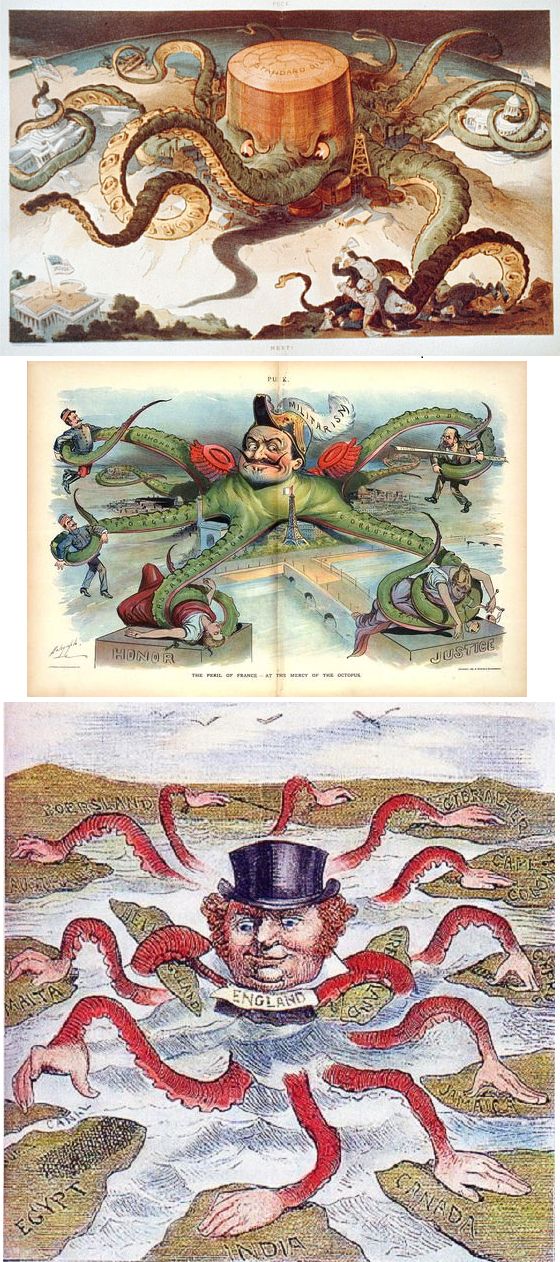
The specter of global domination

spectreWhen Ian Flemming created the fictional SPECTRE (SPecial Executive for Counter-intelligence, Terrorism, Revenge and Extortion), a terrorist organisation aimed at world domination, he chose a familiar icon — the octopus — long favored by those who want to evoke images of evil. Its tentacles represent strength, stealth, ugliness, vast reach, and ruthlessness.

nrolFor the National Reconnaissance Office (NRO), which chose a world-grasping octopus and the slogan “Nothing is Beyond Our Reach” to adorn its latest spy satellite that launched from California on Thursday, the octopus represents “a versatile, adaptable, and highly intelligent creature.”

That’s an accurate description of an octopus as a creature but not of an octopus as a symbol.

While the mission of NROL-39 is classified, it is believed to be a remnant of the Future Imagery Architecture, a program which was described in the New York Times in 2007 as “perhaps the most spectacular and expensive failure in the 50-year history of American spy satellite projects.”

nrol-39

In a recent interview with the BBC, Glenn Greenwald said:

The goal of the United States government and the UK government, its closest surveillance ally, is to eliminate all privacy globally, by which I mean, to make every form of electronic communication by and between all human beings, collected, stored, analyzed, and monitored by the U.S. and its four English-speaking Five Eyes partners in the surveillance world.

One can view NROL-39 and its choice of symbols as yet another example of this relentless drive towards global domination in surveillance that Greenwald describes, or, one can apply a bit of analysis in a more fruitful, realistic but perhaps less hyperbolic direction.

As news reports appeared showing the NRO’s poor choice of imagery, I expect that inside the Pentagon and across the intelligence community, there was no shortage of individuals who smacked their own foreheads as they wondered: who could be so clueless? U.S. intelligence already has a massive image problem. It just got worse.

As a defense establishment agency, I’m sure the NRO does not have an artist-in-residence who is given a free hand to design and deploy a spy satellite logo of their choice. On the contrary, like any other government bureaucracy, the NRO no doubt has a careful review process through which draft designs are viewed and approved or rejected. So it’s very unlikely that when NROL-39 blasted into orbit, the global dominating octopus on its side lacked any of the sign-offs in the stages of authorization required by the agency. In other words, government officials across multiple ranks of seniority saw the logo and said: “Looks good to me.”

What the octopus logo reveals says much less about the ability of the intelligence agencies to control the world than it says about the competence and judgement of the people in charge.

The NRO is run by Betty J. Sapp and she isn’t a rocket scientist — business management is supposedly her expertise.

When those aspects of an intelligence agency’s work that are on public display evince this level of cluelessness, there’s no reason to imagine that under a cloak of secrecy it operations are more efficient.

We probably have less reason to be worried about our freedoms being curtailed than we have reason to be angry about the vast waste of resources all incurred in the name of national security.

octopus-domination

Facebooktwittermail

The misleading metaphor of the selfish gene

David Dobbs writes: A couple of years ago, at a massive conference of neuroscientists — 35,000 attendees, scores of sessions going at any given time — I wandered into a talk that I thought would be about consciousness but proved (wrong room) to be about grasshoppers and locusts. At the front of the room, a bug-obsessed neuroscientist named Steve Rogers was describing these two creatures — one elegant, modest, and well-mannered, the other a soccer hooligan.

The grasshopper, he noted, sports long legs and wings, walks low and slow, and dines discreetly in solitude. The locust scurries hurriedly and hoggishly on short, crooked legs and joins hungrily with others to form swarms that darken the sky and descend to chew the farmer’s fields bare.

Related, yes, just as grasshoppers and crickets are. But even someone as insect-ignorant as I could see that the hopper and the locust were wildly different animals — different species, doubtless, possibly different genera. So I was quite amazed when Rogers told us that grasshopper and locust are in fact the same species, even the same animal, and that, as Jekyll is Hyde, one can morph into the other at alarmingly short notice.

Not all grasshopper species, he explained (there are some 11,000), possess this morphing power; some always remain grasshoppers. But every locust was, and technically still is, a grasshopper — not a different species or subspecies, but a sort of hopper gone mad. If faced with clues that food might be scarce, such as hunger or crowding, certain grasshopper species can transform within days or even hours from their solitudinous hopper states to become part of a maniacally social locust scourge. They can also return quickly to their original form.

In the most infamous species, Schistocerca gregaria, the desert locust of Africa, the Middle East and Asia, these phase changes (as this morphing process is called) occur when crowding spurs a temporary spike in serotonin levels, which causes changes in gene expression so widespread and powerful they alter not just the hopper’s behaviour but its appearance and form. Legs and wings shrink. Subtle camo colouring turns conspicuously garish. The brain grows to manage the animal’s newly complicated social world, which includes the fact that, if a locust moves too slowly amid its million cousins, the cousins directly behind might eat it.

How does this happen? Does something happen to their genes? Yes, but — and here was the point of Rogers’s talk — their genes don’t actually change. That is, they don’t mutate or in any way alter the genetic sequence or DNA. Nothing gets rewritten. Instead, this bug’s DNA — the genetic book with millions of letters that form the instructions for building and operating a grasshopper — gets reread so that the very same book becomes the instructions for operating a locust. Even as one animal becomes the other, as Jekyll becomes Hyde, its genome stays unchanged. Same genome, same individual, but, I think we can all agree, quite a different beast.

Why?

Transforming the hopper is gene expression — a change in how the hopper’s genes are ‘expressed’, or read out. Gene expression is what makes a gene meaningful, and it’s vital for distinguishing one species from another. We humans, for instance, share more than half our genomes with flatworms; about 60 per cent with fruit flies and chickens; 80 per cent with cows; and 99 per cent with chimps. Those genetic distinctions aren’t enough to create all our differences from those animals — what biologists call our particular phenotype, which is essentially the recognisable thing a genotype builds. This means that we are human, rather than wormlike, flylike, chickenlike, feline, bovine, or excessively simian, less because we carry different genes from those other species than because our cells read differently our remarkably similar genomes as we develop from zygote to adult. The writing varies — but hardly as much as the reading.

This raises a question: if merely reading a genome differently can change organisms so wildly, why bother rewriting the genome to evolve? How vital, really, are actual changes in the genetic code? Do we even need DNA changes to adapt to new environments? Is the importance of the gene as the driver of evolution being overplayed?

You’ve probably noticed that these questions are not gracing the cover of Time or haunting Oprah, Letterman, or even TED talks. Yet for more than two decades they have been stirring a heated argument among geneticists and evolutionary theorists. As evidence of the power of rapid gene expression mounts, these questions might (or might not, for pesky reasons we’ll get to) begin to change not only mainstream evolutionary theory but our more everyday understanding of evolution. [Continue reading…]

Facebooktwittermail

It’s not just the genes

Eric E. Schadt writes: It’s been 10 years since an international consortium of scientists successfully completed the mapping of the human genome — a world-changing project that couldn’t have happened without public and private support. The feat neatly coincided with the 50th anniversary of the description of DNA’s double helix by Nobel laureates James Watson and Francis Crick. These are incredible achievements, and today, we couldn’t conceive of the future of medicine without them.

Equally unfathomable is a view of medicine that doesn’t take into account the trove of clinically relevant information available for any individual person, and for all people more generally. DNA holds (among other things) your personal architectural blueprint, but unto itself, it is a fairly static factor, the genome in your normal, healthy cells changing very little over the course of your life. We know with certainty that DNA alone is not a categorical predictor of disease. The BRCA1 or BRCA2 gene mutation, for example, signals significantly higher risk for breast cancer in women, but people with the same defective gene often have remarkably different outcomes. Researchers and the public are asking: why is that?

Whether disease manifests, the age at which it manifests, and how severe it becomes, all depend on a multitude of other factors and the dynamic interplay between them: RNA, metabolites, proteins, healthy and diseased tissues, insulin and cholesterol levels, weight, age, gender, tobacco use, and toxic exposures — to name just a few. To achieve a comprehensive understanding of disease so that we can better diagnose and treat it, researchers must examine a hierarchy of levels — multiple scales — of all observable characteristics. Each element — from molecules, to cells, to tissues, to organs, to the person, and then to the community at large — and the flow of information between these elements, is a biological data point at a particular point in time, and the observation of many millions of these elements in a given individual and population of time is where “big data” meets medicine. [Continue reading…]

Facebooktwittermail