The Guardian reports: Canada’s rush to exploit its tar sands and shale gas resources will destroy the environment “as fast as possible”, according to Noam Chomsky.
In an interview with the Guardian, the linguist and author criticised the energy policies of the Canadian government under Prime Minister Stephen Harper.
He said: “It means taking every drop of hydrocarbon out of the ground, whether it’s shale gas in New Brunswick or tar sands in Alberta and trying to destroy the environment as fast as possible, with barely a question raised about what the world will look like as a result.”
But indigenous peoples in Canada blocking fossil fuel developments are taking the lead in combatting climate change, he said. Chomsky highlighted indigenous opposition to the Alberta tar sands, the oil deposit that is Canada’s fastest growing source of carbon emissions and is slated for massive expansion despite attracting international criticism and protest.
“It is pretty ironic that the so-called ‘least advanced’ people are the ones taking the lead in trying to protect all of us, while the richest and most powerful among us are the ones who are trying to drive the society to destruction,” said Chomsky. [Continue reading…]
Yes, I’m an ethical person — before lunch, anyway
Pacific Standard: When was the last time you engaged in unethical behavior? Be honest, now, and be specific: What time of day was it when you cheated on that test, lied to your spouse, or stole that item from the company break room?
If it was late afternoon or evening, you don’t have an excuse, exactly, but you certainly have company.
A newly published paper entitled The Morning Morality Effect suggests we’re more likely to act unethically later in the day. It provides further evidence that self-control is a finite resource that gradually gets depleted, and can’t be easily accessed when our reserves are low. [Continue reading…]
Music: Jon Hassell — ‘Last Night The Moon Came’
The U.S. plan to build a Libyan army
Frederic Wehrey writes: Last month, discussing the Obama administration’s plans for a more modest Middle East policy, National Security Adviser Susan Rice noted that Washington “can’t just be consumed 24/7 by one region, important as it is.” From now on, she implied, countries in the region, including Libya, would be relegated to second-tier priority.
As she spoke, the U.S. military’s Africa Command (AFRICOM) was preparing to step up its assistance in Libya to help the country rebuild its weak security sector. Over the summer, AFRICOM, along with the militaries of Italy, Turkey, and the United Kingdom committed to help train, advise, and equip a new Libyan army — a “general purpose force,” in formal military terms — with the United States responsible for approximately 5,000 to 8,000 soldiers. The plan seems reasonable on paper. Trained at overseas bases outside Libya, the new force will allow the government to project its own authority, protect elected officials and institutions from the militias operating within the country, and compel the militias to demobilize and disarm. Washington sees the effort as a crucial step in Libya’s democratic transition and as a way to halt extremism and prevent the country’s lawlessness from spilling over its borders.
But the force’s composition, the details of its training, the extent to which Libyan civilians will oversee it, and its ability to deal with the range of threats that the country faces are all unclear. And the stakes are enormous. There are signs that some militias within Libya are trying to bloody the new army’s nose before it even enters the fight: a campaign of shadowy assassinations against military officers, particularly in the east, is likely half vendetta against representatives of the old order and half attempt to deter the central government’s monopolization of military force.
The case of a separate and underreported U.S. effort to train a small Libyan counterterrorism unit inside Libya earlier this year is instructive. The unit, set up by U.S. special operations forces, was hardly representative of Libya’s regional makeup: recruitment appeared to be drawn overwhelmingly from westerners to the exclusion of the long-neglected east. In addition, the absence of clear lines of authority — nearly inevitable given Libya’s fragmented security sector — meant that the force’s capabilities could just have easily ended up being used against political enemies as against terrorists.
Things came to a head in August, when a tribal militia launched a pre-dawn raid on the poorly guarded training camp near Tripoli. No U.S. soldiers were there, but the militia did make off with sensitive U.S. military equipment. And that spelled the end of the mission; the effort was aborted and U.S. forces went home. (The Libyan government and U.S. special operations forces are currently searching for a new training site inside Libya to restart it.) Drawing lessons from this fiasco, the United States and its NATO partners have wisely decided that the new training mission for the general purpose force will take place outside Libya — in Bulgaria, Italy, Turkey, and the United Kingdom. But that alone won’t be enough to ensure that the effort doesn’t face more significant hurdles. [Continue reading…]
Reuters reports: Heavy fighting between militias using rifles, grenades and anti-aircraft weapons erupted in several parts of Tripoli on Tuesday in the worst violence in the Libyan capital for weeks.
Fighting started in Tripoli’s eastern Suq al-Juma district and a central area where two burned out pick-ups belonging to a militia on the government payroll could be seen. Libyan news websites said at least one person had been wounded.
The shooting started after a member of a militia was detained at a checkpoint after which fellow fighters arrived trying to free him, a militia source said.
Reuters reporters in Tripoli could hear shots from rocket propelled-grenades and anti-aircraft guns throughout the night. Tripoli was quiet on Tuesday morning but occasional rifle shots could still be heard.
Syria: A war with no end in sight
Stuart Montgomery writes: The Syrian Civil War has been raging for two years. Countless casualties have been sustained on each side, and the humanitarian problem continues to worsen.
So how do you end a civil war?
There are three potential outcomes: regime victory, rebel victory and a negotiated settlement. Currently, the last option is the championed outcome in the international context of the Syrian Civil War. Recently, the United States and Russia, reeling on the recent success of the chemical weapons deal, announced plans to convene an international conference to negotiate peace. Turkey, France and the United Kingdom, countries once considering military action, now support a peace settlement. Political pundits point to the example of Kosovo, as they argue for a quick, clean and negotiated peace. Respected strategist Edward Luttwak argued that a negotiated settlement would best serve U.S. interests. This option has appeal, because it avoids a messy military intervention. However, a negotiated peace is not risk-free.
Historically, negotiated settlements ending civil wars, are temporary at best. Angola, Sudan and Lebanon provide unfortunate examples of civil wars that were only temporarily halted by a negotiated peace. Another example, Kosovo is now relatively stable, but has been governed by a large, expensive, U.N. force for over a decade.
Why do negotiated settlements break apart?
Conflict reignites, because the issues that are at the root of the war are never truly resolved. Monica Duffy Toft, professor at Oxford’s Blavatnik School of Government, argues that rebel victories result in a more stable peace in her book Securing the Peace, on civil war termination. Shouldn’t the choice be clear? Unfortunately supporting Syrian rebels is unpalatable, because of their fractious nature and key groups’ affiliation with Al Qaeda. Supporting Bashar al-Assad is equally unattractive, and unrealistic. Therefore, wouldn’t a negotiated settlement, even if temporary, best protect U.S. security interests?
A negotiated peace is not without problems. First, both Assad’s regime and Al Qaeda affiliates would continue to exist and be armed in some power sharing structure in Syria. Without the presence of a large peacekeeping force, which is unlikely with the lack of support and enthusiasm in the United States and abroad, each side would have little incentive to disarm and cooperate. Instead, these factions would focus on outmaneuvering each other for survival, rather than rebuilding Syria. [Continue reading…]
CNN reports: Al Qaeda has swept to power with the aim of imposing a strict Islamist ideology on Syrians across large swathes of Syria’s rebel-held north, according to a CNN survey of towns, activists and analysts that reveals an alarming increase in al Qaeda-linked control in just the past month.
Al Qaeda-backed militants known as the Islamic State of Iraq and Syria (ISIS) are the predominant military force in northern Syria, according to activists and seasoned observers, and have a powerful influence over the majority of population centers in the rebel-held north.
Rami Abdul Rahman, from the Syrian Observatory for Human Rights, said: “ISIS is the strongest group in Northern Syria — 100% — and anyone who tells you anything else is lying.”
CNN conducted dozens of interviews with activists, local and international observers and residents of the towns affected by ISIS in preparing this study. Many of the Syrians CNN spoke to talked anonymously for fear of angering ISIS, saying ISIS has in some areas made it a crime punishable by flogging to even say their name.
The swift al Qaeda expansion poses a severe policy dilemma for the United States and its European allies who have long delayed their promised armed assistance to rebel groups as they struggled with fears that the weapons could end up in the hands of al Qaeda-backed extremists.
Observers say the delay has provided a vacuum in the often chaotic rebel ranks that the organized and fearless Islamists have moved to fill.
Many observers explain that the extent of ISIS’s discipline and resources — they are said to have considerable cash at their disposal — means that the other rebel groups operating in the north do not seek to confront them.
Charles Lister, analyst at IHS Jane’s Terrorism and Insurgency Centre, said: “Although not a numerically dominant force, ISIS is playing an increasingly pre-eminent role in the northern Syrian insurgency.
“Much of this is a result of its capability to exploit superior levels of financing and resources — essentially, to spread itself thinly enough to exert influence and/or control, but not too thin as to be overpowered by rivals.”
Most activists point to a clear strategy by ISIS — which aims to dominate a large swathe of the north from the north-western town of Idlib to the north-eastern city of Raqqa and beyond — of focusing on population centers on the edges of rebel-held territory and slowly choking off central areas. Some ISIS figures have described a broader aim of trying to link the Sunni province of Anbar in Iraq to the Mediterranean coast, near the Syrian town of Latakia.
Reuters reports: The international body tasked with eliminating Syria’s chemical weapons has raised only enough money so far to fund its mission through this month, and more cash will have to be found soon to pay for the destruction of poison gas stocks next year.
The Organisation for the Prohibition of Chemical Weapons, which won the Nobel Peace Prize last month, is overseeing the destruction of Syria’s nerve agent stocks under a U.S.-Russian agreement reached in September.
It has so far raised about 10 million euros ($13.5 million) for the task.
“It is the assessment of the Secretariat that its existing personnel resources are sufficient for operations to be conducted in October and November 2013,” said an October 25 OPCW document seen by Reuters. At the time, its account held just 4 million euros.
Lally Weymouth interviews Saudi Arabia’s Prince Turki:
What do you and your country think is the best outcome in Syria?
The best outcome is to stop the killing.
How?
We had a proposal, put forth by our foreign minister, that you have to level the playing field. And that means Bashar’s military superiority has to be checked by giving the opposition the means to defend themselves. You’re not talking about sending troops on the ground. Over the past two and half years, if anti-tank, anti-aircraft defensive weapons had been distributed to the opposition—and not all the opposition, [but] the opposition that is for an inclusive Syria—then they would have been able to checkmate the military superiority of Bashar al-Assad and force him to come to the negotiating table. Unfortunately, that did not happen. While Europe and America continued to deny the opposition the means to defend against Bashar’s lethal weapons, the Russians and the Iranians continued to supply Bashar with whatever he needed.
So it’s up to the United States and the Europeans to arm the opposition?
Absolutely. The Europeans put an embargo on arms to Syria. They could see … that that embargo wasn’t affecting Assad but it was definitely denying his opponents … weapons. It took the Europeans two and a half years to change their view and finally say “OK, we can afford to sell these weapons to the opposition.” But none of these countries did. The Americans have not only not sold them, but they have declared they have no intention of providing these weapons to the opposition. So how can you level the playing ground if one side is continually supplied with what it needs by the Russians and the Iranians, and the other side is continually denied those things?
Do you think your country will sit by?
My country has been trying to push not just the United States but the Europeans as well.
Do you feel Saudi explanations fall on deaf ears with the Obama administration?Every day there are more than 50 to 100 people killed in Syria. And the world sits back and watches.
Do you feel President Obama just doesn’t get it?
I don’t know if he gets it or not. But I think the world community is definitely at fault here. The Russians because they are supporting Bashar and allowing him to do the killing. The Chinese because they have vetoed any measures in the United Nations to prevent him from doing that. The Europeans for not supplying the opposition with weapons. The United States for continually not supplying the opposition with what they need. It’s a worldwide apathy—a criminally negligent attitude toward the Syrian people.
So what do you think will happen in Syria?
They are going to continue the killing.
And Assad will stay in power as things stand now?
As things stand now, Bashar al-Assad is under the protection of the Security Council because of the chemical weapons resolution.
40 percent of Syrian population need humanitarian assistance, says UN
Reuters reports: The United Nations estimates that around 9.3 million people in Syria or about 40 percent of the population need humanitarian assistance due to the country’s 2-1/2-year, the U.N. humanitarian office said on Monday.
“The humanitarian situation in Syria continues to deteriorate rapidly and inexorably,” U.N. humanitarian chief Valerie Amos told the U.N. Security Council behind closed doors, according to her spokeswoman Amanda Pitt.
“The number of people we estimate to be in need of humanitarian assistance in Syria has now risen to some 9.3 million,” Pitt said, summarizing Amos’ remarks to the 15-nation council. “Of them, 6.5 million people are displaced from their homes, within the country.” [Continue reading…]
Did Israel, under the Shah, help start Iran’s nuclear program?
The Times of Israel reports: Sometime in the late 1970s, Yaakov Nimrodi, who served as military attaché in Israel’s unofficial embassy in Iran, hosted a number of high-ranking army officers at his Tehran home. Trying to impress his esteemed guests, Nimrodi asked his son Ofer to show them his skills on the piano. At first the child hesitated, but his father insisted, so he played a little bit. The Iranian generals loved the performance, and applauded heartily. Then Iran’s chief of staff, Gen. Fereydoun Djam, speaking in Persian, called little Ofer over to him.
“He took off his gold watch and gave it to me as a present,” Ofer Nimrodi, now 56, remembered. “I’m an 8-year-old boy, I have no idea what’s happening. But [Djam] said, ‘You played really nicely, you deserve it.’ I looked at my dad and he said, ‘No, General Djam, this is inappropriate, please.’ But the Iranian general insisted, and more than 30 years later Nimrodi, a prominent businessman and former publisher of the Maariv daily, still possesses the watch.
There are countless such anecdotes that illustrate the close ties between the State of Israel and the Iranian regime of Shah Mohammad Reza Pahlavi before he was deposed in 1979 — a relationship utterly unthinkable in the current political climate.
Before the Islamic Revolution, thousands of Israelis, mostly diplomats and businessmen, sought and found their fortunes in Iran. A gripping documentary, by Dan Shadur and Barak Heyman, tells this “untold story of the Israeli paradise in Iran.”
“Before the Revolution” reminds viewers that there used to be daily El Al flights connecting Tehran with Tel Aviv; that there was an Israeli school in the Iranian capital — one of only two outside Israel; and that some Israelis made so much money in Iran in a few years that upon their return they could afford to buy large houses in fancy Tel Aviv suburbs without mortgages. Over 8mm video footage from the 1970s, the 54-minute film quotes Israelis saying their years in Iran were “the happiest times in our lives.” They recall Purim parties in Tehran that “felt like Tel Aviv.” Former kibbutzniks talk of suddenly having maids to cook and clean for them.
“Before the Revolution” — which is now being screened at film festivals, was shown on Israel’s YES satellite TV, and will hit international television screens later this year — does not ignore the more dubious aspects of Israel’s close ties with the dictatorial regime. The film contains some chilling quotes of Israelis who say they were aware of the regime’s human rights abuses (including torture of dissidents) but couldn’t be bothered with that, as they were busy making money and partying in the shah’s splendid palaces. It details the massive arms deals (Yaacov Nimrodi sold the Iranians advanced missile systems and 50,000 Uzi submachine guns). And it depicts a controversial framework of military and intelligence cooperation that likely included helping set up what became Tehran’s rogue nuclear program. [Continue reading…]
Report: CIA made doctors torture suspected terrorists after 9/11
Institute on Medicine as a Profession: An independent panel of military, ethics, medical, public health, and legal experts today charged that U.S. military and intelligence agencies directed doctors and psychologists working in U.S. military detention centers to violate standard ethical principles and medical standards to avoid infliction of harm. The Task Force on Preserving Medical Professionalism in National Security Detention Centers (see attached) concludes that since September 11, 2001, the Department of Defense (DoD) and CIA improperly demanded that U.S. military and intelligence agency health professionals collaborate in intelligence gathering and security practices in a way that inflicted severe harm on detainees in U.S. custody.
These practices included “designing, participating in, and enabling torture and cruel, inhumane and degrading treatment” of detainees, according to the report. Although the DoD has taken steps to address some of these practices in recent years, including instituting a committee to review medical ethics concerns at Guantanamo Bay Prison, the Task Force says the changed roles for health professionals and anemic ethical standards adopted within the military remain in place.
“The American public has a right to know that the covenant with its physicians to follow professional ethical expectations is firm regardless of where they serve,” said Task Force member Dr. Gerald Thomson, Professor of Medicine Emeritus at Columbia University. “It’s clear that in the name of national security the military trumped that covenant, and physicians were transformed into agents of the military and performed acts that were contrary to medical ethics and practice. We have a responsibility to make sure this never happens again.”
The Task Force report, supported by the Institute on Medicine as a Profession and the Open Society Foundations, calls on the DoD and CIA to follow medical professional standards of conduct to enable doctors and psychologists to adhere to their ethical principles so that in the future they be used to heal, not injure, detainees they encounter. The Task Force also urges professional medical associations and the American Psychological Association to strengthen ethical standards related to interrogation and detention of detainees.
The report, Ethics Abandoned: Medical Professionalism and Detainee Abuse in the War on Terror, is based on two years of review of records in the public domain by a 19-member task force. The report details how DoD and CIA policies institutionalized a variety of interventions by military and intelligence agency doctors and psychologists that breach ethical standards to promote well-being and avoid harm. [Continue reading…]
CIA secret prisons: a decade later, justice in Africa?
John Sifton writes: I have just arrived here in the Gambia, in westernmost Africa, to testify before the African Commission of Human Rights about a CIA rendition case involving Djibouti, 4,000 miles east at the mouth of the Red Sea.
The case against Djibouti was brought by Mohammed Abdullah Saleh al-Asad, a Yemeni citizen who was arrested in 2003 in Tanzania and taken on a private flight to Djibouti. There the CIA — with help from Djibouti authorities — detained him short term and then flew him to another CIA facility in Afghanistan. His petition provides evidence that he was subjected to beatings and torture in both locations. The CIA appears to have realized later that al-Asad was not involved in terrorism or al-Qaeda, and returned him to Yemen in 2005.
The al-Asad case is one of several brought to hold the US government and its co-perpetrators accountable for unlawful arrests, detentions, and interrogations carried out by the CIA during the Bush administration — serious abuses that my colleagues and I documented for Human Rights Watch in numerous reports in 2004 to present. Known CIA interrogation techniques included severe sleep deprivation, forced standing, exposure to cold, slapping and hitting, confining detainees in small boxes, and throwing detainees against the wall. Some were waterboarded. [Continue reading…]
NSA’s YouTube PR blunder
Alphaville Herald: Strategic blunder is probably the best description of the last week’s decision to publish Jessica Tozer’s 30 minute interview with General Keith Alexander on YouTube [below]. What were they thinking?
After the strangely-edited video was placed in the free-fire zone of open public YouTube ratings, the General has been subjected to continuous withering enemy fire from viewers. Apparently Keith “collect-it-all” Alexander’s vision of NSA unconstitutional blanket surveillance is not popular. As of this writing, the video has 247 “likes” and 14,889 dislikes.
Doesn’t Alexander have someone in PR to advise against this sort of doomed
propagandasocial media outreach? With a 98% downvote rating, the NSA will need more than a oddly-staged video with narco-ambient background music to persuade the public.
No to asylum, but Germans want to hear what Snowden has to say
Deutsche Welle reports: Chancellor Angela Merkel’s government has again ruled out granting asylum to NSA whistle-blower Edward Snowden. This comes amid growing calls for a way to be found for Snowden to meet with German parliamentarians.
The chancellor’s spokesman on Monday took great pains to stress the need to avoid a break with Washington over allegations of the mass surveillance of German citizens by the US National Security Agency (NSA), and possibly even the tapping of Merkel’s mobile phone.
“The trans-Atlantic alliance remains for us Germans of exceptional importance,” Merkel’s spokesman, Steffen Seibert told reporters in Berlin. He added that Germany had benefitted more than virtually any other nation from its friendly relations with the United States and that this was a major factor to be weighed up in any and all decisions the government made.
Seibert also ruled out the idea of Berlin granting former NSA subcontractor Edward Snowden asylum in Germany, so that he could testify before a parliamentary committee looking into the US spying allegations. Snowden’s situation, he said, did not meet the criteria for such a move.
Hermann Gröhe, the general secretary of Chancellor Merkel’s Christian Democratic Union (CDU), made a similar statement, noting that the United States, which wants to put Snowden on trial on espionage charges, has a valid extradition agreement with Germany.
Meanwhile, a senior member of the Social Democrats (SPD), with whom the CDU aims to form the next government, has called for German officials to question Snowden in Moscow. Speaking on ARD public television on Sunday evening, Thomas Oppermann also didn’t rule out the possibility of talking to Snowden in Germany. Whatever happened, he said, there needed to be a humanitarian solution to Snowden’s status, while at the same time keeping German-US relations in tact.
NSA hack is blatantly illegal and they know it

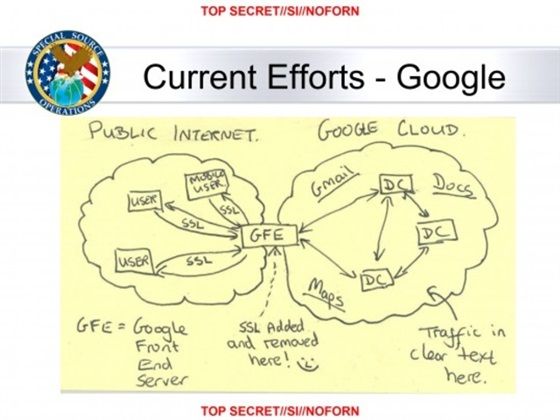
Robert X. Cringely writes: The latest Edward Snowden bombshell that the National Security Agency has been hacking foreign Google and Yahoo data centers is particularly disturbing. Plenty has been written about it so I normally wouldn’t comment except that the general press has, I think, too shallow an understanding of the technology involved. The hack is even more insidious than they know.
The superficial story is in the NSA slide (above) that you’ve probably seen already. The major point being that somehow the NSA — probably through the GCHQ in Britain — is grabbing virtually all Google non-spider web traffic from the Google Front End Servers, because that’s where the SSL encryption is decoded.
Yahoo has no such encryption.
The major point being missed, I think, by the general press is how the Google File System and Yahoo’s Hadoop Distributed File System play into this story. Both of these Big Data file systems are functionally similar. Google refers to its data as being in chunks while Hadoop refers to blocks of data, but they are really similar — large flat databases that are replicated and continuously updated in many locations across the application and across the globe so the exact same data can be searched more or less locally from anywhere on Earth, maintaining at all costs what’s called data coherency.
Data replication, which is there for reasons of both performance and fault tolerance, means that when the GCHQ in London is accessing the Google data center there, they have access to all Google data, not just Google’s UK data or Google’s European data. All Google data for all users no matter where they are is reachable through any Google data center anywhere, thanks to the Google File System.
This knocks a huge hole in the legal safe harbor the NSA has been relying on in its use of data acquired overseas, which assumes that overseas data primarily concerns non-U.S. citizens who aren’t protected by U.S. privacy laws or the FISA Court. The artifice is that by GCHQ grabbing data for the NSA and the NSA presumably grabbing data for GCHQ, both agencies can comply with domestic laws and technically aren’t spying on their own citizens when in fact that’s exactly what they have been doing. [Continue reading…]
Google’s Eric Schmidt lambasts NSA over spying
The Wall Street Journal reports: Google Inc. Executive Chairman Eric Schmidt slammed reports that the U.S. government allegedly spied on the company’s data centers, describing such an act as “outrageous” and potentially illegal if proven.
“It’s really outrageous that the National Security Agency was looking between the Google data centers, if that’s true. The steps that the organization was willing to do without good judgment to pursue its mission and potentially violate people’s privacy, it’s not OK,” Mr. Schmidt told The Wall Street Journal in an interview. “The Snowden revelations have assisted us in understanding that it’s perfectly possible that there are more revelations to come.”
Mr. Schmidt said Google had registered complaints with the NSA, as well as President Barack Obama and members of the U.S. Congress.
“The NSA allegedly collected the phone records of 320 million people in order to identify roughly 300 people who might be a risk. It’s just bad public policy…and perhaps illegal,” he said.
When contacted Monday, the NSA referred to its statement last week that said recent press articles about the agency’s collection had misstated facts and mischaracterized the NSA’s activities. [Continue reading…]
NSA chief likely to be stripped of cyber war powers
The Hill reports: Senior military officials are leaning toward removing the National Security Agency director’s authority over U.S. Cyber Command, according to a former high-ranking administration official familiar with internal discussions.
Keith Alexander, a four star general who leads both the NSA and Cyber Command, plans to step down in the spring.
No formal decision has been made yet, but the Pentagon has already drawn up a list of possible civilian candidates for the next NSA director, the former official told The Hill. A separate military officer would head up Cyber Command, a team of military hackers that trains for offensive cyberattacks and protects U.S. computer systems.
The administration might also decide to have two military officers lead the two agencies.
Britain’s response to the surveillance scandal should ring every alarm bell
Simon Jenkins writes: What separates a necessary defender of the British state and a Stasi in the making? Seventy world human rights organisations today write to the British prime minister, deploring his response to recent revelations of what his spies have been up to. His response, in their view, has been “to condemn rather than to celebrate investigative journalism“.
David Cameron’s remarks have been extraordinary. They have contrasted with the American response to the same revelations about what are closely allied electronic spying agencies, the NSA in America and GCHQ in Britain. Washington, from president to congress to the press, has accepted that democratic and judicial oversight has broken down. Internet and phone traffic has been comprehensively hacked and stored, to be accessed globally by hundreds of thousands of staff. The system appears both insecure and out of control. Not a voice in America, not even the agencies themselves, opposes urgent reform.
In Britain there has been no questioning, only a hysterical rubbishing of the press. Even reporting the revelations has been said to jeopardise national security and “put lives at risk”. Parliamentary oversight has been made to look puny and ignorant. There is not talk of investigating the intelligence community, only of whether the press should be prosecuted. This is not a free state at work. [Continue reading…]
Growing calls for Germany to offer Snowden asylum
Der Spiegel reports: There are growing calls in Germany not only to question Edward Snowden in connection with the ongoing NSA scandal, but also to offer him safe passage and asylum. Yet the heads of the two major political camps fear the wrath of the United States.
Hans-Christian Ströbele, a lawyer and parliamentarian for Germany’s Green Party, turned 74 this year. He has devoted more than 50 of those years to the political struggle for justice and for what is good in the world – or at least that’s how he sees it. “Have you ever been on the wrong side of things?” Ströbele was asked in a recent television interview.
“Politically speaking?” he asked the interviewer, glancing at the ceiling. For two seconds, it seemed as if he had to consider the question, but he quickly regained his composure and emphatically replied: “No.”
Now Ströbele is waging another political battle, probably the most noteworthy one of his life. Last Thursday, he went to Moscow and spent three hours speaking with Edward Snowden, the man whose revelations about the spying activities of the United States have both captivated the world for months and deeply changed its perceptions.
Ströbele, a lawmaker from the Friedrichshain-Kreuzberg election district in Berlin, was the first politician in the world to meet with Snowden in his Moscow exile. Snowden’s mission is now Ströbele’s mission. He wants to bring the American whistleblower to Germany to testify before an investigative committee of the German parliament, the Bundestag, and in doing so provide him with a secured right of residence in Germany.
Ströbele knows that granting Snowden the right to stay in Germany would create problems for German-American relations. The Americans have already submitted an extradition request, just in case Snowden ever sets foot on German soil. But Ströbele doesn’t care. He sets his own priorities and, once again, he believes himself to be on the right side of history, notwithstanding Germany’s trans-Atlantic partnership with the United States. “If the political will exists, as well as the courage, including the courage to stand up to presidents, then it’s possible,” Ströbele said after returning from Moscow.
Germany now faces a test of courage, one that affects the German parliament, the heads of the two major parties, the conservatives and the center-left Social Democratic Party (SPD), who are currently hammering out the details of a grand coalition government in negotiations set to conclude by Christmas. Most of all, it affects Chancellor Angela Merkel.
So should the Bundestag hear Snowden’s testimony before an investigative committee? The answer seems straightforward. Why shouldn’t German lawmakers hear what he has to say, the man on whose revelations the entire NSA scandal is based and who has already told Ströbele that he is willing to come to Germany?
The second, more fundamental question is harder to answer: whether Snowden should be granted the right to live in Germany or a comparable country, and therefore protection from the Americans. This is precisely the condition Snowden has set for his willingness to testify. He knows that his asylum in Russia is limited to one year, which means that it expires in nine months. He is testing the waters to see where he could live safely in the future. Germany appears to be his top choice. [Continue reading…]
A resumption of history in the Middle East
Rami G Khouri writes: Observing the Middle East from the United States, where I have spent the last month, has been fascinating, because historic changes are occurring in some relationships between these two regions. This includes evolving American ties with the five key strategic players in the region: Saudi Arabia, Israel, Iran, Turkey and Egypt. The most important changes are taking place in the triangular relationship among the United Sates and each of Israel, Iran and Saudi Arabia. Three simultaneous things are occurring here that are intriguing, but their permanent implications remain unclear because events are in their early days.
The first is the United States’ resumption of direct and serious talks with Iran in a more positive atmosphere that seeks to end the dispute over Iran’s nuclear capabilities while also addressing Iranian concerns about American policy toward Iran. Should the negotiations between Iran and the P5+1 powers succeed, as I expect, this could mark a revolutionary new era when Iran would slowly resume normal ties with global powers and reshape its relations within the Middle East. This in turn could have major implications for Saudi Arabian and Gulf Cooperation Council policies, as well as conditions in Syria and Iraq, and the status of Hezbollah and Lebanon.
Washington’s evolving perceptions of Iran reflect the second change, which is a rare case of the U.S. pursuing policies in the Middle East that are not fully in line with Israeli fears or wishes. Israel and its influential American mouthpieces in Washington have lobbied overtime in recent months to prevent a U.S.-Iranian dialogue or serious negotiations that could lead to a rapprochement. They have failed to date in this. Washington has tried to placate Israeli concerns with the rhetoric that Israel expects to hear from its friends in the U.S., but President Barack Obama has ignored Israeli exhortations and moved ahead sharply to negotiate with Iran. We can expect major consequences from a U.S. foreign policy that is shaped by U.S. national interests, rather than by Israeli dictates, fears and manipulations. [Continue reading…]
Assad’s war on doctors
Annie Sparrow, deputy director of the human rights program at Icahn School of Medicine at Mount Sinai in New York, writes: Over the last few weeks, the growing plight of Syria’s civilian population has drawn belated international attention to the country’s failing health system. In late October, in the eastern part of the country, the World Health Organization confirmed an outbreak of polio — a highly infectious, fast-spreading disease that poses a potential threat not just to Syria but to the entire region. At the same time, reports of malnutrition and disease in the besieged areas on the outskirts of Damascus and other embattled cities, where there are severe shortages of food and milk, have raised new fears of a spreading public health disaster. But these developments are hardly new, nor are they, as the international press has suggested, simply the unfortunate byproducts of an increasingly brutal war. They are connected to something far more sinister: a direct assault on the medical system by the Syrian government as a strategy of war.
The Assad regime has come to view doctors as dangerous, their ability to heal rebel fighters and civilians in rebel-held areas a weapon against the government. Over the past two and a half years, doctors, nurses, dentists, and pharmacists who provide treatment to civilians in contested areas have been arrested and detained; paramedics have been tortured and used as human shields, ambulances have been targeted by snipers and missiles; medical facilities have been destroyed; the pharmaceutical industry devastated. Directly and indirectly, the attacks have had a profound effect on tens of thousands of health professionals and millions of Syrian patients, let alone the more than 2 million refugees who have fled to neighboring countries.
Here is how a surgeon from Aleppo describes the attitude of the Syrian government. Last April, while treating a man seriously wounded by a government sniper, he was accosted and wrenched away by a military intelligence officer: “We are shooting at them in order to kill them. This is obvious,” the intelligence officer told him. “Since you are stopping him from dying, you are a terrorist. For this you will be punished.” The surgeon’s clinic was destroyed, his wife’s clinic was shut down, and they were forced to flee Aleppo. As a surgeon, he is not authorized to practice in Turkey, where they have taken refuge, despite the urgent need of his skills there.
In the northwest city of Idlib, the Red Crescent hospital was simply taken over by the Syrian army after a systematic crackdown on its medical staff. Before the war, the hospital had some twenty doctors and forty nurses. By March 2012, when the army arrived, there were only three doctors left — two anesthetists and a surgeon — and two nurses. The hospital’s director, Dr. Abdulrazaq Jbero, had been killed a few weeks earlier by a government sniper on his way back from Damascus in a Red Crescent vehicle. [Continue reading…]
Among observers who are reflexively skeptical of any reporting critical of the Assad regime, here is one attempt to dismiss Sparrow’s report:
Given how accurate coverage of Syria over here has been, I’m skeptical. The hospitals in Iraq were a complete mess after the invasion, between destruction and looting and lack of power. And the professional classes were fleeing because they had enough money and skills to do so. Oh, and no media coverage of that here, from what I could tell at the time. So a comparison v. how messed up Iraq’s hospitals were v. Syria’s now would provide a useful reality check.
There is actually a much more obvious and immediate parallel that can be drawn: attacks on doctors in Bahrain.
Having witnessed the Obama administration ineffectual appeals for Bahrain to exercise restraint even as the U.S. has continued supplying it with weapons, Assad could reasonably have concluded that he could employ the same tactics with impunity.