



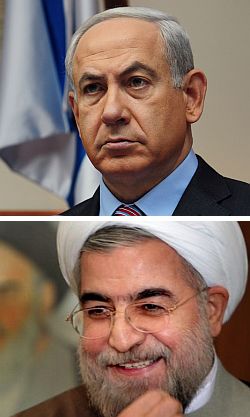
Daniel Levy writes: On Monday, Sept. 30, U.S. President Barack Obama will welcome Israeli Prime Minister Benjamin Netanyahu to the White House for the first time in 18 months. Much has changed in the intervening period — both leaders have been re-elected, Obama has made his first visit as president to Israel, Israeli-Palestinian peace talks have been relaunched, and that rather pragmatic-sounding Hasan Rouhani chap has been elected president in Iran.
In what might be called an anti-“Asia pivot” speech, Obama announced to the U.N. General Assembly this week that the United States is engaged in the Middle East “for the long haul” and that “in the near term, America’s diplomatic efforts will focus on two particular issues: Iran’s pursuit of nuclear weapons and the Arab-Israeli conflict.”
That message will be viewed as a mixed bag in Jerusalem, which is keen for a greater American footprint in the region but is less enthusiastic about the idea of peacemaking with the Palestinians and deal-making with the Iranians taking top billing. For that reason, the upcoming White House meeting will likely find the two leaders back on familiar terrain, more focused on testing each other’s underlying intentions than on working together as close allies.
The U.S. president is something of an open book, but Netanyahu’s approach requires a little more interpretation and context. Too much of that analysis has been consistently wrong, and thankfully so. If prominent Netanyahu watchers had gotten it right, we would be marking the second or third anniversaries of Israeli bombing campaigns against Iran.
Netanyahu is indeed back in threatening mode. His latest rhetorical flourish is to quote Hillel’s ancient maxim “If I am not for myself, who will be for me?” — an upgrade of his previous refrain regarding Israel’s “right to defend itself by itself.” That language is being widely interpreted by Israeli commentators as a reaffirmation of Israel’s willingness to strike Iran alone if Netanyahu’s red lines on Iran’s nuclear program are deemed to have been crossed.
This debate has taken on a new urgency given the diplomatic opening seemingly created by the election of Rouhani. It is no secret that Netanyahu has been dragged out of his comfort zone by the possibility of a U.S.-Iran rapprochement. Former President Mahmoud Ahmadinejad’s aggressive and insulting behavior made him a convenient adversary for Israel; Rouhani and his diplomatic team, notably polished Foreign Minister Javad Zarif, present a challenge of a very different order of magnitude. [Continue reading…]
 On September 11, Israel’s secret police (Shin Bet) arrested a Belgian windows and roofing salesman who is alleged to be an “Iranian agent … sent to Israel to set up a base for Iranian intelligence and terrorism networks”.
The Israeli government delayed releasing information about the arrest until Prime Minister Benjamin Netanyahu set off for Washington on his mission to counter the “the onslaught of smiles” that Americans have been subjected to over the last few days.
Reasons the Israelis give for regarding Ali Mansouri with suspicion, include:
Mans left Iran the year after the revolution and has spent most of his adult life living in Turkey and Belgium.
The Jerusalem Post reports:
Public defense lawyers representing Mansouri said that their client is a Belgian businessman who is not motivated by any pro-Iranian agenda.
The attorneys, Michael Orkavi and Anat Yaari, said their client had been denied access to a lawyer for nine days. They added that a more complex picture exists than the one being presented by security forces, and that the full details would emerge in court after Mansouri is charged.
Mans’ cover as a ‘salesman’ seems quite convincing. But maybe that’s because he’s just a salesman. The only thing he’s definitely ‘guilty’ of is having been born in Iran.

Mother Jones: Lt. Gen. Jerry Boykin, a top executive at the influential Family Research Council, has joined the chorus of religious conservatives touting the Syrian conflict as a prelude to Armageddon. On Wednesday, Boykin appeared on Prophetic Perspectives on Current Events, a talk show hosted by dominionist preacher Rick Joyner (see the video above). The pair discussed a passage in Isaiah 17, which predicts Damascus will be reduced to “a ruinous heap.”
“One of the scriptures that has never been fulfilled and has to be fulfilled before this age can end is that Damascus will be destroyed, never inhabited again,” Joyner explained. “What in the world could cause a city to be destroyed and never inhabited again?” Boykin didn’t hesitate. “One of the ways Damascus could be destroyed, never to be re-occupied, would be through a chemical attack,” he replied. ” So let’s just take a scenario: The Free Syrian Army takes Damascus and Bashar al-Assad is in a desperate mode now…. What would be his final act? Well it may very well be to unload all his chemical weapons on the population center there in Damascus. Destroy the city and destroy it in a way that he just kills maybe millions of people. But the byproduct is that he has residue there that could make Damascus uninhabitable and for a very long time.”
This is not the first time Boykin has embraced the notion that war in the Middle East will lay waste to the Syrian capital—and pave the way for Jesus’s return. He recently wrote an endorsement for Damascus Countdown, a fictionalized account of the looming biblical conflict by best-selling author Joel Rosenberg. And he has spoken at several of Ronseberg’s annual Epicenter Conferences, which explore the Middle East’s role in biblical prophesy.
Rania Abouzeid writes: The pretense that the so-called Syrian opposition-in-exile speaks for those inside the country, never firm to begin with, was further exposed late on Tuesday, in a two-minute video statement called “Communiqué No. 1,” which was issued by eleven armed rebel groups that are influential in northern Syria. Their message was simple: the Western-backed hotel revolutionaries jetting from capital to capital, claiming leadership in the political National Coalition and an interim government-to-be, don’t speak for them—and they won’t listen to them. The new coalition, which has yet to announce its name, also said it wants Islamic Sharia law to be the basis of any future government, and that the various opposition parties should unite within “an Islamic framework.”
There has long been a disconnect between those fighting and bleeding inside Syria and the political and diplomatic machinations of those in exile. What is new here is that at least three of the eleven groups—Liwa al-Tawhid, Liwa al-Islam, and Suqour al-Sham—are aligned with the military wing of the National Coalition, the Supreme Military Council, which is supported by the West and is what passes for the leadership of the loose franchise outfit known as the Free Syrian Army (F.S.A.). Now they have publicly thrown in their lot with Jabhat al-Nusra, which also signed on to the statement and is connected to Al Qaeda.
This public alliance of affiliates of the F.S.A. and of Al Qaeda, however, is more of a shift on paper than a marked change in how things work on the ground. There has long been operational coördination on a local level—for a particular battle or in a certain geographic area. All that has really happened at this stage is that a fig leaf has dropped.
The fighting men within Syria have long despised their political and military leaders-in-exile. It’s common to hear them say, “We are in the khanadik”—trenches—“and they are in the fanadik,” hotels. In late August, four of the leaders of the F.S.A.’s five fronts said that the National Coalition—their own political counterparts—had no legitimacy. They threatened to resign from the Supreme Military Council because of, among other things, “the lying promises of those states who claim to be friends of Syria,” who have not provided assistance “worthy of the sacrifices of the Syrian people.”
The disunity goes deeper. Colonel Abdul-Jabbar Agaydee, the top F.S.A. commander in the northern city of Aleppo and a man who doesn’t spend his time in hotel lobbies, has lambasted the Supreme Military Council, of which he himself is a member, saying it is “completely disconnected from reality.” [Continue reading…]
ACLU National Security Project: Over the last three years, the FBI has dramatically expanded its No-Fly List of suspected terrorists, including blacklisting innocent Americans who present no threat to security.
The Americans we represent in Latif v. Holder, the ACLU’s challenge to the government’s No-Fly List procedures, provide a prime example. They were each denied boarding on planes, deprived of their right to travel, and smeared as suspected terrorists. Yet the government continues to deny them any after-the-fact explanation for their blacklisting or any meaningful chance to clear their names.
The FBI’s violation of these Americans’ due process rights is, in and of itself, abusive and unlawful. After all, preventing people from correcting the errors that led to their inclusion on a blacklist does not make our skies any safer, but it does harm constitutionally protected rights to travel and reputation — as a federal court recently recognized. And a closer look into the experiences of several ACLU clients shows another, even darker side to the No-Fly List.
FBI agents have tried to use the No-Fly List as a draconian tool to coerce Americans into spying on their communities.
FBI agents put this pressure on ACLU clients Abe Mashal, a Marine veteran; Amir Meshal; and Nagib Ali Ghaleb. Each of these Americans spoke to FBI agents to learn why they were suddenly banned from flying and to clear up the errors that led to that decision. Instead of providing that explanation or opportunity, FBI agents offered to help them get off the No-Fly List — but only in exchange for serving as informants in their communities.Our clients refused.
The ACLU’s report, Unleashed and Unaccountable: The FBI’s Unchecked Abuse of Authority, explains what happened to Nagib Ali Ghaleb. [Continue reading…]
The New York Times reports: Tunisia’s governing Islamist party, Ennahda, thrust into power by the Arab Spring, has agreed to step down after months of political wrangling with a hard-bargaining opposition.
In three weeks, the Ennahda-led government is to hand over power to an independent caretaker government that will lead the country through elections in the spring. The deal comes as part of negotiations to restart Tunisia’s democratic transition after secular opposition groups, protesting the assassinations of two of their politicians, stalled work on a new constitution and an election law this summer.
The two sides will enter discussions this week mediated by the Tunisian General Labor Union, the nation’s largest. Its deputy secretary general, Bouali Mbarki, announced Ennahda’s acceptance of the plan on Saturday.
The move comes less than three months after the Islamist government of President Mohamed Morsi of Egypt, also elected during the Arab Spring uprisings, was ousted by the military.
Ennahda officials have repeatedly made statements in recent weeks signaling the party’s readiness to resign as a way to break the political impasse. The opposition, and the union, have until now pressed for more concrete action. [Continue reading…]
Ethan Watters writes: In the summer of 1995, a young graduate student in anthropology at UCLA named Joe Henrich traveled to Peru to carry out some fieldwork among the Machiguenga, an indigenous people who live north of Machu Picchu in the Amazon basin. The Machiguenga had traditionally been horticulturalists who lived in single-family, thatch-roofed houses in small hamlets composed of clusters of extended families. For sustenance, they relied on local game and produce from small-scale farming. They shared with their kin but rarely traded with outside groups.
While the setting was fairly typical for an anthropologist, Henrich’s research was not. Rather than practice traditional ethnography, he decided to run a behavioral experiment that had been developed by economists. Henrich used a “game”—along the lines of the famous prisoner’s dilemma—to see whether isolated cultures shared with the West the same basic instinct for fairness. In doing so, Henrich expected to confirm one of the foundational assumptions underlying such experiments, and indeed underpinning the entire fields of economics and psychology: that humans all share the same cognitive machinery—the same evolved rational and psychological hardwiring.
The test that Henrich introduced to the Machiguenga was called the ultimatum game. The rules are simple: in each game there are two players who remain anonymous to each other. The first player is given an amount of money, say $100, and told that he has to offer some of the cash, in an amount of his choosing, to the other subject. The second player can accept or refuse the split. But there’s a hitch: players know that if the recipient refuses the offer, both leave empty-handed. North Americans, who are the most common subjects for such experiments, usually offer a 50-50 split when on the giving end. When on the receiving end, they show an eagerness to punish the other player for uneven splits at their own expense. In short, Americans show the tendency to be equitable with strangers—and to punish those who are not.
Among the Machiguenga, word quickly spread of the young, square-jawed visitor from America giving away money. The stakes Henrich used in the game with the Machiguenga were not insubstantial—roughly equivalent to the few days’ wages they sometimes earned from episodic work with logging or oil companies. So Henrich had no problem finding volunteers. What he had great difficulty with, however, was explaining the rules, as the game struck the Machiguenga as deeply odd.
When he began to run the game it became immediately clear that Machiguengan behavior was dramatically different from that of the average North American. To begin with, the offers from the first player were much lower. In addition, when on the receiving end of the game, the Machiguenga rarely refused even the lowest possible amount. “It just seemed ridiculous to the Machiguenga that you would reject an offer of free money,” says Henrich. “They just didn’t understand why anyone would sacrifice money to punish someone who had the good luck of getting to play the other role in the game.”
The potential implications of the unexpected results were quickly apparent to Henrich. He knew that a vast amount of scholarly literature in the social sciences—particularly in economics and psychology—relied on the ultimatum game and similar experiments. At the heart of most of that research was the implicit assumption that the results revealed evolved psychological traits common to all humans, never mind that the test subjects were nearly always from the industrialized West. Henrich realized that if the Machiguenga results stood up, and if similar differences could be measured across other populations, this assumption of universality would have to be challenged.
Henrich had thought he would be adding a small branch to an established tree of knowledge. It turned out he was sawing at the very trunk. He began to wonder: What other certainties about “human nature” in social science research would need to be reconsidered when tested across diverse populations? [Continue reading…]

Annalee Newitz writes: One thousand years ago, in the place where St. Louis, Missouri now stands, there was once a great civilization whose city center was ringed with enormous earthen pyramids, vast farmlands, and wealthy suburbs. For hundreds of years it was the biggest city in North America. Then a mysterious fire changed everything.
The city that once existed in St. Louis’ current footprint is known today as Cahokia, and its creators are commonly called the Mound Builders because of the 120 or so enormous mounds they left behind. Shaped much like the stone pyramids of the Maya civilization to the south, these mounds rose up hundreds of feet, and were often built on top of tombs. At their summits were ceremonial buildings made from wood and thatch. Unfortunately, many of these magnificent creations were destroyed in the nineteenth century when St. Louis was built. Below, you can see one of the only remaining pyramids, known as Monk’s Mound.
The first evidence of a settlement in the Cahokia area is from the year 600 CE, at a time when the Maya civilization would have been at its peak. But it wasn’t until after the largest cities of the Maya began to fall in the 1000s that Cahokia came into its own. It’s estimated that the city center held as many as 15,000 people (making it comparable in size to European cities of the same era), and reached the height of its productivity between roughly 1000-1300 CE. [Continue reading…]

The New York Times reports: Since 2010, the National Security Agency has been exploiting its huge collections of data to create sophisticated graphs of some Americans’ social connections that can identify their associates, their locations at certain times, their traveling companions and other personal information, according to newly disclosed documents and interviews with officials.
The spy agency began allowing the analysis of phone call and e-mail logs in November 2010 to examine Americans’ networks of associations for foreign intelligence purposes after N.S.A. officials lifted restrictions on the practice, according to documents provided by Edward J. Snowden, the former N.S.A. contractor.
The policy shift was intended to help the agency “discover and track” connections between intelligence targets overseas and people in the United States, according to an N.S.A. memorandum from January 2011. The agency was authorized to conduct “large-scale graph analysis on very large sets of communications metadata without having to check foreignness” of every e-mail address, phone number or other identifier, the document said. Because of concerns about infringing on the privacy of American citizens, the computer analysis of such data had previously been permitted only for foreigners.
The agency can augment the communications data with material from public, commercial and other sources, including bank codes, insurance information, Facebook profiles, passenger manifests, voter registration rolls and GPS location information, as well as property records and unspecified tax data, according to the documents. They do not indicate any restrictions on the use of such “enrichment” data, and several former senior Obama administration officials said the agency drew on it for both Americans and foreigners.
N.S.A. officials declined to say how many Americans have been caught up in the effort, including people involved in no wrongdoing. The documents do not describe what has resulted from the scrutiny, which links phone numbers and e-mails in a “contact chain” tied directly or indirectly to a person or organization overseas that is of foreign intelligence interest.
The new disclosures add to the growing body of knowledge in recent months about the N.S.A.’s access to and use of private information concerning Americans, prompting lawmakers in Washington to call for reining in the agency and President Obama to order an examination of its surveillance policies. Almost everything about the agency’s operations is hidden, and the decision to revise the limits concerning Americans was made in secret, without review by the nation’s intelligence court or any public debate. As far back as 2006, a Justice Department memo warned of the potential for the “misuse” of such information without adequate safeguards. [Continue reading…]
Reuters reports: Bashar al-Assad, who only a month ago faced the likelihood of U.S. missile strikes that could have tipped the balance of Syria’s war against him, has won a reprieve.
His supporters, political sources in Damascus say, are jubilant, convinced the threat of regime change has lifted and that the Assads can face down opponents they consider weak – U.S. President Barack Obama and France’s President Francois Hollande among them – just as they saw off their predecessors.
“I think they feel that they can live this out and wait for leaders like Hollande and Obama to leave office, just as they did with Jacques Chirac and George W. Bush,” said one well-placed source in Damascus, speaking on condition of anonymity.
“I think Assad feels that the chemical weapons actually saved his regime, rather than brought it down.”
The mood shift is a consequence of the world’s confused response to a sarin gas attack on rebel suburbs of Damascus last month, the sources say. Russian President Vladimir Putin, Assad’s ally in the 30 months-old conflict, conjured up a diplomatic process to confront the atrocity. [Continue reading…]
Fred Abrahams writes: One month after an attack with Sarin gas killed hundreds of people on the outskirts of Damascus, people in the affected areas are facing a humanitarian crisis, Syrian activists are warning.
The Syrian government, whose forces in all likelihood launched the chemical attack of August 21, is blocking the delivery of food and medical supplies.
As world leaders debate how to secure chemical weapons in Syria, they should demand that aid reaches the victims of chemical attacks, and others in need.
In the Western Ghouta town of Moadamiya, one of two areas where chemical weapons struck, an aid worker said the government has blocked food, milk and medicine for three months.
“We are prisoners in our city and homes,” the aid worker told Human Rights Watch by phone. He said residents were boiling tree leaves for soup with salt and olives. Starvation had claimed four children and two adults.
A report by the Syrian Violations Documentation Center (VDC) says conditions in Moadamiya have reached “catastrophic levels.”
An aid worker in Eastern Ghouta, also hit with chemical weapons, told Human Rights Watch the area is besieged and, “witnessing a shortage of every kind of food you can think of.” The painkiller paracetamol has jumped ten times in price, he said.
“The biggest fear we are all facing now is winter season,” the aid worker said. “I don’t know how we will survive the winter.” [Continue reading…]
The New York Times reports: As the pace of efforts to scrutinize Syria’s chemical weapons stockpiles quickens, United Nations inspectors said on Friday that they were investigating reports that the weapons were used seven times in Syria, including three after an attack on Aug. 21 on the outskirts of Damascus, the Syrian capital, that set off an international crisis.
The disclosure, which came in a statement from the United Nations in Damascus that was quoted in news reports, came as the Organization for the Prohibition of Chemical Weapons, the group in The Hague that oversees the international treaty banning them, planned a meeting late Friday to approve a separate schedule for inspections of chemical weapons storage and production sites. Syria applied to join the treaty this month.
A joint proposal by the United States and Russia to be put before the organization’s executive council on Friday calls for the completion of inspections and the destruction of “production and mixing/filling equipment” by November, according to a text on the organization’s Web site.
An official at the Organization for the Prohibition of Chemical Weapons said that, if the meeting of the 41-nation Executive Council approves the plan to deploy inspectors in Syria at its meeting later on Friday, a first team of experts could leave for Syria on Monday and plan to arrive there on Tuesday.
The official, who declined to discuss the composition of the team, spoke on the condition of anonymity because the plan had not yet been approved.
In a breakthrough accord on Thursday, the five permanent members of the United Nations Security Council, which include the United States and Russia, the Syrian government’s most powerful ally, agreed on a resolution that would require Syria to give up its chemical weapons, although there would be no automatic penalties if the Syrians failed to comply. More than 100,000 people have died in Syria’s civil war, now in its third year. [Continue reading…]
The New York Times reports: What to believe? That’s a key question in the diplomatic duel over Syria, as Russia continues to dispute evidence in a United Nations inspectors’ report that points to the Syrian government’s complicity in the Aug. 21 chemical attack on the Damascus suburb of Ghouta.
The Russians, who insist the attack was a “provocation” by Syrian rebels, dismiss the findings of the U.N. experts as “biased.” Instead they cite the report of a Lebanese-born nun who, from a hotel room in Geneva, did her own analysis of videos of the scene at Ghouta and declared them fake.
So goes another chapter in a continuing information war that has made reporting on the bloody, multisided conflict in Syria such a nightmare for journalists, and such a difficult story for their readers.
Not only has Syria become ever more dangerous for reporters — 16 foreign and 60 Syrian journalists are currently detained, kidnapped or missing in Syria, according to Reporters Without Borders — but fewer newspapers around the world have the budgets to send correspondents abroad, let alone to war zones.
Finding out the truth, and figuring out whom to believe, has become even more treacherous in a world awash in YouTube videos, tweets and rumors spread by the Internet. Sorting out the facts from the fake adds new burdens and risks to the business of gathering news.
Into this breach have stepped various human rights and other nongovernmental organizations now filling the gaps left by the these shifts and twists of the media world.
Six days before the publication of the U.N. report, Human Rights Watch released its own investigation of the Aug. 21 attack that also found evidence “strongly” suggesting that the government of President Bashar al-Assad was responsible.
Not for the first time, this kind of independent report made front-page news in the world’s newspapers, which, for the most part, were unable to confirm the facts on the ground with their own reporting.
“The NGOs are doing more and more of the investigative work that journalists don’t do — either because the media they work for is understaffed, underfunded or uninterested,” said Alfred de Montesquiou, a prize-winning war reporter for the French weekly magazine Paris Match. Reached on assignment in the Central African Republic, he cited both Human Rights Watch and Amnesty International for their work in Syria, breaking or confirming major stories, and identifying key players.
It’s a role that these organizations are ready to assume, even as they defend their main purpose, which is to be advocates for victims not only of war but of injustice, abuse or discrimination around the world.
“We do feel that as journalism has ebbed, we have a responsibility to flow,” said Carroll Bogert, deputy executive director for external relations at Human Rights Watch headquarters in New York.
Human Rights Watch works in 90 countries with a staff of about 400 people based in 60 locations, many of them, not surprisingly, ex-journalists. Its budget, all privately raised, has shot up to a current $70 million from about $13 million in 1998 — when Ms. Bogert, a former foreign correspondent for Newsweek, joined.
With these resources, Human Rights Watch continues to turn out the kind of in-depth reports, each one exhaustively vetted by lawyers, editors and experts, that are increasingly hard to find in newspapers.
But there’s a difference.
“We don’t just stop at the water’s edge of journalism,” Ms. Bogert said. “We investigate, we expose and we push for change. We are advocates.”
That last role sets human rights researchers apart from journalists but not, Ms. Bogert insisted, at the expense of their credibility.
“We don’t go into the field with a narrative,” she said. “We go with open notebooks, and open minds.”
Some nongovernmental agencies have already evolved into journalistic-type multimedia, multiplatform operations, with videos, Twitter accounts, maps, graphs, satellite imagery and staff experts in areas from health to weapons. The New York Times credited forensic work by Human Rights Watch analysts in a pivotal story that traced the trajectory of rockets used in the Aug. 21 attack.
In Syria, where it has a long history chronicling complaints of human rights abuses by the government of Mr. Assad, Human Rights Watch has the same security concerns as journalists. That means it does much its work from afar, sifting through testimony, checking back with trusted sources and authenticating videos, many of which end up being discarded.
“The reason we have impact is that we have a trusted brand,” Ms. Bogert said. “What we publish has to meet rigorous standards.”
The news release used to be the classic way for NGOs to get out their message, but that, too, is changing. Human Rights Watch, for instance, has opened space on its Web site for “dispatches” written by its researchers, offering brief and quick reactions to news events. For instance, a critical response to the Op-Ed article in The New York Times this month by President Vladimir V. Putin of Russia was posted on the Web site within nine hours, getting 40,000 hits. This past week, a detailed rebuttal of Russia’s position on the Ghouta attack, written by Ms. Bogert, ran in the Moscow newspaper Vedomosti.
“Is it journalism?” Ms. Bogert asked. “I don’t know, but it is information that people need, and that people are using.”
Ms. Bogert insisted that Human Rights Watch had no intention of taking the place of foreign correspondents who remain their essential partners. “We are not dancing on the grave of journalism,” she said, “but it is a fact that there are fewer traditional journalists working for established papers. That’s not good for us, that’s not good for them, but we are among those information providers who are filling the gap.”
Raphaël Lefèvre writes: The openly difficult relationship between Saudi Arabia and Muslim Brotherhood chapters across the region has become a salient feature of Middle East politics since the advent of the “Arab Spring.” This mutual mistrust has increased in the wake of the Kingdom’s recent support for the military takeover in Cairo and the generals’ subsequent repression of the Brotherhood there. But how is the Islamist organization affected by this dynamic in Syria, where the Muslim Brothers and the Saudis both battle against Bashar al-Assad?
The question has become ever more relevant since Saudi Arabia’s takeover of the “Syrian file” from the hands of the Qataris last May.[1] Yet the answer is steeped in ambiguities. On the one hand, the relationship between Riyadh and the Syrian Brotherhood suffers from political contradictions and a lack of genuine trust. On the other hand, the two actors know each other well and have a common short and medium-term interest: to see the Iran and Hezbollah-backed Syrian regime replaced by a new political system dominated by Sunnis. But the moving sands of Egypt might soon reach Syria too, and the consequences for the local Brotherhood branch there may one day be significant.
To understand the relationship between the Syrian Brotherhood and Saudi Arabia, often described by Syrian Brothers themselves as “complex,”[2] one first needs to look a few decades back. For it was after the Syrian Brotherhood’s rebellion in the late 1970s that both actors really started to know each other. Fleeing harsh repression in the early 1980s, tens of thousands of Muslim Brothers escaped Syria and took refuge in Jordan, Iraq, and, to a lesser extent, Turkey and Saudi Arabia. It is estimated that the number of Brothers residing in the Kingdom today is in the low thousands.
This relatively sizeable presence initially posed challenges to Saudi rulers, who considered the Brotherhood’s goal of politicizing Islam a threat to the apolitical nature of their deeply conservative Wahhabi society. “The Saudi government believes that the implementation of the Brotherhood’s political project—calling for elections and the formation of parties—would mean the end of its own model, which depends on the control of a ruler who has all powers,” argued a leader of the Syrian Brotherhood who has family in the Gulf. The Kingdom therefore regulated the Syrian Brothers’ presence in Saudi Arabia by allowing them to carry out political activities in private but forbidding any politicization of Saudi society, with the promise of an uncompromising and harsh response as a deterrent. “We would be very cautious not to cross these lines,” recounted another Brother who was raised in Saudi Arabia. “There would be Syrian Brotherhood gatherings in houses or mosques but, to be discreet, we would only go and leave by a group of two or three individuals. We wouldn’t mix with members of other Brotherhood chapters, and we would almost never disclose our political affiliation in the presence of Saudi citizens.”
Thus, despite a sometimes heavy intelligence surveillance, the Kingdom nonetheless allowed the Syrian Brotherhood to operate underground. Saudi Arabia even became the place of residence for two leaders of the organization: Hassan al-Houeidi from Deir Ezzor, who lived in Medina, and Abdel Fatah Abu Ghuddah, a distinguished Islamic scholar from Aleppo who was based in Riyadh. This 30-year presence of an important share of the Syrian Brotherhood in the Kingdom helps explain why, short-term mutual interests aside, the Saudi rulers have for a long time tolerated the group more than its Egyptian counterpart. [Continue reading…]
Der Spiegel reports: Once just a small group, now there are several thousand foreign jihadist fighters present in Syria today. Though some rebel leaders say their presence does pose a danger, the impact of these groups is often exaggerated by the Western media.
The role of foreign jihadists linked to al-Qaida in Syria has been the subject of intense discussion in the Western media, among think tanks and inside governments. Yet despite the attention paid to the issue, the research behind the reports published is often thin.
There’s a good reason for this, too: Very few foreign journalists are still traveling within the areas of Syria that are no longer controlled by the regime of dictator Bashar Assad. Of course, other factors also influence the reporting. Right from the start, the regime described the insurgency in its propaganda as the action of “foreign terrorists,” and it has often used the Russian media in particular as a platform for spreading false accounts of events.
In early September, for example, the regime attributed an attack by diverse rebel groups on two checkpoints held by Christian militiamen in the western Syrian city of Malloula to al-Qaida. It claimed that the group had attacked and damaged churches and that it drove Christians into the streets and forced them to convert to Islam, with the threat of decapitation if they didn’t. This horrific version of the story made its way into reporting by American and British news agencies. Indeed, few reported that the nuns at Maaloula’s Tekla monastery had denied that such attacks had even taken place. [Continue reading…]