Hooman Majd writes: What is striking about traveling to Iran these days, less than a couple of months since the inauguration President Hassan Rouhani, is how little seems to have changed since the latter years of the presidency of Mahmoud Ahmadinejad, who was perhaps the most destructive force in Iranian politics in a generation, reviled in the West for his anti-Semitic remarks and at home for his vainglory and destruction of the nation’s economy.
A little below the surface, of course, there are differences, from the less conspicuous presence of the gasht-e-ershad, the morality police, to a gradual easing of some social restrictions. But wariness remains, as if the political clouds and the rumble of thunder auguring calamity are permanent fixtures in the Iranian sky — winds of change, stiff breezes really, notwithstanding.
There is little of the laughter and joy and celebration that the world witnessed when Rouhani defeated the favorites of the Islamic system in the presidential election this summer; instead, there are questions. Can he, or will he be allowed to, deliver on his campaign promises? Can he fix the economy without a rapid rapprochement with the West? Is the West even interested in engagement, or would it prefer to bring Persia to its knees, for the second time in a hundred years?
Rouhani campaigned, much like his American counterpart five years ago, on a platform of hope and change. But few Iranians are naïve enough to believe that change will be easy, not in the Islamic Republic, where bureaucratic entropy butts heads with a political system seemingly designed to confound not just foreigners but any attempts at real reform.
But Iranians remain guardedly hopeful, and so should we who do not have to live under the strictest sanctions regime imposed on Iran since the birth of the Islamic republic, or with an economy in tatters, sky-high unemployment and severely restricted civil liberties. Hopeful that what they — and we — are witnessing, from Rouhani’s speeches challenging the status quo, to his cabinet members’ breaking of taboos, to the apparent and sudden willingness of the regime to engage in reasonable behavior, is not a chimera but a sign that the Islamic Revolution has finally grown up.
In Rouhani many Iranians see a man they need not revere, but rather a man they must support because he echoes the desires of the people. That he enjoys, as he has declared and as his top advisers affirmed to me in his office in Tehran, the full support of the one center of power — the supreme leadership — that could silence that voice, is apparent to any thinking Iranian. The only caveat is that the Rouhani administration believes that the time for comprehensive engagement with the West, and for closing the wounds of hostility, is limited — and that it is now.
It is tempting to believe that Iran’s sudden openness to compromise on its nuclear program, its easing of social restrictions, and even its surprising openness to sitting down with the Great Satan is due solely to escalating pressure and threats. But the Obama administration should be mindful that even if that were true a continuation of a strict policy toward Iran could derail a negotiated settlement on the nuclear issue but also the Rouhani presidency.
The wolves in Tehran may have retreated into their dens, but they remain ready to pounce at Rouhani’s first misstep. As the president intimated recently, in essence there is only one thing he now requires for an eventual conclusion to negotiations over the scope of Iran’s nuclear program — and that is “respect” from the West. [Continue reading…]
Yahya Ababneh, source of Mint Press chemical weapons ‘report’ appears to be a fraud
Yahya Ababneh, source of a report which alleged that Saudi Prince Bandar bin Sultan was responsible for the chemical weapons attack outside Damascus on August 21, now appears to be a fraud operating under multiple names using a fake work history and comes from Russia.
Brian Whitaker writes: According to Ababneh’s profile on LinkedIn, the professional networking website, he has carried out journalistic assignments “in Jordan, Syria, Lebanon, Saudi Arabia, Russia, and Libya for clients such as al-Jazeera, al-Quds al-Arabi, Amman Net, and other publications”.
So far, though, no evidence has emerged to support this claim and internet searches in English and Arabic for articles that carry his byline have drawn a blank.
To add to this mystery, Ababneh’s profile was deleted from LinkedIn yesterday, though a cached copy can be found here.
One thing that doesn’t show up in the cache is the endorsements given to Ababneh by other LinkedIn users. On the deleted page, he had received endorsements for his skills from two people – Ghazal Omid of the Iran Future organisation and Sufian Ababneh, a legal adviser at the Jordanian embassy in London. Among other things, Sufian Ababneh had endorsed him for his skills as an actor.
@snarwani @Brown_Moses #Syria Mint Press journalist Yahya Ababneh claims to work for Al Jazeera. But Al Jaz web has no record of him.
— Anita McNaught (@anitamcnaught) September 21, 2013
And seems to have a Russian VKontakte page that says he was born in St. Petersburg http://t.co/AQkNczvYJ0 @daoudkuttab
— Laura Rozen (@lrozen) September 22, 2013
Dwindling faith in the American dream
Gary Younge writes: The final chapter of America’s Promise, a high-school textbook on American history, ends with a rallying cry to national mythology. “The history of the United States is one of challenges faced, problems resolved, and crises overcome,” it states. “Throughout their history Americans have remained an optimistic people, carrying this optimism into the new century. The full promise of America has yet to be realised. This is the real promise of America; the ability to dream of a better world to come.”
Such are the assumptions beamed from the torch of Lady Liberty, coursing through the veins of the nation’s political culture and imbibed with mothers’ milk. Their nation, many will tell you, is not just a land mass but an ideal – a shining city on the hill beckoning a bright new tomorrow and a dazzling dawn for all those who want it badly enough. Such devout optimism, even (and at times particularly) in the midst of adversity makes America, in equal parts, both exciting and delusional. According to Gallup, since 1977 people have consistently believed their financial situation will improve next year even when previous years have consistently been worse.
But when President Barack Obama was planning his run for a second term his pollsters noticed a profound shift in the national mood. The optimism was largely gone – and with it both the excitement and the delusion. The time-honoured rhetorical appeals to a life of relentless progress, upward mobility and personal reinvention didn’t work the way they used to.
“The language around the American dream wasn’t carrying the same resonance,” Joel Benenson, one of Obama’s key pollsters, told the Washington Post. “Some of the symbols of achieving the American dream were becoming burdens – owning that house with the big mortgage was expensive, owning two cars and more debts; having your kid go to college. The cost and burden of taking out those loans was making a lot of Americans ambivalent. They weren’t sure a college education was worth it.”
This wasn’t just about the recession – though of course that didn’t help – but a far more protracted, profound and painful descent in expectations and aspirations that has been taking place for several decades. For underpinning that faith in a better tomorrow was an understanding that inequality in wealth would be tolerated so long as it was coupled with a guarantee of equality of opportunity. In recent years they have seen both heading in the wrong direction – the gap between rich and poor has grown even as possibilities for economic and social advancement have stalled. [Continue reading…]
Video: Benjamin Barber on why mayors should rule the world
Jewish minority rule
J.J. Goldberg writes: One of the most common arguments in favor of the two-state solution to the Israeli-Palestinian conflict is the so-called demographic threat or demographic time-bomb. Proponents worry that if Israel continues to control the Palestinian territories, with or without formal annexation, the different birthrates of Jews and Arabs will eventually result in Jews being a minority in the territory under Israeli control. At that point Israel will no longer be a Jewish state — or, alternatively, will be a Jewish state with a non-Jewish majority that is disenfranchised because of its ethnic identity. There’s a word for that. I won’t say it, but I’ll note that it’s Afrikaans in origin.
How far off such a situation might be is a topic of considerable debate. Some say the threshold will be crossed within a decade or less. Others suggest a longer timeline is possible. A few on the right believe there’s no threat at all, either because Jewish and Arab fertility rates are converging or because Palestinian population figures are inflated. By and large, though, demography appears to be a very mainstream worry.
Well, worry no more. It turns out we’re there already. Comparing the annual Rosh Hashanah population report from Israel’s Central Bureau of Statistics, released September 2, with the midyear (July 1) population figures for the West Bank and Gaza in the CIA World Factbook, it turns out that Jews are now (as of Rosh Hashanah) outnumbered by Arabs under Israeli sovereignty by a grand total of 50,827. So the question is no longer whether or when the Jewish state will feature a minority ruling a majority. The question now is what to do about it. [Continue reading…]
Secret recordings reveal Mubarak’s frank views on the U.S., Israel and the Brotherhood
The New York Times reports: Hosni Mubarak looked like a stalwart American ally but worried for years that Washington was trying to oust him as president of Egypt, he confided to a doctor recently in surreptitiously recorded conversations that came to light here last week.
“How did the revolution start?” Mr. Mubarak mused about his ouster, in early 2011. “The Americans worked on it since 2005, and I had a feeling then.”
The conversations were recorded over a period of months this year and were authenticated over the weekend when the doctor, an ear, nose and throat specialist, was summoned to testify about them. They offer a rare, unadulterated taste of the former president’s attitudes about a host of subjects — Washington, Israel, his Arab neighbors, Jews, the Muslim Brotherhood, Egypt’s new military leaders and most of all himself.
For all the aid the United States gave Egypt during his 30 years in power, his comments suggest that Washington gained little sway over Mr. Mubarak. And he expressed nothing but pride in his rule despite the steady decline of Egypt’s economy and influence.
The Islamists who won power after his removal “blame ‘the former regime’ for everything,” Mr. Mubarak is heard complaining in one recording. Speaking of the Egyptian population, he said, “They lived — they were 43 million when I received them and 90 million when I handed them over.”
The recordings were released last week through the Web site of the newspaper Youm el-Saba, and quickly captivated Egyptians with details like Mr. Mubarak’s boasts of his heroism as a pilot in the 1973 war against Israel, and his shock at the high prices of groceries. “An egg is one pound?” he said in shock, joking, “So let’s eat potato sandwiches!”
Mr. Mubarak apparently did not foresee the ouster in July of his successor, Mohamed Morsi of the Muslim Brotherhood. In a recording made in the spring, he was asked whether he thinks the military will act to stop the turmoil between Mr. Morsi’s opponents and his supporters; he responded, “What would they do?” He is heard guessing wrongly about Gen. Abdul-Fattah el-Sisi, the head of the military, saying he thought General Sisi supported Mr. Morsi and his Islamist allies: “The defense minister, I think, is to their liking.”
He realized his mistake after General Sisi seized power. In a later recording, someone said the general had turned out not to be a Muslim Brotherhood supporter after all. Mr. Mubarak laughed wryly: “No, no, he turned out to be devious.” [Continue reading…]
Bruce Schneier: NSA spying is making us less safe
Bruce Schneier, a cryptographer and author on security topics, is now helping The Guardian sift through documents leaked by Edward Snowden. He talked to MIT Technology Review about what he is learning.
MIT Technology Review: Taken together, what do all of the Snowden documents leaked thus far reveal that we didn’t know already?
Bruce Schneier: Those of us in the security community who watch the NSA had made assumptions along the lines of what Snowden revealed. But there was scant evidence and no proof. What these leaks reveal is how robust NSA surveillance is, how pervasive it is, and to what degree the NSA has commandeered the entire Internet and turned it into a surveillance platform.
We are seeing the NSA collecting data from all of the cloud providers we use: Google and Facebook and Apple and Yahoo, etc. We see the NSA in partnerships with all the major telcos in the U.S., and many others around the world, to collect data on the backbone. We see the NSA deliberately subverting cryptography, through secret agreements with vendors, to make security systems less effective. The scope and scale are enormous.
The only analogy I can give is that it’s like death. We all know how the story ends. But seeing the actual details, and seeing the actual programs, is very different than knowing it theoretically.
The NSA mission is national security. How is the snooping really affecting the average person?
The NSA’s actions are making us all less safe. They’re not just spying on the bad guys, they’re deliberately weakening Internet security for everyone—including the good guys. It’s sheer folly to believe that only the NSA can exploit the vulnerabilities they create. Additionally, by eavesdropping on all Americans, they’re building the technical infrastructure for a police state.
We’re not there yet, but already we’ve learned that both the DEA and the IRS use NSA surveillance data in prosecutions and then lie about it in court. Power without accountability or oversight is dangerous to society at a very fundamental level. [Continue reading…]
How the NSA is damaging the American economy
Network World reports: The spectacle of National Security Agency contractor Edward Snowden exposing the covert spying nature of US federal officials has sent ripple waves through the technology industry — especially in the outsourcing arena.
Experts predict the NSA fiasco could result in the loss of business for some hosting vendors, but it’s hard to say exactly what the impact has been or will be.
The head of a European cloud computing provider said recently though that he’s seen a “measurable impact” from companies looking to use its services to escape what they fear could be the prying eyes of the US NSA.
“It has not been a profound surge, but there is definitely a measureable impact,” says Robert Jenkins, co-founder and CTO of Cloud Sigma, which is headquartered in Switzerland and has data centers across Europe and the United States. “We’ve definitely seen cases where people are turning to us because of this.”
Forrester analyst and cloud tracker James Staten predicted this could happen in a blog post in the summer. Information Technology & Innovation Foundation (ITIF) estimated in a report that the US cloud computing market could stand to lose up to $35 billion by 2016 because of vendors bypassing US providers and looking to overseas competitors. Staten says that’s the low end of an estimate though. [Continue reading…]
Music: Avishai Cohen — ‘Song For My Brother’
Mint Press and Dale Gavlak under threat from mysterious ‘third parties’?
No one is safe — not even in Minnesota — from the long arm of Saudi intelligence.
Publish something that offends Prince Bandar bin Sultan and your career might be destroyed, perhaps even your life will be in danger — at least that’s the picture currently be conjured up by Mnar Muhawesh, executive director and editor at large for MintPress News. No doubt these fears resonate with all those lonely individuals who have taken it upon themselves to challenge the political establishment in the United States and the Middle East.
However, whether Mint Press and one of its reporters, Dale Gavlak, have indeed provoked Prince Bandar’s wrath by alleging his involvement in the August chemical attacks outside Damascus, he probably doesn’t need to take any action since the publication and journalist are doing a very effective job at destroying each other.
But let’s backtrack a bit and let Clay Claiborne, in colorful style, sum up how we reached this point:
For three days after the sarin gas attack that murdered over a thousand Syrians, a third of them children, in suburban Damascus on 21 August 2013, the Assad Regime denied that any such attack had even happened. As the videos and eyewitness reports began to come out, that position became untenable, so the Assad Regime started saying “Well then, the rebels must have done it.”
The Left and the Peace and Just Us* movement in the United States is so thoroughly infiltrated with Assad apologists, and other opportunists more comfortable in blindfolds, that many readily jumped on this “blame the victims, let Assad off the hook” bandwagon.
I find what these people have been doing, marching under the flag of the fascist dictator and embellishing his trash, despicable.
One of the more popular theories of how the opposition gassed its own people was a story published by Mint Press. This story, in addition to absolving Assad of any responsibility for the attack and putting the blame squarely with the rebels, had many elements in common with the sort of racist saga were the bungling, stupid [sand] niggers, acting at the behest of some rich white Jew, in this case played by the Saudi Prince Bandar, ends up doing themselves in by a stupid accident.
Dale Gavlak’s name appeared in the byline for that story, but she is currently engaged in a legal fight to have her name removed. She tells the New York Times, that MintPress has “refused ‘repeated demands’ to remove her byline from the article and that she has now retained a lawyer to press her case.”
Earlier, Gavlak issued a statement saying:
I did not travel to Syria, have any discussions with Syrian rebels, or do any other reporting on which the article is based. The article is not based on my personal observations and should not be given credence based on my journalistic reputation.
But now Muhawesh has responded:
Gavlak pitched this story to MintPress on August 28th and informed her editors and myself that her colleague Yahya Ababneh [whose name appears after Gavlak’s on the byline] was on the ground in Syria. She said Ababneh conducted interviews with rebels, their family members, Ghouta residents and doctors that informed him through various interviews that the Saudis had supplied the rebels with chemical weapons and that rebel fighters handled the weapons improperly setting off the explosions.
When Yahya had returned and shared the information with her, she stated that she confirmed with several colleagues and Jordanian government officials that the Saudis have been supplying rebels with chemical weapons, but as her email states, she says they refused to go on the record.
Gavlak wrote the article in it’s entirety as well as conducted the research. She filed her article on August 29th and was published on the same day.
Dale is under mounting pressure for writing this article by third parties. She notified MintPress editors and myself on August 30th and 31st via email and phone call, that third parties were placing immense amounts of pressure on her over the article and were threatening to end her career over it. She went on to tell us that she believes this third party was under pressure from the head of the Saudi Intelligence Prince Bandar himself, who is alleged in the article of supplying the rebels with chemical weapons.
One of the principle websites which helped bring widespread attention to the original MintPress story was Antiwar.com. They have now issued a “Retraction and Apology to Our Readers for Mint Press Article on Syria Gas Attack.”
The staff of Antiwar.com sincerely and deeply apologizes for being a part of spreading this article. We also apologize to Dale Gavlak.
Gavlak’s disavowal of the story is somewhat undermined by an email she sent to MintPress on August 29 and which she shared with Brown Moses Blog:
Pls find the Syria story I mentioned uploaded on Google Docs. This should go under Yahya Ababneh’s byline. I helped him write up his story but he should get all the credit for this.
The New York Times adds:
The dispute over the article has caused even some contributors to MintPress to ask questions about its mission and how it is financed. Steve Horn, an investigative reporter based in Madison, Wis., said in an e-mail that he has decided to cut ties to the news site as a result of Ms. Gavlak’s objections to how her name was used. “I departed because I feel I was misled about the credibility of the article — which I trusted largely because Dale’s name was on it — and because of that, I no longer feel it’s a credible outlet. Frankly, I’m not sure it ever was.”
The thing to not lose sight of here, is that the MintPress story at the center of this fight contained nothing more than rumors.
Rumors can turn out to be true if they lead to an investigation that reveals substantive facts. But this has been the feature of the rebel-instigated-chemical-attack narrative from beginning to end — it has been propelled and propagated without any credible supporting evidence. Moreover, those pushing the narrative have shown an unconscionable lack of interest in evidence, allowing themselves to become enslaved to their own ideological convictions.
The philosophy of Pope Francis
You don’t have to be a Jesuit, or a Catholic, or a Christian, or even religious, to appreciate the new pope. Quite simply, Pope Francis exudes a great deal of humanity and for that reason alone is likely to be of immense influence both inside and outside the Catholic church.
While sharing the sense, widely noted, that Francis is a man of genuine humility, just as importantly he strikes me as a real philosopher. But what do I mean by real philosopher?
When I went to university, I went to study philosophy, but I had a very naive view about what that meant and quickly became disenchanted. What I learned was that in an academic environment hardly anyone practices philosophy. It is a purely intellectual pursuit and it focuses largely on the philosophical work of others. Least of all is it a pursuit whose primary purpose is that it should provide the tools of life. There are in academic philosophy very few real philosophers. The life of the mind is sequestered as though the intellect might usefully function without having any real bearing on the social and material world.
Most people who focus on the question, how should I live?, will likely turn sooner or later to religion. Yet religion, even in an era where religious choices are no longer narrowly circumscribed by culture, can be frustrating for those who are philosophically inclined and believe in the importance of independent thinking. Religion too often comes burdened by dogma and the anti-intellectual orientation of faith.
For the non-religious, it’s easy to dismiss an individual who has been invested with the institutional authority of a pope, because such a figure is assumed to function as the preeminent and most powerful defender of dogma. This is why it’s so interesting to listen to Francis — a man who is not only defying a lot of the stereotypes about the papacy, but who is demonstrating what it means to be a real philosopher.
Here’s an example that comes from a penetrating interview conducted by a fellow Jesuit (the religious order founded by Ignatius of Loyola), Antonio Spadaro, and published in America, the weekly Catholic magazine:
I ask Pope Francis about the fact that he is the first Jesuit to be elected bishop of Rome: “How do you understand the role of service to the universal church that you have been called to play in the light of Ignatian spirituality? What does it mean for a Jesuit to be elected pope? What element of Ignatian spirituality helps you live your ministry?”
“Discernment,” he replies. “Discernment is one of the things that worked inside St. Ignatius. For him it is an instrument of struggle in order to know the Lord and follow him more closely. I was always struck by a saying that describes the vision of Ignatius: non coerceri a maximo, sed contineri a minimo divinum est (“not to be limited by the greatest and yet to be contained in the tiniest — this is the divine”). I thought a lot about this phrase in connection with the issue of different roles in the government of the church, about becoming the superior of somebody else: it is important not to be restricted by a larger space, and it is important to be able to stay in restricted spaces. This virtue of the large and small is magnanimity. Thanks to magnanimity, we can always look at the horizon from the position where we are. That means being able to do the little things of every day with a big heart open to God and to others. That means being able to appreciate the small things inside large horizons, those of the kingdom of God.
“This motto,” the pope continues, “offers parameters to assume a correct position for discernment, in order to hear the things of God from God’s ‘point of view.’ According to St. Ignatius, great principles must be embodied in the circumstances of place, time and people. In his own way, John XXIII adopted this attitude with regard to the government of the church, when he repeated the motto, ‘See everything; turn a blind eye to much; correct a little.’ John XXIII saw all things, the maximum dimension, but he chose to correct a few, the minimum dimension. You can have large projects and implement them by means of a few of the smallest things. Or you can use weak means that are more effective than strong ones, as Paul also said in his First Letter to the Corinthians.
“This discernment takes time. For example, many think that changes and reforms can take place in a short time. I believe that we always need time to lay the foundations for real, effective change. And this is the time of discernment. Sometimes discernment instead urges us to do precisely what you had at first thought you would do later. And that is what has happened to me in recent months. Discernment is always done in the presence of the Lord, looking at the signs, listening to the things that happen, the feeling of the people, especially the poor. My choices, including those related to the day-to-day aspects of life, like the use of a modest car, are related to a spiritual discernment that responds to a need that arises from looking at things, at people and from reading the signs of the times. Discernment in the Lord guides me in my way of governing.
“But I am always wary of decisions made hastily. I am always wary of the first decision, that is, the first thing that comes to my mind if I have to make a decision. This is usually the wrong thing. I have to wait and assess, looking deep into myself, taking the necessary time. The wisdom of discernment redeems the necessary ambiguity of life and helps us find the most appropriate means, which do not always coincide with what looks great and strong.”
Video: Gilbert Achcar on the revolutionary processes in the Arab uprisings
Climate change: IPCC issues stark warning over global warming
The Guardian reports: Scientists will this week issue their starkest warning yet about the mounting dangers of global warming. In a report to be handed to political leaders in Stockholm on Monday, they will say that the burning of fossil fuels and deforestation have now led to a warming of the entire globe, including land surfaces, oceans and the atmosphere.
Extreme weather events, including heatwaves and storms, have increased in many regions while ice sheets are dwindling at an alarming rate. In addition, sea levels are rising while the oceans are being acidified – a development that could see the planet’s coral reefs disappearing before the end of the century.
Writing in the Observer ahead of the report’s release, the economist and climate change expert Lord Stern calls on governments to end their dithering about fossil fuels and start working to create a global low-carbon economy to curtail global warming. Governments, he states, must decide what “kind of world we want to present to our children and grandchildren”.
The fifth assessment report on the physical science of climate change by the Intergovernmental Panel on Climate Change (IPCC) warns that humanity is on course over the next few decades to raise global temperatures by more than 2C compared with pre-industrial levels. Such a rise could trigger the release of plumes of the greenhouse gas methane from the thawing Arctic tundra, while the polar ice caps, which reflect solar radiation back into space, could disappear.
Although the report does not say so, Earth would probably then be facing a runaway greenhouse effect.
The scientists’ warning – the most comprehensive and convincing yet produced by climate scientists – comes at a time when growing numbers of people are doubting the reality of global warming. Last week, the UK Energy Research Centre (UKERC) published a survey showing that the proportion of British people who do not think the world’s climate is changing has almost quadrupled since 2005.
Asked if they thought Earth’s climate was changing, 5% of respondents said “no” in 2005, a figure that rose to 11% last year and reached 19% this year. [Continue reading…]
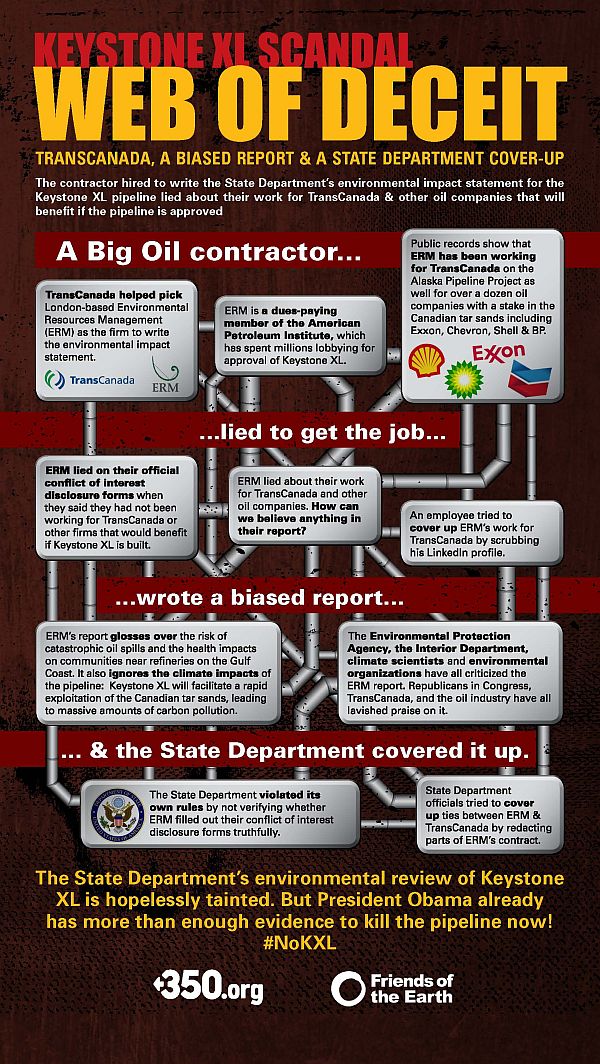
Keystone XL scandal web of deceit
NPR interview with Trita Parsi on the chance of an historic thaw in U.S.-Iran relations
Iran’s elite military warns of dangers of dealing with U.S.
Reuters reports: Iran’s elite Revolutionary Guard has warned of the dangers of dealing with U.S. officials, ahead of expected diplomatic contacts, underlining the internal challenges President Hassan Rouhani could face to improve ties with the West.
Rouhani is expected to pursue a charm offensive in the coming week while in New York for the U.N. General Assembly in order to set the right tone for further nuclear talks with world powers which he hopes will bring relief from sanctions, according to diplomats and analysts.
Hours before leaving for New York on Sunday, the new Iranian president said that Tehran was ready for negotiations with Western powers provided they set no pre-conditions. He also said the world needed to accept Iran’s right to enrich uranium.
The Islamic Revolutionary Guard Corps (IRGC) military force was established to safeguard Iran’s revolution in 1979 and has since influenced political, social and economic affairs.
“Historical experiences make it necessary for the diplomatic apparatus of our country to carefully and sceptically monitor the behaviour of White House officials so that the righteous demands of our nation are recognised and respected by those who favour interaction,” an IRGC statement said.
It added the IRGC would support initiatives that were in line with national interests and strategies set forth by Iran’s theocratic leader and highest authority, Ayatollah Ali Khamenei.
The United States and its allies have imposed tough economic sanctions on Iran over suspicions Tehran intends to develop a nuclear capability. Iran says the programme is purely peaceful.
The IRGC statement, published by Iran’s Tasnim news agency on Saturday and marking the 33rd anniversary of the start of the Iran-Iraq war, came days after Khamenei and Rouhani told the security hardliners to stay out of politics, in effect instructing them not to scupper the new centrist government’s attempt to resolve the nuclear dispute.
How France’s burqa ban is promoting deadly intolerance
Nabila Ramdani writes: Join me in a criminal court in suburban Paris on almost any weekday and I’ll show you exactly where national debates about female face coverings end up.
Ever since France introduced its “burqa ban” in 2011, there has been a constant stream of wretched cases involving the handful of Muslims who choose to wear such garments. Not only are perfectly upstanding women being fined for their choice of dress, principally the full-body niqab, which leaves a slit for the eyes, but an increasing number of defendants are being tried for attacking them.
One case involves two self-styled “patriotic vigilantes” who targeted a pregnant 21-year-old in the commuter town of Argenteuil, north-west of Paris, in June. The new law persuaded the men to shout racist insults before putting the woman in hospital, where she lost her baby. Another three reported cases on the same council estate over the course of just one month this summer saw full-veil wearers assaulted as their attackers shouted: “Dirty Arab, dirty Muslim.”
Those calling for a veil ban in Britain have clearly ignored such depressingly routine cases. They do not realise how the legislation introduced by President Nicolas Sarkozy’s government has not only stigmatised Muslim women, but somehow legitimised physical attacks on them. The ban in France is a hateful assault on basic freedoms, one that has been seized on by an unlikely alliance of rightwing politicians and feminists. [Continue reading…]
In secret, Fisa court contradicted U.S. supreme court on constitutional rights
Yochai Benkler writes: On Tuesday, the Foreign Intelligence Surveillance Court (FISC) declassified an opinion in which it explained why the government’s collection of records of all Americans’ phone calls is constitutional, and that if there is a problem with the program, it is a matter of political judgment, not constitutional law. So, should Americans just keep calm and carry on phoning? Not really.
Instead, we should worry about a court that, lacking a real adversarial process to inform it, failed while taking its best shot at explaining its position to the public to address the most basic, widely-known counter-argument to its position. The opinion does not even mention last year’s unanimous US supreme court decision on the fourth amendment and GPS tracking, a decision in which all three opinions include strong language that may render the NSA’s phone records collection program unconstitutional. No court that had been briefed by both sides would have ignored the grave constitutional issues raised by the three opinions of Justices Scalia, Sotomayor, and Alito in United States v Jones. And no opinion that fails to consider these should calm anyone down.
The newly-released FISC opinion, the first to opine on the legality of the phone metadata collection program since the Snowden leaks brought the program to national attention, is based on two straightforward points.
First, in 1979, the supreme court held in Smith v Maryland that using “pen registers” that record what number called what other number, when, and for how long, did not violate the fourth amendment. The court in Smith reasoned that individuals have no expectation of privacy in information they knowingly hand over to the phone company. The FISC reasoned that even though the NSA metadata program collected more information than the program the supreme court upheld 35 years ago, the details did not make a constitutional difference. Individuals have no fourth amendment rights in their phone call metadata.
The second component of the FISC argument was that “grouping together a large number of individuals”, no single one of whom has “a fourth amendment interest”, “cannot result in a fourth amendment interest springing into existence ex nihilo”. Adding up many zeros doesn’t create a positive value; bulk collection of unprotected materials over a sustained period of years raises no special constitutional considerations.
Standing on its own, this logic may seem persuasive. But only until you think about how last year’s Jones decision by the supreme court destabilizes this logic. [Continue reading…]