
Daily Archives: November 5, 2007

NEWS, ANALYSIS, OPINION & EDITOR’S COMMENT: Musharraf’s detour on the path to democracy

Pakistan shakes off U.S. shackles

…it turns out that the former prime minister Bhutto’s abrupt departure for Dubai in the United Arab Emirates last Thursday against the advice rendered by most of her party leaders happened just in time when it dawned on the US and Britain that despite their strong urgings, the generals were hell-bent on the imposition of emergency rule. The US and Britain counseled her to get out of harm’s way and quickly leave the country.

The initial statements of “regret” by the Western capitals, especially Washington, need to be taken with a pinch of salt. To be sure, the US policy toward Pakistan finds itself in a cul-de-sac. Musharraf’s move coincides almost to the hour with the thundering speech by President George W Bush at the Heritage Foundation, a Washington-based think-tank, on Thursday in which he blasted the US Congress for failing to take his “war on terror” not seriously enough, and he went on to compare Osama bin Laden to Adolf Hitler and Vladimir Lenin.

Addressing his neo-conservative acolytes, Bush came back to his favorite theme that via his “war on terror”, he was actually waging a global war for democracy and freedom. He compared Islamist “plans to build a totalitarian Islamist empire … stretching from Europe to North Africa, the Middle East and South East Asia” to the Third Reich. He claimed that US-led campaigns have “liberated 50 million people from the clutches of tyranny” in Iraq and Afghanistan. Bush said the people in the Middle East are “looking to the United States to stand up for them”.

Alas, we knew only a day later that just as Bush was speaking, one of his staunchest allies in his pet global war was squashing democracy and freedom. The US doublespeak becomes all too apparent in the mildly reproachful comment over Musharraf’s move, bordering on resignation, by the US spokesmen. It indicates that Washington’s dealings with the Musharraf regime will continue and normal business will resume once the dust has settled down. [complete article]
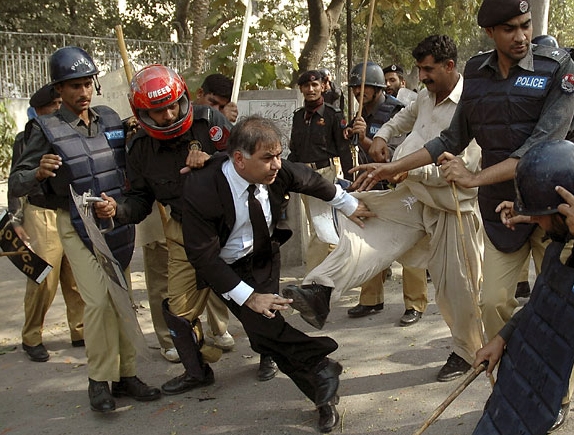
lawyersdefendingdemocracy.jpg

Editor’s Comment — These images of protesting lawyers in Pakistan deserve to become one of the lasting icons of the so-called war on terrorism. The Bush administration — however much handwringing it might engage in — once again has put itself on the wrong side of the law. Tariq Azim Khan, Pakistan’s minister of information, in what the New York Times describes as “unusually candid terms,” says that the United States would rather have a “stable” Pakistan than risk see democracy “fall into the hands of extremists.” In the same cynical spirit as talk-circuit motivational speakers, administration officials have now adopted a the journey is the goal philosophy as they express their hope that General Musharraf can keep Pakistan on the “path to democracy.”

(And here’s a note to America’s legal profession: How about demonstrating outside the White House in solidarity with your Pakistani counterparts? Their willingness to stand up to batton-wielding police is the kind of pro bono work that democracy defenders the world over, should be applauding.)

A second coup in Pakistan

The key question Musharraf faces is how long the army will continue to back him. Rank-and-file soldiers are keenly aware of the widening gulf between them and the public they are supposed to protect. The army, already demoralized, is unwilling to fight a never-ending war against its own people.

For now, the judges are gone, the media has been censored, the opposition and lawyers jailed and curtailed. But Musharraf’s emergency is not sustainable. Ruling by force without any political support will prove impossible. [complete article]

U.S. military aid to Pakistan misses its Al Qaeda target

Despite billions of dollars in U.S. military payments to Pakistan over the last six years, the paramilitary force leading the pursuit of Al Qaeda militants remains underfunded, poorly trained and overwhelmingly outgunned, U.S. military and intelligence officials said.

Pakistani President Pervez Musharraf cited the rising militant threat in declaring a state of emergency on Saturday and suspending the constitution.

But rather than use the more than $7 billion in U.S. military aid to bolster its counter-terrorism capabilities, Pakistan has spent the bulk of it on heavy arms, aircraft and equipment that U.S. officials say are far more suited for conventional warfare with India, its regional rival. [complete article]

Editor’s Comment — Hmmm… So we’re supposed to believe the administration isn’t happy to see military aid being spent on F-16s? On the contrary, it just sounds like that well-oiled revolving door that circulates American tax dollars, allocated as “foreign aid,” back into the pockets of American defense contractors. That’s how the military-industrial complex is designed to run isn’t it?

Fear and brutality inside the fiefdom of Islamist shock jock

The tourist brochures call it the Switzerland of south Asia – a mountain idyll of rushing turquoise rivers, snow-dusted peaks and Pakistan’s sole ski piste.

But now the Swat valley in northern Pakistan has a dark new reputation, as the frontline in the country’s faltering war on Islamist extremism.

On Saturday General Pervez Musharraf cited surging violence in Swat – including suicide bombings, beheadings and kidnappings – as a justification for the imposition of emergency rule. His security forces are battling an Islamist militia led by Maulana Fazlullah, a radical cleric with a flair for theatrics who wants to turn Swat into a mini Islamic fiefdom. The fight has been short but brutal, leaving hundreds dead. [complete article]


Facebooktwittermail

NEWS: Taliban make territorial advances

Taliban capture third western Afghan district

Taliban insurgents have captured a third district in western Afghanistan, local officials said on Monday, defying Western assertions the rebels are unable to mount large military offensives.

The hardline Islamist Taliban relaunched their insurgency two years ago to topple the pro-Western Afghan government and eject the 50,000 foreign troops, expanding their operations further from the mainly Pashtun south where they are strongest.

Western forces say the Taliban’s greater reliance this year on suicide and roadside bombs is a result of heavy battlefield casualties they and Afghan troops have inflicted on the rebels and the insurgents’ inability to hold ground.

But in the last week, the Taliban have captured three districts in the western province of Farah, bordering Iran, forcing lightly armed Afghan police to flee and defying Afghan and foreign forces to retake the lost ground. [complete article]

Facebooktwittermail

OPINION: Rethinking the war on terror

Rethinking the war on terror

In the last four years a great number of works have appeared which attempt to come to grips with the Bush Administration’s war on terror. Many of them are polemical, and few seem to me to be of lasting value. However, David Cole and Jules Lobel have crafted in Less Safe, Less Free one of the most important critiques to be put forward so far from the civil libertarians. They offer unsparing criticism, muster their arguments with skill and artistry, and most importantly they offer constructive criticism of the current Bush Administration model. On January 20, 2009, a new president will occupy the White House. The electoral process for Bush’s successor has already begun—the earliest such election contest in history—and polls show that Americans are uncharacteristically engaged and eager to see a turnover.

The key issue in this process will certainly be the war on terror and the paradigms that drive it. But it is distressing that this debate can only occur in the context of the election cycle. The most depressing fact about the Bush Administration is not the abject failure of its counter-terrorism policies; it is the Administration’s refusal to recognize the areas where those policies have fallen short and take some steps to correct them. Unlike any of its predecessors, this Administration has withdrawn from a public discussion of its own policies. [complete article]

Facebooktwittermail

ANALYSIS & EDITOR’S COMMENT: Deep in the (well-populated, well-connected, fertile) desert

Tourist trips to the Box-on-the-Euphrates

Is the Box-on-the-Euphrates in a remote place?

Details like that might seem insignificant, but they are not. Often, it seems to me, intelligence judgments are supported by informal bits of “color” or what you might call the gouge — circumstantial details that aren’t part of any official briefing, but appear in loose talk to bolster a judgment. Recall the “viewing stand” that North Korea never built, but nonetheless contributed to a false alarm about North Korean nuclear testing in Spring 2005.

One detail in the Box-on-the-Euphrates story that seems to lend credence to the “nuclear reactor” hypothesis is that the site is remote, and therefore suspicious. Here is how Martha Raddatz at ABC put it:

The official said the suspected nuclear facility was approximately 100 miles from the Iraqi border, deep in the desert along the Euphrates River. It was a place, the official said, “where no one would ever go unless you had a reason to go there.”

But the claim the the location is remote is, itself, an exaggeration. [complete article]

Editor’s Comment — As I pointed out a week ago, the fact that the Box on the Euphrates is not in a remote location is evident simply from studying Google Earth images. It’s very easy to zero in on the site’s location because the Euphrates river valley comprises two broad ribbons of rich agricultural land in the middle of which an arid interlude — no more than a few miles long — divides the river valley. This is the spot that, from a narrow-angle view, looks like the middle of nowhere.
middle of nowhere
Syria is not the American mid-West — in other words, agriculture is not highly mechanized and thus requires plenty of labor. Close to the “isolated” location that the media has only depicted in close aerial shots, there are lots of towns and villages. A surfaced road and a railway track run either side of the “nuclear” site. By no definition of the expression, can this be called “the middle of nowhere” — unless, that is, it’s an expression being used by those parochial observers who regard Syria itself as the middle of nowhere.

Facebooktwittermail

OPINION: Nuclear hypocrisy

No exceptions

How can a country, which according to endless foreign reports has kept secret for years several atomic weapons, manage to rally the international community in a struggle against a neighboring country that insists on acquiring nuclear energy? What do Israeli politicians answer to those asking why Iran should not be allowed to acquire the same armaments that are already in the arsenals of neighboring countries, like Pakistan and India? The common response is that “Iran is the sole country whose president, Mahmoud Ahmadinejad, declares openly that he intends to destroy the state of Israel.” This argument is a double-edged sword, par excellence, used by a country that sports a radiant nuclear glow (according to foreign press reports, of course), and who has a senior minister, one assigned to dealing with strategic threats, who has threatened to bomb the Aswan Dam.

What will Israel’s policy – or for that matter, America’s – be, if in Iran’s upcoming elections, Ahmadinejad were to give way to a more moderate leader, who were to announce that Iran recognizes Israel’s right to exist within the 1967, borders? Will Iran become one of the “moderate” Muslim states, like, say, Pakistan, which is allowed to develop nuclear weapons? There was a day when our friend the Shah ruled Iran, and then came the Ayatollahs, with whom we were happy to trade arms, until the whole affair became muddled. Regimes come and go, but nuclear weapons are forever. [complete article]

Facebooktwittermail

OPINION: Talking about talking

This is no basis for talks

David Trimble cannot be accused of lacking knowledge of what the Irish problem was about; he had been part of the problem as well as the solution. However, his lack of expertise on the Palestinian problem – which he admitted on the BBC’s Newsnight recently – surely renders him ill qualified to insist, as he did on these pages recently, that Hamas should be excluded from any talks until it first complies with the conditions of the Quartet (the US, Russia, EU and UN): recognition of Israel, repudiation of violence and recognition of past agreements between Israel and the PLO.

Trimble’s warning against learning the wrong lessons from the Northern Ireland peace process derives from the assertion that the process was based on clear preconditions. Others involved in the process, such as Michael Ancram, Stephen Byers, Lord Alderdice, Peter Hain and Alastair Crooke, have refuted this claim. In any conflict, what really matters is first to secure a cessation of violence and to persuade the parties to negotiate how to live in peace.

Had the IRA been asked to sign up to the same conditions imposed on Hamas today, no peace would ever have prevailed in Northern Ireland, and Britain might still have been subject to IRA attacks. Hamas is being asked to accept that it is legitimate for Israel to occupy the homes of Palestinians and to deny them the right to return to these homes. It is asked to renounce violence while the Israelis are under no obligation to reciprocate. It is asked to recognise agreements that have been humiliating and detrimental to Palestinians. What would remain to discuss were these conditions met? And what guarantees are there that the result would be peace? [complete article]

The day after Annapolis

No invitations have even been issued for the Bush administration’s planned Middle East peace conference later this fall and US Secretary of State Condoleezza Rice is already talking about “the day after.”

Rice is back in Jerusalem for her eighth visit of the year as she tries to keep the conference on track and temper expectations.

After her first round of talks with Israeli leaders, Rice told reporters that the meeting in Annapolis (now expected to be held in late November or early December) would be “the beginning of a process, not a single point in time.” [complete article]

Facebooktwittermail

ANALYSIS: Is Israel about to attack Hezbollah?

Is Israel about to attack Hizballah?

Is Israel laying the ground for pre-emptive air strikes against targets belonging to the militant Shi’ite group Hizballah in Lebanon?

Tensions have been building along the Lebanon-Israel border in recent days. The Israeli army was engaged last week in large-scale military exercises in northern Israel, close to the border with Lebanon, putting into practice the lessons learned from last year’s 34-day war against Hizballah. The exercises took place at the same time as Israeli jets conducted a growing number of mock air raids and overflights in Lebanese airspace. Israeli aircraft fly in Lebanese airspace on a near daily basis, but last week Lebanese army anti-aircraft units fired at the jets for the first time since the end of the war.

Hizballah, too, is reported to have carried out over the weekend its largest ever military manouevers in south Lebanon. According to a report Monday in Lebanon’s Al-Akhbar newspaper, Hizballah’s three-day exercise was a response to the Israeli army’s own maneuvers and was intended, according to quoted Hizballah sources, to “deter the enemy from undertaking any further Lebanese adventures.” [complete article]

Facebooktwittermail

NEWS: Equality before the law during a civil war?

Trial nearer for Shiite ex-officials in Sunni killings

An Iraqi judge has ruled that there is enough evidence to try two former Health Ministry officials, both Shiites, in the killing and kidnapping of hundreds of Sunnis, many of them snatched from hospitals by militias, according to American officials who are advising the Iraqi judicial system.

The case, which was referred last week to a three-man tribunal in Baghdad, is the first in which an Iraqi magistrate has recommended that such high-ranking Shiites be tried for sectarian violence. But any trial could still be derailed by the Health Ministry, making the case an important test of the government’s will to administer justice on a nonsectarian basis.

The Iraqi investigation has confirmed long-standing Sunni fears that hospitals had been opened up as a hunting ground for Shiite militias intent on spreading fear among Sunnis and driving them out of the capital. Even before the case, Baghdad residents told of death threats against doctors who would treat Sunnis, of intravenous lines ripped from patients’ arms as they were carried away, and of relatives of hospitalized Sunnis who were killed when they came to visit. [complete article]

Facebooktwittermail

NEWS: Africa doesn’t want AFRICOM

Skepticism, distrust greet America’s new military command in Africa

Just a few years ago, the U.S. military was all but absent from the oil-rich waters of West Africa’s Gulf of Guinea.

This year, it plans to be there every day.

Africa’s strategic importance is on the rise, as the U.S. acknowledged last month with the creation of a new unified U.S. military command for the continent called Africom. Monday brings the first military mission to Africa since Africom’s founding, a U.S. Navy cruiser on a half-year training exercise through the Gulf of Guinea that stops first in Senegal’s capital, Dakar.

For American commanders, Africom means consolidating responsibility for a continent previously split among three other regional commands, each of which saw Africa as a secondary interest.

However, Africom’s creation has provoked so much skepticism on the continent that one of the most basic questions — where it will be located — remains unresolved. [complete article]

Facebooktwittermail