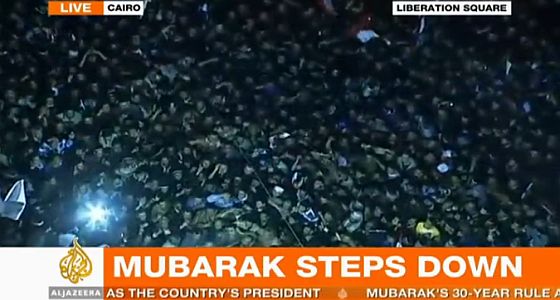
Even though many Western and Israeli freedomphobes have warned about a looming threat from Islamic extremists in Egypt, they overlook the fact that Egypt’s ultra-conservative Salafi Muslims were in the “pro-stability” camp, unwilling to challenge the Mubarak regime.
Salafis unanimously boycotted the revolution, claiming it was sedition. They accepted decades of injustice, but rejected the revolution. The revolution revealed an unintended alliance between the Mubarak regime and the Salafi movement. On the one hand, this movement is backed by elements in Saudi Arabia. On the other hand, its members are periodically subjected to harassment by the regime. However, the regime does not see this as completely eliminating its alliance with the movement, as long as the movement continues to support the regime politically.
One of the paradoxes of the Egyptian revolution is that a regime that had just recently banned Salafi TV channels and accused them of inciting sectarian conflict reversed its position and employed Salafi sheikhs in its war against the revolution. This time, Salafi sheikhs and figures, such as Mohammed Hassan, Mahmoud Al-Masri, Mostafa al-Adawi, appeared on state television and private channels close to the regime. They called for an end to protests, using arguments about security and the dangers of sedition. Some went as far as questioning the patriotism of those who instigated the revolution, arguing that it was an American-Zionist conspiracy or akin to the Iranian revolution. The manipulative statements of Iranian leaders in support of the Egyptian uprising further contributed to the Salafi counterattack.
The position of Salafis toward the Egyptian revolution comes as no surprise, especially as they have a history of supporting the regime. The famous Salafi edict to kill prominent reform advocate Mohammed ElBaradei is proof. The same sheikh issued an edict banning nominations against President Mubarak in the 2005 presidential elections on grounds that Mubarak was the commander of the faithful. What’s surprising, however, is the position of Salafis in Alexandria. This school is among the most independent from the regime and has sometimes even opposed it. Its members have been subjected to tight security measures and arrest campaigns. These campaigns peaked following the attack on the Two Saints Church in Alexandria on New Year ’s Eve. Hundreds of Salafis were arrested and one died as a result of torture. Despite this, the Salafs in Alexandria (and across various other governorates) opposed the revolution, going as far as closing down some mosques on the “Friday of Departure.” They stoked fears about the threat other political currents–a possible reference to ElBaradei’s National Association for Change–posed to the Islamic identity.
Salafis are the strongest source of religious support–direct and indirect–for the regime at the moment. But this means the future of the Salafi movement is on the line. On the one hand, the revolution’s triumph over the Salafi movement might lead Salafis to revise their positions. On the other hand, if the revolution is unable to achieve its democratic aspirations, the Salafi movement may reassert its old position with the backing of the regime.
Pankaj Mishra warns that the roots of despotism run deep.
I wonder if western leaders, shamed into moral bluster after being caught in flagrante with Mubarak, will, when we relax our vigils, tip the balance towards “stability” and against real change.
I grow a bit apprehensive too, recalling the words of an extraordinarily perceptive observer of Egypt’s struggles in the past: “The edifice of despotic government totters to its fall. Strive so far as you can to destroy the foundations of this despotism, not to pluck up and cast out its individual agents.”
This was the deathbed exhortation-cum-warning of the itinerant Muslim Jamal al-Din al-Afghani (1838-97) who pursued a long career in political activism and trenchant journalism. Travelling through Afghanistan, Iran, Egypt and Turkey in the last half of the 19th century, al-Afghani saw at first hand how unshakeable the “foundations of despotism” in Muslim countries had become.
That they were reinforced in the next century, even though many of the “individual agents” of despotism were plucked up and cast out, would not have surprised him.
He spent eight years in Egypt at a crucial time (1871-79), when the country, though nominally sovereign, was stumbling into a long and abject relationship with western powers.
Egypt’s military has dissolved parliament and suspended the constitution, two days after Hosni Mubarak, the long-serving president, stepped down in the wake of a popular uprising.
The country’s Supreme Council of Armed Forces announced on Sunday that it would remain in charge of the country for six months until a new government is formed.
The military council announced the move in a statement on state television, adding that it would form a panel to amend the constitution before submitting the changes to a popular referendum.
The announcement came shortly after Egypt’s prime minister announced that the cabinet appointed by Mubarak shortly before he stepped down, would stay in place.
Ahmed Shafiq, speaking after his first cabinet meeting since Mubarak left on Friday, said Egypt’s caretaker government will remain for the country’s transition towards democracy.
He said that security would remain a priority and pledged to fight corruption and restore peace in the country, following 18 days of pro-democracy protests.
“The first priority for this government is to restore security and to facilitate daily life for its citizens,” he said. “I guarantee that this [cabinet] will return rights to the people and fight corruption.”
Military in charge
Al Jazeera’s James Bays, reporting from Cairo, said the two announcements do not indicate that the prime minister and military council are talking against each other.
Click here for more of Al Jazeera’s special coverage
But it is “quite clear that the power now rests entirely” with the military council, he said.
“They’ve taken on the role of the presidency and the prime minister and the other ministers carry out their orders.
“The key point is the military is saying they are only in power for a temporary basis, for six months or they’ll go earlier if elections are called before six months.
But our correspondent noted that “one thing that wasn’t in that communique that protesters have asked for, was the repeal of emergency laws”.
As the train of democracy gathers steam in Egypt, there are those nearby who seem eager to throw themselves under its wheels.
No doubt an observer such as the Israeli historian, Benny Morris, is vain enough to imagine that he is not about to get run over but, on the contrary, hopes his grave warnings will encourage others to seize the train’s brakes and prevent an imminent catastrophe.
What is more likely to happen is that we will only need wait a matter of months before Morris and fellow fearmongers will be exposed as hysterical fools or intellectual rogues.
Morris believes that those of us in the West currently intoxicated by the glorious vision of democracy taking birth in Egypt, have only been able to indulge in such emotions because we don’t understand what Egyptians really want.
Alas, I fear, Westerners will see what most Egyptians actually think and want if and when the country holds free and fair general elections (perhaps in September-October). And I fear that they will be surprised—perhaps even shocked—by the results, and by what the Egyptian masses then say about what they actually think and want. I fear that at that point, “Death to Israel,” “Death to America,” and “Allahu Akbar” will drown out every democratizing and liberalizing chant.
But by then the genie will be well out of the bottle; by then, it will be too late.
Trapped inside a misanthropic Zionist mindset, Morris seems incapable of recognizing that at the core of the Egyptian and Tunisian revolutions, the driving force is not ideological. It is a universal and human demand for respect.
Sensing themselves newly visible on a world stage, ordinary Tunisians and Egyptians stood up, individually and collectively, and said: we refuse to be treated as less than human. We are reclaiming the dignity that is everyone’s birthright and will no longer tolerate the abuse of brutal rulers or the indifference of foreign powers. We demand to be heard and respected.
To the extent that the call from the dignity revolutions is being heard far beyond the Arab world, it resonates most with those who to differing degrees and for different reasons, share the same experience. That many of us live in democracies does little to diminish a sense that our governments do not represent our interests. And that so many of our fellow citizens respond to this reality with indifference only makes us envy the courage and imagination of people who do otherwise as they rise up, declare and discover: we have the power to change the world.
The stark realization slowly dawning on Washington is that the United States cannot be on the right side of Arab democracy if it is on the wrong side of Palestinian freedom. Israel’s security and peace treaties are certainly compatible with a recalibrated American policy in the region, but not the continuation of occupation and inequality for Palestinians. This shouldn’t pose such a conundrum: the status quo has constrained the prospects for both the Arab and Jewish-Israeli publics. For all of its qualitative military edge and American backing, Israel does not feel secure, accepted or calm about its future.
Things get messy though when America fails to apply its own values to the Middle East. Some are advocating for precisely that values-free option, apparently believing that the adage of Israel being the only democracy in the Middle East is not so much a lament as an aspiration. That translates into continued support for Arab autocracies or insisting on what might be called democracy minus for Arab countries in which the balance between military and civilian rule still rests primarily with the former, and by denying democratic Islamist parties the right to participate in peaceful politics.
Representative government in the Arab world will inevitably include a role for Islamists, something seized on by democracy’s opponents as a scare tactic to plead for the continued rule of the authoritarian devil we know. Those warning of a Khomeinist takeover are either desperately ignorant of Arab reality or intentionally misleading. Iran’s system of theocratic republicanism carries no attraction for the Arab pro-democracy movements. If anything, it is Turkey’s system of parliamentary citizen-state democracy, which is held up as a model.
There is another way to look at this region in transition and to plan for the future. The best option for getting this right and being credible is in allowing American policy to reflect American political values.
Imagine that: American foreign policy that isn’t riddled with hypocrisy!
George Bush — with a less than democratic spirit — used to say, you’re either for us or against us. The same can be said about democracy: you’re either for democracy or against it.
We no longer live in an era where something called democracy can be reserved for a privileged minority. Those who now claim that democratic rights should only be selectively recognized are, quite simply, opponents of democracy.
Since the end of the Cold War, conservatives have argued that the world should be seen through the lens of a clash between civilizations. The world could be divided, they argued, on the basis of different cultures and their distance from Western values.
Countries where the majority of the population is Muslim were grouped together as the ‘Islamic world’ and seen as culturally prone to fanaticism and violence. Revolution there could only mean Islamic revolution along the lines of Iran in 1979. Democracy could only emerge if imposed by force from outside, as disastrously attempted in the Iraq War.
Liberals had their own version of such thinking, particularly after 9/11. Rejecting the necessity of a clash between civilizations, they spoke of a dialogue between civilizations. But they shared with conservatives the assumption that culture was the primary driving force of political conflict.
There was something of this thinking in President Obama’s famous 2009 speech in Cairo, addressed to “the Muslim world.” Liberals like Obama thought it possible that dialogue could allow for the peaceful co-existence of cultural differences between Muslims and the West. Conservatives, on the other hand, feared that no dialogue was possible with Islam, and it was better for the West to ready itself for inevitable conflict.
These have been the terms of debate between liberals and conservatives since 9/11.
Significantly, both sides in the debate assumed that the fundamental divisions in the world were cultural rather than political.
The answer, in Egypt, was with poetry, tech lingo, hieroglyphics and more.
For weeks, in Tahrir Square and elsewhere, demonstrators were telling President Hosni Mubarak to leave, playfully using a variety of dialects and languages to get the idea across.
And on Friday, Mr. Mubarak finally got the message and resigned.
In countries under authoritarian rule, “speaking truth to power” typically takes the form of highly colorful and creative modes of expression. Playing with language is often one of the few ways to challenge an oppressive political system, and the pointed humor behind the linguistic ingenuity can create strong bonds of solidarity.
Indeed, there are strong parallels in the fall of Ceausescu in Romania or Suharto in Indonesia. Indonesian activists in the 1990s, for instance, turned their president’s name into a snarky acronym: “sudah harus tobat” (“should have repented by now”).
On their own protest signs, Egyptian wordsmiths transliterated “irhal,” the standard Arabic imperative for “depart,” into Egyptian hieroglyphics so that “the pharaoh” would understand. And a popular rhyming chant on Tahrir Square played with high and low forms of Arabic, explaining to Mr. Mubarak that “irhal” means “imshi,” a colloquial Egyptian word that might be best rendered in English as “beat it.”
Even though the Egyptian revolution has frequently been described as leaderless and it clearly enjoyed support from all sections of Egyptian society and beyond being a demand for democratic rights was non-ideological, it was not unplanned.
An article in the Wall Street Journal and a documentary by Al Jazeera reveal new details of some of the ingenious and meticulous organization that translated the will of the Egyptian people into a viable force capable of toppling a regime.
The youth organizers of the uprising knew their challenge was to outwit police who were expert at containing demonstrations and keeping ordinary Egyptians away.
They met daily for two weeks [in early January] in the cramped living room of the mother of Ziad al-Alimi. Mr. Alimi is a leading youth organizer for Mr. ElBaradei’s campaign group. His mother, a former activist who served six months in prison for her role leading protests during the bread riots in 1977, lives in the middle-class neighborhood of Agouza on the west bank of the Nile.
Those present included representatives from six youth movements connected to opposition political parties, groups advocating labor rights and the Muslim Brotherhood.
They chose 20 protest sites, usually connected to mosques, in densely populated working-class neighborhoods around Cairo. They hoped that such a large number of scattered rallies would strain security forces, draw larger numbers and increase the likelihood that some protesters would be able to break out and link up in Tahrir Square.
The group publicly called for protests at those sites for Jan. 25, a national holiday celebrating the country’s widely reviled police force. They announced the sites of the demonstrations on the Internet and called for protests to begin at each one after prayers at about 2 p.m.
But that wasn’t all.
“The 21st site, no one knew about,” Mr. Kamel said.
To be sure, these activists weren’t the only ones calling for protests that day. Other influential groups rallied their resources to the cause. The Facebook page for Khaled Said, the young man beaten to death by police in Alexandria, had emerged months earlier as an online gathering place for activists in Egypt.
There was an Arabic page and an English page, and each had its own administrators. Mr. Ghonim, the Google executive, has now been identified as one. The pages’ other administrators remain anonymous.
An administrator for the English-language page, who uses the online moniker El-Shaheed, or The Martyr, recounted the administrators’ role in the protests in an interview with The Wall Street Journal via Gmail Chat. El-Shaheed recalled exchanging messages with the site’s Arabic-language administrator on Jan. 14, just as news broke of the Tunisian president’s flight from his country. Mr. Kamel and his cohorts, who had already begun plotting their protest, now had another powerful recruiting force.
“I was talking with Arabic admin and we were watching Tunisia and the moment we heard Ben Ali ran away, he said, ‘We have to do something,’ ” said El-Shaheed, whose true identity couldn’t be determined.
The Arabic administrator posted on the Arabic page an open question to readers: “What do you think we should give as a gift to the brutal Egyptian police on their day?”
“The answer came from everyone: Tunisia Tunisia : ),” wrote El-Shaheed.
For the final three days before the protest, Mr. Kamel and his fellow plotters say they slept away from home, fearing police would come to arrest them in the middle of the night. Worrying their cellphones would be monitored, they used those of family members or friends.
They sent small teams to do reconnaissance on the secret 21st site. It was the Bulaq al-Dakrour neighborhood’s Hayiss Sweet Shop, whose storefront and tiled sidewalk plaza—meant to accommodate outdoor tables in warmer months—would make an easy-to-find rallying point in an otherwise tangled neighborhood no different from countless others around the city.
The plotters say they knew that the demonstrations’ success would depend on the participation of ordinary Egyptians in working-class districts like this one, where the Internet and Facebook aren’t as widely used. They distributed fliers around the city in the days leading up to the demonstration, concentrating efforts on Bulaq al-Dakrour.
“It gave people the idea that a revolution would start on Jan. 25,” Mr. Kamel said.
In the days leading up to the demonstration, organizers sent small teams of plotters to walk the protest routes at various speeds, to synchronize how separate protests would link up.
On Jan. 25, security forces predictably deployed by the thousands at each of the announced demonstration sites. Meanwhile, four field commanders chosen from the organizers’ committee began dispatching activists in cells of 10. To boost secrecy, only one person per cell knew their destination.
In these small groups, the protesters advanced toward the Hayiss Sweet Shop, massing into a crowd of 300 demonstrators free from police control. The lack of security prompted neighborhood residents to stream by the hundreds out of the neighborhood’s cramped alleyways, swelling the crowd into the thousands, say sweet-shop employees who watched the scene unfold.
At 1:15 p.m., they began marching toward downtown Cairo. By the time police redeployed a small contingent to block their path, the protesters’ ranks had grown enough to easily overpower them.
The other marches organized at mosques around the city failed to reach Tahrir Square, their efforts foiled by riot-police cordons. The Bulaq al-Dakrour marchers, the only group to reach their objective, occupied Tahrir Square for several hours until after midnight, when police attacked demonstrators with tear gas and rubber bullets.
It was the first time Egyptians had seen such a demonstration in their streets, and it provided a spark credited with emboldening tens of thousands of people to come out to protest the following Friday. On Jan. 28, they seized Tahrir Square again. They have stayed there since.
Egyptians triumphed over their police state without Western help or even moral support. During rigged parliamentary elections, the West barely raised an eyebrow. And when the protests began at Tahrir Square, Secretary of State Hillary Rodham Clinton said that the Mubarak government was “stable” and “looking for ways to respond to the legitimate needs and interests of the Egyptian people.”
Commentators have repeatedly referred to the Obama administration playing catch-up during the Egyptian revolution, yet its seeming inability to track fast-changing events was merely an expression of its unwillingness to embrace the direction those events were heading.
Immediately after Hosni Mubarak resigned, Jake Tapper from ABC News tweeted that he couldn’t find anyone in the administration who thought that whatever comes next would be better for U.S. interests than Mubarak had been.
The dictator’s departure is not being celebrated in Washington. The leaders of the free world have a singular lack of enthusiasm for freedom.
The administration has not merely repeatedly stumbled, but has functioned as a dead weight, attempting to slow the pace of what may become the most significant transformation in world order since the birth of Western colonial power.
America’s friends in Israel have been equally unenthusiastic about the turn of events. After Mubarak’s defiant speech on Thursday night when he insisted he would sit out his term as president, “Israel breathed a sigh of relief,” according to Israeli commentator, Alex Fishman. The respite must have felt dreadfully brief.
But if Americans want to grasp the significance of the Egyptian revolution, they need look no further than this country’s much bloodier assertion of people power: the American revolution.
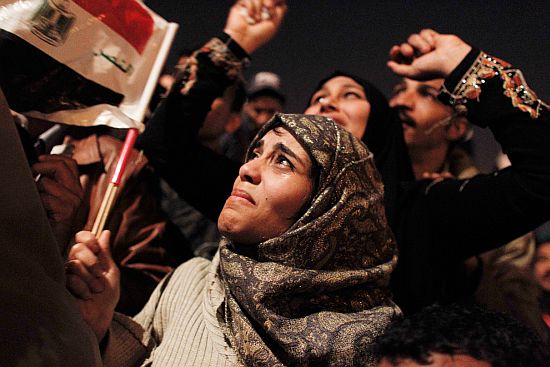
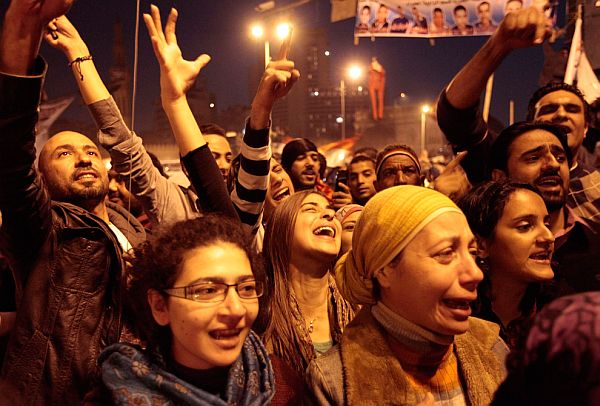
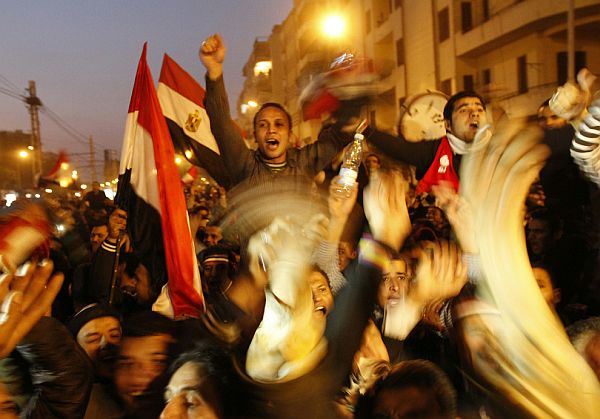
For the first time in Egypt’s history, the Egyptian people have made a declaration of sovereignty and claimed their right of self-governance. Is that not something that every person on the planet who cherishes life and liberty can joyfully celebrate?
As Western leaders now line up, having no choice but to express their support for the revolution, while sagely offering guidance and assistance in managing an “orderly transition” to a democratic system, they do so with a palpable ambivalence.
People power is in jeopardy of sweeping the Middle East and undoing the carefully constructed “stability” through which for most of the last century the West has managed the control of its most vital resource: oil.
Worse for the United States, the Egyptian revolution now undermines the US government’s ability to sustain an unswerving loyalty to the preeminence of Israel’s security interests.
A democratic Egyptian government will not have the autocratic latitude that until now enabled Mubarak’s complicity in the siege of Gaza or his willingness to participate in the charade of a peace process going nowhere.
Stepping back from the most obvious regional implications of what is now unfolding, there is a more far-reaching dimension.
When in 1990 President George HW Bush used the phrase “new world order”, his words had an ominous ring both because they implied that this would be an American-defined order but also — on the brink of the first Gulf War — a militarily-imposed order. The new order was synonymous with the dubious claim that the collapse of the Soviet Union represented an American “victory” in the Cold War.
A new world order worthy of the name, however, should represent something much more significant than the strategic reapportioning of power on a geopolitical level. It should involve the reapportioning of power through which global affairs become the people’s affairs. It should mean that international relations can no longer be conducted within the confines of intrinsically undemocratic arenas where ordinary people have no voice.
The people-power unleashed in Egypt has the potential to serve as a democratizing force that not only threatens autocratic leaders in the Middle East but also technocratic and nominally democratic leaders in the West — those whose complacent style of governance has depended on the political passivity of the populations they nominally serve while providing ready access for corporate interests to exercise their undemocratic influence.
The West, far from representing a model of democracy ripe for export has instead long been mired in a post-democratic phase where the foundational concept of demos, the people, has withered.
Individual wealth has supplanted the need for social solidarity as citizenship has been substituted by consumerism. Our material self-sufficiency has robbed us of the experience of mutual reliance and worn thin the fabric of society.
In a new world order, a new democracy might spread not just further east but also further west.
There is also a bittersweet note in this moment.
The Western exporters of democracy delivered the war in Iraq and yet as we witness events unfold in Egypt, it’s hard not to wonder what might have been possible had the people of Iraq, without Western help or hindrance, been allowed the same opportunity to claim their own freedom.
Live updates:
FINALLY MUBARAK RESIGNS! Suleiman announces the armed forces are now in control of Egypt.
Wall Street Journal — How young activists outwitted Egypt’s feared security forces to spur an uprising many here had long thought impossible.
7.20 — @avinunu: BBC Arabic: Switzerland has frozen Mubarak’s bank accounts.
Al Jazeera — Brief profiles of country’s Supreme Council of the Armed Forces as Hosni Mubarak hands over power to the body.
Reaction from Washington – ABC’s Jake Tapper: “cant find anyone in O admin who thinks whatever comes next will be better for U.S. interests than Mubarak was.”
Al Arabiya — nearly 20 million Egyptians are in the street today.
4.05pm — @ashrafkhalil: Everybody calm down about reports that Mubarak has “left Cairo.” He runs country from Sharm El Shiekh more than half the time#egypt #jan25
One cannot but note the “miraculous” nature of the events in Egypt: something has happened that few predicted, violating the experts’ opinions, as if the uprising was not simply the result of social causes but the intervention of a mysterious agency that we can call, in a Platonic way, the eternal idea of freedom, justice and dignity.
The uprising was universal: it was immediately possible for all of us around the world to identify with it, to recognise what it was about, without any need for cultural analysis of the features of Egyptian society. In contrast to Iran’s Khomeini revolution (where leftists had to smuggle their message into the predominantly Islamist frame), here the frame is clearly that of a universal secular call for freedom and justice, so that the Muslim Brotherhood had to adopt the language of secular demands.
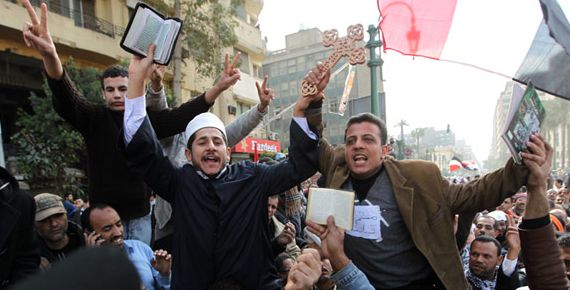
The most sublime moment occurred when Muslims and Coptic Christians engaged in common prayer on Cairo’s Tahrir Square, chanting “We are one!” – providing the best answer to the sectarian religious violence. Those neocons who criticise multiculturalism on behalf of the universal values of freedom and democracy are now confronting their moment of truth: you want universal freedom and democracy? This is what people demand in Egypt, so why are the neocons uneasy? Is it because the protesters in Egypt mention freedom and dignity in the same breath as social and economic justice?
Der Spiegel — Mubarak has rejected an offer to put him up in a German luxury clinic to provide him with a dignified exit from power. He doesn’t need medical treatment, his vice president said.
3.50pm — @arabist: America is really a push-over. Govts. in TelAviv and Cairo take its money and then tell it to fuck off. Americans deserve better FP leaders.
Associated Press — Binyamin Ben-Eliezer of Israel’s Labor Party said he spoke with Mubarak just hours before the Egyptian president’s speech late Thursday.
Describing his conversation with Mubarak, Ben-Eliezer said: “He knew that this was it, that this was the end of the road.”
“He was looking for only one thing – give me an honorable way out. Let me leave in an honorable fashion,” Ben-Eliezer told Israel’s Army Radio.
Control of Egypt’s economy appeared to be slipping out of the government’s hands, as strikes multiplied across the country and leading business figures sought to disassociate themselves with the Mubarak regime.
Thousands of workers in key industries walked out from their jobs, piling pressure on a political leadership already rocked by the 17th straight day of street protests calling for the president to stand down.
In a further blow to leading NDP members, who in recent years have styled themselves as pro-business reformers, several large companies took out adverts in local newspapers putting distance between themselves and the regime.
Israelis deeply confused about the nature of political stability — still cling to the idea that Mubarak is a stabilizing force:
“Israel breathed a sigh of relief,” Israeli commentator Alex Fishman wrote in Friday’s daily Yedioth Ahronoth after Mubarak’s speech. Fishman noted that now it was unlikely there would be any shifts in Egypt’s foreign policy until at least September. “We’ve received an extension. Which will make it possible for the State of Israel to study the developments closely and to try to prepare for them,” Fishman wrote.
By the standards of any modern politician, it was truly dreadful: in turns vain, arrogant, patronising, condescending and defiant. Above all, it showed Mubarak totally out of touch with the mood of the country and the will of the people that he governs. The only thing to be said in its favour is that it illustrated, in just a few hundred words, all the reasons why he ought to go (even if he’s still refusing to do so).
He began by addressing the people as his “sons and daughters” – a phrase that might slip past unnoticed, though in fact it encapsulates the fundamental problem with Arab leaders and how they perceive themselves and their citizens. They behave like the traditional head of an Arab household, the paterfamilias – a remote, supposedly wise and almost God-like figure who rarely speaks but, when he does, must always be obeyed because he knows what’s best for his children.
3.45pm — @alaa: I’m not religious, and I want a secular egypt, but those secularists who think religion has no role in political life know nothing #Jan25
Most Egyptians cannot make heads or tails of the strangest evening since the crisis began on January 25th. But the night’s events confirm a few things. Mr Mubarak appears to be delegating more power, both formally and de facto, to Mr Suleiman. Even some senior officials now say he is a mere figurehead. The army continues to send mixed messages, perhaps reflecting an internal split, and the political elite that fronts for the military appears ever more out of the loop.
But most of all, the young men and women who form the bulk of the protest movement and have had some success in recent days in spreading dissent to ministries, factories and public services—postal workers, telecommunication workers, bus drivers and hospital staff have staged partial strikes—are becoming increasingly convinced that their country’s leadership is deaf to their pleas.
Earlier today, the Egyptian blogger Sandmonkey wrote the following post: “Mubarak’s Gamble”
Earlier yesterday, I spoke to Wael Ghonim and he told me to expect some very good news around 5 pm that night, but he never elaborated what it is. Around 10 am, we heard that Saudi Arabia, alongside UAE and Kuwait, are creating an aid package to Egypt to possibly replace that of the US. Around 4 pm last night, we recieved the news that the President itends to step down tonight and give all of his responsbilities to the VP, Omar Suleiman. The Army then convened and issued its first statement, in a meeting without Mubarak or his VP around 5 pm. Around 9 pm Egypt time, Obama did a speech congratulating the people of Egypt for their march for democracy, so it seemed like a done deal. Finally, an hour later than originally announced, President Hosny Mubarak , against all expectations and information, refused to step down from his post, and said that he refuses any foreign interference in Egypt. The White House then announced that it has been double-crossed by the Egyptian regime.
Now, what does this all mean?
Well, 4 main things:
1) Mubarak is not going to leave Office without bloodshed. Any attempt for a peaceful exit has been discarded by his regime, and they are intending to fight the will of the people until the end.
2) Mubarak has burned the image of Hossam Badrawy and the Wisemen council with his speech. Hossam Badrawy, the secretary general of the NDP, was the face of the NDP that announced Mubarak’s intenetion to abdicate power later tonight. Now the man has no credibility. Same goes for the Wiseman Council, since Mubarak’s speech was focused on how he has met their demands, which don’t include him leaving. If most of them don’t quit their posts today, I would be greatly surprised.
3) We are seeing the first possible split in the power structure in Egypt: It seems that the Armed forces are in one camp, and the president, intelligence agencies and the republican guard in another camp. If you add to the equation the Ministery of Interior and the protesters, you have 4 players right now in an intensely unpredictable power struggle. We are now awaiting the second statement from the High council of amred forces to clearify their position once and for all. Whether the Army is with or against the people will determine a lot of today’s outcome.
4) Mubarak has now put the US in a corner: He double-crossed the White House, and announced his intentions to fight foriegn intervention. Adding to that the news of the arab aid, he is sending the US a clear message: “I could tell you and your aid to go to hell, and get the money from the arabs instead. Where does this leave your precious Israel? If you don’t want us to cause problems on that front, you better shut up about what we will do and get with the program, or else!”
If you take all of those factors into consideration, the situation starts looking intensely ominous. If the regime and the army has split, we could see major fighting and bloodshed today. If the Army is with the President, then they will all turn their guns on the Protesters, who are determined not to live under Mubarak rule for one extra day. It also means that he put on the line the future of the transitional government with Omar Suleiman in charge, because Suleiman’s fate seems intensely intertwined with the President now. This has become a fight for survival: it’s either the regime or the people. The bad news is, the regime has all the weapon and organization. The good news is, the people are determined and increasing in numbers and the army might step in and save us all unnecessary bloodshed.
Lyrics: “I went down and I said I am not coming back, and I wrote on every street wall that I am not coming back.
“All barriers have been broken down, our weapon was our dream, and the future is crystal clear to us, we have been waiting for a long time, we are still searching for our place, we keep searching for a place we belong too, in every corner in our country.
“The sound of freedom is calling, in every street corner in our country, the sound of freedom is calling..
“We will re-write history, if you are one of us, join us and don’t stop us from fulfilling our dream.”
Robert Tait describes 28 hours in the dark heart of Egypt’s torture machine:
The sickening, rapid click-click-clicking of the electric shock device sounded like an angry rattlesnake as it passed within inches of my face. Then came a scream of agony, followed by a pitiful whimpering from the handcuffed, blindfolded victim as the force of the shock propelled him across the floor.
A hail of vicious punches and kicks rained down on the prone bodies next to me, creating loud thumps. The torturers screamed abuse all around me. Only later were their chilling words translated to me by an Arabic-speaking colleague: “In this hotel, there are only two items on the menu for those who don’t behave – electrocution and rape.”
Cuffed and blindfolded, like my fellow detainees, I lay transfixed. My palms sweated and my heart raced. I felt myself shaking. Would it be my turn next? Or would my outsider status, conferred by holding a British passport, save me? I suspected – hoped – that it would be the latter and, thankfully, it was. But I could never be sure.
I had “disappeared”, along with countless Egyptians, inside the bowels of the Mukhabarat, President Hosni Mubarak’s vast security-intelligence apparatus and an organisation headed, until recently, by his vice-president and former intelligence chief, Omar Suleiman, the man trusted to negotiate an “orderly transition” to democratic rule.
Judging by what I witnessed, that seems a forlorn hope.
I had often wondered, reading accounts of political prisoners detained and tortured in places such as junta-run Argentina of the 1970s, what it would be like to be totally at the mercy of, and dependent on, your jailer for everything – food, water, the toilet. I never dreamed I would find out. Yet here I was, cooped up in a tiny room with a group of Egyptian detainees who were being mercilessly brutalised.
Iranian opposition leader Mehdi Karroubi has been put under house arrest, his official website says.
Security officials at the premises say the measures will last until next week, it adds. No one is being allowed to enter the house except his wife.
Mr Karroubi and Mir-Hossein Mousavi, another opposition leader, had called for a rally on Monday to support the popular uprisings in Egypt and Tunisia.
The authorities refused permission, calling it a political move.
Although Iran’s establishment supports the Egyptian popular protests, a spokesman for Iran’s judiciary said on Wednesday that Iranians should show their solidarity by taking part in official rallies this Friday to commemorate the anniversary of Iran’s revolution.
Choosing another day to hold a rally means that the opposition leaders “wish to be in a separate front and will create divisions”, he told a news conference in Tehran.
[T]he cold peace Israel has forged with Arab dictators is unraveling. This may, in the short term, empower Israeli Prime Minister Benjamin Netanyahu’s Likud ideologues who will argue that Arab democrats are out to “delegitimize” Israel. But in the long run, the emergence of an Arab democratic polity should convince Israeli voters that their leaders have become too complacent and too isolationist. After Tahrir, a majority of Israelis may conclude that they can’t live in the neighborhood without forging a real peace with their neighbors.
The separation wall was never a real answer to Israel’s security predicament, and it will be less so when a democratically elected government governs Egypt. The policy of separation — hafrada in Hebrew — had some short-term strategic viability when the largest Arab country was willing to police Israel’s southern border and keep Hamas penned up inside its Gaza prison. But no legitimate government in Cairo will be able to continue its complicity with the Gaza blockade — particularly not if the Muslim Brotherhood is a player in a new government.
In reality, Israel will come under renewed pressure to deal with both Hamas and the Palestinian Authority in the West Bank. Hamas’s ideology is certainly vile, but it won the last Palestinian legislative election in 2006 and has more or less observed a cease-fire with Israel since early 2009. In December 2010, the Hamas prime minister in Gaza, Ismail Haniyeh, announced that his party would abide by any peace settlement if it were to be ratified by a referendum of the Palestinian people. Furthermore, as we recently learned from Al Jazeera’s Palestine Papers — the leaked documents on the 2008 Abbas-Olmert talks — the two sides are not that far apart on a comprehensive peace settlement that would create a Palestinian state.
So here is the uplifting news: What is happening in Tahrir Square may actually propel the politicians in Washington, Jerusalem, and Ramallah to forge the Israeli-Palestinian peace deal that all of us know is there for the taking. And if that doesn’t happen? Absent a comprehensive peace settlement, Israel and the United States will find themselves increasingly isolated in the new Middle East.
Associated Press report reveals the lack of accountability in the CIA where officers responsible for botched operations end up getting promotions.
In December 2003, security forces boarded a bus in Macedonia and snatched a German citizen named Khaled el-Masri. For the next five months, el-Masri was a ghost. Only a select group of CIA officers knew he had been whisked to a secret prison for interrogation in Afghanistan.
But he was the wrong guy.
A hard-charging CIA analyst had pushed the agency into one of the biggest diplomatic embarrassments of the U.S. war on terrorism. Yet despite recommendations by an internal review, the analyst was never punished. In fact, she has risen to one of the premier jobs in the CIA’s Counterterrorism Center, helping lead President Barack Obama’s efforts to disrupt al-Qaida.
In the years since the Sept. 11, 2001, terrorist attacks, officers who committed serious mistakes that left people wrongly imprisoned or even dead have received only minor admonishments or no punishment at all, an Associated Press investigation has revealed. The botched el-Masri case is but one example of a CIA accountability process that even some within the agency say is unpredictable and inconsistent.
Though Obama has sought to put the CIA’s interrogation program behind him, the result of a decade of haphazard accountability is that many officers who made significant missteps are now the senior managers fighting the president’s spy wars.
The AP investigation of the CIA’s actions revealed a disciplinary system that takes years to make decisions, hands down reprimands inconsistently and is viewed inside the agency as prone to favoritism and manipulation. When people are disciplined, the punishment seems to roll downhill, sparing senior managers even when they were directly involved in operations that go awry.
Two officers involved in the death of a prisoner in Afghanistan, for instance, received no discipline and have advanced into Middle East leadership positions. Other officers were punished after participating in a mock execution in Poland and playing a role in the death of a prisoner in Iraq. Those officers retired, then rejoined the intelligence community as contractors.
Nearly three years ago, a group of youth activists with a strong sense of Internet organizing and more than a little help from abroad was preparing for a grassroots, high-tech opposition movement.
In early 2008, Ahmed Salah and Ahmed Maher, young members of the Kefaya (“Enough”) opposition group that made a strong run against Mubarak in the 2005 presidential election, branched off and formed a group they called the April 6 Youth Movement. The group took its name from the date of the first demonstration it supported — a workers’ strike planned for April 6, 2008, in el-Mahalla el-Kubra, an important town for the Egyptian textile industry. To galvanize the strike effort, April 6 activists used Facebook, Twitter, blogs, and other new-media tools to report events, alert participants about security situations, and provide legal assistance to those rounded up by state security forces.
But from the beginning, the group’s founders were anticipating a far more critical date: the Nov. 28, 2010, parliamentary elections. With memories of Iran’s post-election protests still fresh in their minds, the young activists hoped that the vote — sure to be marred by ballot stuffing, bought votes, and thuggery — would spark a mass movement that would bring Mubarak’s nearly 30-year reign to an end.
By early 2009, the group’s membership was 70,000 strong — still small numbers for a country of 82 million, yet it represented something genuinely new in Egypt’s stagnant political environment. The young activists soon took cues from Iran’s Green Movement, which was born out of the June 2009 post-election protests. They built on best practices and addressed the glaring weaknesses of the Iranian grassroots opposition movement. One of their first projects was a manual on protest methods, composed mostly of contributions from the group’s members, which were solicited online. Friends passed it to friends and added ideas on topics ranging from security to graffiti. I became aware of the group in January 2010, when a fellow reporter forwarded me the manual.
In its early experiments with organizational tactics and online safety, the group sometimes reached out to some unlikely partners. Digital media experts in the organization consulted with Italian anarchist party activists for advice on how to use “ghost servers,” which bounce Internet searches to nonexistent servers to confuse any online monitoring, allowing users to share information and continue coordinating their activities in heavily monitored digital and telecom environments, such as in Egypt, where email accounts and Facebook are watched closely.
In President Obama’s latest statement on events in Egypt, he does not swerve from the position he has maintained from day one: that of a concerned but impotent spectator.
“In these difficult times, I know that the Egyptian people will persevere, and they must know that they will continue to have a friend in the United States of America.”
But does this friend intend to do anything other than express beliefs and hopes about a desirable outcome?
“As we have said from the beginning of this unrest, the future of Egypt will be determined by the Egyptian people.” And in another nod to people power: “The Egyptian people have made it clear that there is no going back to the way things were: Egypt has changed, and its future is in the hands of the people.”
And yet the whole world knows that the US is not an impotent and innocent onlooker — it is deeply invested in supporting Egypt’s military.
The White House claims it supports democracy in Egypt and that the US should have no role in determining who governs, yet Obama can certainly make the continuation of military aid contingent on the existence of a democratic government.
At this decisive moment when the Egyptian military has to choose between supporting an embattled and increasingly desperate president or siding with the people, the risk of losing one third of the country’s military funding could bring some much-needed clarity to the generals’ thinking.
This website or its third-party tools use cookies, which are necessary to its functioning. By closing this banner, you agree to the use of cookies.