Monthly Archives: August 2011

How Israel trains its children to hate and kill Palestinians

The Guardian reports:

Nurit Peled-Elhanan, an Israeli academic, mother and political radical, summons up an image of rows of Jewish schoolchildren, bent over their books, learning about their neighbours, the Palestinians. But, she says, they are never referred to as Palestinians unless the context is terrorism.

They are called Arabs. “The Arab with a camel, in an Ali Baba dress. They describe them as vile and deviant and criminal, people who don’t pay taxes, people who live off the state, people who don’t want to develop,” she says. “The only representation is as refugees, primitive farmers and terrorists. You never see a Palestinian child or doctor or teacher or engineer or modern farmer.”

Peled-Elhanan, a professor of language and education at the Hebrew University of Jerusalem, has studied the content of Israeli school books for the past five years, and her account, Palestine in Israeli School Books: Ideology and Propaganda in Education, is to be published in the UK this month. She describes what she found as racism– but, more than that, a racism that prepares young Israelis for their compulsory military service.

“People don’t really know what their children are reading in textbooks,” she said. “One question that bothers many people is how do you explain the cruel behaviour of Israeli soldiers towards Palestinians, an indifference to human suffering, the inflicting of suffering. People ask how can these nice Jewish boys and girls become monsters once they put on a uniform. I think the major reason for that is education. So I wanted to see how school books represent Palestinians.”

In “hundreds and hundreds” of books, she claims she did not find one photograph that depicted an Arab as a “normal person”. The most important finding in the books she studied – all authorised by the ministry of education – concerned the historical narrative of events in 1948, the year in which Israel fought a war to establish itself as an independent state, and hundreds of thousands of Palestinians fled the ensuing conflict.

The killing of Palestinians is depicted as something that was necessary for the survival of the nascent Jewish state, she claims. “It’s not that the massacres are denied, they are represented in Israeli school books as something that in the long run was good for the Jewish state. For example, Deir Yassin [a pre-1948 Palestinian village close to Jerusalem] was a terrible slaughter by Israeli soldiers. In school books they tell you that this massacre initiated the massive flight of Arabs from Israel and enabled the establishment of a Jewish state with a Jewish majority. So it was for the best. Maybe it was unfortunate, but in the long run the consequences for us were good.”

Children, she says, grow up to serve in the army and internalise the message that Palestinians are “people whose life is dispensable with impunity. And not only that, but people whose number has to be diminished.”


Facebooktwittermail

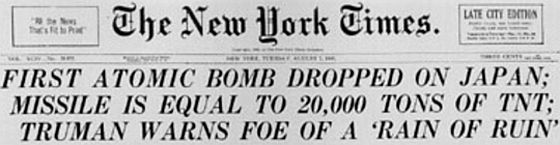
When Truman opened the nuclear era — with a lie

Greg Mitchell writes:

On August 6, 1945, President Harry S. Truman faced the task of telling the press, and the world, that America’s crusade against fascism had culminated in exploding a revolutionary new weapon of extraordinary destructive power over a Japanese city.

It was vital that this event be understood as a reflection of dominant military power and at the same time consistent with American decency and concern for human life. Everyone involved in preparing the presidential statement sensed that the stakes were high, for this marked the unveiling of both the atomic bomb and the official narrative of Hiroshima.

When the astonishing news emerged that morning, exactly sixty-six years ago, it took the form of a routine press release, a little more than a thousand words long. President Truman was at sea a thousand miles away, returning from the Potsdam conference. Shortly before eleven o’clock, an information officer from the War Department arrived at the White House bearing bundles of press releases. A few minutes later, assistant press secretary Eben Ayers began reading the president’s announcement to about a dozen members of the Washington press corps.

The atmosphere was so casual, and the statement so momentous, that the reporters had difficulty grasping it. “The thing didn’t penetrate with most of them,” Ayers later remarked. Finally, they rushed to call their editors, and at least one reporter found a disbeliever at the other end of the line. The first few sentences of the statement set the tone:

“Sixteen hours ago an American airplane dropped one bomb on Hiroshima, an important Japanese Army base. That bomb had more power than 20,000 tons of TNT.… The Japanese began the war from the air at Pearl Harbor. They have been repaid many fold.… It is an atomic bomb. It is a harnessing of the basic power of the universe.”

Although details were modified at the last moment, Truman’s four-page statement had been crafted with considerable care over many months. If use of the atomic bomb was inherent in its invention, an announcement of this sort was inevitable. Only the timing was in doubt.

From its very first words, however, the official narrative was built on a lie. Hiroshima was not an “army base” but a city of 350,000. It did contain one important military base, but the bomb had been aimed at the very center of a city (and far from its industrial area). This was a continuation of the American policy of bombing civilian populations in Japan to undermine the morale of the enemy. It was also to take advantage of what those who picked the targed called the special “focusing effect” provided by the hills which surrounded the city on three sides. This would allow the blast to bounce back on the city, destroying more of it, and its citizens.

The vast majority of the dead in Hiroshima would not be military personnel and defense workers but women and children.

There was something else missing in Truman’s announcement: because the president in his statement failed to mention radiation effects, which officials knew were horrendous, the imagery of just a bigger bomb would prevail in the press. Truman described the new weapon as “revolutionary” but only in regard to the destruction it could cause, failing to mention its most lethal new feature: radiation.

Many Americans first heard the news from the radio, which broadcast the text of Truman’s statement shortly after its release. The afternoon papers quickly arrived with banner headlines: “Atom Bomb, World’s Greatest, Hits Japs!” and “Japan City Blasted by Atomic Bomb.” The Pentagon had released no pictures, so most of the newspapers relied on maps of Japan with Hiroshima circled.

By that evening, radio commentators were weighing in with observations that often transcended Truman’s announcement, suggesting that the public imagination was outrunning the official story. Contrasting emotions of gratification and anxiety had already emerged. H.V. Kaltenhorn warned, “We must assume that with the passage of only a little time, an improved form of the new weapon we use today can be turned against us.”

It wasn’t until the following morning, August 7, that the government’s press offensive appeared, with the first detailed account of the making of the atomic bomb, and the Hiroshima mission. Nearly every US newspaper carried all or parts of fourteen separate press releases distributed by the Pentagon several hours after the president’s announcement. They carried headlines such as: “Atom Bombs Made in 3 Hidden Cities” and “New Age Ushered.”

Many of them written by one man: W.L. Laurence, a Pulitzer Prize–winning reporter for the New York Times, “embedded” with the atomic project. General Leslie Groves, military director of the Manhattan Project, would later reflect, with satisfaction, that “most newspapers published our releases in their entirety. This is one of the few times since government releases have become so common that this has been done.”

Facebooktwittermail

Egypt comes to Israel

Noam Sheizaf reports:

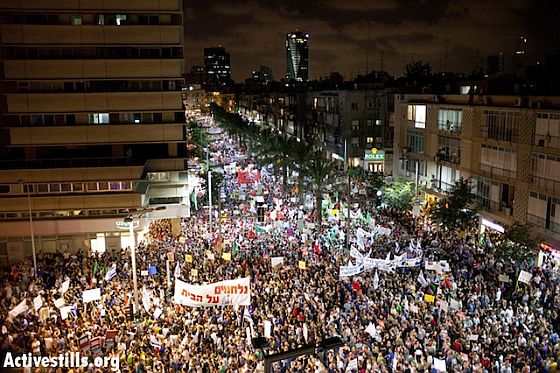
Around 300 thousands Israelis took the streets on Saturday night, calling for social justice and the introduction of a welfare state. Estimates are that this has been the largest demonstration in the country’s history.

The biggest of several rallies took place in Tel Aviv, where over 200,000 marched to the government building on Kaplan Street (Rabin Square, the usual site of such protests, is being renovated and was closed to the public). 30,000 marched in Jerusalem to PM Netanyahu’s house. Smaller rallies were held in Modi’in, Haifa, Nes Tziona and other towns. In Kiryat Shmone, protesters blocked the highway leading north.

Despite attempts by the organizers to convey a non-partisan message, many of the demonstrators directed their calls at Prime Minister Binyamin Netanyahu, and some held signs calling for his resignation. Former activist and Hadash MK called to the protesters: “With you, we will win over this pathetic government.” As was the case in previous rallies, the most popular call was “the people demand social justice,” followed by “Here comes the welfare state.”

Gideon Levy writes:

Tel Aviv was bursting at the seams last night. It was not the mother of all protests – it was the grandmother of all protests. The city looked yesterday like one of the stormiest cities on earth. Streams of people were flowing in every direction, some on foot, some in cars. Buses and trains spewed out the crowds, and not everyone even managed to get to the area of the protest. An amazingly large sign, in Hebrew and Arabic – the latter is about to cease being an official language in this country – read “Egypt is here.”

Indeed, the pictures last night looked like the nights of Tahrir Square. Now the comparison to the Cairo revolution is not exaggerated or wishful thinking. Now it really does resemble it, not including the violence, of course.

And really, when size talks, as it did last night, violence is not needed. A regime that remains impassive to such gigantic rallies would be completely insensitive, and in any case is destined to fall.

Prime Minister Benjamin Netanyahu can go on joking with his ministers; his fate is sealed. The cynics can continue tsk-tsking and talking about the “confused” and “spoiled” protest, and yet, a protest it is, the likes of which has never been seen here.

Facebooktwittermail

After historic downgrade, U.S. must address its chronic debt problems

A commentary in China’s official Xinhua News Agency says:

The days when the debt-ridden Uncle Sam could leisurely squander unlimited overseas borrowing appeared to be numbered as its triple A-credit rating was slashed by Standard & Poor’s (S&P) for the first time on Friday.

Though the U.S. Treasury promptly challenged the unprecedented downgrade, many outside the United States believe the credit rating cut is an overdue bill that America has to pay for its own debt addition and the short-sighted political wrangling in Washington.

Dagong Global, a fledgling Chinese rating agency, degraded the U.S. treasury bonds late last year, yet its move was met then with a sense of arrogance and cynicism from some Western commentators. Now S&P has proved what its Chinese counterpart has done is nothing but telling the global investors the ugly truth.

China, the largest creditor of the world’s sole superpower, has every right now to demand the United States to address its structural debt problems and ensure the safety of China’s dollar assets.

To cure its addiction to debts, the United States has to reestablish the common sense principle that one should live within its means.

Facebooktwittermail

‘Israel is inadvertently becoming a part of the Middle East’

Amira Hass reports:

Palestinian social leaders believe the social protests that have erupted throughout Israel are largely influenced by the Arab Spring, contending Israelis must realize they too are suffering due to the occupation and money spent on settlements in the West Bank.

Israelis are imitating the Arab world, and West Bank Palestinians believe this to be a good thing. According to the Ma’an news agency, 14,032 (nearly 75%) of the 18,722 readers who responded to their online survey, believe that what is happening in Israel’s streets is influenced by and imitating the “Arab Spring”.

“Israel is inadvertantly becoming a part of the Middle East,” said sociologist Honaida Ghanim, who researches Israeli society, adding that “this is the power of bottom-up activity, when the country’s ideologists aren’t consulted.”

Ghanim wasn’t surprised when the protests began. As an Israeli citizen, born in Marja and General Director of “MADAR” the Palestinian Forum for Israeli Studies, the sociologist is well acquainted with Israeli polarization. However, she is certain that the recent events in Egypt and Tunisia had a large impact on the Israeli protest movement.

Sufian Abu Zaida is a member of Fatah and former prisoner, who currently teaches about Israeli society in the Birzeit University and the Al-Quds Open University. He was born in Jabaliya, a refugee camp in the Gaza Strip, to a family of refugees from the town Burayr (today Bror Hayil).

The Palestinian teacher promises to remind his students next year that “this might be the first thing Israelis learnt from Arabs. They have always presented themselves as the only positive ray of light in a pitch black Middle East. Suddenly there is something to learn from these retards.”

Ghanim cited additional sociological factors as part of the impetus for change in Israel, saying “on the one hand, there is neo-liberalism and globalization that have resulted in an unacceptable gap between the wealth of the state and individuals and the harshness of life for the masses. On the other hand, these are similar tools – online social networks, with Facebook heading the list, which had a far-reaching effect on the media.”

Despite this, there isn’t much interest among the Palestinians in the protest occupying Israel for over three weeks. “We are a people in perpetual struggle with the government, three weeks of protest are not long enough to seriously catch our attention,” said Nariman al-Tamimi, from Nabi Salih, and Afaf Ghatasha, a feminist activist and member of the Palestinian People’s Party.

However, they are both impressed – as are other Palestinians –that the Israeli movement is geared toward improving the already high level standard of living in Israel in comparison to that of most Palestinians. Israelis are making “demands that are luxuries,” according to Ghatasha.

Facebooktwittermail

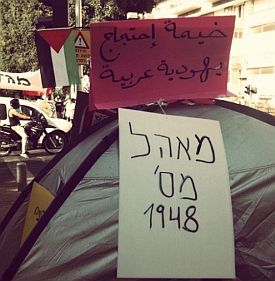
Tent 1948

Abir Kopty writes:

If you are Palestinian, it will be difficult to find anything to identify with in Tel Aviv’s tents’ city, until you reach Tent 1948. My first tour there was a few days ago, when I decided to join Tent 1948. Tent 1948’s main message is that social justice should be for all. It brings together Jewish and Palestinian citizens who believe in shared sovereignty in the state of all its citizens.

For me, as Palestinian, I don’t feel part of the July 14 movement, and I’m not there because I feel part, almost every corner of this encampment reminds me that this place does not want me. My first tour there was pretty depressing, I found lots of Israeli flags, a man giving a lecture to youth about his memories from ’48 war’ from a Zionist perspective, another group marching with signs calling for the release of Gilad Shalit, another singing Zionist songs. This is certainly not a place that the 20% of the population would feel belong to. The second day I found Ronen Shuval, from Im Tirtzu, the extreme right wing organization giving a talk full of incitement and hatred to the left and human rights organizations. Settlers already set a tent and were dancing with joy.

The existence of Tent 1948 in the encampment constitutes a challenge to people taking part in the July 14 movement. In the first few days, the tent was attacked by group of rightwing activists, who beat activists in the tent and broke down the Palestinian flag of the tent. Some of the leaders of the July 14 movement have said clearly that raising core issues related to Palestinian community in Israel or the occupation will make the struggle “lose momentum”. They often said the struggle is social, not political, as if there was a difference. They are afraid of losing supporters if they make Palestinian issues bold.

The truth is that this is the truth.

The truth is, this is exactly what might help Netanyahu, if he presses the button of fear, recreates the ‘enemy’ and reproduce the ‘security threat’, he might be able to silence this movement. The problem is not with Netanyahu, he is not the first Israeli leader to rely on this. The main problem is that Israelis are not ready yet to see beyond the walls surrounding them.

Facebooktwittermail

Worst US loss of life in Afghan war as helicopter crash kills 38

The Guardian reports:

The US suffered its worst single loss of life in the nearly 10-year Afghan war when a helicopter carrying 31 special forces soldiers crashed on Friday night in the east of the country.

Both the Taliban, via a spokesman reached by telephone, and Afghan officials in Wardak province, to the west of Kabul, said insurgents had shot down the Chinook helicoter with a rocket.

Nato would only confirm that “there was enemy activity in the area” and that the US-led alliance was still trying to work out what had happened. US air force captain Justin Brockhoff, a Nato spokesman, said: “We are in the process of accessing the facts.”

A western official said 37 people were on board, all of whom were killed. The Afghan president, Hamid Karzai, said the helicopter was carrying 31 US special forces and seven members of the Afghan national army.

It is very unusual for Nato deaths from a single incident to reach double figures. The previous most deadly day for foreign troops was in June 2005 when 16 US soldiers were killed when a Taliban rocket hit a Chinook in the eastern province of Kunar.

The crash happened at 3am when the helicopter was hovering over the town of Tangi Joi Zareen, in the district of Saidabad, according to a spokesman for the provincial governor.

A Taliban spokesman, Zabiullah Mujahid, said Nato attacked a house in the district where insurgent fighters were gathering. He said eight insurgents died in the fighting.

Special forces from many nations, including the UK, conduct up to half a dozen such operations every night, usually targeting mid-level insurgent commanders whose whereabouts are pinpointed by high-tech intelligence gathering teams.

The downing of a helicopter, quite apart from the massive loss of life, will alarm war planners who rely heavily on Nato’s air superiority in the fight against the Taliban. They will want to discover whether the aircraft was downed by a lucky shot from a rocket-propelled grenade, a highly inaccurate weapon, or by something more sophisticated.

Facebooktwittermail

Broadcasting Hama ruins, Syria says it has ended revolt

The New York Times reports:

Syria’s state news media broadcast stark images of the destruction in the besieged city of Hama for the first time on Friday, showing burned buildings, makeshift barricades and deserted streets strewn with rubble in footage that appeared designed to show that government forces had put down a rebellion in the city.

The images were unmistakably Hama, Syria’s fourth-largest city and a focal point of the five-month-old uprising that has left President Bashar al-Assad’s leadership isolated and weakened. They suggested the military had retaken control of a city that had briefly wrested itself from four decades of authoritarian rule by the Assad family and enjoyed an unprecedented measure of freedom.

The reports by Syrian television and Sana, the official news agency, portrayed the army as Hama’s savior. The news appeared aimed at reinforcing the leadership’s message to internal opponents that they are regarded as armed insurrectionist gangs inspired by hostile foreign powers and will be dealt with accordingly. But the television footage of the wreckage in Hama also implicitly acknowledged that the violence there had been far more serious than Mr. Assad’s government had until now been willing to publicly admit.

It also underlined a legacy of the assault: Hama was remarkably peaceful after security forces withdrew in June. Violence erupted only when the government, fearing the momentum the city might provide the uprising, began its ferocious assault on Sunday. Although government officials insist the protesters were armed, not a single weapon was seen in the streets on a recent visit, an account confirmed by diplomats in their trips there. Barricades were set up, but only to block the return of the military and security forces.

“Today we are alive, but tomorrow we don’t know,” said a resident reached by telephone who gave his name as Fadi. “The humanitarian situation is getting worse day by day.”

Government officials offered an altogether different version of events, in reports from Damascus, the capital, that appeared more and more to defy reality.

Facebooktwittermail

Breivik’s guru comes out of hiding, briefly

Peder Jensen, the 36-year-old Norwegian blogger, who until now has only been publicly known as “Fjordman“, was cited in terrorist Anders Behring Breivik’s manifesto 111 times. The blogger has just given his first and only interview with the Norwegian tabloid, VG, after having been questioned for hours by Norwegian police. He says he is now going into hiding for his own safety.

I have not read the manifesto, but I have seen bits and pieces referred in the media, and some parts have been shown to me by others, he says.

During the period between 2009 and 2010 he received a handful of emails from Breivik, where he told Jensen that he was working on a book. In one email written towards the end of 2009, he also asked if he could meet his political idol «Fjordman». Jensen refused.

I don’t know why he wanted to meet me, but I declined. Not because of his extreme views, but because he didn’t seem very interesting – like a vacuum cleaner salesman. «Pie in the sky», I thought to myself when I re-read the emails, says Jensen, again stressing that he never met Breivik personally.

Police sources confirm that Jensen has been questioned as the blogger «Fjordman», and that they are certain of his identity.

– I feel it’s my duty to give a statement to the police, and I wanted to do this interview because my name eventually would have emerged anyway, resulting in a media frenzy. It is also a way for me to clear my name, says Jensen.

Norwegian police confiscated his computer Thursday, and even though he was questioned as a witness, he feels that the police are looking to implicate him.

Maybe one of things the police will be looking for on Jensen’s computer is a copy of Breivik’s manifesto.

I realize this guy must be feeling extremely paranoid right now but the idea that he would be told that he was a guiding light for Breivik and that he had been cited that number of times, and yet to decide not to read the manifesto — that seems hard to fathom.

Having questioned Jensen, I wonder whether Norwegian investigators have also expressed any interest in talking to Jensen’s ideological counterparts in the US, Pamela Geller and Robert Spencer, and if so, would these “counter-jihadists” agree to help the inquiry?

Facebooktwittermail

Israel’s “July 14” movement

Zeev Sternhell writes:

In these times of hope and anticipation, it is difficult not to wonder what form the protest might have taken, and what results it might already have achieved, if there had been a large and authentic social-democratic party here with a labor union worthy of the name, at its side. Indeed a spontaneous uprising that does not find political expression very soon, and does not threaten those who are in power, will of necessity have very limited achievements.

Even Prime Minister Benjamin Netanyahu understands that when there is no opposition with an ideology of structural social change, and which is capable of garnering electoral support for a comprehensive national economic program, the danger facing him and his party is negligible. The truth is that the protesters themselves have already presented him with a way out. His representatives will anoint the protest leaders with pure oil, will set up teams and present ideas, will throw them a few bones and then will move to the area where there is no greater expert than Netanyahu: drawing out time and making promises that no one intends to keep.

The real problem, however, is not the government but rather the political elite. Except for a small number of politicians on the center-left, like Knesset member Shelly Yachimovich (Labor ), most of the political leadership is partner to the blind belief in the unique qualities of a free market. There were indeed people outside the political arena who for decades contended that a free market creates no less poverty and misery than wealth and welfare; there were those who believed that poverty is not some kind of natural phenomenon but rather something created by man. But all of them were considered “populist.” There were people who saw in the state a tool for correcting distortions and supplying cheap and good-quality services to the entire population, but they were denounced as wanting to return to the 1950s.

Therefore the young demonstrators would do well to remember May 1968 in Europe. Beyond the obvious differences, there is a common denominator: a protest that does not find immediate political expression is destined to disintegrate.

Uri Avnery writes:

It all started in a remote little town in Tunisia, when an unlicensed market vendor was arrested by a policewoman. It seems that in the ensuing altercation, the woman struck the man in the face, a terrible humiliation for a Tunisian man. He set himself on fire. What followed is history: the revolution in Tunisia, regime change in Egypt, uprisings all over the Middle East.

The Israeli government saw all this with growing concern – but they didn’t imagine that there might be an effect in Israel itself. Israeli society, with its ingrained contempt for Arabs, could hardly be expected to follow suit.

But follow suit it did. People in the street spoke with growing admiration of the Arab revolt. It showed that people acting together could dare to confront leaders far more fearsome than our bumbling Binyamin Netanyahu.

Some of the most popular posters on the tents were “Rothschild corner Tahrir” and, in a Hebrew rhyme, “Tahrir – Not only in Cahir” – Cahir being the Hebrew version of al-Cahira, the Arabic name for Cairo. And also: “Mubarak, Assad, Netanyahu”.

In Tahrir Square, the central slogan was “The People Want to Overthrow the Regime”. In conscious emulation, the central slogan of the tent cities is “The People Want Social Justice”.

Who are these people? What exactly do they want?

It started with a demand for “Affordable Housing”. Rents in Tel Aviv, Jerusalem and elsewhere are extremely high, after years of Government neglect. But the protest soon engulfed other subjects: the high price of foodstuffs and gasoline, the low wages . The ridiculously low salaries of physicians and teachers, the deterioration of the education and health services. There is a general feeling that 18 tycoons control everything, including the politicians. (Politicians who dared to show up in the tent cities were chased away.) They could have quoted an American saying: “Democracy must be something more than two wolves and a sheep voting on what to have for dinner.”

A selection of the slogans gives an impression: We want a welfare state! Fighting for the home! Justice, not charity! If the government is against the people, the people are against the government! Bibi, this is not the US Congress, you will not buy us with empty words! If you don’t join our war, we shall not fight your wars! Give us our state back! Three partners with three salaries cannot pay for three rooms! The answer to privatization: revolution! We were slaves to Pharaoh in Egypt, we are slaves to Bibi in Israel! I have no other homeland! Bibi, go home, we’ll pay for the gas! Overthrow swinish capitalism! Be practical, demand the impossible!

What is missing in this array of slogans? Of course: the occupation, the settlements, the huge expenditure on the military.

This is by design. The organizers, anonymous young men and women – mainly women – are very determined not to be branded as “leftists”. They know that bringing up the occupation would provide Netanyahu with an easy weapon, split the tent-dwellers and derail the protests.

We in the peace movement know and respect this. All of us are exercising strenuous self-restraint, so that Netanyahu will not succeed in marginalizing the movement and depicting it as a plot to overthrow the right-wing government.

Meanwhile, the Los Angeles Times reports:

Israel’s Interior Ministry gave the final green light Thursday to the construction of more than 900 new homes in a Jewish development built on land seized during the 1967 Mideast war.

Palestinians and anti-settlement groups said the Har Homa expansion, which has been working its way through Israeli regulatory agencies since last year, will occupy one of the last remaining undeveloped hillsides in the area and effectively cut off direct access between Palestinian neighborhoods in East Jerusalem and Bethlehem.

Palestinians hope to one day include both areas in a contiguous, independent state.

“This is very alarming because it will create a very big obstacle to the two-state solution,” said Hagit Ofran of Peace Now, an Israeli group that tracks settlements.

She said the project, one of the largest planned in East Jerusalem in recent years, appears to have been fast-tracked, based on the speed of the approval process. Nevertheless, she said construction would not likely break ground for three more years.

Facebooktwittermail

Once untouchable, the old despot and his sons faced the wrath of the nation they had terrorised

Robert Fisk writes:

Just when the Arab dictators desperately need to drink the secure, cool waters of an Arab summer, along came the Egyptians yesterday to poison the well. Deep into its depths, those dictators could see a flickering enmeshed face, fragile, fingers playing over its nose and mouth, the arm of a man on a stretcher raised to prevent the light getting too close but – for just a few brief moments – with the same old arrogant eyes. Then the heavy black mike appeared in the man’s left hand. “I am here, your honour,” said a chillingly strong voice. “I have not committed any such crimes.”

Yes, the Egyptians really did put their wretched, ancient dictator on trial yesterday, along with his effete, sullen sons – both dressed in white as if heading for yet another summer tennis party, an illusion broken only by the green Koran under Alaa Mubarak’s arm. An encouragement to his dessicated, 83-year-old father, Hosni? Or an insult to the dead?

The lawyers screamed their clients’ pain; of torture, of snipers, of the murder of Egypt’s own people in the January-February uprising, of the brutality of the security forces, of corruption on a Mafia scale. And to whom else did these terrible charges apply? We thought about Damascus, of course. And Tripoli. And the Bahraini capital of Manama. And of Rabat and Amman and Algiers and Riyadh…

And across the vast, arid wastelands of the Arab despots, the government televisions continued to show game shows and cooking classes and domestic dramas and friendly crowds, all of whom loved their presidents and kings and potentates, who could never – could they? – be accused of these awful crimes. Outside Egypt itself, the only live coverage of the trial was broadcast by post-revolutionary Tunisia and that nemesis of the Mubarak regime and of the United States and of Israel: the Hezbollah’s Al-Manar television.

“Are you Mohamed Hosni Sayed Mubarak?” asked Judge Ahmed Refaat. Or Bachar al-Assad? Or Muammar Gaddafi? Or His Majesty King Hamad? Or even His Highness King Abdullah, Guardian of the Three Holy Places in a place called Saudi Arabia?

Facebooktwittermail

Inside Egypt’s Salafis

Lauren Bohn writes:

“All Americans think I’m a terrorist,” 34-year-old Salafi political organizer Mohammed Tolba exhales with his trademark belly laugh. He grips his gearshift and accelerates to 115 miles per hour down a winding overpass in Cairo. “But I only terrorize the highways.” Since the fall of Egyptian president Hosni Mubarak, Tolba has constantly been on the go. “The media says we all wear galabeyas (long Islamic dress), put our women in niqabs (a face veil), and will cut off people’s hands,” Tolba says, dramatically feigning a yawn. “We’re the new boogey-man, but people need to know we’re normal — that we drink lattes and laugh.”

To this end, the silver-tongued IT consultant shuttles regularly from the modish offices of popular television personality Bassem Youssef (he’s starring in a segment on the “Egyptian Jon Stewart’s” highly anticipated new show) to the considerably less shiny quarters of Cairo’s foremost Salafist centers. He’s been conducting leadership and media-training workshops for Salafis. “These guys don’t know how to talk to the public,” says Tolba, rubbing his eyes in exhaustion. “Once they open their mouths and face a camera, man, they ruin everything.”

The same might be said for their debut on Egypt’s main stage last Friday, as hundreds of thousands of Salafis joined other Islamist groups in Cairo’s Tahrir Square. Droves of people from governorates across Egypt got off buses near Tahrir Square, chanting “Islamic, Islamic, we don’t want secular.” One Salafi, Hisham al-Ashry, beamed with pride as he walked back from the square to his tailor shop downtown. “Today is a turning point, we finally showed our strength.” Meanwhile, “the liberals and the leftists are freaking out. God protect the nation and revolution,” noted popular blogger Zeinobia.

Who are the faces and voices of an oft-deemed bearded and veiled monolith that packed the square? And what exactly do they want?

“Salafi” has become something of a catchall name for any Muslim with a long beard, but Salafism is not a singular ideology or movement with one leader. As Stéphane Lacroix, a French scholar of Islamist movements, explains, it’s more a “label for a way of thinking” guided by a strict interpretation of religious text. Salafis aspire to emulate the ways of the first three generations of Islam. Many Salafis have cultivated a distinctive appearance and code of personal behavior, including untrimmed beards for men and the niqab for women.

The Salafi culture has been growing in Egypt for decades, but until the revolution had little formal political presence. “Satellite salafism” hit Egypt in 2003, with around 10 Salafi-themed TV channels broadcasting from Egypt on Nilesat. The intensely popular Al-Nas, Arabic for the People, began broadcasting in 2006. Its programming focuses on issues of social justice and sermons by prominent Salafi preachers, like Mohammed Yaqoub and Mohammed Hassan, whose tapes and books are common fixtures among street vendors throughout Cairo. Nobody knows exactly how many Salafis there now are in Egypt, but Abdel Moneim Abouel Fotouh, a presidential candidate formerly of the Muslim Brotherhood, recently estimated their number at around 20 times the number of Muslim Brotherhood members (unofficial reports estimate Muslim Brotherhood membership between 400,000 to 700,000 members).

Facebooktwittermail

Somalia famine’s devastation

The Associated Press reports:

Kaltum Mohamed sits beside a small mound of earth, alone with her thoughts. It is her child’s grave—and there are three others like it.

Just three weeks ago, Mohamed was the mother of five young children. But the famine that has rocked Somalia has claimed the lives of four of them. Only a daughter remains. The others starved to death before Mohamed’s eyes as she and her husband trekked to Somalia’s capital, Mogadishu, in search of aid.

Thousands of parents are grieving in Somalia and in refugee camps in neighboring countries amid Somalia’s worst drought in 60 years.

The drought and famine in Somalia have killed more than 29,000 children under the age of 5 in the last 90 days in southern Somalia alone, according to U.S. estimates. The U.N. says 640,000 Somali children are acutely malnourished, suggesting the death toll of small children will rise.

Facebooktwittermail

The U.S. defense establishment is the world’s largest socialist economy

Fareed Zacharia writes:

The Pentagon’s budget has risen for 13 years, which is unprecedented. Between 2001 and 2009, overall spending on defense rose from $412 billion to $699 billion, a 70 percent increase, which is larger than in any comparable period since the Korean War. Including the supplementary spending on Iraq and Afghanistan, we spent $250 billion more than average U.S. defense expenditures during the Cold War — a time when the Soviet, Chinese and Eastern European militaries were arrayed against the United States and its allies. Over the past decade, when we had no serious national adversaries, U.S. defense spending has gone from about a third of total worldwide defense spending to 50 percent. In other words, we spend more on defense than the planet’s remaining countries put together.

It is not unprecedented for defense spending to fall substantially as we scale back or end military actions. After the Korean War, President Dwight Eisenhower cut defense spending 27 percent. Richard Nixon cut it 29 percent after Vietnam. As tensions declined in the 1980s, Ronald Reagan began scaling back his military spending, a process accelerated under Presidents George H.W. Bush and Bill Clinton. Given the enormous run-up in spending under George W. Bush, even if President Obama made comparable cuts to that of those presidents today, defense spending would remain substantially above the levels under all those presidents. The Bowles-Simpson commission’s plan proposed $750 billion in defense cuts over 10 years. Lawrence Korb, who worked at the Pentagon for Ronald Reagan, believes that a $1 trillion cut over 10 to 12 years is feasible without compromising national security.

Serious conservatives should examine the defense budget, which contains tons of evidence of liberalism run amok that they usually decry. Most talk of waste, fraud and abuse in government is vastly exaggerated; there simply isn’t enough money in discretionary spending. Most of the federal government’s spending is transfer payments and tax expenditures, which are — whatever their merits — highly efficient at funneling money to their beneficiaries. The exception is defense, a cradle-to-grave system of housing, subsidies, cost-plus procurement, early retirement and lifetime pension and health-care guarantees. There is so much overlap among the military services, so much duplication and so much waste that no one bothers to defend it anymore. Today, the U.S. defense establishment is the world’s largest socialist economy.

Facebooktwittermail

Proposed Israeli law would formalize second-class status for Arab citizens

A new bill presented in Israel’s Knesset aims to have the “Jewish nature” of the state preferred over democracy, to end Arabic’s status as one of Israel’s official languages, and to have Jewish law “guide” courts’ rulings. Noam Sheizaf reports:

There is one talking point repeated in every hasbara (the Hebrew term for state sponsored propaganda) talk given by an Israeli representative, or in every booklet your campus’ Jewish Agency representative might hand you. It has to do with “the full rights” of Palestinian citizens in Israel, including the status of Arabic as an official language, and the equality of all Israeli citizens under the law. This is the heart of “the only democracy in the Middle East” claim.

Those who are familiar with Israeli society, know that Arab citizens are discriminated against in many ways: Some of these ways are formal—like the new bill allowing segregated communities; the law against family unification of Arab citizens; the absentees’ property laws, and more—while other are a matter of practice, such as the fact that some government agencies won”t hire Arabs, or the that the courts mete out harsher sentences to Arab citizens convicted of the same crimes as Jewish citizens.

Yet a new bill, signed by members of opposition and coalition alike, aims to strip Israel even of the appearance of democracy. If passed (it has a fair chance), this law will determine that in any case of contradiction between democratic values and the Jewish nature of the state, the Jewish element will prevail. More specifically, the bill aims to cancel the status of Arabic as one of Israel’s two official languages; it orders the state to develop communities for Jews only; and in a passage that seems to be taken from the Iranian constitution, declares that when there is no law referring to a certain case, courts should rule in the spirit of halakha, or Jewish religious jurisprudence.

Facebooktwittermail