Author Archives: News Sources

Obama’s Iran choice

M.J. Rosenberg writes: An article in Tuesday’s New York Times suggests that there is a method to the madness of the Republican presidential candidates’ hawkish rhetoric on Iran. I had thought that the reason all the Republican candidates (with the exception of Ron Paul) are such noisy warmongers is because that is their natural proclivity – and because it pleases donors (such as Sheldon Adelson, Newt Gingrich’s big campaign funder) who base their political choices on Binyamin Netanyahu’s desires.

But Times reporter Mark Landler suggests that one of the results of this year’s conveniently timed Iran crisis is to present President Barack Obama with a choice of two options, either of which the GOP could successfully exploit to defeat him in the election.

As Landler points out:

In late June, when the campaign is in full swing, Mr Obama will have to decide whether to take action against countries, including some staunch allies, if they continue to buy Iranian oil through its central bank.

After fierce lobbying by the White House, which opposed this hardening in the sanctions that have been its main tool in pressuring Tehran, Congress agreed to modify the legislation to give Mr Obama leeway to delay action if he concludes the clampdown would disrupt the oil market. He may also invoke a waiver to exempt any country from sanctions based on national security considerations.

Under normal circumstances, a president’s decision to invoke a national security waiver on any foreign policy matter is hard to challenge. In this case, the president’s concern that imposing new sanctions would cause oil prices to soar (and disrupt economic recovery) would be good reason to pass on the latest congressional sanctions law.

But the political consequences of waiving could be dire.

Remember, the sanctions law in question is a creation of AIPAC and has been at the top of its agenda during this entire Congress. If Obama waives it, Netanyahu would use the media to make sure that his displeasure was known. The lobby, the Republican presidential candidate and even many of AIPAC’s Democratic cutouts on Capitol Hill would all scream bloody murder. [Continue reading…]


Facebooktwittermail

Israel’s routine abuse of Palestinian children

The Guardian reports: The room is barely wider than the thin, dirty mattress that covers the floor. Behind a low concrete wall is a squat toilet, the stench from which has no escape in the windowless room. The rough concrete walls deter idle leaning; the constant overhead light inhibits sleep. The delivery of food through a low slit in the door is the only way of marking time, dividing day from night.

This is Cell 36, deep within Al Jalame prison in northern Israel. It is one of a handful of cells where Palestinian children are locked in solitary confinement for days or even weeks. One 16-year-old claimed that he had been kept in Cell 36 for 65 days.

The only escape is to the interrogation room where children are shackled, by hands and feet, to a chair while being questioned, sometimes for hours.

Most are accused of throwing stones at soldiers or settlers; some, of flinging molotov cocktails; a few, of more serious offences such as links to militant organisations or using weapons. They are also pumped for information about the activities and sympathies of their classmates, relatives and neighbours.

At the beginning, nearly all deny the accusations. Most say they are threatened; some report physical violence. Verbal abuse – “You’re a dog, a son of a whore” – is common. Many are exhausted from sleep deprivation. Day after day they are fettered to the chair, then returned to solitary confinement. In the end, many sign confessions that they later say were coerced.

These claims and descriptions come from affidavits given by minors to an international human rights organisation and from interviews conducted by the Guardian. Other cells in Al Jalame and Petah Tikva prisons are also used for solitary confinement, but Cell 36 is the one cited most often in these testimonies.

Between 500 and 700 Palestinian children are arrested by Israeli soldiers each year, mostly accused of throwing stones. Since 2008, Defence for Children International (DCI) has collected sworn testimonies from 426 minors detained in Israel’s military justice system.

Their statements show a pattern of night-time arrests, hands bound with plastic ties, blindfolding, physical and verbal abuse, and threats. About 9% of all those giving affidavits say they were kept in solitary confinement, although there has been a marked increase to 22% in the past six months.

Few parents are told where their children have been taken. Minors are rarely questioned in the presence of a parent, and rarely see a lawyer before or during initial interrogation. Most are detained inside Israel, making family visits very difficult.

Human rights organisations say these patterns of treatment – which are corroborated by a separate study, No Minor Matter, conducted by an Israeli group, B’Tselem – violate the international convention on the rights of the child, which Israel has ratified, and the fourth Geneva convention.

Facebooktwittermail

In his victory speech, Newt doubles down on racism, hints at anti-Semitism

Matthew Rothschild writes: Newt Gingrich must know he’s on to something. After being criticized as racist for calling Barack Obama the “food stamp President,” Gingrich kept on calling him that Saturday night after winning the South Carolina primary.

Gingrich said that though some of the elite media don’t like to hear it, “President Obama is the most effective food stamp President in American history.”

And he repeated the “food stamp” term two more times, including when he said: “If you want your children to have a life of dependency and food stamps, you have a candidate. It’s Barack Obama.”

Gingrich understands that this coded language helped him enormously in South Carolina, so he’s not discarding it. He’s doubling down on it.

And he’s throwing in hints of anti-Semitism along the way.

“The centerpiece of this campaign is American exceptionalism versus the radicalism of Saul Alinsky,” he said. And he repeated Saul Alinsky’s name two more times.

Now, not many people listening to that speech knew who Saul Alinsky was. (He was a community organizer who wrote several books, including Rules for Radicals.) But what they could easily figure out was that he’s some Jewish guy, someone not “American” like they are.

Facebooktwittermail

Do drones undermine democracy?

Peter W Singer writes: In democracies like ours, there have always been deep bonds between the public and its wars. Citizens have historically participated in decisions to take military action, through their elected representatives, helping to ensure broad support for wars and a willingness to share the costs, both human and economic, of enduring them.

In America, our Constitution explicitly divided the president’s role as commander in chief in war from Congress’s role in declaring war. Yet these links and this division of labor are now under siege as a result of a technology that our founding fathers never could have imagined.

Just 10 years ago, the idea of using armed robots in war was the stuff of Hollywood fantasy. Today, the United States military has more than 7,000 unmanned aerial systems, popularly called drones. There are 12,000 more on the ground. Last year, they carried out hundreds of strikes — both covert and overt — in six countries, transforming the way our democracy deliberates and engages in what we used to think of as war.

We don’t have a draft anymore; less than 0.5 percent of Americans over 18 serve in the active-duty military. We do not declare war anymore; the last time Congress actually did so was in 1942 — against Bulgaria, Hungary and Romania. We don’t buy war bonds or pay war taxes anymore. During World War II, 85 million Americans purchased war bonds that brought the government $185 billion; in the last decade, we bought none and instead gave the richest 5 percent of Americans a tax break.

And now we possess a technology that removes the last political barriers to war. The strongest appeal of unmanned systems is that we don’t have to send someone’s son or daughter into harm’s way. But when politicians can avoid the political consequences of the condolence letter — and the impact that military casualties have on voters and on the news media — they no longer treat the previously weighty matters of war and peace the same way.

Facebooktwittermail

A new generation of political Islamists steps forward

Olivier Roy writes: Everywhere, the Muslim Brotherhood is benefiting from a democratization it did not trigger. There is a political vacuum because the liberal vanguard that initiated the Arab Spring did not try, and did not want, to take power. This was a revolution without revolutionaries. Yet the Muslim Brothers are the only organized political force. They are rooted in society, and decades of opposition against authoritarian regimes gave them experience, legitimacy and respect. Their conservative agenda fits a conservative society, which may welcome democracy but did not turn liberal.

Under these circumstances, the ghost of a totalitarian Islamic state is raised, with the specter of imposing sharia and closing the short democratic parenthesis. But such an outcome is unlikely.

The Islamists have, in fact, changed: They are more middle-class “bourgeois,” and they benefited from the liberalization of local economies during the last decades of the 20th century, especially in countries with no oil rent. The Islamists have also drawn lessons from the failure of ideological regimes and from the success of Turkey’s AKP party. They are no longer advocating jihad and understand geostrategic constraints, such as the need to maintain peace, even a cold one, with Israel. Realism is the starting point of political wisdom.

The Islamists have been elected with a clear agenda: stability, good governance and a better economy. If they have been able to reach a larger constituency than the hard-core supporters of sharia, it is precisely because they can combine such a reformist agenda while talking about religion, values, identity and tradition. The Nahda party won the majority of the votes cast at the Tunisian consulate of San Francisco, although Tunisian expatriates in Silicon Valley are not known for their Islamic fundamentalism.

This mix of technocratic modernism and conservative values is their brand, and to turn their back on multipartism and legalism would alienate a large portion of their constituency, at a time when they have no means to confiscate power. They have neither military forces nor oil wealth to bypass the people: They have to negotiate and deliver. Their electorate wants stability and peace, not revolution.

They are stepping into a new political landscape: a democracy, although a fledgling and fragile one. The only way to maintain their legitimacy is through elections. Even if their pristine political culture is not democratic, they are formatted by the democratic landscape, much as the Roman Catholic Church ended up accepting democratic institutions. But it will take time.

Facebooktwittermail

Muslim Brotherhood win just short of a majority in Egyptian parliamentary election

McClatchy reports: Islamists won a combined 70 percent of parliamentary seats in the first election after Egypt’s revolution, according to official results Saturday that cemented the victory of rival religious parties belonging to the Muslim Brotherhood and the more fundamentalist Salafists.

More than 10 million Egyptians cast votes for the Brotherhood’s Freedom and Justice Party, handing it 47 percent of the parliament. But the lack of an outright majority means the FJP must build alliances, most likely with established liberal parties, to keep the focus on issues such as economic initiatives and the transfer of power from Egypt’s interim military rulers.

The goal, politicians involved in negotiations said, would be to isolate the upstart Salafist Nour Party, which won a surprising 25 percent of seats. It advocates the immediate application of strict Islamic law. The Salafists’ literal interpretation of Islam is anathema to the Brotherhood and liberal parties alike, not to mention alarming to Egypt’s Western allies and foreign investors.

“The fears and concerns over Islamists are legitimate, not only because they are Islamists, but more importantly because we have not tried them before,” said Khalil al Anani, a United Kingdom-based scholar of Islamist movements. “However, overestimating these fears can blow the whole transition process.”

Liberal Egyptians said fear naturally accompanies the rise of the Salafists, a group whose clerics have espoused bans on alcohol and bikinis, and tacitly support self-appointed morality squads that harass unveiled women or unmarried couples. The Nour Party has hedged its stand toward such puritanical stances, but makes no secret of its goal for the application of Sharia law.

A group of Egyptian artists – including some of the country’s top painters, novelists and playwrights – are unconvinced that the Brotherhood can rein in the Salafists, so they’ve formed a coalition to defend intellectuals from what they fear will be inevitable attacks on freedom of expression.

Facebooktwittermail

Hamas political chief to step down

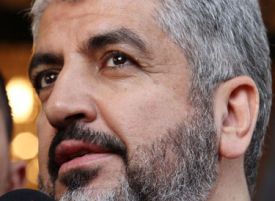
The Guardian reports: Khaled Meshaal, the political head of Hamas, is to step down from his position when elections for the leadership of the Palestinian Islamist organisation take place in the next few months.

A statement from Meshaal’s office said the Damascus-based leader would not seek re-nomination after 16 years at the helm, but would continue to serve the movement. It followed reports of the move earlier this week.

Meshaal has indicated in recent weeks that Hamas should make a strategic departure from armed struggle to popular non-violent resistance in the wake of the Arab spring revolutions and the success of Islamist parties in elections.

The new approach caused a rift with the internal Gaza leadership, which said there would be no change in Hamas policy. “There has been no change concerning our mode of thinking towards the conflict,” Mahmoud Zahar, the most senior Hamas figure inside Gaza, told the Guardian in an interview this month.

Meshaal’s decision to step down may indicate that the Hamas leadership within Gaza has won a power struggle.

Meshaal had also been pushing for Palestinian reconciliation and the formation of a national unity government ahead of elections. However, he was reported to be frustrated with the slow and uncertain progress, and few observers believe elections will take place this year.

The Hamas leader was also looking for a new base for the organisation amid the ongoing revolt in Syria. Hamas had refused to back the regime of the Syrian president, Bashar al-Assad, infuriating the Iranian government, which had sponsored both it and the Syrian leadership.

Facebooktwittermail

The uphill battle against Citizens United

Steven Rosenfeld writes: The movement to overturn the Supreme Court’s controversial Citizens United ruling and confront the doctrine of corporate personhood stands at a perilous crossroads.

Across the country, two distinct strategies are converging on Congress. More than a million people have signed online petitions. State legislators, city and township governments, Democratic Party groups and unions have sponsored and passed measures in 23 states demanding that Congress pass a constitutional amendment to reassert and elevate the political speech of ordinary citizens and roll back the growing political speech and legal privileges of corporations.

The two approaches can be seen in the protest signs and sound bites proclaiming, “Money is Not Speech” and “Overturn Corporate Personhood.” But these slogans are not calling for the same remedy, especially when transformed into legal language in 10 proposals that have been introduced in the current Congress.

The first would address campaign finance setbacks in a 35-year line of Supreme Court rulings, including the Citizens United ruling in 2010, which deregulated campaign spending by corporations and unions. The second would go further and seek to revoke the status of corporations as persons under the Constitution, rolling back more than a century of Supreme Court rulings under various amendments — not just those concerning political speech.

These two approaches expose an emerging split among progressives with deeper problems that go beyond the steep if not improbable political climb required to adopt any constitutional amendment: passage by two-thirds of Congress followed by ratification by three-quarters of state legislatures.

With a few exceptions, the growing movement to overturn Citizens United and revoke corporate personhood is not being taken seriously beyond America’s liberal communities. The guardians of American capitalism — the U.S. Chamber of Commerce and Republican National Committee — do not even feel a need to attack it, unlike recent barbs aimed at the National Popular Vote campaign to reform the Electoral College.

Corporate America’s assessment that this activity is not yet a serious threat to their power is also shared by another key sector of the progressive spectrum. Many of the country’s top liberal constitutional scholars have been silent, as this bandwagon has gathered momentum. They sympathize with its goals but think its champions are not only overpromising to grassroots supporters but have not thought out what they want Congress to do. Nor do they think the frontline voices have done a good job explaining what is at stake beyond hurling bumpersticker slogans. In other words, they reach the same conclusion as America’s corporate titans: this clamor is not yet poised to upend the law behind America’s political system. [Continue reading…]

Facebooktwittermail

Protesters storm grounds of Libya’s interim government’s headquarters in Benghazi

The Associated Press reports: Hundreds of angry Libyans on Saturday stormed the transitional government’s headquarters in the eastern city of Benghazi, carting off computers, chairs, and desks while the country’s interim leader was still holed up in the building.

Libyans have grown increasingly frustrated with the pace and direction of reforms in the country more than three months after the end of the civil war that ousted longtime dictator Moammar Gadhafi. Those concerns spurred residents in Benghazi, where the uprising against longtime leader Moammar Gadhafi broke out in February, to begin protests nearly two weeks ago to demand transparency and justice from the country’s new leaders.

The melee at the National Transitional Council’s headquarters began after protesters broke through the gates using hand grenades and streamed into the grounds of the headquarters. They banged on the building’s doors and demanded officials meet with them.

In a bid to calm tensions, NTC chief Mustafa Abdul-Jalil tried to address the crowd from a second-floor window, but protesters began throwing bottles at him.

Protesters then torched Abdul-Jalil’s armored Land Cruiser and broke into the headquarters itself, smashing windows to get inside and cart off furniture and electronics.

A security official in the building said a team of some 50 guards dressed as civilians were trying to calm the protesters.

The official, who served as a revolutionary commander during the civil war, said Abdul-Jalil was still in the building and was refusing to leave. He spoke on condition of anonymity because of the sensitivity of the subject.

Some of the protesters pitched tents weeks ago outside the NTC’s headquarters to protest a set of election laws they say were drafted by the interim leaders without consulting the public.

Facebooktwittermail

Iraq: Under worse management

Bloomberg Businessweek reports: Seif Abdel Sadeh’s eyes lolled as his brother tipped a cup of orange juice to his swollen lips. As he lifted his arm to push his brother’s hand away, he grimaced, agitating the charred skin on his face, causing still more pain. The day before, Seif, 18, was walking to his Sadr City high school when a bomb strapped to a motorcycle exploded. It shattered his left leg and sent so much shrapnel into his right leg that it had to be removed. The bomb that hit Seif that morning, and another that went off minutes later, killed a dozen Iraqis, mostly day laborers waiting to pick up work at a busy intersection on the road that connects Sadr City, a suburb of Baghdad, to the downtown expressway.

Seif’s family huddled around his hospital bed. “We lived in fear of this happening to one of our kids,” Seif’s father, Abdel Sadeh, said, fingering a set of worry beads. His eyes welled up. “Who benefits from attacking innocent people?” He saw the blasts as bad omens: “These attacks are proof that the political parties are going to start tearing this country apart now.”

By some statistical measures, Iraq today is safer and more stable than it has been in nearly a decade. In 2011, fewer than 1,500 Iraqi civilians were killed by bombs, sniper ambushes, and other “enemy attacks,” according to the Brookings Institute Iraq index, the lowest figure since the fall of Saddam Hussein. Business owners say they’re freer than ever to travel, borrow from international creditors, and transfer money abroad. A visitor to Baghdad can take heart in the signs of postwar normalcy: the shouts of young men watching soccer in the cafés, the laughter of children tromping off to school.

Iraq, however, is far from stable. The wave of violence that has rocked the country since the last U.S. troops rolled back across the border into Kuwait on Dec. 18 began with a dozen coordinated attacks in Baghdad on Dec. 22 that killed upwards of 60 people; then there were the Jan. 5 bombings in Kadhimiya and Sadr City and another attack on a bus full of Shiite pilgrims the same day, near the holy city of Karbala. All 30 passengers died. Fifty-three more pilgrims were killed near Basra on Jan. 14, and 10 died in attacks on a police station in Ramadi the next day. Add the victims of drive-by shootings and bombings at military and police checkpoints from Fallujah to Mosul, and the total number of dead in the month since the withdrawal tops 250.

The end of the U.S. military’s long, bloody adventure in Iraq signals the start of a new, highly uncertain chapter in the country’s development. In the scenario conjured by optimistic U.S. and Iraqi officials, an Iraq free of tyranny, terrorism, and foreign occupation will transform itself into a modern and open economy in the heart of the Arab world. That vision recedes a bit more every day as sectarian tensions reemerge, corruption hinders development, and the country’s political leadership moves against its opponents and flirts with autocracy. Iraqis are reluctant to ask aloud if the most recent attacks represent the deadly half-life of war, or, as Abdel Sadeh and many others I spoke to during four weeks in December and January say they fear, another meltdown.

Facebooktwittermail

Why Obama’s ‘targeted killing’ is worse than Bush’s torture

Mary Ellen O’Connell writes: By June 2004, it was confirmed that the US was using torture at secret detention sites and at Guantánamo Bay, Cuba. It was in that month that piles of “torture memos” were released to the public. Torture did not officially end until President Obama took office in January 2009.

A similar story is emerging with respect to targeted killing. The Obama administration has produced its own infamous memo; like many of the torture memos, it was written by lawyers in the Department of Justice’s Office of Legal Counsel. It concerns something that many consider worse than torture: the memo apparently seeks to justify “targeted killing“.

Calls have gone out for the release of the memo, but there really is no need. We did need to see the torture memos, but not because anyone with legal expertise on the subject would be enlightened by the analysis – torture is absolutely prohibited. The legal analysis could only be specious. Rather, prior to mid 2004, the use of torture, rendition and secret detention were only rumored. The fact of the memos gave credence to speculation.

In the case of targeted killing, the world can see what is happening. The memo need not be published to confirm the fact. And, as with torture, the memo will not contain a persuasive legal argument respecting the fundamental human rights and humanitarian law at issue.

“Targeted killing” is the killing of certain individuals away from battle zones using military means, including missiles, bombs and commando raids. The missiles and bombs are often delivered by drone aircraft. Given the munitions, it is the rare attack that spares the lives of bystanders – over 2,200 persons are estimated to have been killed in the three years of the Obama administration in Pakistan alone. We have no estimates for deaths in Yemen or Somalia, the other scenes of relentless attacks.

“Targeted killing” has become the euphemism du jour. Remember “harsh interrogation”? The conduct discussed in the killing memo was once simply referred to as assassination.

Facebooktwittermail

Obama’s only way out of Afghanistan is to talk

Tariq Ali writes: This week Afghan guerrillas carried out yet another raid on the Kandahar airbase. General John Allen, the American commander of the Nato-led International Security Assistance Force (Isaf), issued an odd statement: “Mullah Omar has lost all control over Taliban insurgents, otherwise he would immediately denounce these attacks and order his ‘forces’ to stop attacking innocent Afghan civilians.”

The same Mullah Omar who has been on the most wanted list since 9/11? Remarkable only if one wasn’t aware that the Omar faction of the Taliban has been conducting on-and-off negotiations with the US for several years. None have so far resulted in an agreement.

The Kandahar attack may have been carried out by another faction, one that is hostile to the very idea of talking to the occupier, but it could just as easily be another shot across the bows of a tired empire, just to hurry things along. All the media-hyped advances in Afghanistan were illusory. Hence the need to negotiate with the insurgents and further isolate the Karzai regime.

Different factions of the neo-Taliban have been preparing to take power for the last two years. Their assaults on security installations, intelligence outposts and helicopters carrying Nato intelligence top brass indicate the extent to which they have infiltrated Isaf’s “loyal Afghan” networks. The form of guerrilla warfare, if not the ideology of its proponents, is not dissimilar to resistance movements in the Second World War and the Vietnamese, Chinese and Cuban experiences, codified by Giap, Mao and Che Guevara.

Facebooktwittermail

The roots of Bain Capital in El Salvador’s civil war

Justin Elliot reports: A significant portion of the seed money that created Mitt Romney’s private equity firm, Bain Capital, was provided by wealthy oligarchs from El Salvador, including members of a family with a relative who allegedly financed rightist groups that used death squads during the country’s bloody civil war in the 1980s

Bain, the source of Romney’s fabulous personal wealth, has been the subject of recent attacks in the Republican primary over allegations that Romney and the firm behaved like, in Rick Perry’s words, “vulture capitalists.”One TV spot denounced Romney for relying on “foreign seed money from Latin America” but did not say where the money came from. In fact, Romney recruited as investors wealthy Central Americans who were seeking a safe haven for their capital during a tumultuous and violent period in the region.

Like so much about Bain, which is known for secrecy and has been dubbed a “black box,” all the names of the investors who put up the money for the initial fund in 1984 are not known. Much of what we do know was first reported by the Boston Globe in 1994 when Romney ran for U.S. Senate against Ted Kennedy.

In 1984, Romney had been tapped by his boss at Bain & Co, a consulting firm, to create a spin-off venture capital fund, Bain Capital.

A Costa Rica-born Bain official named Harry Strachan invited friends and former clients in Central America to a presentation about the fund with Romney in Miami. The group was impressed and “signed up for 20% of the fund,” according to Strachan’s memoir. That was about $6.5 million, according to the Globe. Bain partners themselves were putting up half the money, according to Strachan. Thus the Central American investors had contributed 40 percent of the outside capital.

Facebooktwittermail

Throw out the playbook for Libya’s elections

Sean Kane writes: After over 40 years of Muammar al-Qaddafi’s Jamahiriya — a by design stateless society of purported direct rule by the popular masses — Libya’s political transition was always going to be sui generis. Other Arab autocrats may have subverted elections and ignored their constitutions, but in most cases at least the motions of representative democracy existed. This was not the case in Libya, where the law organizing the country’s first elections is scheduled for publication this weekend. As Othman El-Mugirhy, the chair of the committee that drafted the law eloquently put it, “Libya has no institutions, it is a state of ashes.”

One legacy of the almost perpetual administrative flux that Qaddafi’s unique governing model engendered is that individuals rather than political parties will likely contest Libya’s forthcoming elections. This has all sorts of unusual consequences, not least of which is potentially turning on its head the widespread belief in the region that early elections favor the Muslim Brotherhood.

Political parties come in for a particularly hard time in Muammar al-Qaddafi’s Green Book, which lays out his Third Universal Theory (the Brother Leader’s proposed alternative to capitalism and communism). Describing political parties as the abortion of democracy and their members as traitors, the Green Book makes the case that parties split society by ensuring “the rule of the part over the whole” and are the “contemporary model of dictatorship” intended to rob people of their right to govern themselves directly.

The decades of demonization of political parties by Qaddafi have left a lasting impact on the Libyan political scene. Many of the nascent political entities in the new Libya seem to prefer to call themselves “movements” or “alliances” rather than use the word party, which still frequently draws a visceral negative reaction.

Countrywide focus group research conducted in Libya by the National Democratic Institute (NDI) in November 2011 tends to confirm this anecdotal impression. NDI found participants’ reactions to the idea of political parties “range from ignorance to skepticism to outright hostility.” Many were concerned that political parties are potentially divisive and could cause conflict among Libyans at a time when the country needs to be united. One participant repeated word for word a Green Book bromide that the larger the number of parties, the greater the divisions and struggle within society.

It is perhaps unsurprising then that the electoral law prepared by Libya’s National Transitional Council (NTC) is widely expected to propose a system in which voters would choose from individual candidates rather than party lists in selecting representatives for the country’s constitutional assembly. The closest international analogue to this type of electoral system is that used in Afghanistan, where its application has contributed to a parliament of individuals rather than parties.

In Libya, such a system makes it likely that candidates in June’s elections for the country’s constitutional assembly will rely on social institutions other than parties to attract votes. In other words, tribal, regional, and family networks are likely to trump political and ideological visions in the coming polls.

This has real implications for the prospects of Libya’s best-organized political party and the only one that scored name recognition in the NDI focus groups — the Muslim Brotherhood. Simply put, being the only political party that ordinary people can name might not be such a good thing among a population that has been acculturated to view parties as synonymous with hidden agendas and narrow interests.

Facebooktwittermail

The struggle against Sopa and Pipa is not over

Dan Gillmor writes: Has Sopa, the draconian copyright legislation under consideration by the American Congress, been firmly put to rest? You might imagine that, while the dust settles from a series of mini-explosions this week in the copyright arena, as a bill that once seemed certain to be enacted has stalled.

But you would be mistaken to think it’s dead. The powerful interests backing Sopa (Stop Online Piracy Act), which proponents say is aimed to stop the worst of the worst infringers, are unhappy with this week’s events, but they have not remotely given up. And they still have time and money on their side.

For the moment, however, it’s plain that the internet community made a huge impact on Congress with a mass online protest that led to a flooding of lawmakers’ email accounts and phone/fax lines. Dozens of lawmakers either backed away from earlier support or announced that they’d gone from neutral to against.

Facebooktwittermail