Author Archives: News Sources

Huge turnout in Tunisia’s Arab Spring election

Reuters reports: Tunisians turned out in huge numbers to vote in the country’s first free election on Sunday, 10 months after Mohamed Bouazizi set himself on fire in a protest that started the Arab Spring uprisings.

The leader of an Islamist party predicted to win the biggest share of the vote was heckled outside a polling station by people shouting “terrorist,” highlighting tensions between Islamists and secularists being felt across the Arab world.

The suicide of vegetable peddler Bouazizi, prompted by despair over poverty and government repression, provoked mass protests which forced President Zine al-Abidine to flee Tunisia. This in turn inspired uprisings in Egypt, Libya, Yemen, Syria and Bahrain.

Rachid Ghannouchi, leader of the moderately Islamist Ennahda party, took his place in the queue outside a polling station in the El Menzah 6 district of the capital.

“This is an historic day,” he said, accompanied by his wife and daughter, both wearing Islamic headscarves, or hijabs. “Tunisia was born today. The Arab Spring was born today.”

As he emerged from the polling station, about a dozen people shouted at him: “Degage,” French for “Go away,” and “You are a terrorist and an assassin! Go back to London!”

Ghannouchi, who spent 22 years in exile in Britain, has associated his party with the moderate Islamism of Turkish Prime Minister Tayyip Erdogan. He has said he will not try to impose Muslim values on society.

In Tunisia, ideas about Islam, and restrictions on things like alcohol, are more relaxed than in many Arab countries.

“This morning I voted for Ennahda and this evening I am going to drink a few beers,” said Makram, a young man from the working class Ettadamen neighbourhood of Tunis.

Nevertheless, the party’s rise worries secularists who believe their country’s liberal traditions are now under threat.

Larbi Sadiki writes: Islamists define all things political in the Arab world. This applies to extremist Islamism as well as to civic Islamism.

Indeed, October 24, 2011, the day after the election, will be a turning point in the history of Tunisia. The Islamists will resoundingly establish themselves as a key political player in the country’s democratic transition. Thus far Tunisia has been run by Francophile elites favouring secular politics. In this regard, Tunisia will be following in Turkey’s footsteps.

Those who are not versed in Tunisian politics should go and stand in the square opposite the Municipality of Tunis and just absorb the architecture of political Tunisia. This square has no analogue elsewhere in the Arab world.

With the municipality to one’s back, the Sadiki school – founded by reformer Khayr al-Din Pasha – symbolises not only Ottoman connections, but also a reformist agenda begun more than 150 years ago. To the right, stands the Aziza Othman hospital, named after a woman who cultivated the earliest forms of civic networks in Tunisia.

Just opposite the Kasbah, the seat of government and the lush manicured trees shading the squares joining the prime minister’s office and the ministry of finance, the onlooker sees architectural syncretism at its best. Various shapes of domes and minarets – Tunisian and Ottoman – dot the skyline of Tunis, the country’s hub of political power. Some of my pro-democratisation students from the University of Exeter and I brainstormed on how to understand this perennial quest for synthesis in Tunisia.

It is this synthesis which will triumph. The embrace of the Habib Bourguiba Avenue, a mini-Champs Elysees with its open-air cafes, a refuge for all, including the unemployed, and the Medina, the Old City, hints at how Tunisia will vote.

Tunisians champion syncretism, and this is really the crux of Tunisia’s “political culture”. They do not wish to ditch their Arab and Islamic heritage. Nor do they wish to detach from the brighter spots of reformist politics in their history. French and European inputs into the mix of their culture are now deep-rooted and appreciated.


Facebooktwittermail

U.S. backs probe into circumstances of Gaddafi death

Reuters reports: Secretary of State Hillary Clinton on Sunday backed a possible U.N. investigation into the death of deposed Libyan leader Muammar Gaddafi and called for the convicted Lockerbie bomber to be jailed again.

There is growing international disquiet about the chaotic scenes surrounding Gaddafi’s apparent summary execution following the fall of his hometown of Sirte on Thursday.

“I would strongly support both a U.N. investigation that has been called for and the investigation that the Transitional National Council said they will conduct,” Clinton told the NBC program “Meet the Press,” referring to Libya’s interim rulers.

“You know, I think it’s important that this new government, this effort to have a democratic Libya, start with the rule of law, start with accountability,” she said.

U.N. Human Rights Commissioner Navi Pillay has called for an investigation into the killing.

Libya’s outgoing prime minister said on Sunday a bullet that hit Muammar Gaddafi’s head may have been fired by one of his own guards during a shootout with government forces in Sirte.

“So I view the investigation on its own merits as important but also as part of a process that will give Libya the best possible chance to navigate toward a stable, secure, democratic future,” Clinton said.

Perhaps the Libyans regard the US as a democratic role model and on that basis assumed that it would be OK and indeed be the American way to administer swift justice to Gaddafi.

If someone like Anwar al-Awlaki could be deemed such an imminent threat to the United States that he could be assassinated and there be no legal justification presented for his killing nor any investigation, should anyone in the Obama administration now wonder why Gaddafi’s captors might have felt similarly empowered to end Gaddafi’s life? After all, Awlaki never killed a single American, whereas Gaddafi was responsible for killing thousands of Libyans.

Facebooktwittermail

Inside the Mideast prisoner swap

Ali Abunimah writes: In recent days, we’ve witnessed the rare spectacle of Israelis and Palestinians celebrating at the same time. Ironically, this was the result of negotiations between the government of Israeli Prime Minister Benjamin Netanyahu and the Palestinian resistance organization Hamas, which Israel and the United States describe as “terrorists.” It was a moment that revealed what it would take for negotiations between seemingly irreconcilable foes to result in a credible agreement and why the current “peace process” has gone nowhere.

But in the wake of the Israel-Hamas agreement under which 1,027 Palestinians held by Israel are being released in exchange for one Israeli soldier held in Gaza, the editors of the New York Times expressed a good deal of frustration.

“If Mr. Netanyahu can negotiate with Hamas — which shoots rockets at Israel, refuses to recognize Israel’s existence,” they wondered in an Oct. 18 editorial, “why won’t he negotiate seriously with the Palestinian Authority, which Israel relies on to help keep the peace in the West Bank?”

What are the chances of this happening? The Times was referring to the supposedly “moderate” Ramallah-based Palestinian Authority of Mahmoud Abbas, whose U.S.-backed security forces collaborate with Israel to keep any form of armed or unarmed Palestinian resistance in check. The Times noted that Netanyahu had defied Israeli families whose loved ones had been killed in armed attacks by some of the Palestinian prisoners: Why can’t Netanyahu also buck the wishes of Israeli settlers in the West Bank in a similar way and put in place a settlement freeze?

Abbas insists he won’t return to negotiations until Israel stops building Jewish-only colonies in the West Bank, especially in and around eastern occupied Jerusalem. The blame lay squarely with Netanyahu according to the Times: “The problem is not that he can’t compromise and make tough choices. It’s that he won’t.”

In calling for a return to negotiations between Israel and the PA, the Times was echoing others — including the Obama administration — who are incapable of seeing alternatives to the failed U.S.-backed “peace process.”

But this is terribly unfair to the Israeli prime minister. Netanyahu has done absolutely nothing that his supposedly more “dovish” predecessors, Prime Minister Ehud Olmert and Foreign Minister Tzipi Livni, did not do. Olmert and Livni did negotiate with Abbas without ever stopping settlement construction and without advancing proposals that would meet even Abbas’ minimalist demands. Netanyahu says he’s willing to do the same and constantly begs Abbas to meet him at the negotiating table.

And the Olmert government, like Netanyahu’s, negotiated with Hamas. The Palestine Papers — a trove of documents and minutes related to the peace process that was leaked to Al Jazeera in January — shed light on what happened.

Facebooktwittermail

The bankers that rule the world

New Scientist reports: As protests against financial power sweep the world this week, science may have confirmed the protesters’ worst fears. An analysis [PDF] of the relationships between 43,000 transnational corporations has identified a relatively small group of companies, mainly banks, with disproportionate power over the global economy.

The study’s assumptions have attracted some criticism, but complex systems analysts contacted by New Scientist say it is a unique effort to untangle control in the global economy. Pushing the analysis further, they say, could help to identify ways of making global capitalism more stable.

The idea that a few bankers control a large chunk of the global economy might not seem like news to New York’s Occupy Wall Street movement and protesters elsewhere. But the study, by a trio of complex systems theorists at the Swiss Federal Institute of Technology in Zurich, is the first to go beyond ideology to empirically identify such a network of power. It combines the mathematics long used to model natural systems with comprehensive corporate data to map ownership among the world’s transnational corporations (TNCs).

“Reality is so complex, we must move away from dogma, whether it’s conspiracy theories or free-market,” says James Glattfelder. “Our analysis is reality-based.”

Previous studies have found that a few TNCs own large chunks of the world’s economy, but they included only a limited number of companies and omitted indirect ownerships, so could not say how this affected the global economy – whether it made it more or less stable, for instance.

The Zurich team can. From Orbis 2007, a database listing 37 million companies and investors worldwide, they pulled out all 43,060 TNCs and the share ownerships linking them. Then they constructed a model of which companies controlled others through shareholding networks, coupled with each company’s operating revenues, to map the structure of economic power.

The work, to be published in PloS One, revealed a core of 1318 companies with interlocking ownerships (see image). Each of the 1318 had ties to two or more other companies, and on average they were connected to 20. What’s more, although they represented 20 per cent of global operating revenues, the 1318 appeared to collectively own through their shares the majority of the world’s large blue chip and manufacturing firms – the “real” economy – representing a further 60 per cent of global revenues.

When the team further untangled the web of ownership, it found much of it tracked back to a “super-entity” of 147 even more tightly knit companies – all of their ownership was held by other members of the super-entity – that controlled 40 per cent of the total wealth in the network. “In effect, less than 1 per cent of the companies were able to control 40 per cent of the entire network,” says Glattfelder. Most were financial institutions. The top 20 included Barclays Bank, JPMorgan Chase & Co, and The Goldman Sachs Group.

John Driffill of the University of London, a macroeconomics expert, says the value of the analysis is not just to see if a small number of people controls the global economy, but rather its insights into economic stability.

Concentration of power is not good or bad in itself, says the Zurich team, but the core’s tight interconnections could be. As the world learned in 2008, such networks are unstable. “If one [company] suffers distress,” says Glattfelder, “this propagates.”

“It’s disconcerting to see how connected things really are,” agrees George Sugihara of the Scripps Institution of Oceanography in La Jolla, California, a complex systems expert who has advised Deutsche Bank.

The top 25 of the 147 superconnected companies

1. Barclays plc
2. Capital Group Companies Inc
3. FMR Corporation
4. AXA
5. State Street Corporation
6. JP Morgan Chase & Co
7. Legal & General Group plc
8. Vanguard Group Inc
9. UBS AG
10. Merrill Lynch & Co Inc
11. Wellington Management Co LLP
12. Deutsche Bank AG
13. Franklin Resources Inc
14. Credit Suisse Group
15. Walton Enterprises LLC
16. Bank of New York Mellon Corp
17. Natixis
18. Goldman Sachs Group Inc
19. T Rowe Price Group Inc
20. Legg Mason Inc
21. Morgan Stanley
22. Mitsubishi UFJ Financial Group Inc
23. Northern Trust Corporation
24. Société Générale
25. Bank of America Corporation

Facebooktwittermail

How to make banks really mad: occupy foreclosures

Mike Konczal asks: Could the next step after camping in Zuccotti Park be camping out in homes facing foreclosure?

As people think a bit more critically about what it means to “occupy” contested spaces that blur the public and the private and the boundaries between the 99% and the 1%, and as they also think through what Occupy Wall Street might do next, I would humbly suggest they check out the activism model of Project: No One Leaves. It exists in many places, especially in Massachusetts — check out this Springfield version of it — and grows out of activism pioneered by City Life Vida Urbana. It is similar to activism done by the group New Bottom Line and other foreclosure fighters. Here is PBS NewsHour’s coverage of the movement.

Facebooktwittermail

A skeptical physicist ends up confirming climate data

The Washington Post reports: Back in 2010, Richard Muller, a Berkeley physicist and self-proclaimed climate skeptic, decided to launch the Berkeley Earth Surface Temperature (BEST) project to review the temperature data that underpinned global-warming claims. Remember, this was not long after the Climategate affair had erupted, at a time when skeptics were griping that climatologists had based their claims on faulty temperature data.

Muller’s stated aims were simple. He and his team would scour and re-analyze the climate data, putting all their calculations and methods online. Skeptics cheered the effort. “I’m prepared to accept whatever result they produce, even if it proves my premise wrong,” wrote Anthony Watts, a blogger who has criticized the quality of the weather stations in the United Statse that provide temperature data. The Charles G. Koch Foundation even gave Muller’s project $150,000 — and the Koch brothers, recall, are hardly fans of mainstream climate science.

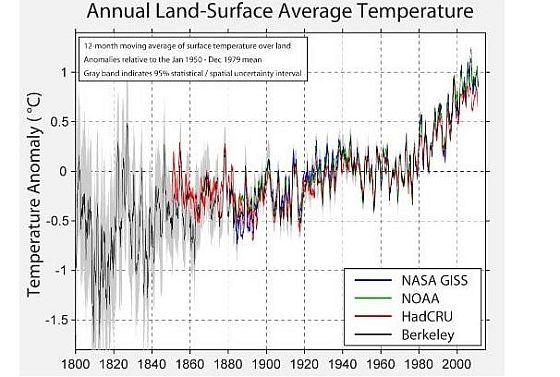
So what are the end results? Muller’s team appears to have confirmed the basic tenets of climate science. Back in March, Muller told the House Science and Technology Committee that, contrary to what he expected, the existing temperature data was “excellent.” He went on: “We see a global warming trend that is very similar to that previously reported by the other groups.” And, today, the BEST team has released a flurry of new papers that confirm that the planet is getting hotter. As the team’s two-page summary flatly concludes, “Global warming is real.”Here’s a chart comparing their findings with existing data:

Facebooktwittermail

Death of Gaddafi revives opposition, and hope, in Syria

Anthony Shadid reports: The death of Col. Muammar el-Qaddafi reverberated across Syria on Friday, reviving protests that had begun to stall and focusing attention on a newly organized, unarmed opposition group seeking to challenge the Assad family’s four decades of rule.

With an ordinary name and ambitious task, the Syrian National Council, announced in Istanbul this month, has begun trying to emulate the success of Libya’s opposition leadership, closing ranks in the most concerted attempt yet to forge an alternative to President Bashar al-Assad and courting international support that proved so crucial in Libya.

“The focus of the world will now turn to Syria,” Samir Nachar, an activist from Aleppo and leader of the group, said Friday. “It’s Syria’s turn to receive attention.”

But the challenges before this effort remain vast, many of them the same issues that have beset the uprising in Syria since it began seven months ago. A gulf still separates the opposition in exile and at home, and rivalries and ideological disputes compromise their work. As important, Europe and the United States have proven reluctant to give the council the recognition that they quickly provided the opposition in Libya.

Perhaps most challenging is a debate that has overshadowed many of its discussions — what kind of international intervention it will seek, as unlikely as the prospect may be now, in trying to end Mr. Assad’s rule. Not even activists these days believe that protests alone, however big, are enough to topple the government.

“Libya’s model will be tempting,” said Louay Hussein, a prominent opposition figure in Damascus, the capital, though a critic of the council itself.

Protests erupted across Syria on Friday, and at least anecdotally, activists called them bigger than in past weeks, and just as bloody. Security forces killed at least 24 people. Colonel Qaddafi’s death offered a bloody lesson in an autocrat’s fate, and became a theme on Facebook pages, Twitter and in the demonstrations themselves. “Qaddafi is gone, your turn is coming, Bashar,” one banner read.

Facebooktwittermail

Libya prepares for liberation ceremony

The Guardian reports: Libya’s transitional government will finally declare the country liberated on Sunday following the capture and killing of the ousted dictator Muammar Gaddafi.

Military official Abdel-Rahman Busin said the governing National Transitional Council (NTC) had begun preparations for a liberation ceremony on Sunday in the eastern city of Benghazi, birthplace of the Libyan revolution.

The declaration of liberation comes after Nato announced it would officially end its seven-month operation in Libya on 31 October.

In another step towards transforming the former dictatorship into a democracy, the interim prime minister Mahmoud Jibril said on Saturday that Libyans should be allowed to vote within eight months to elect a national council that would draft a new constitution and form an interim government.

In the meantime, the priority was to remove weapons from the country’s streets and restore stability and order, Jibril said at the World Economic Forum in Jordan.

“The first election should take place within a period of eight months, maximum, to constitute a national congress of Libya, some sort of parliament,” he said.

“This national congress would have two tasks: draft a constitution, on which we would have a referendum, and the second to form an interim government to last until the first presidential elections are held.”

The Nato secretary general, Anders Fogh Rasmussen, said late on Friday that the 31 October end to the alliance’s operation would be confirmed formally next week. Diplomats said Nato air patrols would continue over Libya for the next nine days as a precautionary measure to ensure the stability of the new regime and would be gradually reduced, assuming there were no further outbreaks of violence.

Facebooktwittermail

After Gaddafi, exhaustion and elation on the streets of Tripoli

Ian Black reports: Martyrs Square in the heart of Tripoli has seen many celebrations since the revolution in August, but the mood on Friday was different. There was jubilation, certainly, but a sense too that something even more profoundly liberating has taken place.

Libya’s first day without Muammar Gaddafi was one for angry reflection about the past, optimism for the future, and a feeling that the ripples of his violent death will embolden those still fighting tyranny on the other fronts of the Arab spring.

Noon prayers in what used to be called Green Square attracted only a few thousand worshippers who gathered under an unseasonably hot sun. Residents of the capital seemed both elated and exhausted after a night of unfettered joy at Thursday’s news from Sirte about the demise of the man who dominated this country for more than 40 years.

“In the beginning of the revolution we believed that the fall of the tyrant would just take a day or two, then a week or two, and then a month or two,” said Sheikh Hamza Abu Faris, his elegant classical Arabic interrupted by calls of “Allahu Akbar” and salutes to the martyrs that echoed off the ramparts of the Ottoman citadel where the “brother leader” used to harangue the crowds.

“I am happy Gaddafi is dead,” grinned Abdullah Ali, a scrawny teenager hawking cigarettes under the Italianate arcade on the side of the square, where revolutionary memorabilia are displayed on wooden stands.

“It’s a bit strange actually,” admitted Hatem, a driver. “Gaddafi had been there all our lives. He forced people to love him. And now he’s really gone.”

Zakaria Bishti, an IT expert, recently returned home from California to find a different Libya to the one he left 13 years ago. “I can see the difference since the revolution,” he said. “People are happier, they are looking to the future. Now they feel that they will benefit from all the oil we sell, that they can live better lives.”

Businessman Omar Miftah, squatting on the pavement in a white robe as he listened to the sheikh’s sermon, was blunt about the meaning of what had happened: “Without Gaddafi,” he pronounced, “things can only get better.”

People want to be certain of the fate of his son Saif al-Islam and intelligence chief Abdullah Senussi. Still, they are now little more than details.

Facebooktwittermail

MI5 references emerge in phone hacking lawsuit

The New York Times reports: A British private detective at the center of the phone hacking scandal that has shaken Rupert Murdoch’s media empire cited the MI5 file of a close friend of Princes William and Harry in notes he kept on his work for the tabloid The News of the World, according to a suit filed in London.

But the court papers, released to The New York Times, do not clearly indicate whether the detective, Glenn Mulcaire, accessed the highly classified intelligence file directly, was told of its contents or was simply noting its existence.

The documents, dated Sept. 23, accuse Mr. Mulcaire and the now-closed News of the World of invading the privacy of Guy Pelly, a London nightclub owner and a confidant of the princes. The defendants, the suit says, hacked Mr. Pelly’s cellphone, set up an e-mail address in his name and flew him to Las Vegas on false pretenses to trick him into revealing details about his royal friends.

But the most intriguing accusation relates to at least two references to Mr. Pelly’s MI5 profile in Mr. Mulcaire’s detailed records. He kept copious notes covering his conversations with his employers at the tabloid, his sources, his methods and the information he gleaned.

One reference, the suit said, was in an electronic file titled “Project Guy W. Pelly,” which “included his mobile number, his parents’ landline number, his parents’ address and a further reference to the MI5 profile.”

Somewhat ambiguously, the suit states: “It is to be inferred that individuals close to members of the Royal Family have MI5 profiles and that this information was obtained unlawfully by the Defendants.”

Facebooktwittermail

Iraq’s government, not Obama, called time on the U.S. troop presence

Tony Karon writes: President Barack Obama’s announcement on Friday that all 40,000 U.S. troops still in Iraq will leave the country by New Year’s Eve will, inevitably, draw howls of derision from GOP presidential hopefuls — this is, after all, early election season. But the decision to leave Iraq by that date was not actually taken by President Obama — it was taken by President George W. Bush, and by the Iraqi government.

In one of his final acts in office, President Bush in December of 2008 had signed a Status of Forces Agreement (SOFA) with the Iraqi government that set the clock ticking on ending the war he’d launched in March of 2003. The SOFA provided a legal basis for the presence of U.S. forces in Iraq after the United Nations Security Council mandate for the occupation mission expired at the end of 2008. But it required that all U.S. forces be gone from Iraq by January 1, 2012, unless the Iraqi government was willing to negotiate a new agreement that would extend their mandate. And as Middle East historian Juan Cole has noted, “Bush had to sign what the [Iraqi] parliament gave him or face the prospect that U.S. troops would have to leave by 31 December, 2008, something that would have been interpreted as a defeat… Bush and his generals clearly expected, however, that over time Washington would be able to wriggle out of the treaty and would find a way to keep a division or so in Iraq past that deadline.”

But ending the U.S. troop presence in Iraq was an overwhelmingly popular demand among Iraqis, and Prime Minister Nuri al-Maliki appears to have been unwilling to take the political risk of extending it. While he was inclined to see a small number of American soldiers stay behind to continue mentoring Iraqi forces, the likes of Shi’ite cleric Moqtada al-Sadr, on whose support Maliki’s ruling coalition depends, were having none of it. Even the Obama Administration’s plan to keep some 3,000 trainers behind failed because the Iraqis were unwilling to grant them the legal immunity from local prosecution that is common to SOF agreements in most countries where U.S. forces are based.

So, while U.S. commanders would have liked to have kept a division or more behind in Iraq to face any contingencies — and, increasingly, Administration figures had begun citing the challenge of Iran, next door — it was Iraqi democracy that put the kibosh on that goal. The Bush Administration had agreed in 2004 to restore Iraqi sovereignty, and in 2005 put the country’s elected government in charge of shaping its destiny. But President Bush hadn’t anticipated that Iraqi democracy would see pro-U.S. parties sidelined and would, instead, consistently return governments closer to Tehran than they are to Washington. Contra expectations, a democratic Iraq has turned out to be at odds with much of U.S. regional strategy — first and foremost its campaign to isolate Iran.

Facebooktwittermail

How the austerity class rules Washington

Ari Berman writes: In September the Committee for a Responsible Federal Budget (CRFB), a bipartisan deficit-hawk group based at the New America Foundation, held a high-profile symposium urging the Congressional “supercommittee” to “go big” and approve a $4 trillion deficit reduction plan over the next decade, which is well beyond its $1.2 trillion mandate. The hearing began with an alarming video of top policy-makers describing the national debt as “the most serious threat that this country has ever had” (Alan Simpson) and “a threat to the whole idea of self-government” (Mitch Daniels). If the debt continues to rise, predicted former New Mexico Senator Pete Domenici, there would be “strikes, riots, who knows what?” A looming fiscal crisis was portrayed as being just around the corner.

The event spotlighted a central paradox in American politics over the past two years: how, in the midst of a massive unemployment crisis—when it’s painfully obvious that not enough jobs are being created and the public overwhelmingly wants policy-makers to focus on creating them—did the deficit emerge as the most pressing issue in the country? And why, when the global evidence clearly indicates that austerity measures will raise unemployment and hinder, not accelerate, growth, do advocates of austerity retain such distinction today?

An explanation can be found in the prominence of an influential and aggressive austerity class—an allegedly centrist coalition of politicians, wonks and pundits who are considered indisputably wise custodians of US economic policy. These “very serious people,” as New York Times columnist Paul Krugman wryly dubs them, have achieved what University of California, Berkeley, economist Brad DeLong calls “intellectual hegemony over the course of the debate in Washington, from 2009 until today.”

Its members include Wall Street titans like Pete Peterson and Robert Rubin; deficit-hawk groups like the CRFB, the Concord Coalition, the Hamilton Project, the Committee for Economic Development, Third Way and the Bipartisan Policy Center; budget wonks like Peter Orszag, Alice Rivlin, David Walker and Douglas Holtz-Eakin; red state Democrats in Congress like Mark Warner and Kent Conrad, the bipartisan “Gang of Six” and what’s left of the Blue Dog Coalition; influential pundits like Tom Friedman and David Brooks of the New York Times, Niall Ferguson and the Washington Post editorial page; and a parade of blue ribbon commissions, most notably Bowles-Simpson, whose members formed the all-star team of the austerity class.

The austerity class testifies frequently before Congress, is quoted constantly in the media by sympathetic journalists and influences policy-makers and elites at the highest levels of power. They manufacture a center-right consensus by determining the parameters of acceptable debate and policy priorities, deciding who is and is not considered a respectable voice on fiscal matters. The “balanced” solutions they advocate are often wildly out of step with public opinion and reputable economic policy, yet their influence endures, thanks to an abundance of money, the ear of the media, the anti-Keynesian bias of supply-side economics and a political system consistently skewed to favor Wall Street over Main Street.

Facebooktwittermail

99ers join Occupy Wall Street movement

Arthur Delaney writes: Fed up with a long jobless spell, Kian Frederick raged against economic injustice during a protest in New York City.

“We’re tired of blaming the victim,” Frederick said during a speech before she and three others were arrested for blocking the street. “If you’re not in the richest 2 percent, you’re struggling. We have to ask the question, why are corporations, major corporations, sitting on millions and billions of record profits by their own account yet they’re still not hiring? We have to ask the question why our government continues to fight itself and ignore our needs.”

Her speech and arrest happened last November, nearly a year before the Occupy Wall Street protests became an international sensation. Way before many of the occupiers took up the cause of the 99 percent, there were “99ers” — the very long-term jobless. Their protests were smaller, and they got less attention. Now several 99ers and the long-term jobless, including Frederick, have joined the Occupy Wall Street cause.

Facebooktwittermail

How income inequality skyrocketed and the 1 percent profited from the decline of unions

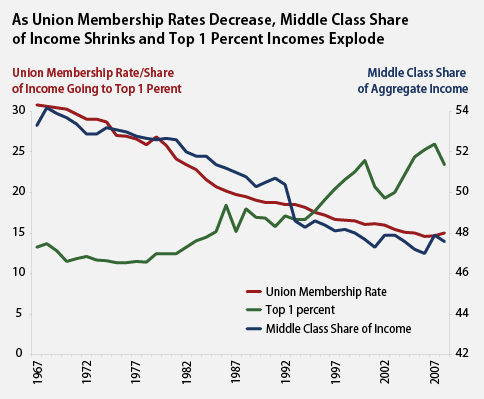
Zaid Jilani writes: This evening, House Majority Leader Eric Cantor (R-VA) will give a speech at the University of Pennsylvania’s Wharton School of Business about how to address income inequality, likely trying to capitalize on the 99 Percent Movement he once derided as unruly “mobs.” Although exactly what policies Cantor will suggest to deal with this social problem are unknown, it’s unlikely that he will touch on one of the chief drivers of American income inequality: the decline of unions.

As CAP’s David Madland and Nick Bunker show in the following chart, the middle class’s share of national income has steadily declined as the percentage of the population in labor unions has fallen. At the same time, the top 1 percent’s share of national income has exploded:

Facebooktwittermail