



Hamed Aleaziz writes: As the autocratic regime in Syria brutally cracks down on a pro-democracy opposition, it is using technology developed by an American company, Blue Coat Systems, to suppress dissent and block access to the internet, tech experts say.
Two weeks ago, Telecomix, a tech activist group, released information from the Syrian government-run Syria Telecommunications Establishment. The release revealed gigabytes of electronic records, called log files, dating back to late July and early August of this year, and the material indicates that Syria’s government is using Blue Coat’s devices [PDF] to prevent its citizens from accessing social media, video-sharing, and other websites. By using the devices, the Syrian regime can block information about its abuses from getting out of the country and monitor web activity. (Peter Fein, a hacktivist with Telecomix, says the information came from "publicly accessible, completely unsecured servers which were found using traditional network scans.") Selling most US-manufactured goods to Syria has been forbidden by US law since 2004.
Jacob Appelbaum, a tech expert and computer science researcher at the University of Washington who was dubbed "The Most Dangerous Man in Cyberspace" by Rolling Stone, said in an email that "the log files are direct evidence" that Syria is utilizing Blue Coat’s technology. "Every IP address in all of the information released is registered in Syria," Appelbaum added. "Every IP address routes from Syria or from known Syrian equipment with the expected latency of machines run in Syria." Appelbaum believes that the Syrian government uses Blue Coat’s device to monitor citizens’ internet activity, record it for future reference, and then take action against dissidents. "That is to say that it’s a super policeman with a general warrant who spies on every person, records everything about that person and their activities and then it acts as the judge, jury and executioner," he wrote.
Jamie Henn, Co-founder and Communications Director of 350.org, writes: Here’s a unique political strategy for you: in the lead up to a crucial election, as anti-corporate sentiment is sweeping the nation, consider giving a huge handout to a major corporation that happens to be your biggest political enemy and is already spending hundreds of millions to defeat you and your agenda.
If that seems too crazy to believe, welcome to the Obama 2012 campaign.
Right now, President Obama is faced with the most crucial environmental decisions he is going to face before the 2012 election: whether or not to approve the permit for the controversial Keystone XL pipeline, a 1,700 mile fuse to the largest carbon bomb on the continent, the Canadian tar sands.
The Keystone XL isn’t just an XL environmental disaster — the nation’s top climate scientists say that fully exploiting the tar sands could mean “essentially game over” for the climate — it also happens to be an XL sized handout to Big Oil and, you guessed it, the Brothers Koch. You want fries with that?
Earlier this year, when Representative Henry Waxman (D-Calif.) attempted to investigate whether or not the Koch Brothers stood to gain from the pipeline, the chairman of the House Committee on Energy and Commerce, Fred Upton (R-Mich.) called the idea an “outrageous accusation” and “blatant political sideshow.” Is it even necessary to mention that reports show Koch and its employees gave $279,500 to 22 of the energy committee’s 31 Republicans and $32,000 to five Democrats?
As you might expect, Upton was completely wrong. Reporters at InsideClimateNews and elsewhere proved that the Koch’s stand to make a fortune with the construction of the pipeline. The brothers already control close to 25 percent of the tar sands crude that is imported into the United State and own mining companies, oil terminals, and refineries all along the pipeline route. You can bet that the champagne will be flowing in Koch HQ when toxic tar sands crude starts moving down the pipe.
Which brings us back to Obama. It’s not too late for the president to intervene and stop the Koch Brothers from pocketing another profit at the expense of the American people. Because it crosses an international border, in order for the Keystone XL pipeline to be built the Obama administration must grant it a “presidential permit” that states that the construction project is in the national interest of the United States.
President Obama can deny the permit, right now, and shut down this flow of cash to the Kochs. In doing so, he’ll show that our national interest isn’t always determined by the 1%, in this case a few big oil companies and the Koch Brothers, but by the 99% of us who have to pay the price for their greed.
Denying the permit will also send a jolt of electricity through President Obama’s base, the millions of us who went out and volunteered and donated to the campaign because we believed in a candidate who said that it was time to “end the tyranny of oil.” In fact, this November 6, thousands of us former believers will be descending on Washington, DC to surround the White House with people carrying placards with the President’s own words in an attempt to resuscitate the 2008 Obama who seemed capable of standing up to folks like the Kochs. You can join here.
I can’t say that I’m privy to what the Obama 2012 campaign will advise the president to do when it comes to the pipeline. But if I was sitting in Chicago watching the Koch Brothers assembled their army of lobbyists across the nation, I’d be thinking that XL handout wasn’t such a good idea.
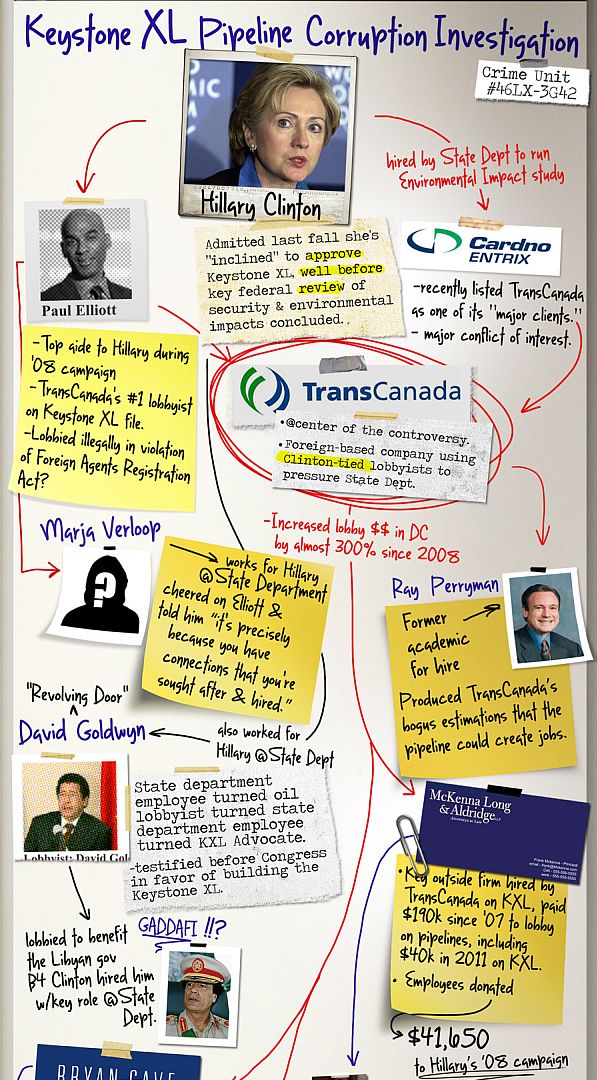
The Keystone XL pipeline network of corruption revealed through an investigation by DeSmogBlog, Oil Change International, The Other 98% and Friends of the Earth (click on the image below to view the complete network):

Larbi Sadiki writes: The Arab Spring, still unfolding, began with death. But that is how life is laboured into this world. And the significance and substance of new life can sometimes be commensurate with the “volume” of death, or the size and stature of the deceased.
Gaddafi was larger than life. He was a “prophet” of revolution, then pan-Arabism, and then pan-Africanism, gradually moving his amorphous programme of statehood from nationalism to transnationalism. On the way, he littered his political history with unruliness, spreading his death squads far and wide, lending support in funding and arms to all and sundry, from Ireland to Chad.
The the self-appointed “prophet”, mentor, architect and non-president president of Libya, “king of kings” of all Africa, wanted a larger power ratio than that occupied by demographically sparse Libya. He sought the mirage of power that would reflect the the country’s huge surface area and the largesse beneath the Libyan Sahara, its reserves of black gold.
One thing stood in his way: his narcissism. It was bigger than even that of Narcissus himself.
That is why the death of Gaddafi unleashes huge potentialities and possibilities that will enliven the remarkable Libyan people. Now it is their turn – after the thousands of deaths, injuries, the devastation, pain and suffering – to breathe life into the new Libya, the post-Gaddafi Libya. But there are challenges.
There is no need for Libyans to reinvent the wheel. The task now is to “quarantine” their passions. Like their Egyptian or Tunisian neighbours, Libyans should not surrender their revolution. Indeed, the bathing water of this revolution has been bloody, and ought to be poured out, discarded. The baby born from this process will need more than nursing: It will need many loving, but – above all else – “thinking”, parents.
Today, they are tasked with laying down their weapons and their emotions to nurture their revolution, or risk the very life of the infant-revolution’s condition. New conditioning – post-conflict reconstruction – needs rational tutelage. This needs to be rationality within Libyan specificity, and all of its complexities – tribal, regional, ideological, and even personal – must now measure to the challenge of life-giving in all its entirety.
Reporting on Gaddafi’s death, Peter Beaumont writes: Witnesses said he perished pleading for mercy after being dragged out of a hiding place inside a concrete drain. According to one fighter, the dying Gaddafi demanded: “What have I done to you?”
Abdel-Jalil Abdel-Aziz, a doctor who accompanied Gaddafi’s body in an ambulance as it was taken from Sirte, said he died from two shots, to the head and chest. “I can’t describe my happiness,” he told the Associated Press. “The tyranny is gone. Now the Libyan people can rest.
Amid the swirl of contradictory reports, one thing was clear: Gaddafi’s death was a humiliating end for a man once used to surrounding himself with cheering crowds of supporters. Video images that emerged showed him being bundled bloodied on to the back of a pick-up truck, surrounded by fighters waving guns and shouting “Allahu Akbar” (God is great).
At first Gaddafi was apparently able to walk with assistance before being lifted on to the truck’s tailgate. A second clip, however, showed him lifeless. In the second sequence, the tunic over one of his shoulders was heavily bloodstained.
Also killed was one of Gaddafi’s sons, Mutassim, a military officer who had commanded the defence of Sirte for his father, according to NTC officials. Gaddafi’s second son, Saif al-Islam, was also said to have been arrested, although the news could not immediately be confirmed.
After his death, Gaddafi’s body was taken – accompanied by a huge convoy of celebrating revolutionaries –to Misrata, two hours away. In Misrata – which itself went through a bitter siege during Libya’s eight-month civil war – the body was paraded through the streets on a truck, surrounded by crowds chanting, “The blood of the martyrs will not go in vain.”
Bouckaert said: “I followed the convoy with the body to Misrata, where it was displayed. I have seen a lot of celebrations in Libya but never one like this.”
Across Libya, as the news broke, there were celebrations. “We have been waiting for this moment for a long time,” the Libyan prime minister, Mahmoud Jibril, told a news conference.
In Tripoli there were volleys of celebratory gunfire as vast crowds waving the red, black and green national flag adopted by the NTC gathered in Martyr’s Square – once the setting for mass rallies in praise of the “Brother Leader”.
Jibril said: “We confirm that all the evils, plus Gaddafi, have vanished from this beloved country. It’s time to start a new Libya, a united Libya. One people, one future.” A formal declaration of liberation would be made by Friday, he added later.
The death of Gaddafi and the fall of Sirte opens the way to national elections which – it had already been announced – would take place eight months after “full liberation” had been achieved.
Reuters now reports: The circumstances of the death of Gaddafi, who had vowed to go down fighting, remained obscure. Jerky video showed a man with Gaddafi’s distinctive long, curly hair, bloodied and staggering under blows from armed men, apparently NTC fighters.
The brief footage showed him being hauled by his hair from the hood of a truck. To the shouts of someone saying “Keep him alive,” he disappears from view and gunshots are heard.
“While he was being taken away, they beat him and then they killed him,” a senior source in the NTC told Reuters before [Libyan Prime Minister Mahmoud] Jibril [reading what he said was a post-mortem report] spoke of crossfire. “He might have been resisting.”
Ahmed Al Omran, a Saudi blogger working for NPR in Washington, says this video shows protesters in Homs singing, “The death of Qaddafi is a lesson to all tyrants.” (H/t Robert Mackey.)
Mahmood Mamdani writes: “Kampala ‘mute’ as Gaddafi falls,” is how the opposition paper summed up the mood of this capital the morning after. Whether they mourn or celebrate, an unmistakable sense of trauma marks the African response to the fall of Gaddafi.
Both in the longevity of his rule and in his style of governance, Gaddafi may have been extreme. But he was not exceptional. The longer they stay in power, the more African presidents seek to personalise power. Their success erodes the institutional basis of the state. The Carribean thinker C L R James once remarked on the contrast between Nyerere and Nkrumah, analysing why the former survived until he resigned but the latter did not: “Dr Julius Nyerere in theory and practice laid the basis of an African state, which Nkrumah failed to do.”
The African strongmen are going the way of Nkrumah, and in extreme cases Gaddafi, not Nyerere. The societies they lead are marked by growing internal divisions. In this, too, they are reminiscent of Libya under Gaddafi more than Egypt under Mubarak or Tunisia under Ben Ali.
Whereas the fall of Mubarak and Ben Ali directed our attention to internal social forces, the fall of Gaddafi has brought a new equation to the forefront: the connection between internal opposition and external governments. Even if those who cheer focus on the former and those who mourn are preoccupied with the latter, none can deny that the change in Tripoli would have been unlikely without a confluence of external intervention and internal revolt.
The conditions making for external intervention in Africa are growing, not diminishing. The continent is today the site of a growing contention between dominant global powers and new challengers. The Chinese role on the continent has grown dramatically. Whether in Sudan and Zimbawe, or in Ethiopia, Kenya and Nigeria, that role is primarily economic, focused on two main activities: building infrastructure and extracting raw materials. For its part, the Indian state is content to support Indian mega-corporations; it has yet to develop a coherent state strategy. But the Indian focus too is mainly economic.
The contrast with Western powers, particularly the US and France, could not be sharper. The cutting edge of Western intervention is military. France’s search for opportunities for military intervention, at first in Tunisia, then Cote d’Ivoire, and then Libya, has been above board and the subject of much discussion. Of greater significance is the growth of Africom, the institutional arm of US military intervention on the African continent.
This is the backdrop against which African strongmen and their respective oppositions today make their choices.
The Washington Post reports: Despite frosty relations with the titans of Wall Street, President Obama has still managed to raise far more money this year from the financial and banking sector than Mitt Romney or any other Republican presidential candidate, according to new fundraising data.
Obama’s key advantage over the GOP field is the ability to collect bigger checks because he raises money for both his own campaign committee and for the Democratic National Committee, which will aid in his reelection effort.
As a result, Obama has brought in more money from employees of banks, hedge funds and other financial service companies than all of the GOP candidates combined, according to a Washington Post analysis of contribution data. The numbers show that Obama retains a persistent reservoir of support among Democratic financiers who have backed him since he was an underdog presidential candidate four years ago.
Obama’s fundraising advantage is clear in the case of Bain Capital, the Boston-based private-equity firm that was co-founded by Romney, and where the Republican made his fortune. Not surprisingly, Romney has strong support at the firm, raking in $34,000 from 18 Bain employees, according to the analysis of data from the Center for Responsive Politics.
But Obama has outdone Romney on his own turf, collecting $76,600 from Bain Capital employees through September — and he needed only three donors to do it.
[…]
Obama’s ties to Wall Street donors could complicate Democratic plans to paint Republicans as puppets of the financial industry, particularly in light of the Occupy Wall Street protests that have gone global over the past week.In response to the protests, the Obama campaign and other Democrats have stepped up their attacks on Romney and other Republicans for their opposition to Wall Street regulations.
One top banking executive who raises money for Obama, discussing fundraising efforts on the condition of anonymity, said reports of disaffection with the president “are exaggerated and overblown.” He said a strong contingent of financiers in New York, Chicago and California remains supportive of Obama and his economic policies, even as some have turned on him.
But, this donor added, “it probably helps from a political perspective if he’s not seen as a Wall Street guy.”
[…]
Obama has raised a total of $15.6 million from employees in the industry, according to the Post analysis. Nearly $12 million of that went to the DNC, the analysis shows.Romney has raised less than half that much from the industry, while Texas Gov. Rick Perry brought in about $2 million. No other Republican candidate has raised more than $402,000 from the finance sector, which also includes insurance and real estate interests.
Even so, Obama clearly has trouble appealing to Wall Street fundraisers, who have emerged in recent years as among the most important sources of campaign cash for major national politicians.
Put aside the DNC money, for example, and Obama’s numbers look much worse: just $3.9 million from the financial sector, compared with Romney’s $7.5 million.
Obama’s campaign committee has raised notably less money from major banking firms such as Goldman Sachs, whose employees gave him more than $1 million in the 2008 cycle. So far this year, about two dozen Goldman employees together have given Obama’s committee about $45,000, one-sixth of the amount Romney’s campaign has taken in.
But six Goldman employees also gave a total of $92,000 to the DNC side of Obama’s fundraising effort.
[…]
Obama retains a core group of supporters on Wall Street who are central to his fundraising efforts. About a third of his top 40 fundraisers, who have helped bundle together $500,000 or more in contributions, hail from the finance sector, including big names such as former New Jersey governor Jon S. Corzine of MF Global, hedge-fund manager Orin Kramer and UBS executive Robert Wolf.Obama’s chief of staff, William M. Daley, was also vice chairman at J.P. Morgan Chase before coming to the White House this year.
Obama’s support within the financial industry tends to be more diffuse than the top Wall Street firms. One of his primary sources of cash, for example, is a small Chicago firm called Chopper Trading, which employs a technique of rapid, computer-assisted trading that some experts blame for volatility in the stock market.
The New York Times reports: The head of the Libyan military council said that Col. Muammar el-Qaddafi was killed Thursday as fighters battling the vestiges of his fallen regime wrested control of his hometown of Surt after a prolonged struggle. Al-Jazeera television showed what it said was Colonel Qaddafi’s corpse as Libyans rejoiced.
Abdul Hakim Belhaj, the leader of the Tripoli military council, said on Al Jazeera that the former leader had been killed and that anti-Qaddafi forces had his body.
The report of Colonel Qaddafi’s death by the highest ranking military officer in Libya’s interim government appeared to put an end to the fierce manhunt for the former leader who remained on the lam in Libya for weeks after the fall of his government.
Libya’s interim leaders had said they believed that some Qaddafi family members — possibly including Colonel Qaddafi and several of his sons — were hiding in the coastal town of Surt or in Bani Walid, another loyalist bastion that the anti-Qaddafi forces captured several days ago.
There were multiple reports on Thursday that Colonel Qaddafi had been either captured or killed in the fighting. Previous such reports regarding high-level Qaddafi officials have proven false.
As rumor of his death spread in the capital, Tripoli, car horns blared as many celebrated in the streets.
Victoria Nuland, the State Department spokeswoman, traveling with Secretary of State Hillary Rodham Clinton in Afghanistan, said the department was aware of the reports “on the capture or killing of Muammar Qaddafi” but could not confirm them “at this time.”
There was no immediate comment from Mr. Jalil, the interim government’s top official. If confirmed, the capture or killing of Colonel Qaddafi — along with the fall of Surt — would allow Mr. Abdul Jalil to declare the country liberated and in control of its borders, and to start a process that would lead to a general election for a national council within eight months.
Libyan fighters said on Thursday that they had routed the last remaining forces loyal to Colonel Qaddafi from the Surt, ending weeks of fierce fighting that had prevented Libya’s interim rulers from declaring the country liberated and starting the transition to an elected government.
A military spokesman for the interim government, Abdel Rahman Busin, said, “Surt is fully liberated.”
Ari Berman writes: If you want to understand how the top 1 percent have accumulated such power in American politics, look no further than Washington’s K Street lobbying corridor. Wall Street has long been the dominant player in the capital. “The banks,” Senator Dick Durbin said in 2009, “are still the most powerful lobby on Capitol Hill. And they frankly own the place.”
The financial sector has spent more money on campaign contributions and lobbying than any other sector of the economy—$4.6 billion on lobbying since 1998 according to Open Secrets. This year, commercial banks and securities and investment firms have spent over $82 million on lobbying, employing over 1,000 lobbyists.
Given these facts, it makes sense that the Occupy Wall Street movement has spread to K Street. Since October 1, demonstrators have gathered in MacPherson Square, their numbers and visibility growing in recent days. Yesterday Harvard professor Larry Lessig, one of the preeminent advocates of true campaign finance reform, spoke to Occupy K Street. Nation intern Cal Colgan attended the talk and passed on some notes.
“Forget the 99 percent,” Lessig said yesterday. “We are the 99.95 percent of people who have never maxed out in a Congressional election campaign by giving the maximum amount. It is .05 percent of America who have given $2500 in the last election to a congressional candidate, .05 percent, and Congress listens to them.” These are the same people who pay lobbyists to convince lawmakers to gut crucial regulations and oppose new ones.
Said Lessig:
It is the first time in American history where we have seen a collapse followed by no fundamental reregulation of the financial services sector because [the banks] have the power to block change from either the Democrats or the Republicans, because they can say to the Democrats or to the Republicans, “If you don’t back us, we guarantee you will lose in the next election.” They are the largest single group of contributors to Congressional elections of any in the country, and they hold this country hostage because of that power, because of that corruption.
Lessig called on the demonstrators to make confronting this legalized system of corruption a central organizing principle of the growing movement, and for the Left to unite with populist Americans on the Right who are similarly frustrated by the stranglehold of money and politics.
Visit msnbc.com for breaking news, world news, and news about the economy
The Washington Post reports: In the days before a CIA drone strike killed al-Qaeda operative Anwar al-Awlaki last month, his 16-year-old son ran away from the family home in Yemen’s capital of Sanaa to try to find him, relatives say. When he, too, was killed in a U.S. airstrike Friday, the Awlaki family decided to speak out for the first time since the attacks.
“To kill a teenager is just unbelievable, really, and they claim that he is an al-Qaeda militant. It’s nonsense,” said Nasser al-Awlaki, a former Yemeni agriculture minister who was Anwar al-Awlaki’s father and the boy’s grandfather, speaking in a phone interview from Sanaa on Monday. “They want to justify his killing, that’s all.”
The teenager, Abdulrahman al-Awlaki, a U.S. citizen who was born in Denver in 1995, and his 17-year-old Yemeni cousin were killed in a U.S. military strike that left nine people dead in southeastern Yemen.
The young Awlaki was the third American killed in Yemen in as many weeks. Samir Khan, an al-Qaeda propagandist from North Carolina, died alongside Anwar al-Awlaki.
Yemeni officials said the dead from the strike included Ibrahim al-Banna, the Egyptian media chief for al-Qaeda’s Yemeni affiliate, and also a brother of Fahd al-Quso, a senior al-Qaeda operative who was indicted in New York in the 2000 attack on the USS Cole in the port of Aden.
The strike occurred near the town of Azzan, an Islamist stronghold. The Defense Ministry in Yemen described Banna as one of the “most dangerous operatives” in al-Qaeda in the Arabian Peninsula, often referred to by the acronym AQAP.
U.S. officials said they were still assessing the results of the strike Monday evening to determine who was killed. The officials would not discuss the attack in any detail, including who the target was, but typically the CIA and the Pentagon focus on senior figures in al-Qaeda’s affiliate in Yemen.
“We have seen press reports that AQAP senior official Ibrahim al-Banna was killed last Friday in Yemen and that several others, including the son of Anwar al-Awlaki, were with al-Banna at the time,” said Thomas F. Vietor, a spokesman for the National Security Council. “For over the past year, the Department of State has publicly urged U.S. citizens not to travel to Yemen and has encouraged those already in Yemen to leave because of the continuing threat of violence and the presence of terrorist organizations, including AQAP, throughout the country.”
A senior congressional official who is familiar with U.S. operations in Yemen and spoke on the condition of anonymity to discuss sensitive policy issues said, “If they knew a 16-year-old was there, I think that would be cause for them to say: ‘Gee, we ought not to hit this guy. That would be considered collateral damage.’ ”
The official said that the CIA and the military’s Joint Special Operations Command are expected to ensure that women and children are not killed in airstrikes in Pakistan and Yemen but that sometimes it might not be possible to distinguish a teenager from militants.
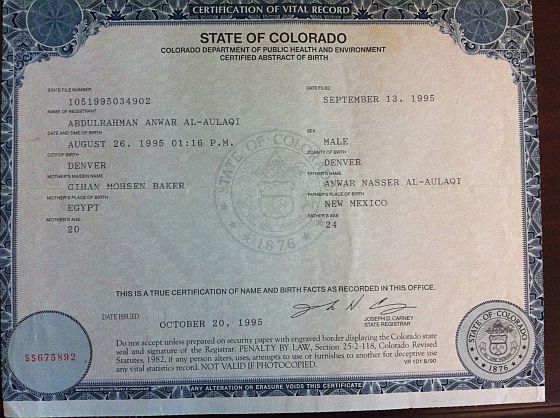
Amy Davidson writes: Here is a birth certificate, for a boy who was born in Denver, Colorado, on September 13, 1995. (Via the Washington Post.) He turned sixteen a month ago, and a few days ago he died, killed when one of his country’s drones hit him and a number of other people in Yemen. His name was Abdulrahman al-Awlaki. His father, Anwar al-Awlaki, who, as the birth certificate notes, was himself born in New Mexico, and was twenty-four years older than his son, was killed a couple of weeks ago, in a separate attack. The father was targeted for assassination. He was an American citizen, and there were no judicial proceedings against him, just, reportedly, a White House legal opinion that concluded that it would be fine to kill him anyway, because the Administration thought he was dangerous. Anwar al-Awlaki was a member of Al Qaeda in the Arabian Peninsula and wrote angry and ugly sermons for them. The Administration says that it had to kill him because he had become “operational,” but so far it has kept the evidence for that to itself.
Was the son targeted, too? The Yemeni government says that another person, a grown man, was the target in the attack that killed Abdulrahman. Maybe he was just in the wrong place, like the Yemeni seventeen-year-old who reportedly died, too. Abdulrahman’s family said that he had been at a barbecue, and told the Post that they were speaking to the paper to answer reports said that Abdulrahman was a fighter in his twenties. Looking at his birth certificate, one wonders what those assertions say either about the the quality of the government’s evidence—or the honesty of its claims—and about our own capacity for self-deception. Where does the Obama Administration see the limits of its right to kill an American citizen without a trial? (The last time I wrote about Awlaki, a reader commented that “Awlaki was a citizen in name only”; but that name is the name of the law, and is, when it comes down to it, all any of us have, unless we want to rely on how charming our government finds us.) And what are the protections for an American child?
You can, in many ways, blame Abdulrahman’s death on his father—for not staying in Colorado, for introducing his son to the wrong people, for being who he was. That would be a fair part of an assessment of Anwar al-Awlaki’s character. But it’s not sufficient. He may have put his child in a bad situation, but we were the ones with the drone. One fault does not preclude another. We have to ask ourselves what we are doing, and at what cost.

Gershon Baskin, a columnist for the Jerusalem Post and founder and co-director of the Israel Palestine Center for Research and Information, describes his role in securing the release of Gilad Shalit. But suppose a Post colleague of his such as Caroline Glick had been given the same opportunity. For the sake of upholding the “principle,” we don’t talk to terrorists, Shalit would still remain captive.
Three days after Gilad was abducted in an attack inside Israel, on sovereign Israeli territory, I was contacted by a Professor “M.,” a professor of economics from a Gaza university, a member of Hamas whom I had met six months before at a conference in Cairo.
He was the first person from Hamas I had ever met, and I was the first Israeli he ever spoke to. We spent more than six hours in dialogue during that conference. For me, it was like a time warp – his words sounded like conversations I had with PLO people 25 years ago.
In 1976, I met the PLO ambassador to the UN. I wanted to convince him to recognize Israel and support the two states for two peoples solution to the conflict. The PLO Ambassador responded: Over my dead body. Jews in Israel must go back from where they came and Palestine must exist from the River to the Sea.
I supported the Quartet conditions for talking to Hamas after the Palestinian elections of January 2006. I believe that official contacts between Israel and other governments and Hamas should stand on the three principles adopted that Hamas must recognize Israel, it must adhere to previous international agreements (meaning Oslo) and it must denounce terrorism and violence. I think it is completely reasonable that these demands were made and that they were steadfastly adhered to.
With regards to civil society, from which I come, there is a completely different set of rules. I have always guided my talks with Arabs over the past 30 years by two principles: I don’t enter into arguments about my (national) right to exist, for me there is no question about it; and I am willing to talk to anyone who is willing to talk to me.
When Professor M. approached me to speak with him in Cairo in December 2005, I gladly accepted.
When three days after the abduction of Gilad Schalit Prof. M. called me and said: “Gershon, we are being bombed, we have no electricity, no water and our lives are in constant danger, we have to do something,” I gladly accepted the challenge to try to do something that would bring Schalit home and end the reason for the Israeli attack in Gaza.
David Graeber writes: Just a few months ago, I wrote a piece for Adbusters that started with a conversation I’d had with an Egyptian activist friend named Dina:
All these years,” she said, “we’ve been organizing marches, rallies… And if only 45 people show up, you’re depressed, if you get 300, you’re happy. Then one day, 200,000 people show up. And you’re incredulous: on some level, even though you didn’t realize it, you’d given up thinking that you could actually win.
As the Occupy Wall Street movement spreads across America, and even the world, I am suddenly beginning to understand a little of how she felt.
On August 2, I showed up at a 7 PM meeting at Bowling Green, that a Greek anarchist friend, who I’d met at a recent activist get together at 16 Beaver Street, had told me was meant to plan some kind of action on Wall Street in mid-September. At the time I was only vaguely aware of the background: that a month before, the Canadian magazine Adbusters had put out the call to “Occupy Wall Street”, but had really just floated the idea on the internet, along with some very compelling graphics, to see if it would take hold; that a local anti-budget cut coalition top-heavy with NGOs, unions, and socialist groups had tried to take possession of the process and called for a “General Assembly” at Bowling Green. The title proved extremely misleading. When I arrived, I found the event had been effectively taken over by a veteran protest group called the Worker’s World Party, most famous for having patched together ANSWER one of the two great anti-war coalitions, back in 2003. They had already set up their banners, megaphones, and were making speeches—after which, someone explained, they were planning on leading the 80-odd assembled people in a march past the Stock Exchange itself.
The usual reaction to this sort of thing is a kind of cynical, bitter resignation. “I wish they at least wouldn’t advertise a ‘General Assembly’ if they’re not actually going to hold one.” Actually, I think I actually said that, or something slightly less polite, to one of the organizers, a disturbingly large man, who immediately remarked, “well, fine. Why don’t you leave?”
But as I paced about the Green, I noticed something. To adopt activist parlance: this wasn’t really a crowds of verticals—that is, the sort of people whose idea of political action is to march around with signs under the control of one or another top-down protest movement. They were mostly pretty obviously horizontals: people more sympathetic with anarchist principles of organization, non-hierarchical forms of direct democracy, and direct action. I quickly spotted at least one Wobbly, a young Korean activist I remembered from some Food Not Bomb event, some college students wearing Zapatista paraphernalia, a Spanish couple who’d been involved with the indignados in Madrid… I found my Greek friends, an American I knew from street battles in Quebec during the Summit of the Americas in 2001, now turned labor organizer in Manhattan, a Japanese activist intellectual I’d known for years… My Greek friend looked at me and I looked at her and we both instantly realized the other was thinking the same thing: “Why are we so complacent? Why is it that every time we see something like this happening, we just mutter things and go home?” – though I think the way we put it was more like, “You know something? Fuck this shit. They advertised a general assembly. Let’s hold one.”
So we gathered up a few obvious horizontals and formed a circle, and tried to get everyone else to join us. Almost immediately people appeared from the main rally to disrupt it, calling us back with promises that a real democratic forum would soon break out on the podium. We complied. It didn’t happen. My Greek friend made an impassioned speech and was effectively shooed off the stage. There were insults and vituperations. After about an hour of drama, we formed the circle again, and this time, almost everyone abandoned the rally and come over to our side. We created a decision-making process (we would operate by modified consensus) broke out into working groups (outreach, action, facilitation) and then reassembled to allow each group to report its collective decisions, and set up times for new meetings of both the smaller and larger groups. It was difficult to figure out what to do since we only had six weeks, not nearly enough time to plan a major action, let alone bus in the thousands of people that would be required to actually shut down Wall Street—and anyway we couldn’t shut down Wall Street on the appointed day, since September 17, the day Adbusters had been advertising, was a Saturday. We also had no money of any kind.
Two days later, at the Outreach meeting we were brainstorming what to put on our first flyer. Adbusters’ idea had been that we focus on “one key demand.” This was a brilliant idea from a marketing perspective, but from an organizing perspective, it made no sense at all. We put that one aside almost immediately. There were much more fundamental questions to be hashed out. Like: who were we? Who did want to appeal to? Who did we represent? Someone—this time I remember quite clearly it was me, but I wouldn’t be surprised if a half dozen others had equally strong memories of being the first to come up with it—suggested, “well, why not call ourselves ‘the 99%’? If 1% of the population have ended up with all the benefits of the last 10 years of economic growth, control the wealth, own the politicians… why not just say we’re everybody else?” The Spanish couple quickly began to lay out a “We Are the 99%” pamphlet, and we started brainstorming ways to print and distribute it for free.
Yves Smith, at Naked Capitalism, where Graeber’s complete article is posted, says: “I have to note that David DeGraw of Amped Status is widely credited as the originator of ‘We are the 99%’.”
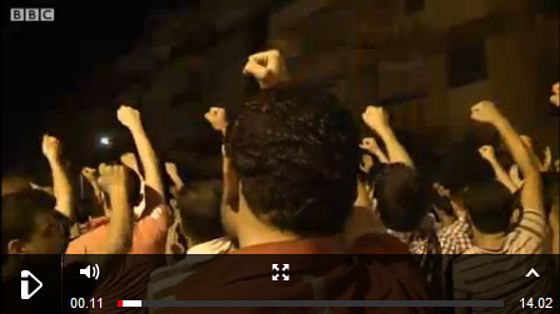
Sue Lloyd-Roberts reports: “You’ll never get there,” Syrians living outside the country said to me when I told them I was on my way to the city of Homs. “It’s circled by tanks on the outside and there’s an army checkpoint on every street corner inside the city.”
Homs was one of the first cities to join the Syrian anti-government uprising when in March thousands gathered in the main square to call for the lifting of the government’s emergency laws and a genuine democracy.
Since then it has been besieged by President Bashar al-Assad’s armed forces and seen almost daily attacks.
The city has earned the unofficial title of the “Capital of the Syrian Revolution” but at a heavy price – almost half of the killings of civilians since the uprising began, estimated to be at least 3,000, have happened there.
I will not describe precisely how I got in to Homs – but I will say that it was entirely due to an incredibly resourceful, brave and cunning network set up by young Syrian activists who want their story told to the outside world. [See also Lloyd-Roberts’ video report.]
