Author Archives: News Sources

Islamophobia, Zionism and the Norway massacre

In a Washington Post op-ed, Abraham Foxman, national director of the Anti-Defamation League compared the Islamophobia that led Anders Behring Breivik to massacre 77 innocent people in Norway to the anti-Semitism that resulted in the Holocaust.

Ali Abunimah welcomes the fact that Foxman is echoing what he and many others have pointed out in recent years.

Foxman points the finger – as others have rightly done – at extreme Islamophobic agitators such as Robert Spencer and Pamela Geller, co-founders of “Stop Islamisation of America” – whose hate-filled writings Breivik cited in his manifesto.

So far, Foxman has it right. But then he drops a clue about what really frightens him:

“One bizarre twist to Breivik’s warped worldview was his pro-Zionism – his strongly expressed support for the state of Israel. It is a reminder that we must always be wary of those whose love for the Jewish people is born out of hatred of Muslims or Arabs.”

Who does Foxman think he is kidding? There is nothing “bizarre” about this at all. Indeed Foxman himself has done much to bestow credibility on extremists who have helped popularise the Islamophobic views he now condemns. And he did it all to shore up support for Israel.

After Norway, Foxman may fear that the Islamophobic genie he helped unleash is out of control, and is a dangerous liability for him and for Israel.

Many American Zionists embraced Islamophobic demagoguery after the September 11, 2001 attacks.

Their logic was encapsulated in then-Israeli opposition leader Benjamin Netanyahu’s notorious assessment that the attacks – which killed almost 3,000 people – would be beneficial for Israel.

Asked what the 9/11 atrocities would mean for US-Israeli relations, Netanyahu told The New York Times, “It’s very good”, before quickly adding, “Well, not very good, but it will generate immediate sympathy” and would “strengthen the bond between our two peoples, because we’ve experienced terror over so many decades, but the United States has now experienced a massive hemorrhaging of terror”.

In order for Israel and the United States to have the same enemy, the enemy could not just be the Palestinians, who never threatened the United States in any way. It had to be something bigger and even more menacing – and Islam fit the bill. The hyped-up narrative of an all-encompassing Islamic threat allowed Israel to be presented as the bastion of “western” and “Judeo-Christian” civilisation facing down encroaching Muslim barbarity. No audience was more receptive than politically influential, white, right-wing Christian evangelical pastors and their flocks.

Facebooktwittermail

It’s time to scrutinize Fox

Michael Massing says that now Rupert Murdoch’s media empire is under examination, it’s time to scrutinize Fox News.

Since being launched in 1996, Fox has had a profound and toxic effect on the press and politics in this country. With a daily prime-time viewership of around 2 million—more than that of CNN and MSNBC combined—it has become the Republican Party’s most powerful booster. “Republicans originally thought that Fox worked for us, and now we are discovering we work for Fox,” David Frum, a former George W. Bush speechwriter, has observed. Fox has put several Republican presidential hopefuls on its payroll and allowed other candidates to fund-raise on its shows. After appearing on Sean Hannity’s program, for instance, 2010 senatorial candidate Sharron Angle boasted that that she had raised $40,000 before even leaving the studio.

Fox has helped to foster the Tea Party and amplify its message. In the days prior to the nationwide Tea Party gatherings on April 15, 2009, Fox ran more than 100 promos touting both its coverage and the movement. (“Americans outraged over unfair and crippling taxes,” went one. “They fight for their future. Neil Cavuto [a Fox anchor] is giving them a voice.”) The endless publicity given the Tea Party, in turn, helped make possible the sweeping Republican gains in the 2010 midterm elections. According to New York magazine, FOX News president Roger Ailes, disappointed with the Republican presidential field, called New Jersey Governor Chris Christie to urge him to enter the race—one of a number of king-making bids by Ailes, who, the magazine observed, has in a sense become “the head of the Republican Party.”

Unlike the News of the World, there’s no indication (as of now) that Fox has engaged in illegal activity. What it has done is violate every journalistic and ethical standard. It has promoted preposterous conspiracy theories, peddled blatant falsehoods, and given a soapbox to all sorts of cranks and crackpots. It ballyhooed President Obama’s “terrorist fist jab,” spread false reports that he attended a madrasa, gave Donald Trump a platform for questioning the president’s US citizenship, and endlessly promoted “Climategate,” the faux-controversy surrounding the leak of emails from climate specialists at the University of East Anglia in England. According to a public-opinion study released six months after the invasion of Iraq, 67 percent of regular Fox viewers believed that the United States had found clear evidence that Saddam Hussein had worked closely with al-Qaeda; another poll released last December reported that 60 percent of Fox viewers believe that most scientists have concluded that climate change is not occurring—examples of how the network has contributed to the steady seepage of know-nothingness throughout the American body politic.

Facebooktwittermail

Syria — ‘Hama is getting massacred’

The New York Times reports:

Syrian security forces bombed the central city of Hama for a second day on Monday as the government pressed its campaign to crush a four-month-old popular uprising against the government of President Bashar al-Assad. On Sunday, at least 70 people were killed when the military and security forces assaulted Hama and other restive cities before dawn, in the broadest and fiercest crackdown yet.

The shelling resumed Monday in the early hours of the morning as people were returning home from mosques where they had performed dawn prayers, according to residents and protesters. At least three people were killed, according to activists.

Obada Arwany, an activist reached by telephone, said that tanks had entered two neighborhoods, Al Qousour and Al Hamidiya, and bombed residential buildings there. One man died in his sleep when his house was bombed and another was killed by a sniper’s bullet as he was getting in his car.

“The city is like a ghost town,” Mr. Arwany said. “We were not expecting this at all. Hama is getting massacred.”

Facebooktwittermail

Benghazi clash exposes cracks in rebel ranks

The New York Times reports:

Rebel fighters challenging the rule of Col. Muammar el-Qaddafi waged an eight-hour gunfight here in their de facto capital on Sunday, against what their leaders called a “fifth column” of Qaddafi loyalists who had posed as a rebel brigade. It was the latest sign of discord and trickery in the rebel ranks to emerge in the four days since the killing of the rebels’ top military leader, Gen. Abdul Fattah Younes, a former Qaddafi confidant who had defected to their side.

The mysterious circumstances of his death have raised new questions about his own loyalties, and about the unity and discipline of the rebel troops. The rebel leaders’ response to the killing has produced a cascade of conflicting stories, hints of conflicts within the rebel government and signs that its leaders are deeply fearful of tribal animosities within their ranks, despite their efforts to portray Libya’s tribal rivalries as antiquated and obsolete.

At the same time, leaders have taken an increasingly hostile and, some journalists said, threatening tone toward the news media.

The developments come at a time when many foreign governments, including the United States, are recognizing the rebels’ governing council as the legitimate government of Libya, with the possibility of turning over to the rebels millions of dollars in frozen Qaddafi government assets.

The gunfight in the city began on Sunday just after midnight and lasted until about 8 a.m. Neighbors hid in their homes as assault rifles, revolvers and rocket-propelled grenades rang out, badly damaging homes and cars around the license plate factory where the so-called fifth column group, numbering several dozen people, was holed up.

In one house that was opened to reporters, the trail of a wounded fighter’s blood led down the stairs from a blast hole made by a grenade. But reporters were not allowed in the factory.

At a news conference on Sunday, rebel leaders said that three of their own fighters had died and eight were wounded in besieging and ultimately capturing the fighters in the factory. Of the fighters in the factory, they said, four died and at least 12 were wounded.

Rebel leaders said they had undertaken the assault in part because of a new drive to bring quasi-independent armed brigades around the city under the direct authority of the rebel military and security forces. It has been five months since the Libyan conflict broke out, and nearly as long since the rebels first talked of establishing a unified command. But the killing of General Younes focused new attention on the disorder among their brigades.

Asked why the rebel security forces had not moved sooner against the so-called fifth column, Mustapha el-Sagazly, the deputy interior minister, said that the group had associated itself with a prominent local tribe that officials were afraid to alienate. “Since the issue of the tribes is sensitive, we did not want to stop them, from the early days,” he said.

To reduce the chances of a tribal backlash, the rebels recruited soldiers and mediators from the same tribe for the assault, Mr. Sagazly said. He declined to name the tribe for fear of insulting it, noting that “most of the sons of the tribe” sided against the group in the factory. He also said that the group in the factory turned out to include some fighters from other tribes and even from other North African countries.

Through the weekend, rebel leaders continued to issue various conflicting and incomplete accounts of the circumstances surrounding the death of General Younes, perhaps trying to tamp down anger over the death among the general’s tribe, the Obeidi, the largest in the eastern Libya.

There were reports on Sunday that the rebel government was moving to name another member of General Younes’s tribe, Suleiman al-Obeidi, as his successor. And whatever suspicious there may have been about General Younes, rebel officials now universally refer to him as a “martyr.”

The Guardian reports:

Outwardly, foreign backers of the rebels insist the NTC is sound, with French defence minister Gerard Longuet saying Paris was not pushing for an immediate resolution: “Impatience is never a good adviser.” He insisted an end to the conflict rested with the people of the Libyan capital: “Things have to move in Tripoli. To put it clearly, the population has to rise up.”

Nerves remain frayed in Benghazi and questions remain over the role, if any, of NTC officials in the death of Younis, following an admission that he had been arrested for questioning on treason allegations just hours before his death.

In London, the defence secretary, Liam Fox, would not be drawn on the assassination. “It’s not yet clear who carried out the killing, and there are claims and counter-claims,” he said. “It will be at least several days until we know exactly what the situation was. There has always been a mixture of people who make up the opposition forces – hardly surprising given the country’s history – and it would be for the Libyans themselves to sort out exactly how any power structure develops post-Gaddafi.”

Sir Menzies Campbell, former leader of the Liberal Democrats, said the killing raised questions about the stability of the NTC and demonstrated the need for a “wholesale” review of policy. He told Sky News: “The assassination has thrown into fairly sharp focus the whole question of the Transitional National Council. What kind of government [it would be], for example, [if] it ever got to Tripoli.

“I also think that claims of success have always got to be taken with a certain amount of scepticism because it’s not about just taking ground temporarily, its taking it permanently. I’ve been saying I think we should take this period for a wholesale examination of policy.

“I supported the military action – I continue to support the British government’s involvement – but I think we have to have a pretty clearer view about what the NTC would be like were they ever to get to Tripoli.”

Facebooktwittermail

Visions collide in a sweltering Tahrir Square

Sandy Tolan writes:

After midnight the Cairo heat finally broke. Mamdouh Hamza, an Egyptian civil engineer, businessman and longtime government critic, was sitting in a plastic chair in an outdoor café at Tahrir Square, puffing on a water pipe. The white-haired Hamza was holding court with his cadre of young revolutionaries, to whom he’d become a kind of beneficent godfather. My colleague Charlotte and I had met him an hour earlier, having interviewed him for a story on Egyptian agriculture and food issues we’re producing for US public radio and TV.

Hamza – builder of major Egyptian development projects but nevertheless a longtime critic of the regime – had been trying to keep a dialogue going between the military council and his “kids” But recently things had broken down, and that morning at 5am, he said, something disturbing and perhaps unrelated happened: Someone called Hamza to say he’d been hired to kill him. But the would-be hit man had changed his mind – “I like you,” he told Hamza – and so he had given the blood money back. Or so the story went.

Hamza seemed to think this was all a hoax, designed to rattle him, and he had no plans to heed the reluctant killer’s warning: that Hamza shouldn’t show up at the square the next day, lest he take a bullet.

Now came Wael Ghonim, he of the social media revolution, with his own followers, to say hello to Hamza. He engaged the older man about finding common ground with the Islamists. Charlotte caught the moment on camera – a young man in a purple pinstripe shirt and designer wire-rim glasses, talking to the shaggy haired professor nearly old enough to be his grandfather – but when Ghonim spotted Charlotte, he insisted she stop shooting. “If you use this,” he said, “I will sue you”. It wasn’t that he didn’t want to be seen speaking of reconciliation with the Islamists; rather, a friend reported, he said he didn’t want to be caught on camera being friendly with Hamza, a fellow secularist.

“If you use this, I will sue you,” the Google MBA repeated to Charlotte, a smile frozen onto his face, before moving off with his entourage.

Signs of strains between secular and Islamic forces have been showing for months. But both sides were expected to be represented in Friday’s mass demonstration. Hamza predicted between 800,000 and a million people would show up.

At two in the morning we headed back downtown to catch a few hours sleep. As we climbed into the taxi, the bearded Salafis, bussed in from all over the nation, were pouring single file into the square: a stream of white robes and skullcaps, part of a planned show of force by Islamists. They would be spending the night in the square, ready with their banners and chants as the sun rose on Cairo three hours later.

Facebooktwittermail

Norway attacks: How far right views created Anders Behring Breivik

The Guardian reports:

The fact that Breivik chose the internet to disseminate his ideology is important. His journey to terrorism was forged within a network of blogs where violence is glorified and multiculturalism despised, along with those who embrace it.

One expert in European rightwing extremism, Andrea Mammone of Kingston University London, says the content of Breivik’s hate was not new, only the manner in which it was fostered.

“The internet is extremely effective at formulating extremist ideals; killing for him was not so strange, it was about killing people who were not like him, who shared different values. He considered himself a new type of elite warrior.”

A bleak scenario is that Breivik – one of thousands who regularly visit such sites – is merely the debutant warrior from a generation that is the first to witness the sociological upheaval caused by the arrival of mass immigration into Scandinavia’s tightly knit, homogeneous communities. Equally crucially, it is the first generation that is internet-savvy.

Matthew Goodwin, rightwing extremism expert at the University of Nottingham, adds that Breivik was radicalised by the same online process as many of the jihadists he so loathed.

Facebooktwittermail

On Norway’s emotional maturity

As Norway has demonstrated this week, anger is often nothing more than the inability to experience grief and acknowledge loss.

Knut Olav Amas writes:

Exactly a week has passed since the twin terror attacks on Norway. As of this writing, the death toll stands at seventy-seven, and more than thirty people, mostly young, are still in the hospital, many of them seriously wounded by the dum-dum bullets used by Anders Behring Breivik. I walked Oslo’s streets again last night, from my newspaper’s office to the Parliament, the government offices, and the cathedral, to observe and understand the grief following the tragedy.

I’ve lived in Oslo for fifteen years, and I’ve never seen my city like this. An ocean of roses is now covering the streets of Oslo and the shores close to Utoya, thirty minutes away, to honor the dead and wounded. These hundreds of thousands of flowers have been brought by a never-ending flow of silent people, young and old. Never before has Norway seen so many people muted for such a long time.

They are also carrying Norwegian flags. We don’t wave our flag all the time the way Americans do, except on May 17th, our national holiday, celebrating the anniversary of the signing our constitution in 1814. In fact, carrying the national flag the rest of the year has been seen as a sign of overwrought patriotism.

Not any longer. Now the flag is again a source of pride, a silent celebration of the joy of being alive and of living in a privileged society. A society where it has long been a virtue to keep a cool head, but not necessarily a warm heart, as the Norwegian author Jo Nesbo noted in the New York Times this week.

In several ways Oslo today reminds me of New York City in the year or so after 9/11: the flags, the flowers, the improvised memorials on street corners and walls. But, more than this, I remember the new and kinder ways people treated each other, transforming the city into a warm, inclusive space. The countless small acts of solidarity in Oslo this week demonstrate that there are other ways to respond to severe threats to a nation than black-and-white thinking. A week later, it’s clear that Norway is working perfectly well even after a traumatic terror attack from within.

The most striking feature of Norway the past seven days is the captivating blend of public emotion and clearheaded, principled liberalism. Leading politicians, including Prime Minister Jens Stoltenberg and Mayor Fabian Stang, have been talking about love, compassion, and consideration. Their words have touched so many of us because they are neither cynical nor calculating—nor are they superficial.

Facebooktwittermail

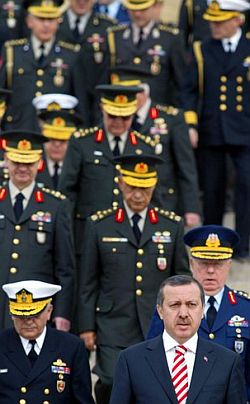
‘The days of Turkey’s military calling the shots are over’

Anthony Shadid reports:

Fifty years ago, when a populist prime minister tangled with the Turkish military, he ended up on the gallows, the mandate of three election victories little consolation. This time around, the rivalry climaxed with most of Turkey’s military command resigning simultaneously, its leader complaining of powerlessness and bad press.

As Turks grappled Saturday with the shock of the resignations — and an extraordinary moment in modern Turkey’s history — officials scrambled to project a facade of business as usual, even as their critics warned of a creeping authoritarianism engineered by Prime Minister Recep Tayyip Erdogan, who has governed since 2003.

But in broader ways, the resignations on Friday delivered Mr. Erdogan a perch to reshape a military bound by civilian control, pursue a foreign policy emboldened by the decisive victory of his conservative and populist party in elections in June and pursue constitutional changes that could transform politics here.

The struggle that has posed the most serious danger to Mr. Erdogan — a powerful military willing to act above the law — in many ways appears to have come to an end.

“The days of Turkey’s military calling the shots are over,” said Cengiz Candar, a prominent columnist. “There’s a new equation in the politics of the country, and anyone depending on the military to score points on a political issue has to forget about it.”

Facebooktwittermail

Fighting back against the CIA drone war

Muhammad Idrees Ahmad writes:

They call it “bug splat”, the splotch of blood, bones, and viscera that marks the site of a successful drone strike. To those manning the consoles in Nevada, it signifies “suspected militants” who have just been “neutralised”; to those on the ground, in most cases, it represents a family that has been shattered, a home destroyed.

Since June 18, 2004, when the CIA began its policy of extrajudicial killings in Pakistan, it has left nearly 250 such stains on Pakistani soil, daubed with the remains of more than 2,500 individuals, mostly civilians. More recently, it has taken to decorating other parts of the world.

Since the Pakistani government and its shadowy intelligence agencies have been complicit in the killings, the CIA has been able to do all this with complete impunity. Major human rights organisations in thrall to the Obama Administration have given it a pass. So have the media, who uncritically accept officials’ claims about the accuracy of their lethal toys.

Two recent developments might change all this.

On July 18, 2011, three Pakistani tribesmen, Kareem Khan, Sadaullah, and Maezol Khan, filed a formal complaint against John A Rizzo, the CIA’s former acting General Counsel, at a police station in Islamabad. Until his retirement on June 25, 2009, Rizzo served as legal counsel to the program whose victims have included Kareem Khan’s son and brother, Maezol Khan’s seven-year-old son, and three family members of Sadaullah (who also lost both legs and an eye in the attack).

In an interview with Newsweek’s Tara McKelvey, Rizzo bragged that he was responsible for signing off on the “hit list” for “lethal operations”. The targets were “blown to bits” in “businesslike” operations, he said. By his own admission, he is implicated in “murder”. Indeed, he boasted: “How many law professors have signed off on a death warrant?” And that is not the full extent of Rizzo’s derring-do: he claims he was also “up to my eyeballs” in Bush’s program of torture in black sites in Afghanistan and elsewhere.

Facebooktwittermail

‘Full-on warfare by the Syrian government on its own people’

Al Jazeera reports:

Syrian forces have killed nearly 140 people, including 100 when the army stormed the flashpoint protest city of Hama to crush dissent on the eve of Ramadan, activists have said.

Rights groups said it was one of deadliest days in Syria since demonstrators first took to the streets on March 15, demanding democratic reforms and the downfall of the government.

As reports of the brutal crackdown on Hama unfurled, Britain, Germany, France, Italy and Turkey condemned the violence, while a US diplomat said it was “full-on warfare”.

AFP reports:

Speaking to the BBC World Service’s Newshour programme, [JJ] Harder [the press attache at the US embassy in Damascus] said: “I think we can safely say it’s full-on warfare by the Syrian government on its own people.”

He said: “This full-on warfare in which the government is engaged in today, I think, amounts to nothing less than a last act of utter desperation.

“They’re killing their own people, they’re sending their tanks into their own cities. It’s ridiculous.”

Asked if he accepted the Syrian government’s contention that its forces were up against armed gangs, Harder said: “There is one big armed gang in Syria and it’s named the Syrian government.

“That’s the armed gang that is pillaging its own cities, that’s the armed gang that is striking terror into the hearts of a lot of these people who are out there who just want to peacefully protest.”

Facebooktwittermail

Islamists flood Tahrir Square in Cairo in show of strength

Anthony Shadid reports:

Tens of thousands of Egyptian Islamists poured into Tahrir Square on Friday calling for a state bound by strict religious law and delivering a persuasive show of force in a turbulent country showing deep divisions and growing signs of polarization.

The shape of Egypt five months into its revolution remains distinctly undecided, and Islamists have long been the best organized political force in this religiously conservative country. Some activists speculated that their show of strength would serve as a jolt to the secular forces who helped to start the revolution but who remain divided, largely ineffectual and woefully unprepared for coming elections.

Others speculated that it might force groups to pick sides in a country where the glow of unity after President Hosni Mubarak’s fall in February has dimmed amid recriminations over the pace, style and substance of change.

“Islamic, Islamic,” went a popular chant. “Neither secular nor liberal.”

After days of negotiations between the rival factions, the demonstration Friday had been billed as a show of national unity, but adherents to a spectrum of religious movements — from the most puritan and conservative, known as Salafists, to the comparatively more moderate Muslim Brotherhood — vastly outnumbered other voices in a sun-drenched Tahrir Square. The numbers of Salafists, in particular, represented the most definitive declaration yet that they represent a formidable force in Egyptian politics, riding an ascent since the revolution that has surprised and unnerved many secular and liberal activists — and poses new challenges to the Muslim Brotherhood.

“It’s simple,” said Mohammed Awad, a 28-year-old accountant. “We’re stronger than any other force in the country, and we’ve made that clear on this day.”

Steve Negus at The Arabist adds:

A few notes on yesterday’s demonstration in Tahrir, generally viewed as an Islamist show of force. First, the numbers. Based on visual cues (beards, galabiyas), signs and slogans I’m guessing at least 90 percent of those in Tahrir were affiliated with the Islamists, and at least half of those were Salafi. I’m guessing also that this was one of the half dozen largest Tahrir “million” rallies since January. The square wasn’t elbow-to-elbow all the way through, but it was elbow-to-elbow in some spots, and a lot of people stayed camped out on downtown streets where they had gone to pray. I understand why the numbers have alarmed revolutionaries who had come to think of the square as their own space.

There have been some reports that Salafis tried to forcefully take control of a speakers’ stage, but the parts of the demonstration which I witnessed were peaceful. I saw no instances of bullying. Islamists and non-Islamists mingled and argued. I saw one angry anti-Islamist marching up Qasr al-Aini between ranks of weary demonstrators shouting “Egypt, my kind mother/I’m not leaving you to the Brothers!”, yet she did not get much of a reaction.

The Salafis’ slogans were provocative. I didn’t hear the “Obama, Obama, we’re all Osama” or “Shut up secularists!” lines that journalists reported, nor did I see Saudi flags. But the tone of what I did here was pretty defiantly affirmative of an Islamic identity for Egypt, ie, not a civic one. “Raise your head high! You’re a Muslim!” might not sound so bad unless you realize it’s a variation on a far more Christian-friendly original, “Raise your head high. You’re an Egyptian”.

A bit of background: Islamist groups including both Brothers and Salafis had originally planned a Friday rally to oppose the idea of “supra-constitutional principles” proposed by some left/liberals — which as they saw it, was a way for Tahrir revolutionaries to decide what was going to be in the constitution before any elections, and before anyone else had a chance to contribute. But the mostly leftist and liberal groups occupying Tahrir weren’t going to vacate the square, so it looked like there were going to be two rival demonstrations. Islamist and non-Islamists got together and agreed to merge the two rallies and focus on things with which they could agree — ie, swifter trials for officials, justice for the “martyrs”. But the demonstrators to whom I spoke, at least the Islamist ones, were clear that they were there to oppose the supra-constitutional principles, and for Egypt to “remain” Islamic.

Many liberals and leftists considered this to be a bit of an ambush. Look at it from the Salafi point of view, though. They’re already worried that the established political forces, none of whom have got to where they are through elections, are going to shape the constitution behind their backs. They finally get a chance to organize an Islamist show of force to insist that they be listened to, but then it’s decided that they can’t actually be Islamist at it. So, it would have been a minor miracle had the Salafis stuck to the program, and chanted only anodyne, uncontroversial slogans.

Facebooktwittermail

Activists vow daily Ramadan protests in Syria

The Guardian reports:

A sweep by government forces has seized one person every hour during the five-month Syrian uprising and detained them in secret, leaving their families no way to locate them, says a human rights group.

The group, Avaaz, claims 2,918 people have been “forcibly disappeared” since anti-government demonstrations began in Syria on 15 March. Most are accused of being involved in the rebellion that continues to undermine a regime long renowned as the Middle East’s most formidable police state.

An additional 12,617 people also remain in detention; however their incarceration has been declared to family members. Tens of thousands more people have fled from towns and villages in northern Syria in the face of intensive military assaults that Damascus claims are ridding the area of criminals and collaborators.

The scale of the detentions in Syria has been compiled by a network of activists and researchers who have provided information to Avaaz. The group has gathered photos of many of the disappeared and is launching an awareness campaign today.

“Hour by hour, peaceful protesters are plucked from crowds by Syria’s infamously brutal security forces, never to be seen again,” said Avaaz’s executive director, Ricken Patel. “President Assad’s attempt to terrorise Syrians into submission isn’t working, but they urgently need the international community to demand the release of the disappeared and a transition to democracy.”

Al Jazeera reports:

When widespread protests broke out in Syria in March, President Bashar al-Assad’s regime turned to its feared security services to smother the anti-government movement.

The bloody response has so far succeeded where other attempts to put down the “Arab awakening” have failed, and President Assad remains in power.

Verifying the toll of the crackdown is difficult, since the government has banned most journalists and observers, but activists and researchers say more than 10,000 people have been detained and at least 1,500 killed since March. A response of proportional size in the United States, by way of comparison, would have meant more than 136,000 people detained and 20,450 killed.

At least 66 people are believed to have died while in the custody of Syrian authorities, according to a list provided by activists to Human Rights Watch researcher Nadim Houry in June.

Outside audiences have encountered the regime’s brutal response primarily through grainy YouTube footage and second-hand accounts relayed by expatriate activists.

These brushstrokes paint a useful yet broad picture: a dozen people killed in this city, a thousand people protesting in that city.

But first-hand accounts from those who have been through the packed cells of Assad’s jails or those who have come under gunfire from his troops offer a more personal understanding of the uprising.

Recently, Al Jazeera spoke with six men, three of whom were in Syria, and three of whom had left the country. All had been arrested or seen relatives suffer at the hands of the security services.

Their stories, which are available below, portray a violent state system in a spasm of panic, unsure of what it is confronting, yet nevertheless determined to crush it.

Stories of six survivors.

Facebooktwittermail

Libya rebels say Younis killers were ‘Islamist element’

The Guardian reports:

The gunmen who shot dead the Libyan rebels’ military chief Abdul Fatah Younis were members of an Islamist-linked militia allied to the campaign to overthrow Muammar Gaddafi, according to a National Transitional Council minister.

After 24 hours of confusion surrounding the death, the NTC’s oil minister, Ali Tarhouni, said Younis had been killed by members of the Obaida Ibn Jarrah Brigade, a militia named after one of the companions of the Prophet Muhammad, suggesting that Islamist elements were involved.

Tarhouni told reporters in Benghazi that a militia leader who had gone to fetch Younis from the frontline had been arrested and had confessed that his subordinates carried out the killing. “It was not him. His lieutenants did it,” Tarhouni said, adding that the killers were still at large.

The NTC leader Mustafa Abdul Jalil said on Thursday that Younis had been recalled for questioning to Benghazi but was killed before he arrived. Relatives said they retrieved a burned and bullet-riddled body.

The Gaddafi government has said the killing is proof the rebels are not capable of ruling Libya. Spokesman Moussa Ibrahim said: “It is a nice slap [in] the face of the British that the [NTC] they recognised could not protect its own commander of the army.”

Facebooktwittermail

Federal judge agrees to limit writer’s testimony

The New York Times reports:

A federal judge dealt a setback on Friday to the Obama administration’s crackdown on the leaking of government secrets to journalists, sharply limiting what prosecutors can ask the author of a book about the C.I.A. in court.

Judge Leonie M. Brinkema of the Federal District Court in Alexandria, Va., issued an order that had been sought by the author, James Risen — who is also a reporter for The New York Times — restricting his testimony in the trial of a former Central Intelligence Agency official, Jeffrey A. Sterling, who is charged with providing classified information to Mr. Risen.

Specialists in media law portrayed the ruling as highly unusual, saying it could set an important precedent. While many states have so-called media shield laws that allow judges to quash subpoenas ordering reporters to testify about their sources by balancing the needs of prosecutors with the public interest, the federal government has no such statute.

“I think it’s an important victory for the First Amendment and for freedom of the press,” Mr. Risen said. “The protection of sources will allow for the American press to continue to find and report the truth.”

Federal prosecutors could appeal the judge’s decision. Alisa Finelli, a Justice Department spokeswoman, declined to comment on the ruling.

Prosecutors have charged Mr. Sterling with being a source for a chapter in Mr. Risen’s 2006 book, “State of War: The Secret History of the C.I.A. and the Bush Administration.” The chapter details an effort by the intelligence agency to sabotage Iranian nuclear research in 2000, portraying the operation as botched in a way that may have helped Iranian scientists gain valuable information about building a nuclear triggering device.

Facebooktwittermail

Roadmap to Apartheid

A message from the makers of Roadmap to Apartheid:

Four years in the making, Roadmap to Apartheid is almost done! Now, we really need everyone’s help to get to the finish line.

Ana Nogueira is a white South African and Eron Davidson a Jewish Israeli. Drawing on their first-hand knowledge of the issues, the producers take a close look at the apartheid comparison often used to describe the Israeli-Palestinian conflict. Narrated by author and activist Alice Walker, the film breaks down the rhetorical analogy into a fact-based comparison, noting where the analogy is useful and appropriate, and where it is not.

There are many lessons to draw from the South African experience relevant to conflicts all over the world. This film is as much a historical document of the rise and fall of apartheid, as it is a film about why many Palestinians feel they are living in an apartheid system today, and why a growing number of people around the world agree with them.

While not perfect the apartheid analogy is a useful framework by which to educate people on the complex issues facing Israelis and Palestinians. Roadmap to Apartheid delves into those issues, comparing the many similar laws and tools used by both Israel and apartheid-era South Africa. The film winds its way through the West Bank, Gaza Strip and Inside Israel itself, showing the audience what life is like for Palestinians in all those areas. Using interviews with Palestinians and Israelis, combined with archival material and anecdotes from South Africans, we will form a complete picture as to why the analogy is being used with increasing frequency and potency.

We have achieved picture lock! This means we are done editing. But there is still a lot to do, and its the most expensive part. Although we have set our goal at $25,000, we are actually in need of $40,000 to pay for all the upcoming costs associated with releasing the film. So even if we reach our Kickstarter goal, please keep donating!

Click here to back this project.

Facebooktwittermail

The News International scandal is just the tip of the iceberg of unelected oligarchies and corporate power in Britain’s democracy

David Beetham writes:

The News International scandal has rightly caused public outrage and led to a sea-change in relations between UK politicians and media moguls. Yet Murdoch’s empire has been only part of a much wider structure of unaccountable power which has exercised a dominant influence over British politics and policy making in the past two decades or more. This ‘unelected oligarchy’ extends to the corporate sector as a whole, including the major financial and banking institutions.

To be sure News International has been unique in its descent to pervasive illegality to maximise sales and profits. Yet it shares the same features that have compromised British democracy from across the corporate sector. These include the use of offshore tax havens, complex legal entities and transfer pricing to minimise the tax contribution of businesses to our public services. They have shared a common anti-public sector agenda which has shaped public opinion and government policy alike: privatisation and outsourcing of government functions and services; cutting the ‘burden’ of government regulation and promoting self-regulation; lowering taxes, especially on business and the wealthy; remedying the deficit in public finances in short order. This agenda has become embedded at the heart of government through a range of corporate stratagems – personal contact with politicians, lobbying power, financing political parties and think tanks, the ‘revolving door’ between business and government appointments, joint partnerships, corporate hospitality, and so on – which have brought governments of all parties under their sway.

The Guardian reports:

Glenn Mulcaire, the private investigator at the centre of the News of the World phone-hacking scandal, has said that he only ever acted on instructions from his employers.

The day after revelations that Sara Payne’s phone may have been targeted by Mulcaire, who worked for the News of the World for several years before being jailed for intercepting voicemail messages in early 2007, the statement issued by his solicitors firmly pushed the spotlight back on his former News International employers.

Mulcaire said he was “effectively employed” by the News of the World from 2002 until 2007 “to carry out his role as a private investigator”.

“As he accepted when he pleaded guilty in 2007 to charges of phone interception he admits that his role did include phone hacking. As an employee he acted on the instructions of others,” said the statement.

“There were also occasions when he understood his instructions were from those who genuinely wished to assist in solving crimes. Any suggestion that he acted in such matters unilaterally is untrue. In the light of the ongoing police investigation, he cannot say any more.”

Reuters reports:

Rupert Murdoch’s biographer says the Murdoch family will no longer be running News Corporation in 60 days’ time, and predicts a massive shake-up at the company as it tries to detach itself from a family name he describes as “toxic.”

“I think actually the Murdochs have to and will step out of not only day-to-day running, but they won’t have jobs within the company,” writer Michael Wolff told Reuters Insider TV late on Thursday.

Wolff said the days of embattled News Corp chief Rupert Murdoch and his son James were numbered because of their handling of a phone hacking scandal that has engulfed the U.S. company’s British newspaper operations.

He said he expected them to step down within two months.

“To restore credibility and to restore trust to this company, the newspapers have to go and the Murdochs have to go,” said Wolff, a Vanity Fair columnist and editorial director of advertising industry magazine Adweek.

Facebooktwittermail

Why the US military is the greatest threat to US national security

Lawrence Korb writes:

In Congressional testimony over the past week, several high ranking military officers, led by Army General Martin Dempsey, the nominee to become the next Chairman of the Joint Chiefs of Staff, have warned about the dire national security consequences that could occur if the defense budget is cut by more than a token amount. Their comments have been reinforced by several Republican members of the House Armed Services Committee. But there are at least five reasons why the defense budget can and should be cut substantially without undo risk.

First, in real or inflation adjusted dollars, it is higher than at any time since World War II, including the Korean and Vietnam Wars and the height of the Reagan buildup. The Korean War peak was $485 billion in FY 1952, Vietnam $409 billion in FY 1968, and the Reagan buildup $546 billion in FY 1985. The baseline defense budget for FY2012 is $585 billion. If one adds in funding for the wars in Iraq and Afghanistan, the total defense budget for the upcoming fiscal year rises to about $700 billion.

Second, the baseline defense budget has risen in real terms for 13 consecutive years, which is unprecedented in American history. The Korean and Vietnam buildups lasted three years and the Reagan buildup but four. Since FY 1998, the baseline budget has risen from $360 billion to $585 billion or 63 percent. Moreover, the military snuck many items that had nothing to do with the wars in Afghanistan and Iraq into the $1.3 trillion war supplemental budgets, for example the F-22 and missile defense.

Third, despite the gusher of defense spending, the military in many ways is no better off than it was 13 years ago. In fact, it may be worse. Its equipment is older, and its forces are training less. This condition is the result of what Admiral Mullen, the current Chairman of the Joint Chiefs of Staff, called the failure to make hard choices. As a result, the Pentagon spent $46 billion on weapon systems it had to terminate and the cost overruns on systems it is currently buying went up by $400 billion. Finally, when pressed, the military leaders themselves have identified nearly $200 billion in savings that could be achieved in the FY 2012-2016 time frame if they operated more efficiently.

Fourth, the military budget must play a role in dealing with what Admiral Mullen calls the greatest threat to our national security, the burgeoning federal deficit which now totals $14.3 trillion. Defense spending now consumes more than half of the total discretionary budget, more than 20 percent of the total budget, up from 16 percent a decade ago, and is at the same level as Social Security and Medicare, which are funded by trust funds.

Fifth, the US is not dealing with an existential threat like we did in the Cold War.

Dempsey and his fellow officers say that cutting the baseline or non-war defense budget by $100 a year billion or by $1 trillion over the next decade will jeopardize our security. Hardly. A $100 billion cut will leave the Pentagon with a baseline defense budget of $480 billion. During the Cold War, the defense budget averaged $450 billion in today’s dollars. And even Secretary Gates admitted we do not need to go back to Cold War levels of defense spending.

Facebooktwittermail