



Ali Gharib lays out the multiplicity of reasons why Dennis Ross — “a three-time-loser on Israeli-Palestinian peace-making” — lacks the competence for any role in the Middle East.
I was struck by an article by Nathan Guttman in the legendary Jewish Daily Forward about Dennis Ross and George Mitchell jockeying for the position of Obama Administration’s point-person in the Middle East peace process. The whole thing is a fascinating read, but this line really jumped out at me:
Others have also described Ross as more skeptical [than Mitchell] about the chances of peace, based on his decades-long experience with trying to bring together the parties.
I don’t want to get all new-agey, but if you think something is difficult or impossible to do, the chances of being able to do it are greatly diminished from the get-go.
So why does this Ross guy keep getting jobs that he doesn’t think are possible? I picked up Ross’ book off of my shelf here in D.C., and it amazed me how many times he says you cannot make any kind of deal with the Iranians. Then, Obama put him in charge of making a deal with the Iranians. Ross, we now learn, doubts that a peace deal can be reached in Israel-Palestine, and Obama gives him a job making peace in Israel-Palestine.
So what does this tell us about Obama? That he’s beholden to AIPAC; that he lacks courage, creativity and imagination. Above all, that lacking confidence in his own capacities of leadership he pays undue deference to the “qualification” that a subordinate possesses talent for no better reason than that he is an old hand — and that’s where Ross has “out performed” George Mitchell: more frequent flyer miles clocked up between the US and the Middle East.
Ynet reports:
Three weeks after the publication of a petition calling on Education Minister Gideon Sa’ar to take action against racism spreading within schools and the general public, teachers told Ynet about the harsh reality they are forced to face daily.
In one case, a 12th grade student of a northern Israeli school wrote “Death to the Arabs” on a test in civics class. In another case, a high school student from Tel Aviv stood up during class, and to the horror of his teacher declared that his dream is to volunteer for the Border Guard, “so that I can spray Arabs to death.” His friends welcomed the announcement with applause.
Moreover, civics teachers around the country have been finding graffiti on the walls of their classrooms, bearing slogans ranging from “Kahane was right” to “A good Arab is a dead Arab.” Other statements incite against the ultra-Orthodox sector and against refugees.
The Guardian reports:
Tunisia’s interim president, Foued Mebazaa, yesterday vowed “a complete break with the past” to calm fears that the revolution was being hijacked by the presence of the dictatorship’s ruling party in the interim government.
In his first televised speech, Mebazaa promised a “revolution of dignity and freedom” following the ousting of Tunisia’s dictator president, Zine al-Abidine Ben Ali, after four weeks of street protests. Mebazaa promised to honour “all the legitimate aspirations of the uprising”.
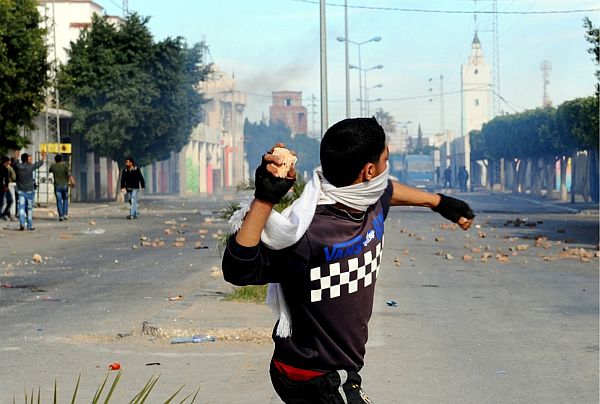
Yesterday, as the interim cabinet held its first meeting, around 500 protestors, mostly the radical left and trade unions, took to the streets in central Tunis demanding that the ruling RCD party be excluded. But the mood in the capital was lightening.
Unlike previous days, the protesters on Bourguiba Avenue were not teargassed or beaten but were instead allowed to stand peacefully protesting until nightfall. Political prisoners, including a key dissident journalist, began to be released, the curfew was shortened, cafes reopened and people milled to work. In the narrow streets of the old medina, tourists were bartering over bags.
On Bourguiba Avenue, Azizi Tej stood in the crowd of demonstrators chanting “Tunisia is free”. An activist in the once banned Islamist Ennahda party, he had been imprisoned three times, tortured, had staged a series of hunger strikes, and had now taken to the streets with the secular radical left. He wanted the remnants of Tunisia’s old regime, the RCD party, to be excluded from the temporary caretaker government.
“The Islamists want democracy,” Tej said. “Lots of us were tortured, it was our Guantánamo Bay. We’ve paid a high price and now some people want to paint us as monsters, we’re not. My religion teaches that I must accept others. We’re proud to share the same God, Jews and Christians are our brothers. We don’t refuse women’s freedoms, we don’t refuse tourism – people would die of hunger if we didn’t have tourism.”
Issandr El Amrani writes:
The elation felt across the Arab world over the Tunisian uprising is deep and palpable. It is not simply that, like most people, Arabs are pleased to see a long-repressed people finally have a shot at gaining their freedom. It is also that many recognise themselves in the Tunisian people and share their hopes, their fears, and also their guilt.
Living in a dictatorship is not simply about shutting up and putting up. It is a humiliation, an abasement of the human spirit, that is reinforced on a daily basis. Every time you lower your voice when mentioning a political leader, every time you shrug off rampant corruption as a fact of life that has no redress, every time you bend the rules in a country where connections systematically trump the rule of law, every time you consider emigration simply to get away from the ambient mediocrity and stasis, you forfeit a little piece of dignity.
Tunisians lived this way for decades, and the Ben Ali regime, which inspired such dread, turned out to be rotten and hollow. This small, well-educated and relatively prosperous country of 10 million – despite the rioting, looting and score-settling that has taken place over the past week – has a real chance at making an unprecedented breakthrough for this region and become genuinely democratic. And if successful, this breakthrough will have been made in spite of western support for the Tunisian regime, and without palace plots and military adventurism. It may yet turn out to be the genuine item, a progressive popular revolution.
The Guardian reports:
Only last week, the dissident blogger Slim Amamou was handcuffed to a chair in the notorious interrogation rooms of Tunisia’s interior ministry being psychologically tormented by the dictator’s henchmen and led to believe that the screams he could hear from neighbouring rooms was his family members being tortured.
It’s a sign of the dizzying speed of change in Tunisia that today he was being sworn in by the prime minister as minister for youth and sport, live-tweeting that the first clash between members of the ruling RCD party was over the fact that “I’m not wearing a tie.”.
Amamou is the CEO of a web development company and calls himself a “partisan of the neutrality of the net”. A member of the Pirate party, inspired by the Swedish movement, he has been active on the underground blogger’s circuit for many years. In a brutally repressive dictatorship, with the world’s most advanced internet censorship technology, rivalling that of China or north Korea, Amamou and his fellow bloggers circulated news and videos in the name of protesting against the repressive regime.
It’s wrong to call the Tunisian uprising a Facebook revolution, but there was no doubt that a cyberwar raged during the four weeks of protests that led to Zine al-Abidine Ben Ali’s fall. While Amamou and his fellow bloggers, such as “A Tunisian Girl”, spread news of the protests and brutal police repression, the state clamped down with its sophisticated counter-technology. The regime hacked into Facebook accounts, swiped passwords and codes and deleted entire pages. This led to a huge international hacking offensive called “Operation Tunisia” in which state sites were targeted, apparently by the collective known as Anonymous.
On 6 January, Amamou was at his office when he was arrested by Ben Ali’s police and accused, along with another key Tunisian blogger, of being part of the operation to “destroy” government sites.

In the New York Times, Anthony Shadid writes:
In a series of stalemates — from the Arab-Israeli conflict to Lebanon — Turkey has proved the most dynamic, projecting an increasingly assertive and independent foreign policy in an Arab world bereft of any country that matches its stature. Its success is a subtle critique of America’s longstanding policy in the Middle East of trying to isolate and ostracize its enemies. From Hezbollah here to the followers of a populist, anti-American cleric in Iraq, Turkey has managed to forge dialogue with America’s enemies and allies alike.
“Turkey has become, I think, until the contrary is proven, an indispensable state in the reorganizing of this region,” said Sarkis Naoum, an analyst and prominent columnist in Beirut.
So far, the interventions of Turkey and others in the Lebanese crisis are mostly symbolic, ventures into a maddeningly complex political landscape that hews to a formula of “no victor, no vanquished.” But in contrast to past crises, when Turkey was virtually irrelevant, the new effort signals the country’s ascent as a regional superpower.
Michael Vlahos writes:
The Spain of Quixote was in 1568 a world empire — and the king’s holdings covered the globe. Its fleets and armies seemed to be everywhere. So, too, is the United States today. With 700 overseas bases, its military personnel are equally omnipresent.
Spanish world authority in the 16th century and that of the United States today are at the core challenged not by “peer competitors” — but by marginal non-state communities at the very rim of civilization itself. How did this happen?
Spain for its part faced insurgents in a place that had only recently become part of its realm, such as the northern provinces of the Netherlands. Areas like Friesland had always been fractious, and no big state had ever succeeded in taming them. Sound familiar?
The Netherlands had for so long been a menagerie of principalities with only the loosest governance. Spain took over and began to make something new — the essence of nation building. In addition, the Spanish effort was determinedly focused on a “whole of government” solution, with their Catholic Church franchise prefiguring the U.S. State Department’s heavy involvement in Afghanistan today. [Continue reading…]
Part Two: Imperial self-destructive perseverance
Robert Fisk writes:
The job of the Arab potentates will be what it has always been – to “manage” their people, to control them, to keep the lid on, to love the West and to hate Iran.
Indeed, what was Hillary Clinton doing last week as Tunisia burned? She was telling the corrupted princes of the Gulf that their job was to support sanctions against Iran, to confront the Islamic republic, to prepare for another strike against a Muslim state after the two catastrophes the United States and the UK have already inflicted in the region.
The Muslim world – at least, that bit of it between India and the Mediterranean – is a more than sorry mess. Iraq has a sort-of-government that is now a satrap of Iran, Hamid Karzai is no more than the mayor of Kabul, Pakistan stands on the edge of endless disaster, Egypt has just emerged from another fake election.
And Lebanon… Well, poor old Lebanon hasn’t even got a government. Southern Sudan – if the elections are fair – might be a tiny candle, but don’t bet on it.
It’s the same old problem for us in the West. We mouth the word “democracy” and we are all for fair elections – providing the Arabs vote for whom we want them to vote for.
In Algeria 20 years ago, they didn’t. In “Palestine” they didn’t. And in Lebanon, because of the so-called Doha accord, they didn’t. So we sanction them, threaten them and warn them about Iran and expect them to keep their mouths shut when Israel steals more Palestinian land for its colonies on the West Bank.
Peter Beaumont writes:
One of Tunisia’s most famous poets, Abou al-Kacem Echebbi, whose face adorns the 30-dinar note, is best known in the wider Arab world for several verses that warn tyrants they will face bloody insurrection. “Who grows thorns will reap wounds,” Echebbi wrote – a line that the country’s dictatorial president, Zine al-Abidine Ben Ali, might be reflecting on in his place of exile, Saudi Arabia.
He may not, however, be the only leader in the region to be doing so. For what has happened in Tunisia, a country which Ben Ali and his cronies controlled since he seized power in 1987, has a message for other regimes whose democratic credentials are less than shining. While it is not clear what Tunisia’s path will be after Friday’s insurrection, the complaints of the protesters are familiar across the region and have also, in some cases, prompted demonstrations. Algeria, home to an often restless young population, has seen protests about unemployment and food prices which began on 5 January and prompted a harsh crackdown. In Jordan, which saw demonstrations last week in five cities, the calls were very similar. There, too, the country’s leader was assailed with demands to resign.
Nowhere has the link between the removal of Ben Ali and other countries been clearer than in Cairo, where on Friday night protests were held by opposition members outside the Tunisian embassy. Their message was explicit: President Hosni Mubarak should follow Ben Ali’s example and leave his country, too.
Adla Massoud writes:
Abdel Bari Atwan, editor of the London-based Al-Quds Al-Arabi, says Tunisian people deserved to be thanked twice: “for proving that the Arab street is not dead as many had expected and is capable of waging an intifada and making sacrifices for change, and for exposing the Arab regimes that claimed to care about human rights and the values of justice and democracy.”
With the emergence of a large layer of educated youth who have no job prospects and no future, the Arab people have reached a boiling point.
They have had enough of chronic unemployment; economic deprivation; rising food prices; insufficient public investment; rampant corruption; and an authoritarian political system that gave Ben Ali twenty three years of corrupt rule.
In Egypt, the President Hosni Mubarak will have held power for three decades this year, and is getting set for another term. In Libya, Muammar Gadaffi has been in power since 1969. The Assads have ruled Syria since 1970.
“The widespread demonstrations in Tunisia” writes political analyst Rami Khouri “mirror a universal pattern of change by citizens who reach a breaking point and go out into the street to brave the bullets of the eternal ruler’s military and security services. When citizens are no longer afraid of the ruler’s bullets, the ruler’s days are numbered.”
Chatham House’ Middle East expert Nadim Shehadi says, “It was an unsustainable economic and political model that has survived for over 30 years and with numerous equivalents in the region. Its persistence has done countless damage and its demise will hopefully serve as an example.”
The biggest challenge facing the Arab world today is youth unemployment. The region has the highest unemployment rate in the world. The current unemployment rate stands at sixteen per cent, eighty per cent of that figure is made up of a youth population of 130 million. A staggering twenty five percent of youth between the ages of 15 and 29 are unemployed.
Describing the path through which Ben Ali rose to power in a bloodless coup in 1987, Paul Legg writes:
In the months leading up the coup, Tunisia watchers could see that Ben Ali was the darling of the western embassies. Well known to the French and American militaries, he was someone the diplomats believed could be trusted to maintain Tunisia’s secular, pro-western policies and keep the country out of the orbit of its dangerous, larger neighbour, Gadaffi’s Libya. Ben Ali had no need of outside support to plan and carry out his seizure of power, but he did so confident in the knowledge of western support.
Ben Ali took power with the familiar promise to move Tunisia towards democracy, but when he organised the country’s first multi-candidate election in 1999, he won with a farcical 99.44% of the vote. This earned him the nickname Mr 99%, although he was also known as Ben A Vie (president-for-life). His own giant posters were soon replacing Bourguiba’s on street corners. Ben Ali’s offer to the Tunisian people was stability, foreign investment, jobs and improved living standards. The price was near-zero tolerance of dissent, a slavish media and an all-inquiring police force. His supporters say the crushing of the Tunisian Islamist movement at the start of the 1990s spared Tunisia the type of conflagration soon to engulf neighbouring Algeria. Critics point to the thousands of human rights activists, politicians and journalists caught up in the crackdown, many of whom were tortured and sentenced to back-breaking labour.
Most Tunisians were prepared to accept Ben Ali’s tradeoff of economic progress in return for total control. The recent downturn in the Tunisian economy with rising joblessness and higher prices showed that Mr 99% was no longer able to deliver his side of the deal. The added toxic ingredient was allegations of personal and family corruption focused on Ben Ali’s second wife, Leila Trabelsi. Loathed by many Tunisians and dubbed by some as the Imelda Marcos of the Maghreb, she allegedly helped her extended family to acquire huge economic holdings across Tunisia. Ben Ali is not the first former dictator to have learned the danger of having a deeply unpopular spouse.
Michael Hanna writes:
For observers throughout the Arab world, the significance of the Tunisian uprising is near-impossible to understate. During this era of retrenchment by aging descendants of revolutionary regimes, the prospect of democratic change had long-ago vanished as a believable possibility. The closest point of reference to the civil unrest in Tunisia is the protest movement that erupted in Iran following the contested presidential elections of June 2009. But the significance of Iran’s post-election events has been minimal in the Arab world, reflecting the Arab-Iranian cultural chasm and the ingrained sense of Arab chauvinism that guides Arab perceptions of international affairs. The Shiite theocracy established in the wake of the 1979 Iranian revolution has always been something of a curiosity for the Arab world and its heavily Sunni population. While the chimerical dreams of Arabism are long gone, events within the Arabic-speaking world – such as Tunisia’s protests – carry special resonance. Since Arab nationalism’s heyday under the 1950s and ’60s stewardship of Egyptian president Gamal ‘Abd al-Nasser, that collective identity has remained, held together by shared media and culture. The role once played by the radio broadcasts of Sawt al-‘Arab (Voice of the Arabs), the Egyptian-run radio station established during the Nasser era, is now filled by the saturation coverage of such Arab satellite stations as al-Jazeera and al-‘Arabiyya. The networks often focus on intra-Arab issues. The protests on the streets of Tunisia were seen far and wide, in real time, by millions of Arabs, with no need for translation or cultural filtering.
With Tunisia’s reputation as something of a stable but sleepy backwater, the events of recent weeks have come as a complete surprise to the world. The uprising remains in flux, its ultimate outcome unclear, and there is no certainty that the country is on its way to a democratic transition, let alone a smooth one. However, the demonstration effect of this uprising is likely not lost on the region’s aging autocrats. A pilot who refused to fly Ben Ali’s family out of Tunisia, interviewed on live television, explained that they were “war criminals.” As the region’s other autocratic rulers retire to bed, this forthright message will be a chilling reminder that their people’s quiescence is not guaranteed, nor is it the same thing as legitimacy. If nothing else, the protests have demonstrated that an Arab head-of-state can be toppled from below and, for leaders as well as activists, have expanded popular notions of the possible. While the U.S. invasion of Iraq and the protests of the “green movement” in Iran have had far-ranging regional ramifications, when it comes to promoting Arab democracy, Tunisia’s 2011 uprising may eclipse them both.
As much as democracy poses a threat to the Arab world’s autocratic leaders, it also threatens Israel. If a day ever comes that the Jewish state is surrounded by democracies, its real identity as a racist ethnocracy will be fully exposed.

Egypt’s Al Ahram reports:
The Arab Network for Human Rights Information (ANHRI) on Saturday condemned Saudi Arabia’s decision to grantasylum to Zine El Abidine Ben Ali, Tunisia’s overthrown president, in a statement entitled “Tunisia’s deposed dictator receives hospitality from Saudi Arabia’s dictator”.
The announcement said that Ben Ali should be tried in front of a Tunisian court for the crimes he committed against the Tunisian people during his 23 years in office.
The statement called Ben Ali the ‘Arab Pinochet’, in reference to Chili’s ex-president and added that Saudi Arabia’s decision to take in Ben Ali after he was refused entry to many countries including France — an outspoken supporter of the 74-year-old leader – indicated to what lengths Arab dictators would go to support each other.
The ANHRI warned that Saudi Arabia is becoming a “refuge for dictators” since it had, in the past, received Uganda’s Idi Amin and Pakistan’s Nawaz Sharif.
Professor Emma Murphy writes:
Zine al-Abidine Ben Ali came to power in 1987 through a constitutional coup and he appears to have been removed from power through a constitutional coup.
The key here on both occasions was not the constitution but the army.
In 1987 the army moved to secure stability as an increasingly senile and paranoid President Bourguiba threatened to bring the country to a political and economic crisis.
Today it has moved to restore that same stability by removing a president whose person and family have become synonymous with corruption, growing wealth disparities, and political repression.
The question now is whether the interim leadership council will be used to move the country towards a democratic future through meaningful political reforms, free and fair elections, a liberalised media and a new inclusive approach to rule, or whether this is a stalling tactic by the army and the regime elite to quell protests and then restore their grip on power.
Patrick Cockburn notes:
Conditions vary across the Arab world but there is plenty in common between the situation in Tunisia and that in Algeria, Jordan and Egypt. Economic and political stagnation is decades old. In some states this is made more tolerable by access to oil revenues, but even this is not enough to provide jobs for educated youths who see their path blocked by a corrupt elite.
There are echoes of the Tunisian crisis in other countries. In Jordan the security forces have been battling rioters in Maan, a traditional site of unrest in the past where the government has difficulty coping. In Kuwait there was an attack by security forces in December on academic and members of parliament. Food prices have been going up.
Yet all these regimes that are now in trouble had a carefully cultivated image in the west of being “moderate” and anti-fundamentalist. In the aftermath of the invasion of Iraq, President George Bush and Tony Blair made much of their democratic agenda for the Middle East, but when one of the few democratic elections to take place in the region produced victory for Hamas among the Palestinians of Gaza and the West Bank, the US did everything to thwart the outcome of the poll.
The Middle East still has a reputation for coups but a striking feature of the region since the early 1970s is how few of the regimes have changed. The forces behind the Tunisian events are not radically new but they are all the more potent for being so long suppressed.
Western governments have been caught on the hop because explosions of social and economic frustration have been long predicted but have never happened. The extent of the uprising is yet to be defined and the Tunisian army evidently hopes that the departure of Mr Ben Ali may be enough for the government to restore its authority. The generals could be right, but the shootings over the last month failed to work. There is no particular reason why the same tactics should start to work now.
Juan Cole writes:
Tunisian President Zine al-Abidin Bin Ali has fled the country before the advancing crowds pouring in to the capital’s center. A French eye-witness said of the masses thronging Bourguiba Avenue that “it was black with people.” The Speaker of Parliament is caretaker leader of the country. The dramatic events in Tunisia yesterday and today may shake the Middle East, as my colleague Marc Lynch suggested. As usual, the important news from the region is being ignored by US television news.
In some ways, the Tunisian Revolution is potentially more consequential for the Middle East than had been the Iranian one. In Iran, Shiite ayatollahs came to power on the back of a similar set of popular protests, establishing a theocracy. That model appealed to almost nobody in the Middle East, with the exception of Shiites in Iraqi and Lebanese slums; and theocratic Shiite Arabs were a minority even in their own ethnic group. Proud Sunni Arab nationalists, in Egypt, Syria, and elsewhere, saw nothing to like there, even though they were saddled with a motley assortment of authoritarian presidents for life, military dictators, kings and emirs. Iranian leaders were shocked and dismayed to find that they had made a ‘revolution in one country.’ Their influence would come from championing the (Sunni) Palestinians and supporting Lebanon when it was attacked by Israel, not from their form of government. Iran was not like the French revolutionary republic, which really did become a model over time for much of Europe. It was an odd man out.
The Enlightenment principle of popular sovereignty has been mostly absent in the Arab world, and elections have been an odd Soviet-style shadow play, merely for show lest the dictators and kings be seen to be medieval in lacking anything called a parliament. Lebanon has been an exception, but with a population of 4 million it is a tiny country. The Kuwait parliament has shown signs of life, but in a constitutional monarchy where it was considered gauche to sharply question a cabinet minister related to the king, those are baby steps. It is too soon to tell if American-sponsored elections in Occupied Iraq are sustainable, and you can’t talk about popular sovereignty in a country occupied by foreign troops.
The Guardian reports:
For the first time – in a state where there is estimated to be one police officer for every 40 adults, two thirds of them in plain clothes, and people are afraid of even discussing politics in private for the informers on every corner – people took to the streets today chanting: “Ben Ali out!” and carrying banners saying “Ben Ali murderer!” They railed against his family and that of his loathed wife, Leila Trabelsi, seen as a cross between Imelda Marcos and Catherine de Medici. “Trabelsi thieves!” read one banner, against the woman whose family is reviled for taking tasty slices of state business and contracts, and plundering Tunisia’s wealth. Tonight there were reports that some of her family’s coastal villas and businesses had been attacked and ransacked.
“Today in Tunis people have said their last word. The people want Ben Ali out, along with his corrupt government which has no credibility,” said Mokhtar Aidoudi, a lawyer who was among the protesters. “We want to be able to express ourselves, a free press,” said a 20-year-old medical student from Sousse. She railed against the suppression of websites in a nation which lawyers say is the world leader in surveillance and internet censorship, rivalling North Korea and China.
“This is it,” said Hussein Bouchabar, a maths teacher who was taken from his classroom in the late 80s and imprisoned for four years for holding views contrary to the regime. Since his release, he has never found work and sells vegetables in a souk. Like others with him at the protest, militia regularly came to his house, to search and ransack it. His phones were tapped, his children could not get university scholarships. “This country is 10 million people living in an open prison, we hope that can change,” said a bus driver protesting with him, who showed his ankle swollen from a beating by police.
The BBC reports:
A state of emergency has been declared in Tunisia amid protests over corruption, unemployment and inflation.
The decree bans more than three people from gathering together in the open, and imposes a night-time curfew.
Tunisian President Zine al-Abidine Ben Ali has dismissed his government and dissolved parliament, and called new elections within six months.
Thousands have gathered in the capital Tunis, urging the president to quit.
Hashem Ahelbarra writes:
Those who watched President Ben Ali delivering his most recent speech noticed a man with a trembling voice saying the opposite of what he stood for.
He said that he was sorry, that he’s been duped by his entourage, that now he got the message and that he will leave power in 2014.
Was he genuine or just buying time.? He is definitely in damage control mode, and while we don’t know for sure what his next move will be, it’s pretty much obvious that the glass ceiling of fear has been for ever shattered in Tunisia and that the police state that Ben Ali created in 1987 when he came to power in a coup seems to be disintegrating.
Simon Tisdall writes:
The trouble started last month when Mohammed Bouazizi, 26, an unemployed graduate, set himself on fire outside a government building in protest at police harassment. Bouazizi’s despairing act – he died of his injuries last week – quickly became a rallying cause for Tunisia’s disaffected legions of unemployed students, impoverished workers, trade unionists, lawyers and human rights activists.
The ensuing demonstrations produced a torrent of bloodshed at the weekend when security forces, claiming self-defence, said they killed 14 people. Independent sources say at least 50 died and many more were wounded in clashes in the provincial cities of Thala, Kasserine and Regueb. The latest reports spoke of continuing clashes in El-Kef and Gafsa.
Despite Ben Ali’s assertions, there is no evidence so far of outside meddling or Islamist pot-stirring. What is abundantly plain is that many Tunisians are fed up to the back teeth with chronic unemployment, especially affecting young people; endemic poverty in rural areas that receive no benefits from tourism; rising food prices; insufficient public investment; official corruption; and a pseudo-democratic, authoritarian political system that gave Ben Ali, 74, a fifth consecutive term in 2009 with an absurd 89.6% of the vote.
In this daunting context, Ben Ali’s emergency job creation plan, announced this week, looks to be too little, too late.
If this long tally of woes sounds familiar, that’s because it’s more or less ubiquitous. Across the Arab world, with limited exceptions in Lebanon, Palestine and Iraq, similar problems obtain to a greater or lesser degree.
Gideon Rachman, currently in Dubai, writes:
In the wake of 9/11, the Americans decided that the Saudi autocracy was thoroughly corrupt and was stoking up radicalism in the Middle East. In 2005 Condi Rice, then Secretary of State, made a famous speech in Cairo calling for democratic reforms in the region. But the election of Hamas in Gaza demonstrated to the Americans that Islamists were quite likely to win free elections. The House of Saud and Hosni Mubarak suddenly looked like quite good bets, again.
Now the Americans seem to be tentatively re-embracing the cause of reform in the Middle East. Perhaps, they have been spooked by events in Tunisia. In any case, Hillary Clinton has just made a big speech down the coast in Qatar, calling for social and political reforms. The Americans seem to be trying to get ahead of events. But I suspect events will get ahead of them.
As the principal backer of autocratic rulers across the region, the only useful thing the US government can do is stand out of the way.
Lebanon’s government collapsed on Wednesday while Prime Minister Saad Hariri was in Washington. It wasn’t until today that he returned to Beirut.
Robert Fisk writes:
There are many who believe that Lebanon will now descend into a civil war, similar to the fratricidal conflict which it endured from 1976 to 1980. I doubt it. A new generation of Lebanese, educated abroad – in Paris, in London, in America – have returned to their country and, I suspect, will not tolerate the bloodshed of their fathers and grandfathers.
In theory, Lebanon no longer has a government, and the elections which were fairly held and which gave Saad Hariri his cabinet are no more. President Michel Suleiman will begin formal talks on Monday to try to create a new government.
But what does Hezbollah want? Is it so fearful of the Hague tribunal that it needs to destroy this country? The problem with Lebanon is perfectly simple, even if the Western powers prefer to ignore it. It is a confessional state. It was created by the French, the French mandate after the First World War. The problem is that to become a modern state it must de-confessionalise. But Lebanon cannot do so. Its identity is sectarianism and that is its tragedy. And it has, President Sarkozy please note, a French beginning point.
The Shias of Lebanon, of which Hezbollah is the leading party, are perhaps 40 per cent of the population. The Christians are a minority. If Lebanon has a future, it will be in due course be a Shia Muslim country. We may not like this; the West may not like this. But that is the truth. Yet Hezbollah does not want to run Lebanon. Over and over again, it has said it does not want an Islamic republic. And most Lebanese accept this.
But Hezbollah has made many mistakes. Its leader, Hassan Nasrallah, talks on television as if he is the President. He would like another war with Israel, ending in the “divine victory” which he claims his last war, in 2006, ended in. I fear the Israelis would like another war too. The Lebanese would prefer not to have one. But they are being pushed further and further into another war which Lebanon’s supposed Western friends seem to want. The Americans and the British would like to hurt Iran. And that is why they would like Hezbollah to be blamed for Mr Hariri’s murder – and for the downfall of the Lebanese government.
Nicholas Noe sees the greatest threat of war emanating from Israel, which having downgraded the threat from Iran, sees Hezbollah as its most immediate military threat. If such a war is to be averted, Washington will need more courage and imagination than have thus far been in evidence.
The Obama administration seems to believe that in order to stave off the logic of approaching war, it should try to manoeuvre Hezbollah into a tough position, thereby restraining it from pushing at the military red line. According to this thinking, to have accepted a Saudi-Syrian sponsored agreement regarding the Hariri tribunal actually would have only emboldened Hezbollah.
This approach is clearly less triumphal than during the heady Bush years (reflecting the changed balance of power in the Middle East as well as a less violence-focused mindset) but the overall direction is similar: throw whatever short-term pressure tools you have against the problem, rhetorically back up your narrow set of “friends” and hope for a miracle, since productive negotiations are essentially unrealistic – this time less because of “evil” opponents than an immovable Israeli ally.
The problem, however, is that Hezbollah will not be substantially boxed in by an indictment from the tribunal, since its domestic enemies are so militarily weak. Moreover, the party is apparently betting that an Israeli “pre-emptive” strike would overwhelm any domestic opposition, especially given Israel’s long history of obtusely, and sometimes wantonly attacking Lebanon as a whole.
Finally, the scent of domestic turmoil and indigenous opposition to Hezbollah is likely to entice Israel further into believing that the time is ripe for a strike against it.
All of which means the Obama administration really only has one good option. The current political breakdown in Lebanon will not be solved without bold steps towards peace that will involve concessions, especially, and perhaps most importantly, via the Syrian track.
Glenn Greenwald writes:
Last week, on January 3, The Guardian published a scathing Op-Ed by James Richardson blaming WikiLeaks for endangering the life of Morgan Tsvangirai, the leader of the democratic opposition in Zimbabwe. Richardson — a GOP operative, contributor to RedState.com, and a for-hire corporate spokesman — pointed to a cable published by WikiLeaks in which American diplomats revealed that Tsvangirai, while publicly opposing American sanctions on his country, had privately urged their continuation as a means of weakening the Mugabe regime: an act likely to be deemed to be treasonous in that country, for obvious reasons. By publishing this cable, “WikiLeaks may have committed its own collateral murder,” Richardson wrote. He added: “WikiLeaks ought to leave international relations to those who understand it – at least to those who understand the value of a life.”
This accusation against WikiLeaks was repeated far and wide. In The Wall Street Journal, Jamie Kirchick — the long-time assistant of The New Republic‘s Marty Peretz — wrote under this headline: “Julian Assange’s reckless behavior could cost Zimbabwe’s leading democrat his life.” Kirchick explained that “the crusading ‘anti-secrecy’ website released a diplomatic cable from the U.S. Embassy in Harare” which exposed Tsvangirai’s support for sanctions. As “a result of the WikiLeaks revelations,” Kirchick wrote, the reform leader would likely be charged with treason, and “Mr. Tsvangirai will have someone additional to blame: Julian Assange of WikiLeaks.” The Atlantic‘s Chris Albon, in his piece entitled “How WikiLeaks Just Set Back Democracy in Zimbabwe,” echoed the same accusation, claiming “WikiLeaks released [this cable] to the world” and that Assange has thus “provided a tyrant with the ammunition to wound, and perhaps kill, any chance for multiparty democracy.” Numerous other outlets predictably mimicked these claims.
There was just one small problem with all of this: it was totally false. It wasn’t WikiLeaks which chose that cable to be placed into the public domain, nor was it WikiLeaks which first published it. It was The Guardian that did that. [Continue reading…]
As someone who jumped to the same false conclusion, I stand corrected and appreciate Greenwald’s tenacity in so closely tracking and analyzing this hugely important story.