Author Archives: News Sources

Dark lord, dark victory — America’s dark passage

At Kosmos Journal, Michael Vlahos writes:

The fall of the Soviet Union initiated a new passage of American identity. Then the 9/11 War took us a long way down the road to journey’s end. This passage is also a migration. America has not simply abandoned one collective identity for another; we have become a different people, a different idea.

Our sacrosanct national narrative of ‘redeemer nation’ has been rewritten into a perverse story of a chosen people beleaguered and a civilization beset by barbarism. Those wretched of the earth we once so proudly pledged our sacred honor to succor and lift up are now our forever-foe — to be monitored, held down and, if necessary, hounded to the darkest ends of the earth.

But the darkness has instead come into us. While official banners still trumpet American altruism, our own spoken words, daily spun into the network ether of contemporary human consciousness, betray our true intent.

Our actions even speak so much louder. Daily our implacable national energies destroy yet more little bits of human society, no longer in the name of their salvation, but rather for our sake to defend the homeland. We are the Dark Lord now — the mythic essence of children’s nightmares. This is the story of our descent.

Part one: enemy of change (PDF)

Part two: dark lord, dark victory (PDF)

Facebooktwittermail

Is America bribing Bibi or blackmailing him?

The Economist‘s Lexington blog says:

Until this weekend, most people assumed that Israel enjoyed an unconditional American promise to maintain its military edge, and a nearly unconditional promise to support it in the United Nations. Now it seems that President Obama is making the continuation of some of these things conditional on Israel’s acceptance of a three-month settlement freeze, during which Israel will be pressed to agree final borders with a putative Palestinian state in the West Bank. That could be construed as a less confrontational, and more subtle, but no less effective version of the way George Bush senior forced a reluctant Yitzhak Shamir to the 1991 Madrid peace conference by withholding loan guarantees. Maybe, just maybe, the Obama peace push in Palestine has stronger legs than jaded onlookers have realised.

Facebooktwittermail

Aung San Suu Kyi’s release

The Los Angeles Times reports:

A day after her release from detention, opposition leader and Nobel Peace Prize laureate Aung San Suu Kyi on Sunday met dozens of ambassadors, hundreds of journalists and thousands of Myanmar citizens, underscoring the importance of dialogue, strength and determination in the battle for democracy in her country.

As a jubilant crowd swelled in front of the headquarters of her disbanded National League for Democracy party, traffic ground to a halt, and people perched in trees, on fences and on vehicle roofs for a look at their charismatic leader.

Her eventual appearance at noon in the doorway of the ramshackle building electrified the audience. “I understand what the people want; they want democracy,” she said to a roar from the crowd. “You must make your voices heard. Only then can we take action.”

An editorial in The Guardian notes:

Those who have campaigned for her release, including many western governments, have cause to celebrate. But this is not yet a defining moment in Burmese history, let alone the “Mandela moment” some believe they see.

Nelson Mandela was freed because those who ruled South Africa knew the game was up, that apartheid was unsustainable. Burma’s military rulers, by contrast, are determined to prolong their grip on power. They have held a bogus election and the party they created to win it has duly won. A general in a lounge suit is prime minister. Some nations, eyeing new trade opportunities, will be amenable to the idea of easing sanctions. Achieving that end is one of the calculations behind Suu Kyi’s release.

She is a symbol of hope, fortitude and strength – one Nobel peace prizewinner whose reputation never falters. But the generals may also reckon that she is a symbol from the past who might struggle to engage with the reality of modern Burma. Her own party, which didn’t contest the election, is split. Her tactical options are narrow and perilous. She has, after all, been locked away twice before. If she causes trouble, she could quickly rejoin the 2,000 unreleased political prisoners.

Facebooktwittermail

The trickledown revolution

Arundhati Roy writes:

On the 64th anniversary of India’s Independence, Prime Minister Manmohan Singh climbed into his bullet-proof soapbox in the Red Fort to deliver a passionless, bone-chillingly banal speech to the nation. Listening to him, who would have guessed that he was addressing a country that, despite having the second-highest economic growth rate in the world, has more poor people than 26 of Africa’s poorest countries put together? “All of you have contributed to India’s success,” he said, “the hard work of our workers, our artisans, our farmers has brought our country to where it stands today…. We are building a new India in which every citizen would have a stake, an India which would be prosperous and in which all citizens would be able to live a life of honour and dignity in an environment of peace and goodwill. An India in which all problems could be solved through democratic means. An India in which the basic rights of every citizen would be protected.” Some would call this graveyard humour. He might as well have been speaking to people in Finland, or Sweden.

If our prime minister’s reputation for “personal integrity” extended to the text of his speeches, this is what he should have said:

    “Brothers and sisters, greetings to you on this day on which we remember our glorious past. Things are getting a little expensive I know, and you keep moaning about food prices, but look at it this way—more than six hundred and fifty million of you are engaged in and are living off agriculture as farmers and farm labour. But your combined efforts contribute less than 18 per cent of our GDP. So what’s the use of you? Look at our IT sector. It employs 0.2 per cent of the population and accounts for 5 per cent of our GDP. Can you match that? It is true that in our country employment hasn’t kept pace with growth, but fortunately 60 per cent of our workforce is self-employed. Ninety per cent of our labour force is employed by the unorganised sector. True, they manage to get work only for a few months in the year, but since we don’t have a category called “underemployed”, we just keep that part a little vague. It would not be right to enter them in our books as unemployed. Coming to the statistics that say we have the highest infant and maternal mortality in the world—we should unite as a nation and ignore bad news for the time being. We can address these problems later, after our Trickle-Down Revolution, when the health sector has been completely privatised. Meanwhile, I hope you are all buying medical insurance. As for the fact that the per capita foodgrain availability has actually decreased over the last 20 years—which happens to be the period of our most rapid economic growth—believe me, that’s just a coincidence.

    “My fellow citizens, we are building a new India in which our 100 richest people, millionaires and billionaires, hold assets worth a full 25 per cent of our GDP. Wealth concentrated in fewer and fewer hands is always more efficient. You have all heard the saying that too many cooks spoil the broth. We want our beloved billionaires, our few hundred millionaires, their near and dear ones and their political and business associates, to be prosperous and to live a life of honour and dignity in an environment of peace and goodwill in which their basic rights are protected.

    “I am aware that my dreams cannot come true by solely using democratic means. In fact, I have come to believe that real democracy flows through the barrel of a gun. This is why we have deployed the Army, the Police, the Central Reserve Police Force, the Border Security Force, the Central Industrial Security Force, the Pradeshik Armed Constabulary, the Indo-Tibetan Border Police, the Eastern Frontier Rifles—as well as the Scorpions, Greyhounds and Cobras—to crush the misguided insurrections that are erupting in our mineral-rich areas.

    “Our experiments with democracy began in Nagaland, Manipur and Kashmir. Kashmir, I need not reiterate, is an integral part of India. We have deployed more than half-a-million soldiers to bring democracy to the people there. The Kashmiri youth who have been risking their lives by defying curfew and throwing stones at the police for the last two months are Lashkar-e-Toiba militants who actually want employment, not azadi. Tragically, 60 of them have lost their lives before we could study their job applications. I have instructed the police from now on to shoot to maim rather than kill these misguided youths.”

In his seven years in office, Manmohan Singh has allowed himself to be cast as Sonia Gandhi’s tentative, mild-mannered underling. It’s an excellent disguise for a man who, for the last 20 years, first as finance minister and then as prime minister, has powered through a regime of new economic policies that has brought India into the situation in which it finds itself now. This is not to suggest that Manmohan Singh is not an underling. Only that all his orders don’t come from Sonia Gandhi. In his autobiography (A Prattler’s Tale), Ashok Mitra, former finance minister of West Bengal, tells his story of how Manmohan Singh rose to power. In 1991, when India’s foreign exchange reserves were dangerously low, the Narasimha Rao government approached the International Monetary Fund (IMF) for an emergency loan. The IMF agreed on two conditions. The first was Structural Adjustment and Economic Reform. The second was the appointment of a finance minister of its choice. That man, says Mitra, was Manmohan Singh.

Over the years, he has stacked his cabinet and the bureaucracy with people who are evangelically committed to the corporate takeover of everything—water, electricity, minerals, agriculture, land, telecommunications, education, health—no matter what the consequences.

(Thanks to reader Aaron Aarons for drawing my attention to this article.)

Facebooktwittermail

The cauldron of global violence

At a time when there are those who still insist that Western civilization is the preeminent source of global stability, two snapshots of the last 1,000 years help put things in perspective. First, an animation of Europe’s fluid borders should make it clear that the West has always been an amorphous concept that can only be loosely mapped onto geographic territory. Second, an animation of global conflict over the same period reveals Europe as the epicenter of global violence.

Facebooktwittermail

How much is a three-month settlement freeze really worth?

The offer of a free squadron of F-35 joint strike fighters is “an offer hard to refuse” a senior Israeli defense official tells the Jerusalem Post, but Aluf Benn suggests the Obama administration wants more than a brief extension of the settlement freeze in return. The goal is a coalition shake-up.

To date, Netanyahu was able to obtain cabinet approval for all U.S. dictates The right wing ministers in his coalition were not enthusiastic and did not go out of their way to sell the decisions to the public, but neither did they oppose the prime minister publicly. Now the situation is different. Shas announced that it will abstain and Foreign Minister Avigdor Lieberman declared that “we will not agree to even a single day of freeze.” If Lieberman votes in favor or abstains, and it does not matter what his excuse will be, he will be called a pushover. So it appears that for the first time, Netanyahu will face a divided vote on an important political issue.

But this is precisely what the Americans want: They want Netanyahu to change the composition of his coalition, bring in Kadima in place of the right wing factions and replace Lieberman with Tzipi Livni. That way the world will see that he’s serious about negotiations with the Palestinians. Netanyahu has opted to date to maintain his alliance with the right, fearing that Lieberman would steal voters away from him and that Livni would try to undermine him and push him out of office. But as the 91st day approaches, it may be that he has no choice.

Facebooktwittermail

Iraq’s disappearing Christians are Bush and Blair’s legacy

William Dalrymple writes:

When George W Bush sent the US into Iraq in 2003, he believed he would be replacing Saddam Hussein with a peaceful, pro-American Arab democracy that would naturally look to the Christian west for support. In reality, seven years on, it appears that he has instead created a highly radicalised pro-Iranian sectarian killing field, where most of the Iraqi Christian minority has been forced to flee abroad.

This week saw new levels of violence directed at Iraq’s Christians. Eight days after the attack on Baghdad’s main Catholic church that left more than 50 worshippers dead, militants detonated more than 14 bombs in Christian suburbs, killing at least four and wounding about 30. Since then the Islamic State of Iraq (ISI), an al-Qaida front, has warned of a new wave of attacks on Christians “wherever they can be reached … We will open upon them the doors of destruction and rivers of blood.”

Before Bush senior took on Saddam for the first time in 1991, there were more than a million Christians in Iraq. They made up just under 10% of the population, and were a prosperous and prominent minority, something exemplified by the high profile of Tariq Aziz, Saddam’s Christian foreign minister. Educated and middle class, the Christians were concentrated in Mosul, Basra and especially Baghdad, which then had the largest Christian population of any city in the Middle East.

Of the 800,000 Christians still in Iraq when Dubya unleashed the US army on Saddam for the second time, two thirds have fled the country.

Facebooktwittermail

India’s sound advice on Iran

Stephen Kinzer writes:

This week in New Delhi, President Obama went further than any of his predecessors toward embracing India as an ally, and most Indians are thrilled by this warm treatment. This does not mean, however, that the two countries will align all of their foreign policies. In some areas, India would like the United States to change its approach.

One key difference is over Iran. India has the wiser policy, and Obama should consider emulating it.

Despite some changes in atmospherics, Obama’s approach to Iran has been remarkably similar to the one President George W. Bush took in his second term: don’t bomb Iran, but continue to threaten that “all options are on the table’’; steadily intensify economic sanctions, despite ample evidence that they weaken civil society and lavishly enrich the repressive Revolutionary Guard; insist on negotiations on the nuclear issue, but refuse to broaden the agenda to include issues that concern Iran.

India, like many other regional powers, takes the Iranian threat far less seriously than the United States does. It does not see Iran as an existential threat to anyone, but rather as just another thuggish country with resources, and wants to see it enticed back into the world’s mainstream. India would like the United States to adopt a more accommodating policy toward Iran — and could even serve as the bridge that makes it possible.

Facebooktwittermail

Bush’s Decision Points is a terrifying journey into the authoritarian mind

Anis Shivani writes:

This would be less grim to talk about if Bush weren’t still with us. But he is, in every way that matters. The Bush Doctrine lives. No leading American politician can disavow the two key aspects of the Bush Doctrine: that we cannot distinguish terrorists from the countries where they live, and that we must act preemptively against gathering threats before they materialize (propositions contradicting international law). Bush’s memoir is arguably the most important book of the year because it reveals — far better than do books by Charlie Savage, Isikoff and Corn, or Bob Woodward — how he fundamentally reconceptualized the functions of the presidency, the balance of power among the branches of government, and the expectations and obligations of citizens, with lasting effects.

Reviews in the Los Angeles Times, Washington Post, and New York Times treat Bush respectfully — much as a Machiavellian prince would desire to be treated after going into retirement; too often reviewers play Bush’s game by humanizing him, or treating him with humor, or safely relegating him to history. But Bush truly was a transformative president, among the rare few, and we deceive ourselves — as many in the commentariat continue to do, as with Maureen Dowd’s light-hearted mockery of him — if we consider him an anomaly, a rare eruption of a virus that won’t repeat itself. This book’s ideas will have resonance with a large segment of the population, and a notable number among the elites; we need to study Decision Points (Crown, Nov. 9) seriously, as onerous a task as it may be, if we are to make sense of the perpetual aura of crisis that has enveloped America, and why we seem to be stuck on a self-destructive path.

Decision Points is a classic recipe for a benign dictatorship, a uniquely American form of dictatorship, to be sure — from its rigid understanding of morality (good versus evil) to its distorted valuation of life (only American lives matter; Bush is not concerned about the loss of civilian life in the countries he attacked) — that gives comfort to many in a time of economic and cultural stress.

Facebooktwittermail

A nation of the richest is not the richest nation

Robert Freeman writes:

For the past thirty years the rich have been waging war on the middle class. It’s been astonishingly effective, partly because it has been undeclared. But even that pretense is now being abandoned. The President’s National Deficit Commission has effectively declared that the rich will now go after what is left of working and middle class wealth and will take whatever steps are necessary to seize it. If allowed to succeed, their plan will reduce Americans to a state of serfdom.

Ronald Reagan began the war on the middle class with his “supply-side” economics. Its very purpose, according to David Stockman, Reagan’s Budget Director, was to transfer wealth and income upwards. It cut the marginal tax rate on the highest income earners from 75% to 35% while dramatically expanding spending for war. The results were two-fold: massive federal debt and an astonishing rise in the share of income and wealth going to those who were already the wealthiest people in the world.

The national debt quadrupled between 1980 and 1992. George W. Bush would repeat Reagan’s policies and double it again between 2000 and 2008. Meanwhile, the share of national income going to the top 1% more than doubled, from 9% to 24%. The share going to the top one-tenth of 1% of income earners more than tripled. We now have the most unequal distribution of income in the developing world and the inequality is growing rapidly.

Shifts of this magnitude over such short periods of time have never been seen in American history. With the rich getting much, much richer, its means that everybody else is getting poorer. And in fact, real wages for median workers are lower today than they were in 1973. Indeed, while the inflation-adjusted income of the bottom fifth of workers fell by $6,900 between 1979 and 2007, the top 1% saw its annual income increase by $741,000!

Facebooktwittermail

Israelis united by fear

Uri Avnery writes:

On Saturday evening, two weeks ago, we returned by taxi from the annual memorial rally for Yitzhak Rabin, and as usual got into a conversation with our driver.

Generally, these conversations flow smoothly, with lots of laughs. Rachel loves them, because they bring us face-to-face with people we don’t normally meet. The conversations are necessarily short, the people express their views concisely, without choosing their words. They are of many kinds, and in the background we generally hear the radio news, talk shows or music chosen by the driver. And, of course, the soldier-son and the student-daughter are mentioned.

But this time, things were less smooth. Perhaps we were more provocative than usual, still depressed by the rally, which was devoid of political content, devoid of emotion, devoid of hope. The driver became more and more upset, and so did Rachel. We felt that if we had not been paying customers, it might have ended in a fight.

The views of our driver can be summed up as follows:

There will never be peace between us and the Arabs, because the Arabs don’t want it.

The Arabs want to slaughter us, always did and always will.

Every Arab learns from early childhood that the Jews must be killed.

The Koran preaches murder.

Fact, wherever there are Muslims, there is terrorism. Wherever there is terrorism, there are Muslims.

We must not give the Arabs one square inch of the country.

What did we get when we gave them Gaza back? We got Qassam rockets!

There’s nothing to be done about it. Only to hit them on the head and send them back to the countries they came from.

According to the Talmudic injunction: He who comes to kill you, kill him first.

This driver expressed in simple and unvarnished language the standard convictions of the great majority of Jews in the country.

It is not something that can be identified with any one part of society. It is common to all sectors.

“Just because you’re paranoid doesn’t mean they aren’t after you,” Joseph Heller wrote and most Israelis believe.

In a way, whether this conviction in a Jewish island surrounded by a sea of enmity has a solid basis in reality is besides the point. If most Israelis believe in the impossibility of peace, that belief itself surely makes peace impossible. But it also begs the question of whether a Jewish state or any other state can have a solid foundation if that foundation is constructed from fear.

Paradoxically, the great demographic threat to Israel may turn out to result from too many Jews — Jews only capable of seeing themselves, their nation and the world through the prism of fear.

For an individual, if fear grows to a proportion where it shapes every feature of their life — if it colors their decisions, their perceptions and everything they think and feel — this is not a way of living but rather a condition that requires treatment. Why should a similar need not equally apply to a whole nation afflicted by the disease of fear?

Many Israelis might counter that so long as the Jewish state can retain its position of regional military supremacy, then it will retain the upper edge in a balance of fear and thus its only concern should be that Israel is able to engender more fear than it suffers. Yet this is the mindset of the survivalist whose fixation on danger has reduced life to the tremors of desperate isolation.

Facebooktwittermail

The legitimacy of the delegitimizers

Matthew Taylor writes:

When North American Jews gathered in New Orleans for their annual General Assembly earlier this week, the mainstream Jewish establishment unveiled a new initiative to counteract the growing international condemnation of Israel’s policies of occupation and land theft. The big plan: delegitimize the delegitimizers.

The Jewish Federations of North America announced at the conference that over the next three years they will invest $6 million to launch an “Israel Action Network.” Based on speakers’ comments at the GA, the strategy seems to be to tar and feather virtually anyone who supports any form of boycott, divestment or sanctions (BDS ) as a “delegitimizer” who is participating in an alleged plot to “destroy the State of Israel.” Instead of spending millions to persuade Israel to change its path, the JFNA prefers to shoot the messengers.

Meanwhile, a few days before the assembly, the U.S.-based advocacy group Jewish Voice for Peace (JVP ) convened a gathering of young Jews from the U.S. and Israel to explore difficult questions that the mainstream leadership seems eager to avoid, such as: How does the occupation delegitimize Israel? When Israel bulldozes Palestinian homes, uproots olive trees, and builds roads designated for settlers only, is that consistent with the Jewish value of respecting your neighbor?

This young group of Jewish activists seems to be an embodiment of Peter Beinart’s recent essay in The New York Review of Books, which explored why Israel’s oppressive policies cause young American Jews to feel alienated. “[Many American Jews have] imbibed some of the defining values of American Jewish political culture … a skepticism about military force, a commitment to human rights … They did not realize that they were supposed to shed those values when it came to Israel,” Beinart wrote in his piece, “The Failure of the American Jewish Establishment.”

Emily Ratner writes:

There’s no getting around it: What we did during Israeli Prime Minister Benjamin Netanyahu’s speech was shockingly rude. We interrupted a head of state, repeatedly, shouting from the tops of chairs into a darkened hall of largely like-minded people, who most likely thought their space was safe from the ever-increasing disruptions of “Israel’s delegitimizers,” as some would call us. Worse still, we did this in my community. Neighbors, co-workers, professors, and fellow students were in attendance, or they’re otherwise finding out what we’ve done. My cheeks are still burning at the thought of what’s to come. And, of course, there’s family. Family. Family.

But each time I think about the hurt I’ve caused with my actions, I’m reminded of the hundreds upon hundreds of New Orleanian Palestinians who have marched this city’s streets, demanding justice in a nation that isn’t listening. I’m reminded of the dozens of Palestinians who stood outside of the Jewish Federations General Assembly on Sunday, braving the cameras of Israeli and US security, facing the very real possibility that because of their protest they’ll be permanently denied entry the next time they attempt to visit their homeland. Their demonstration was featured for fifteen seconds on a single local news channel, and those Palestinian protesters have far more to risk than I do. I am ashamed of the hurt I have caused people that I love, but I am overcome with the bravery of the millions of Palestinians who struggle daily to carve justice into a global structure that finds their very existence inconvenient and inappropriate. I am doubled over by the reality of more than sixty years of displacement, of the state-sanctioned murder of so many mothers, sisters, brothers, and fathers; of homes destroyed, rebuilt, and destroyed again. Of checkpoints. Of landlessness. Of criminalized identity. Of siege. And I am pulled to my feet by the steadfastness of the people who are at the heart of this struggle. From the Palestinians who remain incarcerated for the crime of protest, who have found themselves barred from home forever for the truths they’ve spoken, who have been shot down by soldiers as they held a rock, a Palestinian flag, a child.

Facebooktwittermail

Did Bibi win the midterms?

James Traub writes:

It is widely believed in Israel that Netanyahu’s close aides have been demeaning Obama to the Israeli public through an orchestrated whispering campaign and that this accounts in part for Obama’s dismal poll ratings there. And he and his Likud party have longstanding ties to the Republican Party, which shares Likud’s faith in free markets, its deep suspicion toward most Arab regimes, and its low regard for the Palestinian sense of grievance. Conservative evangelicals, an important GOP constituency, also tend to be passionately pro-Israel. Thus after the new settlement flare-up, Daniel C. Kurtzer, a former U.S. ambassador to Israel, told the New York Times that with the Republicans now in the ascendant, Netanyahu “feels that he’s got a freer hand here.”

I called the office of Rep. Eric Cantor, the Republican whip and the leading GOP voice on Israel, to ask whether he felt this was so. Cantor has, among other things, suggested that aid to Israel be removed from the foreign-assistance budget so that his party could zero out funding to unfriendly countries while sparing Israel. Cantor was unavailable to talk, but I was sent remarks he had just made on talk radio-host Don Imus’s Imus in the Morning: “I don’t understand how the president wants to push our best ally in the Middle East into a posture of thinking that we’re not going to back their security.” Cantor said that “it is very controversial” to “slam our ally, Israel,” adding that “most Americans understand that Israel’s security is synonymous with America’s security.”

Actually, it’s extraordinary to think that any country’s security can be “synonymous” with that of the United States, though of course even this assumes that Netanyahu’s definition of Israel’s security is right, while that of, say, former prime ministers Ehud Olmert and Ariel Sharon, or aspiring prime minister Tzipi Livni, is wrong. Or is Cantor saying that Americans should automatically accept Israel’s own definition of its security? The United States doesn’t automatically accept even Britain’s definition of its own security. Whichever it is, the Israel-is-always-right wing of the Republican Party is in a much more powerful position today than it was two weeks ago, and Netanyahu would have every reason to believe that the GOP has his back. So much for those who say that the election had no effect on the conduct of foreign affairs.

Facebooktwittermail

Baghdad attacks on Christians prompt archbishop’s call for mass exodus

The Guardian reports:

The martyr in their midst was known all around the area. But in case anyone had missed it, a mourning sign had been posted outside Saad Adwar’s house in the Baghdad suburb of Kampsar, revealing exactly where he lived.

It said simply that Adwar had been killed “by the hand of a spiteful and hateful enemy while he prayed to his holy God in Our Lady of Salvation church” nine days ago.

This morning, the terrorists who had killed 44 of Baghdad’s Christians at their place of worship, came hunting them once more – this time in their homes.

They struck 10 times just after 7am in six different places in Baghdad, almost all of them Christian houses.

Mortars damaged two homes in the south. Improvised bombs damaged four in the north of the city and four in the east. A total of four people were killed and 25 injured. Worse was the effect on the city’s already traumatised Christian minority, which now seems more fearful than ever – and potentially poised for another mass exodus.

Facebooktwittermail

Major Dutch pension fund divests from occupation

Electronic Intifada reports:

The major Dutch pension fund Pensioenfonds Zorg en Welzijn (PFZW), which has investments totaling 97 billion euros, has informed The Electronic Intifada that it has divested from almost all the Israeli companies in its portfolio.

PGGM, the manager of the major Dutch pension fund PFZW, has adopted a new guideline for socially responsible investment in companies which operate in conflict zones.

In addition, PFZM has also entered into discussions with Motorola, Veolia and Alstom to raise its concerns about human rights issues. All three companies have actively supported and profited from Israel’s occupation of the West Bank (including East Jerusalem) and the Gaza Strip.

Facebooktwittermail

US military destroys hundreds of Afghan homes

You first have to destroy the nation so that you can then rebuild it — this seems to be innovative thinking that Gen David Petreaus has brought to Afghanistan.

Flatten a farmer’s home, destroy his source of livelihood, and then hand him a compensation card that can only be redeemed by an Afghan government official. This, we are supposed to believe, is a way of strengthening the connection between Afghans and their government.

No need to ask why this is a war with no end in clear sight.

Ben Gilbert reports:

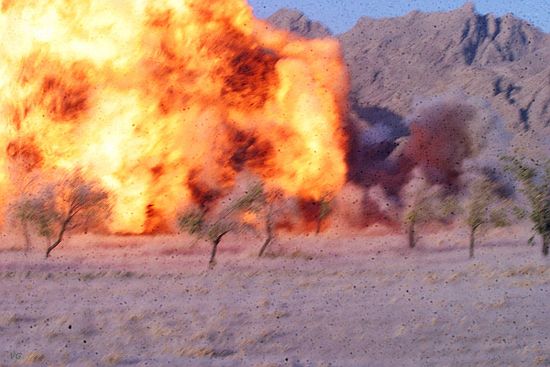
The U.S. military has destroyed hundreds of Afghan civilian homes, farm houses, walls, trees and plowed through fields and buildings using explosives and bulldozers in war-torn Zhari district, a practice that has begun to anger Afghan villagers.

The much anticipated third phase of the Kandahar campaign, called Operation Dragon Strike, has U.S. troops from the 2nd brigade, 101st Airborne Division pushing into a dangerous swath of once-Taliban dominated territory from Highway 1 to the Arghandab River.

But it has come at much material cost to the Afghans, who complain that the troops are destroying their property, leaving some homeless and blocking their irrigation canals —potentially derailing the all-important counterinsurgency strategy that aims to win the hearts and minds of regular Afghans.

“You bulldozed some of my trees, they’re blocking the canal, now we can’t get water to the orchard,” Haji Jilal, a frail, weathered Afghan farmer with a white beard said to one of the U.S. military’s Afghan interpreters on a recent patrol here.

Military officials said the majority of the buildings blown up, and fields and walls plowed through, have been either booby-trapped or used by the Taliban as hideouts and shooting positions.

They also argue the destruction is actually a positive development — it forces Zhari residents to go to their local government center for compensation. U.S. Army commanders see this as a way to kick-start progress toward the final goal of the Kandahar campaign: connect the people of Zhari district to the Afghan government.

Facebooktwittermail

The Palestinians of Israel are poised to take center stage

Seumas Milne writes:

In a quiet street in the Sheikh Jarrah district of occupied East Jerusalem 88-year-old Rifka al-Kurd is explaining how she came to live in the house she and her husband built as Palestinian refugees in the 1950s. As she speaks, three young ultra-orthodox Jewish settlers swagger in to stake their claim to the front part of the building, shouting abuse in Hebrew and broken Arabic: “Arab animals”, “shut up, whore”.

There is a brief physical confrontation with Rifka’s daughter as the settlers barricade themselves in to the rooms they have occupied since last winter. That was when they finally won a court order to take over the Kurd family’s extension on the grounds that it was built without permission – which Palestinians in Jerusalem are almost never granted. It is an ugly scene, the settlers’ chilling arrogance underpinned by the certain knowledge that they can call in the police and army at will.

But such takeovers of Palestinian homes in Sheikh Jarrah have become commonplace, and the focus of continual protest. The same is true in nearby Silwan, home to upwards of 30,000 Palestinians next to the Old City, where 88 homes to 1,500 Palestinians have been lined up for demolition to make way for a King David theme park and hundreds of settlers are protected round the clock by trigger-happy security guards.

Throughout the Arab areas of Jerusalem, as in the West Bank, the government is pressing ahead with land expropriations, demolitions and settlement building, making the prospects of a Palestinian state ever more improbable. More than a third of the land in East Jerusalem has been expropriated since it was occupied in 1967 to make way for Israeli colonists, in flagrant violation of international law.

Israel’s latest settlement plans were not “helpful”, Barack Obama ventured on Tuesday. But while US-sponsored Israeli-Palestinian negotiations go nowhere and attention has been focused on the brutal siege of Gaza, the colonisation goes on. It is also proceeding apace in Israel proper, where the demolition of Palestinian Bedouin villages around the Negev desert has accelerated under Binyamin Netanyahu.

About 87,000 Bedouin live in 45 “unrecognised” villages, without rights or basic public services, because the Israeli authorities refuse to recognise their claim to the land. All have demolition orders hanging over them, while hundreds of Jewish settlements have been established throughout the area.

The Israeli writer Amos Oz calls the Negev a “ticking time bomb”. The village of Araqeeb has been destroyed six times in recent months and each time it has been reconstructed by its inhabitants. The government wants to clear the land and move the Bedouin into designated townships. But even there, demolitions are carried out on a routine basis.

Facebooktwittermail