Author Archives: News Sources

Why Aung San Suu Kyi’s ‘Mandela moment’ is a victory for Myanmar’s generals

Maung Zarni writes: Though in exile 6,000 miles away from Myanmar, I can almost taste the euphoria of my fellow dissidents. Aung San Suu Kyi’s wildly popular opposition – the National League for Democracy – has won a landslide in the multiparty elections, and 31 million voters, most apparently backing the NLD, are savouring a long-awaited moment of jubilation. The NLD leader, whom they call Amay or mother, appeared on TV, her eyes shining with tears of joy.

Even foreign journalists covering the country in the 25 years since Aung San Suu Kyi was placed under house arrest have scarcely been able to conceal their excitement at the prospect of a new era of freedom and democracy, ushered in through her non-violent, pragmatic leadership.

Myanmar’s Mandela moment has arrived. Or has it?

A sober analysis may be in order. Aside from the fact that Myanmar’s military leaders have, constitutionally, blocked any possibility of “the Woman” with her two “impure-blooded sons” and “foreign privileges” assuming the presidency, Aung San Suu Kyi’s party faces huge barriers to turn a resounding electoral mandate into a real step towards a genuinely representative government.

And this is not the first time the public has felt euphoric about the power of its votes. In May 1990 Aung San Suu Kyi and her then fledgling opposition party won a decisive mandate taking 82% of the parliamentary seats and 62% of the total votes. That landslide came despite the fact that the generals placed her and her senior colleagues under house arrest on the eve of the elections, in effect barring them from the electoral process. So the opposition knows how it feels to fail to convert this mandate a quarter-century ago into a real political gain or put the country on the path of democracy. [Continue reading…]


Facebooktwittermail

Aung San Suu Kyi victory will test commitment to human rights in Myanmar

By Andrew Fagan, University of Essex

Myanmar has taken a potentially momentous step away from dictatorship and towards democracy. More than 6,000 candidates from 91 political parties competed for the votes of 33m registered voters on November 8 in the country’s first credible elections since 1960.

The precise outcome won’t be known for days, but Aung San Suu Kyi’s National League for Democracy (NLD) is claiming to have gained at least 70% of the votes cast. Senior figures in the ruling party are conceding defeat.

No one should underestimate the significance of power changing hands in Myanmar via the ballot box. However, this will only finally occur in March 2016, when the newly-elected MPs vote for a new president and a new government will be formed.

Continue reading

Facebooktwittermail

Anti-ISIS airstrikes are killing more civilians than ISIS fighters

Hassan Hassan writes: Last Thursday, Russian fighter jets carried out devastating raids in the ISIL-held Syrian city of Albukamal, near the Iraqi border. At least 30 civilians were killed in the twin attacks in the city centre. Many more were seriously injured. According to activists who document atrocities, not a single ISIL member was killed in the raids.

Leaflets dropped by the regime also warned this was only the start: “The intensity of the attacks is increasing. The worst is coming. Crushing attacks will be directed to this area.”

The leaflets suggest the raids were not intended to attack ISIL specifically but were part of a systematic campaign against the local population. Also, even before the current intensity of the air strikes increases in Deir Ezzor, the government still kills more than three times the number of those killed by ISIL. According to DeirEzzor24, an organisation whose members inside the province risk their lives to document ISIL’s daily atrocities, 77 people were killed by the regime last month, compared with 25 civilians killed by the terrorist group.

The level of devastation committed by the regime in ISIL-held areas often goes unnoticed. No condemnation was issued from the US-led coalition of the massacre of civilians, which reinforces the feeling often expressed by locals that the regime, Russia and the international coalition seem to be taking turns in attacking residential areas, especially as ISIL has adjusted to the air attacks and evacuated its bases.

If the international coalition believes that ISIL does not command the support of the local population living under it, as officials often claim, then silence over such atrocities cannot be justified. Locals living under ISIL are the international coalition’s safety net against the group and its attempts to ensconce itself in areas under its control, especially in border areas where locals still view it with suspicion.

Silence over such atrocities and failure to distance the anti-ISIL coalition from them only bolsters the group’s claims that there is a global war on those communities. The attacks in those areas, in particular, have no apparent tactical purpose other than to punish the local population. [Continue reading…]

Facebooktwittermail

How the West’s unwillingness to support pro-democracy activists has empowered ISIS

Samira Shackle reports on Mohamed Soltan’s incarceration in Egypt and his ongoing struggle to promote democracy: Finally, in May this year, physically frail and psychologically pressured, Soltan was deported to the US. He had given up his Egyptian citizenship, making him eligible for a presidential decree that allows for the deportation of foreign prisoners. Before leaving prison, Soltan was not allowed to say goodbye to his father, who is on death row.

Since then, Soltan has dedicated himself to speaking out, meeting with US Secretary of State John Kerry and ambassador to the UN Samantha Power to argue that western security interests are at stake. “The Egyptian regime is not facing any real substantial consequences for escalating repression. The non-violent opposition is not rewarded for maintaining its non-violence. The longer we’re turning a blind eye and being silent about this, the more likely folks inside prison will adopt more extremist ideas.”

For a time during his incarceration, Soltan shared a cell with Isis and Al-Qaeda militants. “They walked around with a victorious air: ‘look, you idiots, your model doesn’t work’. There’s a growing disbelief in freedom and democracy amongst moderate Islamists. Literally daily, things are happening that is proving the very simple arguments the Isis guys were making. You are facing so much oppression and there’s no outlet for it, no dialogue, no space for political dissent. People feel continuingly abandoned by the international community, which is legitimising this coup and giving it everything it needs to thrive.” [Continue reading…]

Facebooktwittermail

U.S.-led air war on ISIS in Syria has little allied support

The New York Times reports: As the United States prepares to intensify airstrikes against the Islamic State in Syria, the Arab allies who with great fanfare sent warplanes on the initial missions there a year ago have largely vanished from the campaign.

The Obama administration heralded the Arab air forces flying side by side with American fighter jets in the campaign’s early days as an important show of solidarity against the Islamic State, also known as ISIS or Daesh. Top commanders like Gen. Lloyd J. Austin III, who oversees operations in Syria and Iraq, still laud the Arab countries’ contributions to the fight. But as the United States enters a critical phase of the war in Syria, ordering Special Operations troops to support rebel forces and sending two dozen attack planes to Turkey, the air campaign has evolved into a largely American effort.

Administration officials had sought to avoid the appearance of another American-dominated war, even as most leaders in the Persian Gulf seem more preoccupied with supporting rebels fighting the government of President Bashar al-Assad of Syria. Now, some of those officials note with resignation, the Arab partners have quietly left the United States to run the bulk of the air war in Syria — not the first time Washington has found allies wanting.

Saudi Arabia and the United Arab Emirates have shifted most of their aircraft to their fight against Iranian-backed Houthi rebels in Yemen. Jordan, reacting to the grisly execution of one of its pilots by the Islamic State, and in a show of solidarity with the Saudis, has also diverted combat flights to Yemen. Jets from Bahrain last struck targets in Syria in February, coalition officials said. Qatar is flying patrols over Syria, but its role has been modest. [Continue reading…]

Facebooktwittermail

Iran tensions grow ahead of key elections

The Financial Times reports: When Iran’s centrist president Hassan Rouhani last month entered the Hosseinieh, the hall in central Tehran where Supreme Leader Ayatollah Ali Khamenei holds his public meetings, for a religious ceremony, he was greeted by jeers.

At the gathering to mark the start of the mourning month of Moharram and, crucially, in the presence of the supreme leader, hardliners chanted “death to hypocrites” as Mr Rouhani and others behind the flagship nuclear deal between Iran and world powers arrived.

The fact that hardliners felt free to criticise the president in the presence of the supreme leader is seen as highly symbolic. With two key elections due in February, moderate politicians believe the shouts were choreographed to demonstrate the supreme leader’s approval of hardliner tactics to undermine the president ahead of these polls. [Continue reading…]

Facebooktwittermail

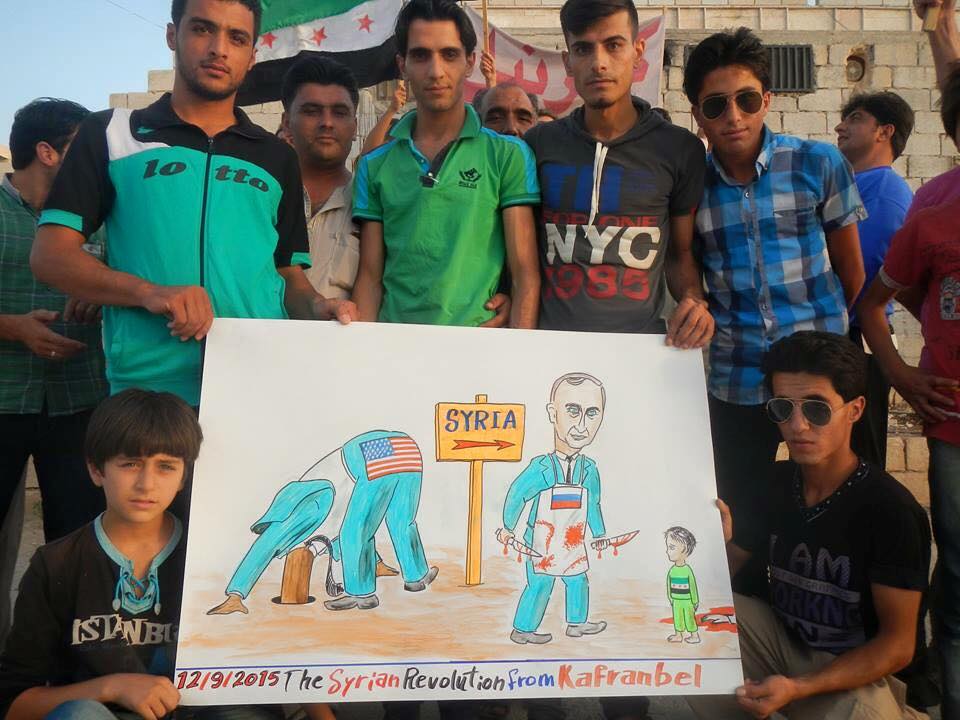
Why is Russia bombing my town?

Kafranbel-poster

Raed Fares writes: On Jan. 29, 2014, I pulled into my driveway after a typical day of work. But after I got out of my car, a masked gunman jumped from his hiding place and fired bullets into my chest. A second gunman then appeared and fired more shots. As I lay bleeding, I felt death embrace me. I did not call for help, for fear the gunmen would return, but as I bled, I wondered what sort of twisted individuals would need to kill others to prove that they were right. No, I thought, only God has the right to remove me from life — and God ultimately saved me from their treachery.

Those gunmen, I am almost certain, were sent from the so-called Islamic State (which we refer to as Daesh because it is neither Islamic nor a state). I am a media and civil society activist from Kafranbel, Syria, a village that has gained global attention for its witty and sarcastic protest banners. We have fought the regime, we have fought extremism and we have maintained our focus on bringing a civil democracy to Syria. The Assad regime has bombed us nonstop since August 2012, killing more than 500 civilians. The Islamic State also used to attack here, raiding our offices and assaulting our activists, but its attempt to kill me was its last gasp in Kafranbel. The people of Kafranbel rose up and kicked the group out. The Islamic State has no presence here today.

Russian warplanes are attacking us anyway. [Continue reading…]

Facebooktwittermail

Turkey’s troubling ISIS game

Roger Cohen writes: Above a restaurant specializing in sheep’s head soup, with steaming tureens of broth in the window, two young Syrian journalists took up residence in this ancient town in southeastern Turkey. They had fled Raqqa, the stronghold in Syria of the Islamic State, or ISIS, and devoted their time to denouncing the crimes of the barbarous jihadi group. Today, their second-floor apartment is a crime scene, with a red police seal on the door.

On Oct. 30, the Islamic State beheaded Ibrahim Abdel Qader, age 22, and slit the throat of 20-year-old Fares Hammadi. They later posted a video of their handiwork, saying enemies “will never be safe from the blade of the Islamic State.” The killers have not been found; a new unease inhabits this bustling town about 30 miles from the Syrian border. “It was shocking to have a first beheading in Turkey,” Omer Yilmaz, the owner of the restaurant, told me. “We are used to bullets, but that, no. To slaughter a human like an animal is unthinkable.”

The unthinkable is becoming conceivable in a combustible Turkey. Syrian violence has seeped over the border. The Islamic State is now entangled in the age-old conflict of Turks and Kurds. During several days near the Syrian border, often in areas with Kurdish majorities, I found simmering anger among Kurds and predictions of worsening bloodshed. [Continue reading…]

Facebooktwittermail

Exxon, Keystone, and the turn against fossil fuels

Bill McKibben writes: The fossil-fuel industry — which, for two centuries, underwrote our civilization and then became its greatest threat — has started to take serious hits. At noon today, President Obama rejected the Keystone Pipeline, becoming the first world leader to turn down a major project on climate grounds. Eighteen hours earlier, New York’s Attorney General Eric Schneiderman announced that he’d issued subpoenas to Exxon, the richest and most profitable energy company in history, after substantial evidence emerged that it had deceived the world about climate change.

These moves don’t come out of the blue. They result from three things.

The first is a global movement that has multiplied many times in the past six years. Battling Keystone seemed utterly quixotic at first — when activists first launched a civil-disobedience campaign against the project, in the summer of 2011, more than ninety per cent of “energy insiders” in D.C. told a National Journal survey that they believed that President Obama would grant Transcanada a permit for the construction. But the conventional wisdom was upended by a relentless campaign carried on by hundreds of groups and millions of individual people (including 350.org, the international climate-advocacy group I founded). It seemed that the President didn’t give a speech in those years without at least a small group waiting outside the hall to greet him with banners demanding that he reject the pipeline. And the Keystone rallying cry quickly spread to protests against other fossil-fuel projects. One industry executive summed it up nicely this spring, when he told a conference of his peers that they had to figure out how to stop the “Keystone-ization” of all their plans. [Continue reading…]

Facebooktwittermail

Sharm el-Sheikh airport officials reveal porous security

The Associated Press reports: All bags are put through a scanner as passengers enter Sharm airport, and carry-on bags go through a second machine at the gate before boarding.

But a scanner in the sorting area for checked-in bags often is not working, all the airport officials speaking to AP said.

One of the officials said the breakdowns in the 10-year-old CTX scanner were because operators didn’t use it properly — “human stupidity,” he said — rather than technical faults.

He said he has seen people unplugging the machine to save power, or because they think they are “giving it a break,” which contributes to the breakdowns.

Another of the officials said the staff made sure the scanner was operating well enough whenever international experts came to review measures at the airport.

“We only care about appearances,” he said. “Once they (higher-ups) hear something is coming, suddenly everything gets fixed. … We wish we had visits every day.”

Several of the officials argued that it was “not that important” that the machine broke down because when it was working, it is only used to scan a sample of the bags, not all of them. [Continue reading…]

Facebooktwittermail

FBI to help Russia investigate plane crash in Egypt

The New York Times reports: The F.B.I. has agreed to help the Russian government with its investigation into the deadly crash of a Russian charter plane in the Sinai Peninsula in Egypt, senior American officials said on Saturday.

Some American officials said that the Russians want help doing a forensic analysis to determine what brought down the Airbus A321-200, while other officials said that the request from the Russians was more general. Although most of the debris is scattered over nearly eight square miles in the desert, some parts of the plane were taken to Russia for analysis.

It is rare for the Russians to make such a request, which was first reported on Friday by CBS News, and some American officials interpreted it as a sign of the challenges facing investigators. [Continue reading…]

The New York Times reports: Russian officials said Saturday that more than 70,000 of their citizens were in Egypt awaiting the arrival of jets being sent to carry them home. British officials said on Saturday that there were about 19,000 Britons at Sharm el Sheikh and that it would take 10 days to get them all home.

The exodus from Sharm el Sheikh has dealt a devastating blow to Egypt’s already sputtering tourism industry. The loss of foreign currency from tourists is likely to greatly increase downward pressure on the value of the Egyptian pound, compounding the damage to the broader economy.

Only a small number of Western European airlines operated direct flights to Sharm el Sheikh before the crash, flying from Britain, Belgium, Germany, Italy and Switzerland. Airlines from some countries, including France and the Netherlands, stopped offering direct service in recent years, in part out of security concerns, European officials said. [Continue reading…]

The New York Times reports: Six days after the crash of a Russian charter flight from the Egyptian resort area of Sharm el Sheikh, the government of Egypt is finding itself increasingly isolated in its resistance to the possibility that a terrorist’s bomb brought down the plane.

Britain has concluded the cause was most likely a bomb. President Obama has said pointedly that he takes the possibility “very seriously.” After standing arm in arm with Egypt for six days in discouraging any such discussion of terrorism, even President Vladimir V. Putin on Friday suspended Russia’s flights to Egypt for fear of another attack, stranding tens of thousands of tourists at the resort.

But the government of Egypt, critically dependent on the money tourists bring to Sharm el Sheikh’s resorts, has dismissed any suggestion that a bombing killed the 224 people aboard as “premature,” “surprising” and “unwarranted.”

The widening chasm between Egypt and the world, some say, recalls an earlier crash, in 1999, when EgyptAir Flight 990 plunged into the ocean off the coast of Nantucket Island. Although American investigators said flight records pointed to the decisions of an Egyptian pilot, the Egyptian government blamed a malfunction in the Boeing airplane, and 17 years later the Egyptian-American dispute over the cause is still unresolved.

In that case, the Egyptian investigation was cloaked in mystery and, critics say, politicized from that start.

“I don’t anticipate the Egyptian investigation here to be any more transparent than their work on EgyptAir 990,” James E. Hall, the former head of the National Transportation Safety Board who oversaw that investigation, said in an interview. [Continue reading…]

Facebooktwittermail

Sharm el-Sheikh flight from UK dodged missile last August

The Guardian reports: A plane carrying British holidaymakers to Sharm el-Sheikh came within 300 metres (1,000ft) of a missile as it neared the Egyptian airport in August, the government has confirmed.

A Thomson Airways flight from London Stansted to the Red Sea resort, carrying 189 passengers, took evasive action after the missile was spotted in its trajectory by the pilot. The crew of flight TOM 476 landed the plane safely and passengers were not advised of the incident, which occurred on 23 August.

The incident is not thought to be directly linked to Britain’s decision to curtail flights to Sharm el-Sheikh in the wake of the crash of the Russian Metrojet airliner, killing 224 people, last Saturday. However, it will underline fears that regional instability could threaten flights, as more countries joined Britain in restricting air travel and imposing tougher security measures. [Continue reading…]

Facebooktwittermail

ISIS’s ‘most potent’ crew is now in Sinai — and says it bombed Russia’s jet

The Daily Beast reports: Soon after Russian planes began dropping bombs on Islamic militants in Syria a month ago, in an effort to prop up the country’s embattled dictator Bashar al-Assad, ISIS vowed that Russia, and by extension its citizens, would be a target. Last Saturday, Russian Metrojet Flight 9268 departed Sharm el-Sheikh, Egypt, and flew directly over the homebase of an ISIS affiliate with the ambition, and perhaps the capability, to make good on that threat.

The growing fears that an explosive device may have brought down the airplane, killing all 224 on board, stems in part from the rise of the ISIS affiliate in the northern part of the Sinai peninsula.

Over the past four years, the self-proclaimed Islamic State’s branch in Egypt’s Sinai peninsula has grown into a formidable threat. It “is one of the group’s most active and potent ISIL affiliates,” a U.S. counterterrorism official told The Daily Beast, using an alternative acronym for the group.

The branch, which calls itself the Islamic State of the Sinai, or Wilayat al Sinai, has twice claimed responsibility for taking down the Russian airliner, most recently on Wednesday. But it hasn’t offered any of ISIS’ trademark evidence, such as martyr statements or videos of the plane crashing. Rather, the group said essentially: “Trust us, we did it.” And that only added to the mystery about how the plane came down.

U.S. officials said this week that some intelligence points to ISIS or its affiliate in Sinai as having detonated bomb on the Russian airliner, though the Obama administration has yet to publicly make that claim, and scant evidence has been put forward.

If Wilayat al Sinai turned its sights on foreign citizens, it would mark a significant evolution in ISIS’ regional strategy, from gobbling up territory to launching attacks on civilians beyond its holdouts in Iraq and Syria. It would also stand as one of the deadliest attack by a terror group since 9/11, and the first successful attack since then against civilian aviation. [Continue reading…]

Facebooktwittermail

State repression and the U.S. role in Sissi’s Egypt

Shadi Hamid writes: I was in Egypt for two of the most important political moments of the Arab Spring: the day President Hosni Mubarak fell on February 11, 2011 and then the lead-up to the Rabaa massacre of August 14, 2013, which Human Rights Watch has called “the worst mass killing in modern Egyptian history.” These two moments serve as appropriate bookends for understanding the recent trajectory of Egyptian politics.

February 11, 2011 was one of those once-in-a-lifetime moments. That night, I overheard an Egyptian woman telling her friend: “I’ve never seen Egyptians so happy in my life.” Neither had I. During those eighteen whirlwind days of protest in Tahrir Square, Islamists, liberals, and leftists fought and died together. They saved each other’s lives. This remarkably diverse movement of secularists, socialists, Muslim Brothers, Salafis, and hardcore soccer fans were drawn together by what they opposed. But if this was the opposition’s most impressive moment of unity, it would also prove to be one of the last. This wasn’t the end of ideology, as some had hoped, but the beginning of a long-running cold – and sometimes hot – war, with questions of religion and identity at its center.

President Mohamed Morsi and the Muslim Brotherhood’s one year in power further polarized an already polarized country, pitting Islamists against non-Islamists in what was increasingly perceived, at least by liberal and secular elites, as an existential battle over the meaning, purpose, and nature of the Egyptian state. This was the context in which the military moved to oust Morsi on July 3, 2013. In the days leading up to the Rabaa massacre, a significant segment of the population cheered on the repression, encouraged by the nearly nonstop demonization of the Brotherhood in the state and private media.

I should say from the outset that the question here is not whether the Brotherhood was any good at governing. It wasn’t. President Morsi and Brotherhood officials failed to govern inclusively, managing to alienate old and new allies alike. They showed favoritism toward Islamist-aligned groups, harassed or threatened prominent opposition voices, and detained secular activists such as April 6th Movement co-founder Ahmed Maher. Reasonable people can disagree on what exactly happened and didn’t happen during Morsi’s short tenure in power. But the very real sins of the Morsi government – and the general illiberalism of the Brotherhood – have nothing to do with whether we, as Americans, should turn a blind eye to the unprecedented levels of violence and repression that have followed Morsi’s removal from power. Importantly, this campaign of repression has targeted not just Muslim Brotherhood members but also liberal, socialist, secular revolutionary activists as well as respected civil society organizations which have dared to speak out against the regime’s policies. [Continue reading…]

Facebooktwittermail

How Egypt became Russia’s top tourism destination

Adam Chandler writes: On Friday, as my colleague Krishnadev Calamur reported, Russia suspended all flights to Egypt while investigators move to determine whether a bomb brought down a plane of Russian tourists in Sinai last weekend.

This is particularly bad news for Egypt. Prior to the crash—which now looks increasingly less mysterious—Russia and Egypt were enjoying a renaissance of political and economic ties. Russian President Vladimir Putin and Egyptian President Abdel Fattah el-Sisi have a strongman bro-ship reminiscent of the days when Gamal Abdul Nasser and Nikita Khrushchev were diverting the Nile together.

During Sisi’s visit to Moscow in August, the third since Sisi took power in 2014, the two men discussed creating a free-trade zone and building a nuclear power plant in Egypt. Putin was also the first major head of state to visit Egypt since the reign of Sisi began. [Continue reading…]

Facebooktwittermail

A Syria-first strategy for defeating ISIS

Fred Hof writes: The four-plus years the United States spent holding Syria at arm’s length, hoping its carnage could be contained while drawing erasable red lines and merely calling on Assad to step aside, have helped to spawn horrific unanticipated consequences and narrowed policy options. Decisions America deferred in 2012 came home to roost in 2015. Everything is harder now, and policy choices run along a spectrum of bad to worse, with “inaction” firmly situated at the “worse” end. And yet hard decisions, if avoided in 2015, can haunt Obama’s successors for decades to come. What should be done right now to defeat ISIS?

In western Syria, the United States and its partners should make civilian protection the near-term centerpiece of their anti-ISIS strategy, before even beginning to seek the political solution [David] Ignatius [in a recent essay] rightly calls the best hope for Syria’s survival. The objective should be twofold: terminate the ability of the Assad regime to kill large numbers of civilians, whether with barrel bombs, artillery shelling, high-performance aircraft bombing and strafing, or missile attacks; and oblige the regime to lift sieges that deny food and medical care to up to 600,000 Syrians. Blunting Assad’s policy of collective punishment ought to be a humanitarian imperative. But it will be good enough if the Obama administration sees civilian protection as an essential anti-ISIS war measure, which it most assuredly is.

How to do it? First, lean hard diplomatically on Russia and Iran. The recent meeting in Vienna among diplomats from world and regional powers means nothing and goes nowhere unless Syrian civilians receive protection from the depredations of their own so-called government. Leaders in Tehran and Moscow have it in their power to compel their client to stop bombing civilians and to lift starvation and disease sieges in accordance with UN Security Council Resolution 2139. After all, without Russia and Iran, Assad is finished. The United States should present them with a straightforward proposition: Get your client to stop committing war crimes and crimes against humanity, or we will take steps to protect Syrians. Russia’s UN ambassador, Vitaly Churkin, announced the day after the Vienna meeting that the Assad regime had stopped barrel bombing—a positive development if true, and an interesting one given Assad’s repeated denials of having used those weapons at all. [Continue reading…]

Facebooktwittermail

ISIS suspected of using chemical weapons in Syria and Iraq

Reuters reports: Chemical weapons experts have determined that mustard gas was used in a Syrian town where Islamic State insurgents were battling another group, according to a report by an international watchdog seen by Reuters.

A confidential Oct. 29 report by the Organisation for the Prohibition of Chemical Weapons (OPCW), a summary of which was shown to Reuters, concluded “with the utmost confidence that at least two people were exposed to sulphur mustard” in the town of Marea, north of Aleppo, on Aug. 21.

“It is very likely that the effects of sulphur mustard resulted in the death of a baby,” it said.

The findings provide the first official confirmation of use of sulphur mustard, commonly known as mustard gas, in Syria since it agreed to destroy its chemical weapons stockpile, which included sulphur mustard.

The report did not mention Islamic State, as the fact-finding mission was not mandated to assign blame, but diplomatic sources said the chemical had been used in the clashes between Islamic State and another rebel group taking place in the town at the time.

“It raises the major question of where the sulphur mustard came from,” one source said. “Either they (IS) gained the ability to make it themselves, or it may have come from an undeclared stockpile overtaken by IS. Both are worrying options.”

Syria is supposed to have completely surrendered the toxic chemicals 18 months ago. Their use violates U.N. Security Council resolutions and the 1997 Chemical Weapons Convention.

The findings were part of three reports released to members of the OPCW last week. They add to a growing body of evidence that the Islamic State group has obtained, and is using, chemical weapons in both Iraq and Syria. [Continue reading…]

Facebooktwittermail