Susan Zalkind writes: It’s nearly midnight in a nondescript condo complex a few blocks from Universal Studios in Orlando, and Tatiana Gruzdeva has been crying all day. Though neither of us knows it yet, as she sits on the corner of her bed and sobs in tiny convulsions, the fact that she’s talking to me will lead to her being arrested by federal agents, placed in solitary confinement, and deported back to Russia.
Next to us on the bed are nine teddy bears. Eight of them came with her from Tiraspol, Moldova. The ninth was a gift from her boyfriend, Ibragim Todashev. Today would have been Ibragim’s 28th birthday, but he is not here to see it, because in the early hours of May 22, 2013, a Boston FBI agent shot and killed him in this very apartment, under circumstances so strange that a Florida state prosecutor has opened an independent investigation. According to the FBI, just before Ibragim was shot—seven times, in two bursts, including once in the top of the head—he was about to write a confession implicating himself and alleged Boston Marathon bomber Tamerlan Tsarnaev in a brutal triple homicide that took place in Waltham, Massachusetts, in September 2011.
I’m sitting awkwardly at one end of the twin bed. She’s crying quietly, cross-legged at the other end, wearing shorts and a white shirt with sequins. Most of her outfits have sequins or rhinestones. She’s 19. I’m 26. We both have long blond hair. We’ve both been close to men who were in trouble with the law, and lost them violently. We’ve been talking for about an hour, mostly about men, and parties, and moving forward after a tragedy. Ibragim was a good man, she says. He could never have committed a murder.
“I’m here alone,” she cries. “I hope it never can be worse than this.”
I try to comfort her, but it’s complicated. We both want to know why Ibragim Todashev was killed. She wants to clear his name. For me, and for the families of the Waltham murder victims, Ibragim’s shooting may have snuffed out the last chance at finding out what really happened that night. In the back of my mind is this question: Did her dead boyfriend kill my friend Erik? [Continue reading…]
Author Archives: News Sources
ISIS withdraws from parts of northern Syria
The Associated Press reports: Members of an al-Qaida-breakaway group withdrew Friday from parts of the northern province of Aleppo, ahead of a Saturday deadline issued by another rebel group that could spark more infighting, opposition activists said.
Fighters from the Islamic State of Iraq and the Levant evacuated from several towns north of Aleppo, including Azaz near the Turkish border, Aleppo-based activists who go by the names of Ibrahim Saeed and Abu Raed said. Rival fighters moved in shortly after, the activists and the Britain-based Syrian Observatory for Human Rights said.
The pullout came three days after the leader of a powerful al-Qaida-linked group in Syria gave the Islamic State a five-day ultimatum to accept mediation by leading clerics to end infighting or be “expelled” from the region.
The ultimatum, announced in an audio recording by the leader of the Nusra Front, aims to end two months of deadly violence between the Islamic State and other Islamic factions that activists say has killed more than 3,000 people. The infighting is undermining the opposition fighters’ wider struggle against President Bashar Assad’s government.
There has been no official reaction from the Islamic State so far but they most likely will reject the ultimatum, possibly leading to more deadly battles in the coming days.
Saeed said Islamic State fighters appear to be withdrawing toward their stronghold in the northeastern city of Raqqa, the first provincial capital in Syria to fall to the rebels. The Islamic State’s shadowy leader, known as Abu Bakr al-Baghdadi, once called it the group’s capital. [Continue reading…]
Mole who met Bin Laden killed by Al Qaeda in Bosnia
NBC News reports: An FBI mole who provided valuable intelligence on al Qaeda and met with Osama bin Laden was lured away from the FBI to work for the CIA, but was killed by al Qaeda operatives in Bosnia who suspected he was an informant, NBC News has learned exclusively.
The informant, a Sudan-born driver and confidante to “Blind Sheikh” Omar Abdel-Rahman, the radical Muslim cleric who allegedly masterminded the first attempt to take down the World Trade Center, had been the sole human asset providing first-person information about al Qaeda in the mid-1990s as the terror group gained strength around the globe.
According to sources familiar with the management of the mole, the FBI recruited him in 1993 because he was a known associate of the Blind Sheikh. [Continue reading…]
GCHQ intercepted webcam images of millions of Yahoo users worldwide
The Guardian reports: Britain’s surveillance agency GCHQ, with aid from the US National Security Agency, intercepted and stored the webcam images of millions of internet users not suspected of wrongdoing, secret documents reveal.
GCHQ files dating between 2008 and 2010 explicitly state that a surveillance program codenamed Optic Nerve collected still images of Yahoo webcam chats in bulk and saved them to agency databases, regardless of whether individual users were an intelligence target or not.
In one six-month period in 2008 alone, the agency collected webcam imagery – including substantial quantities of sexually explicit communications – from more than 1.8 million Yahoo user accounts globally.
Yahoo reacted furiously to the webcam interception when approached by the Guardian. The company denied any prior knowledge of the program, accusing the agencies of “a whole new level of violation of our users’ privacy”. [Continue reading…]
Qatar’s foreign domestic workers subjected to slave-like conditions
The Guardian reports: Foreign maids, cleaners and other domestic workers are being subjected to slave-like labour conditions in Qatar, with many complaining they have been deprived of passports, wages, days off, holidays and freedom to move jobs, a Guardian investigation can reveal.
Hundreds of Filipino maids have fled to their embassy in recent months because conditions are so harsh. Many complain of physical and sexual abuse, harassment, long periods without pay and the confiscation of mobile phones.
The exploitation raises further concerns about labour practices in Qatar in advance of the World Cup, after Guardian reports about the treatment of construction workers. The maids are not directly connected to Qatar’s preparations for the football tournament, but domestic workers will play a big role in staffing the hotels, stadiums and other infrastructure that will underpin the 2022 tournament. [Continue reading…]
Egypt’s ‘AIDS curing device’ may be a fake bomb detector
Mashable: On Saturday, the Egyptian army unveiled a “miraculous” device it claims will detect and cure AIDS and Hepatitis. But the device, named C-Fast, looks eerily similar to a fake bomb detector sold by a British company to Iraq in the late 2000s.
That device, codenamed ADE 651, was later found to be a scam. One that reportedly cost the Iraqi government as much as $85 million dollars, and perhaps hundreds of lives. Its creator, James McCormick, was indicted and later sentenced to 10 years in prison.
The possible link between the C-Fast and the fake bomb detector, named ADE 651, was first spotted by the Libyan Youth Movement, a citizen organization born after the Egyptian revolution of 2011. The group posted a picture of the two devices on Twitter.
Palestinians besieged in Yarmouk

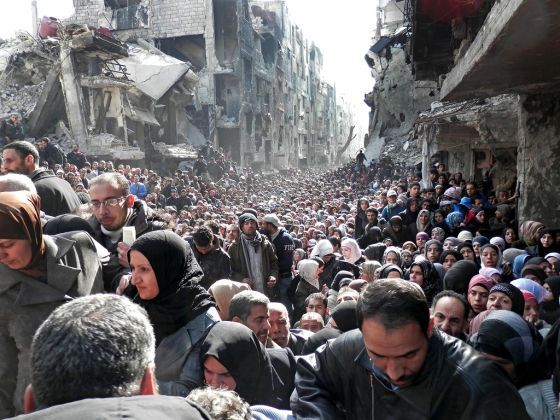
The Guardian reports: It is a vision of unimaginable desolation: a crowd of men, women and children stretching as far as the eye can see into the war-devastated landscape of Yarmouk refugee camp in Damascus.
A photograph released on Wednesday by the UN agency for Palestinian refugees, UNRWA, shows the scene when thousands of desperate Palestinians trapped inside the camp on the edge of the Syrian capital emerged to besiege aid workers attempting to distribute food parcels.
More than 18,000 people are existing under blockade inside Yarmouk, enduring acute shortages of food, medicines and other essentials. Much of the camp has been destroyed by shelling, and attempts to deliver aid to those inside have been hampered by continued fighting in Syria’s three-year-old civil war.
United Nations workers have delivered about 7,000 food parcels over recent weeks, following negotiations between the Syrian government, rebel forces and Palestinian factions within the camp. The most recent delivery, of 450 parcels, was on Wednesday. The UN acknowledges that the level of aid is a “drop in the ocean”. [Continue reading…]
Forget the NSA, the LAPD spies on millions of innocent folks
LA Weekly reports: Edward Snowden ripped the blinds off the surveillance state last summer with his leak of top-secret National Security Agency documents, forcing a national conversation about spying in the post-9/11 era. However, there’s still no concrete proof that America’s elite intelligence units are analyzing most Americans’ computer and telephone activity — even though they can.
Los Angeles and Southern California police, by contrast, are expanding their use of surveillance technology such as intelligent video analytics, digital biometric identification and military-pedigree software for analyzing and predicting crime. Information on the identity and movements of millions of Southern California residents is being collected and tracked.
In fact, Los Angeles is emerging as a major laboratory for testing and scaling up new police surveillance technologies. The use of military-grade surveillance tools is migrating from places like Fallujah to neighborhoods including Watts and even low-crime areas of the San Fernando Valley, where surveillance cameras are proliferating like California poppies in spring.
The use of militarized surveillance technology appears to be spreading beyond its initial applications during the mid-2000s in high-crime areas to now target narrow, specific crimes such as auto theft. Now, LAPD and the Los Angeles County Sheriff are monitoring the whereabouts of residents whether they have committed a crime or not. The biggest surveillance net is license plate reading technology that records your car’s plate number as you pass police cruisers equipped with a rooftop camera, or as you drive past street locations where such cameras are mounted. [Continue reading…]
Is solitary confinement an impossible idea?
Benjamin Wallace-Wells writes: On July 8 of last year, a 50-year-old man named Todd Ashker, an inmate at California’s Pelican Bay State Prison, began a hunger strike. He had compiled a list of demands, but the essential one was that the policy that dictated the terms of his imprisonment be abolished. Ashker was housed in Pelican Bay’s Security Housing Unit, the most restrictive prison unit in California and a place of extreme isolation. Convicts stay in their cells 23 hours a day and leave only to exercise in a concrete room, alone; their meals are fed into their cell through a slot. Other than an awareness that they are staring at the same blank wall as seven other men kept in their “pod,” they are completely alone. Ashker has been there since 1990; in his view, he has been subject to nearly a quarter-century of continuous torture. “I have not had a normal face-to-face conversation with another human being in 23 years,” he told me recently, speaking from the other side of a thick plate of glass.
The sheer length of time inmates spend here has made Pelican Bay a novel experiment in social control. The California prison system allows any confirmed gang member to be kept in the SHU indefinitely, with a review of his status only every six years. (Prisoners who kill a guard or another inmate, by contrast, are given a five-year term in the SHU.) This policy has filled Pelican Bay with men considered the most influential and dangerous gang leaders in California. Ashker, allegedly a senior member of the Aryan Brotherhood, had for years shared a pod with Sitawa Jamaa, allegedly the minister of education of the Black Guerrilla Family, and Arturo Castellanos, allegedly an important leader of the Mexican Mafia. In the next pod over was Antonio Guillen, allegedly one of three “generals” of Nuestra Familia. According to the state, these men have spent much of their lives running rival, racially aligned criminal organizations dedicated, often, to killing one another. But over a period of years, through an elaborate and extremely patient series of conversations yelled across the pod and through the concrete walls of the exercise room, the four men had formed a political alliance. They had a shared interest in protesting the conditions of their confinement and, eventually, a shared strategy. They became collaborators.
The men planned for the hunger strike meticulously. They had staged two more modest strikes in 2011, and afterward some had staged private fasts in their cells to try to learn how long they might be able to go without food. The four men had spent the spring putting on weight. Ashker had calculated how much water he needed to drink to keep his electrolytes balanced, his heart pumping: 240 ounces a day. In June, the men sent letters to an activist group detailing their grievances, explaining when the strike would begin, and asking other prisoners to join them. In letters to families and friends, they spread the word. Corrections officers throughout the state heard the news; on July 2, a few senior officials visited from Sacramento to meet with the prisoners and measure their intent. They left convinced the men were serious. Then, a few days later, the prisoners stopped eating.
The severity of his isolation meant that as the strike began, Ashker had little idea of what effect it was having or how many other prisoners had decided to join him. It turned out to be the largest coordinated hunger strike in American history. [Continue reading…]
Maidan, Ukraine … Tahrir, Egypt … the square symbolises failure, not hope
Simon Jenkins writes: The experience was eerie. I was watching a documentary, The Square, on Netflix about the 2011 Tahrir Square occupation when the lead character, Ahmed, let out a cry of delight, “The revolution has been won.” At that very moment my radio blurted out a voice live from a different square, Kiev’s Maidan. “The revolution has been won,” it repeated.
Squares are famously potent political theatres. This year is a second showing for Ukraine’s revolution, and a third for Egypt’s. Western TV viewers have cheered them all on. We thrill to see young people hurling rocks at power. Fire, smoke, bloodstained flags, broken heads, water, gas and sinister paramilitaries are Les Misérables for slow learners. We can sit with a front seat in the auditorium of history. It beats polling booths any day.
Tahrir and Maidan squares thus join Istanbul’s Taksim, Tehran’s Azadi, Beijing’s Tiananmen, Prague’s Wenceslaus, Athens’s Syntagma, London’s Trafalgar and a dozen other urban spaces the world over as icons of modern revolutionary politics. Their furniture is the barricade, their tipple the Molotov cocktail, their tonic the tear gas canister. They gather people in their thousands to sacred forums and invite the world to witness the latest trial of strength with a supposedly oppressive regime. Sometimes they even win.
If I were a dictator I would build shopping malls over these places right away, as Turkey’s Recep Erdoğan tried to do last year in Taksim’s Gezi Park. At the very least, I would learn the message of Tiananmen: that a crowd once formed in a square is fiendishly hard to remove, and creates worse publicity worldwide than a dozen provincial massacres.
Vladimir Putin reportedly damned Ukraine’s Viktor Yanukovych for failing immediately to remove crowds from Maidan, at whatever cost in brutality. It is hard to imagine Putin allowing an occupation of Red Square. [Continue reading…]
Watch: Zeynep Tufekci on social media-fueled protest style from Arab Spring to Gezi protests in Turkey
What can we learn from the protest wave of the last years? How does social media impact the capacity for collective action? Does social media contribute to blunting movement impacts by facilitating horizontal, non-institutional and “leaderless” movements? How do these movements compare with their predecessors like the civil-rights or anti-colonial movements? In this talk Zeynep Tufekci — assistant professor at the University of North Carolina, a faculty associate at Berkman Center for Internet & Society, and a fellow at the Center for Information Technology Policy at Princeton University — discusses these questions by drawing from research on a variety of social movements including the “Arab Spring”, European indignados movements, Occupy and Turkey’s Gezi protests. (October 15, 2013, Berkman Center for Internet & Society, Harvard University.)
NSA inspector general speaks on Snowden for first time, says he was ‘manic in his thievery’
Kevin Gosztola reports: During a day-long conference at the Georgetown University Law Center, Dr. George Ellard, the inspector general for the National Security Agency, spoke for the first time about the disclosures made by former NSA contractor Edward Snowden.
In addressing the alleged damage caused by Snowden’s disclosures he compared Snowden to Robert Hanssen, a former FBI agent and convicted spy who sold secrets to the Russians.
Ellard has been the NSA’s inspector general since 2007. In this capacity he has not spoken in a public forum before so that made what he said additionally significant. Had Snowden made the decision to report his concerns through approved NSA channels it would have been through Ellard’s office.
Ellard was part of a panel discussion on whether there was a “new paradigm of leaking.” The panel included Alex Abdo, staff attorney of the ACLU National Security Project, Georgetown Law professor David Cole and Kenneth Wainstein, former Homeland Security Advisor and former Assistant Attorney General for National Security.
When Ellard began his prepared statements, he acknowledged that he had approached this event with some level of trepidation. [Continue reading…]
White House considers four options for modifying NSA mass phone surveillance
The Wall Street Journal reports that administration lawyers have presented the White House with four options for reforming the NSA’s mass phone-surveillance program the first of which would require phone companies to store such data and deliver specific search requests.
A second option presented to the White House would have a government agency other than the NSA hold the data, according to a U.S. official. Candidates for this option could include the Federal Bureau of Investigation, which some current and former intelligence officials have recommended.
Another possibility floated in policy circles was turning the program over to the custody of the Foreign Intelligence Surveillance Court, which oversees the phone-data and other NSA surveillance programs, but judges have balked at an expanded role for the court.
A third option would be for an entity outside the phone companies or the government to hold the data, officials said. This approach has been criticized by privacy groups who say such a third party would just become an extension of the NSA and would provide no additional privacy benefit.
A final alternative would be to scrap the phone-data program and instead bolster investigative efforts under current authorities to obtain the information about possible terrorist connections some other way, an official said. Mr. Obama acknowledged this approach in his January speech, but said “more work needs to be done to determine exactly how this system might work.”
Leaked tapes prompt calls for Turkish PM to resign
The Guardian reports: Turkish opposition parties called on the prime minister to resign on Tuesday as a result of an explosive corruption scandal in which he was allegedly caught on tape ordering his son to get rid of millions of dollars in incriminating cash.
Recep Tayyip Erdogan responded in characteristically robust form, dismissing the allegations against him as a plot to bring down his government – the latest in a wave of accusations fuelling widespread popular protest against his 11-year rule.
Recordings of phone-tapped conversations leaked on the internet appear to capture Erdogan instructing his 33-year-old son, Bilal, to dispose of large amounts of hidden funds from their private home in the midst of a corruption investigation.
Erdogan has rejected the allegations as “complete lies”, insisting the recordings were fabricated to discredit his government. “Yesterday they published a play that they have assembled and dubbed themselves,” he told a meeting of his ruling Justice and Development party (AKP). “What has been done is a vile attack against the Republic of Turkey and her prime minister. If we bow to this, we will be doing injustice to all coming prime ministers and ministers.” [Continue reading…]
FBI had human source in contact with bin Laden as far back as 1993
The Washington Times reports: In a revelation missing from the official investigations of the Sept. 11, 2001, terrorist attacks, the FBI placed a human source in direct contact with Osama bin Laden in 1993 and ascertained that the al Qaeda leader was looking to finance terrorist attacks in the United States, according to court testimony in a little-noticed employment dispute case.
The information the FBI gleaned back then was so specific that it helped thwart a terrorist plot against a Masonic lodge in Los Angeles, the court records reviewed by The Washington Times show.
“It was the only source I know in the bureau where we had a source right in al Qaeda, directly involved,” Edward J. Curran, a former top official in the FBI’s Los Angeles office, told the court in support of a discrimination lawsuit filed against the bureau by his former agent Bassem Youssef.
Mr. Curran gave the testimony in 2010 to an essentially empty courtroom, and thus it escaped notice from the media or terrorism specialists. The Times was recently alerted to the existence of the testimony while working on a broader report about al Qaeda’s origins.
Members of the Sept. 11 commission, congressional intelligence committees and terrorism analysts told The Times they are floored that the information is just now emerging publicly and that it raises questions about what else Americans might not have been told about the origins of al Qaeda and its early interest in attacking the United States.
“I think it raises a lot of questions about why that information didn’t become public and why the 9/11 Commission or the congressional intelligence committees weren’t told about it,” said former Rep. Peter Hoekstra, Michigan Republican, who chaired the House Permanent Select Committee on Intelligence from 2004 through 2007 when lawmakers dealt with the fallout from the 9/11 Commission’s official report.
“This is just one more of these examples that will go into the conspiracy theorists’ notebooks, who say the authorities are not telling us everything,” Mr. Hoekstra told The Times in an interview last week. “That’s bad for the intelligence community. It’s bad for law enforcement and it’s bad for government.”
Former Rep. Lee Hamilton, an Indiana Democrat who co-chaired the 9/11 Commission with former New Jersey Gov. Thomas Kean, said that as far as he can remember, the FBI never told the commission that it had been working a source so close to bin Laden that many years before 9/11.
“I do not recall the FBI advising us of a direct contact with Osama bin Laden,” Mr. Hamilton told The Times in a recent interview. [Continue reading…]
Syria: Leader of the Nusra Front challenges ISIS
The Associated Press reports: The leader of a powerful al-Qaida-linked group in Syria gave a rival breakaway group a five-day ultimatum to accept mediation by leading clerics to end infighting or be “expelled” from the region.
The ultimatum announced in an audio recording by the leader of the Nusra Front aims to end months of deadly violence between the Islamic State of Iraq and the Levant and other Islamic factions. The fighting has killed hundreds of people since the beginning of the year and is undermining their wider struggle against President Bashar Assad.
It comes two days after the killing of Abu Khaled al-Suri, who had acted as al-Qaida chief Ayman al-Zawahri’s representative in Syria. Rebels and activists believe he was assassinated by two suicide attackers from the Islamic State of Iraq and the Levant.
Both the Nusra Front and the Islamic State of Iraq and the Levant are considered terrorist organizations by the United States.
Al-Zawahri has named the Nusra Front al-Qaida’s branch in Syria and broken ties with the Islamic State, which has increasingly clashed with rebel brigades in opposition-held areas of Syria. The Islamic State has angered other factions with its brutal tactics and campaign to Islamize areas under its control in the northeast.
More than 2,000 people have been killed in the fighting between the Islamic State and rebel groups, including the Nusra Front.
Abu Mohammed al-Golani, the Nusra Front leader, suggested in the audio recording arbitration by clerics to stop the infighting. He warned the Islamic State that it would be driven from Syria and “even from Iraq” if it rejected the results of arbitration. He did not elaborate on how his group might do that. [Continue reading…]
Guantanamo activist’s arrest sparks debate on foreign support for Syria
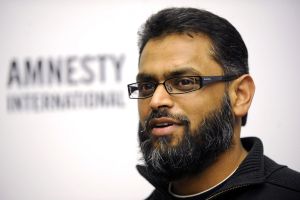
The Toronto Star reports: The arrest in Birmingham of Moazzam Begg, a former Guantanamo Bay detainee and outspoken critic of Britain’s counterterrorism policies, has sparked a debate about foreign support for Syria’s conflict and accusations that the activist’s detention was politically motivated.
Begg, a 45-year-old British citizen who spent more than three years in Guantanamo before being released in 2005 without charge, was one of four people arrested in a terrorism sweep by West Midlands police Tuesday on suspicion of facilitating terrorism overseas.
Although it is rare to identify detained suspects who are not charged, West Midlands police confirmed Begg’s arrest to local media due to “high public interest.”
“All four arrests are connected,” Detective Superintendent Shaun Edwards told The Guardian, referring to Begg and a 36-year-old man, a 44-year-old woman and her son, aged 20, who were also taken into custody. “They were all preplanned and intelligence-led. There was no immediate risk to public safety.”
He added: “We continue to urge anyone planning to travel to Syria to read the advice issued by the Foreign Office.”
Begg, who was reportedly also questioned on suspicion of attending a terrorist training camp, is the high-profile director of the London-based organization CAGE.
Through his advocacy work, he has met with foreign ministers, deputy prime ministers and Britain’s Lord Chancellor. According to a cable released through WikiLeaks, the U.S. ambassador to Luxembourg once commended Begg as an ally in the sensitive task of settling Guantanamo detainees whom the Pentagon has cleared for release.
Begg has found himself targeted by Western security services in the past and recently had his passport confiscated. In 2011, he was barred from boarding a direct flight from London to Toronto, where he was scheduled to give a speech. He was told he was being turned back in case the flight was rerouted to the U.S. [Continue reading…]
U.N.: Syrians soon to become world’s biggest refugee population, surpassing Afghans
The Associated Press reports: Syrians could soon overtake Afghans as the world’s biggest refugee population, with their numbers expected to pass 4 million by year’s end, a top U.N. official said Tuesday.
High Commissioner for Refugees Antonio Guterres spoke as the international community sharply urged Syria to comply with a new Security Council resolution demanding that President Bashar Assad and the opposition provide immediate access for humanitarian aid.
Opposition activists say more than 140,000 people have died in the conflict, which enters its fourth year next month. The U.N. says 9.3 million Syrians are in need of humanitarian assistance.
The number of Afghan refugees was 2.6 million at the end of 2012, UNHCR says. Syrians, with nearly 2.5 million registered as refugees, should overtake that long before the end of the year. About one-half of the refugees are children.