The Washington Post reports: The National Security Agency is harvesting hundreds of millions of contact lists from personal e-mail and instant messaging accounts around the world, many of them belonging to Americans, according to senior intelligence officials and top-secret documents provided by former NSA contractor Edward Snowden.
The collection program, which has not been disclosed before, intercepts e-mail address books and “buddy lists” from instant messaging services as they move across global data links. Online services often transmit those contacts when a user logs on, composes a message, or synchronizes a computer or mobile device with information stored on remote servers.
Rather than targeting individual users, the NSA is gathering contact lists in large numbers that amount to a sizable fraction of the world’s e-mail and instant messaging accounts. Analysis of that data enables the agency to search for hidden connections and to map relationships within a much smaller universe of foreign intelligence targets.
During a single day last year, the NSA’s Special Source Operations branch collected 444,743 e-mail address books from Yahoo, 105,068 from Hotmail, 82,857 from Facebook, 33,697 from Gmail and 22,881 from unspecified other providers, according to an internal NSA PowerPoint presentation. Those figures, described as a typical daily intake in the document, correspond to a rate of more than 250 million a year. [Continue reading…]
Author Archives: News Sources
Bush administration feared chemical weapons inspections would conflict with rationale for invading Iraq
The New York Times reports: More than a decade before the international agency that monitors chemical weapons won the Nobel Peace Prize, John R. Bolton marched into the office of its boss to inform him that he would be fired.
“He told me I had 24 hours to resign,” said José Bustani, who was director general of the agency, the Organization for the Prohibition of Chemical Weapons in The Hague. “And if I didn’t I would have to face the consequences.”
Mr. Bolton, then an under secretary of state and later the American ambassador to the United Nations, told Mr. Bustani that the Bush administration was unhappy with his management style.
But Mr. Bustani, 68, who had been re-elected unanimously just 11 months earlier, refused, and weeks later, on April 22, 2002, he was ousted in a special session of the 145-nation chemical weapons watchdog.
The story behind his ouster has been the subject of interpretation and speculation for years, and Mr. Bustani, a Brazilian diplomat, has kept a low profile since then. But with the agency thrust into the spotlight with news of the Nobel Prize last week, Mr. Bustani agreed to discuss what he said was the real reason: the Bush administration’s fear that chemical weapons inspections in Iraq would conflict with Washington’s rationale for invading it. Several officials involved in the events, some speaking publicly about them for the first time, confirmed his account. [Continue reading…]
The scary map of the Middle East is the current one
Rami G Khouri writes: An article and map in The New York Times’ Sunday edition two weeks ago examined the possibility that current upheavals may cause some Arab states to break up into smaller units. Written by the veteran foreign correspondent Robin Wright, the article created lively discussion among Middle East-focused circles in the United States, and in the Middle East it sparked wild speculation that it evidenced a new plan by Western powers, Israelis and others of evil intent to further partition large Arab countries into many smaller, weaker ones. The title of the article, “How 5 Countries Could Become 14,” naturally fed such speculation, as did the immediate linkage in millions of Arab minds of how British and French colonial officials in 1916-1918 partitioned the former Ottoman lands of the Levant into a series of new countries called Jordan, Syria, Lebanon, Iraq and Israel, while their colonial handiwork had also created new entities that ultimately became independent countries such as Kuwait, Bahrain, the United Arab Emirates and others.
Wright’s article explored the possibility that Libya could fracture into three units, Iraq and Syria into five units (of Druze, Kurds, Alawites, Sunnis and Shiites), Saudi Arabia into five units, and Yemen into two units. Syria might trigger such fragmentation across the region in stressed multisectarian societies. She did not advocate this, but only speculated whether sectarian stresses and conflicts might reconfigure countries that were not designed by the will of their own people.
Most critics of the article and map were horrified by the possibility that foreign powers may once again be at work redrawing the map of the Middle East, reaffirming two of the greatest lived traumas that have long plagued the Arab world: the ability and willingness of external powers to meddle deeply and structurally in our domestic condition, and the total inability of vulnerable, helpless Arab societies to do anything about this.
I understand the harsh reactions by Arabs who fear another possible redrawing of our map by foreign hands, but I fear that this is not really the bad news of the day; the really bad news is the state of existing Arab countries, and how most of them have done such a terrible job of managing the societies that they inherited after 1920.
The horror map is not the one published in the NYT two weeks ago; it is the existing map and condition of the Arab countries that have spent nearly a century developing themselves and have so little to show for it.
Not a single credible Arab democracy. Not a single Arab land where the consent of the governed actually matters. Not a single Arab society where individual men and women are allowed to use all their God-given human faculties of creativity, ingenuity, individuality, debate, free expression, autonomous analysis and full productivity. Not a single Arab society that can claim to have achieved a reasonably sustainable level of social and economic development, let alone anything approaching equitable development or social justice. [Continue reading…]
Radiation experts confirm polonium on Arafat clothing
AFP reports: Swiss radiation experts have confirmed they found traces of polonium on clothing used by Yasser Arafat which “support the possibility” the veteran Palestinian leader was poisoned.
In a report published by The Lancet at the weekend, the team provide scientific details to media statements made in 2012 that they had found polonium on Arafat’s belongings.
Arafat died in France on November 11 2004 at the age of 75, but doctors were unable to specify the cause of death. No autopsy was carried out at the time, in line with his widow’s request.
His remains were exhumed in November 2012 and samples taken, partly to investigate whether he had been poisoned — a suspicion that grew after the assassination of Russian ex-spy and Kremlin critic Alexander Litvinenko in 2006.
That investigation is ongoing, conducted separately by teams in France, Switzerland and Russia.
In the Lancet report, eight scientists working at the Institute of Radiation Physics and University Centre of Legal Medicine in Lausanne said they had carried out radiological tests on 75 samples. [Continue reading…]
Gov’t moves to keep NSA surveillance lawsuit away from Supreme Court
Ars Technica: Not long after widespread NSA phone surveillance was revealed by a series of leaks this summer, the Electronic Privacy Information Center, a privacy-oriented nonprofit, tried a bold and novel legal tactic: it appealed straight to the Supreme Court, asking for an immediate shutdown of the program.
The high court was the only place to turn, wrote EPIC, because it can’t go to Foreign Intelligence Surveillance Court (FISC), which actually authorized the orders. EPIC’s argument was straightforward: the FISC could only authorize NSA spying on foreigners, not Americans.
Now Solicitor General Donald Verrilli, who represents the Obama Administration at the Supreme Court, has advised the justices not to take the case. It’s not a surprising move. Just the publicity of a Supreme Court debate over NSA spying would be a giant headache for the administration; not to mention, the government obviously doesn’t want the program shut down.
How did a form of torture become policy in America’s prison system?
Andrew Gumbel writes: In 1831, Alexis de Tocqueville visited the Eastern State Penitentiary in Philadelphia to observe first-hand the effects of a peculiar — and, at the time, entirely novel — form of incarceration. The Quakers, who had opened the prison two years earlier, believed that long-term solitary confinement was an ideal form of religious penitence (whence the term penitentiary) and would hasten prisoners’ rehabilitation and reintegration into society. They saw it not as extreme punishment but as a progressive idea, far preferable to the giant holding pens typical of the age, where mutilations and violence among prisoners were common, and spiritual betterment all but unthinkable.
Tocqueville was favorably impressed. “Can there be a combination more powerful for reformation,” he wrote, “than that of a prison which hands over the prisoner to all the trials of solitude, leads him through reflection to remorse, through religion to hope, and makes him industrious by the burden of idleness?”
Ten years later, Dickens paid his own visit to Eastern State, and came away with a rather different opinion. Solitary confinement, he found, inflicted unimaginable torment on the minds of those subjected to it. Far from leading prisoners to enlightenment, it ruined their concentration and haunted them with hideous visions. They fell into deep despair, losing track of time and of themselves. “I hold this slow and daily tampering with the mysteries of the brain, to be immeasurably worse than any torture of the body,” he wrote in his American Notes for General Circulation:
[B]ecause its ghastly signs and tokens are not so palpable to the eye and sense of touch as scars upon the flesh; because its wounds are not upon the surface, and it extorts few cries that human ears can hear […] It wears the mind into a morbid state, which renders it unfit for the rough contact and busy action of the world.
Dickens was not alone. Harry Hawser, who wrote poems about his experience at Eastern State around the same time, hauntingly described the effects of being plunged into a “living tomb.” By the end of the 19th century, the Supreme Court noted that solitary confinement had caused many prisoners to fall “into a semi-fatuous condition,” and others still to kill themselves or to become violently insane. By World War I, the practice was largely abandoned.
Still, the idea never entirely went away, and in our bewildering world of chronically overcrowded, gang-infested prisons, it has returned with a vengeance. The new generation of high-security supermax prisons, whose spreading popularity over the past 40 years has coincided with an explosion in prisoner numbers, is premised on the notion that dangerous inmates — the “worst of the worst,” in official parlance — need to be kept separate from the general prison population, and from each other. [Continue reading…]
Why Julian Assange is a crucial historical figure
Benjamin Wallace-Wells writes: Assange’s entire public life has been an experiment on the theme of trust, one devoted to the conviction that the public trust in government has been badly misplaced. But for a time, in 2010, Assange felt a part of something larger—if not affiliated with any institution other than his own, then at least part of a broader political movement against American power. The Fifth Estate, a thoughtful drama out this week with the English actor Benedict Cumberbatch as Assange, focuses on the extraordinary eight-month period when WikiLeaks published the military’s war logs from Afghanistan and Iraq, the State Department’s internal cables, and the “Collateral Murder” video—everything that made Assange famous. There was a casual brutality to the way that powerful states and companies seemed to behave in these documents: A Shell executive bragged about having packed the Nigerian government with sympathizers, American military officers substantially underreported the numbers of Iraqi civilians their soldiers were killing. In London, WikiLeaks became an Establishment liberal cause, and the Australian found himself joined by human-rights crusaders who had been knighted by the queen, journalists and filmmakers, concerned citizens and TED Talk celebrities.
These allegiances were always bound to collapse—Assange is simply too weird, in his person and his politics, to have become part of any mainstream coalition—but they have collapsed so completely that there is little left of Assange’s public image right now beyond the crude cartoon. Vain and self-mythologizing, he has been accused of sexual assault by two of his supporters; a prophet of the mounting powers of the surveillance state, he now reportedly lives in a fifteen-by-thirteen-foot room in London’s Ecuadoran Embassy, sleeping in a women’s bathroom, monitored by intelligence agencies at all times; still trusting of the volunteers around him, he gave one such man access to secret American diplomatic cables about Belarus, only to find that information passed along to the Belarusian dictator. It is as if Assange has been consumed by his own weaknesses and obsessions. Calling around, I’d heard that the last prominent London intellectual who still supported him was the writer Tariq Ali, but when I finally reached him, via Skype, on an island in the Adriatic, it turned out that Ali, too, had grown exasperated with Assange. “He hasn’t formulated his worldview,” Ali said. “Certainly he is hostile to the American empire. But that’s not enough.” Assange has come to be seen, as a journalist at The Guardian put it, as nothing more than “a useful idiot.”
All of this is Assange’s own doing. And yet it is strange how completely these dramas have obscured the power of his insights and how fully we now seem to be living in Julian Assange’s world. His real topic never was war or human rights. It was always surveillance and the way that technology unbalanced the relationship between the individual and the state. Information now moves through electronic circuits, which means it can all be collected, stored, analyzed. The insight that Assange husbanded (and Snowden’s evidence confirmed) is that the sheer seduction of this trove—the possibility of secretly knowing everything about other people—would lead governments and companies to abandon their own laws and ethics. This is the paranoid worldview of a hacker, assembled from a lifetime of chasing information. But Assange proved that it was accurate, and the consequence of his discovery has been a strange political moment, when to see the world through the lens of conspiracies has not only made you paranoid. It’s also made you aware. [Continue reading…]
GCHQ accused of monitoring privileged emails between lawyers and clients
The Guardian reports: GCHQ is probably intercepting legally privileged communications between lawyers and their clients, according to a detailed claim filed on behalf of eight Libyans involved in politically sensitive compensation battles with the UK.
The accusation has been lodged with Britain’s most secret court, the investigatory powers tribunal (IPT), which examines complaints about the intelligence services and government use of covert surveillance. Most of its hearings are in private.
The allegation has emerged in the wake of the Guardian’s revelations about extensive monitoring by GCHQ of the internet and telephone calls, chiefly through its Tempora programme.
The system taps directly into fibre optic cables carrying the bulk of online exchanges transiting the UK and enables intelligence officials to screen vast quantities of data.
The eight Libyans, members of two families now living in the country’s capital, Tripoli, say they were victims of rendition. They claim they were kidnapped by MI6 and US intelligence agencies, forcibly returned to Colonel Muammar Gaddafi’s regime and tortured. At that time, in 2004, when Gaddafi relinquished his nuclear weapons programme, intelligence relations between Tripoli, London and Washington were close.
A landmark legal action between Abdel Belhaj, 47, and the UK government is due to be heard at the high court shortly to resolve the kidnap and torture allegations.
But lawyers working with the human rights group Reprieve fear their ability to fight the case will be undermined because their legal correspondence may be surreptitiously monitored. [Continue reading…]
Who should judge whether Snowden’s leaked secrets are too sensitive to report?
Nick Davies writes: In the last few days, two national newspapers – the Times and the Mail – have suggested that the Guardian has been wrong to publish material leaked by Edward Snowden on the specific grounds that journalists cannot be trusted to judge what may damage national security.
Ignore for a moment the vexing sight of journalists denouncing their own worth. Set aside too the question of why rival newspapers might want to attack the Guardian’s exclusives. Follow the argument. Who should make the judgment?
The official answer is that we should trust the security agencies themselves. Over the past 35 years, I’ve worked with a clutch of whistleblowers from those agencies, and they’ve all shared one underlying theme – that behind the screen of official secrecy, they had seen rules being bent and/or broken in a way which precisely suggested that the agencies should not be trusted. Cathy Massiter and Robin Robison, for example, described respectively MI5 and GCHQ pursuing politically motivated projects to spy on peace activists and trade unionists. Peter Wright told of MI5 illegally burgling its way across London “while pompous bowler-hatted civil servants in Whitehall pretended to look the other way”. David Shayler exposed a plot both lawless and reckless by MI5 and MI6 to recruit al-Qaida supporters to assassinate Colonel Gaddafi.
All of this was known to their bosses. None of it should have been happening. But the agencies in whom we are invited to place our trust not only concealed it but without exception then attacked the whistleblowers who revealed it. [Continue reading…]
New York Times says UK tried to get it to hand over Snowden documents
The Guardian reports: The editor of the New York Times, Jill Abramson, has confirmed that senior British officials attempted to persuade her to hand over secret documents leaked by the former National Security Agency contractor Edward Snowden.
Giving the newspaper’s first official comments on the incident, Abramson said that she was approached by the UK embassy in Washington after it was announced that the New York Times was collaborating with the Guardian to explore some of the files disclosed by Snowden. Among the files are several relating to the activities of GCHQ, the agency responsible for signals interception in the UK.
“They were hopeful that we would relinquish any material that we might be reporting on, relating to Edward Snowden. Needless to say I considered what they told me, and said no,” Abramson told the Guardian in an interview to mark the International Herald Tribune’s relaunch as the International New York Times.
The incident shows the lengths to which the UK government has gone to try to discourage press coverage of the Snowden leaks. In July, the government threatened to take legal action against the Guardian that could have prevented publication, culminating in the destruction of computer hard drives containing some of Snowden’s files. [Continue reading…]
Did the U.S. make a mistake in seizing Anas al-Liby?
Jamie Dettmer reports: For Americans, he is a monster, a major al-Qaeda leader who had a hand in the 1998 U.S. embassy bombings in Kenya and Tanzania that killed more than 224 civilians and—until U.S. Special Forces snatched him off the streets of Tripoli last week—a veteran terrorist tasked with uniting jihadists not just in Libya but across the arc of North Africa.
Sitting down, though, with his wife of 22 years and three sons in their cramped apartment, on the elevated ground floor of a small apartment building in a middle-class district in the Libyan capital on Saturday evening, I heard a different story that didn’t fit the bogeyman portrait drawn by American officials.
And it is one that prompts the question: has the U.S. got the right man?
For his family, Abu Anas al-Liby, to use his nom de guerre, is an easy-going husband and kind, playful father who, just days before a Delta Force team grabbed and bundled the 49-year-old out of Libya, told his oldest son, Abdullah, that he was looking forward to becoming a grandfather.
For them, he is a Libyan patriot who sacrificed a great deal. His commitment to the ousting of Libya’s longtime dictator, Col. Muammar Gaddafi, required them all to suffer, including several years of imprisonment in poor conditions in Iran after the family fled Afghanistan. They say they endured harassment and surveillance in Britain, where they sought political asylum and lived from 1997 to 2000. [Continue reading…]
Gaza chokes as Egypt’s economic garotte tightens
The Guardian reports: In Gaza City’s main market Mohammed Hilis stood disconsolately among piles of fruit and vegetables, waiting for customers. In the runup to Eid al-Adha, the second most important festival in the Muslim calendar, the market was unusually quiet. Steep price rises, unpaid salaries and layoffs – the consequences of the new Egyptian regime’s antipathy towards Hamas – have been painfully felt by the Gaza Strip.
“A kilo of tomatoes used to be one shekel [17p]; now it is five shekels. Most prices have gone up 50 – 60%,” said Hilis. “Why? Because of the costs of transportation, because there is no power to pump water to the fields, because there is no water. So people buy less.” As a result, his wages have slumped from 30 – 20 shekels a day, playing its small part in propelling the downward spiral of Gaza’s economy.
Six years after Israel imposed a stranglehold on Gaza as a punitive measure against the Hamas government, the strip of land along the Mediterranean is facing a new chokepoint from the south. After the Egyptian military forced President Mohamed Morsi out of office in July amid a brutal crackdown on the Muslim Brotherhood, the army embarked on a drive to regain control of the anarchic Sinai peninsula, isolate the Brotherhood’s allies in neighbouring Gaza, and halt the traffic in goods, weapons and people through the tunnels under the border with the Palestinian territory.
According to the commander of Egypt’s border guards force, Major-General Ahmad Ibrahim, almost 800 tunnels have been destroyed by his troops this year. Hamas is coy about the number of tunnels put out of action. But Hatem Owida, Gaza’s deputy economic minister, said activity had been reduced by 80-90% since the military takeover in Egypt. [Continue reading…]
Syrian combatants urged to let inspectors visit chemical sites
The New York Times reports: Pressure mounted on Syrian rebels on Monday to permit access to chemical weapons sites in areas under their control, as the head of the international watchdog on such toxic munitions said the rapidly shifting lines in the civil war made it difficult for inspectors to reach some locations.
Ahmet Uzumcu, director general of the Organization for the Prohibition of Chemical Weapons, which won the Nobel Peace Prize last Friday, told the BBC that the government of President Bashar al-Assad had been cooperating with inspectors who had reached 5 out of 20 chemical weapons production sites.
But some other sites had “access problems,” he said, reflecting perils and complexities facing inspectors who are trying to dismantle chemical weapons facilities as the war rages around them.
Some roads “change hands from one day to another, which is why we appeal to all sides in Syria to support this mission, to be cooperative and not render this mission more difficult,” Mr. Uzumcu said. “It’s already challenging.”
A Western diplomat in the Arab world, moreover, said that while the Syrian government was legally responsible for dismantling its chemical weapons, its opponents should cooperate in the process, as several chemical weapons sites were close to confrontation lines or within rebel-held territory.
“The international community also expects full cooperation from the opposition,” the diplomat said, speaking on condition of anonymity to discuss a sensitive issue.
There were clear signs from inspectors in Syria “that the government is delivering on its responsibilities and the opposition needs to hear a clear signal that they must play their part, too, in making sure that the inspectors have free and unhindered access to the chemical weapons sites with complete safety and security,” the diplomat said. “However divided the opposition might be, it would look very bad if the government was seen to be cooperating fully, while inspections were held up because of problems with the opposition.”
The inspection team has not publicly cited any specific instance of opposition fighters impeding access to chemical weapons sites. [Continue reading…]
America’s war against tribal Islam
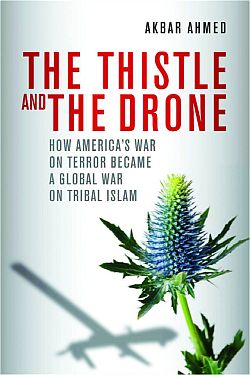
Malise Ruthven writes: Tolstoy’s novella Hadji Murad opens with the image of a beautiful thistle flower, wrenched from a ditch, that the narrator seeks to add to his bouquet. His effort to pluck it, however,
proved a very difficult task. Not only did the stalk prick on every side—even through the handkerchief I wrapped round my hand—but it was so tough that I had to struggle with it for nearly five minutes, breaking the fibres one by one; and when I had at last plucked it, the stalk was all frayed, and the flower itself no longer seemed so fresh and beautiful…. But what energy and tenacity! With what determination it defended itself, and how dearly it sold its life!
This late masterpiece, written in 1904 but never published in Tolstoy’s lifetime, was based on a real-life episode. In 1851 the Avar warlord Hajimurad al-Khunzaki, a confederate of the Imam Shamil, who led the resistance to Russia’s annexation of the Caucasus, betrayed his ally and went over to the Russians. In Tolstoy’s story he is driven by ambition, hoping to govern the Caucasian tribes under the “white tsar.”
The most telling portrayals in the story — apart from Hadji Murad himself, with his thistle-like mix of bravery, integrity, cunning, confusion, and childlike candor — are the complementary, almost symmetrical descriptions of Tsar Nicholas I and the Imam Shamil, both of whom are depicted as cold-eyed, ruthless autocrats who represent opposing forces of absolutism. As Tolstoy himself explained:
It is not only Haji Murad and his tragic end that interest me. I am fascinated by the parallel between the two main figures pitted against each other: Shamil and Nicholas I. They represent the two poles of absolutism — Asiatic and European.
The reality, however, was a great deal more complicated than a clash of absolutisms. Far from being the cold and ruthless autocrat depicted by Tolstoy, Shamil, as the murshid, or spiritual guide, of the orthodox Muslim Khalidiyya-Naqshbandiyya order, was a leader who sustained the loyalty of the warring Caucasian tribes by diplomacy rather than force. A Russian source described him as “a man of great tact and a subtle politician.” His charismatic appeal was underpinned by his reputation for piety and evenhandedness in dispensing justice in accordance with Islamic sharia norms. These had been severely tested when the Russians introduced alcohol into the region, corrupting, by sharia standards, the tribal chiefs who became their clients.
As a renowned warlord and tribal leader, Hadji Murad had been a Russian loyalist, defending Avaristan in the eastern part of Daghestan against Shamil’s encroachments. It was only after the Russians had replaced him as their client in Avaristan by a rival who had him arrested and abused that Hadji Murad responded to Shamil’s overtures and joined the jihad.
The result of his defection in January 1841 had been dramatic: by April Shamil ruled an area three times as large as at the beginning of 1840, with a cascade of formerly compliant clans joining the jihad. Hadji Murad’s rift with Shamil was a classic example of hubris. Hoping to be named his successor as imam, he refused to recognize the nomination of Shamil’s eldest son, Ghazi Muhammad. Faced with this challenge to his authority, Shamil convened a secret council that charged Hadji Murad with treason and sentenced him to death. Warned by friends, he redefected to the Russians in November 1851.
As an anthropologist with deep knowledge and direct experience of tribal systems, Akbar Ahmed demonstrates in The Thistle and the Drone how richly Tolstoy’s thistle metaphor applies to contemporary conditions in regions, distant from urban centers, where clans resist the writ of government while also engaging with it. He points to their “love of freedom” to act without external constraints, as well as
egalitarianism, [and] a tribal lineage system defined by common ancestors and clans, a martial tradition, and a highly developed code of honor and revenge — these are the thistle-like characteristics of the tribal societies…. Moreover, as with the thistle, there is a clear correlation between their prickliness, or toughness, and the level of force used by those who wish to subdue these societies, as the Americans discovered after 9/11.
Ahmed is especially troubled by the use of drones against Muslim tribal groups in Afghanistan, Pakistan, Yemen, and Somalia, but his analysis of the nature of the state and its relation with tribal peoples has application far beyond the condition of Muslim tribal societies. [Continue reading…]

Israel’s struggle to define itself
Joseph Dana writes: As the Second World War reached its height in the early 1940s, the largest Zionist paramilitary group in Palestine, known simply as the Irgun (the Organisation), sent a young emissary to the United States. His assignment was to raise money to save the Jews of Europe but the task quickly transformed into raising funds and diplomatic cover for the Irgun’s campaign of terror against the British in Palestine.
While in Washington, Hillel Kook, the Irgun’s emissary and the nephew of the Chief Ashkenazi Rabbi of Israel, Avraham Kook, changed his name to Peter Bergson. By most accounts, Bergson was successful at his task but during the operation in the United States his ideology transformed from traditional proto-Likud thinking into something more akin to the debate about a one-state solution in contemporary Israel/Palestine.
Peter Bergson was one of the first to argue for a “Hebrew” republic that would grant full rights to Jew and non-Jew alike. His essential argument was that the people of the land of Israel had an equal stake in the reformation of an ancient Hebrew republic while those outside could elect to join but should not apply external influence.
In the short term, both Palestinian and Jew had a shared interest in fighting together against the British mandate and, for Bergson, this partnership could materialise into something deeper after the goal of independence was achieved. He wanted a democratic Israel, which didn’t use Jewish ethnicity as a pretext for rights and was thus a state of all of its citizens. As history would have it, Bergson’s concept of a Hebrew republic never materialised.
While in Washington, Bergson distributed a number of pamphlets outlining his radical new approach to the conflict in the Middle East including a slim volume titled Manifesto of the Hebrew Nation which announced, in no uncertain terms, that “the Jews in the United States do not belong to the Hebrew nation. These Jews are Americans of Hebrew descent”. [Continue reading…]
Iran rejects West’s demand to ship out uranium stockpiles
Reuters reports: Iran on Sunday rejected the West’s demand to send sensitive nuclear material out of the country but signaled flexibility on other aspects of its atomic activities that worry world powers, ahead of renewed negotiations this week.
Talks about Iran’s nuclear programme, due to start in Geneva on Tuesday, will be the first since the election of Iranian President Hassan Rouhani, who has tried to improve relations with the West to pave a way for lifting economic sanctions.
Rouhani’s election in June to succeed Mahmoud Ahmadinejad has raised hopes of a negotiated solution to a decade-old dispute over Iran’s nuclear programme that could otherwise trigger a new war in the volatile Middle East.
Iranian Deputy Foreign Minister Abbas Araqchi’s comments on Sunday may disappoint Western officials, who want Iran to ship out uranium enriched to a fissile concentration of 20 percent, a short technical step away from weapons-grade material.
However, Araqchi, who will join the talks in Switzerland, was less hardline about other areas of uranium enrichment, which Tehran says is for peaceful nuclear fuel purposes but the West fears may be aimed at developing nuclear weapons capability.
“Of course we will negotiate regarding the form, amount, and various levels of (uranium) enrichment, but the shipping of materials out of the country is our red line,” he was quoted as saying on state television’s website. [Continue reading…]
Video — Syria 2013: As the U.S. steps back, France & Saudi Arabia step forward
Key Syria opposition group refuses Geneva peace talks
AFP reports: A key group within the Syrian opposition National Coalition said Sunday it would not attend proposed peace talks in Geneva and would quit the Coalition if it participated.
The decision deals a potential blow to international efforts to convene a peace conference in Geneva, which was first proposed for June but has been pushed back multiple times.
The Syrian Red Crescent meanwhile said it had evacuated around 1,500 people from a suburb of the capital Damascus that has been under a regime siege for months.
The president of Syrian National Council, the biggest member of the opposition Coalition, told AFP on Sunday that it was impossible to carry out negotiations given the suffering of people on the ground.
“The Syrian National Council, which is the biggest bloc in the Coalition, has taken the firm decision… not to go to Geneva, under the present circumstances (on the ground),” George Sabra told AFP.
“This means that we will not stay in the Coalition if it goes” to the peace talks, he added. [Continue reading…]

