Author Archives: News Sources

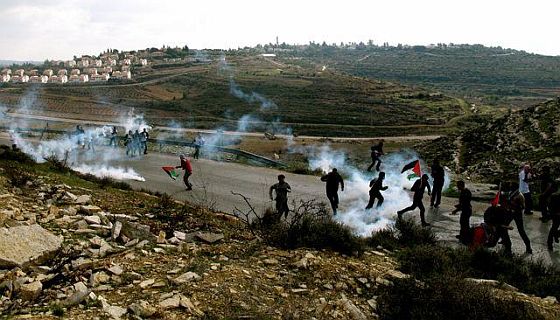
Is this where the Third Intifada will start?

Ben Ehrenreich writes: On the evening of Feb. 10, the living room of Bassem Tamimi’s house in the West Bank village of Nabi Saleh was filled with friends and relatives smoking and sipping coffee, waiting for Bassem to return from prison. His oldest son, Waed, 16, was curled on the couch with his 6-year-old brother, Salam, playing video games on the iPhone that the prime minister of Turkey had given their sister, Ahed. She had been flown to Istanbul to receive an award after photos of her shaking her fist at an armed Israeli soldier won her, at 11, a brief but startling international celebrity. Their brother Abu Yazan, who is 9, was on a tear in the yard, wrestling with an Israeli activist friend of Bassem’s. Nariman, the children’s mother, crouched in a side room, making the final preparations for her husband’s homecoming meal, laughing at the two photographers competing for shots from the narrow doorway as she spread onions onto oiled flatbreads.

On the living-room wall was a “Free Bassem Tamimi” poster, left over from his last imprisonment for helping to organize the village’s weekly protests against the Israeli occupation, which he has done since 2009. He was gone for 13 months that time, then home for 5 before he was arrested again in October. A lot happened during this latest stint: another brief war in Gaza, a vote in the United Nations granting observer statehood to Palestine, the announcement of plans to build 3,400 homes for settlers, an election in Israel. Protests were spreading around the West Bank.

That night, the call came at about 7:30. Twenty people squeezed into three small cars and headed to the village square. More neighbors and cousins arrived on foot. (All of Nabi Saleh’s 550 residents are related by blood or marriage, and nearly all share the surname Tamimi.) Then a dark Ford pulled slowly into the square, and everyone fell silent.

Bassem, who is 45, stepped out of the car, straight-spined, his blue eyes glowing in the lamplight. He seemed a little thinner and grayer than the last time I saw him, in July. He hugged and kissed his eldest son. Ahed was next, then one by one, in silence, Bassem embraced family and friends, Palestinian activists from Ramallah and Jerusalem, Israeli leftists from Tel Aviv. When he had greeted everyone, he walked to the cemetery and stopped in front of the still-unmarked grave of his brother-in-law Rushdie, who was shot by Israeli soldiers in November while Bassem was in prison. He closed his eyes and said a quick prayer before moving on to the tomb of Mustafa Tamimi, who died after being hit in the face by a tear-gas canister in December 2011.

Back at home, Bassem looked dazed. Nariman broke down in his arms and rushed outside to hide her tears. The village was still mourning Rushdie’s death, but the young men couldn’t keep up the solemnity for long. They started with little Hamoudi, the son of Bassem’s cousin, tossing him higher and higher in the air above the yard. They set him down and took turns tossing one another up into the night sky, laughing and shouting as if they never had anything to grieve. [Continue reading…]


Facebooktwittermail

Saudi Arabia may stop beheading due to swordsmen shortages

Al Ahram reports: A joint Saudi committee composed of representatives of the ministries of interior, justice and health is mulling the replacement of beheading with firing squads for capital sentences due to shortages in government swordsmen, Saudi daily Al-Youm reported on Sunday.

The committee argued that such a step, if adopted, would not violate Islamic law, allowing heads – or emirs – of the country’s 13 local administrative regions to begin using the new method when needed.

“This solution seems practical, especially in light of shortages in official swordsmen or their belated arrival to execution yards in some incidents; the aim is to avoid interruption of the regularly-taken security arrangements,” the committee said in a statement.

The ultra-conservative Gulf kingdom beheaded 76 people in 2012, according to an AFP tally based on official figures. Human Rights Watch (HRW) put the number at 69.

Rape, murder, apostasy, armed robbery and drug trafficking are all punishable by death under Saudi Arabia’s strict version of Sharia, or Islamic Law.

Facebooktwittermail

The Muslim Brotherhood’s fight against women’s rights

The New York Times reports: During its decades as an underground Islamist movement, the Muslim Brotherhood has long preached that Islam required women to obey their husbands in all matters.

“A woman needs to be confined within a framework that is controlled by the man of the house,” Osama Yehia Abu Salama, a Brotherhood family expert, said of the group’s general approach, speaking in a recent seminar for women training to become marriage counselors. Even if a wife were beaten by her husband, he advised, “Show her how she had a role in what happened to her.”

“If he is to blame,” Mr. Abu Salama added, “she shares 30 percent or 40 percent of the fault.”

Now, with a leader of the Brotherhood’s political arm in Egypt’s presidential palace and its members dominating Parliament, some deeply patriarchal views the organization has long taught its members are spilling into public view. The Brotherhood’s strident statements are reinforcing fears among many Egyptian liberals about the potential consequences of the group’s rise to power and creating new awkwardness for President Mohamed Morsi as he presents himself as a new kind of moderate, Western-friendly Islamist.

In a statement Wednesday on a proposed United Nations declaration to condemn violence against women, the Brotherhood issued a list of objections, which formally laid out its views on women for the first time since it came to power.

In its statement, the Brotherhood said that wives should not have the right to file legal complaints against their husbands for rape, and husbands should not be subject to the punishments meted out for the rape of a stranger.

A husband must have “guardianship” over his wife, not an equal “partnership” with her, the group declared. Daughters should not have the same inheritance rights as sons. Nor should the law cancel “the need for a husband’s consent in matters like travel, work or use of contraception” — a reform in traditional Islamic family law that was enacted under former President Hosni Mubarak and credited to his wife, Suzanne.

Egypt’s Daily News adds: The National Council for Women (NCW) denied in a statement released on Thursday that a declaration regarding violence against women currently being drafted in the 57th United Nations’ Commission on the Status of Women breaches Islamic Shari’a.

The Muslim Brotherhood released a statement on Wednesday denouncing the declaration for “contradicting principles of Islam and destroying family life and the entire society”.

“The Brotherhood’s statement is completely unfounded,” the NCW said in its statement. The council added that the final draft of the declaration is yet to be released and voted on.

The council denied that the declaration goes against the principles of Islam, eliminates Islamic manner or destroys families. “This misleading allegation abuses religion to taint the UN and stall women’s rights,” the statement read. It added that the “accusations” referred to in the Brotherhood’s statement are all non-existent in the draft declaration.

“The points mentioned in the Brotherhood’s statement cannot be found in the declaration; neither literally nor metaphorically,” said Abeer Abul Ella, head of the NCW’s media office.

In its statement, the Muslim Brotherhood listed ten points allegedly present within the declaration which represent “the final step in the intellectual and cultural invasion of Muslim countries”.

Facebooktwittermail

Pope Francis’s book reveals a radical progressive in the making

The Guardian reports: The In his own words, Pope Francis comes over as a clever, thoughtful and skilful mixture of social conservative and radical progressive who preaches zero tolerance of pederast priests but whose own behaviour during the terror of Argentina’s military juntas remains decidedly blurred.

In his latest book, On Earth and Heaven, the man then known as Jorge Bergoglio, discusses the divine and the mundane with the prominent Jewish rabbi Abraham Skorka in a series of conversations published in 2010.

Bergoglio appears as a man with a profound social conscience, expressing admiration of some atheist socialists and professing a genuine belief in interfaith dialogue – to the extent that some radical Catholics accuse him of heresy.

He is critical of those who covered up the paedophile scandal that has done so much damage to the church he now leads.

“The idea that celibacy produces paedophiles can be forgotten,” he says. “If a priest is a paedophile, he is so before he becomes a priest. But when this happens you must never look away. You cannot be in a position of power and use it to destroy the life of another person.”

Bergoglio says he has never had to deal with such a case, but when a bishop asked what he should do, he told him the priest should be sacked and tried, that putting the church’s reputation first was a mistake.

“I think that is the solution that was once proposed in the United States; of switching them to other parishes,” he says. “That is stupid, because the priest continues to carry the problem in his backpack.” The only answer to the problem, he adds, is zero tolerance. [Continue reading…]

Facebooktwittermail

Argentina’s dirty war casts a shadow over Pope Francis

Franz Jalics SJ

Christopher Dickey reports: The new pope won over the crowd in St. Peter’s Square on Wednesday night with his kindly voice and humble words. But whispers about his past hover like a threatening storm over his papacy. When Jorge Mario Bergoglio, now Pope Francis, was the head of the Jesuit order in Argentina, did he do too little to protect his priests from a savage military dictatorship? Or, worse, did he denounce some of them as guerrilla sympathizers, virtually sentencing them to death?

The allegations are not new, but they are persistent.

“It was the time of the civil war between the extreme right-wing and left-wing groups in Argentine society,” wrote Franz Jalics, an Argentine priest [correction: he’s Hungarian], looking back decades later. It was 1976, and after years of growing violence by various guerrilla groups, a military junta had seized power in Buenos Aires. The secretive campaign waged by the generals, known as the “dirty war,” was ferocious. Thousands of people were “disappeared” at the hands of a special Navy unit that took some prisoners to concentration camps and threw others into the sea from helicopters.

One Sunday morning the unit came for Jalics and another Jesuit priest, Orlando Yorio. Rumor had it that the two were sympathetic to the guerilla groups. An influential member of the local Catholic hierarchy had apparently confirmed that information to the junta.

Their tormentors used drugs and torture to try to make them talk. For five months, blindfolded and chained the whole time, the priests lived in terror, convinced that at any second they’d be killed. “My fears don’t seem exaggerated to me even today,” Jalics wrote, nearly 20 years later. When the dictatorship ended and several commanders were put on trial, he wrote, “there were no surviving witnesses from the 6,000 people whom this particular group had abducted. Only we two survived. All the others had been killed.”

In Jalics’s book, first published in 1994, he writes about the intense rage he felt against the man (unnamed) he believed had betrayed him in meetings with the military. More recently Argentine muckraker Horacio Verbitsky reported in a series of detailed articles and in his own book that the betrayer was Bergoglio, head of the Jesuit order in Argentina at the time. Verbitsky bases that allegation on interviews with Yorio, who died of natural causes in 2000, and on several documents.

Jalics does not name the object of his rage himself, and appears never to have confirmed Verbitsky’s reports publicly. Why? Perhaps because, as Jalics writes, he forgave his enemy as Christians are supposed to do.

Bergoglio’s fellow cardinals certainly knew about the allegations, but chose not to believe them when they voted for him to be pope. Australia’s Cardinal George Pell told a television interviewer on Thursday: “Those stories were dismissed years ago. They were a smear and a lie. They were laid to rest years ago.”

Not really. As recently as October 2012, Argentina’s bishops under Bergoglio’s leadership issued a collective apology for failing to protect their flock adequately during the dictatorship, blaming both the right-wing generals and the left-wing guerrillas for the years of bloodshed. The Daily Beast’s Mac Margolis reports from Rio de Janeiro that Bergoglio’s biographer, Sergio Rubín, has been defending the new pope in the press by claiming that his “nonconfrontational” attitude toward the junta was pragmatism at a time when many people were being persecuted, tortured, and killed.

As Rubín tells the story, Bergoglio persuaded the chaplain of the junta’s leader to call in sick so Bergoglio could go to the general’s home to say Mass and raise the question of the abducted priests personally. Rubín argues that Bergoglio’s later reluctance to talk about his role during the dirty war is a sign of “humility.”

“What is a well-established point is that the leadership of the Catholic Church in Argentina during the dictatorship was pretty much silent,” says José Miguel Vivanco, director of the Americas division at Human Rights Watch in New York. He won’t comment on the allegations against the new pope, but acknowledges that “some bishops were openly sympathetic to the military junta.”

Jalics’s humble little book is not an exposé like Verbitsky’s, it is not a smear, and it does not read like a lie. I bought it on Thursday morning in the “spirituality” section of a store run by nuns a couple of blocks from St. Peter’s Square. Its title is Contemplative Retreat: An Introduction to the Contemplative Way of Life and to the Jesus Prayer.

Only six of the book’s 332 pages deal with Jalics’s experiences in 1976 and what happened to him afterward, and he tells the story as an example of the power of contemplation, the importance of forgiveness. The entire grim experience, he claims, was a source of “purification.”

“I went to this particular person to tell him that he was playing with our lives. The man promised me he would communicate to the military that we were not terrorists.” [Continue reading…]

Facebooktwittermail

A divine threat to Argentina?

Martín Caparrós writes: This week, Habemus papam — we have a pope — became an Argentine idiom. [Jorge Mario Bergoglio’s] election underlines the assumption that the center of Catholicism is shifting to the world’s poorer regions of Africa, Asia and Latin America. And yet in his own country, the poor are migrating en masse to Pentecostal and other Christian churches that are more charismatic and less institutionally compromised than the Old Lady from Rome.

Perhaps Pope Francis’ election will reverse that shift. In fact, I dread the effect that this unexpected divine favor will have on my country. We are a society that turned to tennis once Guillermo Vilas won a Grand Slam in France; grew obsessed with basketball when Manu Ginobili made his mark in the American N.B.A.; started raving about monarchy when an Argentine-born princess married the crown prince of the Netherlands; and has persisted in doubting Jorge Luis Borges’s value because he never won the international honor of a Nobel Prize. The fact that “one of us” is now sitting on St. Peter’s throne may have a huge effect on the weight of Catholicism on our lives.

Catholicism has never excelled at letting nonbelievers live as they believe they should. The right to legal abortion, for one, will be a ruthless field of that battle: “our” pope will surely never allow his own country, where legal abortion remains severely limited, to set a bad example. Here, as everywhere, the Vatican is a main lobbying force for conservative, even reactionary, issues. An Argentine pope can bring this power to uncharted heights.

Or perhaps not. I hope I am wrong: it has often been my lot. For infallibility, please ask for el Papa Francisco.

Facebooktwittermail

Obama’s plan to expand the war on terrorism

Rosa Brooks writes: When a government is accused of activities that stretch or violate the law, it has three choices: 1) change the activities to conform with the law; 2) change the law to conform with the activities; or 3) lie (about the nature of the activities, the meaning of the law, or both).

Option 3 isn’t a comfortable one for the Obama administration, which is, thank heaven, not prone to outright lying. Some senior officials tolerate a moderate amount of fudging and obfuscation, but when the fudge factor gets too high, it induces visible queasiness. Over the last couple of weeks, we’ve seen more than a little such discomfort on the faces of those stuck with justifying U.S. drone policy to Congress and the public.

That’s not surprising: As the targets of U.S. drone strikes have expanded from senior Taliban and al Qaeda operatives to a far broader range of individuals with only the most tenuous links to al Qaeda, the administration’s legal arguments for targeted killings have grown ever more tortured and complex. In particular, it’s gotten progressively more difficult for officials to avoid blushing while claiming that U.S. drone policy is fully consistent with Congress’s 2001 Authorization for Use of Military Force (AUMF), which authorizes force only against those who bear some responsibility for the 9/11 attacks.

With Option 3 — lie, lie, lie — off the table, and fudging and obfuscation growing harder to comfortably sustain, the thoughts of administration officials turn naturally to Option 2: change the law. Thus, as the Washington Post reported last weekend, some administration officials are apparently considering asking Congress for a new, improved “AUMF 2.0,” one that would place U.S. drone policy on firmer legal footing.

Just who is behind this notion is unclear, but the idea of a revised AUMF has been gaining considerable bipartisan traction outside the administration. In a recent Hoover Institution publication, for instance, Bobby Chesney, who served in the Obama Justice Department, teams up with Brookings’s Ben Wittes and Bush administration veterans Jack Goldsmith and Matt Waxman to argue for a revised AUMF — one that can provide “a new legal foundation for next-generation terrorist threats.”

I’m as fond of the rule of law as the next gal, so in a general sense, I applaud the desire to ensure that future executive branch counterterrorist activities are consistent with the laws passed by Congress. But “laws” and “the rule of law” are two different animals, and an expanded new AUMF is a bad idea.

Sure, legislative authorization for the use of force against “next generation” terrorist threats would give an additional veneer of legality to U.S. drone policy, and make congressional testimony less uncomfortable for John Brennan and Eric Holder. But an expanded AUMF would also likely lead to thoughtless further expansion of targeted killings. This would be strategically foolish, and would further undermine the rule of law.

An expanded AUMF is also unnecessary. Even if Congress simply repealed the 2001 AUMF (as the New York Times editorial board urges) instead of revising it, the president already has all the legal authority he needs to keep the nation safe.

If U.S. drone policy is currently on shaky legal ground, it’s not for lack of inherent executive authority (or international law authority) to use force against any terrorist organization that poses an imminent and grave threat to the United States. U.S. drone policy is on shaky legal ground because the administration has lost sight of the difference between threats that are imminent and grave and threats better characterized as speculative and minor. [Continue reading…]

Facebooktwittermail

Prisoner protest at Guantánamo Bay stains Obama’s human rights record

Amy Goodman writes: Reports are emerging from the US military prison at Guantánamo Bay that a majority of the prisoners are on a hunger strike. Of the detainees, 166 remain locked up, although more than half have been cleared by the Obama administration for release. Yet, there they languish – in some cases, now in their second decade – in a hellish legal limbo, uncharged yet imprisoned.

President Barack Obama’s failure to close Guantánamo, as he boldly promised to do with an executive order signed on 22 January 2009, and the deterioration of conditions at the prison under his watch will remain a lasting stain on his legacy. From Guantánamo, Yemeni prisoner Bashir al-Marwalah wrote to his lawyer:

“We are in danger. One of the soldiers fired on one of the brothers a month ago. Before that, they send the emergency forces with M-16 weapons into one of the brothers’ cell blocks … Now they want to return us to the darkest days under Bush. They said this to us. Please do something.”

Al-Marwalah was referring to the first recorded use of rubber bullets being fired at a Guantanamo prisoner by the US military guards there. [Continue reading…]

Facebooktwittermail

Blackwater — a virtual extension of the CIA

Eli Lake reports: Last month a three-year-long federal prosecution of Blackwater collapsed. The government’s 15-felony indictment — on such charges as conspiring to hide purchases of automatic rifles and other weapons from the Bureau of Alcohol, Tobacco, Firearms, and Explosives — could have led to years of jail time for Blackwater personnel. In the end, however, the government got only misdemeanor guilty pleas by two former executives, each of whom were sentenced to four months of house arrest, three years’ probation, and a fine of $5,000. Prosecutors dropped charges against three other executives named in the suit and abandoned the felony charges altogether.

But the most noteworthy thing about the largely failed prosecution wasn’t the outcome. It was the tens of thousands of pages of documents — some declassified — that the litigation left in its wake. These documents illuminate Blackwater’s defense strategy — and it’s a fascinating one: to defeat the charges it was facing, Blackwater built a case not only that it worked with the CIA — which was already widely known—but that it was in many ways an extension of the agency itself.

Founded in 1997 by Erik Prince, heir to an auto-parts family fortune, Blackwater had proved especially useful to the CIA in the early 2000s. “You have to remember where the CIA was after 9/11,” says retired Congressman Pete Hoekstra, who served as the Republican chairman of the House Permanent Select Committee on Intelligence from 2004 to 2006 and later as the ranking member of the committee. “They were gutted in the 1990s. They were sending raw recruits into Afghanistan and other dangerous places. They were looking for skills and capabilities, and they had to go to outside contractors like Blackwater to make sure they could accomplish their mission.” [Continue reading…]

Facebooktwittermail

Why gun makers fear the NRA

Bloomberg: In the days after the Sandy Hook Elementary School massacre on Dec. 14, executives with a half-dozen major U.S. gun manufacturers contacted the National Rifle Association. The firearm industry representatives didn’t call the NRA, which they support with millions of dollars each year, to issue directives. On the contrary, they sought guidance on how to handle the public-relations crisis, according to people familiar with the situation who agreed to interviews on the condition they remain anonymous.

While the Obama administration had reacted meekly to mass shootings in Tucson and Aurora, Colo., Sandy Hook would be different. Twenty first-graders were dead. The president, a gun control supporter who previously had avoided the radioactive issue, wiped away tears when talking on television about the “beautiful little kids.” As a nation, the normally stoic president added, “We have been through this too many times.” In crass political terms, he was newly reelected and had less to lose in confronting pro-gun forces. The NRA’s leadership faced a choice: Go to the mattresses as usual, or acknowledge the special horror of Sandy Hook and offer an olive branch.

That decision rested with Wayne LaPierre, the NRA’s chief executive since 1991. One of Washington’s most durable and enigmatic power brokers, LaPierre arrived at the organization in 1978 with a master’s in political science from Boston College. The bookish Roanoke (Va.) native didn’t know much about firearms. Colleagues joked that duck hunting with Wayne was more dangerous for the hunters than the ducks. Nevertheless, driven by an ambition impressive even by Washington standards, he rose swiftly, a mild-mannered presence in private who developed an Elmer Gantry-like persona for speeches and interviews.

In the immediate wake of Sandy Hook, the NRA reassured nervous gun company reps that they could stand down, according to people familiar with the situation. LaPierre would handle it.

One week after the massacre, he delivered a nationally televised tirade tinged with his trademark cultural resentment and paranoia. “Is the press and the political class here in Washington, D.C., so consumed by fear and hatred of the NRA and American gun owners,” he said, “that you’re willing to accept the world where real resistance to evil monsters is [an] unarmed school principal left to surrender her life, her life, to shield those children in her care?”

As intended, LaPierre’s performance received massive media attention. It also upset many—including some gun makers. “The funerals were still going on in Newtown,” says Joseph Bartozzi. “Parents were burying their children.” A senior vice president at O.F. Mossberg & Sons, a shotgun and rifle manufacturer in North Haven, Conn., Bartozzi belongs to the NRA and applauds its stalwart defense of Second Amendment rights. But this time, LaPierre’s diatribe struck him as ill-timed and graceless.

The companies that make and market firearms might prefer a softer tone, but they rarely complain publicly about NRA fear mongering because it’s been so good for business. Corporate donations to the NRA, which together with its affiliates has annual revenue of $250 million, have risen during the past decade, a period when the organization has taken increasingly absolutist positions. Still, it’s not the industry that muscles the NRA.

“NRA leadership worries about two things above all else: perpetuating controversy to stimulate fundraising from individual members and protecting its right flank from the real crazies,” says Richard Feldman, author of a feisty 2007 memoir, Ricochet: Confessions of a Gun Lobbyist. Feldman has worked in various capacities for both the NRA and the industry. “The idea that the NRA follows orders from the gun companies is a joke,” he says. “If anything, it’s the other way around.”

NRA spokesman Andrew Arulanandam declined to comment for this article, as did LaPierre and other top officials at the lobby group’s Fairfax (Va.) headquarters. New York Mayor Michael Bloomberg, a gun control advocate, founded Bloomberg LP, which owns this magazine.

Gun companies defer to the NRA for two main reasons: First, there’s intimidation. The lobby group has incited potentially ruinous consumer boycotts against firearm makers that fail to follow the NRA line with sufficient zeal. Second, regardless of some executives’ concerns about civil discourse, gun companies benefit financially from the NRA’s hype. Alarms about imminent gun confiscation—an NRA staple, despite its implausibility—reliably send firearm owners back to retail counters. Sales are booming. Mossberg is running three shifts a day. “Demand,” Bartozzi says, “is very strong.” [Continue reading…]

Facebooktwittermail

Pope Francis: questions remain over his role during Argentina’s dictatorship

The Guardian reports: As head of the Jesuit order from 1973 to 1979, Jorge Bergoglio – as the new pope was known until yesterday – was a member of the hierarachy during the period when the wider Catholic church backed the military government and called for their followers to be patriotic.

Bergoglio twice refused to testify in court about his role as head of the Jesuit order. When he eventually appeared in front of a judge in 2010, he was accused by lawyers of being evasive.

The main charge against Bergoglio involves the kidnapping of two Jesuit priests, Orland Yorio and Francisco Jalics, who were taken by Navy officers in May 1976 and held under inhumane conditions for the missionary work they conducted in the country’s slums, a politically risky activity at the time.

His chief accuser is journalist Horacio Verbitsky, the author of a book on the church called “El Silencio” (“The Silence”), which claims that Bergoglio withdrew his order’s protection from the two priests, effectively giving the military a green light for their abduction.

The claims are based on conversations with Jalics, who was released after his ordeal and later moved to a German monastery.

Bergoglio has called the allegations “slander” and holds that, on the contrary, he moved behind the scenes to save the lives of the two priests and others that he secretly hid from the death squads. In one case, he claims he even gave his identity papers to one dissident who looked like him so that he could flee the country.

For some, that makes him a hero. Other are sceptical. Eduardo de la Serna, co-ordinator of a left-wing group of priests who focus on the plight of the poor, told Radio del Plate that: “Bergoglio is a man of power and he knows how position himself among powerful people. I still have many doubts about his role regarding the Jesuits who went missing under the dictatorship.”

Many in the church are keen to move on from that dark period in the history of Argentina and the church. They say the new pope helped to heal the wounds of the dirty war and to restore the credibility of the Catholic hierarchy.

Facebooktwittermail

A high-security ghetto for London’s new global super-rich

Nicholas Shaxson writes: Up until the 18th century, Knightsbridge, which borders genteel Kensington, was a lawless zone roamed by predatory monks and assorted cutthroats. It didn’t come of age until the Victorian building boom, which left a charming legacy of mostly large and beautiful Victorian houses, with their trademark white or cream paint, black iron railings, high ceilings, and short, elegant stone steps up to the front door.

This will not be the impression a visitor now gets as he emerges from the Knightsbridge subway station’s south exit. He will be met by four hulking joined-up towers of glass, metal, and concrete, sandwiched between the Victorian splendors of the Mandarin Oriental Hotel, to the east, and a pretty five-story residential block, to the west. This is One Hyde Park, which its developers insist is the world’s most exclusive address and the most expensive residential development ever built anywhere on earth. With apartments selling for up to $214 million, the building began to smash world per-square-foot price records when sales opened, in 2007. After quickly shrugging off the global financial crisis the complex has come to embody the central-London real-estate market, where, as high-end property consultant Charles McDowell put it, “prices have gone bonkers.”

From the Hyde Park side, One Hyde Park protrudes aggressively into the skyline like a visiting spaceship, a head above its red-brick and gray-stone Victorian surroundings. Inside, on the ground floor, a large, glassy lobby offers what you’d expect from any luxury intercontinental hotel: gleaming steel statues, thick gray carpets, gray marble, and extravagant chandeliers with radiant sprays of glass. Not that the building’s inhabitants need venture into any of these public spaces: they can drive their Maybachs into a glass-and-steel elevator that takes them down to the basement garage, from which they can zip up to their apartments.

The largest of the original 86 apartments (following some mergers, there are now around 80) are pierced by 213-foot-long mirrored corridors of glass, anodized aluminum, and padded silk. The living spaces feature dark European-oak floors, Wenge furniture, bronze and steel statues, ebony, and plenty more marble. For added privacy, slanted vertical slats on the windows prevent outsiders from peering into the apartments.

In fact, the emphasis everywhere is on secrecy and security, provided by advanced-technology panic rooms, bulletproof glass, and bowler-hatted guards trained by British Special Forces. Inhabitants’ mail is X-rayed before being delivered. [Continue reading…]

Facebooktwittermail

Secularism, the Arab way

Issandr El Amrani writes: Free Arabs, a new Web site run by a group of Arabs — some in the Middle East, others in the West — is causing a stir. Gathered under the slogan “Democracy, Secularism, Fun,” it laments the fact that “millions of Arabs have internalized the notion that secularism is tantamount to faithlessness, and is all about demonizing Islam and promoting a dissolute way of life.

Not only can secularism coexist with religion, Free Arabs argues, but it protects the free exercise of religion and can help promote other civil liberties, like gay rights.

The group is defending a no-compromise version of secularism — one that may be too much to ask of many Arab politicians, particularly those in the fledging new liberal parties that have emerged since the Arab uprisings.

Some don’t want to be dragged into culture wars, a favorite ground for Islamists who bank on the fact that many Arab societies are still socially conservative. Others are just plain conservative themselves, even on issues far more basic than gay rights — like whether gender equality should be applied to inheritance and other questions traditionally governed by Islamic law.

Still, the controversy triggered by Free Arabs is just the kind of debate Islamists and secularists in the Arab world should be having, if only because they couldn’t have had it under the old regimes. Also, there’s plenty of room for debate: In this part of the world, the term “secular” means very different things to different people. [Continue reading…]

Facebooktwittermail

Iraq’s pain has only intensified since 2003

Sami Ramadani writes: It has always been painful for me to write about Iraq and Baghdad, the land of my birth and the city of my childhood. They say that time is a great healer, but, along with most Iraqis, I feel the pain even more deeply today. But this time the tears for what has already happened are mixed with a crippling fear that worse is yet to come: an all-out civil war. Ten years on from the shock and awe of the 2003 Bush and Blair war – which followed 13 years of murderous sanctions, and 35 years of Saddamist dictatorship – my tormented land, once a cradle of civilisation, is staring into the abyss.

Wanton imperialist intervention and dictatorial rule have together been responsible for the deaths of more than a million people since 1991. And yet, according to both Tony Blair and the former US secretary of state Madeleine Albright, the “price is worth it“. Blair, whom most Iraqis regard as a war criminal, is given VIP treatment by a culpable media. Iraqis listen in disbelief when he says: “I feel responsibility but no regret for removing Saddam Hussein.” (As if Saddam and his henchmen were simply whisked away, leaving the people to build a democratic state). It enrages us to see Blair build a business empire, capitalising on his role in piling up more Iraqi skulls than even Saddam managed.

As an exile, I was painfully aware of Saddam’s crimes, which for me started with the disappearance from Baghdad’s medical college of my dearest school friend, Hazim. The Iraqi people are fully aware, too, that Saddam committed all his major crimes while an ally of western powers. On the eve of the 2003 invasion I wrote this for the Guardian: “In Iraq, the US record speaks for itself: it backed Saddam’s party, the Ba’ath, to capture power in 1963, murdering thousands of socialists, communists and democrats; it backed the Ba’ath party in 1968 when Saddam was installed as vice-president; it helped him and the Shah of Iran in 1975 to crush the Kurdish nationalist movement; it increased its support for Saddam in 1979…helping him launch his war of aggression against Iran in 1980; it backed him throughout the horrific eight years of war (1980 to 1988), in which a million Iranians and Iraqis were slaughtered, in the full knowledge that he was using chemical weapons and gassing Kurds and Marsh Arabs; it encouraged him in 1990 to invade Kuwait…; it backed him in 1991 when Bush [senior] suddenly stopped the war, exactly 24 hours after the start of the great March uprising that engulfed the south and Iraqi Kurdistan…; and it backed him as the ‘lesser evil’ from March 1991 to September 11 2001 under the umbrella of murderous sanctions and the policy of “containment”.” [Continue reading…]

Facebooktwittermail

Pope Francis

The Guardian reports: Cardinal Jorge Mario Bergoglio, who has become the Catholic church’s 266th pope, is the choice of humility, a Jesuit intellectual who travels by bus and has a practical approach to poverty: when he was appointed a cardinal, Bergoglio persuaded hundreds of Argentinians not to fly to Rome to celebrate with him but instead to give the money they would have spent on plane tickets to the poor.

Something of a surprise choice – he was quoted as a 30/1 outsider going into the conclave – the archbishop of Buenos Aires was one of the leading challengers to Joseph Ratzinger during the 2005 conclave that elected the latter as Benedict XVI.

A champion of liberation theology which some thought might have been too much for conservatives in the Vatican, he nonetheless is considered a candidate that everyone in the higher echelons of the church respects. He becomes the church’s first Latin American pope.

Much is made of his humility: he gave up the grandiose setting of the cardinal’s residence in the Argentine capital for the trappings of a small apartment, and rejected the notion of a chauffeur driven car for public transport.

Bergoglio, who will take the name Francis as pope, was born in December 1936, one of five children of an Italian railway worker. He taught literature and psychology in Argentina before being ordained in 1969. He was created a cardinal by John Paul II on 21 February 2001.

The Associated Press reports: He considers social outreach, rather than doctrinal battles, to be the essential business of the church.

He accused fellow church leaders of hypocrisy and forgetting that Jesus Christ bathed lepers and ate with prostitutes.

“Jesus teaches us another way: Go out. Go out and share your testimony, go out and interact with your brothers, go out and share, go out and ask. Become the Word in body as well as spirit,” Bergoglio told Argentina’s priests last year.

Bergoglio’s legacy as cardinal includes his efforts to repair the reputation of a church that lost many followers by failing to openly challenge Argentina’s murderous 1976-83 dictatorship. He also worked to recover the church’s traditional political influence in society, but his outspoken criticism of President Cristina Kirchner couldn’t stop her from imposing socially liberal measures that are anathema to the church, from gay marriage and adoption to free contraceptives for all.

“In our ecclesiastical region there are priests who don’t baptize the children of single mothers because they weren’t conceived in the sanctity of marriage,” Bergoglio told his priests. “These are today’s hypocrites. Those who clericalize the Church. Those who separate the people of God from salvation. And this poor girl who, rather than returning the child to sender, had the courage to carry it into the world, must wander from parish to parish so that it’s baptized!”

Facebooktwittermail

Deadlock in Cairo

Hazem Kandil writes: The Egyptian revolt is trapped in a balance of weakness. None of the key actors has the power to consolidate a new regime, or even to resurrect the old one. Alliances are necessary, but nobody knows which will last. Every combination seems equally plausible, but each would lead the country in a very different direction. Egypt’s old regime depended on a ‘power triangle’: an uneasy partnership between the military (primarily the army), the security services (the police and secret police under the control of the Interior Ministry), and the political establishment. The uprising in January 2011 disrupted this delicate balance. It inadvertently enhanced the leverage of the military, left the security services largely untouched and created a political vacancy which Islamists, secular revolutionaries and old regime loyalists all scrambled to fill. The three political rivals would find themselves playing a game of musical chairs under the fretful gaze of the military and the security services, and it isn’t yet clear who is the winner.

The armed forces facilitated the popular uprising that ousted Mubarak because – contrary to the academic consensus – they had become the least privileged partner in Egypt’s ruling bloc. Eager to increase its autonomy and regional influence, the army welcomed the chance to renegotiate the existing power arrangements. The Supreme Council of the Armed Forces (SCAF) dissolved Mubarak’s National Democratic Party and flirted with the idea of restructuring the Interior Ministry and restricting the powers of the security services. But since no one turned up who was powerful enough to replace Mubarak, the SCAF was forced instead to co-operate with the ministry to avert chaos. By the summer of 2012, it was ready to hand over government to anyone who seemed reasonably capable, so long as they pledged to respect the military’s status. The Muslim Brotherhood was the most plausible candidate. Its familiar willingness to appease whoever was in power made it a safer ally than any of the embittered remnants of the old regime. And the hostility of its rhetoric where Israel is concerned had the twin advantages of justifying the maintenance of a strong army, while alarming Western powers just enough to make them accept the army’s continued oversight: the army would curb Islamist excess, should there be any.

Mohamed Morsi was sworn in in June, and six weeks later, on 12 August, he managed to reshuffle the armed forces’ general command without offending military sensibilities. The defence minister and chairman of the SCAF, Mohamed Hussein Tantawi, and the military chief of staff, Sami Hafez Anan, were decorated and given honorary roles after leaving their posts. Other high-ranking officers did even better: the outgoing commander of the navy was put in charge of the Suez Canal; the commander of the air defence force became chairman of the Arab Organisation for Industrialisation; and another senior SCAF officer, Mohamed al-Assar, became assistant minister of defence. To further emphasise his reluctance to rock the boat, Morsi chose their replacements from a list of senior commanders. The director of military intelligence, Abdel Fattah al-Sisi, was handed the defence portfolio, and the commander of the Third Field Army, Sedky Sobhy, was promoted to chief of staff. On the night these measures were announced, Morsi promised – it was a telling speech – to respect the armed forces’ independence. He also promised weapons and training from a wider range of sources, i.e. not just the US. In November the army was able to buy Turkish drones for the first time. Morsi also gave his support to the army’s counterterrorist operations in Sinai in order to satisfy the military’s overwhelming desire to re-establish sovereignty over the peninsula, demilitarised since the Camp David Accords. The extent of the Islamists’ deference to the military was made plain when the Supreme Guide of the Muslim Brotherhood was forced to retract derogatory remarks he had made about the military’s willingness to bend to the wishes of politicians. And at the end of February, it was reported that Morsi had cancelled plans to replace the now intransigent al-Sisi as minister of defence in light of the armed forces’ objections. [Continue reading…]

Facebooktwittermail

Is any hope left for Mideast peace?

Rashid Khalidi writes: What should Barack Obama, who is to visit Israel next Wednesday for the first time in his presidency, do about the Israeli-Palestinian conflict?

First, he must abandon the stale conventional wisdom offered by the New York-Washington foreign-policy establishment, which clings to the crumbling remnants of a so-called peace process that, in the 34 years since the Camp David accords, has actually helped make peace less attainable than ever.

When the most recent iteration of this process began with high hopes at the Madrid peace conference in 1991, which led to the Oslo accords two years later, there were 200,000 Israelis illegally settled in the occupied Palestinian territories: today, there are more than twice as many.

During this time, under four successive presidents, the United States, purportedly acting as an honest broker, did nothing to prevent Israel from gradually gobbling up the very land the two-state solution was to be based on.

Until 1991 most Palestinians, although under Israeli military occupation, could nonetheless travel freely. Today, an entire generation of Palestinians has never been allowed to visit Jerusalem, enter Israel or cross between the West Bank and Gaza. This ghettoization of the Palestinians, along with the unrest of the second intifada of 2000-5 and the construction of seemingly permanent settlements and of an apartheid-style wall, are the tragic fruits of the so-called peace process the United States has led.

The “peace process” has consisted of indulging Israeli intransigence over Palestine in exchange for foreign-policy goals unrelated to the advancement of peace and Palestinian freedom. [Continue reading…]

Facebooktwittermail