Author Archives: Paul Woodward

The reconstruction blame game

At Mother Jones, Daniel Schulman writes:

After years of a US presence in Iraq and Afghanistan, rebuilding and stabilization projects remain disjointed and chaotic, resulting in wasted taxpayer dollars and, potentially, the deaths of soldiers and civilians. Meanwhile, the nearly six-year-old State Department office that was supposed to coordinate these efforts isn’t even fully operational. And for that, according to the official who heads the division, Sen. Tom Coburn (R-Okla.) is partly to blame.

As the Obama administration surges soldiers and civilians into Afghanistan, the State Department’s Office of the Coordinator for Reconstruction and Stabilization (known as S/CRS) is a key player in synchronizing the alphabet soup of agencies and divisions involved in the effort. But its effectiveness has come under fire—from Stuart Bowen, the Special Inspector General for Iraq Reconstruction and from members of the congressionally chartered Commission on Wartime Contracting. On Monday, the commission held a hearing on coordination failures and grilled officials from the Pentagon, the US Agency for International Development, and the State Department on their teamwork. Not masking his anger, Chris Shays, the panel’s co-chair and a former Republican congressman from Connecticut, laid out the stakes: “The lack of coordination costs billions and billions and billions of dollars—huge waste, which means that we don’t optimize the dollars that we spend. It also results in the loss of lives in our military, the loss of lives in our diplomatic corps, the loss lives of our civil servants, the loss of lives of our contractors…It’s a huge, huge issue.”

Facebooktwittermail

U.S., Afghan officials hope insurgent feud signals split

McClatchy reports:

Simmering divisions between rival Islamist groups erupted into open warfare in northern Afghanistan this weekend as Taliban forces battled fighters from one of their main allies, Afghan officials said Sunday.

With their leader pursuing tentative peace talks with the Afghan government, more than 100 Hezb-i-Islami militants fighting the Taliban put down their weapons and surrendered to Afghan government forces, said officials in Baghlan province, where the battles broke out.

While the Taliban sought to downplay the fighting and a Hezb-i-Islami spokesman said that his group and the Taliban must fight “the same occupiers,” Afghan government and American military officials expressed hope that the battles might signal a split in the insurgency.

“Hezb-i-Islami are willing to talk, and they are much closer than the Taliban,” said Malway Abdul Haq Mazhari, a lawmaker from Baghlan province.

Hezb-i-Islami is led by Gulbuddin Hekmatyar, a veteran militant who received American support when he fought the Soviet occupation of Afghanistan in the 1980s, then allied himself with the Taliban, and is now exploring a truce with the Afghan government.

Facebooktwittermail

Strong showing for Moqtada al-Sadr

Reuters reports:

Supporters of a fiery anti-U.S. cleric may have staged a comeback in Iraq’s parliamentary election in Baghdad’s Sadr City slum, once a bastion of Shi’ite militants and now a bellwether of Shi’ite political sentiment.

Moqtada al-Sadr, who galvanized Iraqi Shi’ites against the U.S. military after the 2003 invasion but has faded from the political scene since he began religious studies in Iran several years ago, broke a long silence ahead of Sunday’s national vote.

He urged followers to vote in the election, an important step for Iraq as it struggles to solidify its democracy and security ahead of a planned U.S. withdrawal by end 2011.

Early indicators show the strategy may have paid off in Sadr City, home to more than 2 million people, for the Iraqi National Alliance (INA), the large Shi’ite coalition Sadr has joined

Facebooktwittermail

Who would want credit for Iraq?

Daniel Larison writes:

Whenever possible, I refer to the Iraq war as a war of aggression, because that is what it is and has always been. One thing that has often puzzled me about the reflex to declare victory in Iraq, as a Newsweek cover story did recently, is that I don’t know what it could possibly mean to achieve a victory that anyone would want to celebrate as the result of a war of aggression. Tens and hundreds of thousands of Iraqis and thousands of Americans are dead. Tens of thousands of Americans are injured, some of them severely, and Iraq now boasts one of the highest percentages of disabled people in the world. Millions of Iraqis were turned into refugees or displaced within their own country. All of this has come about because of a war that did not have to happen. All of this has come about because of a war we started. It is bad enough that our government unleashed this hell on people who had never actually done America any harm, but it is unconscionable that any of us celebrate what has been done as if it were something good and worthwhile.

Of course the new administration will try to make the best of it, claim progress and take credit for anything it can. That is in the political self-interest of this administration. Having inherited a mess that the political class has convinced itself was improving, it would not be advantageous to be the one overseeing the unraveling. The rest of us are not burdened by such considerations.

Facebooktwittermail

Incompetent McCarthyism and shared beliefs

Scott Horton takes on the neocon campaign against a group of lawyers, now working for the Obama Administration, who “voluntarily represented terrorists.”

…the incompetent McCarthyites haven’t done their homework. On a list of lawyers in recent government service who have served alleged terrorists, the first name might be Michael Chertoff’s. Chertoff served as counsel to Magdy El-Amir, a man identified as a leading Al Qaeda fundraiser in North America. Chertoff went on to head the criminal division at Justice and then to become secretary of Homeland Security. There is no hint that his ties to El-Amir in any way influenced Chertoff in his duties in the Bush Administration, nor would any reasonable person suspect that they would. The list would also include Michael Mukasey, Bush’s last attorney general, whose law firm had an active pro bono program writing appeals briefs in support of the Guantánamo inmates on constitutional issues, and Rudy Giuliani, whose firm was and is also engaged in representing Gitmo prisoners. It therefore came as no surprise when leading Republican lawyers quickly came out attacking the Cheney-Kristol-Goldfarb project as “shameful.”

But the question that Liz Cheney asks is an appropriate one. “Whose values do they share?” Perhaps it’s the values of John Adams. After the Boston Massacre, when revolutionary sentiment was flaring, Adams stood up to represent the British soldiers accused of slaughtering his fellow Bostonians in a criminal trial, and he helped them beat the rap. Most of his fellow citizens were dumbstruck by his decision, but at the end of a long life, looking back, Adams decided that this was “one of the best Pieces of Service I ever rendered my Country.” It’s the values of Kenneth Royall, the JAG colonel who defended a group of accused German saboteurs during World War II, bringing their appeal to the Supreme Court against the wishes of his commander-in-chief. Royall’s brilliant defense got him a promotion to brigadier general, and it later helped drive President Truman’s decision to name him the last American secretary of war. Vigorous defense of even the meanest person accused is an essential part of our democracy and our notions of justice—but it’s not a value that is shared by Liz Cheney.

Whose values does Liz Cheney share? Look at the nations around the world in which criminal defense counsel are harassed and persecuted. Look at Putin’s Russia and the case of Sergei Magnitsky, or Mugabe’s Zimbabwe and the case of Beatrice Mtetwa. Perhaps it is in countries like Russia and Zimbabwe that Liz Cheney and her Weekly Standard friends might find governments that share their values.

Meanwhile, the ACLU ran an ad in the New York Times on Sunday, calling on President Obama not to reverse his administration’s decision to prosecute the 9/11 suspects in civilian courts.

Facebooktwittermail

The Iranian riddle

Trita Parsi writes:

Iran is the 21st century equivalent of 1930s Russia — a riddle wrapped in a mystery inside an enigma. The Iranians haven’t stumbled upon this mystifying state coincidentally, and the enigma isn’t the result of outsiders’ failure to try to understand them. Rather, the Iranian government has a deliberate policy aimed at confusing the outside world about its goals and decision-making processes. “There is an intention out there to confuse,” a noted Iranian professor told me in Tehran a few years ago. The rulers in Tehran think that opacity and the perception of unpredictability buy them security.

Given that intent, it is hardly surprising that Washington has had such a difficult time formulating a successful Iran policy. Right now, the Obama Administration is embarking on the sanctions track, pursuing both a U.N. Security Council resolution, as well as measures by a coalition of the willing that would go beyond anything imposed by the U.N. The idea is that a tough sanction regime would hit the Iranian government — and especially the Islamic Revolutionary Guards — while sparing Iran’s population.

Yet despite what they say, few in Washington believe sanctions alone will alter Iran’s behavior. They have never worked as well as they might in Iran; rhetoric has only served to raise tensions further. The experience of the Bush Administration shows that the combination of sanctions and rhetoric about regime change — remember the “Axis of Evil?” — helped strengthen the hands of Iran’s hard-liners. It vindicated Tehran’s paranoia and reduced options available to the U.S. If the Iranian regime thinks that the real aim of U.S. policy is to topple it, it is hardly likely to make the conciliatory policy changes — for example, on its nuclear program — that the U.S. seeks.

So what should Washington do? A starting point should be to recognize that the U.S. is no longer dealing with an Iran that merely simulates indecisiveness. On the contrary, Iran seems genuinely irresolute and paralyzed by the Khamenei government’s loss of legitimacy and continued conflicts both within the élite and between the government and the people.

Facebooktwittermail

Israel’s game of bluff

Didi Remez has translated parts of a column by Nahum Barnea that appeared in Hebrew in Yediot‘s Friday political supplement. Barnea considers the assessments by Dr. Moshe Vered who published a study last year on possible scenarios that would result from an Israeli military strike on Iran’s nuclear facilities.

Barnea goes on to say:

The game is now approaching the critical stage, the “money time.” Netanyahu and Barak are waving the military card. “All the options are on the table,” they say, accompanying the sentence with a meaningful look. There are Israelis, in uniform and civilian clothes, who take them seriously. The Obama administration is troubled. It is no accident that US Chairman of the Joint Chiefs of Staff Admiral Michael Mullen was sent here, to make it clear that the US was vetoing a military strike. It is no accident that Barak was invited to Washington and Vice President Biden will be coming here on Monday. He is not only coming to visit Yad Vashem.

I find it difficult to believe that Netanyahu will undertake such a weighty and dangerous decision. It is more reasonable to assume that he and Barak are playing “hold me back.” On the day they will be called upon to explain why Iran attained nuclear weapons, they will say, each on his own, what do you want from me, I prepared a daring, deadly, amazing operation, but they—the US administration, the top IDF brass, the forum of three, the forum of seven, the forum of ten—tripped me up. They are to blame.

Netanyahu and Barak know: there is no military operation more successful, more perfect, than an operation that did not take place.

Netanyahu has upgraded Ahmadinejad to the dimensions of a Hitler. Against Hitler, one fights to the last bunker. This is what Churchill did, and Netanyahu wants so badly to be like Churchill. His credibility—a sensitive issue—is on the table. If he retreats, the voters will turn their back on him. Where will he go? In his distress, he may run forward.

The fascinating side of this story is that very few Israelis would appear to believe their prime minister. If they believed him, they would not run in a frenzy to buy apartments in the towers sprouting like mushrooms around the Kirya. In the event that Iran should be bombed, the residents of the towers would be the first to get it. If they believed [Netanyahu], the real estate prices in Tel Aviv would drop to a quarter of their current value, and long lines of people applying for passports would extend outside the foreign embassies.

Given that, as Barnea notes, Israelis can tell Netanyahu is bluffing, there seems little reason to doubt that the Israeli prime minister’s bluff is equally transparent to both Washington and Tehran.

Washington feels obliged to play along in order to make the Israeli threat seem credible. Tehran in turn needs to show that it will not bow to foreign pressure and thus the likely effect of Israel’s threats is to make the Iranian nuclear program advance more quickly than it would have minus the pressure.

How can this possibly serve Israel’s interests? In terms of thwarting Iran’s nuclear program it doesn’t, but this is not the Jewish state’s primary goal. What it wants more than anything else is to promote division across the region and thereby undermine the power of the opponents of Zionism.

Come the day that “the Iranian threat” turns out to have been overstated, a new threat will emerge. Israel cannot survive without its beloved enemies.

Facebooktwittermail

How the war on drugs gave birth to a permanent American undercaste

At TomDispatch, Michelle Alexander writes:

Ever since Barack Obama lifted his right hand and took his oath of office, pledging to serve the United States as its 44th president, ordinary people and their leaders around the globe have been celebrating our nation’s “triumph over race.” Obama’s election has been touted as the final nail in the coffin of Jim Crow, the bookend placed on the history of racial caste in America.

Obama’s mere presence in the Oval Office is offered as proof that “the land of the free” has finally made good on its promise of equality. There’s an implicit yet undeniable message embedded in his appearance on the world stage: this is what freedom looks like; this is what democracy can do for you. If you are poor, marginalized, or relegated to an inferior caste, there is hope for you. Trust us. Trust our rules, laws, customs, and wars. You, too, can get to the promised land.

Perhaps greater lies have been told in the past century, but they can be counted on one hand. Racial caste is alive and well in America.

Facebooktwittermail

Does Obama have a vision?

At Time, Mark Halperin writes:

Who would have thought that one of Barack Obama’s biggest missteps as president would be repeating some of the bad habits of George W. Bush? No single factor was more instrumental in Obama’s 2008 victory than his pledge to completely reverse the nation’s course once in the White House. Instead, over the past year, Obama has mimicked some of Bush’s most egregious blunders, leading to much of the political predicament in which the present decider finds himself today.

This is not to say that Obama has maintained Bush’s policies, although his administration’s continuity on issues ranging from Afghanistan to Wall Street has alienated the left. And he certainly hasn’t done himself any favors by failing to inspire the general public to rally around his agenda. But Obama’s stumbles atop the high-wire of running the federal government has created perhaps the greatest danger to his presidency, and they are oddly reminiscent of the misguided practices which tripped up his predecessor.

Reuters reports:

President Barack Obama will outline his administration’s vision for space agency NASA and an eventual trip to Mars during a conference in Florida in April, the White House said on Sunday.

Obama has had to defend his commitment to the space agency in the politically important U.S. state after submitting a budget to Congress that would cancel a program to return U.S. astronauts to the moon.

Obama wants to refocus NASA efforts on technologies to prepare for human missions to other destinations in the solar system.

In Mark Halperin’s analysis of the failings of the Obama administration the key word is “missteps”.

Journalists these days love judgement-free terms like this. Another favorite is “recalibrate”. These words evoke an image of political conduct that suggests Washington is a machine (usually poorly oiled) and the president is the master mechanic. He will do swimmingly well if he can just figure out exactly where to apply the lubricants. Up steps an old hand like Halperin, happy to advise which are the squeaky wheels that need fixing.

No doubt Obama is lacking in executive experience but unfortunately his problems seem to run much deeper than that. If he is unencumbered by Bush’s ideological rigidity, this appears to have less to do with being his being more intellectually nimble than with his being more shamelessly cynical.

The latest example of Obama’s cynicism is that he isn’t willing to ditch the scientifically unjustifiable objective of a human mission to Mars. One can only assume that this decision is driven by his fear that to abandon such a project would make him appear less adventurous, less visionary than his predecessor — even though when Bush announced that objective it was decried by scientists unwilling to indulge in the former president’s comic-book fantasies.

If Obama’s problem is less mechanical and more attitudinal, what’s he going to do? Tell us he realizes that in his first year he approached his job with too much cynicism but he’s recently had some good discussions with Axelrod and once again he’s rediscovered his inspirational core?

Of course cynicism isn’t a misstep and it can’t really be fixed — only exposed and condemned.

Facebooktwittermail

The theft of Africa

Rich countries, faced with the prospect of future food shortages, are buying up massive tracts of land in Ethiopia and elsewhere across the continent with little regard for the rights and needs of the indigenous populations.

The Observer reports:

The land rush, which is still accelerating, has been triggered by the worldwide food shortages which followed the sharp oil price rises in 2008, growing water shortages and the European Union’s insistence that 10% of all transport fuel must come from plant-based biofuels by 2015.

In many areas the deals have led to evictions, civil unrest and complaints of “land grabbing”.

The experience of Nyikaw Ochalla, an indigenous Anuak from the Gambella region of Ethiopia now living in Britain but who is in regular contact with farmers in his region, is typical. He said: “All of the land in the Gambella region is utilised. Each community has and looks after its own territory and the rivers and farmlands within it. It is a myth propagated by the government and investors to say that there is waste land or land that is not utilised in Gambella.

“The foreign companies are arriving in large numbers, depriving people of land they have used for centuries. There is no consultation with the indigenous population. The deals are done secretly. The only thing the local people see is people coming with lots of tractors to invade their lands.

“All the land round my family village of Illia has been taken over and is being cleared. People now have to work for an Indian company. Their land has been compulsorily taken and they have been given no compensation. People cannot believe what is happening. Thousands of people will be affected and people will go hungry.”

Last year the New York Times reported on projects being funded by Middle Eastern investors like Mohammed Al Amoudi:

Al Amoudi’s plans raise a recurring question surrounding investment in food production: who will reap the benefits? As we drove down to the waterside, through fields dotted with massive sycamores, a farm supervisor told me that the 2,000-acre enterprise currently produces food for the local market, but there were plans to irrigate with water from the lake, and to shift the focus to exports. In the distance, dozens of laborers were bent to the ground, planting corn and onions.

Later, when I asked a couple of workers how much they were paid, they said nine birr each day, or around 75 cents. It wasn’t much, but Al Amoudi’s defenders say that’s the going rate for farm labor in Ethiopia. They argue that his investments are creating jobs, improving the productivity of dormant land and bringing economic development to rural communities. “We have achieved what the government hasn’t done for how many years,” says Arega Worku, an Ethiopian who is an agriculture adviser to Al Amoudi. (Al Amoudi declined to be interviewed.) Ethiopian journalists and opposition figures, however, have questioned the economic benefits of the deals, as well as Al Amoudi’s cozy relationship with the ruling party.

By far the most powerful opposition, however, surrounds the issue of land rights — a problem of historic proportions in Ethiopia. Just down the road from the farm on Lake Ziway, I caught sight of a gray-bearded man wearing a weathered pinstripe blazer, who was crouched over a ditch, washing his shoes. I stopped to ask him about the fence, and before long, a large group of villagers gathered around to tell me a resentful story. Decades ago, they said, during the rule of a Communist dictatorship in Ethiopia, the land was confiscated from them. After that dictatorship was overthrown, Al Amoudi took over the farm in a government privatization deal, over the futile objections of the displaced locals. The billionaire might consider the land his, but the villagers had long memories, and they angrily maintained that they were its rightful owners.

Facebooktwittermail

US preparing to send Special Ops forces into Somalia

The New York Times reports:

The Somali government is preparing a major offensive to take back this capital block by crumbling block, and it takes just a listen to the low growl of a small surveillance plane circling in the night sky overhead to know who is surreptitiously backing that effort.

“It’s the Americans,” said Gen. Mohamed Gelle Kahiye, the new chief of Somalia’s military, who said he recently shared plans about coming military operations with American advisers. “They’re helping us.”

That American assistance could be crucial to the effort by Somalia’s government to finally reassert its control over the capital and bring a semblance of order to a country that has been steeped in anarchy for two decades. For the Americans, it is part of a counterterrorism strategy to deny a haven to Al Qaeda, which has found sanctuary for years in Somalia’s chaos and has helped turn this country into a magnet for jihadists from around the world.

The United States is increasingly concerned about the link between Somalia and Yemen, a growing extremist hot spot, with fighters going back and forth across the Red Sea in what one Somali watcher described as an “Al Qaeda exchange program.”

But it seems there has been a genuine shift in Somali policy, too, and the Americans have absorbed a Somali truth that eluded them for nearly 20 years: If Somalia is going to be stabilized, it is going to take Somalis.

“This is not an American offensive,” said Johnnie Carson, the assistant secretary of state for Africa. “The U.S. military is not on the ground in Somalia. Full stop.”

Not an American offensive… An elusive truth has been absorbed…

But what’s the very next piece of information in this report?

An unnamed American official in Washington says: “What you’re likely to see is airstrikes and Special Ops moving in, hitting and getting out.”

Facebooktwittermail

‘We have an American occupation and an Iranian administration’

Anthony Shadid reports from Falluja on the Iraqi elections:

In this town, nicknamed the City of Mosques, the scratchy loudspeakers of muezzins that once preached resistance to the American occupation implored Sunni Arabs to defy bombs and vote Sunday. They did, in a landmark election that demonstrated how far Iraq has come and perhaps how far it has to go.

The droves of Sunni Arab residents casting ballots in towns like Falluja, the name itself an indelible symbol of America’s entanglement here, promised to redraw Iraq’s political landscape. The turnout delivered Sunnis their most articulated voice yet on the national stage, seven years after the American-led invasion ended their dominance.

Yet the very act of their empowerment on Sunday may make that landscape even more combustible. Voters here faced an unprecedented diversity of choices, even within coalitions, that could fragment their representation. Their demands, from securing the presidency for a Sunni to diluting Iran’s influence, could make the already formidable task of forming a coalition government even more difficult.

At polling stations near cratered buildings, past blast walls that still bore the pockmarks of bullets, the sentiments of voters who largely boycotted Iraq’s national elections in 2005 illustrated that divide. Even as many cast ballots for the slate of Ayad Allawi, a secular Shiite and former prime minister, they condemned religious Shiite parties. With the invective once reserved for Americans, voters now attacked Iran, seen here as the patron of Iraq’s Shiite-led government.

“There’s no more war, it’s true, but we’re still not free,” Riyadh Khalaf, 47, a laborer, said as he stood near a polling station in the neighborhood of Andalus, where distant bombings reverberated through the morning. “We have an American occupation and an Iranian administration.”

Facebooktwittermail

The real Ajima

Al Jazeera reports from Ajimi, the location of the Oscar-nominated film of the same name.

Haaretz reports:

A day before a film about crime and tension in Jaffa will compete for an Academy Award, protestors took to the streets to denounce what they see as increased police violence in Jaffa.

“We are calling out, together, against violence – violence from the police,” said Gabi Abad, head of the Arab Jaffa organization.

“The body that is supposed to protect us is attacking us… We tell the police – we are against violence, especially against the innocent,” he added.

The Israeli movie “Ajami,” about strife between Jaffa’s Muslim and Christian Arabs, is up for an Oscar for best foreign film.

Hundreds of demonstrators marched through Jaffa from the central square toward the police department. Among the demonstrators were family members of “Ajami” co-director Scandar Copti. Copti’s mother, Mary, on Saturday demonstrated outside Jaffa’s police station.

At Mondoweiss, Ira Glunts writes:

Just hours before the ceremony, Scandar Copti angered Jewish Israeli government officials by declaring, “I am not part of the national team…. I cannot represent a country that does not represent me.”

This quickly brought reaction from Jewish government officials. Limor Livnat, Minister of Sport and Culture, opined: “It is sad that a director supported by the state ignores those who helped him create and express himself…. Happily, the rest of the movie’s team see themselves as part of the State of Israel and are proud to represent it in the Oscars as ambassadors of liberated cultural expression.” Member of Knesset Daniel Hershkowitz eschewed the gentler and nuanced critical style of Livat and spoke directly to the fears of the cultural ambassador types when he warned, “the man who directed the film with Israeli funding might wrap himself with a Hamas flag tonight. If the movie wins an Oscar, it might be a Pyrrhic victory for Israel.”

The chances are “Ajami” will not win the Oscar. My bookie is laying 7 to 1. If it beats the odds and wins, we will then see a real Israeli mini-drama in Hollywood. The plot: will Copti accept the award saying he is not a representative of Israel and what will he say about the real life Ajami?

At The Palestine Chronicle, Michelle J. Kinnucan quotes Palestinian attorney Raja Shehadeh who reviewed the film for the BBC:

[The world of Ajami is] a city of drive-by shootings, drugs, and racketeering, where men, young and old, are shot or stabbed to death on the slightest provocation and shady sheikhs in Arab dress sort out the blood money in what is supposed to pass as tribal justice. … the unrelieved blood-letting punctuated only by moments of love and loyalty to family and friends leaves us in no doubt that the Jewish citizens of Israel exist in a jungle infested by bloodthirsty, uncivilized Arabs who live inside and outside its borders exactly as Israeli propagandists claim. If Israel is to make it, the story goes, this tiny bastion of civilization has no choice but to remain militarized and on full alert. What the film fails to open our eyes to is why life in Jaffa has come to this. After one of the senseless murders by Arab assailants, the Israeli television commentator explains that poverty and unemployment often lead to crime. But are these the only reasons that explain why things have become so bad in Ajami? The film makes no reference to what Jaffa has been and what it has gone through or the present threat of eviction facing many in its Ajami quarter. Before most of its inhabitants were forced out by Israel in the 1948 Nakba–the catastrophe–it was a prosperous city of over one hundred thousand citizens that was described as the “Bride of the Sea.” After the establishment of Israel the city was left to rot. Nor does the film give any hint of the host of economic and travel restrictions imposed on the territories Israel occupied in 1967, restrictions which force another of its characters, Malik, a one-time resident of Nablus, to seek illegal employment in Jaffa and there, enduring daily hardships, he becomes involved in drug dealing and dies as a result. … surely a film that wants us to open our eyes to reality should not serve ideology by compromising truth. In July 1936, Ben-Gurion, one of the founders of Israel, wrote, in his diary: “I would welcome the destruction of Jaffa, port and city. Let it come. It would be for the better. If Jaffa went to hell, I would not count myself among the mourners.”

Facebooktwittermail

Iraqi elections

The New York Times reported:

A concerted wave of attacks struck Baghdad and other cities across the country on Sunday as Iraqis voted to elect a new parliament and possibly a new prime minister. Explosions reverberated across the capital moments before the polls opened and continued through the morning haze for the first hours of voting.

At least 38 people were killed and dozens more wounded in Baghdad alone by the time polls officially closed there, the Interior Ministry reported.

Insurgents in Iraq had vowed to disrupt the election, and the attacks appeared timed to frighten voters away from polling sites. If that were the intent, it did not succeed entirely.

By late morning the attacks — dozens of mortars, rockets and bombs — had tapered off, and Iraqis lined up to vote, many of them expressing anger and determination.

“Everyone went,” Maliq Bedawi, 45, who works at Baghdad International Airport, said as he waved his purple-stained finger. He stood outside the rubble of an apartment building that was struck and destroyed by what the police said was a Katyusha rocket. “They were defiant about what happened. Even people who didn’t want to vote before, they went after this rocket.”

Iraqis, he went on, “are not afraid of bombs anymore.”

The Washington Post reported:

As Obama administration officials tried in recent weeks to anticipate what could go wrong in Sunday’s elections in Iraq, they realized with some relief that they are largely powerless to control what happens.

In twice-daily meetings leading up to the vote and in a final preelection videoconference Thursday with the U.S. ambassador and military commander on the ground, officials contemplated the possibilities. Violence, intimidation or fraud might limit turnout or mar the legitimacy of the vote. Post-election political jockeying could delay the formation of a government for months and leave a dangerous power vacuum. Iran could create mischief, or worse.

But beneath the last-minute activity in Washington, officials have recognized that the electoral contest and its aftermath are in the hands of the Iraqis. Nearly seven years after U.S.-led troops took over Iraq, the administration appears content with its changing role there.

Committed to halving the contingent of nearly 100,000 U.S. troops in Iraq by summer’s end as he escalates a red-hot war in Afghanistan, President Obama has set a high bar for intervening — or even acknowledging serious concern about the future.

Facebooktwittermail

There has never been an Israeli peace camp

Gideon Levy at his best:

The Israeli peace camp didn’t die. It was never born in the first place. While it’s true that since the summer of 1967, several radical and brave political groups have been working against the occupation – all worthy of recognition – a large, influential peace camp has never existed here.

It’s true that after the Yom Kippur War, after the first Lebanon War and during the giddy days of Oslo (oh, how giddy those days were), citizens took to the streets, generally when the weather was nice and when the best of Israeli music was being performed at rallies, but few people really said anything decisive or courageous, and fewer still were willing to pay a personal price for their activities. After the assassination of Prime Minister Yitzhak Rabin, people lit candles in the square and sang Aviv Geffen songs, but this certainly isn’t what one would call a peace camp.

It is also true that the stance advocated by the so-called Matzpen movement immediately after the Six-Day War has now more or less become the Israeli consensus position – but it is mere words, devoid of content. Nothing meaningful has been done so far to put it into practice. One would have expected more, a lot more, from a democratic society in whose backyard such a prolonged and cruel occupation has existed and whose government has primarily invoked the language of fear, threats and violence.

There have been societies in the past in whose name frightful injustice has been committed, but at least within some of them, genuine, angry and determined left-wing protest took place – of the sort that requires personal risk and courage, and which is not limited to action within the cozy consensus. An occupying society whose town square has been empty for years, with the exception of hollow memorial rallies and poorly attended protests, cannot wash its hands of the situation. Neither democracy nor the peace camp can.

If people didn’t take to the streets in large numbers during Israel’s Operation Cast Lead in Gaza, then there isn’t a genuine peace camp. If people don’t flood the streets now – when dangers lie in wait and opportunity is wasted time after time, and democracy sustains blow after blow on a daily basis and there are no longer sufficient resources to properly defend it, and when the right wing controls the political map and settlers amass more and more power – then there is no genuine left wing.

There is nothing like the debate over the future of the Meretz party to demonstrate the sorry state of the left. This comes in the wake of the strange and ridiculous report last week about the party’s poor showing in the last election, and which gives every possible recommendation. Meretz disappeared because the party fell silent; you don’t need a commission to find that out. But even during its relatively better days, Meretz was not a real peace camp. When Meretz applauded Oslo, it deliberately ignored the fact that the champions of the “historic” peace accords never intended to evacuate even a single settlement over the course of the great “breakthrough” that earned its promoters Nobel peace, yes, peace prizes. This camp also overlooked Israel’s violations of the agreements, its illusions of peace.

Above all, however, the problem was rooted in the left’s impossible adherence to Zionism in its historical sense. In precisely the way there cannot be a democratic and Jewish state in one breath, one has to first define what comes before what – there cannot be a left wing committed to the old-fashioned Zionism that built the state but has run its course. This illusory left wing never managed to ultimately understand the Palestinian problem – which was created in 1948, not 1967 – never understanding that it can’t be solved while ignoring the injustice caused from the beginning. A left wing unwilling to dare to deal with 1948 is not a genuine left wing.

The illusory left never understood the most important point: For the Palestinians, consenting to the 1967 borders along with a solution to the refugee problem, including at least the return of a symbolic number of refugees themselves, are painful concessions. They also represent the only just compromise, without which peace will not be established; but there’s no sense in accusing the Palestinians of wasting an opportunity. Such a proposal, even including the “far-reaching” proposals of Ehud Barak and Ehud Olmert, has never been made to them.

Meretz will surely find some kind of organizational arrangement and will again get half a dozen members elected to the Knesset, on a good day maybe even a dozen. This doesn’t mean much, however. The other left-wing groups, both Jewish and Arab, remain excluded. No one has any use for them, no one thinks about including them, and they are too small to have any influence. So let’s call the child by its real name: The Israeli peace camp is still an unborn baby.

Facebooktwittermail

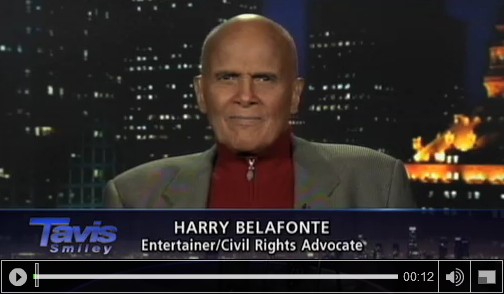
Belafonte on King and Obama

Harry Belafonte interviewed on PBS:

Barack Obama is first and foremost a man. He is flawed. He has his contradictions. He has revealed those contradictions.

There is a question that we have: do we get behind him and push him to become what we know he should be? Or do we lay back, watch him drift, watch him capitulate to the enemy and then say, “Ah ha! We knew it all along.”

Is not his conclusion to be ours? Is not his fate also to be ours? What role do we as a people play in forcing the mission to go where we know it must go?

Facebooktwittermail

Obama advisers set to recommend military tribunals for alleged 9/11 plotters

The Washington Post reports:

President Obama’s advisers are nearing a recommendation that Khalid Sheik Mohammed, the self-proclaimed mastermind of the Sept. 11, 2001, attacks, be prosecuted in a military tribunal, administration officials said, a step that would reverse Attorney General Eric H. Holder Jr.’s plan to try him in civilian court in New York City.

The president’s advisers feel increasingly hemmed in by bipartisan opposition to a federal trial in New York and demands, mainly from Republicans, that Mohammed and his accused co-conspirators remain under military jurisdiction, officials said. While Obama has favored trying some terrorism suspects in civilian courts as a symbol of U.S. commitment to the rule of law, critics have said military tribunals are the appropriate venue for those accused of attacking the United States.

Scott Horton comments:

In sharp violation of rules of prosecutorial conduct and ethics, political figures in the White House are engaged in the micromanagement of decisions concerning the prosecution of individual criminal defendants. Rahm Emanuel is a political figure, without any serious legal expertise or abilities. He openly presented the question as a matter of political opportunity—thereby infecting the criminal justice system with political horse-trading. This is more than just unseemly. It presents a direct affront to the integrity of the criminal justice system. After eight years in which Karl Rove manipulated essential prosecutorial decisions at Justice, now his successor is engaged in the same type of misconduct. But unlike Rove, Emanuel does it openly.

Facebooktwittermail

The Guantánamo “Suicides”: A Camp Delta sergeant blows the whistle

In Harper’s, Scott Horton writes:

When President Barack Obama took office last year, he promised to “restore the standards of due process and the core constitutional values that have made this country great.” Toward that end, the president issued an executive order declaring that the extra-constitutional prison camp at Guantánamo Naval Base “shall be closed as soon as practicable, and no later than one year from the date of this order.” Obama has failed to fulfill his promise. Some prisoners there are being charged with crimes, others released, but the date for closing the camp seems to recede steadily into the future. Furthermore, new evidence now emerging may entangle Obama’s young administration with crimes that occurred during the George W. Bush presidency, evidence that suggests the current administration failed to investigate seriously—and may even have continued—a cover-up of the possible homicides of three prisoners at Guantánamo in 2006.

Facebooktwittermail