Author Archives: Paul Woodward

The Fort Hood massacre and questions of terrorism

Fort Hood gunman gave signals before his rampage

In late July, Major Hasan moved into a second-floor apartment on the north side of Killeen, paying $2,050 for his six-month lease up front, said the apartment manager, Alice Thompson. The two-story faded brick complex, Casa del Norte Apartments, has an open courtyard with exterior stairs and advertises move-in specials.

A few days later, Major Hasan bought an FN Herstal 5.7-millimeter pistol at a popular weapons store, Guns Galore, just off the highway that runs between the mosque that Major Hasan attended and the base, federal law enforcement officials said.

The tenants generally saw him leave early and come home late in the afternoon, usually in his fatigues. He never had visitors, they said, but he was friendly with his neighbors.

“The first day he moved in, he offered to give me a ride to work,” said Willie Bell, 51, who lived next door. “He’d give you the shoes and shirt and pants off him if you need it. Nicest guy you’d want to meet.

“The very first day I seen him, he hugged me like, ‘My brother, how you doing?’ ”

In mid-August, another tenant, a soldier who had served in Iraq, was angered by a bumper sticker on Major Hasan’s car proclaiming “Allah is Love” and ran his key the length of Major Hasan’s car. Ms. Thompson learned of it and told Major Hasan about it that night, and though he called the police, Major Hasan did not appear to be angered by it. [continued…]

Officials: U.S. aware of Hasan efforts to contact al Qaeda

US intelligence agencies were aware months ago that Army Major Nidal Hasan was attempting to make contact with people associated with al Qaeda, two American officials briefed on classified material in the case told ABC News.

It is not known whether the intelligence agencies informed the Army that one of its officers was seeking to connect with suspected al Qaeda figures, the officials said.

One senior lawmaker said the CIA had, so far, refused to brief the intelligence committees on what, if any, knowledge they had about Hasan’s efforts.

CIA director Leon Panetta and the Director of National Intelligence, Dennis Blair, have been asked by Congress “to preserve” all documents and intelligence files that relate to Hasan, according to the lawmaker.

On Sunday, Senator Joseph Lieberman (D-CT) called for an investigation into whether the Army missed signs as to whether Hasan was an Islamic extremist.

“If Hasan was showing signs, saying to people that he had become an Islamist extremist, the U.S. Army has to have a zero tolerance,” Lieberman told Fox News Sunday. [continued…]

Editor’s Comment — If an investigation and Hasan’s own testimony eventually lead to the determination that the Fort Hood massacre was an act of terrorism — meaning, it was a premeditated attack whose victims were selected for political rather than personal reasons — then there already appears to be enough evidence to draw one conclusion: Hasan was a US Army major who became a terrorist and not a terrorist who joined the army.

If it is determined that this was an act of terrorism, then the next question will be: at what point did Hasan make the transition from being someone with profound misgivings about the wars; someone who suffered the indignities of being a target of anti-Muslim bigotry; to someone who wanted to use violence not merely to vent stored up rage but in order to send a message.

At this point, in spite of mounting anecdotal evidence that the killings were an act of terrorism, there is no unambiguous signature — a fact that suggests that not only in this particular case far more remains unknown than known, but that the linguistic clarity through which we are now so used to applying these terms “terrorist” and “terrorism”, point to something far more complex and far more difficult to define than the glib use of these words imply.

As a psychiatrist, one might expect that Hasan’s understanding of the workings of the human mind will make his own testimony unusually illuminating.

Unfortunately, we live in an era where the treatment of tortured psyches has been reduced to an often perfunctory practice in dispensing brain-numbing drugs. This was a physician who appears to have had no inkling how to treat himself. His case may ultimately present more questions than answers.


Facebooktwittermail

Hezbollah gears up for new war

Hezbollah gears up for new war

Hezbollah is rapidly rearming in preparation for a new conflict with Israel, fearing that Benjamin Netanyahu’s government will attack Lebanon again prior to any assault on Iran’s nuclear facilities.

Last week, Israeli commandos seized a ship in the Mediterranean loaded with almost 400 tonnes of rockets and small arms – which Israel claimed was being sent from Iran to its Hezbollah allies. In dramatic further evidence of growing tensions, the Observer has learned that Hezbollah fighters have been busy reinforcing fixed defence positions north of the Litani river.

Having lost many of its bunkers in the south, Hezbollah is preparing a new strategy to defend villages there.

Although the organisation denied last week that the weapons were intended for its use, senior commanders have done little to disguise the scale of rearmament. “Sure, we are rearming, we have even said that we have far more rockets and missiles than we did in 2006,” said a Hezbollah commander, speaking on condition of anonymity. [continued…]

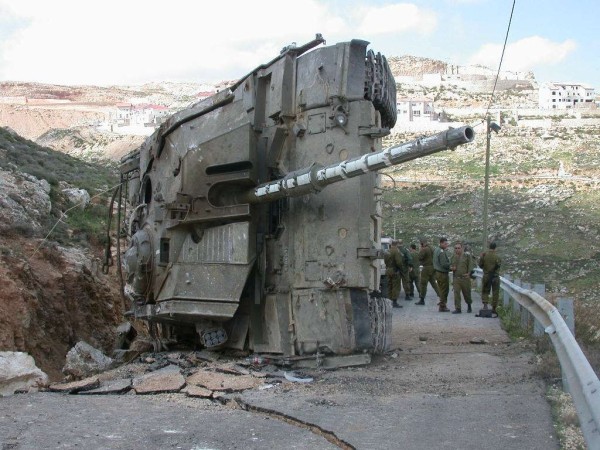
Editor’s Comment — “We expect the Israelis to come soon, if not this winter, then they will wait until spring, when the ground isn’t too soft for their tanks,” says a Hezbollah commander.

Israel’s readiness to launch an attack on Iran may hinge on its readiness to send tanks back into Lebanon.

The war on Gaza, even to the extent that it may have served as a training exercise in preparation for another round of fighting with Hezbollah, probably did little to dispel the haunting memories of 2006. The Merkava tank, previously one of the IDF’s most potent symbols of invincibility, ended up exposing Israel’s military vulnerability.

Facebooktwittermail

Is using aid to Israel as leverage becoming a mainstream idea?

Is using aid to Israel as leverage becoming a mainstream idea?

Tom Friedman today has some very harsh words for both the Israelis and Palestinians, both of whom — he claims — are not serious about reaching a peace agreement. As a result, these are the principles which Friedman — rather surprisingly — advocates the U.S. should follow:

Let’s just get out of the picture. Let all these leaders stand in front of their own people and tell them the truth: “My fellow citizens: Nothing is happening; nothing is going to happen. It’s just you and me and the problem we own.”

Indeed, it’s time for us to dust off James Baker’s line: “When you’re serious, give us a call: 202-456-1414. Ask for Barack. Otherwise, stay out of our lives. We have our own country to fix.” …

If the status quo is this tolerable for the parties, then I say, let them enjoy it. I just don’t want to subsidize it or anesthetize it anymore. We need to fix America. If and when they get serious, they’ll find us.

The only specific course of action Friedman explicitly advocates to fulfill those principles is that the U.S. cease its efforts to forge a resolution of the Israeli-Palestinian conflict and stop trying to pressure them into concessions, instead leaving each side to stew in the status quo — in other words, do exactly that which the Netanyahu government would like most. That would be a perfectly fine suggestion if not for the fact that the U.S. is heavily invested in the outcome of that process and its interests substantially and directly impacted by what happens. That’s because we single-handedly enable Israeli behavior with our massive amounts of military aid, diplomatic protection, and weapons supplying, which means Israeli behavior is rationally perceived by much of the Muslim world as being one and the same as American behavior. Muslim anger towards Israel will inevitably translate into Muslim anger towards the U.S. for as long as we continue to flood Israel with aid and cover. [continued…]

Israel’s apartheid is worse than South Africa’s

Regardless of whether there is a Democrat or a Republican in the White House, the United States became a distinctly pro-Israel world power after the 1967 war. It has no intention of being a “balanced mediator” when it comes to the conflict with the Palestinians.

Barack Obama’s public relations moves in the Arab world have frightened many average Israelis. But Netanyahu and Ehud Barak, allies of the final takeover of the West Bank, know very well that U.S. policy has not changed. It doesn’t take a genius to read the working papers of past prime ministers.

The prevailing attitude of all U.S. administrations was drafted by Henry Morgenthau, and was later updated by Kenneth Waltz. One line guided all of them – Dennis Ross, Martin Indyk, George Mitchell – essentially, that any possible settlement must match the positions of the stronger party. [continued…]

Abbas charts new course by abandoning faith in the US

‘Who lost China?” was the battle cry of a witch-hunt conducted in the US State Department following the 1949 victory of Mao Zedong’s communists. The department’s “China hands”, critics charged, had been woefully ignorant of the dynamics at work on the ground in China after the Second World War, and undermined the US ally Chiang Kai-shek. While the purge that followed is unlikely to be repeated, Washington may soon be asking itself, albeit quietly, “Who lost Fatah?”

Last week’s announcement by the Palestinian president Mahmoud Abbas that he would not seek re-election next January was a warning to the Obama administration, which had put Mr Abbas in an untenable position. Having retreated from its own demand that Israel halt all construction in East Jerusalem and the West Bank, Washington expected Mr Abbas to open talks with the Israeli prime minister Benjamin Netanyahu without conditions.

For the Palestinians, however, the settlement-freeze demand was a test of Mr Obama’s willingness to pressure the Israelis into taking steps they won’t take by choice. Mr Abbas knows that Mr Netanyahu, if it were up to him, would not yield to a viable, independent Palestinian state based on the 1967 borders. If the US is not prepared to pressure Israel, negotiations would not only be fruitless, they would actually help sustain a reality that is relatively comfortable for the Israelis but intolerable for the Palestinians. [continued…]

U.N.’s Goldstone criticizes U.S. reaction to Gaza report

The head of a U.N. investigation that accused Israel of war crimes in Gaza, Richard Goldstone, has said he is disappointed there has been such a “lukewarm” reaction to his findings in the United States.

The report by Goldstone, a South African jurist, lambasted both sides in the December-January war, which killed up to 1,387 Palestinians and 13 Israelis, but was harsher toward Israel.

It gave Israel and Palestinian Hamas militants six months to mount credible investigations or face possible prosecution in The Hague. Both Israel and Hamas denied committing war crimes. [continued…]

Facebooktwittermail

Obama leaning toward 34,000 more troops for Afghanistan

Obama leaning toward 34,000 more troops for Afghanistan

President Barack Obama is nearing a decision to send more than 30,000 additional U.S. troops to Afghanistan next year, but he may not announce it until after he consults with key allies and completes a trip to Asia later this month, administration and military officials have told McClatchy.

As it now stands, the administration’s plan calls for sending three Army brigades from the 101st Airborne Division at Fort Campbell, Ky. and the 10th Mountain Division at Fort Drum, N.Y. and a Marine brigade, for a total of as many as 23,000 additional combat and support troops.

Another 7,000 troops would man and support a new division headquarters for the international force’s Regional Command (RC) South in Kandahar, the Taliban birthplace where the U.S. is due to take command in 2010. Some 4,000 additional U.S. trainers are likely to be sent as well, the officials said. [continued…]

British army wants to retreat in Afghanistan

Army chiefs are drawing up plans to withdraw British troops from outlying bases in Afghanistan.

In what would be a significant change of strategy against the growing Taliban insurgency, they are considering abandoning several bases including Musa Qala, the scene of bloody battles that claimed 15 British lives. Army forces would attempt to hold only the larger towns in Helmand province.

It is understood the new “retrenchment” strategy is backed by the head of the army, General Sir David Richards. [continued…]

Is it time for Britain to pull out of Afghanistan?

In a week where one of the policemen being trained by British soldiers to protect his own country turned on his mentors and shot dead five in cold blood, an increasing number of people are asking what we are doing in Afghanistan and whether it is worth it.

Public opposition to the war has risen sharply: in a ComRes survey for the BBC published today, 64% said the war was “unwinnable” and 63% thought British troops should be withdrawn “as soon as possible”. In a YouGov poll last week for Channel 4, 35% of people thought all UK troops should be withdrawn immediately, up from 25% two weeks ago.

On radio phone-in and news programmes, discussion has been of little else. “There is a real chance we will lose this struggle in the bars and front rooms of Britain,” warned Lord Ashdown, the former leader of the Liberal Democrats.

Among those now calling for a “fundamental rethink” is Kim Howells, chairman of the parliamentary intelligence and security committee and a former Foreign Office minister.

Howells last week wrote an article questioning whether spending £2.6 billion a year keeping troops in Afghanistan was the best way to protect national security. He called for a phased withdrawal and more focus on domestic spying.

Nobody doubts the courage and skill of the armed forces, or seeks to betray the memory of the fallen by walking away. But is it right to keep sending more? Or is it time we changed strategy or even pulled out? [continued…]

Facebooktwittermail

Fears of anti-Muslim backlash after Fort Hood massacre

Fears of anti-Muslim backlash after Fort Hood massacre

The shooting rampage by a US army psychiatrist, Major Nidal Malik Hasan, at Fort Hood in Texas, came almost six months after the Camp Liberty killings in Iraq where an American army sergeant killed five fellow soldiers at a combat stress centre.

Maj Hasan, one of only 408 psychiatrists serving 553,000 active-duty US troops around the world, was likely to have worked in such a centre when sent to Iraq or Afghanistan. Among the 13 killed on Thursday at the Fort Hood Readiness Centre, a soldier’s last stop before deployment, five were fellow therapists, the army said. [continued…]

Little evidence of terror plot in base killings

After two days of inquiry into the mass shooting at Fort Hood, investigators have tentatively concluded that it was not part of a terrorist plot.

Rather, they have come to believe that Maj. Nidal Malik Hasan, the Army psychiatrist accused in the shootings, acted out under a welter of emotional, ideological and religious pressures, according to interviews with federal officials who have been briefed on the inquiry.

Investigators have not ruled out the possibility that Major Hasan believed he was carrying out an extremist’s suicide mission. [continued…]

Facebooktwittermail

In an unstable Pakistan, can nuclear warheads be kept safe?

In an unstable Pakistan, can nuclear warheads be kept safe?

In the tumultuous days leading up to the Pakistan Army’s ground offensive in the tribal area of South Waziristan, which began on October 17th, the Pakistani Taliban attacked what should have been some of the country’s best-guarded targets. In the most brazen strike, ten gunmen penetrated the Army’s main headquarters, in Rawalpindi, instigating a twenty-two-hour standoff that left twenty-three dead and the military thoroughly embarrassed. The terrorists had been dressed in Army uniforms. There were also attacks on police installations in Peshawar and Lahore, and, once the offensive began, an Army general was shot dead by gunmen on motorcycles on the streets of Islamabad, the capital. The assassins clearly had advance knowledge of the general’s route, indicating that they had contacts and allies inside the security forces.

Pakistan has been a nuclear power for two decades, and has an estimated eighty to a hundred warheads, scattered in facilities around the country. The success of the latest attacks raised an obvious question: Are the bombs safe? Asked this question the day after the Rawalpindi raid, Secretary of State Hillary Clinton said, “We have confidence in the Pakistani government and the military’s control over nuclear weapons.” Clinton—whose own visit to Pakistan, two weeks later, would be disrupted by more terrorist bombs—added that, despite the attacks by the Taliban, “we see no evidence that they are going to take over the state.”

Clinton’s words sounded reassuring, and several current and former officials also said in interviews that the Pakistan Army was in full control of the nuclear arsenal. But the Taliban overrunning Islamabad is not the only, or even the greatest, concern. The principal fear is mutiny—that extremists inside the Pakistani military might stage a coup, take control of some nuclear assets, or even divert a warhead. [continued…]

Facebooktwittermail

U.S. State Department: Israel is not a tolerant society

U.S. State Department: Israel is not a tolerant society

Israel dismally fails the requirements of a tolerant pluralistic society, according to a new report from the U.S. State Department.

Despite boasting religious freedom and protection of all holy sites, Israel falls short in tolerance toward minorities, equal treatment of ethnic groups, openness toward various streams within society, and respect for holy and other sites.

The comprehensive report, written by the State Department’s Bureau of Democracy, Human Rights and Labor, says Israel discriminates against groups including Muslims, Jehova’s Witnesses, Reform Jews, Christians, women and Bedouin.

The report says that the 1967 law on the protection of holy places refers to all religious groups in the country, including in Jerusalem, but “the government implements regulations only for Jewish sites. Non-Jewish holy sites do not enjoy legal protection under it because the government does not recognize them as official holy sites.” [continued…]

Israel… just another state

One would think that the bitterness [among Israelis] towards the current president of America has to do with the fears about potential damage to Israel being realized. However, in practice, America’s confused policy brought grimmer results than our failed soccer team, while serving Netanyahu’s vision for four years of slumber at office.

From the very first moment, Israelis sensed the “he’s not one of us” feeling about Obama. Yet even this does not fully explain the acrimony.

It is clear that Obama is not getting on his knees and kissing the ground we walk on, yet even the paranoid Israeli public will find it difficult to present hard evidence that he is persecuting us.

And perhaps this is where the problem lies: It’s not about Obama being against us; rather, it’s the fact that he doesn’t care about us. He’s just indifferent. [continued…]

Half a meeting

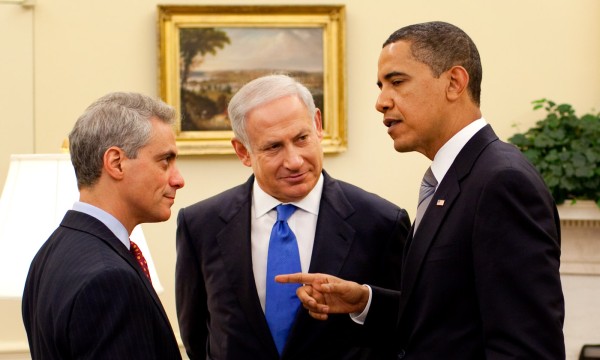
Netanyahu is sure that he knows who is to blame [for strained US-Israeli relations]: White House Chief of Staff Rahm Emanuel. He heard inside information, from the White House, verified information. Emanuel drips venom. My sources may be less good, but the picture they paint is different. Netanyahu’s problem, they say, is not Emanuel. It is Obama.

Netanyahu is convinced that since the first day of his term, Emanuel has been plotting to isolate Israel from America, to shrink it in the eyes of its voters and to destroy it politically. This step failed. Support for Israel in American public opinion has only increased. It’s not Israel that is isolated in America, but rather the Palestinians. Personal admiration for him also increased. It increased in wake of his speech at the UN General Assembly. There are no other leaders in the world today that speak to Americans in their own language. They’ve known him in America for 30 years now. [continued…]

Good riddance, Abbas

The announcement that Mahmoud Abbas has decided not to stand for re-election as head of the Palestinian Authority should come as a relief to all Palestinians. In fact, Abbas’s departure will open a much-needed opportunity to take stock of where things stand and assess the future course of the Palestinian struggle.

Never an appealing or charismatic figure, Abbas has been losing popular support since his first day in office five years ago (his term technically expired in January 2009). Since the 1993 Oslo Accords, in which he played a prominent role, the official Palestinian leadership has been pursuing a formula for peace — the two-state solution — that has yielded nothing more than the intensification of the Israeli occupation of Palestinian territory. Those 16 years have been characterized by the further immobilization and immiseration of the Palestinian people, and an ever-growing list of civilian casualties, most recently in Gaza.

We are left with no other conclusion than this: that the so-called peace process with which Abbas has been indelibly associated, albeit as the Israelis’ junior assistant, was calculated to produce exactly these results. The very first step of the Oslo process, undertaken with Abbas’s assent in 1993, was to fragment and separate the occupied territories into shards of land, disconnected from each other and from the outside world, under total, institutionalized Israeli domination. Take one look at a map and you can’t miss the separation of Gaza from the West Bank and East Jerusalem, and the further internal splintering of the West Bank, all of which is the direct result of Oslo. [continued…]

Facebooktwittermail

Prospect of more U.S. troops worries Afghan public

Prospect of more U.S. troops worries Afghan public

As Americans, including President Obama’s top advisers, tensely debate whether to send more American troops to Afghanistan, Afghans themselves are having a similar discussion and voicing serious doubts.

In bazaars and university corridors across the country, eight years of war have left people exhausted and impatient. They are increasingly skeptical that the Taliban can be defeated. Nearly everyone agrees that the Afghan government must negotiate with the insurgents. If more American forces do arrive, many here say, they should come to train Afghans to take over the fight, so the foreigners can leave.

“What have the Americans done in eight years?” asked Abdullah Wasay, 60, a pharmacist in Charikar, a market town about 25 miles north of Kabul, expressing a view typical of many here. “Americans are saying that with their planes they can see an egg 18 kilometers away, so why can’t they see the Taliban?” [continued…]

The generals’ revolt

In early October, as President Obama huddled with top administration officials in the White House situation room to rethink America’s failing strategy in Afghanistan, the Pentagon and top military brass were trying to make the president an offer he couldn’t refuse. They wanted the president to escalate the war — go all in by committing 40,000 more troops and another trillion dollars to a Vietnam-like quagmire — or face a full-scale mutiny by his generals.

Obama knew that if he rebuffed the military’s pressure, several senior officers — including Gen. David Petraeus, the ambitious head of U.S. Central Command, who is rumored to be eyeing a presidential bid of his own in 2012 — could break ranks and join forces with hawks in the Republican Party. GOP leaders and conservative media outlets wasted no time in warning Obama that if he refused to back the troop escalation being demanded by Gen. Stanley McChrystal, the commander overseeing the eight-year-old war, he’d be putting U.S. soldiers’ lives at risk and inviting Al Qaeda to launch new assaults on the homeland. The president, it seems, is battling two insurgencies: one in Afghanistan and one cooked up by his own generals. [continued…]

The Pentagon’s building boom in Afghanistan indicates a long war ahead

In recent weeks, President Obama has been contemplating the future of U.S. military operations in Afghanistan. He has also been touting the effects of his policies at home, reporting that this year’s Recovery Act not only saved jobs, but also was “the largest investment in infrastructure since [President Dwight] Eisenhower built the Interstate Highway System in the 1950s.” At the same time, another much less publicized U.S.-taxpayer-funded infrastructure boom has been underway. This one in Afghanistan.

While Washington has put modest funding into civilian projects in Afghanistan this year — ranging from small-scale power plants to “public latrines” to a meat market — the real construction boom is military in nature. The Pentagon has been funneling stimulus-sized sums of money to defense contractors to markedly boost its military infrastructure in that country.

In fiscal year 2009, for example, the civilian U.S. Agency for International Development awarded $20 million in contracts for work in Afghanistan, while the U.S. Army alone awarded $2.2 billion — $834 million of it for construction projects. In fact, according to Walter Pincus of the Washington Post, the Pentagon has spent “roughly $2.7 billion on construction over the past three fiscal years” in that country and, “if its request is approved as part of the fiscal 2010 defense appropriations bill, it would spend another $1.3 billion on more than 100 projects at 40 sites across the country, according to a Senate report on the legislation.” [continued…]

Facebooktwittermail

The predator war

What are the risks of the CIA’s covert drone program?

On August 5th, officials at the Central Intelligence Agency, in Langley, Virginia, watched a live video feed relaying closeup footage of one of the most wanted terrorists in Pakistan. Baitullah Mehsud, the leader of the Taliban in Pakistan, could be seen reclining on the rooftop of his father-in-law’s house, in Zanghara, a hamlet in South Waziristan. It was a hot summer night, and he was joined outside by his wife and his uncle, a medic; at one point, the remarkably crisp images showed that Mehsud, who suffered from diabetes and a kidney ailment, was receiving an intravenous drip.

The video was being captured by the infrared camera of a Predator drone, a remotely controlled, unmanned plane that had been hovering, undetected, two miles or so above the house. Pakistan’s Interior Minister, A. Rehman Malik, told me recently that Mehsud was resting on his back. Malik, using his hands to make a picture frame, explained that the Predator’s targeters could see Mehsud’s entire body, not just the top of his head. “It was a perfect picture,” Malik, who watched the videotape later, said. “We used to see James Bond movies where he talked into his shoe or his watch. We thought it was a fairy tale. But this was fact!” The image remained just as stable when the C.I.A. remotely launched two Hellfire missiles from the Predator. Authorities watched the fiery blast in real time. After the dust cloud dissipated, all that remained of Mehsud was a detached torso. Eleven others died: his wife, his father-in-law, his mother-in-law, a lieutenant, and seven bodyguards.

Pakistan’s government considered Mehsud its top enemy, holding him responsible for the vast majority of recent terrorist attacks inside the country, including the assassination of former Prime Minister Benazir Bhutto, in December, 2007, and the bombing, last September, of the Marriott Hotel in Islamabad, which killed more than fifty people. Mehsud was also thought to have helped his Afghan confederates attack American and coalition troops across the border. Roger Cressey, a former counterterrorism official on the National Security Council, who is now a partner at Good Harbor, a consulting firm, told me, “Mehsud was someone both we and Pakistan were happy to see go up in smoke.” Indeed, there was no controversy when, a few days after the missile strike, CNN reported that President Barack Obama had authorized it.

However, at about the same time, there was widespread anger after the Wall Street Journal revealed that during the Bush Administration the C.I.A. had considered setting up hit squads to capture or kill Al Qaeda operatives around the world. The furor grew when the Times reported that the C.I.A. had turned to a private contractor to help with this highly sensitive operation: the controversial firm Blackwater, now known as Xe Services. Members of the Senate and House intelligence committees demanded investigations of the program, which, they said, had been hidden from them. And many legal experts argued that, had the program become fully operational, it would have violated a 1976 executive order, signed by President Gerald R. Ford, banning American intelligence forces from engaging in assassination.

Hina Shamsi, a human-rights lawyer at the New York University School of Law, was struck by the inconsistency of the public’s responses. “We got so upset about a targeted-killing program that didn’t happen,” she told me. “But the drone program exists. ” She said of the Predator program, “These are targeted international killings by the state.” The program, as it happens, also uses private contractors for a variety of tasks, including flying the drones. Employees of Xe Services maintain and load the Hellfire missiles on the aircraft. Vicki Divoll, a former C.I.A. lawyer, who now teaches at the U.S. Naval Academy, in Annapolis, observed, “People are a lot more comfortable with a Predator strike that kills many people than with a throat-slitting that kills one.” But, she added, “mechanized killing is still killing.” [continued…]

Facebooktwittermail

Iraq on the edge

Iraq on the edge

Iraqis prefer checkpoints manned by Iraqis—as I observed time and again, they have learned how to navigate them. They often appear to know one of the security men—perhaps a distant relation or a friend of a friend. They know how to butter up the checkpoint guards with a kind word or humorous turn of phrase, and get past them even if they lack official permission. By contrast, they find American (or Peruvian) checkpoints, with their large signs in hortatory English and poorly rendered Arabic, bewildering, arbitrary, and humiliating. Over the years, many an altercation has occurred in these places owing to misunderstandings, impatience, or simply ill will.

Conversely, many Americans dislike, distrust, and resent Iraqi checkpoints. In a recent incident reported by Anthony Shadid in The Washington Post, Iraqi soldiers allegedly beat four American DynCorps contractors who refused to follow their orders at one of the entrances to the Green Zone[1] —a reminder that the tables are turning. I had flashed only two pieces of ID on my first visit to the Green Zone. But on my second day, Iraqi soldiers at the checkpoint one encounters when entering the Green Zone from the 14th of July Bridge insisted that I also produce an official bahtch or, failing that, procure a US Department of Defense escort, since I had told them I was on my way to meet General Raymond Odierno, who has succeeded David Petraeus as the US commanding officer in Iraq.

An American soldier lingering nearby, with no apparent mission other than to monitor the Iraqi soldiers, sauntered up to find out why I was being denied access to the Green Zone. After listening to my explanation that the Iraqis, now joined by an officer, required that I have an escort, he launched a verbal offensive that was as deeply insulting to the Iraqis’ national self-esteem (“This is why we were able to defeat them in two days”) as it was disrespectful and crude (“We could easily kill them all”).

The Iraqis, while knowing no English, could not possibly have misinterpreted the soldier’s abrasive body language, and I ended up trying to calm them down in the row that followed. When a DOD escort arrived, the American wandered off, leaving in his wake injured pride and burning anger over a relationship that had never worked. [continued…]

Facebooktwittermail

Fort Hood suspect was ‘mortified’ about deployment

Fort Hood suspect was ‘mortified’ about deployment

Born and reared in Virginia, the son of immigrant parents from a small Palestinian town near Jerusalem, he joined the Army right out of high school, against his parents’ wishes. The Army, in turn, put him through college and then medical school, where he trained to be a psychiatrist.

But Maj. Nidal Malik Hasan, the 39-year-old man accused of Thursday’s mass shooting at Fort Hood, Tex., began having second thoughts about a military career a few years ago after other soldiers harassed him for being a Muslim, he told relatives in Virginia.

He had also more recently expressed deep concerns about being sent to Iraq or Afghanistan. Having counseled scores of returning soldiers with post-traumatic stress disorder, first at Walter Reed Army Medical Center in Washington and more recently at Fort Hood, he knew all too well the terrifying realities of war, said a cousin, Nader Hasan. [continued…]

Editor’s Comment — A few thoughts:

1. I’m a firm believer in the Occam’s-razor-school of journalism (if only it existed!), so the most obvious explanation for why this happened is also the most credible explanation — absent further evidence to the contrary.

2. Hasan, as reported above, desperately wanted to avoid being sent to Iraq or Afghanistan. He had multiple compelling reasons not to want to go, but probably highest among those reasons was the fact that he’d spent a great deal of time counseling war casualties. Just imagine how many recruits the US military would get if every kid walking into a recruitment office was first told to spend a few weeks talking to victims of post-traumatic stress disorder as they recounted their fresh experiences of war!

3. Just as is the case with a guy who goes on a shooting spree after being ignored for a promotion or getting fired, this is not rational behavior. Even the rationale that he hoped to get killed in the process seems questionable. Hasan’s behavior suggests he flipped out, which is to say, his capacity to make rational judgments was overwhelmed by extraordinarily intense emotions.

4. It’s incredibly unfortunate that he happened to be a Muslim. Had he been a Southern Baptist, I don’t imagine the blogosphere would now be busy attempting to ascribe his behavior to his religious beliefs. Timothy McVeigh, while awaiting trial, said in an interview with Time that he was raised Catholic and maintained its core beliefs. No one has suggested that might account for what he did. In Hasan’s case, the existence of web postings by a “NidalHasan” reveal nothing unless it can first be established that they were indeed written by the shooter.

5. The idea that a human being can snap like this is profoundly disturbing to most people and the need to rationalize it in some way so that its recurrence appears less likely caters to our collective desire to live in a world that is more predictable than it actually is.

6. Assuming this guy recovers, whatever he has to say should prove more illuminating than anything that’s been said so far.

Facebooktwittermail

Middle East peace process R.I.P.

Obama fails in Middle East

The announcement by Palestinian President Mahmoud Abbas that he will not run for reelection is the exclamation point on the utter collapse of the Obama adminstration’s Middle East policy. Launched to great expectations — the appointment of George Mitchell, Obama’s Cairo declaration that the plight of the Palestinians is intolerable — it is now in complete disarray. It is, without doubt, the first major defeat for Obama’s hope-and-change foreign policy.

Here’s how it unraveled. First, Obama began a test of strength with Israel over that country’s policy of illegal settlements, an expansion of its occupation of the West Bank driven by extremist, right-wing settlers who are fanatical, Bible-believing cultists who think that Israel has some God-given right to that territory. The settler-kooks — indeed, one of their past leaders was named Rabbi Kook — are supported by ultra-hardliners in Israel’s security establishment, who see the West Bank as strategic depth in Israel’s defense posture. What happened after Obama told Israel it had to stop settlements? Nothing. Score: Netanyahu 1, Obama 0. [continued…]

Editor’s Comment — In his somewhat hagiographic report on Clinton’s tour of the region, Joe Klein suggests that the Secretary of State’s “recklessness” in Jerusalem might coincide with her emergence as a single strong voice on foreign policy as the administration’s diplomatic efforts are increasingly in disarray.

“In the course of the trip, there were the first stray wisps of a hint that Clinton wanted to begin asserting her independence, as the Administration, facing roadblocks across the world, struggled for a firmer foreign policy tone after an opening nine months that might be called the Rodney King — ‘Can’t we all just get along?’ — phase,” Klein wrote.

Another way of putting this might be to say that in an administration that lacks leadership, there are likely to be an increasing number of freelancers as a power vacuum creates openings for political opportunists. The current trend is heading from bad to worse.

In a warning to Obama, Abbas quits election

“It’s time for you to find another donkey.” With those words, according to Palestinian sources, Palestinian Authority (PA) President Mahmoud Abbas told the Palestine Liberation Organziation (PLO) executive committee that he would not seek re-election in January. The 74-year-old leader, on whom U.S. peace efforts in the Middle East are heavily dependent, reiterated that message later on Thursday in a televised address from his home in Ramallah. “This decision does not at all amount to bargaining or political maneuvering. While I appreciate the views expressed by brothers [in the PLO, who rejected his move], I hope they will understand my wish.”

The prime audience for Abbas’ statement, of course, was not the PLO leadership but the Obama Administration. According to Palestinian sources who attended the meeting, Abbas told his PLO comrades that the U.S. had “cheated” him by retreating from its insistence that Israel end settlement construction in the West Bank and East Jerusalem. “We welcomed it, and were optimistic when President Obama announced the need for a complete halt to settlements, including natural growth,” Abbas said. “We were surprised by his support for the Israeli position.” [continued…]

Facebooktwittermail

UN assembly votes for probes of Gaza war charges

UN assembly votes for probes of Gaza war charges

In a move that angered Israel, the U.N. General Assembly voted on Thursday to urge the Jewish state and Palestinians to investigate war crimes charges leveled in a controversial U.N. report on the Gaza war.

The Arab-drafted resolution is nonbinding and unlikely to lead to inquiries by either Israel or the militant Palestinian Hamas movement that rules Gaza into their conduct during the December-January conflict.

But the outcome was seen by Arab states as a public relations coup and a public discomfiture for Israel, which has reacted with outrage to the findings of the U.N. report, as have American Jewish groups. [continued…]

No safe haven for suspected war criminals

The Jerusalem Post recently quoted Michael Oren, Israel’s ambassador to the US, as lamenting the “tactical” problem of Israel being unable to defend itself without facing prosecution. He added that “no one in Israel buys” that the Israeli military targeted civilians during Operation Cast Lead last winter.

“It goes not just against all of our principles, but the personal knowledge of people who participated in the operation,” he said, adding that he was speaking from personal experience.

Meanwhile, back in the real world, human rights campaigners and lawyers working in the West Bank and Gaza Strip have been collecting evidence of serious human rights violations by Israel’s military for many years. Some of those violations appear to amount to grave breaches (i.e. war crimes) contrary to the Fourth Geneva Convention 1949, which protects civilians living under military occupation. After many years of placing the evidence of such war crimes before the Israeli legal system and attempting to seek justice locally, Palestinian victims have lost any faith in the Israeli legal system. [continued…]

Facebooktwittermail

Afghanistan’s civil war

No insurgency here

Two conclusions are inescapable from the fiasco of Afghanistan’s presidential elections and the McChrystal assessment: There is no electoral solution to Afghan government’s crisis of legitimacy, and there is no military solution to the challenge of the Taliban. And when observing the current Afghan conflict not from the perspective of America’s post-9/11 intervention, but from Afghanistan’s own quarter-century of warfare, a third conclusion becomes still more apparent: What we confront is not, in fact, an insurgency but rather a civil war — one whose resolution can only be found in a new decentralized Afghan politics based on the enduring, if ugly, realities of power there, and not through another decade of Western military intervention.

If there is one lesson to be drawn from the withdrawal of Hamid Karzai’s main rival from the second round of the elections — and his own subsequent appointment as president for another term — it is that the ability of outsiders to influence the existing politics of Afghanistan is now near zero, even when the object of our entreaties is a politician whose very existence has long depended entirely on Western support and funding. Like a patient rising from a hospital bed after a near-death experience only to rob his doctor blind on the way out the door, Karzai has conclusively demonstrated that his utility to Western interests — as well as to the Afghan people whom he’s grossly robbed of a chance for representative government — is over. [continued…]

UN relocates foreign staff in Afghanistan

The United Nations mission in Afghanistan announced plans on Thursday to relocate hundreds of foreign staff members, sending some out of the country, in the wake of a lethal attack on its workers at a guesthouse last week.

The relocation of its workers here, while temporary, is one more signal of mounting pressure on United Nations operations as security deteriorates around the region. The move comes four days after the United Nations announced that it was withdrawing its international workers from northwestern Pakistan, where insurgents are fighting Pakistani troops and have carried out a string of attacks.

In recent weeks, United Nations workers on both sides of the border have been singled out in deadly attacks, in what appears to be a deliberate campaign by insurgents to undercut international support for the embattled Afghan and Pakistani governments. [continued…]

Facebooktwittermail

Iran tested advanced nuclear warhead design – secret report

Iran tested advanced nuclear warhead design – secret report

The UN’s nuclear watchdog has asked Iran to explain evidence suggesting that Iranian scientists have experimented with an advanced nuclear warhead design, the Guardian has learned.

The very existence of the technology, known as a “two-point implosion” device, is officially secret in both the US and Britain, but according to previously unpublished documentation in a dossier compiled by the International Atomic Energy Agency (IAEA), Iranian scientists may have tested high-explosive components of the design. The development was today described by nuclear experts as “breathtaking” and has added urgency to the effort to find a diplomatic solution to the Iranian nuclear crisis.

The sophisticated technology, once mastered, allows for the production of smaller and simpler warheads than older models. It reduces the diameter of a warhead and makes it easier to put a nuclear warhead on a missile. [continued…]

Bunkers or breakthrough?

In his last month as head of the International Atomic Energy Agency, Mohamed ElBaradei finds himself at the explosive crux of the world’s nuclear politics, ferrying messages between the Obama administration and Tehran. “They are talking through me,” he says.

Talking is something, even through a mediator, given all the poisonous U.S.-Iranian history, but time is short. President Obama’s Iran outreach is on the line in the days before ElBaradei departs on Nov. 30. It’s critical that Obama succeed or a futile confrontation-sanctions scenario will be locked in. Any vestigial hopes for a more peaceful Middle East will recede.

Protesters, Iran’s brave campaigners for a freer and more open country, are chanting, “Obama, Obama — either you’re with them or you’re with us.” That must hurt in the Oval Office. The window is narrowing for the president to show that outreach can normalize the psychotic U.S.-Iranian relationship where confrontation only comforts it. I still believe normalization is the last best hope for Iranian reform. [continued…]

Student stuns Iran by criticizing supreme leader

An unassuming college math student has become an unlikely hero to many in Iran for daring to criticize the country’s most powerful man to his face.

Mahmoud Vahidnia has received an outpouring of support from government opponents for the challenge — unprecedented in a country where insulting supreme leader Ayatollah Ali Khamenei is a crime punishable by prison.

Perhaps most surprising, the young math whiz has so far suffered no repercussions from the confrontation at a question-and-answer session between Khamenei and students at Tehran’s Sharif Technical University.

In fact, Iran’s clerical leadership appears to be touting the incident as a sign of its tolerance — so much so that some Iranians at first believed the 20-minute exchange was staged by the government, though opposition commentators are now convinced Vahidnia was the real thing. [continued…]

Facebooktwittermail

Report: U.S. stopped Israel from attacking ‘Hezbollah arms ship’

Report: U.S. stopped Israel from attacking ‘Hezbollah arms ship’

The United States informed Israel of a ship carrying tons of weapons allegedly en route from Iran to Hezbollah, but vetoed Israel’s plans to attack, the A-Sharq Al-Awsat newspaper reported on Friday.

Israel raided the ship in the waters off the coast of Cyprus earlier this week and redirected it to the Ashdod port, where it unloaded 500 tons of weapons. The ship was released back onto its route to Turkey and Egypt late Wednesday, after Israel confirmed that the crew was not connected to the cargo found aboard.

In its report on Friday, A-Sharq Al-Awset cited Israeli sources as saying that Israel had intended to attack the ship but had refrained at the insistence of the U.S. No other source could confirm the report. Hezbollah has vehemently denied any link to the weapons and denounced “Israeli piracy” in international waters. [continued…]

Facebooktwittermail

How Israel creates the scenario for the next war

The doomsday weapon

Every few weeks you have to sow fear, every few months you need to make threats, and once every year or two you have to have another little war. Blind cooperation between the defense establishment and the media holds the promise of another round of fighting. In that way, it’s possible to escape some of the blame from the Goldstone report and wallow in the conditions we love best: being the victim, feeling threatened and uniting in the face of the great external danger allegedly in the offing.

The Israel Defense Forces will be above it all and cleanse itself of a series of suspicions and failures. This can also translate into huge budgets, glorified importance and influence for both the generals and the military commentators. It also creates good television ratings and sells sensationalist newspapers and advanced weapon systems. What’s better than that for us?

The most recent cry of alarm: NASA in Palestine, Israel’s Rafael Advanced Defense Systems in Gaza. Hamas launches an Iranian rocket – it must be Iranian – 60 kilometers. The head of Military Intelligence reported on it, Prime Minister Benjamin Netanyahu spoke immediately about missile systems, and the media immediately broke into its favorite war dance. “Three million citizens within range,” “Confrontation in December,” “Are you within range?” “Outskirts of Tel Aviv in danger,” “Doomsday weapons” – frightening headlines accompanied by no less scary maps. “This is a new dimension confronting the IDF. It’s not a simple matter. It’s really a different story altogether. We should remember that there will be many casualties on the home front,” roared the national baritone – the military commentator on television.

So again we are dealing with the grotesque – a strip of land under siege wallowing in its distress and ruins, with a pitiful paramilitary organization whose weapons arsenal would be an embarrassment to an IDF basic training camp. And it already proved its inadequacy in the last war. But the militants are portrayed to us as a superpower. That’s how they create the scenario for the next war. That’s how they empower not just the enemy, but first and foremost the IDF, which can beat the enemy [continued…]

U.N. set to endorse inquiry into possible war crimes in Gaza

The General Assembly is preparing to approve a resolution that would endorse a United Nations report calling on both Israel and the Palestinians to investigate possible war crimes in the Gaza Strip within three months.

The assembly began discussing the nonbinding resolution, introduced by about 20 Arab League members, including Iraq, on Wednesday, but with about 50 nations scheduled to speak, a vote was not likely until Thursday. Given the widespread support for the Palestinian cause and broad criticism of Israel, passage of the measure seemed assured.

Some members of the European Union were threatening to abstain, however, holding out for changes. One issue was wording that would require Secretary General Ban Ki-moon to work with the Security Council on additional action; another was the resolution’s full endorsement of a decision last month by the United Nations Human Rights Council to adopt the report completely, diplomats said. [continued…]

Editor’s Comment — Israel’s ambassador to the UN, Gabriela Shalev, declares the Goldstone report as “conceived in hate and executed in sin.”

Israel’s former ambassador to the UN, Danny Gillerman, is on his way to New York to assist in the PR campaign against the report. “This is war, and in war when you are sent a Tzav Shmone (emergency draft order), you enlist,” Gillerman tells Ynet.

The more overblown the rhetoric gets, the more Israel reinforces its international image as a nation governed by buffoons and demagogues.

The battle over Palestinian representation

“From now on, Palestinian leaders will be judged by the stand they took on the Goldstone Report — anyone who tried to bury it, or who remained silent, will have lost their claim to leadership,” a Palestinian historian friend remarked after popular outrage forced the Palestinian Authority’s Mahmoud Abbas to rescind his decision to postpone the Report at the Human Rights Council.

Now the Report has moved to the United Nations General Assembly, where the United States, flanked by Israel and some European allies, has reportedly spent the weekend putting heavy pressure on representatives from African countries and others who might have wanted to uphold international law and end impunity.

Two key issues faced the General Assembly at its November 4 debate: Whether to endorse or simply “take note” of the Goldstone Report, as Israel’s supporters would like. And whether to exclude the High Commissioner for Human Rights from follow-up in favor of the UN Secretary General’s office. Seasoned UN observers fear that giving Ban Ki-moon’s office control over follow-up would effectively bury the report because of the political pressures that can, and are, placed on him. [continued…]

Jewish Appeal to Support the Goldstone Report

The primary author of the recently released UN Report on Gaza, the internationally respected jurist Richard Goldstone, has been attacked by establishment voices within the Jewish community. When those within a community try to “excommunicate” and dishonor truth-tellers, it is our obligation and responsibility to speak out vehemently on their behalf and on behalf of the truth they bring.

By all accounts, Judge Goldstone, who has a deep connection to Israel, approached his task with no pre-conceptions about what he and his team would find as they investigated the circumstances and aftermath of the Israeli attack on Gaza. Goldstone is a former South African constitutional law court judge who also served as a prosecutor of the Yugoslav and Rwandan war crimes tribunals. His credentials for this task are impeccable.

For following where the truth led him and releasing a report detailing human rights abuses and violations of international law by Israel, as well as by Hamas, Judge Goldstone should be applauded for his honesty and integrity. Instead, he and the report have been viciously and relentlessly attacked by many within the Jewish community.
When it comes to Israel, hard-core censorship and intimidation by those claiming to speak in the name of the Jewish people have been the order of the day. Our saying, “Three Jews — four opinions,” reflects the traditional Jewish encouragement to argue and debate. However, the reality, sadly, is that diverse opinions are welcome — except when it comes to Israel. [continued…]

Facebooktwittermail

Palestinians may need to pursue “one-state solution”

Palestinians may need to pursue “one-state solution”

Palestinians may have to abandon the goal of an independent state if Israel continues to expand Jewish settlements and the United States does not stop it, chief Palestinian negotiator Saeb Erekat said on Wednesday. It may be time for Palestinian President Mahmoud Abbas to “tell his people the truth, that with the continuation of settlement activities, the two-state solution is no longer an option”, Erekat told a news conference.

Israel has rejected the idea of a de facto annexation of the occupied West Bank, incorporating the Palestinians as citizens, as “demographic timebomb” that would make Jews the minority. [continued…]

Editor’s Comment — The problem with the expression “one-state solution” is that it treats “one-state” as a proposition about something that might or might not exist in the future and then considers who would or would not consent to its creation.

The question is, can Israel dismantle what it has already created?

Gaza would seem to prove that the answer is no, since even when Israel showed it could withdraw its troops and a few thousand settlers, it couldn’t relinquish military and economic control over the territory. Gaza also serves as the most compelling reason why most Israelis won’t seriously entertain the idea of ending the occupation of the West Bank.

More than anything else, the two-state solution has functioned as a mirage that distracts attention away from the present one-state reality.

The task at hand seems to have more to do with destroying an illusion and unmasking a reality than it does with constructing a vision of a better future.

Once it dawns on the majority of Israelis that without having a consensus about what they were doing, they have indeed created a single state in which half the population is Palestinian, a decades-long process of political reform can begin.

Settlers force Palestinians out of East Jerusalem home

Rioting settlers forced a Palestinian family out of their home in the East Jerusalem neighborhood of Sheikh Jarrah yesterday, after the district court denied the residents’ appeal to remain on the premises.

Shortly after the verdict was passed dozens of settlers stormed into the house with hired security guards, demanding that the family vacate immediately. A violent riot erupted between the Jewish settlers and the neighborhood’s Palestinian residents. Police were called in to disperse the protesters.

A legal battle has raged for some 30 years over the ownership of 28 houses in the Sheikh Jarrah neighborhood. The specific house in question, built 10 years ago by the al-Kurd family, was unoccupied and locked up for eight years by court order pending the settlement of a land-ownership dispute. [continued…]

35% of East Jerusalem expropriated – study

Irael has expropriated some 35 per cent of East Jerusalem’s territory, over 24,000 dunums of land, from its Palestinian owners despite the fact that in 20 years the majority of Jerusalem’s population will be Palestinians, a study said.

According to the study, compiled by the Friedrich Ebert Foundation, Palestinians currently make up 35 per cent of the city’s population compared with 25.5 per cent in 1967, adding that “in the absence of a political agreement on the borders of the city and the status of its Palestinian residents, Jerusalem is approaching a bi-national urban reality”.

The study by the Germany-based organisation examined the building policies in Jerusalem intended to change the facts on the ground and ensure a solid Jewish majority in the city, said a statement e-mailed to The Jordan Times yesterday. [continued…]

Facebooktwittermail