Author Archives: Paul Woodward

Judge faults freezing of assets in terror case

Judge faults freezing of assets in terror case

In a ruling that threw into doubt one of the government’s main counterterrorism tools, a federal judge said the Treasury Department acted unconstitutionally three years ago when it froze the assets of an Ohio charity suspected of aiding terrorists.

The ruling challenged a key tactic used by the government under an emergency executive order signed by President George W. Bush two weeks after the Sept. 11 attacks. If upheld, the ruling could severely undercut the government’s authority and ultimately require it to get a warrant and submit to court review in moving against charities.

In the last eight years, the Treasury Department has used its broadened authority to freeze tens of millions of dollars in assets held by eight charities within the United States and hundreds of other groups and individuals outside this country, all without warrants and court approval.

The ruling was issued late Tuesday by James G. Carr, the chief federal judge in northern Ohio. Judge Carr set a hearing in September to determine how to correct what he said were constitutional flaws in the government’s case. [continued…]

Facebooktwittermail

Ahmadinejad submits a cabinet of acolytes

Ahmadinejad submits a cabinet of acolytes

President Mahmoud Ahmadinejad of Iran, facing a persistent opposition movement and rivals in his own conservative camp, submitted a list of proposed cabinet members Wednesday that would shore up his inner circle of loyalists and remove all the ministers who criticized him during a political confrontation last month.

The list of nominees, reported by Iran’s state news agency, must still be approved by Parliament in a vote of confidence later this month. There are signs that some of Mr. Ahmadinejad’s choices will face resistance from lawmakers, who have been warning him for weeks to pick people on the basis of competence and not loyalty.

At the same time, Mr. Ahmadinejad’s ambitions for greater control over Iran’s complex power structure appeared to suffer a setback on Wednesday when the new chief of Iran’s judiciary, Sadeq Larijani, promoted one of the president’s critics to the powerful position of national prosecutor general. Gholam-Hussein Mohseni-Ejei, whom the president dismissed as intelligence minister last month after a bitter dispute, will become the nation’s top prosecutor, Mehr News reported.

Mr. Larijani also replaced other top judiciary officials, including the hard-line Tehran prosecutor Saeed Mortazavi, replacing them with staunch conservatives who are not necessarily Ahmadinejad allies, Mehr reported.

Mr. Ahmadinejad submitted his new cabinet list just before the legal deadline, apparently in an effort to minimize the time legislators would have to review it. But the Parliament speaker, Ali Larijani, one of the president’s most prominent rivals (and a brother of Sadeq Larijani), postponed the Parliament session to vote on the nominees after it became clear that Mr. Ahmadinejad intended to push his announcement to the last moment. [continued…]

Facebooktwittermail

One-third of Israeli soldiers might refuse to evacuate outposts

One-third of Israeli soldiers might refuse to evacuate outposts

Using Israel Defense Forces soldiers to enforce law among the Jewish population in the territories, especially during the evacuation of illegal outposts, might lead soldiers and even commanders to refuse orders, the commander of the Judea and Samaria division, Brig. Gen. Noam Tibon wrote three months ago in a memo.

The memo, distributed to commanders of units operating in the West Bank, states every unit might have a “bottom third of soldiers and commanders with difficulties,” who would require “individual follow-up and conversations.”

The memo calls on battalion and company commanders to draw “clear red lines” regarding refusing orders. Until orders are refused, commanders should treat soldiers with sensitivity, but once an order is refused, unambiguous action should be taken, the memo states.

It instructs commanders to postpone setting a date for a court-martial, so that it won’t become “an opportunity for a media provocation.” Continue reading

Facebooktwittermail

Netanyahu’s defiance of US resonates at home

Netanyahu’s defiance of US resonates at home

For five months, Israeli Prime Minister Binyamin Netanyahu has been fending off U.S. pressure to halt the expansion of West Bank settlements. Now he is reaping dividends for his defiance.

Although Israeli leaders have historically been reluctant to publicly break with the United States for fear of paying a price in domestic support, polls show that Netanyahu’s strategy is working. And that means that after months of diplomacy, the quick breakthrough that President Obama had hoped would restart peace talks has instead turned into a familiar stalemate.

Arab states largely have rebuffed Obama’s request for an overture to Israel until the settlement issue is resolved — a stand that Egyptian President Hosni Mubarak emphasized in a meeting with Obama on Tuesday — and the Palestinians have said a settlement freeze is a precondition for resuming negotiations. Meanwhile, the Israeli public seems to have rallied around Netanyahu’s refusal to halt all settlement construction, a backlash that intensified when the Obama administration made clear that it wanted Israel to stop building Jewish homes in some parts of Jerusalem as well as in the occupied West Bank. [continued…]

Obama says Mideast peace process is in a ‘rut’

President Obama said Tuesday that the Middle East peace process was in a “rut,” and prodded Egyptian President Hosni Mubarak to help break an Arab-Israeli standoff that has frustrated the administration’s effort to restart talks.

“If all sides are willing to move off of the rut that we’re in currently, then I think there is an extraordinary opportunity to make real progress,” Obama said in an appearance with Mubarak at the White House. “But we’re not there yet.” [continued…]

Facebooktwittermail

Empty slogans of change in Afghanistan

Empty slogans of change in Afghanistan

The 2009 presidential election is only a day away and Afghans are basking in the global media spotlight. The Taliban are staging spectacular attacks, aware that the violence will make international headlines and provide them with free publicity. Campaigners are driving up and down the country in vehicles covered in posters, wooing the population with the promise of a better future. Free lunches, a rare concept in Afghanistan, have become the rule these days as campaigners feed the poor in the hope of getting votes in return for pilau rice. The poor, in turn, should be forgiven for wishing every day were campaign day. Such charity, after all, is a rarity in the Islamic Republic of Afghanistan.

Democracy is apparently working small wonders in Afghanistan. Local newspapers quote the Qur’an as evidence that there is no contradiction between Islam and the principles of democracy. Presidential candidates invoke early Muslim history to show that the rule of the people is rooted in Muslim tradition. Debate instead of violence; citizenship instead of clientelism; nationhood instead of tribalism; all are recurrent phrases in articles revealing the desires of progressive Afghans for their country. The second presidential debate, aired live on national TV, included Hamid Karzai and was broadly interpreted as a sign that democracy is slowly taking root in Afghanistan. The cost of the election process: $221m. Democracy doesn’t come cheap but in a country where humans are forced to live in caves for want of a roof over their heads, the electoral pomp can seem morally questionable. [continued…]

Facebooktwittermail

Iranian cleric predicts opposition will topple Ahmadinejad

Iranian cleric predicts opposition will topple Ahmadinejad

His newspaper was shut down Monday, and generals and hard-line clerics have called for him to be put on trial. Yet defeated Iranian presidential candidate Mehdi Karroubi says opposition to the government is growing by the day.

The white-turbaned Shiite cleric, who has held several senior government positions since the 1979 Islamic revolution, said in an interview Tuesday that President Mahmoud Ahmadinejad, along with the clerics and Revolutionary Guard commanders who support him, will be defeated by what he describes as a burgeoning movement of ordinary people, ayatollahs and lawmakers.

“In the streets, in the bazaars, at weddings and in mosques, everywhere you can hear people complaining about what has happened” since Ahmadinejad’s disputed reelection June 12, Karroubi said. “This belief is growing at an extraordinary pace. Yes, people might be more cautious, since the situation in our country is dangerous, but their thoughts, their ideas have not changed.” [continued…]

Moussavi claims government link to rapes

The opposition leader Mir Hussein Moussavi on Tuesday accused “establishment agents” of raping and torturing prisoners, adding a prominent voice to critics who had made the charge and openly defying hard-liners who had denounced the claims as slander.

“Those who committed the crimes were establishment agents,” Mr. Moussavi said in a statement posted on his Web site.

He said “the use of force and money” could not silence the accusations, but only a “quick, open and precise investigation of complaints by detained protesters and their families.” [continued…]

Facebooktwittermail

U.S. envoy has ‘useful dialogue’ with anti-American Pakistani leader

U.S. envoy has ‘useful dialogue’ with anti-American Pakistani leader

Obama administration officials have pledged to talk to world leaders no matter their views. On Tuesday, they showed that the offer extends to Islamists who spend the day denouncing America from the street corners.

U.S. envoy Richard C. Holbrooke met with Liaqat Baloch, a leader of Pakistan’s Jamaat-i-Islami party. About an hour later, as the bearded scholar prepared to depart for an anti-American rally across town, the veteran diplomat said that despite their disagreements, the meeting had begun “a very useful dialogue.”

Pakistan is eager for U.S. aid, but many people are wary of U.S. intentions. Jamaat-i-Islami has limited leverage in the government, but it is one of the most influential Pakistani Islamist parties, and its anti-American views are widely shared, U.S. officials say. [continued…]

Facebooktwittermail

Damascus agrees to help monitor Iraqi border

Damascus agrees to help monitor Iraqi border

The Obama administration and Damascus tentatively agreed to establish a tripartite committee, with Baghdad, to better monitor the Syrian-Iraqi border as the Pentagon draws down American troops from Iraq in coming months, said senior U.S. officials.

The proposed three-way border-control assessments could boost Iraqi security and patch one of the region’s most volatile fault lines. The initiative was made by a team of U.S. Central Command officers and their Syrian counterparts last week in Damascus.

The pact awaits the green light from Baghdad, which expressed frustration at being excluded from the U.S.-Syrian talks, saying they violated Iraqi sovereignty on security matters.

Iraqi Prime Minister Nouri al-Maliki met Syrian President Bashar Assad in Damascus on Tuesday. A statement issued late in the day by the Iraqi prime minister’s office in Baghdad said only that the two sides “discussed the expansion of the Iraqi and Syrian cooperation” in border control. [continued…]

Facebooktwittermail

American teens gathering in Middle East pose terrorist threat

American teens are fighting back in Israel

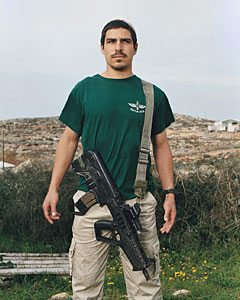
Later this year, 21-year-old Ephraim Khantsis will pack a couple of suitcases, say good-bye to his mother, leave his home in Brooklyn, and move to Israel. On arrival in Jerusalem he will enroll in a yeshiva, or religious school, that is popular with Americans. After a few months he will make his way north, to a place this young American feels is his true home: the Jewish settlement of Kfar Tapuach.

Perched on a hill just off Route 60, the main north-south road in the occupied West Bank, Kfar Tapuach is known as a particularly hard-line community. Home to about 600 people, the settlement has a history of welcoming American immigrants whose beliefs and acts raise alarms among Israeli intelligence agencies, leading them to monitor it as a haven for suspected terrorists.

Khantsis, who is in the process of applying for Israeli citizenship, will fit right in. Like the assassinated Brooklyn-born rabbi Meir Kahane, the man some in Kfar Tapuach consider their spiritual leader, Khantsis believes that all Arabs and Palestinians should be forcibly removed from territory controlled by Israel, including the West Bank.

“It’s the most humane way to solve the situation,” Khantsis—who has just graduated from Stony Brook University, on Long Island, with a degree in computer science—says, sipping a soda in an Israeli-run kosher pizzeria in Bensonhurst, Brooklyn, this past June. He acknowledges that he is advocating ethnic cleansing. Continue reading

Facebooktwittermail

Huckabee says 2 states in Holy Land ‘unrealistic’

Huckabee says 2 states in Holy Land ‘unrealistic’

US presidential contender Mike Huckabee said Tuesday there should be no Palestinian state in the West Bank and endorsed Israeli settlements there, sharply disagreeing with Washington and much of the world.

A three-day tour of Israel, hosted by a far-right group of religious nationalists, is taking Huckabee to some of the most contentious hotspots in the Israeli-Palestinian conflict including a West Bank settlement outpost that even Israel’s hard-line government considers illegal and an east Jerusalem housing project that the Obama administration has demanded be halted.[continued…]

Facebooktwittermail

Israeli officials: New West Bank projects frozen (briefly)

Israeli officials: New West Bank projects frozen

Israel has quietly stopped approving new building projects in the West Bank while publicly still refusing U.S. demands for a formal settlement freeze, officials, peace activists and settlers said Tuesday.

Prime Minister Benjamin Netanyahu’s office denied there was any agreement among senior ministers to freeze new construction. But settlement watchdog Peace Now said no new building had been approved since Netanyahu took office in March.

President Barack Obama’s administration has been prodding Israel to shelve all settlement construction on land Palestinians want for a future state, a demand Israel has said it cannot accept. The issue has grown into a rare public disagreement between the two close allies.

However, several government officials said Tuesday that Israel has decided to temporarily stop green-lighting new projects because of the international pressure.

The move falls short of the U.S. demand because it doesn’t amount to a full freeze — projects approved in the past are still being built, and groups tracking settlements say the pace of construction in the settlements has not slowed. [continued…]

Israel agrees to freeze settlement construction as gesture to US

Despite pressure from right-wing ministers, the housing minister has yet to issue one building tender in the settlements, including in the large settlement blocs, since Netanyahu has taken office. This has been confirmed by Prime Minister Netanyahu’s office. The ministry also did not issue new tenders in the final days of Olmert’s administration. The right-wing and the haredi sector have expressed their disappointment over this quiet policy.

Right-wing ministers claim that this policy has been forced upon Israel and undermines the country’s sovereignty in areas over which there should not be any dispute.

Habayit Hayehudi Chairman Daniel Hershkowitz attacked the settlement freeze policy: “The State of Israel is not a satellite of the US. We have a strategic alliance and close friendly relations with the Americans, but it is a two-way alliance. They need us, too, and we must stand our ground, even more so since the Palestinians show their true face anew each and every time proving that theirs is not a face of peace. As long as this remains the situation in the Middle East, the Americans must halt their pressure on the settlement and not prevent natural growth just as we do not get involved in building in Arizona. The natural growth in Judea and Samaria and the building in the settlement blocs and Jerusalem are a red line that must not be crossed.” [continued…]

U.S. group invests tax-free millions in East Jerusalem land

American Friends of Ateret Cohanim, a nonprofit organization that sends millions of shekels worth of donations to Israel every year for clearly political purposes, such as buying Arab properties in East Jerusalem, is registered in the United States as an organization that funds educational institutes in Israel.

The U.S. tax code enables nonprofits to receive tax-exempt status if they engage in educational, charitable, religious or scientific activity. However, such organizations are forbidden to engage in any political activity. The latter is broadly defined as any action, even the promotion of certain ideas, that could have a political impact.

Financing land purchases in East Jerusalem would, therefore, seem to violate the organization’s tax-exempt status. Continue reading

Facebooktwittermail

Quiet slicing of the West Bank makes abstract prayers for peace obscene

Quiet slicing of the West Bank makes abstract prayers for peace obscene

When peace-loving Israeli liberals present their conflict with Palestinians in neutral, symmetrical terms – admitting that there are extremists on both sides who reject peace – one should ask a simple question: what goes on in the Middle East when nothing is happening there at the direct politico-military level (ie, when there are no tensions, attacks or negotiations)? What goes on is the slow work of taking the land from the Palestinians on the West Bank: the gradual strangling of the Palestinian economy, the parcelling up of their land, the building of new settlements, the pressure on Palestinian farmers to make them abandon their land (which goes from crop-burning and religious desecration to targeted killings) – all this supported by a Kafkaesque network of legal regulations.

Saree Makdisi, in Palestine Inside Out: An Everyday Occupation, describes how, although the Israeli occupation of the West Bank is ultimately enforced by the armed forces, it is an “occupation by bureaucracy”: it works primarily through application forms, title deeds, residency papers and other permits. It is this micro-management of the daily life that does the job of securing slow but steady Israeli expansion: one has to ask for a permit in order to leave with one’s family, to farm one’s own land, to dig a well, or to go to work, to school, or to hospital. One by one, Palestinians born in Jerusalem are thus stripped of the right to live there, prevented from earning a living, denied housing permits, etc.

Palestinians often use the problematic cliché of the Gaza strip as “the greatest concentration camp in the world”. However, in the past year, this designation has come dangerously close to truth. This is the fundamental reality that makes all abstract “prayers for peace” obscene and hypocritical. The state of Israel is clearly engaged in a slow, invisible process, ignored by the media; one day, the world will awake and discover that there is no more Palestinian West Bank, that the land is Palestinian-frei, and that we must accept the fact. The map of the Palestinian West Bank already looks like a fragmented archipelago. [continued…]

The Holocaust’s shadow over Israel’s choices

No people mourn better than the Jewish people. For seven days after death, the family sits shiva, a vigil at home for loved ones to comfort one another and reflect on the life lost. During the following year and then beyond, the stages of mourning develop to allow next of kin to continue their lives while still remembering who is gone from them.

The process is successful for Jews, but it is failing the Jewish state. Six decades since the gravest of their tragedies, Jews have collectively yet to find a sustainable way of moving on without forgetting the Holocaust. The inability to do so poses dire consequences for Israel and the possibility for peace.

For Israel, the Holocaust didn’t end in 1945, but reconstituted itself in the country’s political and social cultures. It’s no accident that Yad Vashem, Israel’s Holocaust museum, is physically connected to Har Hertzl, Israel’s national cemetery. The symbolism hits you over the head: Israel was born out of the Holocaust, and the price to protect the Jewish people from another one is steep. There is truth in that, but also danger. Binding too tightly the slaughter of Jewish civilians by Nazis and the deaths of Israeli soldiers by Arabs turns every threat to Israel into another Holocaust. [continued…]

Facebooktwittermail

Big challenges ahead for Mahmoud Abbas

Big challenges ahead for Mahmoud Abbas

Mahmoud Abbas, the 74-year-old leader of the Palestinian Fatah movement, registered a significant achievement in holding the movement’s Sixth General Conference, which has been wrapping up its business in Bethlehem in the Israeli-occupied West Bank this week.

But veteran Palestinian analysts say Abbas’s biggest internal political challenges still lie ahead. Many of these challenges, they note, stem directly from the compromises he made to be able to convene the conference at all – and to ensure that it presented the trappings of success in the form of a political platform and leadership elections.

One of the biggest compromises was linked to the decision to hold the conference inside the Israeli-occupied West Bank. That meant there were numerous long time Fatah activists from the demographically weighty Palestinian diaspora – and from Gaza – who were barred from attending by Israel. [continued…]

Growing threat to Hamas: Gazans who think it has sold out

Two years after its takeover of the Gaza strip, Hamas has faced down its greatest challenger: A militant, Al Qaeda-inspired organization that says Hamas is not Islamic enough.

Last Friday, Hamas forces and the Jund Ansar Allah (Soldier of God) movement fought a day-long gun and artillery battle that killed about 30 in the southern Gaza town of Rafah after the group’s spiritual leader, Sheikh Abdel Latif Moussa, declared an Islamic emirate in Gaza and denounced Hamas. Mr. Moussa was killed in the fighting, centered on the mosque where he and his followers had gathered.

It was the first time an Al Qaeda-inspired group had directly challenged Hamas’ rule in the Gaza Strip but it may not be the last. Fueled by the failure of Hamas to address the area’s growing poverty and isolation, and Hamas’ relative recent restraint in its confrontation with Israel, analysts say such organizations are growing in the territory. [continued…]

Facebooktwittermail

Iran official denies he made nuclear talks statement

Iran official denies he made nuclear talks statement

A senior Iranian official denied on Tuesday he had made any statement saying Tehran was ready for talks with the West on its disputed nuclear program, state television reported.

The same television network earlier said the official — Iran’s envoy to the U.N. nuclear watchdog, Ali Asghar Soltanieh — “announced Iran’s readiness to take part in any negotiations with the West based on mutual respect.”

But it later quoted Soltanieh, Iran’s International Atomic Energy Agency (IAEA) representative, as saying he had not given any interviews or made any comments on the issue, without elaborating where the initial report came from. [continued…]

Facebooktwittermail

Taliban hardliners spread out to undermine Afghanistan election

Taliban hardliners spread out to undermine Afghanistan election

The Taliban leadership has redeployed some of its most hardline foot soldiers into areas of Afghanistan where local insurgents are reluctant to disrupt the country’s elections on Thursday.

Details of the move emerged as a statement, said to carry the authority of the Taliban leader, Mullah Omar, reiterated that the movement would attempt to stop Afghans from voting.

The insurgent leadership appears to be trying to harden resolve among its men on the ground and foil deals struck between the government and individual commanders designed to guarantee peace on polling day. [continued…]

Pakistan captures aide of Taliban commander

Pakistani security forces have captured a close associate of Taliban leader Baitullah Mehsud, who was believed slain in a U.S. missile strike earlier this month.

The capture of Mr. Mehsud’s close associate, Maulvi Omar, deals another blow to a Taliban insurgency that has wracked Pakistan but now appears locked in disarray. Mr. Omar’s arrest turns a key Taliban aide into a potential source of information on the militant network based operating on Afghanistan’s border.

Mr. Omar, who worked as a spokesman for Tehrik-e-Taliban Pakistan, the group led by Mr. Mehsud, was arrested Monday night, say intelligence sources in Islamabad. He was believed to be traveling to a meeting with Taliban commanders. One official in the Mohmand tribal region — where Mr. Omar was based — said his arrest came with the help of local anti-Taliban militia. [continued…]

Facebooktwittermail

Murder, torture, sexual orientation and gender in Iraq

Murder, torture, sexual orientation and gender in Iraq

Iraqi militias are carrying out a spreading campaign of torture and murder against men suspected of homosexual conduct, or of not being “manly” enough, and Iraq authorities have done nothing to stop the killing, Human Rights Watch said in a report released today. Human Rights Watch called on Iraq’s government to act urgently to rein in militia abuses, punish the perpetrators, and stop a new resurgence of violence that threatens all Iraqis’ safety.

The 67-page report, “‘They Want Us Exterminated’: Murder, Torture, Sexual Orientation and Gender in Iraq,” documents a wide-reaching campaign of extrajudicial executions, kidnappings, and torture of gay men that began in early 2009. The killings began in the vast Baghdad neighborhood of Sadr City, a stronghold of Moqtada al-Sadr’s Mahdi Army militia, and spread to many cities across Iraq. Mahdi Army spokesmen have promoted fears about the “third sex” and the “feminization” of Iraq men, and suggested that militia action was the remedy. Some people told Human Rights Watch that Iraqi security forces have colluded and joined in the killing. [continued…]

Iraq may hold vote on U.S. withdrawal

US troops could be forced by Iraqi voters to withdraw a year ahead of schedule under a referendum the Iraqi government backed Monday, creating a potential complication for American commanders concerned about rising violence in the country’s north.

Prime Minister Nouri al-Maliki’s move appeared to disregard the wishes of the U.S. government, which has quietly lobbied against the plebiscite. American officials fear it could lead to the annulment of an agreement allowing U.S. troops to stay until the end of 2011, and instead force them out by the start of that year.

The Maliki government’s announcement came on the day that the top U.S. general in Iraq proposed a plan to deploy troops to disputed areas in the restive north, a clear indication that the military sees a continuing need for U.S. forces even if Iraqis no longer want them here. [continued…]

Facebooktwittermail

When it comes to terrorist suspects in detention, Obama is finding that Bush set a difficult precedent to break

Overdue process

The cavernous room in the U.S. District Court in Washington, D.C., was nearly empty, except for a few journalists holding yellow legal pads. A small parade of government lawyers marched in and rested their briefcases on their desks before approaching the trio of lawyers representing Mohammed Jawad, an Afghan national who was detained in 2002 after being accused of throwing a grenade at an American convoy, injuring several American soldiers. He was between 12 and 17 years old at the time and has been in U.S. custody for seven years. The hearing, held in June, was not related to Jawad’s guilt or innocence. Rather, it was his habeas corpus proceeding — the legal challenge to the government’s ability to hold him in the first place.

It is widely believed that Jawad’s confession, offered to Afghan authorities shortly after his capture, was coerced through torture. Jawad is illiterate, and the confession was written in a dialect he didn’t speak, accompanied by a separate page bearing only his thumbprint. His military defense attorney, Maj. Eric Montalvo, says that as soon as Jawad was asked about the incident in a language he could understand, he denied everything. Then, Montalvo says, Jawad was handed over to American interrogators who tortured him (“They did things that were classified”). After Jawad attempted suicide in his Guantánamo cell in 2003, he was subjected to the government’s “frequent flyer” program, in which the detainee is moved from cell to cell every few hours for days or weeks on end, in order to deny him sleep.

Because Jawad was technically captured “on the battlefield,” he appeared before a military commission in 2007. At the hearing, the presiding judge threw out the coerced confessions and the original prosecutor, Lt. Col. Darrel Vandeveld, resigned in disgust, penning a letter in which he denounced the commissions as a travesty. Jawad has been denied a criminal trial, where his culpability might be determined according to the high standards of federal courts. “Under the Bush administration, there was this attempt to blur the criminal-justice system and the military-justice system and create this hybrid system that lacked due-process safeguards,” says Stacy Sullivan, a counterterrorism adviser for Human Rights Watch. “We hoped that during the Obama administration we’d be able to put those pieces back where they belong. That doesn’t seem to be happening.” [continued…]

Facebooktwittermail

Will Iran’s Larijani brothers challenge Ahmadinejad?

Will Iran’s Larijani brothers challenge Ahmadinejad?

The brothers Larijani — often referred to as the Kennedys of Iran — are emerging as a powerful counterweight to President Mahmoud Ahmadinejad from within the conservative camp. And unlike other Ahmadinejad rivals, the Larijanis are fully endorsed by Iran’s Supreme Leader, Ayatullah Ali Khamenei.

The Aug. 15 appointment of Sadegh Larijani as head of Iran’s judiciary puts Larijanis in control of two out of the three branches of Iran’s government. Older brother Ali Larijani is speaker of parliament.

Over the past 30 years, the five sons of a senior cleric have been a major force in Iran’s power structure, either serving in or running for positions including the presidency and various diplomatic roles as well as posts in Cabinet ministries, the Council of Guardians, the legislature, the powerful National Security Council, the judiciary, Iran’s top broadcasting authority and even the Revolutionary Guards. Over the past year, they have consolidated their power. [continued…]

Militarization of the Iranian judiciary

In 2001, Sadeq Larijani was the youngest jurist ever to be appointed to the Guardian Council, the twelve-person body responsible for approving all laws passed by the Majlis and for supervising elections. In the course of his Guardian Council activities, he has tried to remain under the radar by avoiding public appearances and media interviews. He has also made every effort to keep his relationships with Khamenei, the intelligence apparatus, and the IRGC under wraps. [continued…]

Khomeini ally now leads Iran dissidents

Three decades ago, Moshen Sazegara quit his studies at the University of Illinois to join Ayatollah Ruhollah Khomeini’s return from exile to lead Iran’s Islamic revolution.

A close aide to Ayatollah Khomeini, Mr. Sazegara was a founder of Iran’s Revolutionary Guard, but an eventual falling-out with the clerical regime sent him back to the United States as an exile.

Today, he has become a global leader for Iranian dissidents who have risen up in opposition to President Mahmoud Ahmadinejad and the clerics who have endorsed his disputed re-election. [continued…]

Clerics’ call for removal challenges Iran leader

A group of Iranian clerics has issued an anonymous letter calling Iran’s supreme leader a dictator and demanding his removal, the latest and perhaps strongest rhetorical attack on him yet in the country’s post-election turmoil.

While the impact of the clerics’ letter, posted late Saturday on opposition Web sites, may have been diluted by the withholding of their signatures, two Iranian experts vouched for its authenticity. Its publication followed other unusual verbal attacks on the leader, Ayatollah Ali Khamenei, in recent days.

Last week a group of former lawmakers issued their own letter calling his qualifications into question. A day earlier, a member of the state body empowered to dismiss Ayatollah Khamenei called for an “emergency meeting” to address criticisms. [continued…]

Iran’s chilling show trials

Iran today is doing what all aging revolutionary regimes seem to do—transforming itself into the image of the very regime it displaced. Just as middle-aged men and women look in the mirror and are surprised to see their fathers and mothers looking back at them, revolutionaries are startled to see themselves inexorably turning into the tyrants they thought they had banished forever.

To put it another way, “Revolutions revolve—360 degrees.” This aphorism, invented years ago by Charles Issawi, the late Egyptian-born Middle East historian at Columbia, captures nicely in four words the typical lifecycle of the great revolutions.

So, even in the absence of hard reporting on the ground, we can tease out some useful insights about the situation in Iran by looking at the experiences of the French or Chinese or Russian revolutions. We should not expect a perfect match. Each of those revolutions had its own political, cultural, and temporal context which made it distinct. However, as Mark Twain observed, “The past does not repeat itself, but it rhymes.” So let’s look for rhymes. [continued…]

Facebooktwittermail