Israel envoy to U.S.: We have no plan to strike Iran
ZAKARIA: Let’s talk about Iran.
John Bolton has recently said that he believes that Israel is likely to attack Iran by the end of this year. Is that true?
OREN: I don’t think it’s true. I think that we are far from even contemplating such things right now.
The government of Israel has supported President Obama in his approach to Iran, initially the engagement, the outreach to Iran. The prime minister…
ZAKARIA: You’re just saying this, Michael. You don’t really — it is well known that the government of Israel was deeply uncomfortable and nervous about the idea of an engagement with Iran.
OREN: We were. But we were greatly comforted during the prime minister’s visit here in May, when the president told the prime minister, sure, that there would be a serious reassessment of the engagement policy before the end of the year.
And we are further reassured now that that end-of-the-year deadline has been moved up to September. We actually have a date when it’s going to occur.
We are comforted by the fact that the administration, in the aftermath of recent events in Iran, has exhibited greater willingness to consider formulating a package of serious sanctions against Iran, even now in advance of the reassessment.
ZAKARIA: Isn’t it true that we now know something about Iran that we weren’t quite sure about, which is, there are many moderates in Iran, both on the streets of Tehran and the rest of the country, but also within the government.
OREN: Unquestionably. We know that the Iranian — certainly, the Iranian people, but even the Iranian leadership, is not as monochromatic as we thought, that there are dissenters. Not necessarily moderates in the sense of their relationship with Israel, but moderates certainly in an internal Iranian context.
But what concerns us, at the end of the day, is not so much a change of personalities, but a change of policy. We would like to see an Iranian willingness to desist from supporting terrorist groups, Hezbollah, Hamas. We’ve seen none of that; on the contrary, business as usual.
We would like to see indications of Iranian willingness to suspend the enrichment of uranium. We’d like to see a willingness evinced on the part of the Iranians to stop producing the centrifuges that enrich that uranium. We’ve seen none of that. On the contrary, we see business as usual for the Iranians, even in their rhetoric across the board. [continued…]
Throwing Ahmadinejad a lifeline
The economics of a gasoline embargo simply doesn’t make sense. Iran imports roughly 40 percent of its domestic gasoline consumption at world prices and then sells it along with domestically refined gasoline at a government-subsidized price of about 40 cents per gallon. As a result, domestic gasoline consumption is high. It is also smuggled and sold to neighboring countries.
Over the past 10 years, this policy has cost Iran in the range of 10 to 20 percent of its G.D.P. annually, depending on world prices and the government-mandated pump price. Yes, a whopping 10 to 20 percent of G.D.P. In need of additional revenues, the regime has wanted to eliminate this subsidy, raise the price to world levels and reduce consumption, but has been paralyzed by the specter of a domestic backlash.
Even assuming that a gasoline embargo would be effective, what would be its result? Consumption would decline by 40 percent and government revenues would go up, because no payment would be needed for gasoline imports.
If Tehran allowed the reduced supply of gasoline to be sold at a price that would equate demand to supply, the price would increase to a level that would eliminate the subsidy, meaning no subsidy for imported gasoline and no subsidy for domestically refined gasoline. The government would have more revenue to spend elsewhere. The sanctions would have done what Tehran has wanted to do for years and the government would not be held responsible! [continued…]



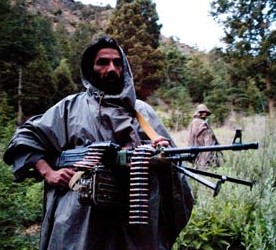 nstead of the trademark Taliban uniforms of turbans, eyeliner and flip-flops, these men wore Russian and Nato poncho raincoats over their shalwars, and boots and trainers. Most striking was the way they held their guns. Instead of carrying them in the standard militia style, on their shoulders or holding them like walking sticks, they wore them strapped around their chests, one hand by the trigger and the other holding the muzzle down. They stood just like the Americans.
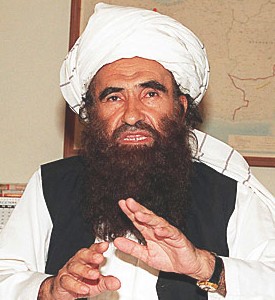 “We are Afghans fighting the jihad and defending our country under the leadership of Jalaluddin Haqqani,” the commander said. He spoke in a schoolmasterly tone. As well as being a commander, Mawlawi Jalali is a teacher in Haqqani’s madrasa.
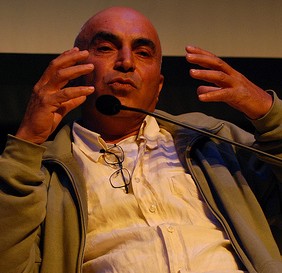 plumber by trade, Ezra Nawi is a Jewish member of a small band of Israeli peace activists who put themselves on the line week in and week out by traveling to the stony hills outside Hebron to help Palestinians defend their land against right-wing Jewish settlers. And he has the lumps to show for it. Four years back, some settlers at Susya had tried to drive a Palestinian family off their land by tossing a dead dog into their well in order to poison the family’s water. The following day, Palestinians hauled the dog out of the well and were trying to draw water under the protection of Nawi and some other volunteers from an Jewish-Arab peace group known as Ta’ayush. Masked settlers appeared, smashed one activist with the butt of a gun and broke a long wooden stick over Nawi’s head.
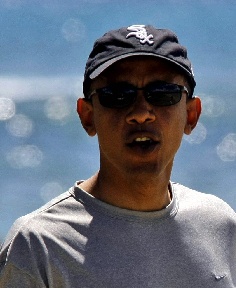 ith great sorrow and deep consternation, we hereby declare the death of the latest hope. Perhaps rumors of its death are greatly exaggerated, to paraphrase the famous quote by Mark Twain, but the fears are being validated day after day. Barack Obama’s America is not delivering the goods. Sharing a glass of beer with a racist cop and a pat on the back of Hugo Chavez are not what we hoped for; wholesale negotiations on freezing settlement construction are also not what we expected. Just over six months after the most promising president of all began his term, perhaps hope has a last breath left, but it is on its deathbed.

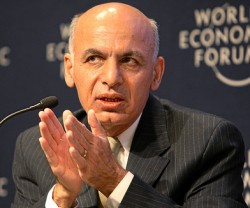
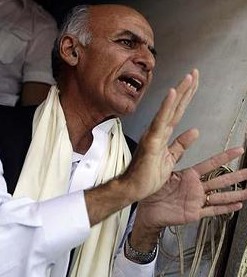 hether wrapped in a shawl for a televised debate, sitting on a dirt floor with a shopkeeper, or thundering over speakers in a dust storm, Ashraf Ghani, the most educated and Westernized of Afghanistan’s presidential candidates, is shaking up the campaign before Thursday’s election in unusual ways.
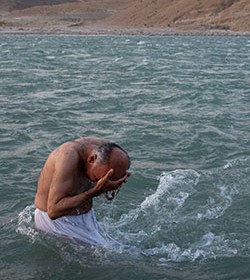 midst a presidential slate now culled to 36 contenders, Ghani, a non-aligned independent, is currently in third place, according to the polls, a Ghilzai Pashtun (that’s good) undercut by a perceived poor grasp of the country’s internecine tribal politics, with no traction among the kingmaker warlords (that’s bad).