Author Archives: Paul Woodward

After Kurdish vote, Talabani pledges to rebuild party

After Kurdish vote, Talabani pledges to rebuild party

Facing what could prove a turning point in tumultuous Kurdish politics, Iraqi President Jalal Talabani vowed Tuesday that he would lead the revival of his party after a surprisingly successful challenge by opponents in last week’s election led some to speculate that it might be the beginning of the party’s end.

In an interview, Talabani, the 75-year-old politician and former guerrilla who founded the Patriotic Union of Kurdistan (PUK) more than 30 years ago, sought to cast the election results in the best light. But the success of the Change list, led by former Talabani colleagues , against an alliance of the PUK and the other leading Kurdish party clearly surprised him.

More than a contest among parochial groups in a relatively quiet region, the struggle for political power in the Kurdish north could have sweeping repercussions for Iraq’s mercurial politics. The alliance between Talabani’s party and Kurdish President Massoud Barzani’s Kurdistan Democratic Party has held for years, though no one has really forgotten the civil war they fought in the 1990s. Their claim to represent Kurdish consensus is crucial, too, in negotiations with Baghdad over today’s most pressing issues: a law to share Iraq’s oil revenue and a resolution to the disputed border between Iraq’s Arab and Kurdish regions. [continued…]

Iraq force soon to be a coalition of one

Commanders of the Multi-National Force-Iraq, as the American-led coalition is formally called, have a looming nomenclature problem.

Two days from now, there will no longer be any other nations with troops in Iraq — no “multi” in the Multi-National Force. As Iraqi forces have increasingly taken the lead, the United States is the last of the “coalition of the willing” that the Bush administration first brought together in 2003.

That is partly because the Iraqi Parliament left suddenly for summer recess without voting to extend an agreement for the British military to keep a residual training force of 100 soldiers in Iraq. As a result, those troops must withdraw to Kuwait by Friday, according to a British diplomat, who declined to be identified in keeping with his government’s practice.

As for the other two small remnants of the coalition, the Romanians and Australians, the Australians will be gone by July 31, too, and the Romanians left last Thursday, according to the Romanian chargé d’affaires, Cristian Voicu. NATO will keep a small training presence in Iraq, but its troops were never considered part of the Multi-National Force because of opposition to the war from many NATO countries. [continued…]

Gates: Some US troops may be leaving Iraq early

The United States is considering speeding up its withdrawal from Iraq because of the sustained drop in violence there, Defense Secretary Robert Gates said Wednesday following discussions with his top commanders in the war.

“I think there’s at least some chance of a modest acceleration,” this year, Gates said.

It was the first suggestion that the Obama administration might rethink its difficult choice to leave a heavy fighting force in Iraq long past the election of an American president who opposed the war. [continued…]

Facebooktwittermail

Anti-American Israeli demonstrator: “At some point, Israel will survive and America will fall”

Yitzhak Rabin’s killers target Obama

In October 1995, Likud Party leader Benjamin Netanyahu appeared before thousands of right-wing demonstrators in Jerusalem’s Zion Square to deliver a stinging denunciation of Israeli Prime Minister Yitzhak Rabin and the Oslo Accords he had signed two years earlier. “Death to Rabin! Nazis! Judenrat!” the demonstrators chanted. Many waved signs depicting Rabin dressed in Nazi regalia.

Concerned that Netanyahu would inflame an already dangerous climate, Israeli Housing Minister Benjamin Ben-Eliezer warned the hyper-ambitious politician, “You’d better restrain your people. Otherwise it will end in murder. They tried to kill me just now… Your people are mad. If someone is murdered, the blood will be on your hands… The settlers have gone crazy, and someone will be murdered here, if not today, then in another week or another month!”

Netanyahu ignored Ben-Eliezer, striding to the podium to chants of “Bibi! Bibi! Bibi!” and an eerily prescient introduction as Israel’s “next prime minister.”

One month later, Rabin was assassinated by Yigal Amir, a right-wing radical and student at Bar-Ilan University, the ideological training ground of Israel’s religious-nationalist front. Rabin’s wife, Leah, refused to forgive Netanyahu, insisting he was at least as responsible for her husband’s murder as the extremist who pulled the trigger. [continued…]

Israeli anthem kits in Arab schools

A leading Arab educator in Israel has described the decision of Gideon Saar, the education minister, to require schools to study the Israeli national anthem as “a kind of attempted rape” of the country’s one-in-four Arab pupils. […]

Mr Saar’s initiative is widely seen among Israel’s 1.3 million Arab citizens as a further indication of the rising nationalistic tide sweeping policymakers. [continued…]

Facebooktwittermail

Associating with anyone from the West is dangerous

Associating with anyone from the West is dangerous

Associating with anyone from the West is dangerous. In these times, those abroad play a delicate but vital role. Their assistance in disseminating information from Iran is crucial but any form of intervention, be it military (the bombing of nuclear facilities) or economic (increased sanctions), is only incredibly destructive. Each threat of military aggression or proposed negotiation deadline makes “green” efforts more difficult. And increased economic sanction deteriorates our lives and safety. Some think the two recent airplane crashes may have been affected by our country’s lack of access to parts and planes.

This is our movement. We appreciate and continue to ask for global solidarity but this struggle is for Iranians. I believe that Nobel Peace Price laureate Shireen Ebadi’s statements echo the wider sentiments of the Iranian people. While speaking in Germany, she stated: “I am against economic sanctions and military interventions… Diplomatic ties must not be severed, instead the embassies could be downgraded to consulates. This would not harm the Iranian people, but it would illustrate the government’s isolation.” Keeping the table open with no conditions and encouraging dialogue with all factions in Iran is vital. However, it must be done extremely carefully so as not to provide any means of leverage for Ahmadinejad. [continued…]

Strong words from Iran’s opposition

The Iranian opposition leader Mir Hussein Moussavi spoke out more strongly than ever before on Monday against the arrests and killings of protesters, hours before Iran’s supreme leader ordered the closing of a “nonstandard” prison apparently in an effort to deflect rising criticism over the issue.

“How can it be that the leaders of our country do not cry out and shed tears about these tragedies?” Mr. Moussavi said, in comments to a teachers’ association that were posted on his Web site. “Can they not see it, feel it? These things are blackening our country, blackening all our hearts. If we remain silent, it will destroy us all and take us to hell.”

Mr. Moussavi’s angry tone appeared to reflect the steadily rising toll of those killed — some after being beaten in prison — in the crackdown that followed the disputed June 12 presidential election. A funeral was held in Tehran on Monday for Amir Javadi-Far, a student activist who died in prison after being arrested, and reports emerged of still more deaths. [continued…]

Iran’s protesters: phase 2 of their feisty campaign

Phase 2 has begun. Six weeks after millions took to the streets to protest Iran’s presidential election, their uprising has morphed into a feistier, more imaginative and potentially enduring campaign.

The second phase plays out in a boycott of goods advertised on state-controlled television. Just try buying a certain brand of dairy product, an Iranian human-rights activist told me, and the person behind you in line is likely to whisper, “Don’t buy that. It’s from an advertiser.” It includes calls to switch on every electric appliance in the house just before the evening TV news to trip up Tehran’s grid. It features quickie “blitz” street demonstrations, lasting just long enough to chant “Death to the dictator!” several times but short enough to evade security forces. It involves identifying paramilitary Basij vigilantes linked to the crackdown and putting marks in green — the opposition color — or pictures of protest victims in front of their homes. It is scribbled antiregime slogans on money. And it is defiant drivers honking horns, flashing headlights and waving V signs at security forces. (See pictures of Iran’s presidential election and its turbulent aftermath.)

The tactics are unorganized, largely leaderless and only just beginning. They spread by e-mail, websites and word of mouth. But their variety and scope indicate that Iran’s uprising is not a passing phenomenon like the student protests of 1999, which were quickly quashed. This time, Iranians are rising above their fears. Although embryonic, today’s public resolve is reminiscent of civil disobedience in colonial India before independence or in the American Deep South in the 1960s. Mohandas Gandhi once mused that “even the most powerful cannot rule without the cooperation of the ruled.” That quotation is now popular on Iranian websites. [continued…]

Gates says U.S. overture to Iran is ‘not open-ended’

Strains between the United States and Israel surfaced publicly in Jerusalem on Monday, as Defense Secretary Robert M. Gates tried to reassure Israelis that American overtures to Iran were not open-ended, and as Defense Minister Ehud Barak of Israel expressed impatience with the Americans for wanting to engage Iran at all.

“I don’t think that it makes any sense at this stage to talk a lot about it,” Mr. Barak said at a joint news conference with Mr. Gates at the King David Hotel in Jerusalem, referring to the American offer to talk to Iran about giving up its nuclear program. Nonetheless, he said Israel was in no position to tell the United States what to do.

But, alluding to a potential Israeli military strike against Iran if it gains nuclear weapons capability, he added: “We clearly believe that no options should be removed from the table. This is our policy, we mean it, we recommend to others to take the same position, but we cannot dictate to anyone.”

Later, Prime Minister Benjamin Netanyahu met with Mr. Gates, and his office released a statement saying that he had pressed Mr. Gates on the need to use “all means” to keep Iran from gaining a nuclear weapon. [continued…]

Russia and Iran join hands

The United States may think of Russia as a strategic partner when it comes to Iran. In reality, the geostrategic tensions between Washington and Moscow are still powerful enough to warrant a common approach by Russia and its eastern neighbor Iran with respect to a deterrent strategy towards the intrusive Western superpower.

This week, a small but significant clue is on full display with joint Russia-Iran military exercises in the Caspian Sea involving some 30 vessels. This is partially disguised by a benign environmental cause.

The maneuver, dubbed “Regional Collaboration for a Secure and Clean Caspian”, combines security and maritime objectives in the Caspian Sea, the world’s largest lake and also a main energy hub that is now the scene of competing alternatives for energy transfer. It signals a new trend in Iran-Russia military cooperation that will most likely increase in the near and intermediate future in light of Iran’s observer status at the Shanghai Cooperation Organization. The continuing standoff over Iran’s nuclear program should affect this warming of relations. [continued…]

Facebooktwittermail

The rise of Ayatollah Moqtada al-Sadr

The rise of Ayatollah Moqtada al-Sadr

When Iraqi cleric Moqtada al-Sadr was a young seminary student during the country’s Baathist era, he preferred playing video games to attending theological courses. Now several years and a U.S. occupation later, that same Sadr is a major Iraqi political figure, studying to become an ayatollah at Shiite Islam’s most prominent religious center of Qom, Iran. Sadr reportedly resides in Tehran and travels weekly to the Iranian shrine-city to study major works of Shiite jurisprudence under an unknown but certainly high-ranking cleric. He will exit his studies as a mujtahid, or learned scholar, with the recognized ability to issue religious decrees.

Behind this remarkable transformation — from disinterested student to occupation-opposing cleric to serious scholar — are big ambitions. And if all goes according to plan, Sadr will have a golden opportunity to return and take Iraq’s political stage by storm. [continued…]

Facebooktwittermail

A century of frenzy over the North-West Frontier

A century of frenzy over the North-West Frontier

Despite being among the poorest people in the world, the inhabitants of the craggy northwest of what is now Pakistan have managed to throw a series of frights into distant Western capitals for more than a century. That’s certainly one for the record books.

And it hasn’t ended yet. Not by a long shot. Not with the headlines in the U.S. papers about the depredations of the Pakistani Taliban, not with the CIA’s drone aircraft striking gatherings in Waziristan and elsewhere near the Afghan border. This spring, for instance, one counter-terrorism analyst stridently (and wholly implausibly) warned that “in one to six months” we could “see the collapse of the Pakistani state,” at the hands of the bloodthirsty Taliban, while Secretary of State Hillary Clinton called the situation in Pakistan a “mortal danger” to global security.

What most observers don’t realize is that the doomsday rhetoric about this region at the top of the world is hardly new. It’s at least 100 years old. During their campaigns in the northwest in the late nineteenth and early twentieth centuries, British officers, journalists and editorialists sounded much like American strategists, analysts, and pundits of the present moment. They construed the Pashtun tribesmen who inhabited Waziristan as the new Normans, a dire menace to London that threatened to overturn the British Empire. [continued…]

Facebooktwittermail

Cheney’s plans for a military coup

Cheney’s plans for a military coup

On Saturday, Mark Mazetti and David Johnston of the New York Times, quoting sources close to former President Bush, revealed that former Vice President Dick Cheney had advocated deploying the military for domestic policing purposes. Bush apparently declined to take Cheney’s advice. The discussions occurred against the backdrop of the so-called “Lackawanna Six” case, involving a group of six Yemeni-Americans from the Buffalo area who later pleaded guilty to charges of providing material support to Al Qaeda and received prison sentences.

The disclosures shed considerable light on two memoranda prepared in the Justice Department’s Office of Legal Counsel by John Yoo (with the help of Robert J. Delahunty on the second memo) at the request of then-White House counsel Alberto Gonzales. The principal memo was part of a group published by the Obama Administration on May 16, provoking widespread public concern. In the memo, Yoo argued that the Fourth Amendment could be viewed as suspended in the event of domestic operations by the military in war time. The second memo, not yet released but discussed here by Prof. Kim Scheppele on the basis of references to it in other documents, apparently attempted to read the Posse Comitatus Act of 1878, which forbids the domestic deployment of the military for police functions, into oblivion. In “George W. Bush’s Disposable Constitution,” I argued that Yoo’s memo was the formula for a dictatorship. Yoo responded to this objection in the Wall Street Journal, arguing that the memo had been authored with a very narrow set of facts in mind, namely an invasion like the sort of attack that was launched on Mumbai on November 26, 2008. But the latest disclosures make clear, once more, that Yoo’s claims are dishonest. [continued…]

Facebooktwittermail

U.S. citizens wrongly detained, deported by ICE

U.S. citizens wrongly detained, deported by ICE

The son of a decorated Vietnam veteran, Hector Veloz is a U.S. citizen, but in 2007 immigration officials mistook him for an illegal immigrant and locked him in an Arizona prison for 13 months.

Veloz had to prove his citizenship from behind bars. An aunt helped him track down his father’s birth certificate and his own, his parents’ marriage certificate, his father’s school, military and Social Security records.

After nine months, a judge determined that he was a citizen, but immigration authorities appealed the decision. He was detained for five more months before he found legal help and a judge ordered his case dropped.

“It was a nightmare,” said Veloz, 37, a Los Angeles air conditioning installer.

Veloz is one of hundreds of U.S. citizens who have landed in the custody of U.S. Immigration and Customs Enforcement and struggled to prove they don’t belong there, according to advocacy groups and legal scholars, who have tracked such cases around the country. Some citizens have been deported. [continued…]

Facebooktwittermail

“I am both Muslim and Christian”

“I am both Muslim and Christian”

Shortly after noon on Fridays, the Rev. Ann Holmes Redding ties on a black headscarf, preparing to pray with her Muslim group on First Hill.

On Sunday mornings, Redding puts on the white collar of an Episcopal priest.

She does both, she says, because she’s Christian and Muslim.

Redding, who until recently was director of faith formation at St. Mark’s Episcopal Cathedral, has been a priest for more than 20 years. Now she’s ready to tell people that, for the last 15 months, she’s also been a Muslim — drawn to the faith after an introduction to Islamic prayers left her profoundly moved. [continued…]

Facebooktwittermail

The effort to “Judaize” Jerusalem is a campaign of ethnic cleansing

The effort to “Judaize” Jerusalem is a campaign of ethnic cleansing

Netanyahu does not care so much whether people believe him or not. This week, like every other week since he returned to power, he was fully occupied with survival. In order to survive, the coalition must remain intact. To achieve this, he must show that he does not “fold” under American pressure. No better place to prove this than Jerusalem.

About Jerusalem, as official spokesmen never tire of telling us, about Jerusalem there is a national consensus. From wall to wall. From Left to extreme Right.

However, this myth is long dead. No such consensus exists. Right now, most Israelis are ready to return the Arab quarters of East Jerusalem to Palestinian rule in return for real peace. I know of no Jewish mother who is ready to sacrifice her son in a war for the Shepherd Hotel.

*

I beg to contradict yet another myth that is being propagated relentlessly by our media: that a national consensus against President Obama is forming.

As we say in classical Hebrew: No bears and no forest. Or more colloquially: No birds and no shoes.

Many Israelis, very many, hope that Barack Obama will do for them what seems impossible without him: bring them peace. They have despaired of our political system, of both the coalition and the opposition, of both Right and Left. They are convinced that only an outside force can realize this hope.

If indeed Obama does clash with Netanyahu over his refusal to freeze the settlements in the West Bank and his insistence on continuing to build in East Jerusalem, it is for Obama’s victory that many Israelis will be praying. They know that in this battle, it is not Netanyahu but Obama who represents the true interests of Israel. [continued…]

In 2 West Bank settlements, sign of hope for a deal

The ultra-Orthodox inhabitants [of Modiin Illit and its sister community, Beitar Illit] often express contempt for the settler movement, with its vows never to move. The people here, who shun most aspects of modernity, came for three reasons: they needed affordable housing no longer available in and around Jerusalem or Tel Aviv; they were rejected by other Israeli cities as too cult-like; and officials wanted their presence to broaden Israel’s narrow border.

Yet they are lumped with everyone else. The settler movement and the Israeli government point to ultra-Orthodox settlements, with their large and ever-increasing families, to argue that there is no way to stop “natural growth” without imposing acute human suffering. Those seeking a freeze use the settlements as evidence that growth is so out of control that drastic action must be taken. More broadly, opponents say the settlements violate international law, legitimize force by armed messianic Jews and ruin the chance of establishing a viable Palestinian state.

But even those who strongly favor a complete freeze acknowledge that the annual settler growth rates of 5 and 6 percent owe a great deal to these two towns that have little to do with the broader settler enterprise.

Dror Etkes of Yesh Din, an antisettlement group in Israel, noted that half of all construction in West Bank settlements was taking place in these two ultra-Orthodox communities, adding that given their location next to the boundary, it was highly likely they would be in Israel in a future deal through a redrawn border. “From a purely geographic point of view, construction there is not as destructive as elsewhere,” he said.

But he does not want building to continue in Modiin Illit or Beitar Illit without a deal for a Palestinian state, nor does he mean to imply that these settlements have been a benign force. “Land has been taken from Palestinians, in some cases from private landowners, for the building in these settlements, and there are many other issues like sewage flow into Palestinian villages that must be addressed,” Mr. Etkes said.

Settler leaders reject any distinction. The fact that the ultra-Orthodox came to the West Bank to solve their housing problems is “completely O.K. with me,” said Dani Dayan, chairman of the Yesha Council, the settlers’ political umbrella group. “They are an integral part of our endeavor and our achievement.”

But even in Bilin, the Palestinian village that abuts Modiin Illit and has become a symbol of Palestinian resistance against Israel’s West Bank separation barrier, the settlers over the fence are viewed as different from the Jewish nationalists in, say, Hebron.

Abedallah Abu Rahma, a teacher from a farming family and a leading activist in the village, pointed toward the settler high-rise buildings visible across the valley from his living room window and said: “They tell us, ‘We are poor, the apartments here are cheaper and we did not know it was a settlement.’ Many told us, ‘Give us our money back and we will leave.’ ”

The Palestinians, who hold weekly demonstrations against the barrier, have even joined forces with some of the settlers. Two years ago, Bilin won a major Supreme Court case that forced a change in the route of the barrier, and some of the documents the victorious villagers used, Mr. Abu Rahma said, had been secretly passed to them by ultra-Orthodox settlers feuding with their own municipal leaders. [continued…]

Facebooktwittermail

Women in Gaza

Women choosing to be

There are many twists in the fate of Palestinians, particularly in the Gaza Strip, but in Palestine as a whole. They are all significant steps in the one million mile journey of my people. Gaza, not more than 360 square kilometres, may be a tiny spot of land on the map, but for many around the world it has become legendary, the embodiment of steadfastness and perseverance for an epoch. Currently bled dry by the Siege imposed for three years now, it still prides itself on teaching the rest of the world what dignity and honour mean. Impoverished families whose houses were demolished in front of their eyes remain unbowed, not willing to give up. Families who lost loved ones in their battle for freedom are determined more than ever. Their plights and misfortunes have only made them stronger, more adamant in their pursuit of liberty. This is the image with which we welcome a visitor to Gaza.

Four years ago, it was an everyday occurrence to hear clashes of gunfire in the streets of Gaza, Palestinian on Palestinian gunfire or Israeli incursions. Above our heads and whenever they wished to, the Israeli Occupation Air Forces could strike a car, a house or a person without prior warning. My home used to be a peaceful area, but I remember four years ago hearing an exchange of heavy gunfire so close that I decided to call the police emergency number: it felt as if the bullets were about to come through my windows. I was worried about my newborn babies. The best answer I could muster from the emergency service was:” What can I do sister, it’s a chaotic country we live in”.

As you walk along the streets and alleys, today, you will see ordinary people, children playing in the streets and alleys, men and women rushing back from their jobs, and order and security back in the streets from which they have long been absent. How, you might ask, can the people of Gaza go about their ordinary lives after such a horrific war? Are they pretending that nothing has happened or is it something else? Yes: it is something else. On this holy land, there is no place for cowardice or retreat. One has only one recourse which is to heal the wounds, wipe the tears and move on. It is one of those situations which echoes: To be or not to be. The people of Gaza have chosen to be. [continued…]

British lawmakers: government should engage Hamas

British lawmakers have released a report urging the government to talk with moderates in the Palestinian militant group Hamas, which controls the Gaza Strip.

The British Parliament’s Foreign Affairs Committee said the current policy of not talking to Hamas is achieving little.

The report published Sunday reinforces a recommendation the committee made two years ago. [continued…]

Facebooktwittermail

Ahmadinejad seen as increasingly vulnerable since re-election

Ahmadinejad seen as increasingly vulnerable since re-election

President Mahmoud Ahmadinejad of Iran dismissed his intelligence minister on Sunday and his culture minister resigned, the latest fallout of a bitter dispute among conservatives that has exposed Mr. Ahmadinejad’s vulnerability in the aftermath of last month’s disputed election.

The intelligence minister, Gholam-Hussein Mohseni-Ejei, is one of several who walked out of a cabinet meeting last week to protest Mr. Ahmadinejad’s promotion of a controversial deputy, Esfandiar Rahim Mashaei.

That dismissal seemed largely symbolic, with only a week left before Mr. Ahmadinejad is inaugurated for a second term and must submit a new cabinet to the Parliament. Analysts say he is trying to show political confidence after the June 12 election, which opposition supporters claim was rigged in his favor. But his conservative rivals appear to smell blood and have pressed him hard over the promotion of Mr. Mashaei.

Mr. Ahmadinejad could face trouble in the coming days, because dismissing ministers, beyond a certain point, triggers a parliamentary vote of confidence on the cabinet. The deputy speaker of Parliament said Sunday that any cabinet meetings before the end of the president’s term would be illegal, state media reported. [continued…]

Iran’s Rafsanjani ignores hardliners’ call on vote

ran’s influential former president Akbar Hashemi Rafsanjani on Sunday defied a call by a group of hardline clerics to back the country’s disputed presidential election result, a news agency reported.

On Friday, 50 members of the 86-seat Assembly of Experts, called on Rafsanjani in a statement to show more support for Supreme Leader Ayatollah Ali Khamenei, who endorsed the re-election of the hardline president, Mahmoud Ahmadinejad, soon after the June 12 vote, which moderates say was rigged.

Challenging the authority of Iran’s most powerful figure, Rafsanjani declared the Islamic republic in crisis in during his sermon on July 17 and demanded an end to arrests of moderates. [continued…]

Facebooktwittermail

Meet the Taliban’s new leader

America’s new nightmare

In all likelihood, you’ve never heard of Mullah Baradar. The only Taliban leader most people know is Mullah Mohammed Omar, the unworldly, one-eyed village preacher who held the grand title amir-ul-momineen—”leader of the faithful”—when he ruled Afghanistan in the late 1990s. Omar remains a high-value target, with a $10 million U.S. bounty on his head. But he hasn’t been seen in at least three years, even by his most loyal followers, and rarely issues direct orders anymore. In his place, the adversary that American forces are squaring off against in Afghanistan—the man ultimately responsible for the spike in casualties that has made July the deadliest month for Coalition soldiers since the war began in 2001—is Baradar. A cunning, little-known figure, he may be more dangerous than Omar ever was.

In more than two dozen interviews for this profile, past and present members of the Afghan insurgency portrayed Baradar as no mere stand-in for the reclusive Omar. They say Baradar appoints and fires the Taliban’s commanders and governors; presides over its top military council and central ruling Shura in Quetta, the city in southwestern Pakistan where most of the group’s senior leaders are based; and issues the group’s most important policy statements in his own name. It is key that he controls the Taliban’s treasury—hundreds of millions of dollars in -narcotics protection money, ransom payments, highway tolls, and “charitable donations,” largely from the Gulf. “He commands all military, political, religious, and financial power,” says Mullah Shah Wali Akhund, a guerrilla subcommander from Helmand province who met Baradar this March in Quetta for the fourth time. “Baradar has the makings of a brilliant commander,” says Prof. Thomas Johnson, a longtime expert on Afghanistan and an adviser to Coalition forces. “He’s able, charismatic, and knows the land and the people so much better than we can hope to do. He could prove a formidable foe.” [continued…]

U.S. weighs private army to protect Afghan bases

The U.S. military is mulling a plan to build a private army to protect bases throughout Afghanistan. On July 10, the Army issued a request for information from companies interested in bidding on an Afghanistan-wide security contract. While a formal solicitation has not been launched, the idea would be to provide security services for approximately 50 or more forward operating bases or command outposts throughout Afghanistan.

Use of private security contractors to protect bases is not new: In Iraq, the U.S. military hired guards to provide fixed-site security at installations throughout the country. Old joke from Iraq: Q: What’s the password to get into the dining facility? A: Jambo, rafiki! (”Hello, friend!” in Swahili — lots of Ugandans were employed as private guards in Iraq.)

As we’ve reported before, Afghanistan has also seen a surge in demand for private security contractors. Back in November, the government issued a solicitation for armed guards to protect installations in southern Afghanistan. In January, U.K. security firm Aegis won a contract to run Afghanistan’s “armed contractor oversight directorate,” which is responsible for keeping tabs on armed contractors hired by the U.S. military, much like the Reconstruction Operations Center in Iraq. Companies like Blackwater Xe have long provided contracted air services. [continued…]

Facebooktwittermail

Worries about a Kurdish-Arab conflict move to fore in Iraq

Worries about a Kurdish-Arab conflict move to fore in Iraq

Louis Khno is a city councilman whose city is beyond his control. In his barricaded streets are militiamen — in baseball caps and jeans, wielding Kalashnikov rifles, with the safeties switched off. They answer to someone else. Leaders of his police force give their loyalty to their ethnic brethren — be they Kurd or Arab. Clergy in the town pledge themselves to the former. Khno and his colleagues to the latter.

“We’re far from the conflict, but now we’ve become the heart of the conflict between Kurds and Arabs,” Khno said. “We’re now stuck in between them.”

Khno called the town “the line of engagement,” one stop along an amorphous frontier in northern Iraq shaped by contested history, geography and authority. Dividing the Kurdish autonomous region from the rest of the country, that frontier represents the most combustible fault line in Iraq today, where Arab and Kurd forces may have come to blows last month along hills of harvested wheat. Kurdish officials suggest that another confrontation is inevitable, with halfhearted negotiations already stalled, and U.S. officials acknowledge that only their intervention has prevented bloodshed.

Since 2003, when U.S. forces barreled into Baghdad, toppling Saddam Hussein, inspiring a Shiite revival and unleashing a Sunni insurgency that drew on a communal sense of siege, the war in Iraq has been in large part a sectarian conflict that pitted Sunni Arab against Shiite Arab. That war has subsided, even if bitterness remains.

For months, there were fears that the sectarian battle might reignite, as the United States withdrew its combat forces. Today, that looks less likely. Rather, U.S. officials say, the biggest threat to Iraq in the years ahead is the ethnic conflict, Kurds in the north against the Arab-dominated government in Baghdad, a still-unresolved struggle that has helped shape Iraq’s history since the British inherited the land after World War I. [continued…]

Now it’s a census that could rip Iraq apart

When Iraqis were drafting their Constitution in 2005, the parties could not agree on who would control Kirkuk, the prized oil capital of the north. They couldn’t even agree on who lived in Kirkuk, which is claimed by the region’s Kurds, but also by its Turkmen minority and Sunni Arabs. For that matter, they couldn’t even agree on where Kirkuk was — in Tamim, Erbil, or Sulaimaniya Province.

So the Iraqis punted, inserting Article 140, a clause that called for a national census, followed by a referendum on the status of Kirkuk, all to be held by the end of 2007. What followed were a succession of delays, against a backdrop of sectarian violence and warnings that Kirkuk could blow apart the Shiite-Kurdish alliance that has governed Iraq since the Americans invaded.

Massoud Barzani, president of the Kurdish regional government, warned two years ago that if “Article 140 is not implemented, then there will be a real civil war.” He’s still waiting.

But so is the threat of civil war, which lurked quietly in the polling places this weekend as residents of Iraq’s Kurdish-dominated areas voted for their regional president and Parliament. Until the status of Kirkuk is clear, nobody really knows how much power those regional officials can wield within the national government, or even whether the Kurds will want to remain part of Iraq. [continued…]

Facebooktwittermail

Assiya Rafiq stands up for women in Pakistan

Not a victim, but a hero

(An update from Nicholas Kristof, July 28.)

After being kidnapped at the age of 16 by a group of thugs and enduring a year of rapes and beatings, Assiya Rafiq was delivered to the police and thought her problems were over.

Then, she said, four police officers took turns raping her.

The next step for Assiya was obvious: She should commit suicide. That’s the customary escape in rural Pakistan for a raped woman, as the only way to cleanse the disgrace to her entire family.

Instead, Assiya summoned the unimaginable courage to go public and fight back. She is seeking to prosecute both her kidnappers and the police, despite threats against her and her younger sisters. This is a kid who left me awed and biting my lip; this isn’t a tale of victimization but of valor, empowerment and uncommon heroism. [continued…]

Facebooktwittermail

Cleric who negotiated Taliban-Pakistan peace deal is arrested

Cleric who negotiated Taliban-Pakistan peace deal is arrested

Pakistani police on Sunday arrested Sufi Mohammed, the Taliban-aligned cleric responsible for brokering a controversial peace deal between Swat Valley militants and the government this year. That deal eventually broke down, leading to the ongoing military offensive against Taliban fighters.

Mohammed is the father-in-law of Maulana Qazi Fazlullah, the Taliban leader who fought Pakistani troops for two years before wresting control of the Swat Valley, once a tourist mecca.

Mohammed negotiated a peace deal with the government in February that called for Fazlullah’s fighters to lay down their arms in exchange for the imposition of Sharia, or Islamic law, in the region. In the spring, Taliban militants in Swat reneged on the truce and moved into the neighboring district of Buner, just 60 miles from the nation’s capital, Islamabad.

Fazlullah’s actions prompted Pakistani leaders to mount an all-out assault on militants in Swat and surrounding regions, a move that forced the exodus of nearly 2 million civilians from the conflict zone. [continued…]

Facebooktwittermail

Iran’s revolution has a vacancy at the top

Iran’s revolution has a vacancy at the top

On June 15, five of my relatives — the oldest 65, the youngest 22 — spent four hours traveling across Tehran’s sprawling metropolis to reach a demonstration against the country’s election result. They first crammed into a creaky Iranian-made car, rode part of the way in a dilapidated bus and walked the final three miles. They strode quietly north along with an estimated 2 million others, hopeful that their show of peaceful force would convince the government to annul the election. The next day, the authorities began viciously attacking demonstrators. They dispatched plainclothes henchmen with pistols in their pockets to shoot randomly at civilians. Dissent, Iranians learned, could cost them their lives.
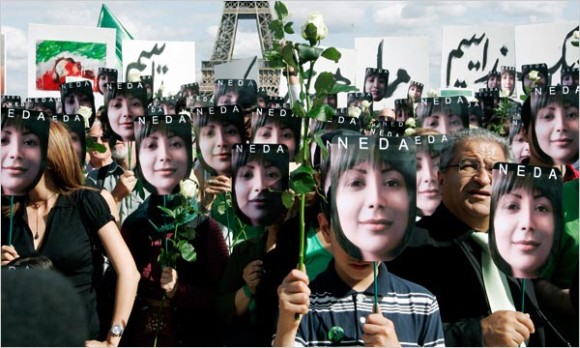
Immediately after the election, such protests evoked the grand marches of the 1979 Islamic revolution. But the scale of the dissent soon diminished. Clearly, the state’s vicious tactics were partly to blame. But Iranians were not simply terrorized into staying at home. Rather, there was no leader inspiring them to take to the streets — and put their lives at risk. The friends and relatives I have spoken to remain outraged over the fraudulent election. But they also remain perplexed by the opposition leaders. Many hailed from the regime’s old-guard elite, and it was unclear how much they would be willing to challenge the Islamic system.

No one had an answer to this central question: For whom, exactly, would ordinary Iranians be willing to put themselves in danger? What sort of leadership is required to make violence worth it? [continued…]

Iran’s opposition calls crackdown ‘immoral’

The leaders of Iran’s opposition movement sent an open letter of protest to the country’s highest religious authorities on Saturday, complaining that the state had used “illegal, immoral and irreligious methods” in the crackdown following last month’s disputed presidential election and calling for the release of hundreds of people arrested since.

The letter came a day after the funeral of a young protester with links to Iran’s political elite, whose father told a senior military commander that the youth had been beaten after his arrest, held incommunicado and allowed to die of an infection. The funeral drew senior figures, including conservative members of Parliament and a representative from the office of Iran’s supreme leader, Ayatollah Ali Khamenei.

The open letter was the latest sign of the opposition movement’s continuing defiance, despite stern warnings by leading clerics to drop the issue and an enormous police presence that has largely scuttled street protests for the past week. It followed a similar call eight days ago by former President Ali Akbar Hashemi Rafsanjani to release the detainees. [continued…]

Facebooktwittermail

Iran ready to strike Israel’s nuclear sites

Iran ready to strike Israel’s nuclear sites

Iran issued a blunt warning to Israel on Saturday that it will launch missile strikes on Israel’s nuclear facilities in the event that the Islamic republic is attacked by the Jewish state. The threat from the head of Iran’s Revolutionary Guard came after a test of Israel’s Arrow missile defence system on Wednesday was reported to have been a ‘resounding failure’.

Inside Iran’s political establishment, President Mahmoud Ahmadinejad after being forced to yield to pressure from the Supreme Leader, Ayatollah Khamenei, who opposed his choice of Esfandiar Rahim Mashai as first vice president, has instead appointed the controversial candidate as his new adviser and head of the presidential office. [continued…]

Facebooktwittermail

Painting Obama as an enemy will hurt Israel badly

Painting Obama as an enemy will hurt Israel badly

In light of the public brawling between Prime Minister Benjamin Netanyahu and U.S. President Barack Obama, we can expect to start seeing graffiti saying things like “America, get out,” “Obama is an Arab” and “Neither a broker nor honest.”

In the new Israeli debate, America is slowly beginning to be perceived as an enemy – and the dispute is going personal: Our prime minister versus their president. Yesterday, he simply demanded that Israel adopt the two-state solution, then called for a freeze on construction in the settlements (without agreeing to settle for “only” the completion of projects already underway), and now he wants to divide Jerusalem. Not Netanyahu – Obama. [continued…]

Facebooktwittermail