That doesn’t mean that the United States won or achieved all of its aims or that fighting among Iraqis will stop. It doesn’t mean that Iraq is stable, democratic and relatively free of corruption.
The war is over for the United States because the Iraqis don’t really need or want American forces around anymore. Every time U.S. troops roll out of the gate with their Iraqi counterparts in Baghdad, they discredit the Iraqi forces in the eyes of their people. They make their Iraqi partners’ jobs harder. Although senior U.S. commanders understand and accept this fact privately, they will never admit it. [continued…]
When thieves shot dead eight guards and made off with $4.8 million in one of Iraq’s biggest-ever bank heists last week, fingers quickly pointed at the Sunni-led insurgency.
Extremists must be turning to crime to finance their activities, so the hypothesis went, and $4.8 million would pay for a lot of bombs.
But after a series of arrests and a sweep of a government compound, Iraqi police say the culprits were Iraqi army officers attached to the elite unit guarding Shiite Vice President Adel Abdul Mehdi. [continued…]
Amin says that he was beaten, whipped, deprived of sleep and threatened with an electric drill while being asked questions that would subsequently be put to him again during non-violent interviews by two MI5 officers. Before Amin went on trial, the judge ruled that his conditions in ISI custody had been “physically oppressive” but that he had exaggerated his mistreatment and that it fell short of torture.
Since then, Human Rights Watch (HRW), the New York-based NGO, has spoken to a number of Pakistani intelligence officers who they say corroborated the accounts of torture given by several British citizens alleging UK complicity.
In the case of Amin, according to HRW, the Pakistani sources said his account was “essentially accurate”, adding that it was a “high-pressure” case and the desire for information on the part of both British and American authorities was “insatiable”. HRW add that their sources say British intelligence officials were “perfectly aware that we were using all means possible to extract information from him and were grateful that we were doing so”. [continued…]
Punjab, the fourth and most strategic province, is the country’s heart — home to the powerful military as well as much of Pakistan’s governing class; social upheaval here would drag the whole country with it. In my travels in this province, none of the mullahs were talking about revolution. In fact, the social justice discussions that have driven political movements in the wider Islamic world — Hamas, Hezbollah, or the Sadr Army of Iraq’s Moktada al-Sadr, for example — were notably absent.
Instead, I have found a surprisingly comfortable coexistence between the mullahs, the landlords and the political elite (the latter two are often one and the same). Even the harder-line preachers, among the sternly traditional Muslims known as Deobandis, have stuck to a bland, nonconfrontational line.
One leader of a Deobandi seminary in Kabirwala, a town in southern Punjab, told me that the land was distributed as God had intended, and that the only problem with the landlords was that some were insufficiently Islamic, though now that was improving.
History explains much of the feudal outlook of the clerics in Punjab. They tend not to oppose the establishment in part because the state itself made them powerful. In the 1980s, the military dictator Zia ul-Haq gave land and money to Deobandis, a policy the United States supported because it needed both Mr. Zia and fervent jihadists in the fight against the Soviets in Afghanistan. [continued…]
After receiving eviction notices last May, three Palestinian families constituting 53 people, including 20 children, were forcibly removed from their homes under High Court order at dawn yesterday, August 2.
The Hanouns, the Rawis and the al-Ghawis, all families who fled their homes in West Jerusalem and became refugees during the 1948 War, have been living in their houses since 1956, when Jordan reached an agreement with UNRWA to resettle them. They are now living on the streets, homeless.
Just a week ago they were living inside their home and now there are Jewish settlers inside, exhibiting not the least bit of remorse for the homeless family just outside. The Hanoun family’s furniture was seized by Israeli forces and they are now responsible for paying the storage and mover fees. Meanwhile, the Jewish settlers are living with round-the-clock security, not allowing anyone near. At one house, the police actually had the nerve to tell us not to film too close, as we should respect the privacy of the new residents. [continued…]
Early in the morning on July 7, an excited crowd of more than 100 gathered in Ben-Gurion International Airport to greet 232 new Jewish immigrants to Israel who arrived from North America on an El Al charter flight organized and funded by Nefesh B’Nefesh (which means “Soul in Soul” in Hebrew). The airport’s old and defunct Terminal 1 has been transformed into a celebratory arrival hall for new immigrants brought by the nonprofit organization, which was founded in 2001 with the aim of revitalizing immigration to Israel from North America and Britain.
Recently considered by the Jewish Agency to be serious competition when it comes to immigration, NBN is now recognized as the official operator of North American immigration to Israel. After some years of animosity and tension between the two groups, the Jewish Agency, along with the Israeli government, signed a contract with NBN last September that not only grants formal recognition to NBN but also guarantees that the government and the Jewish Agency will each fund a third of NBN’s $12 million annual budget. The remaining third comes from private donors. It is noteworthy, given the fact that Israeli taxpayer money goes toward this enterprise, that so few Israelis have heard of it. [continued…]
An Israeli judge has ruled that Israel has authority over a disputed area in the Ayalon Valley, a move that could allow the confiscation of Palestinian land bordering the occupied West bank.
The decision, reported in the Israeli press on Sunday, goes against a previous agreement that all issues of sovereignty must be decided by both parties.
Unlike East Jerusalem or the Golan Heights, both considered internationally to be occupied territory, the area around Latrun, about 25km from Jerusalem, was never annexed by Israel. [continued…]
About half of Israelis believe that in order to be a “true Israeli,” one has to have been born in Israel, so finds the Israel Democracy Institute in its annual Israeli Democracy Index, published Monday.
The report, which this year focused on the integration of Russian immigrants into Israeli society, tested the prevalent notion that the integration was smooth. The findings of the study, however, suggested otherwise. The study revealed that most Russian immigrants feel that they have no power to change their immediate reality, even 20 years after the immigration from the former Soviet Union began.
The democracy poll was conducted in March 2009, and included a random sample of adult Israelis. 1,191 people were polled in three different languages: Hebrew, Arabic and Russian. The margin of error is 2.8 percent.
The study found that the mood of the Russian immigrants is generally darker, the problems they face are tougher, and that their reactions are harsher than veteran Israelis’. The immigrant sector voices more concern over Israel’s security threats, is less connected to Israel, and fewer immigrants say that they would want their children to grow up in Israel.
The report found that 77 percent of Russian immigrants support promoting Arab migration from Israel, as opposed to 47 percent of native Jews who say they would support such a policy. 33 percent of the native Jews accept the existence of Arab political parties within the Knesset, while only 23 percent of the immigrants accept this fact. 27 percent of Israelis oppose the statement “a Jewish majority is necessary for fateful decisions for the country” ? in comparison with 38 percent who opposed the same statement in 2003. These figures indicate a growing support for the stripping of political rights from Israel’s Arab minority. [continued…]
I was one of about 175 Americans who formed the VIVA PALESTINA USA Convoy that entered the Gaza Strip on Wednesday evening, July 15, 2009, carrying medical and other humanitarian aid. We entered the Gaza Strip through the Rafah crossing from Egypt with permission to stay 24 hours.
The 1.5 million people who live in the Gaza Strip have been under Israeli restrictions for over 15 years. Starting in the mid-1990s, Israel imposed restrictions on permits for Palestinian men to work in Israel. Coincident with the unilateral, non-negotiated Israeli withdrawal of settlers and its army in 2005, Israel started to restrict imports and exports. Israel tightened these restrictions in 2006 in response to Hamas winning a majority in the Palestinian Authority elections, and again in 2007 when Hamas won a mini-civil war that was initiated by Fatah and took exclusive control of the Gaza Strip. Restrictions of food, fuel, and medical supplies triggered a humanitarian crisis in the Gaza Strip with the U.N. reporting a large fraction of the people, especially children, suffering from malnutrition. The cut-off of import and export of commercial goods led to destruction of the economy and massive unemployment. The situation was made much worse by the December 2008-January 2009 bombing by Israel that resulted in over 1,400 killed and many buildings destroyed, including government and civic buildings and housing for over 100,000 people. [continued…]
In coming weeks, senior administration officials said, the White House will begin a public-relations campaign in Israel and Arab countries to better explain Mr. Obama’s plans for a comprehensive peace agreement involving Israel, the Palestinians and the Arab world.
The campaign, which will include interviews with Mr. Obama on Israeli and Arab television, amounts to a reframing of a policy that people inside and outside the administration say has become overly defined by the American pressure on Israel to halt settlement construction on the West Bank.
“We’re at a crucial moment now,” said Martin S. Indyk, a former ambassador to Israel and peace negotiator in the Clinton administration. “There are only so many visits George Mitchell can make.” [continued…]
Historically speaking, the Iranian government has enjoyed four sources of legitimacy: its ability to manage state affairs (and thus the people’s consent), its official religious authority, its commitment to Iran’s independence, and a stable base of social support. All of these have now been irretrievably undone.
The massive vote rigging on June 12 brought President Mahmoud Ahmadinejad’s ability to run the state’s affairs under intense public scrutiny, and the spontaneous uprising of the people in its wake openly removed the government’s political legitimacy.
Shortly after, in his speech at Friday prayer, Ayatollah Ali Khamenei, the supreme leader, declared war on the people, threatening a violent crackdown unless the results of the election were duly accepted. This removed the last vestiges of the regime’s religious legitimacy as well.
It had been waning for some time already, not only because it stands in opposition to Islam understood as a discourse of freedom, but even within the regime and among traditionalists. Ayatollah Ali Sistani (the greatest Shia clergyman in Iraq) was opposed to the principle of Velayat-e Faqih (the rule of the imamate), and Ayatollah Hossein Ali Montazeri (Khomeini’s would-be successor who later became his critic) had argued that the doctrine was simply a proof of shirk, or false God-making. [continued…]
The Obama Administration has begun to signal that if Iran hasn’t responded positively to its offer of negotiations over the nuclear question by mid September when the UN General Assembly convenes, Washington will move to implement what Secretary of State Hillary Clinton calls “crippling action” against Iran. They’re unlikely to get Chinese and Russian assent for further UN Security Council sanctions, but the US is moving towards using its commercial and financial muscle to force third-country corporations to cut ties with Iran that enable it to trade internationally. The prime goal of these US sanctions is choking off the gasoline imports on which the Iranian economy depends because of its own limited refining capacity. Companies in Europe, India and elsewhere that enable this trade will be targeted for sanctions unless they cut off gasoline supplies to Iran. At the same time, the US is signalling that it’s urging the Israelis to wait for diplomacy to play out before they launch military strikes, subtly flicking if not quite rattling a sabre.
Yet, there’s a consensus across the political spectrum that Iran is simply not in a position to engage in nuclear talks right now, given the turmoil within the regime. And Washington’s own opening demands are still stuck in the Bush era, insisting that Iran forego the right to enrich uranium – a position rejected by all the factions in Iran. It’s not hard to see, though, that if this autumn Iran suddenly finds itself facing gasoline sanctions and sabre rattling from Israel, behind demands that it surrender what it sees as its nuclear rights, many of those who are currently challenging Mr Ahmadinejad and Mr Khamenei will change their stance if they perceive the Islamic Republic under external threat. The “crippling action” Mrs Clinton now threatens may finally achieve what Mr Ahmadinejad and Mr Khamenei have thus far failed to do – persuade the key factions of the opposition to close ranks behind the regime. [continued…]
Iranian authorities accused several politicians, including former Vice President Mohammad Ali Abtahi, of planning the riots before the elections and sparking them by allegations of vote fraud.
” ‘Cheating’ was the code word for the riot in which people were mobilized to take to the streets,” the Fars news agency quoted Abtahi as saying.
“Of course, I was not in favor of Ahmadinejad’s presidency. I did not accept this election, and by that non-acceptance I prevented the growth of civil society and I betrayed Iranian culture and history,” Abtahi said, according to Fars.
The normally jovial cleric appeared gaunt and withdrawn as he sat in the courtroom. A photograph showed Abtahi reading the confession from a handwritten document. Reformist news websites quoted his wife as saying he had been drugged. His daughter told BBC Persian that his lawyer had been barred from the proceedings. [continued…]
Iran’s former President Mohammad Khatami vehemently condemned a series of confessions extracted from his political allies and broadcast on state television as part of what he described as a “show trial.”
In comments published today on his website, Khatami, onetime leader of the nation’s reformist movement, warned that the confessions aired during Saturday’s mass trial for those allegedly behind Iran’s weeks of unrest would backfire by further dividing the people from the establishment. [continued…]
President Mahmoud Ahmadinejad of Iran, under attack from a defiant protest movement that rejects his re-election as fraudulent and from a rising chorus of critics within his own hard-line camp, defended himself on Friday and denied reports that he had fallen out of favor with the country’s supreme leader.
Conservatives have accused Mr. Ahmadinejad of showing insufficient respect for the leader, Ayatollah Ali Khamenei, during a recent dispute over cabinet choices. Some have even hinted that the combative president, who is scheduled to be sworn in for a second term next week, may not last if he does not change his ways. [continued…]
Will the turmoil in Iran continue? Can Ayatollah Khamenei survive? Can the regime continue to call itself “Islamic”? Now that the supreme leader has shed his religious mantle and has trashed the constitution, the options are far narrower than you might think.
To gauge Iran’s future, it is essential to emphasize the obvious—the “Islamic” Republic of Iran was built on velayat-e-faqih, Ayatollah Khomeini’s concept of clerical oversight, which was intended to reverse Iran’s drift toward secularism under the shah.
Khomeini understood that for his imprint to be accepted, it would have to show respect for centuries of Iranian history and civilization and for the traditional Shiism practiced in Iran. This meant just rule, social and economic justice, the freedom to chose rulers, the obligation to fight oppression and the glorification of martyrdom among others—something that the shah had ignored to his own peril. Khomeini knew full well, from his own experience under the shah, that Iran, unlike other countries in the region, could not be governed by force for long. As such, Khomeini adopted a religious mantle and a new constitution to bolster his legitimacy. It looks like that same mantle has now become a noose around his successor’s neck. [continued…]
“Hamas is very close on recognition of Israel,” says Ahmed Yousef, the Islamist movement’s deputy foreign minister, speaking from the top floor of a high-rise building in Gaza City. “We show all sorts of ideological flexibility on this.” That does not, alas, mean he can unequivocally accept the three conditions the Quartet (the United States, the European Union, the UN and Russia) laid down three years ago if Hamas is to join international negotiations. But he comes close to doing so, sounding almost desperate to stretch the semantic elastic to satisfy the doubters. It is a formulation that sticks closely to the enunciations of both Khaled Meshaal, the movement’s Syria-based leader, and Ismail Haniyeh, its prime minister in Gaza.
Hamas “honours” all previous agreements of the Palestine Liberation Organisation [with Israel], which include recognition, provided the other side abides by all its reciprocal promises. Hamas is ready to extend its present “unilateral ceasefire” if the other side formally agrees to one: not exactly the Quartet’s demand for a definitive disavowal of violence. And when it comes to recognising Israel, “the issue is not Israel’s right to exist. We know Israel is there. It’s not a matter of recognition.” The distinction, it seems, is a semantic but nonetheless ticklish one: between acceptance and recognition. Some diplomats draw an analogy with the Irish republicans of Sinn Fein, who engaged in negotiations with Britain over Northern Ireland after disavowing violence, but still refused to accept the province’s legitimacy as part of the United Kingdom. [continued…]
Saudi Arabia praised the Obama administration Friday for its “early and robust focus” on the Middle East while rebuffing its efforts to push Riyadh to take confidence-building steps toward Israel.
“Incrementalism and the step-by-step approach has not, and we believe will not, achieve peace,” said the visiting Saudi foreign minister, Prince Saud al-Faisal, with Secretary of State Hillary Rodham Clinton at his side. “Temporary security, confidence-building measures will also not bring peace.”
Former Senate majority leader George J. Mitchell, President Obama’s special envoy for Middle East peace, has traveled almost monthly to the region, seeking to coax the Israelis and Palestinians into peace talks while also encouraging Arab states to offer incentives to Israel to take bold steps, such as a freeze on settlement growth in the Palestinian territories. [continued…]
Police on Sunday submitted a recommendation for the state prosecution to indict Foreign Minister Avigdor Lieberman on charges of bribery, fraud, money laundering, witness harassment and obstruction of justice.
A police source has said the investigation is “practically over,” and the body of evidence is sufficient to support an indictment on the charges.
Last month, Attorney General Menachem Mazuz met with police investigations division head Yoav Sigalovich, national fraud squad head Shlomo Ayalon and detectives involved in the investigation. [continued…]
It has been nearly a decade since the Jewish settlement of Migron appeared on the hilltop opposite this Palestinian village, beginning with a communications tower and followed by a cluster of homes and a fence around approximately 90 acres of land.
Data tucked onto the hard drive of anti-settlement activist Dror Etkes’s computer indicates that the land belongs to the residents of Burqa and nearby Deir Dibwan, and Etkes said he expects that information will one day force the settlers to leave.
The compulsion won’t come from Israel’s politicians, world public opinion or the Obama administration, Etkes contends, but from Israel’s Supreme Court, where local advocacy groups are having increased success challenging settlements with simple property claims. [continued…]
US commanders in Afghanistan aren’t the only ones worried that civilian deaths are costing them hearts and minds. The Taliban, which has planted bombs in schools and occasionally burned its opponents alive, has put out a new code of conduct for militants that appears to be an attempt to project a softer image to the Afghan people.
The little blue booklet, “The Islamic Emirate of Afghanistan’s Rules for Mujahideen,” is sort of a Scouts codee for the Taliban. Approved by Mullah Omar, titular head of the Afghan Taliban. Mujahideen or “holy warriors” are urged not to discriminate on the basis of ethnicity and to always behave “properly” with civilians. Suicide-bombing should only be used on high-value targets, and avoiding civilian casualties is paramount, the booklet says.
“Every member of the Mujahideen must do their best to avoid civilian deaths, civilian injuries and damage to civilian property. Great care must be taken,” the booklet urges Taliban fighters. “Suicide attacks should only be used on high and important targets. A brave son of Islam should not be used for lower and useless targets.” [continued…]
Why give up on poppy eradication?
Last year the Afghan government eradicated 5,000 hectares of about 159,000 that were cultivated. More than 70 military and militia men were killed and a couple of hundred million dollars were spent—tens of thousands of dollars per hectare—to destroy 3 percent of the crop. Eradication is supposed to have a double function: first, to reduce cultivation; and second, to deter farmers from planting. But nobody is deterred by a 3 percent risk. The money would be better spent on development assistance, like hospitals and schools.
You’ve suggested that Afghanistan produces much more opium than the world actually consumes.
Oh, yes. Since 2005 the Afghans have cultivated almost twice world demand. The bottom should have fallen out of the opium market. It has not. And we have been wondering what happened to the opium, where it is. Now, in a number of military operations in the southern provinces, NATO troops have found huge amounts, which is evidence that the Taliban have been sitting on huge stockpiles. [continued…]
Last September, Gen. David H. Petraeus told reporters in Baghdad that the United States had been assured by the Iraqi government that the 3,400 Iranian dissidents in a camp in eastern Iraq would continue to be protected after the Americans turned over responsibility for the camp to Iraqi forces.
Last week’s bloody melee between Iraqi police officers and the residents of the camp has not only raised fresh doubts in Washington about the worth of these assurances, but has also exposed just how little leverage American officials now have in a country they largely controlled for almost six years.
It has also forced the Obama administration to confront some of the thorny issues that bedeviled its predecessor: how to prevent Iraq from falling deeper under Tehran’s influence, and how to fashion a tough Iran policy amid delicate negotiations to dismantle the country’s burgeoning nuclear program. [continued…]
Bombings at five Shiite Muslim mosques killed 29 worshippers Friday in a series of attacks that Iraqi army and police officers are interpreting as a sign that insurgents are determined to destabilize the country now that American forces have withdrawn from Iraqi cities and towns.
“You will see them attempting to start the sectarian violence again,” said a high-ranking Iraqi army officer who commands a unit in western Baghdad. He asked not to be named because he isn’t authorized to speak to the media.
Iraqi army and police officers told McClatchy that the pattern of attacks against the armed forces and civilians resembles the tactics that the extremist Sunni group al Qaida in Iraq used before 2006. The increase in car bombs, roadside bombs and death threats indicates that the Islamic extremist group is attempting to restore ground it lost during the “surge” of American forces in 2008, the officers said. [continued…]
In Tehran, just before the election, I sat down with Nasser Hadian, who once taught at Columbia and is now at Tehran University. He’s an influential thinker on foreign affairs who got to know [Dennis] Ross while he was in the United States. Hadian told me that Iran has taken Obama’s outreach seriously. Hadian has been part of a group of foreign-policy experts, convened by Mahmoud Vaezi at the Center for Strategic Research in Tehran, who have been meeting every two weeks to review how to respond to the U.S. offer. Vaezi prepares reports that are submitted to Ali Akbar Hashemi Rafsanjani, the reformist former president who has been bitterly critical of the June 12 vote, and to Khamenei himself.
The discussions, I was told, have been detailed, including a review of who might lead any eventual bilateral negotiations from the Iranian side. One name that has been proposed is Ali Akbar Velayati, a former foreign minister who is a top adviser to Khamenei. In this light, the fact that Velayati praised Obama after the election for remaining quiet about it is interesting. Velayati also said, “America accepts a nuclear Iran, but Britain and France cannot stand a nuclear Iran.” This is a new language, however wide of the truth. The bizarre official lambasting of Britain — and demonizing of the BBC rather than the Voice of America — can be seen as the Iranian authorities trying to keep their U.S. options open.
“My argument in all the meetings has been: You have to go for full normalization and comprehensive engagement on all the issues,” Hadian told me. “Not a U.S. consulate in Tehran, or the nuclear issue in isolation; that won’t work. And because I know we cannot normalize unless Israeli concerns are addressed, I’ve argued that Ross would be an important assurance, someone able to convince the American Jewish lobby that any eventual agreement is workable.” That view, he suggested, had gained some traction in Tehran.
Hadian said Iran has looked at everyone in the policy mix — Burns, Ross, Talwar, Vali Nasr (an Iranian-American aide to Richard Holbrooke, the State Department envoy), Gary Samore (a nonproliferation expert at the N.S.C.), Tony Blinken (a national security adviser to Vice President Joe Biden) — and the general feeling was positive. “What Obama has already done for the United States in the Muslim world is unbelievable,” he said. “It is not easy for anyone here to attack him.”
But Hadian is a reformist who backed Moussavi. The Iran he talked about has not disappeared postelection — Velayati is as influential as ever — but it’s shaken. Khamenei, who just turned 70, knows he is vulnerable right now; it’s far from clear he’d be ready to negotiate from vulnerability. His suspicion of the United States is deep; anti-Americanism has worked for him over a 20-year rule. “Khamenei still believes the United States wants to go back to the patron-client relationship and the nuclear issue is being used for that,” Sadjadpour, of the Carnegie Endowment, told me. Even if he chooses to talk, would it not be in pursuit of a familiar Iranian tactic — stringing things out, as the centrifuges spin, until cracks appear among the Western allies, or China and Russia come to Tehran’s defense?
One thing is clear: Iran is no position to talk right now. It has no functioning national-security apparatus as its leaders scramble to shore up the regime. The republican pillar of the Islamic Republic has been destroyed to salvage a hard-line rightist order, but the price of this violent gamble in terms of lost support, internal division and external criticism has been immense. Iran has morphed in the global consciousness, to the point that U2 and Madonna have adopted the cause of Iranian democracy. With oil down and opposition up, Iran’s regional ascendancy is stalled or already in reverse. [continued…]
The top U.S. commander in Afghanistan is preparing a new strategy that calls for major changes in the way U.S. and other NATO troops there operate, a vast increase in the size of Afghan security forces and an intensified military effort to root out corruption among local government officials, according to several people familiar with the contents of an assessment report that outlines his approach to the war.
Gen. Stanley A. McChrystal, who took charge of U.S. and NATO forces in Afghanistan last month, appears inclined to request an increase in American troops to implement the new strategy, which aims to use more unconventional methods to combat the growing Taliban insurgency, according to members of an advisory group he convened to work on the assessment. Such a request could receive a chilly reception at the White House, where some members of President Obama’s national security team have expressed reluctance about authorizing any more deployments.
Senior military officials said McChrystal is waiting for a recommendation from a team of military planners in Kabul before reaching a final decision on a troop request. Several members of the advisory group, who spoke about the issue of force levels on the condition of anonymity, said that they think more U.S. troops are needed but that it was not clear how large an increase McChrystal would seek. [continued…]
The chief of Palestinian militant group Hamas said his organization is prepared to cooperate with the U.S. in promoting a peaceful resolution to the Arab-Israeli conflict if the White House can secure an Israeli settlement freeze and a lifting of the economic and military blockade of the Gaza Strip.
Khaled Meshaal, 53 years old, said in a 90-minute interview at Hamas’s Syrian headquarters that his political party and military wing would commit to an immediate reciprocal cease-fire with Israel, as well as a prisoner swap that would return Hamas fighters for kidnapped Israeli soldier Gilad Shalit.
He also said his organization would accept and respect a Palestinian state based on 1967 borders as part of a broader peace agreement with Israel—provided Israeli negotiators accept the right of return for millions of Palestinian refugees and the establishment of a capital for the Palestinian state in East Jerusalem. [continued…]
Perhaps no Fatah figure has become as emblematic of the failures of Fatah as Dahlan, the polarizing politician who’s been alternately embraced and shunned by America.
Dahlan is viewed with skepticism by some American security leaders and reviled by Hamas for his heavy-handed crackdown on the Islamic group as the former head of security in Gaza.
Dahlan has kept a low profile since his Gaza City home was looted and burned during the 2007 Hamas takeover.
Now he’s preparing to run for the Fatah Central Committee.
“If Dahlan wins, then Fatah will have lost,” said Mohanned Abdel Hamid, a political analayst and occasional columnist for al Ayyam newspaper. “He is dangerous and self-serving.”
On a recent afternoon at the Elite coffee shop in Ramallah, a small group of middle-aged Fatah members who hope to take part in the convention criticized Dahlan and the old Fatah leaders.
“He is the main reason for the dispersed state of Fatah and he has not been held accountable for his actions,” said Allam Hattab, a Fatah member from Tulkarem who accused Dahlan of trying to buy votes. “I’m telling you, there will be a split after the conference.” [continued…]
Make them wait By Trita Parsi, Foreign Policy, July 30, 2009
The Obama administration should avoid repeating the key mistake of the Bush administration, for which Iran was solely viewed through the prism of its nuclear program. Delaying nuclear talks a few months won’t make a dramatic difference to Iran’s nuclear program. It could, however, determine which Iran America and the region will be dealing with for the next few decades — one in which democratic elements strengthen over time, or one where the will of the people grows increasingly irrelevant to Iran’s decision-makers.
Moreover, even nuclear talks would have a negligible impact on the election dispute, Iran currently is not in a position to negotiate. Some in Washington believe that the paralysis in Tehran has weakened Iran and made it more prone to compromise. But rather than delivering more, Iran’s government currently couldn’t deliver anything at all. The infighting has simply incapacitated Iranian decision makers. [continued…]
Two important developments over the past few days suggest that a possible confrontation may be under way between Iran’s Supreme Leader, Ayatollah Sayyed Ali Khamenei, and the high command of Iran’s Revolutionary Guards Corps (IRGC).
One development was the order issued by Ayatollah Khamenei overruling Mahmoud Ahmadinejad’s appointment of Esfandiar Rahim Mashaei as his First Vice President (Iran’s president has eight vice presidents). The second was the firing of ultra hardliner Gholamhossein Mohseni Ejehei, the Minister of Intelligence.
A reliable source in Tehran told the author that both episodes were meant to be signals by the IRGC’s high command to Ayatollah Khamenei that they were in control, and that he should toe the line — their line. According to the source, Ayatollah’s Khamenei’s order to fire Mashaei was delivered to the Voice and Visage (VaV) of the Islamic Republic (Iran’s national radio and television network) on the day Mashaei was appointed by Ahmadinejad. The VaV was asked to announce the order on national television and radio, but Ezzatollah Zarghami, the director of VaV and a former officer in the IRGC, refused to do so. [continued…]
In his 1998 speech to the American people, Iran’s reformist president, Muhammad Khatami, said he prayed that “at the close of the 20th century, people would . . . begin a new century of humanity, understanding and durable peace, so that all humanity would enjoy the blessings of life.’’
Khatami’s address marked a stunning departure from the anti-Americanism that had fueled the Iranian revolution. A scholar of The Enlightenment, he praised Alexis de Tocqueville’s “Democracy in America,’’ which “reflects the virtuous and human side of this American civilization. In [Tocqueville’s] view, the significance of this civilization is in the fact that liberty found religion as a cradle for its growth, and religion found protection of liberty as its divine calling. Therefore, liberty and faith never clashed.’’
By insisting on the compatibility of religion and liberty in America, Khatami laid a philosophical foundation for bridging the political divide between Iran and the United States. He did not vilify the United States as the “Great Satan.’’ Instead he held the United States as a model for emulation – a democratic civilization whose success reflected the ingenious combination of the principles of religion and the virtues of liberty. [continued…]
The Iranian authorities sent a mixed message of clemency and firmness on Wednesday, saying that more detainees arrested in the post-election crackdown would soon be freed, but also that 20 protesters charged with serious crimes would be put on trial, starting this weekend.
There were also new arrests, including those of two prominent reformists, Saeed Shariati and Shayesteh Amiri, opposition Web sites reported. Separately, an “underground network providing foreign media outlets with photos and footage of the post-election unrest” has been identified and its members arrested, the state-run Press TV reported, citing security forces.
The report said that the network was made up of “pro-reform extremists” and that at least two members had confessed to providing images of the unrest to Western news media in an effort to “stage a regime change” in Iran. The Iranian leadership has blamed foreign media for riots and rallies after the disputed June 12 presidential election. [continued…]
Thousands and possibly tens of thousands of mourners, many of them black-clad young women carrying roses, overwhelmed security forces today at Tehran’s largest cemetery to gather around the grave of Neda Agha-Soltan, the young woman whose videotaped shooting at a June 20 demonstration stunned the world.
Amateur video apparently taken at Behesht Zahra cemetery and quickly uploaded to the Internet shows a sea of mourners moving through the cemetery chanting slogans. “Death to the dictator,” chanted those in one long procession, kicking up a storm of dust as they walked. “Neda is not dead. This government is dead.” [continued…]
As the old saying goes, “guests, like fish, begin to smell after three days.” Since the signing of the 2009 Security Agreement, we are guests in Iraq, and after six years in Iraq, we now smell bad to the Iraqi nose. Today the Iraqi Security Forces (ISF) are good enough to keep the Government of Iraq (GOI) from being overthrown by the actions of Al Qaeda in Iraq (AQI), the Baathists, and the Shia violent extremists that might have toppled it a year or two ago. Iraq may well collapse into chaos of other causes, but we have made the ISF strong enough for the internal security mission. Perhaps it is one of those infamous paradoxes of counterinsurgency that while the ISF is not good in any objective sense, it is good enough for Iraq in 2009. Despite this foreboding disclaimer about an unstable future for Iraq, the United States has achieved our objectives in Iraq. Prime Minister (PM) Maliki hailed June 30th as a “great victory,” implying the victory was over the US. Leaving aside his childish chest pounding, he was more right than he knew. We too ought to declare victory and bring our combat forces home. Due to our tendency to look after the tactical details and miss the proverbial forest for the trees, this critically important strategic realization is in danger of being missed. [continued…]
Violent clashes continued for a second day Wednesday between Iraqi troops and members of an Iranian opposition group whose camp the Iraqis stormed Tuesday, presenting the first major dilemma for the U.S. government since Iraq proclaimed its sovereignty a month ago.
At least eight Iranians have been killed and 400 wounded since Tuesday, when hundreds of Iraqi police and soldiers in riot gear plowed into Camp Ashraf, northeast of Baghdad, using Humvees donated by the U.S. military, according to group leaders and Abdul Nasir al-Mahdawi, the governor of Diyala province.
Camp residents described the day’s events as a massacre and the aftermath as a tense stalemate. [continued…]
You wake up in the morning to find your nostrils clogged. Houses and trees have vanished beneath a choking brown smog. A hot wind blasts fine particles through doors and windows, coating everything in sight and imparting an eerie orange glow.
Dust storms are a routine experience in Iraq, but lately they’ve become a whole lot more common.
“Now it seems we have dust storms nearly every day,” said Raed Hussein, 31, an antiques dealer who had to rush his 5-year-old son to a hospital during a recent squall because the boy couldn’t breathe. “We suffer from lack of electricity, we suffer from explosions, and now we are suffering even more because of this terrible dust.
“It must be a punishment from God,” he added, offering a view widely held among Iraqis seeking to explain their apocalyptic weather of late. “I think God is angry with the deeds of the Iraqi people.”
The reality is probably scarier. Iraq is in the throes of what some officials are calling an environmental catastrophe, and the increased frequency of dust storms is only the most visible manifestation. [continued…]
Hillary Clinton, the US secretary of state, personally intervened to suppress evidence of CIA collusion in the torture of a British resident, the high court heard today.
The dramatic turn emerged as lawyers for Binyam Mohamed, the UK resident abused in Pakistan, Afghanistan, Morocco and Guantánamo Bay, joined by lawyers for the Guardian and other media groups, asked the court to order the disclosure of CIA material.
It consists of a seven-paragraph summary of what the CIA knew, and what it told MI5 and MI6, about the treatment of Mohamed. Lord Justice Thomas and Mr Justice Lloyd Jones, the judges hearing the case, have said that the summary contains nothing that could possibly be described as “highly sensitive classified US intelligence”. [continued…]
The feds have been hyping their domestic terrorism cases for several years now, and the arrest of seven North Carolina men this week appears to be no exception.
The headliners in the case, of course, are ordinary folks Daniel Patrick Boyd and his two sons, who prosecutors say led three lives: good family men, likeable neighbors and secret terrorists. [continued…]
Political hard-liners warned President Mahmoud Ahmadinejad on Tuesday that he could be deposed like past Iranian leaders if he continued to defy the country’s supreme religious leader.
The implied threat was the latest evidence of the rift within Iran’s conservative camp and could serve to further sap the authority of a president already considered illegitimate by reformists.
The Islamic Society of Engineers, a political group close to parliamentary speaker Ali Larijani, warned in an open letter to Ahmadinejad that he could suffer the same fate as Prime Minister Mohammed Mossadegh, who was deposed in 1953 in a CIA-backed coup with the acquiescence of the clergy.
The letter also cites the experience of President Abolhassan Bani-Sadr, who was ousted in 1981 and fled the country after he fell out with the Islamic Republic’s founder, Ayatollah Ruhollah Khomeini. Both leaders had been elected by huge margins.
“It seems you want to be the sole speaker and do not want to hear other voices,” the group’s letter says, noting that recent actions by Ahmadinejad have frustrated his own supporters. “Therefore it is our duty to convey to you the voice of the people.” [continued…]
Nasser Hadian, a political scientist, told me [in early 2009]: “I say to my students, it’s hard to wait but you should be patient. The laws of the country cannot forever lag behind the reality, and Iran’s reality today is that women have been empowered and secularism has spread.” Nor, I thought, in an election year, could politics forever lag behind these facts.
The June 12 election offered a potential bridge between this youthful Iran in rapid evolution, curious about the world and increasingly connected to it online, and revolutionary institutions that had veered in a conservative direction under Ahmadinejad. Presidential votes have served as safety valves in the past. They have provided modest course corrections that have made the term “Republic” not altogether meaningless. Iran was distinguished in a despotic region by its unpredictable elections, as when the reformist Mohammad Khatami won in a landslide in 1997.
Khatami, who ended up changing more tone than substance, said he would stand again this year, before desisting in favor of Moussavi, a former prime minister of impeccable revolutionary credentials, a distant relative of Ayatollah Khamenei, a staunch nationalist, and seemingly the very embodiment of unthreatening change. Khamenei, as president, had worked with Moussavi in the war-ravaged 1980s. Their relationship was uneasy but survived eight years. Allergic to another Khatami presidency, the supreme leader appeared to have made his peace with Moussavi, even if his preference for Ahmadinejad was clear.
But Khamenei’s acquiescence was to the Moussavi of early May: drab, detached, and dutiful. By early June, he had become the energized anti- Ahmadinejad. Apathy among Iranians had yielded to the activism that would produce the 85 percent turnout. Moussavi had been propelled in part by his charismatic wife, Zahra Rahnavard, whom I saw just before the election at a big Tehran rally where, in floral hijab, she began with a resounding “Hello Freedom!” and proceeded to warn that “if there is rigging, Iran will have a revolution.” [continued…]
Some prisoners say they watched fellow detainees being beaten to death by guards in overcrowded, stinking holding pens. Others say they had their fingernails ripped off or were forced to lick filthy toilet bowls.
The accounts of prison abuse in Iran’s postelection crackdown — relayed by relatives and on opposition Web sites — have set off growing outrage among Iranians, including some prominent conservatives. More bruised corpses have been returned to families in recent days, and some hospital officials have told human rights workers that they have seen evidence that well over 100 protesters have died since the vote.
On Tuesday, the government released 140 prisoners in one of several conciliatory gestures aimed at deflecting further criticism. President Mahmoud Ahmadinejad issued a letter urging the head of the judiciary to show “Islamic mercy” to the detainees, and on Monday Iran’s supreme leader, Ayatollah Ali Khamenei, personally intervened and closed an especially notorious detention center.
But there are signs that widespread public anger persists, and that it is not confined to those who took to the streets crying fraud after Mr. Ahmadinejad’s landslide victory last month. Several conservatives have said the abuse suggests a troubling lack of accountability, and they have hinted at a link with Mr. Ahmadinejad’s recent willingness to defy even the venerated Ayatollah Khamenei. [continued…]
Iraqi troops and police carried out a bloody raid Tuesday on the camp of an Iranian opposition group that the United States has long sheltered, marking the Iraqi government’s boldest move since it declared its sovereignty a month ago and offering the latest sign that American influence is waning as Iranian clout rises.
The operation, which caught U.S. officials off guard, coincided with a visit by Defense Secretary Robert M. Gates, and analysts said it appeared designed to send a message of Iraqi independence.
The Mujaheddin-e Khalq, or MEK, has supplied information about Iran’s nuclear program to the United States, but the group has long been an irritant to the Islamic republic, which has repeatedly asked the government of neighboring Iraq to expel MEK members. The way Baghdad deals with the group is widely seen as a signal of whether Iraq is more heavily swayed by Iran or by the United States.
Leaders of the group said Iraqi troops fatally shot four residents Tuesday night and wounded scores. U.S. officials have long opposed a violent takeover of the camp northeast of Baghdad, and the Iraqi government’s willingness to carry out the raid while Gates was in the country startled some American officials. [continued…]
The fate of one of the youngest detainees at the Guantánamo Bay prison is emerging as a major test of whether the courts or the president has the final authority over when prisoners there are released.
After a federal judge said earlier this month that the government’s case for holding the detainee, Mohammed Jawad, was “riddled with holes,” the Obama administration conceded defeat and agreed that Mr. Jawad would no longer be considered a military detainee. But the administration said it would still hold him at the prison in Cuba for possible prosecution in the United States.
On Tuesday, Mr. Jawad’s lawyers attacked that position, arguing that the government had given up any authority to hold him. “Enough is enough,” the lawyers said in legal papers that urged the judge, Ellen Segal Huvelle, to send him back to Afghanistan, which has requested his return. [continued…]
Daniel Boyd was a man of rare conviction for these parts.
Rare because he and his family were Muslims in this quiet rural subdivision where the denominations generally run from Baptist to Presbyterian. But also rare for his intensity.
“How many Christians you see standing in the yard praying five times a day?” asked Jeremy Kuhn, 20, who lives across the street. “They just believed more than anyone else.”
But to the disbelief of Mr. Kuhn, the federal authorities say Mr. Boyd and two of his sons took their convictions beyond religious faith and into terrorism. They were among seven men charged on Monday with supporting violent jihad movements in countries including Israel, Jordan, Kosovo and Pakistan. An eighth man was still being sought, said a spokeswoman for federal prosecutors in Raleigh, about 20 miles north of here.
The men are charged with stockpiling automatic weapons and traveling abroad numerous times to participate in jihadist movements. There is no indication in the indictment that they were planning attacks in the United States, though prosecutors said they had practiced military tactics this summer in a rural county close to Virginia. [continued…]
Piece by piece, the truth is finally coming out about Britain’s own Guantánamo Bay – Diego Garcia. Today the human rights lawyers group Reprieve began a legal case on behalf of Saad Iqbal Madni, who they say was transited through the UK-controlled Indian Ocean island as part of the CIA’s secret rendition programme.
Madni, whom Reprieve says was tortured in Egypt, Afghanistan, and Guantánamo Bay after his stopover in Diego Garcia, has been released in Pakistan where – according to Clive Stafford Smith, the Reprieve director – he is “effectively crippled by his torture”.
For more than six years following the declaration of a war on terror in 2001, British and US officials adamantly rejected the existence of a rendition facility or secret CIA prison on the island, the site of a major British-American military base since the 1970s and long off-limits to civilians, reporters, and investigators. Dismissing reports about detainees on the atoll as “totally without foundation”, Britain’s then foreign secretary, Jack Straw, asserted: “United States authorities have repeatedly assured us that no detainees have at any time passed in transit through Diego Garcia or its territorial waters or have disembarked there.”
However, allegations kept accumulating. [continued…]
It is hard not to feel like it is déjà vu all over again.
A US Middle East peace envoy travels to Damascus and then to Israel in an effort to jump start Israel-Syrian negotiations over a land for peace deal involving the Golan Heights, which Israel annexed in 1967.
At the same time progress on the Israeli-Palestinian front seems stymied and the US remains reluctant to impose a final solution on the two parties.
The push towards Israeli-Syrian peace negotiations fits a familiar pattern in the larger Middle East peace process, one that returns to the first years of the Oslo peace process in the mid-1990s. [continued…]
Sacha Baron Cohen, who makes low-grade shock comedies such as the moronic Borat, is an unreconstructed zionist. Some friends also find his politics distasteful but acknowledge Cohen’s comedic ‘talents’. I can make no such acknowledgment and have never found his movies or grotesque characters remotely worthwhile, half-way satirical or even genuinely funny.
In his latest, Brüno, he interviews near Bethlehem Palestinian shop-keeper and non-violence activist Ayman Abu Aita, luring him into appearing in the movie under false pretenses.




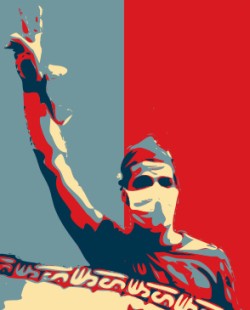 istorically speaking, the Iranian government has enjoyed four sources of legitimacy: its ability to manage state affairs (and thus the people’s consent), its official religious authority, its commitment to Iran’s independence, and a stable base of social support. All of these have now been irretrievably undone.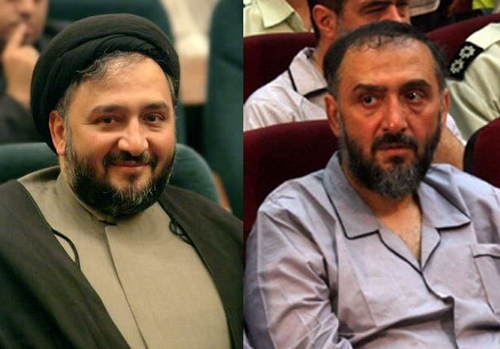

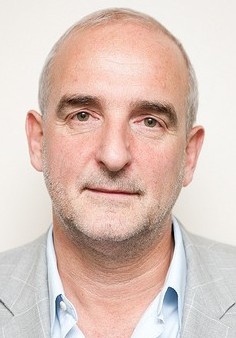 n Tehran, just before the election, I sat down with Nasser Hadian, who once taught at Columbia and is now at Tehran University. He’s an influential thinker on foreign affairs who got to know [Dennis] Ross while he was in the United States. Hadian told me that Iran has taken Obama’s outreach seriously. Hadian has been part of a group of foreign-policy experts, convened by Mahmoud Vaezi at the Center for Strategic Research in Tehran, who have been meeting every two weeks to review how to respond to the U.S. offer. Vaezi prepares reports that are submitted to Ali Akbar Hashemi Rafsanjani, the reformist former president who has been bitterly critical of the June 12 vote, and to Khamenei himself.
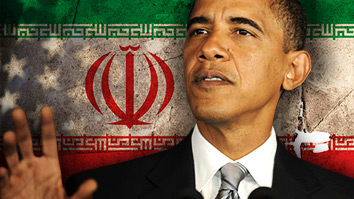 he Obama administration should avoid repeating the key mistake of the Bush administration, for which Iran was solely viewed through the prism of its nuclear program. Delaying nuclear talks a few months won’t make a dramatic difference to Iran’s nuclear program. It could, however, determine which Iran America and the region will be dealing with for the next few decades — one in which democratic elements strengthen over time, or one where the will of the people grows increasingly irrelevant to Iran’s decision-makers.
 olitical hard-liners warned President Mahmoud Ahmadinejad on Tuesday that he could be deposed like past Iranian leaders if he continued to defy the country’s supreme religious leader.