Author Archives: Paul Woodward

Israel’s Orwellian message on human rights

It would appear that Israel’s borders now extend as far as most of Europe.

This weekend hundreds of people participating in the Welcome to Palestine campaign have been barred from “entering” Israel by being prevented from leaving their own country.

Article 13 of The Universal Declaration of Human Rights says:

Everyone has the right to leave any country, including his own, and to return to his country.

Israel provided airlines with a list of individuals whose right of entry it denies, ordered these airlines to prevent them from boarding their flights and threatened the airlines with sanctions if they failed to comply. So much for the human right of freedom of movement.

Anticipating that Israeli intelligence might not have been able to identify everyone they are afraid of, the Israeli Prime Minister’s Office prepared a letter to be handed to activists who manage to reach Ben-Gurion International Airport.

The letter looks like it could have been hammered out by Benjamin Netanyahu himself on a manual typewriter as he struggles to protect Israel from its latest existential threat. It’s ironic that a state that craves respect and recognition as a democratic state, expresses itself in the sarcastic language one might expect from a paranoid autocratic ruler.

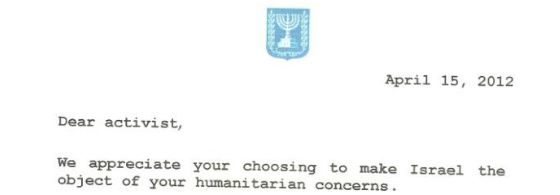
Unwelcome to Israel letter

The unsigned letter (without corrections) states:

Dear activist,

We appreciate your choosing to make Israel the
object of your humanitarian concerns.

We know there are manyother worthy choices.

You could have chosen to protest theSyrian
regime’s daily savagery against its own people,
which has claimed thousands of lives.

You could have chosen to protest the Iranian
regime’s brutal crackdown on dissent and support
of terrorism throughout the world.

You could have chosen to protest Hamas rule in
Gaza, where terror organizations commit a double
war crime by firing rockets at civilians and
hiding behind civilians.

But instead you chose to protest against Israel,
the Middle East’s sole democracy, where women are
equal, the press criticizes the government, human
rights organizations can operate freely,
religious freedom is protected for all and
minorities do not live in fear.

We therefore suggest that you first solve the
real problems of the region, and then come back
and share with us your experience.

Have a nice flight.

In 2008, Israel’s Ambassador to the UN, Gabriela Shalev, commemorated the 60th anniversary of the Universal Declaration of Human Rights, saying:

Let us reaffirm that each and every state –– regardless of circumstances –– must fulfill its primary responsibility to respect and protect the rights of all individuals, without distinction of any kind. Let us continue to promote the work of non-governmental organizations and human rights defenders who have played a critical role in assessing violations and protection gaps. Let us work towards supporting international mechanisms, such as human rights treaty bodies, international and regional tribunals and courts and the ICC – all of which seek to provide effective tools to ensure adequate redress and respect for human rights.

In an era when we are increasingly interconnected –– in a time when information rapidly flows across oceans and continents –– we must shine the light of the Universal Declaration to the four corners of the globe. We must commit our resources, as well as our collective resolve and determination, to secure human life, dignity and basic rights for all.

For in the end, human rights are not merely legal instruments. They are expressions of our common humanity, our common vision for a better, more just world.

Nice words. It’s a shame they have such little meaning in a state that repeatedly trumpets its claim to be the region’s “sole democracy” yet denies the human rights of almost four million Palestinians living under Israel military rule or control.

Meanwhile, this is how Israelis treat foreign human rights activists if they manage to reach the West Bank:

Just as disturbing as this soldier’s unprovoked use of violence are the comments below the video.

Facebooktwittermail

Goldberg slipping on Grass

The idea that the world can be divided into powers that can be trusted with nuclear weapons and those that can’t is the foundation of the dispute with Iran, but if this idea really carried any weight, why would President Obama be an advocate of global nuclear disarmament?

Admittedly, he’s a half-hearted advocate — he’s presented it as a long-term goal, but a goal without a deadline is just a dream. Disarmament is Obama’s nice idea. But any serious proponent of disarmament recognizes that no one can be trusted with nuclear weapons.

Imagine your Uncle Harry and Aunt Judy come over for dinner. Uncle Harry’s a retired nuclear scientist and quite a handyman. Over dinner Aunt Judy proudly mentions he has just completed a project he’s been laboring over for many years: he’s constructed a suitcase nuclear bomb and it’s in the trunk of their car outside.

You flip out.

“Don’t worry,” Aunt Judy assures you. “Uncle Harry’s totally trustworthy.”

But you don’t care whether Uncle Harry is as trustworthy as Moses. It doesn’t make you any less scared of the bomb.

As for how trustworthy the Israelis are with their arsenal of nuclear bombs, since they won’t even admit they possess any, I’d say they should inspire less confidence than Uncle Harry.

And as for the method and extent of a possible Israeli attack on Iran — whether it would only involve conventional weapons and whether it would just employ aircraft or perhaps also ballistic missiles — I don’t recall anything specific be placed upon or removed from that proverbial table that accommodates all threats. So who’s to say one way or the other whether Günther Grass’s fears about such an attack are overblown? We don’t know.

Jerry Haber writes: Grass’s poem What must be said has been defended and attacked throughout the globe. The poem protests against the German sale of a nuclear submarine to Israel; appeals for international control of the Israel and Iranian nuclear program by an authority accepted by both governments; and, though by a German author, refuses to be silent about Israel’s nuclear power, despite Germany’s past crimes against the Jewish people (and humanity). Grass speaks as a German who does not want to be indirectly responsible for a horrific catastrophe, but rather, as he puts it,  wants to give help to Israelis, Palestinians, and others in the region “and, finally, to ourselves as well.” This part of Grass’s poem, the main part, is eminently reasonable. Only a twisted mind would find it anti-Semitic or even anti-Zionist.

The poem employs, however, rhetoric that is offensive to Iranians and to Israelis.  It calls the Iranian leader a loudmouth who keeps his people under his thumb and pushes them  to organized cheering. It imputes to the Israeli leaders the claim to have a right to a first strike capability that could “snuff out” or “annihilate” the Iranian people by using the nuclear submarine sold it by the Germans.Both claims belong more to the exaggerated bombast of living rooms (and blogs) than to a serious cri de coeur. They demean the poet, and they enable the poem to be easily dismissed by the partisans.

But suppose Grass had been more accurate in his description of the possible consequences of Israel’s attack? Suppose that instead of writing “a strike to snuff out the Iranian people” he had written  “a strike that may kill or maim hundreds of thousands of people”?

According to the Center for the Strategic and International Studies, a strike on the Bushehr Nuclear Reactor alone “will cause the immediate death of thousands of people living in or adjacent to the site, and thousands of subsequent cancer deaths or even up to hundreds of thousands depending on the population density along the contamination plume.”

Criticism of Israel on that score would not only not count as being anti-Semitic; it could even be advanced by those “sympathetic to Israel’s dilemma.” Or so says Bloomberg’s Jeffrey Goldberg:

The morality of a [pre-emptive Israeli] strike, which could cause substantial Iranian casualties, would be questioned even by those sympathetic to Israel’s dilemma.

Goldberg is astounded at the line that Grass did use and considers the poem anti-Semitic. But had Grass’s poem included the more “modest” claim of the possible hundreds of thousands of casualties, rather than the possible annihilation of the Iranian people, would Goldberg have dropped the anti-Semitism charge? In a post accusing Grass of anti-Semitism, Goldberg says that Israel is “contemplating targeting six to eight nuclear sites in Iran for conventional aerial bombardment,” which may be correct,though one retired American general thinks otherwise.  There is, to be sure, a clear difference between the nuclear bombing of conventional sites and the conventional bombing of nuclear sites. But what they share in common is the possible causation of  “substantial Iranian casualties,” to use Goldberg’s phrase. So why is Grass being anti-Semitic when he morally criticizes the consequences of an Israeli strike, whereas Goldberg is not?

If I understand Goldberg correctly, there are two distinctions between Grass’s standing vis-à-vis the moral criticism of Israel, and his own. First,  Grass is a German and a former member of the SS.  So he has to shut up – unless, perhaps, he proves himself to be one of those Germans who are “sympathetic to Israel’s dilemma.”

Second, Goldberg misreads Grass as saying that Israel seeks to annihilate the Iranians. This is nowhere stated or implied by Grass in his poem.  Instead, he says that Israel seeks the right of a preventative first strike which could annihilate the Iranian people. What’s the difference between the two? Well, it’s the difference between saying that Israel attacked Gaza in Operation Cast Lead in a way that could (and, in fact, did) kill fourteen hundred Gazans and between saying that  Israel sought to kill fourteen hundred Gazans.

Why does Goldberg read Grass in this way? He writes

To make yourself believe that Israel is seeking to murder the 74 million people of Iran, you must make yourself believe that the leaders of the Jewish state outstrip Adolf Hitler in genocidal intent.

Goldberg reads Grass as accusing Israel of outdoing Hitler in its evil “genocidal intent” – a reading that is interesting for what it says about Goldberg’s own mind,  but it is more interesting for what it says about the manner in which some Israeli advocates  think about criticism of Israeli military power, to turn one of Goldberg’s felicitous phrases.  What could be more anti-Semitic than accusing Israel of being more genocidal than Hitler? After all, to call for a nuclear embargo on Israel is to imply that Israelis cannot be trusted to act responsibly in the use of nuclear weapons, or in the bombing of nuclear facilities. It is to demean the Israelis, to place them on the same level, if not lower, than the Islamist regime in Iran. It is to claim that like the Iranians the Israelis are not to be trusted with nuclear weapons because we suspect them of genocidal intent. [Continue reading…]

Facebooktwittermail

“Can a Jew be a good Jew and still be opposed to Zionism and to Israel?”

“Can a Jew be a good Jew and still be opposed to Zionism and to Israel?” This was one of the challenging questions posed by Mike Wallace, a Jew himself, to Abba Eban, Israel’s ambassador to the United States in 1958. That was back in the days when there wasn’t just daylight between Israel and the United States, but divisions could openly be discussed.

Meanwhile, don’t forget to enjoy the clean satisfying smoke of Parliament cigarettes.

Check out Noam Sheizaf’s post on the whole interview.

Facebooktwittermail

Getting duped by Israel and the American media

I’ve been duped,” declared the popular travel writer Rick Steves after watching the documentary, Peace, Propaganda, and the Promised Land.

His perception of Israel was so radically altered he felt compelled to write at the Huffington Post: “If you are a friend of Israel, you must watch Peace, Propaganda, and the Promised Land.”

The ideologically inclined are likely to read a strong political message in what Steves wrote, but my hunch is that his post was prompted by something else — an everyday concern he has as a travel writer.

Every seasoned traveler knows two things:

1. The most interesting way of experiencing another culture is through deep immersion, and
2. the most common obstacle to that experience is the tourist trade.

As a result, it’s important to get streetwise not so much because foreigners — and especially Americans — are easy targets for one kind of scam or another, but because those who profit from tourism tend to be the least faithful representatives of their own culture. That’s why, as Steves often says, the authentic experience is most often going to be found by going off the beaten track. And this quest for authenticity makes the traveler watch out for false promises.

A good travel writer has little patience for travel guides that paint deceptive pictures — where charming turns out to be tacky or a popular destination turns out to be a tourist trap.

But now, when Steves says he’s been duped, he’s describing a much higher level of misrepresentation. Israel is not the country he took it to be and their is for him a measure of insult in this discovery.

No one takes kindly to being treated like a sucker.

Rick Steves does not have a political axe to grind, but he does have a genuine appreciation of other cultures and an awareness of the degree to which most Americans are ignorant about the rest of the world.

He writes:

On the road, you learn that ethnic underdogs everywhere are waging valiant but seemingly hopeless struggles. When assessing their tactics, I remind myself that every year on this planet many languages go extinct. That means that many heroic, irreplaceable little nations finally lose their struggle and die. There are no headlines—they just get weaker and weaker until that last person who speaks that language dies, and so does one little bit ethnic diversity on our planet.

I was raised so proud of Nathan Hale and Patrick Henry and Ethan Allen—patriotic heroes of America’s Revolutionary War who wished they had more than one life to give for their country. Having traveled, I’ve learned that Patrick Henrys and Nathan Hales are a dime a dozen on this planet—each country has their own version.

I believe the US tends to underestimate the spine of other nations. It’s comforting to think we can simply “shock-and-awe” our enemies into compliance. This is not only untrue…it’s dangerous. Sure, we have the mightiest military in the world. But we don’t have a monopoly on bravery or grit. In fact, in some ways, we might be less feisty than hardscrabble, emerging nations that feel they have to scratch and claw for their very survival.

We’re comfortable, secure, beyond our revolutionary stage…and well into our Redcoat stage. Regardless of our strength and our righteousness, as long as we have a foreign policy stance that requires a military presence in 130 countries, we will be confronting determined adversaries. We must choose our battles carefully. Travel can help us understand that our potential enemies are not cut-and-run mercenaries, but people with spine motivated by passions and beliefs we didn’t even know existed, much less understand.

Growing up in the US, I was told over and over how smart, generous, and free we were. Travel has taught me that the vast majority of humanity is raised with a different view of America. Travelers have a priceless opportunity to see our country through the eyes of other people. I still have the American Dream. But I also respect and celebrate other dreams.

Facebooktwittermail

Rick Steves discovers Palestine and the Israeli occupation

Rick Steves is the Mr Rogers of travel shows. I picture him as someone who probably smiles even when he’s asleep. So if this guy gets upset about something, it has to be serious.

Here’s Steves’ commentary from one of his shows several years ago while visiting Israel:

Tourists become pilgrims at Israel’s Holocaust Memorial. All visiting heads of state are brought here to Yad Vashem. The Memorial Museum chronicles the slaughter of 6 million Jews by Nazi Germany. Artist David Olere left an excruciating record in these drawings of his 26 months in Nazi concentration camps. He was a prisoner at Drancy, Auschwitz, Mauthausen, Melk and finally liberated from Ebensee in 1945.

The boxcar monument is a chilling reminder of Hitler’s master plan to eliminate Jews, gypsies, homosexuals, the mentally ill and political dissenters. Train loads were carted away.

And here along the “Avenue of Righteous Gentiles”, trees are planted to honor non-Jews who risked their lives to help the persecuted. Yad Vashem imprints on visitors a searing impression of the horror. One must recognize the cause and the enormity of the Holocaust to understand the history of modern Israel.

The sky-scrapers of Tel Aviv are exclamation points which seem to declare that freedom is worth fighting for. The fruits of all the struggle may best be enjoyed here in the cosmopolitan heart of Israel. My best tip for enjoying Tel Aviv: see it as a fun-loving resort, just the opposite of Jerusalem.

Tel Aviv’s waterfront promenade is the place to rock to the rhythm of contemporary Israel — foamy cafes, sugar-sand beaches and the Mediterranean. With a “use it or lose it” approach to the good life, young Israelis embrace the present.

But then something happened… Yesterday, at Huffington Post, Steves wrote:

I’ve been duped.

Do you know the frustration you feel when you believed in something strongly and then you realize that the information that made you believe was from a source with an agenda to deceive?

I just watched a powerful and courageous documentary called Peace, Propaganda, and the Promised Land. It certainly has its own agenda and doesn’t present balanced coverage. Still, it showed me how my understanding of the struggles in the Middle East has been skewed by most of our mainstream media. I saw how coverage of the Israeli/Palestinian problem is brilliantly controlled and shaped. I pride myself in understanding how the media works… and I find I’ve been bamboozled.

Invest 75 minutes in watching this, because most of the time we only hear one viewpoint when it comes to the interminable struggle in the Holy Land. While this documentary would never be shown on commercial TV in the USA, it can be viewed online (Peace, Propaganda, and the Promised Land). In my view, many Palestinians live under inhumane conditions, and U.S. taxpayers help to make it happen. Please, watch this and then share your impressions.

Criticism of Israel’s policies is not automatically anti-Semitic (see J-Street for an example of a pro-Israel, pro-peace group). In fact, the irony is that for Israel’s hard-liners, their clever PR strategy could be their own worst enemy. While Israel certainly deserves security on its land, the Israeli occupation of Palestinian territory (in Gaza and the West Bank) degrades Israel and drives Palestinians to desperation. The question of whether Israel is conducting a brutal military occupation or a reasonable defense against terrorism gets no real airtime. If we care about the long-term security of Israel, we have a responsibility to understand what our government is funding and supporting.

I believe that watching this documentary is a painful first step to finding a just and lasting peace in the Middle East. If you are a friend of Israel, you must watch Peace, Propaganda, and the Promised Land.

Peace, Propaganda, and the Promised Land was made in 2003 during the Second Intifada. Very little of its content will come as news to regular readers of this site. What is striking about Rick Steves’ reaction to the documentary is that it reveals the degree to which Americans who are cosmopolitan and reasonably well-informed about the world still by and large have a deeply distorted view of Israel. When the veil falls away they are shocked by what they discover.

Ignorance provides the bedrock of the United States’ close relations with Israel and as that ignorance erodes, more and more Americans will become angry and ashamed about the role they unwittingly played in the support of a state whose brutality has for so long and so effectively been hidden from American eyes.

Facebooktwittermail

Iran Standard Time: Nowruz on the Hormuz

One of the paradoxes of the way the U.S. media covers the rest of the world is that on the one hand, the only matters that merit attention are those which are deadly serious — wars, famine, catastrophes, and crises of one kind or another — and yet at the same time these stories are told with as much depth as a comic book cartoon strip.

Iran is ruled by “mad mullahs” plotting to get their hands on nuclear weapons. A “noose” of sanctions is being tightened around the country to force its leaders to back away from their diabolical efforts.

In this narrative the country of 70 million ordinary people and their everyday lives is lost.

In a new feature, “Iran Standard Time,” Tehran Bureau is offering some of the details of life and lives in their minute richness — the kind of details that get lost by a media which fixates on danger and ignores people.

Tehran Bureau: “This weather is terrible for chicken farmers,” jokes Hossein, a dark, wiry man in his late 20s, as he looks at the sunrise over the Persian Gulf, largely blotted out by a dense sandstorm. “The sand gets caught in chicks’ throats and they suffocate.”

Hossein, who supplies Tehran’s jujeh kebab vendors by personally slaughtering 2,000 chicks every 45 days, is one of around 200 passengers aboard the Hormuz, a rusted ship docked in Iran’s biggest port, Bandar Abbas, waiting for the weather to clear to sail to the Emirati city of Sharjah. He is from Bastak, a tiny ancient Iranian town in the southern stretch of the Zagros mountain range. Its 6,000 inhabitants speak a Middle Persian dialect, and most of them move between these hot highlands to the even hotter irrigated deserts of the UAE for business or to see their migrant relatives.

Flanking Hussein on the sunny deck is his friend and hamshahri (town-fellow) Ali, a skinny onion farmer who is adroitly peeling a orange with his large cracked hands, and fortuitously, Farzin, a professor of water resources from Shahrekord University. The professor says that our current predicament is the result of winds sweeping across lands that have been affected by the region’s five-year drought. “The drought is strong in the southwest near Iraq and Saudi and in the northeast, near Afghanistan,” he explains with the aid of a map he carries around. “In Shahrekord, we are in the Zagros Mountains, which used to have a very snowy climate. Now we just get rain.”

We are on the last Iranian vessel to cross the now world-famous Strait of Hormuz before Nowruz, the Iranian New Year. It’s filled with people who were too late or too broke to find a flight during the notoriously busy final days of the Persian year, when Iran experiences an exodus for the two-week break. What the demob-happy passengers don’t know yet is that they will be spending Nowruz at sea, as a ten-hour delay stretches into a two-day waiting game.

I had spent the day before in Bandar Abbas, against the emphatic advice of my guidebook. Bandar, a sweltering town even in spring, is home to some of Iran’s best beaches — even if classical aesthetes might demur over everything aside from its clear water. Thronged with visitors from all over the country hitting the Persian Gulf for the holidays, the scene is a very Iranian affair: girls flying kites, boys on camels or quad bikes, men smoking, families picnicking, litter everywhere, women swimming in full hejab, and morality beach police enforcing strict swimwear rules (don’t wear it). The women of Bandar mostly forgo the chador and northern Iran’s stark black sartorial style, opting instead for colorful sari-like gowns, which drape over their heads and shoulders. [Continue reading…]

Facebooktwittermail

The intellectual cowardice of Günter Grass’s critics

In his controversial new poem, “What Must Be Said,” Günter Grass felt obliged to anticipate the utterly predictable reaction: “the verdict ‘Anti-semitism’ falls easily.”

Jacob Heilbrunn describes Grass’s language as “wild and fevered and calumniatory,” though this is a more accurate description of his own feculent commentary. Under a headline posing the question, Is Günter Grass An Antisemite?, Heilbrunn proceeds with passion and no reason to a foregone conclusion:

Now, anti-Semitism is a charge that is flung about too frequently against critics of Israel. Unfortunately, in this instance it is fully deserved. Here is what must be said: Grass has achieved the impossible. He has further besmirched his reputation.

The theatrical and logical contours of the performances of Israel’s mindless and rabid defenders should by now be perfectly familiar.

First comes the shock and outrage. When anyone in proximity to the trauma of the Holocaust gets upset they tend to solicit a human response. We don’t try and reason with them — we offer them sympathy and try and soothe their distraught emotions. But when the shock and outrage is contrived, it serves a purpose: it is designed to distract and pacify those who might otherwise pose awkward or challenging questions.

Then comes the defamation. Why must Grass be condemned and his words ignored? Because as a seventeen year-old he served for five months in the Waffen-SS. “[A] former member of the SS has no moral standing, to put it mildly, to criticize Israel.” Heilbrunn whips the SS line so hard and fast, he’s forced to drag up from his thesaurus the awkward phrase “quondam SS member.”

Then comes the logical sleight-of-hand: a criticism is rebuffed by being restated in a distorted form. And the distortion always involves the same shift: actions are treated as matters of identity.

Israel is attacked not because of what it does but because of what it is: a Jewish state. Actions demand accountability, but if the assault is treated as striking at the state’s very identity, then the victim can bask in its innocence.

This is how it works in Grass’s case. Grass has written that Israel poses the greatest threat to world peace. Read the headlines, listen to the politicians and commentators. How outrageous! Except there’s one small problem: that’s not what he wrote. He wrote this:

Why only now, grown old,
and with what ink remains, do I say:
Israel’s atomic power endangers
an already fragile world peace? [My emphasis.]

When there is a rush to war because of the mere fear that Iran might develop nuclear weapons, how can the world remain silent about the fact that Israel already possesses hundreds of these tools of genocide?

What is being described as an attack on Israel is no such thing. It is a demand that Israel’s own nuclear arsenal be recognized and acknowledged as a decisive element in the rising tension in the Middle East.

Perhaps there are those who believe that Israel’s existence utterly depends on its possession of nuclear weapons. If that’s the case then maybe we should no longer refer to it as a Jewish and democratic state, but as a nuclear-armed Jewish and democratic state, since retaining the ability to incinerate its neighbors is apparently an essential attribute of such a state.

If however the existence of a Jewish state and its possession of a nuclear arsenal are not inextricably intertwined, then it is perfectly legitimate for Günter Grass or anyone else to say that in the shadow of war, the world can no longer remain silent about Israel’s weapons of mass destruction.

Facebooktwittermail

Günter Grass and Israeli hypocrisy

In his new poem, “What Must Be Said,” Germany’s most celebrated writer Günter Grass writes: “I’ve broken my silence/ because I’m sick of the West’s hypocrisy…” yet that hypocrisy is itself merely a shield for Israel’s own hypocrisy.

Israel treats the mere possibility of a nuclear-armed Iran as an existential threat while refusing to acknowledge the existential threat that it poses to everyone in the region through its own concealed and uninspected arsenal of hundreds of nuclear weapons.

Grass hopes that having broken his own silence others will follow his lead and demand “the governments of/ both Iran and Israel allow an international authority/ free and open inspection of/ the nuclear potential and capability of both.”

This reads and no doubt is intended much more as a political statement than a work of poetry, though it nevertheless contains a poetic force in what can be seen as a symbolic and historic transition: that not even Germans are willing to keep reissuing the license that allows Israelis to use the Holocaust as a perfect shield for deflecting all criticism.

Hans Kundnani writes:

[W]hat makes the publication of the poem significant is that it expresses a sense of anger against Israel that – justified or not – many Germans seem increasingly to share. This anger is partly a response to Israel’s rightward shift during the past decade. But it seems also to be a product of developments in Germany and in particular the way that the Holocaust has receded in significance during the last decade. Increasingly, Germans seem to see themselves as victims rather than perpetrators.

A poll in January 2009 – during the Gaza war – suggested that German attitudes to Israel were in flux. Nearly half of respondents said they saw Israel as an “aggressive country” and only around a third of respondents said they felt Germany had a special responsibility towards Israel. Sixty per cent said Germany had no special responsibility (the figure was even higher among younger Germans and among those living in the former East Germany).

This anger against Israel is exacerbated by the sense some Germans have of not being able to say what they really think – as Grass suggests in the poem. This has created a pent-up resentment towards Israel that could at some point explode. It will be interesting to see whether Grass’s poem leads in the next few weeks and months to the debate about Germany’s “special relationship” with Israel that he seems to hope it would.

Angela Merkel – who has declined to comment on Grass’s poem – is personally committed to the Jewish state but is under increasing pressure on this issue, on which she is unusually out of step with German public opinion.

Last year, Germany voted in favour of a UN resolution demanding a halt to Israeli settlement expansion – an unusual break with Israel. Later in the year, Germany opposed the Palestinian statehood bid at the UN. But according to one poll, 84% of Germans supported Palestinian statehood and 76% believed Germany should act to recognise it – an even higher proportion in each case than in France or the UK.

An Israeli military strike on Iran could create a sudden rupture between Germany and Israel in the way that the Iraq war did between Germany and the US. My sense is that were Israel to launch a military strike on Iran, what remaining sympathy there is in Germany for Israel would evaporate almost overnight.

Facebooktwittermail

How Britain destroyed the father of computer science

One hundred years ago the father of computing was born. As one of the most influential men of the 20th century, Alan Turing’s name should be as well known as Einstein’s, yet rather than being showered with honors in his lifetime, he suffered the abuse of state brutality guided by the prevailing bigotry of that era.

Neurobonkers writes: Radiolab have done a fantastic twenty-minute podcast (MP3) on Alan Turing, the man who cracked the Enigma – arguably the pinnacle moment leading to the victory of the Allies in the Second World War.

While alive, Turing was never thanked or given acknowledgement for his work but instead suffered suffered a tragic, brutal blow in 1952 when he was arrested for homosexuality. The court ordered Turing to be “cured” with massive doses of Estrogen. The untested experiment resulted in Turing suffering a range of humiliating symptoms which if anything, had the opposite of their intended effect, Turing certainly didn’t turn around and decide to stop being homosexual. To put this abuse in context, Estrogen therapy is today used as a part of male-to-female transgender medical procedures (as well as for female contraceptives).

The side effects were not the worst problem from Turing’s perspective. Turing feared that his work would be dismissed by his peers, he was correct. Turing was sacked from his job at GCHQ and barred from discussing his cryptographic work. Turing killed himself two years after his conviction on 8th June 1954.

At the end of last year, the [British] Government was handed a petition for the pardon of Alan Turing with 21,000 signatures. The government declined this February:

“A posthumous pardon was not considered appropriate as Alan Turing was properly convicted of what at the time was a criminal offence. He would have known that his offence was against the law and that he would be prosecuted. It is tragic that Alan Turing was convicted of an offence which now seems both cruel and absurd-particularly poignant given his outstanding contribution to the war effort. However, the law at the time required a prosecution and, as such, long-standing policy has been to accept that such convictions took place and, rather than trying to alter the historical context and to put right what cannot be put right, ensure instead that we never again return to those times”.

Turing’s treatment serves as a reminder that democracy is not always enlightened and the will of the people can be brutal.

Even now, in a country that recognizes some limited gay rights there is the bizarre spectacle of a popular movement “in defense” of marriage which claims that same-sex marriage threatens the institution of marriage. As a predominantly Republican movement, it makes me wonder whether most Republicans believe that without constitutional protection they are all at risk of becoming homosexuals. I also wonder why those who want to defend marriage are not focusing their attention on a much more obvious threat: divorce.

Facebooktwittermail

Philip Weiss reclaims his American spirit

Philip Weiss writes: I need to reclaim my American spiritual roots. This website [Mondoweiss] has been about Jewishness for me because the neoconservative project for the Middle East made me Jewish (as I have said many times) but I will have a Jewishness that is authentic to my experience. I love the Passover deliverance story only if it is shared. I hate the Purim story, I don’t even know what my Torah portion was about. The story of the binding of Isaac has helped me understand my relationship with my father, and all authority, but honestly I was more thrilled by getting to the place it took place in Minnesota when I was 21 — Dylan’s Highway 61– than by Mount Moriah in occupied East Jerusalem.

I don’t need Jewish sovereignty over the Temple Mount to believe in the binding. Any more than my wife needed Christian sovereignty in Jerusalem to bring me along when a group of English nuns she’d met took her on the Stations of the Cross last year, a powerful story about heresy and excommunication.

I find as much power in Jim’s beating his deaf daughter in Huck Finn as I do in the binding of Isaac, and I want an identity politics that respects my spirit and the American winds that move it, from Mark Twain to Melville to Carson McCullers to Isaac Singer to Schocken’s translations of Kafka to my lapsed Protestant wife’s yoga and ayurvedhic medicine and Tarot. I don’t want chosenness. Not when I’ve learned so much from lapsed Catholics with values of humility and egalitarianism. And J Street has credibility in part because its leader’s father was in the Irgun? What does the Irgun have to teach me?

Do I sound like a nativist? I don’t care; Israel never called to me. I believe Zionism’s greatest achievement is the idea of Jewish physical labor. I don’t want my foreign policy guided by Jeffrey Goldberg who felt unsafe here and emigrated to Israel. I would rather a nativist foreign policy that is thoughtful of the Americans who are likely to have to go off and do the fighting (not us).

I can’t understand Hebrew because I had American enthusiasms. I was listening to the Wailers and role-modeling Joseph Pulitzer who said that his job was to afflict the comfortable and comfort the afflicted, and Harrison Salisbury who put out the Pentagon Papers and Sy Hersh who exposed My Lai and Melville who said that all men wear muzzles on their souls and he wanted to undo the muzzles, anticipating gay liberation by 100 years.

I am sick of our media valorizing a democracy that has not had our hard lessons in liberation.

That has not integrated the armed forces—we did that in 1948.

That excludes minorities from the governing coalition – we fixed that in 1964.

That redlines Palestinian home sales—we got rid of the gentleman’s agreement in the 60s.

That has segregated schools– we attacked that in 1954.

That breaks historic compromises and extends rightlessness into the territories—we did that between 1854-1861, till that regime was washed away by “verry much bloodshed,” as John Brown prophesied.

I’m proud of a country that gave a home to Ali Abunimah when Israel wouldn’t let him or his family go to the place his parents were born. And if Israel ceases to be a Jewish state it will be no spiritual rubble for me, no, it will be because it honors a principle that my forefathers put down in the Declaration of Independence and our leaders are still struggling to make real.

Religion is the thing that gives your life meaning. It’s the codes and ideas and koans and dreams and stories that sustain you and give you purpose and explain your responsibilities to yourself and others and the land. It’s not a book in a church. Emerson said the dead books scatter your force, lose your time and blur the impression of your character. My codes are American ones, shot through with Jewish diaspora yearnings and my wife’s mystical explorations, and my story is American and my guides are American pantheists from Thoreau to Joan Osborne.

My story is only half American — I was 29 when I arrived here — but having been guided by Thoreau most of my life, I can say Phil and I share the same faith.

Beyond that, there is something about Jewish identity in America that I not only can say as a non-Jew, but that is a dimension of Jewish identity that must in fact be illuminated by non-Jews.

In a society in which there is little evidence of any remaining institutionalized mainstream antisemitism, for the vast majority of us non-Jews, Jewish identity is something about which we are indifferent. Whether someone is or is not a Jew simply does not matter. No one scores or loses any points on account of being Jewish.

Hearing Peter Beinart describe his grandmother’s experience of repeatedly being uprooted because she was Jewish shows the stark contrast with different places and times where Jewish identity was not simply an internal and communal self-identification, but was a target for hatred.

As much as such memories remain embedded in the Jewish experience, they are at least for most American Jews not a significant dimension of contemporary Jewish life in this country. And in the absence of external forces of negative reinforcement, the only thing that really threatens Jewish identity is that individual Jews become tired or see no reason to labor at differentiating themselves from non-Jews.

When identity can only be sustained through a firm grasp, it seems inevitable that over time that grasp will loosen and the identity will gradually dissolve and transform.

As much as modernity may have made all of our identities much more difficult to grasp, we are less at risk of becoming untethered than at risk of tying ourselves to false anchors.

Facebooktwittermail

Why safety is dangerous

The following article looks at the harmful effects of excessive hygiene and while it’s clearly directly relevant to America’s hand-sanitizing cleanliness-obsessed culture, the fear of germs is itself symptomatic of a wider culture of fear.

In our hunger to feel safe we have lost an understanding of the healthiness of insecurity and the pathology of safety. A society that craves constant safety can never grow up. It ends up becoming literally and metaphorically allergic to life.

Sedeer at Inspiring Science writes: Since moving to Finland, I’ve become accustomed to asking guests whether they have any allergies before I prepare dinner. I grew up in the developing world where allergies and asthma seem to be much less common than they are here; in fact, various studies have found higher rates of allergy and autoimmune conditions in developed than developing countries. One explanation for this is the “hygiene hypothesis,” which proposes that excessive hygiene early in life can affect the development of the immune system and result in allergic conditions and autoimmune diseases in later life. In a recent study appearing in Science, a team of scientists in Germany and the United States present evidence supporting the hygiene hypothesis and the importance of an early challenge to the immune system.

The researchers tested this idea in mice, which are commonly used as a model system to study the human immune response; they compared the immune systems and responses of germ-free (GF) mice, which were completely free of any microorganisms, and specific pathogen-free (SPF) mice, which had normal gut microbiota but were free of pathogens. The researchers measured the level of invariant Natural Killer T (iNKT) cells, which are an important part of the immune system, and found that the germ-free mice had more iNKT cells in their colon and lungs than their SPF counterparts. In addition to playing a vital role in our immune response, iNKT cells have also been implicated in several autoimmune conditions; the GF mice were more susceptible to induction of asthma and colitis (an autoimmune bowel inflammation), perhaps due to the increased quantity of iNKT cells. Although allowing the adult germ-free mice to be recolonized by microbes didn’t reduce their iNKT levels or their susceptibility to asthma or colitis, recolonization of pregnant GF mice just before delivery did lead to normal iNKT levels and reduced susceptibility in their offspring. Simply having microbiota wasn’t enough; the microbes had to be present at the right developmental stage in order to properly regulate the immune response. [Continue reading…]

Facebooktwittermail

U.S. Navy program to study how troops use intuition

The New York Times reports: The United States Navy has started a program to investigate how members of the military can be trained to improve their “sixth sense,” or intuitive ability, during combat and other missions.

The idea for the project comes in large part from the testimony of troops in Iraq and Afghanistan who have reported an unexplained feeling of danger just before they encountered an enemy attack or ran into an improvised explosive device, Navy scientists said.

“Research in human pattern recognition and decision-making suggest that there is a ‘sixth sense’ through which humans can detect and act on unique patterns without consciously and intentionally analyzing them,” the Office of Naval Research said in an announcement late last month. The scientists managing the program — which the the naval research office is calling “revolutionary” — commonly refer to this mysterious perception as feeling one’s “Spidey sense” tingling, after the intuitive power of Spiderman.

“Evidence is accumulating that this capability, known as intuition or intuitive decision making, enables the rapid detection of patterns in ambiguous, uncertain and time restricted information contexts,” the office said, citing numerous peer-reviewed studies in cognitive psychology and neuroscience.

The program, called Enhancing Intuitive Decision Making Through Implicit Learning, will be making available $3.85 million over four years to researchers who want to investigate how intuition works. Initial proposals are due April 15, and executives at more than a dozen companies specializing in fields like logistics, software and artificial intelligence have so far expressed interest in applying for the money.

It’s a sad fact that when the U.S. government weighs up the merits of ways to creatively invest tax dollars, the surest way of ensuring backing for unusual research is to show that it could improve America’s war-fighting capabilities.

What would add an interesting dimension to this study on intuition would be if it was made into a cross-cultural study examining differences in intuitive faculties between fighters operating overseas and those defending their home turf.

Facebooktwittermail

The new antisemitism in America

For over a decade, Americans have been told that the threat of terrorism lurks everywhere — that it is the preeminent threat to security across the globe and that, if politicians and other public figures are to be taken seriously, it poses an even greater threat to life on this planet than climate change.

Not surprisingly, this fear-mongering has had an effect and produced what arguably actually poses a greater threat to the citizens of this country: the creation of Americans whose fear of “terrorists” provokes murderous rage.

Realistically, such Americans can probably be assumed to be much more numerous than would-be terrorists in this country. The existence of such individuals does not seem to cause much public concern however, for the simple reason that they only pose a threat to a relatively small minority of Americans: anyone who appears to be Muslim.

The Associated Press reports: A woman from Iraq who was found beaten next to a threatening note saying “go back to your country” has died, and police are investigating the possibility of a hate crime.

Hanif Mohebi, the director of the San Diego chapter of the Council on American-Islamic Relations, said Shaima Alawadi was taken off life support Saturday afternoon.

“The family is in shock at the moment. They’re still trying to deal with what happened,” said Mohebi, who met with family members.

Alawadi, a 32-year-old mother of five, had been hospitalized since her 17-year-old daughter found her unconscious in the dining room of the family’s suburban San Diego house on Wednesday, police Lt. Steve Shakowski said.

“A hate crime is one of the possibilities, and we will be looking at that,” Lt. Mark Coit said. “We don’t want to focus on only one issue and miss something else.”

The daughter, Fatima Al Himidi, told KUSI-TV her mother had been beaten on the head repeatedly with a tire iron, and that the note said “go back to your country, you terrorist.”

While Alawadi is widely being described as an Iraqi immigrant, it’s worth noting that having arrived here in 1993, she had spent most of her life and all of her adult life in the United States.

Facebooktwittermail

Mohamed Merah and the folly of the war on terror

Following the dramatic killing of Mohamed Merah in Toulouse yesterday, there has been plenty of finger-pointing by those who believe the young gunman should have been stopped before anyone had been shot, or that the operation during which he was held under siege could have been handled better.

There is perhaps only one lesson to be drawn, but it’s a truth everyone knows but no one fully digests: we can’t predict the future.

Only once it becomes the past is the future turned into something seemingly obvious. But the idea that Merah should or could have been stopped presupposes that he knew where he was going — it turns out he didn’t.

As the Wall Street Journal reports:

Merah… initially had no plans to attack the Jewish school where he allegedly gunned down three children and a teacher, and instead had planned to target another soldier, said the head of France’s intelligence agency.

Mr. Merah spoke to police negotiators during a 33-hour standoff that ended with his death on Thursday from a police gunshot to the head. During the siege he claimed responsibility for killing seven people, including three French paratroopers, prosecutors said.

In an interview with French newspaper Le Monde to be published Saturday, French intelligence chief Bernard Squarcini said Mr. Merah told police the school attack early Monday morning was improvised.

“According to what he said during the siege, he wanted to kill another military man, but got there too late,” said Bernard Squarcini, the head of the Central Directorate of Interior Intelligence. “Since he knew the area well, he improvised and attacked the Ozar Hatorah school.”

Who knows why Merah was late. Maybe he overslept. Whatever the reason, it seems his attack on the Jewish school was capricious. That he justified his brutality with the explanation that he was avenging the deaths of Palestinian children might reveal less about his ideological focus than it says about a desire to mask his violent impulsiveness.

AFP reports:

Israeli security experts on Friday heaped scathing criticism on the French police’s handling of a 32-hour siege involving a gunman who killed seven people, three of them Jewish children.

“Operational failure” was the title of an analysis in the top-selling Yediot Aharonot daily written by former special forces officer Lior Lotan, who now heads a counter-terrorism think-tank.

“The French security forces failed in their mission,” he wrote of their attempt to capture self-proclaimed Al-Qaeda gunman Mohamed Merah at an apartment in the southwestern French city of Toulouse.

Police from the elite RAID unit failed to make proper use of “deception and concealment” thereby letting the suspect take the initiative, he wrote of the operation which ended when Merah jumped out of a window and was shot dead as he tried to fire on police.

“This is not how a professional unit to combat terror behaves,” former commando officer Uri Bar-Lev wrote in the rival Maariv newspaper.

“But it’s not fair for us to level criticism at them. They don’t have the professionalism and the experience that we’ve accumulated in combating terror.”

Perhaps these Israelis would have been a little more cautious about trumpeting Israeli expertise had they known that Israel actually had an opportunity to stop Merah: he was arrested in Jerusalem in 2010 and then released.

Haaretz reports:

The head of the French intelligence agency DCRI said in an interview on Friday that the Toulouse shooter was arrested by Israel Police in Jerusalem in 2010, after he was found in possession of a knife.

Bernard Squarcini told the French newspaper Le Monde that Mohamed Merah… was held by police in Jerusalem during his visit to Israel in 2010, but was released shortly after his detainment.

Squarcini said that Merah visited several other Middle Eastern countries during that trip, including Turkey, Syria, Lebanon, Jordan, and Afghanistan. He said that French intelligence tracked him and investigated to see if he is suspicious, but found that he had not been engaging in any ideological activism or religious activity.

Squarcini responded to allegations about the French intelligence services’ failures during the hunt after Merah.

When asked about French Interior Minister Claude Guean’s statements about a possible intelligence failure, Squarcini said that the minister’s words were misinterpreted. “People, including children, died in a cruel way,” he said, “and we inevitably ask the question – could we have done something different? Did we miss something? Were we fast enough?”

On Thursday, Le Monde reported that Merah was not a member of any well-known Islamic terrorist organization, but did undergo a process of radicalization. He was also added to a “no fly” list maintained by U.S. authorities some time ago, two American officials told Reuters. The officials would not disclose precisely when Merah was placed on the list.

Although someone of this name is apparently on a no-fly list, it remains to be seen whether this was the gunman. It would seem likely that the Mohamed Merah on the list was the same as the one who had escaped from a prison outside Kandahar in 2008, but Afghan authorities say this man was not French.

The New York Times reported:

The Afghan authorities said that a Mohammad Merah was arrested on Dec. 19, 2007, and convicted of planting bombs in and around the southern city of Kandahar, which is the area where the Taliban movement began.

“All I can say is that we have this guy Mohammed Merah in our records, but he’s an Afghan citizen,” said Brig. Gen. Abdul Raziq, the police chief of Kandahar Province. “He’s certainly not French.”

He was sent to serve his three-year sentence at the city’s Saraposa prison, said Ghulam Faruq, the chief of the detention facility, citing prison records. That is a high-security prison on Kandahar’s southern outskirts.

“We have this name in our book,” Mr. Faruq said. “He was registered in 2007 and he was brought to the prison and he was convicted for planting bombs and I.E.D.’s inside and outside Kandahar city.”

A spokesman for the government of Kandahar Province, Zalmai Ayoubi, said that the man was from Kandahar and that officials even knew his father’s name — Ahmad Shah, also a citizen of Afghanistan.

And to confuse matters even more, The Independent reports that Merah was arrested by U.S. in Afghanistan in 2008 and then sent home to France. Keep in mind that by that time Merah was only 19.

The Washington Post reports:

The French Defense Ministry said that before his jihad-related travels, Merah had tried once to enlist in the regular French army and once in the Foreign Legion. Both times he was turned down, the ministry said, because of a long record of juvenile offenses such as purse snatching and dealing in stolen goods.

Might these rejections have been instrumental in turning the teenager in a radical direction?

Francois Molins, the chief Paris prosecutor heading the investigation into Merah’s actions has an obvious question: how could the unemployed Merah afford his rented car, his two automatic rifles, his several pistols and his trips to Afghanistan?

The one person who might be able to answer these and other important questions is his 29-year-old brother, Abdelkader Merah, who was arrested on Wednesday and can be held without charge for 96 hours.

Abdelkader has already told the police that he is proud of how his brother died, that he approved of his actions and that he has no regrets.

A woman from the same neighborhood as Merah in Toulouse, told Le Télégramme that the “true mind” behind the suspect was his brother Abdelkader.

As the French police and security services continue their investigation, there might be new revelations about mistakes made and warning signs ignored, yet what will most likely remain outside scrutiny is the culpability of the political leaders on both sides of the Atlantic who over the last decade effectively empowered terrorists and would-be terrorists by promoting the idea that such individuals, through an audacious violent action, could bring a nation to its knees.

Too much attention has been given to the threat of terrorism and far too little to the ways we react.

Facebooktwittermail

The story we’ll never know

Reuters reports: A 23-year-old gunman suspected of killing seven people in southwestern France in the name of al Qaeda, jumped from a window to his death in a hail of bullets after police stormed his apartment on Thursday.

“At the moment when a video probe was sent into the bathroom, the killer came out of the bathroom, firing with extreme violence,” Interior Minister Claude Gueant said, adding that Merah was firing several guns at once.

“In the end, Mohamed Merah jumped from the window with his gun in his hand, continuing to fire. He was found dead on the ground,” he told reporters at the scene. Two police commandos were wounded.

The New York Times reports: A top editor at the news channel France 24 said in a televised interview that she had spoken by telephone to a man who claimed to be the shooter in the hours before the police surrounded Mr. Merah’s building. “He was calm, was speaking in very good French and punctuated by Arabic expressions,” said the editor, Ebba Kalondo. She also said he spoke of planning more attacks and of intending to post video of his killings online.

“This man wanted to bring the Republic to its knees,” President Nicolas Sarkozy of France said on Wednesday, but “the Republic did not yield.” He spoke in nearby Montauban at a funeral service for three soldiers that Mr. Merah said he had killed in the days leading up to Monday’s killings of a rabbi and three children at a religious school here.

No doubt Sarkozy, in the middle of an election campaign, can be expected to frame this story in melodramatic terms, but just because Merah boasted that he had brought France to its knees, is no reason to treat that claim seriously by acting as though it demanded to be refuted.

If Merah had instead claimed that he was about to take over the world, would Sarkozy be saying that France stopped that from happening?

Yesterday, the French defense minister seemed to have a more sober assessment of the situation.

“This will not last for days, because of physical and mental fatigue. All the experience with crazed gunmen like this is that they stop at some point,” defence minister Gerard Longuet said on TF1 television.

“What we want is to capture him alive, so that we can bring him to justice, know his motivations and hopefully find out who were his accomplices, if there were any,” he added.

Unless it turns out Merah was a secret blogger or kept some other kind of journal, it seems unlikely that we’ll ever know much more about his motives or methods.

If there is one salutary lesson for American observers to take away from this, it is that just as was already shown in the 2008 Mumbai attacks and the 2011 Norway attacks, terrorism does not require access to high explosives or complex bomb-making skills. All that is necessary is easy access to guns and yet in the United States the relationship between gun control and counter-terrorism can’t even be discussed.

Facebooktwittermail

Child killers: Mohamed Merah and Sgt. Robert Bales

As much as the loss of innocent life universally provokes grief, horror, and rage, never is this more so than when the victims are children killed in cold calculation by adults.

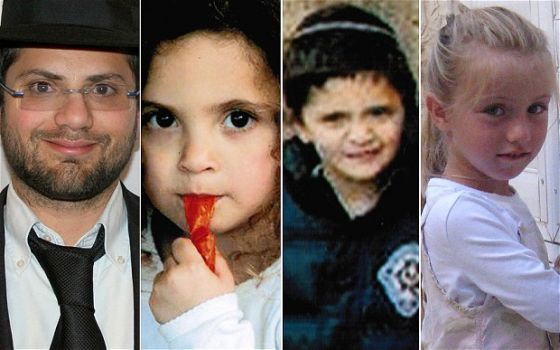
Even before Mohamed Merah had been tracked down to an apartment in Toulouse, the names and images of some of his victims had been widely publicized.

Rabbi Jonathan Sandler, 30, his two sons, Gabriel, 3, Arye, 6, and Miriam Monsonego, 8.

Such are the typical records of lives cut short — faces with bright shining eyes looking into a future they never reached.

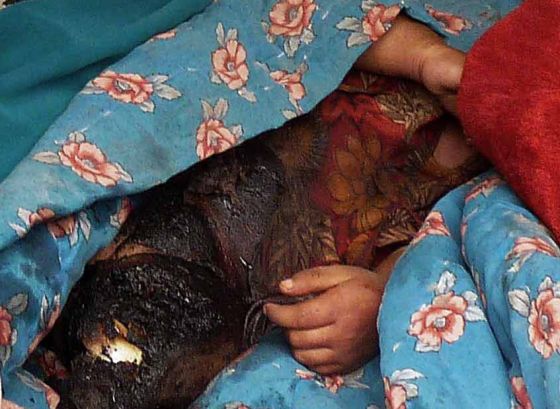
In the first few days after Robert Bales gunned down his sixteen victims, we knew neither his name nor theirs. All we saw was a glimpse of a child’s charred body — a detail from an AFP photograph which showed victims in the back of a pickup truck surrounded by those in grief. The larger photograph was widely published, but few if any outlets drew attention to this gruesome element — a glimpse of a life lost but no record whatsoever of the lives lived.

The charred body of Shatarina, Zahra, Nazia, Masooma, Farida, Palwasha, Nabia, Esmatullah, or Faizullah? We'll never know.

When it comes to Bales’ victims all we have is a list of names without ages.

But are Robert Bales and Mohamed Merah as radically different as is the coverage of their crimes?

Reuters reports:

Merah’s profile is typical of hundreds of second- or third-generation French immigrants from North Africa who have travelled to Afghanistan or Pakistan over the last two decades attracted by militant Islamist groups, security officials say.

Many were radicalised by the Israeli-Palestinian conflict, which triggered a wave of attacks on Jewish targets in France in the early 2000s, including arson attacks on synagogues. The number of anti-Semitic attacks declined last year, figures published by the Jewish community showed.

But this profile of radicalization does not diverge so far from the portrait of Sergeant Bales since both men were seen by those who knew them as regular guys.

Cedric Lambert, 46, father of an upstairs neighbour, said Merah was friendly and had helped them about 10 months ago to carry a heavy sofa upstairs.

“He was extremely normal,” Lambert said.

A group of four 24-year-old men of similar ethnic background who said they were friends of Merah tried to go to his apartment block on Wednesday to persuade him to surrender but were stopped at a police roadblock.

All told a Reuters reporter he had never talked to them about religion and they had no idea he had been to Afghanistan.

One friend who gave his name as Kamal, a financial adviser at La Banque Postale, said he had known Merah at school and they had done soccer training together after meeting again two years ago.

“He is someone who is very discreet. He is not someone who would brag and go around and say ‘Oh look at my new girlfriend, look how great I am.’ He is very polite and always well-behaved,” Kamal said.

“He never spoke about Islam but he did pray. But we all pray five times a day. There’s nothing strange about that.”

Another friend of Moroccan origin, who gave the pseudonym Danny Dem, said Merah had tried to enlist in the French army but had been rejected. He said he had seen Merah in a city centre nightclub just last week.

Merah did not drink “but I don’t think he is any more religious than I am. I think he has just lost the plot,” Danny Dem said.

A third contemporary, who declined to give his name, said he went to primary school with Merah and they had remained friends.

“He likes football and motor-bikes like any other guy his age,” said the man, dressed in a blue French national soccer shirt. “I didn’t even know he prayed.”

Pamela Geller, from her perch in Manhattan, made this comment while French police attempted to negotiate Merah’s surrender: “Negotiations? He should be shot in the head.”

She also offers this advice: “Jews. please. leave. Europe.”

I wonder whether President Obama would share Geller’s view, given that no one seems to be in any doubt that Merah is the killer? Even if he does, the problem with the administration of instant “justice,” is not simply that it might be of dubious legality but that it undermines a crucial element of criminal investigation: to better understand the motives of the perpetrator.

This isn’t a matter merely of academic interest.

When Merah claims that he was trying to avenge the deaths of Palestinian children killed by Israelis, is he merely parroting the views of radicals by whom he was indoctrinated, or was the Israeli-Palestinian conflict the primary cause of his radicalization? It’s worth knowing the answer and if he gets shot in the head we’ll probably never find out.

As for the idea that the death of four Jews in France — indisputably targets of an anti-semitic attack given that Merah knew perfectly well that these individuals had no role in the killing of Palestinian children — the idea that these deaths should prompt other Jews to flee Europe, begs this question:

If this would be sufficient cause for Jews to flee Europe, haven’t Jews in Israel already been given thousands of similar reasons to flee the Jewish state?

Neither flight nor vengeance offer an intelligent answer to this violence.

Facebooktwittermail

Why Netanyahu must think the killing of Jewish children in France is a good thing

On September 11, 2001, after 3,000 people had been killed, Benjamin Netanyahu said the attacks would be “very good,” having the effect of strengthening the bond between America and Israel.

Seven years later the then-leader of Likud held to the same conclusion as U.S. forces struggled to contain the civil war in Iraq.

“We are benefiting from one thing, and that is the attack on the Twin Towers and Pentagon, and the American struggle in Iraq,” the Israeli newspaper Ma’ariv quoted Netanyahu as saying in April, 2008. He added, these events “swung American public opinion in our favor.”

While the Israeli prime minister has been forthright in talking about how he sees the killing of Americans as serving Israel’s interests, there are limits to his candor. No one would expect him to declare that the shooting of Rabbi Jonathan Sandler, his two sons, Gabriel and Arieh, and seven-year-old Miriam Monsonego in Toulouse on Monday, was “very good.”

Even though I don’t believe Netanyahu is a ghoul who celebrates death, as a political opportunist he undoubtedly recognizes when tragedy serves his own political agenda.

The Guardian spoke to their reporter, Phoebe Greenwood, who has been at the funeral of Rabbi Sandler and the other victims in Jerusalem today.

One mourner told Phoebe that although the school [in Toulouse] was “a very safe place”, the murders would make many Jews worried about security in Europe consider moving to Israel. She said: “Many of the people who are thinking about moving to Israel now certainly will.”

Whether that’s true, there’s little doubt that Netanyahu and many of Israel’s other leaders would welcome a growing sense among the Jewish diaspora that Israel is the only safe place for Jews to live — even as these same leaders push for another war in the Middle East and thereby increase the chances that the Jewish “safe haven” will come under attack.

The alleged gunman in France, Mohammad Merah, a 24-year-old Frenchman of Algerian descent, is said to have wanted to avenge the deaths of Palestinian children. He also claims to have ties to al Qaeda.

Documents seized from Osama bin Laden’s compound in Abbottabad confirm that the al Qaeda leader strongly believed that the movement he had spawned should be focused on Palestine. As Paul Pillar writes:

The one issue that bin Laden evidently stressed to his associates should be emphasized publicly above all others was Palestine. He criticized affiliates and followers for justifying their actions as responses to local matters rather than being performed on behalf of the preeminent cause for all Muslims, which was Palestine. In making such admonitions, bin Laden was recognizing the enormous salience the Palestinian issue continues to have for for Muslims generally. It has all the ingredients for a cause well suited for exploitation by extremists. At its core is the injustice of indefinite occupation by a conquering power of land that is home to Muslims. On top of that is a added religious dimension to the conflict and the perception of the occupying power as a kind of Western, Judeo-Christian imposition on the Middle East.

That bin Laden was issuing such instruction is a further indication of the power of Palestine as an extremist cause célèbre. Bin Laden’s first wish probably would have been to overthrow the House of Saud in Arabia. His strategy of going after the far enemy in the form of the United States as a way of defeating the near enemies in Arab capitals was never more than a minority view in jihadist circles. In this respect he did not see eye-to-eye with his onetime mentor Abdullah Azzam, who believed the first priority of jihad ought to be the liberation of Muslim lands from non-Muslim occupiers. That is why Azzam was a leader in supporting the Afghan jihad against Soviet occupation, and why he—himself a Palestinian—believed liberation of Palestinian land from Israeli occupation needed to be given foremost priority. The Palestinian issue has the power it does not because individual terrorist leaders like bin Laden necessarily make it their first personal priority but instead because it has tremendous resonance among the Muslim populations to which they appeal. The reason that supporters and rank-and-file practitioners of anti-U.S. terrorism cite most frequently for their hatred of the United States is U.S. condoning of Israeli occupation of Palestinian-inhabited land and of other Israeli actions that involve the killing or subjugation of Muslims.

There are many good reasons not to let the Israeli-Palestinian issue fester. Its role as a readily exploitable extremist cause is one of them.

The problem is, as much as the conflict is an exploitable cause for extremists, extremist acts of violence are themselves events that can easily be exploited by those who want to claim that the life of every Jew is at risk and that an undercurrent of antisemitism still pervades the world.

In other words, for those Jews inside and outside Israel who react to terrorism targeting Jews by saying, “I told you so,” such attacks validate their view of the world. This violence is less a problem to be remedied, than a confirmation that part of what it means to be Jewish is to be hated and that the only way of surviving in such a world is through the segregation provided by a Jewish state.

From the mindset of eternal victim-hood, it makes no difference what you do, since it is your fate to always be judged because of who you are.

Facebooktwittermail

Remembering the names of the victims

Qais Azimy, a senior producer for Al Jazeera in Afghanistan, acknowledges that his outlet like most others, neglected to pay much attention to the victims in the recent massacre.

In the days following the rogue US soldier’s shooting spree in Kandahar, most of the media, us included, focused on the “backlash” and how it might further strain the relations with the US.

Many mainstream media outlets channelled a significant amount of energy into uncovering the slightest detail about the accused soldier – now identified as Staff Sergeant Robert Bales. We even know where his wife wanted to go for vacation, or what she said on her personal blog.

But the victims became a footnote, an anonymous footnote. Just the number 16. No one bothered to ask their ages, their hobbies, their aspirations. Worst of all, no one bothered to ask their names.

In honoring their memory, I write their names below, and the little we know about them: that nine of them were children, three were women.

The dead:
Mohamed Dawood son of Abdullah
Khudaydad son of Mohamed Juma
Nazar Mohamed
Payendo
Robeena
Shatarina daughter of Sultan Mohamed
Zahra daughter of Abdul Hamid
Nazia daughter of Dost Mohamed
Masooma daughter of Mohamed Wazir
Farida daughter of Mohamed Wazir
Palwasha daughter of Mohamed Wazir
Nabia daughter of Mohamed Wazir
Esmatullah daughter of Mohamed Wazir
Faizullah son of Mohamed Wazir
Essa Mohamed son of Mohamed Hussain
Akhtar Mohamed son of Murrad Ali

The wounded:
Haji Mohamed Naim son of Haji Sakhawat
Mohamed Sediq son of Mohamed Naim
Parween
Rafiullah
Zardana
Zulheja

But even with these names now published, it seems unlikely that this will have much impact on the perceptions of those Americans who see Robert Bales himself as the victim.

Imagine how different the story would be had he embarked on his killing spree after returning home and the victims had white faces and English names. We would by now know vastly more about them and the portraits of “Bobby” Bales would no doubt be much less sympathetic.

Exactly what set off the Army sergeant accused of massacring 16 civilians in Afghanistan’s Kandahar Province is far from clear. But already, organizations and individuals with differing agendas have portrayed Bales as the personification of something that is profoundly broken, and have seized on his case to question the war itself or to argue that the American government is asking too much of its warriors.

On the website of Iraq Veterans Against the War, organizer Aaron Hughes declared that Afghan war veterans “believe that this incident is not a case of one ‘bad apple’ but the effect of a continued U.S. military policy of drone strikes, night raids, and helicopter attacks where Afghan civilians pay the price.” Those veterans, he wrote, “hope that the Kandahar massacre will be a turning point” in the war.

“Send a letter to the editor of your local paper condemning the massacre and calling for an end to our occupation in Afghanistan,” Hughes wrote.

On March 11, authorities say, Bales, a 38-year-old married father of two from Washington state, stalked through two villages, gunned down civilians and attempted to burn some of the bodies. The dead included nine children.

In Lake Tapps, Wash., neighbors knew Bales as a patriot, a friendly guy who loved his wife and kids, and a man who never complained about the sacrifices his country repeatedly asked of him. They find it hard to believe he could be capable of such depravity.

“I kind of sympathize for him, being gone, being sent over there four times,” said Beau Britt, who lives across the street. “I can understand he’s probably quite wracked mentally, so I just hope that things are justified in court. I hope it goes OK.”

Paul Wohlberg, who lives next door to the Baleses, said: “I just can’t believe Bob’s the guy who did this. A good guy got put in the wrong place at the wrong time.” [Associated Press]

Facebooktwittermail