Author Archives: Paul Woodward

Obama’s choice

Vanity Fair shares some of the revelations from Barack Obama’s youthful love life. Nothing here that would interest National Inquirer, but this caught my attention from the recollections of Alex McNear, a young woman from Occidental College, California, who had enchanted the 20-year-old Obama:

Obama was obsessed with the concept of choice, she said. Did he have real choices in his life? Did he have free will? How much were his choices circumscribed by his background, his childhood, his socio-economic situation, the color of his skin, the expectations that others had of him? How did choice influence his pres­ent and future? Later, referring back to that discussion, he told Alex in a letter that he had used the word “choice” “as a convenient shorthand for the way my past resolves itself. Not just my past, but the past of my ancestors, the planet, the universe.” His obsession with the concept of choice, he said in a later interview at the White House, “was a deliberate effort on my part to press the pause button, essentially, and try to orient myself and say, ‘Okay, which way, where am I going?’ ”

Prior to his election, a philosophically inclined president sounded, at least to some of us, like a good idea — especially when contrasted against a president who expressed such disdain for the intellect. But in place of The Decider, we ended up with a president who perpetually maneuvers in accordance with the dictates of circumstance.

Free will might be an illusion, but if so, it’s an illusion I would prefer a president to believe in.

Facebooktwittermail

Why Israel needs to keep the Palestinians under its heel

Steve Linde, editor-in-chief of the Jerusalem Post, was master of ceremonies at a conference the newspaper hosted in New York City on Sunday. There were 1,200 attendees.

Caroline B. Glick, Post senior contributing editor, drew cheers from the crowd when she called for permanent Israeli control of Judea and Samaria [the West Bank], saying it was better to keep the Palestinians inside Israel rather than allow them to establish a “terror state.”

Have no doubt: neither Glick nor those cheering her believe that keeping Palestinians permanently inside Israel should lead to them acquiring equal rights as Israeli citizens. What she is advocating is quite simply the institutionalization of Jewish fascism in a Jewish apartheid state. But that was just an uncontroversial side note in the event.

This is how Haaretz described what Linde called “most dramatic moment in the conference”:

An embarrassing confrontation broke out … when former Mossad chief Meir Dagan accused Environmental Protection Minister Gilad Erdan of lying, while Erdan replied that Dagan is sabotaging Prime Minister Benjamin Netanyahu’s efforts to put a halt to Iran’s nuclear aspirations.

At the conference … the two also exchanged harsh words after Dagan warned Erdan over the so-called “Dagan law,” forbidding former security officials to issue open statements until a certain cooling period wears off.

“As in Germany, you know where you begin but you don’t know where you end,” Dagan told the audience.

The exchange erupted after Dagan was asked about statements made by former head of the Shin Bet security service Yuval Diskin. Diskin criticized Netanyahu and Defense Minister Ehud Barak on Friday over their bellicose stance on Iran, as well as what he called the premier’s unwillingness to advance peace talks with the Palestinian Authority.

Dagan said that Diskin was his friend, and added that he “spoke his own truth.” “Diskin is a very serious man, a very talented man, he has a lot of experience in countering terrorism,” he said, adding that he “talked about a matter that is close to his heart.” Dagan also dismissed criticism of Diskin for not voicing his opinion to Netanyahu and Barak earlier. According to Dagan, Diskin had done so “in close quarters and on many occasions.”

“I have no doubt that the Israeli Air Force is able to destroy the infrastructure of Iran’s nuclear program – but five minutes later, Israel would find itself involved in a regional war, involving Hezbollah and possibly Syria,” the former Mossad chief said.

Dagan also said that an attack would bolster the support for the Iranian regime as opposed to the sanctions imposed by the international community which have been eroding its public support.

He added that a regional war would lead the superpowers to impose a settlement with the Palestinians on Israel – a settlement which he vehemently opposes.

Erdan replied that “if Diskin thinks things are so dangerous, he should not have stayed in his post for five years and agree to a sixth year. He should have resigned.” Dagan intervened at this point and countered that “I may be impolite, but I prefer the truth be told.”

Erdan then said he would prefer if “Mossad chiefs do not sabotage Netanyahu’s efforts to garner the world’s support against Iran. He also referred to Diskin’s description of Barak and Netanyahu’s “messianic tendencies,” and asked, “Is this how a serious man, as you describe him, speaks?”

The exchange between Erdan and Dagan clearly made the audience and American members of the panel uncomfortable.

The ever-eloquent Alan Dershowitz garnered a standing ovation from the crowd when he appealed to Israelis not to hang their dirty laundry in public, keep internal debates in Israel and, when on American soil, refrain from criticizing standing presidents such as Obama, who was essentially a friend of Israel.

For his part, Dershowitz focused his anger at what he called the almost eroticized delegitimization of Israel among certain intellectual elites, including Jews and Israelis.

This new form of anti-Semitism, he said, was as lethal as the rhetoric before the Holocaust, and he urged Israel and world Jewry to combat it effectively.

So let’s be sure I understand this correctly. Dershowitz would presumably see this post as one small part of the delegitimization effort — whether he would discern an almost eroticized element I have no idea. At the same time he apparently does not regard Caroline Glick’s promotion of Jewish fascism as in any way undermining the legitimacy of Israel. Fascism OK. Criticism not OK.

Maybe this explains why Linde was able to wrap up the event feeling deeply satisfied.

As I took a taxi to JFK, the Russian Jewish cabbie asked what I had done in New York. When I told him, he said: “Oh, I heard it was a big success.

“I gave a few of your people a ride to and from the airport.”

And at the airport, the El Al security employee remarked, “Wow, you guys created a big buzz. I’ve seen it on the news all over the place.”

With such glowing reviews (“the Zionist dream is alive and well, and the Jewish state has many more fans than foes,” says Linde), it makes you wonder why anyone’s worried about delegitimization.

Oh right, it’s because there’s another Holocaust lurking round the corner. How could I forget?

Facebooktwittermail

What happens when government is no longer by the people

John Wonderlich describes how the new cybersecurity bill, CISPA, or HR 3523, is terrible on transparency: it dismisses the Freedom of Information Act (FOIA).

The FOIA is, in many ways, the fundamental safeguard for public oversight of government’s activities. CISPA dismisses it entirely, for the core activities of the newly proposed powers under the bill.

If this level of disregard for public accountability exists througout the other provisions, then CISPA is a mess. Even if it isn’t, creating a whole new FOIA exemption for information that is poorly defined and doesn’t even exist yet is irresponsible, and should be opposed.

If you’re carelessly creating whole new exemptions to FOIA without hearings on the question, that suggests that the public interest isn’t being considered in this legislation. I suspect that (again) government officials have been at the table with industry, and (again) think that the interests of the public at large can be swept aside.

When public interest gets swept aside this isn’t just a familiar story about Washington; it tells us something about the nature of modern democracy: those responsible for serving the interests of the public do not see themselves as members of the public.

The people are an amorphous and somewhat impotent other who are treated as spectators to the workings of government and commerce. They are an occasional irritant, sometimes need to be shown patronizing gestures of deference, but most of the time can be regarded with as much seriousness as a flock of penguins might be viewed — though penguins tend to get more affectionate attention than ordinary people.

Why do government officials and corporate representatives have such a weak identification with the public? Mostly because they are so deeply identified with their work. Who they are and what they do appear to them to be one and the same.

Facebooktwittermail

Never forget… World War II

Shmuel Rosner writes: The seven days between Holocaust Memorial Day (last Thursday) and Independence Day (this Thursday) are packed with national symbolism. Seven days to remind the Jews of Israel of their trajectory from near annihilation to sovereign revival. Seven days for much sorrow and much pride.

And seven perfect days for political messaging.

Prime Minister Benjamin Netanyahu opened the season last week by dismissing those who “prefer that we not speak of a nuclear Iran as an existential threat” and “do not like it when I speak such uncomfortable truths.” These “truths” are in fact a matter of much debate, and yet Netanyahu can’t really go wrong asserting them as fact. However remote the possibility that a nuclearized Iran would actually spell calamity for Israel, that outcome is too serious not to strike fear.

It wasn’t the first time Netanyahu used the specter of the Holocaust to characterize the danger posed by Iran. I remember hearing him make the case at the annual gathering of the Jewish Federations of North America in Los Angeles in 2006. “It is 1938,” he said back then. “Iran is Germany, and it is about to arm itself with nuclear weapons.”

Six years later, for Netanyahu at least, it’s still 1938 — maybe 1939 — and Iran is still comparable to Nazi Germany. During his speech last week, Netanyahu told his many critics that those who do not understand in the same terms as he does the gravity of the threat “have learned nothing from the Holocaust.”

Apparently one of those know-nothings is the Nobel Laureate and Holocaust survivor Elie Wiesel. “Iran is a danger, but to claim that it is creating a second Auschwitz? I compare nothing to the Holocaust,” Wiesel told the Globes last week. He believes that to invoke the Holocaust like this is to trivialize it.

Yes, to invoke the Holocaust in response to every Israeli fear is to trivialize it — but it also isolates the Holocaust from the horror of a war in which as many as 70 million people died. Those who beat the drums of war need to remember how hard war is to contain and how unpredictable its outcome. Netanyahu doesn’t just trivialize the Holocaust; he trivializes war itself.

Facebooktwittermail

Paul Krugman’s silence on Israel: the power of the lobby or the weakness of its critics?

Yesterday, Paul Krugman wrote a brief post on his New York Times blog, The Conscience of a Liberal:

Something I’ve been meaning to do — and still don’t have the time to do properly — is say something about Peter Beinart’s brave book The Crisis of Zionism.

The truth is that like many liberal American Jews — and most American Jews are still liberal — I basically avoid thinking about where Israel is going. It seems obvious from here that the narrow-minded policies of the current government are basically a gradual, long-run form of national suicide — and that’s bad for Jews everywhere, not to mention the world. But I have other battles to fight, and to say anything to that effect is to bring yourself under intense attack from organized groups that try to make any criticism of Israeli policies tantamount to anti-Semitism.

But it’s only right to say something on behalf of Beinart, who has predictably run into that buzzsaw. As I said, a brave man, and he deserves better.

So if Krugman felt the need to say something about Beinart’s book, I guess this was it — he’s said something.

To borrow one of President Obama’s favorite words when it comes to Israel, Beinart has made a stalwart defense of the two-state solution. He did so at a time that there is a widening consensus that the expansion of Israeli settlements across the West Bank has made the creation of a Palestinian state virtually impossible.

While Beinart has been widely praised for his courage, it’s less obvious to me whether he is being bold or simply astute. He’s young enough to not want to find himself on the wrong side of a generational divide and to that extent he seems to be following rather than leading opinion among younger American Jews. Indeed, he still has plenty of catching up to do.

As for Krugman, his own focus is domestic and economic, so I understand that he has other battles to fight. But when he says, “I basically avoid thinking about where Israel is going,” he might as well have said he chooses to keep his head in the sand. He will only refer to the Israel lobby by the euphemism “organized groups” and knowing that he risks attack, raises his head above the parapet simply to declare that he is unarmed.

No doubt the lobby and its attack dogs like Alan Dershowitz can be viscous and unrelenting, but there are at least two ways of responding to intimidation: to be intimidated or to be defiant.

When the lobby attacks, too many people respond by bemoaning its might and its ruthlessness; too few offer the right wing Zionists the scorn they deserve.

Maybe if Israel’s most rabid defenders were more frequently mocked, their power would turn out not to be as great as it is feared.

From his secure positions as a tenured professor at Princeton and New York Times columnist even if Krugman wasn’t to make it a regular habit, he could stand up and take an occasional shot at the lobby without putting his life in danger.

Facebooktwittermail

The real existential threat to Israel: honest debate

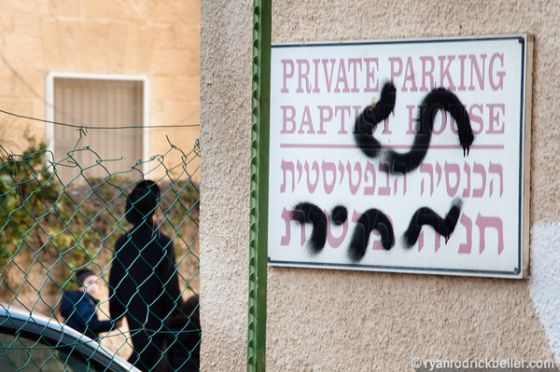
'Jesus is the son of a whore,' 'we will crucify you,' 'Jesus is dead' and 'death to Christianity' were among messages left behind by vandals who attacked the Baptist Narkis Street Congregation in West Jerusalem on February 20. Photo: Ryan Rodrick Beiler

When Israel’s ambassador to the U.S., Michael Oren, called Jeff Fager, chairman of CBS News and executive producer of 60 Minutes to speak about their upcoming report, “Christians of the Holy Land,” it’s clear he had only one objective: to kill the report.

When interviewed by Bob Simon, Oren did not express concern about how 60 Minutes would report on the plight of Palestinian Christians living in the West Bank. His objection was that CBS should find any merit in the topic whatsoever. Why should the fate of Christians living under Israeli occupation deserve any attention while Christians elsewhere in the Middle East face persecution? The story, Oren was convinced, was merely a pretext for attacking Israel.

In February this year, vandals — the evidence suggests they were Jewish settlers — daubed “Death to Christianity” on the walls of a Baptist church in Jerusalem. “The graffiti also included profanity about Jesus, and the vandals slashed the tires of several cars parked in the church compound,” Reuters reported.

It wasn’t long before Oren spoke up on the op-ed page of the Wall Street Journal denouncing attacks on Christians and the desecration of a church — though not the one in Jerusalem. The vandalism that concerned him involved the Arabic letters for Hamas being sprayed on a church in Bethlehem in 1994. About the much more recent vandalism on the church in Jerusalem he said absolutely nothing.

Oren’s message while ostensibly being an expression of concern about the plight of Christians across the Middle East, including Palestinian Christians living in the West Bank, was instead a message tailored to resonate with American Christian Zionists: Jews and Christians stand in solidarity opposed to Islamic extremism.

Kairos Palestine, a group of Palestinian Christians in the West Bank who featured in the 60 Minutes report, were quick to denounce Oren’s statement.

In this inaccurate and manipulative text, Oren… blames the plight of Palestinian Christians on oppression at the hands of Palestinian Muslims — rather than at the hands of the illegal Israeli occupation itself, as is our reality.

We add our voices to several other recently published responses that have emphasized this reality and the ways in which Oren’s op-ed attempts to mask it. Indeed, contrary to his assertions, Christian persecution is caused mainly by the occupation that systematically degrades all Palestinians, restricts our movement, confiscates our land, devastates our economy, and violates our rights — including the very basic right to a decent life.

We are particularly troubled by Oren’s attribution of migration within the Palestinian Christian community to ill-treatment by Palestinian Muslims. This damaging analysis wilfully ignores the underlying political oppression that afflicts Christians and Muslims alike. In the case of Bethlehem, for instance, it is in fact the rampant construction of Israeli settlements, the chokehold imposed by the separation wall, and the Israeli government’s confiscation of Palestinian land — largely Christian-owned land in the Bethlehem area — that has driven many Christians to leave.

In Oren’s op-ed and his dealings with CBS we see the two main thrusts of the Zionists’ communications strategy: propaganda and suppression.

If critics can’t be drowned out in the media then efforts to silence them have to become more direct. Never is their any willingness to face a challenge directly. Zionism, it would seem, even for its most strident proponents is indefensible. Rather than respond to honest criticism, first comes the hasbara, then the silencing, and if neither of those work, the plea: our survival is at stake!

But what really threatens Israel?

The breakdown of public morality, in my view, poses the greatest single existential threat to Israel. It is this threat that undermines Israel’s ability to cope with other threats; that saps the willingness of Israelis to fight, to govern themselves, and even to continue living within a sovereign Jewish state. It emboldens Israel’s enemies and sullies Israel’s international reputation. The fact that Israel is a world leader in drug and human trafficking, in money laundering, and in illicit weapons sales is not only unconscionable for a Jewish state, it also substantively reduces that state’s ability to survive.

Those being the words of Michael Oren not long before he became an ambassador and one of the pillars of Israel’s public morality.

Facebooktwittermail

Being spat at remains part of life for Christians in Jerusalem — the story 60 Minutes left out

I published the post below last November. While a CBS 60 Minutes segment on “Christians of the Holy Land” which aired last night focused on Palestinian Christians living under Israeli occupation, it’s noteworthy that no mention was made of near daily assaults on Christians in Jerusalem.
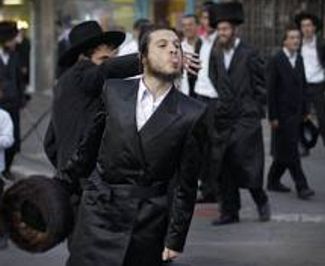
On November 4, 2011, Haaretz reported: Ultra-Orthodox young men curse and spit at Christian clergymen in the streets of Jerusalem’s Old City as a matter of routine. In most cases the clergymen ignore the attacks, but sometimes they strike back. Last week the Jerusalem Magistrate’s Court quashed the indictment against an Armenian priesthood student who had punched the man who spat at him.

Johannes Martarsian was walking in the Old City in May 2008 when an young ultra-Orthodox Jew spat at him. Maratersian punched the spitter in the face, making him bleed, and was charged for assault. But Judge Dov Pollock, who unexpectedly annulled the indictment, wrote in his verdict that “putting the defendant on trial for a single blow at a man who spat at his face, after suffering the degradation of being spat on for years while walking around in his church robes is a fundamental contravention of the principles of justice and decency.”

“Needless to say, spitting toward the defendant when he was wearing the robe is a criminal offense,” the judge said.

In 2009, the Jerusalem Post reported: News stories about young Jewish bigots in the Old City spitting on Christian clergy – who make conspicuous targets in their long dark robes and crucifix symbols around their necks – surface in the media every few years or so. It’s natural, then, to conclude that such incidents are rare, but in fact they are habitual. Anti-Christian Orthodox Jews, overwhelmingly boys and young men, have been spitting with regularity on priests and nuns in the Old City for about 20 years, and the problem is only getting worse.

“My impression is that Christian clergymen are being spat at in the Old City virtually every day. This has been constantly increasing over the last decade,” said Daniel Rossing. An observant, kippa-wearing Jew, Rossing heads the Jerusalem Center for Jewish-Christian Relations and was liaison to Israel’s Christian communities for the Ministry of Religious Affairs in the ’70s and ’80s.

For Christian clergy in the Old City, being spat at by Jewish fanatics “is a part of life,” said the American Jewish Committee’s Rabbi David Rosen, Israel’s most prominent Jewish interfaith activist.

“I hate to say it, but we’ve grown accustomed to this. Jewish religious fanatics spitting at Christian priests and nuns has become a tradition,” said Roman Catholic Father Massimo Pazzini, sitting inside the Church of the Flagellation on the Via Dolorosa.

These are the very opposite of isolated incidents. Father Athanasius of the Christian Information Center called them a “phenomenon.” George Hintlian, the unofficial spokesman for the local Armenian community and former secretary of the Armenian Patriarchate, said it was “like a campaign.”

Christians in Israel are a small, weak community known for “turning the other cheek,” so these Jewish xenophobes feel free to spit on them; they don’t spit on Muslims in the Old City because they’re afraid to, the clerics noted.

In 2004, Eric J Greenberg, wrote in The Forward: It has been Jerusalem’s dirty little secret for decades: Orthodox yeshiva students and other Jewish residents vandalizing churches and spitting on Christian clergyman as they walk along the narrow, ancient stone streets of the Old City.

Now, however, following a highly publicized fracas last week between a yeshiva student and the archbishop of Jerusalem’s Armenian Church, the issue is generating unprecedented media attention in Israel. The fight started after a yeshiva student at the respected Har Hamor yeshiva spat on Archbishop Nourhan Manougian during a Christian holy procession in the Old City.

In the wake of the incident, a top Armenian Church official told the Forward that his church is calling on the Israeli government and on rabbis around the world to help put a stop to the offensive, decades-long abuse.

“These ultra-Orthodox Jews are the ones causing this scandal, those that live here in our neighborhood and the ones that come visit the Western Wall,” said the church official, Aris Shirvanian, in a phone interview Monday. He spoke from the patriarchate’s world headquarters in the Armenian Quarter, one of the famed four quarters of the Old City of Jerusalem.

“We would like to see the authorities… become more strict with the offenders,” said Shirvanian, director of ecumenical and foreign relations of the Armenian Patriarchate. “We would also ask rabbis to get involved in educating this one sector of the Jewish society.”

Har Hamor is one of the leading institutions of religious Zionism, Israel’s equivalent of Modern Orthodoxy. Most sources interviewed for this article suggested that the abusive practices were more common in the ultra-Orthodox or Haredi community, which is characterized by greater insularity… But sources told the Forward that the practice has recently been picked up by other segments of the Orthodox world, including visiting American yeshiva students.

The controversy comes as the Israeli government and Diaspora Jewish organizations have been attempting to focus international attention on what they describe as a surge in antisemitism across the globe. Beyond potentially undermining these efforts, the reports of anti-Christian harassment could weaken Israel’s claim to be an effective guardian of Christian and Muslim rights in Jerusalem.

“Protection of everything sacred to other religions is one of the justifications for Israel’s sovereignty in Jerusalem, whose legitimacy will be undermined if this spitting becomes prevalent,” said a former Israeli chief rabbi, Israel Meir Lau. Lau condemned the harassment, and warned that such incidents could fuel antisemitism outside of Israel.

Besides the Armenian rite, clergy of other Christian churches have been targeted, Shirvanian said. “This is not happening only to Armenian clergy, but also to the Catholics, Syrians, Romanians and Greek Orthodox.”

Following the incident involving Manougian, numerous Israeli government officials and Jewish religious and organizational leaders have stepped forward to condemn the acts.

Interior Minister Avraham Poraz called the yeshiva students’ behavior “intolerable,” and asked Internal Security Minister Gideon Ezra to “take all the necessary steps to prevent these incidents in the future.”

At the end of 2009, Beth Din Tzedek, the tribunal justice of the Orthodox Jewish community in Jerusalem, issued the following statement:

Recently, repeated complaints have been made by gentiles regarding recurring harassment and insults directed at them by irresponsible youths in various places in the city, especially in the vicinity of Shivtei Yisrael Street and adjacent to the grave of Shimon the Just.

Besides desecrating the Holy Name, which in itself represents a very grave sin, provoking gentiles, according to our sages — blessed be their holy and righteous memory — is forbidden and is liable to bring tragic consequences upon our own community, may God have mercy.

We hereby call upon anyone who has the power to end these shameful incidents through persuasion, to take action as soon as possible to remove these hazard, so that our community may live in peace.

The tribunal in issuing this appeal apparently did not see itself as possessing the power to reign in its own community. Neither did it see fit to offer an apology to Jerusalem’s Christians. It’s primary concern was what kind of backlash the behavior of its own youth might eventually provoke.

The robed Christian clergy are not the only gentiles who have been subjected to spitting attacks. A year ago, Anne Barker, Middle East correspondent for Australia’s ABC News, described the humiliation and degradation she experienced when a mob of angry Orthodox men spat on her while she was reporting on street protests in Jerusalem.

I was aware that earlier protests had erupted into violence on previous weekends — Orthodox Jews throwing rocks at police, or setting rubbish bins alight, even throwing dirty nappies or rotting rubbish at anyone they perceive to be desecrating the Shabbat.

But I never expected their anger would be directed at me.

I was mindful I would need to dress conservatively and keep out of harm’s way. But I made my mistake when I parked the car and started walking towards the protest, not fully sure which street was which.

By the time I realised I’d come up the wrong street it was too late.

I suddenly found myself in the thick of the protest – in the midst of hundreds of ultra-Orthodox Jews in their long coats and sable-fur hats.

They might be supremely religious, but their behaviour — to me — was far from charitable or benevolent.

As the protest became noisier and the crowd began yelling, I took my recorder and microphone out of my bag to record the sound.

Suddenly the crowd turned on me, screaming in my face. Dozens of angry men began spitting on me.

I found myself herded against a brick wall as they kept on spitting — on my face, my hair, my clothes, my arms.

It was like rain, coming at me from all directions — hitting my recorder, my bag, my shoes, even my glasses.

Big gobs of spit landed on me like heavy raindrops. I could even smell it as it fell on my face.

Somewhere behind me — I didn’t see him — a man on a stairway either kicked me in the head or knocked something heavy against me.

I wasn’t even sure why the mob was angry with me. Was it because I was a journalist? Or a woman? Because I wasn’t Jewish in an Orthodox area? Was I not dressed conservatively enough?

In fact, I was later told, it was because using a tape-recorder is itself a desecration of the Shabbat even though I’m not Jewish and don’t observe the Sabbath.

It was lucky that I don’t speak Yiddish. At least I was spared the knowledge of whatever filth they were screaming at me.

Facebooktwittermail

Video: 60 Minutes — Christians of the Holy Land

Considering that this is a story that the Israeli government tried to suppress, it could have been more hard-hitting. In the end, Israel’s Ambassador to the U.S. Michael Oren made himself the highlight of the piece by parading the rampant paranoia and defensiveness that has come to shape all of Israel’s actions in the international arena.

As for how much influence this report will have on the perceptions of those American Christians who need enlightening about the effects of the Israeli occupation, I fear that their judgements will be more strongly colored by the fact that the Christians interviewed here are also Palestinians than by the fact that they belong to the same faith. In other words, for those for whom there is little distinction between being Christian and being American, it ain’t of no concern what folks say elsewhere, even in the Holy Land.

Facebooktwittermail

Remembering where we live

A time-lapse of Planet Earth, created from images produced by the geostationary Electro-L Weather Satellite. No audio

There seems to be something insolent about naming a single day as an occasion for raising global awareness about that upon which our life depends every day. Maybe Earth Day could better be called Not-Dead-Yet Day as a blunter reminder of the fragility of life on this planet.

We occupy this miniscule point in space around which nothing more than a gossamer-thin layer of life-sustaining gases separates us from an infinite lifeless void. There is surely nothing about our improbable existence we can take for granted. And yet, without even the faintest idea of what this might imply for either our future or that of the whole planet, we have taken over.

Time lapse sequences taken from the International Space Station, August to October, 2011

Like every other colonialist throughout the ages, we look out across our dominion having lost any understanding of what it means to have a sense of place.

Even so, strip away the blinding effect of claimed ownership and perhaps there remains a chance we can remember what we once all knew.

As Gary Snyder wrote: “We are all indigenous to this planet, this mosaic of wild gardens we are being called by nature and history to reinhabit in good spirit.”

The Milky Way and views filmed from El Teide,
Spain's highest mountain, April, 2011. TSOphotography

Facebooktwittermail

CIA wants to expand campaign to kill men with guns and beards

In one of the first reports on the Obama administration’s use of so-called “signature strikes,” this is how they were described in the Wall Street Journal: “Signature strikes target groups of men believed to be militants associated with terrorist groups, but whose identities aren’t always known. The bulk of CIA’s drone strikes are signature strikes.”

To say men “whose identities aren’t always known,” sounds like the manicured language government officials always favor and journalists gladly regurgitate. Probably much more accurate would be to say men whose identities are almost always unknown.

Presidential authorization is not sought for such attacks — how indeed could such a request be couched? “We spotted a bunch of guys with beards and guns. Can we kill them?” The White House is only informed after the “fact” — that x number of “terrorists” were eliminated in a drone strike. The coordinates of the location of the attack are most likely the only indisputable facts in these cases.

“Roger”, chief of the CIA’s Counterterrorism Center, who has been the driving force behind the escalation of these attacks and whose relentless approach is said to have meshed with President Obama’s mindset, gives this assessment of the scope of the campaign: “There is no end in sight.”

The massive expansion of remote warfare may turn out to be among the most lasting legacy of a president who once declared that he didn’t just want to end the war in Iraq but also end the mindset that took us to war.

The Washington Post reports: The CIA is seeking authority to expand its covert drone campaign in Yemen by launching strikes against terrorism suspects even when it does not know the identities of those who could be killed, U.S. officials said.

Securing permission to use these “signature strikes” would allow the agency to hit targets based solely on intelligence indicating patterns of suspicious behavior, such as imagery showing militants gathering at known al-Qaeda compounds or unloading explosives.

The practice has been a core element of the CIA’s drone program in Pakistan for several years. CIA Director David H. Petraeus has requested permission to use the tactic against the al-Qaeda affiliate in Yemen, which has emerged as the most pressing terrorism threat to the United States, officials said.

If approved, the change would probably accelerate a campaign of U.S. airstrikes in Yemen that is already on a record pace, with at least eight attacks in the past four months.

For President Obama, an endorsement of signature strikes would mean a significant, and potentially risky, policy shift. The administration has placed tight limits on drone operations in Yemen to avoid being drawn into an often murky regional conflict and risk turning militants with local agendas into al-Qaeda recruits.

A senior administration official, who like others spoke on the condition of anonymity to discuss sensitive internal deliberations, declined to talk about what he described as U.S. “tactics” in Yemen, but he said that “there is still a very firm emphasis on being surgical and targeting only those who have a direct interest in attacking the United States.”

U.S. officials acknowledge that the standard has not always been upheld. Last year, a U.S. drone strike inadvertently killed the American son of al-Qaeda leader Anwar al-Awlaki. The teenager had never been accused of terrorist activity and was killed in a strike aimed at other militants.

Some U.S. officials have voiced concern that such incidents could become more frequent if the CIA is given the authority to use signature strikes.

“How discriminating can they be?” asked a senior U.S. official familiar with the proposal. Al-Qaeda’s affiliate in Yemen “is joined at the hip” with a local insurgency whose main goal is to oust the country’s government, the official said. “I think there is the potential that we would be perceived as taking sides in a civil war.”

There is however one dimension of this new era that has yet to unfold: a new kind of blowback that is surely inevitable.

Drones might have become the weapon of choice for “taking out” terrorists, but sooner or later they are destined to become deadly tools of terrorism.

A few months ago, Al Jazeera had a show on drones in which the presenter and a producer demonstrated how easy small drones are to operate — though in the process they accidentally landed one on the roof of a federal building!

Josh Rushing, a former U.S. Marines captain and now AJ host, noted some of the implications about the location in Washington DC where the show’s producers were able to fly this small commercial drone:

Imagine the threat that this poses. If you look out of the window… we’re about two or three blocks from the US Capitol, about five, six blocks from the White House that way. So you’re right between the White House and the Capitol building. This has to be some of the most restricted airspace in the entire world and yet you were able to go out and fly this [drone] around without F-16s scrambling overhead.

Drones might currently frequently be deployed to target suspected terrorists, but it’s easy to imagine that a drone of the kind Al Jazeera flew could, with relatively minor adaptations, be modified into a remote-controlled weapon of assassination or a dirty bomb. Come that day, no one will be able to seriously claim, we could never have imagined this happening.

Facebooktwittermail

New video showing Lt. Col. Eisner’s multiple attacks on protesters

When video footage showing Lt. Col. Shalom Eisner slamming his rifle into Andreas Ias’ face first went viral, Eisner’s defenders were quick to dispute the evidence. A common refrain was that the clip lacked context, the assumption presumably being that if viewers saw more extended video then Eisner would be exonerated. Well, the context is now available and it turns out Eisner’s unprovoked attack on Ias was one of several caught on video. No wonder the IDF and Israeli government were swift to dismiss the officer rather than dig themselves into a deeper hole trying to defend the indefensible.

Facebooktwittermail

Can Iran risk acquiring nuclear weapons and can the world risk Israel keeping them?

Setting aside the comic book narrative that portrays suicidal “mad mullahs” plotting to commit a second Holocaust, it is widely assumed that if Iran actually succeeded in becoming a nuclear-armed state, it’s nuclear weapons would be a strategic asset. The thinking goes that nuclear strength offers a layer of protection that will deter military adventurism among ones adversaries. But could Iran be confident that calculus would apply to Israel?

Fred Kaplan describes the reasons why deterrence is weaker if nuclear adversaries are much closer together than the U.S. and the Soviet Union. In the case of Iran and Israel however, proximity is not the only issue. In the cost-benefit analysis the Iranians have presumably had under long review, they must surely have asked and be asking themselves this question: How great is the risk that Israel might launch a nuclear strike on Iran preemptively because its leaders panicked?

As much as Israel has sought to cultivate its mad dog image, it’s hard not to also see that Israel’s political leaders have a long history of overreacting to threats that were much smaller than perceived. This tendency to overreact, far from presenting the image of a country that is supremely vigilant about its security, suggests a kind of institutionalized and culturally embedded hyper-vigilance. Israel acts like a state in perpetual trauma — a country that displays the symptoms of PTSD. If it operates on a hair-trigger now, susceptible to being “set off” by tiny “threats” like flotillas and flytillas, how much more sensitive would that hair-trigger become if the threat was the possibility of a nuclear strike from Iran?

Netanyahu and others in Israel might for political purposes frequently overstate their own fears about Iran, but the question Iranians and everyone else should be asking is whether Israel’s use of its own nuclear weapons will sooner or later become inevitable and if the consensus is that it will, then the most urgent task becomes: What would it take to disarm the most dangerous nuclear state in the world?

Fred Kaplan writes:

Moscow and Washington are 5,000 miles apart. If they were 900 miles apart (as Tehran and Jerusalem are), there probably would have been a nuclear war at some point in the last 50 years. It takes a half hour for an ICBM to fly from Moscow to Washington; that’s just barely enough time for the president to decide what to do if a blip on the radar screen suggests an attack is underway. It takes about five minutes for a short-range missile to fly from Tehran to Israel. That’s probably not enough time.

There were several times during the Cold War when America’s finely tuned radars mistook a flock of geese for a flight of Soviet missiles or when a software glitch produced a false warning of an attack. In all these instances, the leaders could afford to wait a bit to see how the signals panned out. According to David Hoffman’s frightening book The Dead Hand: The Untold Story of the Cold War Arms Race and Its Dangerous Legacy, there was an incident in 1983 when a Soviet early-warning satellite picked up signals of an American missile attack. The signal in this case was never straightened out; the system kept warning of an attack all the way until the point when the warheads would have exploded, had there really been an attack. Luckily, the Soviet lieutenant colonel at the monitoring station, thinking that this couldn’t really be happening, decided—on his own authority—to tell his commander that it was a false alarm and, therefore, there was no need to launch the Soviets’ own ICBMs. He was lying: According to the warning system, the attack was real. But by lying, he probably prevented World War III.

It’s not at all clear that an Iranian or Israeli officer would keep his cool under similar circumstances (or that he’d be so laid back to begin with)—especially if the false warning coincided with a diplomatic crisis or a military exercise or some other moment of extraordinary tension.

I don’t think the Iranian nuclear program constitutes an urgent danger. But if there is a way to nip this whole panoply of nightmare scenarios in the bud—if there’s a diplomatic route to keeping Iran from going nuclear—then it’s worth pursuing, at some effort and cost.

Facebooktwittermail

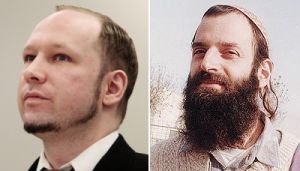
Anders Breivik: Norway’s Baruch Goldstein

Anders Behring Breivik, the Norwegian mass murderer who killed 77 fellow Norwegians last July, wants to portray himself as both sane and the champion of a righteous cause. In his testimony before a court in Oslo he has said that he and other militant nationalists in the West are “selling dreams” to inspire others.

Can a man who has displayed such ruthlessness become a source of inspiration? The answer is clearly yes and one of the most obvious parallels to Breivik would be Baruch Goldstein.

After the American-born Jewish Israeli physician killed 29 Palestinians and wounded another 125 at the Cave of the Patriarchs massacre in Hebron in 1994, thousands of people visited Goldstein’s grave to pay their respects.

A few days after the massacre, the New York Times reported:

Dr. Goldstein, who was finally overcome and beaten to death by the worshipers, was buried today in Qiryat Arba after a funeral service in which some mourners praised him as a hero and a righteous man. His grave was said to be temporary, and there are plans to move him to the Jewish cemetery in Hebron when tensions ease.

“One million Arabs are not worth a Jewish fingernail,” Rabbi Yaacov Perrin said in a eulogy. At the service in Jerusalem, attended by 300 people, one man shouted, “We are all Goldstein,” an opinion echoed across Qiryat Arba by neighbors who said variously that they approved of his attack on the Arabs or at the least could not judge him.

Goldstein was a follower of Rabbi Meir Kahane and belonged to Kahane’s Jewish Defense League.

After Breivik’s bombing and shooting rampage, those in Europe and the United States who share his views about an “Islamic threat” have largely wanted to distance themselves from his actions even while defending his outlook.

There are however a few exceptions.

Anders Breivik, The Kangaroo Court and The Lies of The Left,” a post at the Jewish Defence League UK website says (excerpt posted here without corrections):

At the beginning of the trial, Officials and Court members shook Breivik’s hand as if to give a Façade that they were not corrupt in the trial of this man. Anders Breivik spoke out and refused to recognize the court as The court room was being held by Leftists who were connected to the Marxist government of Norway. Quite rightly, because it was a classic Kangaroo court. the judges and prosecution were constantly staring at Breivik wide eyed, they were like a bunch of children trying an adult, they looked completely unprofessional and out of their league. A man like Breivik in a case such as this surely deserves a better trial than that?
[…]
[W]hat happened on Utoya was regrettable, but those to blame are those who held the rally, the Labour Youth and the Norwegian government. Breivik killed nobody under the age of 14 in the shootings, they were young adults. The rally at Utoya was certainly no “kids day out” it was an Far Left indoctrination weekend, set on a picturesque island, only the day before those attending were holding “Boycott Israel” banners to show the cameras. You tell me what “child” attends political meetings? You tell me what “child” is classed as an up and coming Politician? They were not children, they were young adults. I hold the same amount of sympathy for the those on Utoya as I would if somebody committed this act on a Hitler Youth camp in the 1940’s, or were they just “children” as well?

“There are thousands and thousands of people desperate like [Breivik]” says co-founder, spokesman and leader of the English Defense League, “Tommy Robinson” (Stephen Yaxley-Lennon).

Breivik’s prosecutors will no doubt work hard to portray the accused as delusional in the hope that the “dreams” he wants to sell will find no buyers. But though his view of the world is no doubt twisted, it is shared far too widely to be dismissed. And were Breivik not a rightwing extremist and white, he would without question have been branded a terrorist and those who share his views be seen as terrorist sympathizers.

The label “terrorist” has little value if it serves as nothing more than as an expression of antipathy, but the ranks of Breivik’s fellow travelers are all too easy to identify.

Robert Spencer and Pamella Geller’s Stop Islamization of America Facebook page has 7,668 likes: Stop Islamization of Norway (Stopp islamiseringen av Norge), 10, 348 members; Stop Islamization of the World, 8,466 likes; Anti-Islam Alliance, 6,312 likes; United States Defense League, 2,321 likes; English Defence League, 13, 679 likes; Stop Islamization of Denmark (Stop Islamiseringen Af Danmark), 2,321 members; and Stop Islamization of Europe – Bulgaria (ДА СПРЕМ ислямизацията!/SIOE Bulgaria), 4,077 members.

Even if the Knights Templar network to which Breivik claims he was recruited doesn’t actually exist, such a group with the aims he has outlined could certainly be created.

The idea that Breivik’s trial and conviction should serve as a warning to those who might contemplate following his lead reflects the slanted view of justice which puts all the emphasis on punishment. Indeed, punishment — whatever form it takes — will for Breivik be turned into some kind of ideological reward.

The most valuable function his trial can serve is as a demonstration that the actions of an individual or handful of individuals should not be used as a justification for abandoning the legal and democratic principles upon which a free society is based.

Erik Dale writes:

Much has been said about how Norway reacted as a nation in the immediate aftermath of the attacks, but in 10 weeks we will know what this nation is really made of.

The first challenge is to accept that no punishment can ever fit the crime. Some have called for changes in the legal system to allow for longer prison sentences or even death, but even if those had been real possibilities no punishment in the world is ever going to feel enough. Others have reacted strongly to pictures of the terrorist smiling and giving extremist salutes in the courtroom, pointing out that he is getting exactly the kind of attention he wants.

We should be outraged by the ideas that motivate him, but if we deny him the chance of explaining himself in an open court, we let the essence of those ideas, oppression and intolerance, dominate us. Although my heart is filled with anger, fear and sorrow, I am glad the Norwegian legal system treats everyone the same and is not subject to popular opinion. Its objective rules are there to deliver justice when emotions get the better of us. If Norwegians can hold on to that, they have already won a great victory.

The second challenge is to remain true to the values of Norwegian society. It is easy to be sympathetic to demands for stronger censorship, policy controls and online surveillance. Many will suggest that Breivik could have been stopped if only we had adopted some measure or other. But such doubts must not be allowed to change Norway. Even more important than the terrorist’s right to speak in court is that the right of opinion and right of organisation keep forming the core of our free society. Right of opinion, the heart of freedom of speech, also includes right of privacy and anonymity.

Extremism of any creed is not fuelled by those who speak in public, but by those who feel that no one speaks for them at all. There must be room for even the dark sides of human nature if Norway is to remain Norway. Only then can Norwegians emerge on the other side of this challenge as a greater and stronger people than they were before.

Facebooktwittermail

What Lt. Col. Shalom Eisner reveals about the IDF and the occupation

A soldier is on the battlefield, face-to-face with the enemy — but he’s run out of ammunition. How’s he going to engage in what could be the final fight for his life?

If he’s an Israeli soldier he’ll most likely employ the no-holds-barred Krav Maga, one of the world’s deadliest hand-to-hand combat styles. This technique derived from street-fighting skills developed by Imi Lichtenfeld, who made use of his training as a boxer and wrestler, as a means of defending Bratislava’s Jewish quarter against attacks by fascist groups in the 1930s.

This is what Lt. Col. Shalom Eisner, deputy commander of the IDF’s Jordan Valley brigade, resorted to when faced with the “threat” posed by a bunch of kids on bicycles on Saturday afternoon.

Eisner might have appeared to have lost control but his was what might be called measured brutality — restrained enough not to kill or to fracture a peaceful protester’s skull.

The following video shows Israelis training in the technique the lieutenant colonel employed.

Amir Mizroch is the editor of the English Newsletter Edition of Israel Hayom, Israel’s most widely-read Hebrew daily newspaper. He says the blow that Eisner delivered to Andreas Ias, an ISM activist participating in the Jordan Valley cycle tour, is a Krav Maga blow that IDF recruits are taught in their first week of basic training.

Eisner’s blow is just one of a sequence of Krav Maga blows that recruits learn. The blow that Eisner delivered, textbook style, could have been followed by at least 4 others in the sequence, which are designed to completely demobilize an enemy, perhaps even kill him. The fact that Eisner lost his cool and ‘reverted to type’ and his training, is an indication that the soldier was not mentally prepared for his mission against the ISM. He shouldn’t have been there in the first place. Eisner is a man the IDF wants in the field to face his opposite numbers in the Syrian army, the Iranian army, or Hezbollah. He is a soldier, a killer if he needs to be. The IDF does not want Eisner in a lose-lose situation where the battle is against peaceful protestors armed with cameras.

Until the army learns this lesson, no amount of sensitivity training, media awareness training, or damage control, is going to fix the problem.

The issue that Mizroch fails to address is the nature of military occupation.

The only reason policing works in a free society is through the support and consent of the wider population. Military occupation like martial law is rule without consent — it is imposed against the will of the people.

Eisner didn’t just lose his cool — he illustrated the very nature of Israel’s rule over the Palestinians: rule by force in which violence is not exceptional; it is the method of government.

Facebooktwittermail

Israel: Lt. Col. Shalom Eisner and his supporters

Lt. Col. Shalom Eisner

Israel’s President Shimon Peres, Prime Minister Benjamin Netanyahu, and IDF Chief of Staff Benny Gantz, all understand the world well enough to be in no doubt that the behavior of Lt. Col. Shalom Eisner as he slammed his M-16 rifle into the face of a Danish activist, Andreas Ias, was bad for Israel.

“Such behavior does not characterize IDF soldiers and officers and has no place in the Israel Defense Forces and in the State of Israel,” Netanyahu said.

Indeed. But the problem for Israel is that not only was Eisner’s behavior not an aberration — it has been widely praised.

In less than 24 hours a Facebook page, “We Support Lt Colonel Shalom Eisner,” has received several hundred “likes.” (The French-speaking creator of the page also happens to like the extremist Jewish Defense League and the English Defense League.)

Former Chief IDF Rabbi Avihai Ronski criticized the swift decision to suspend Eisner, who he described as “a highly ethical individual.”

“How can you say this was ‘a serious event’ after only a few seconds of footage? These kinds of incidents are why today’s commanders feel they have no backing.”

Danny Dayan, the chairman of the Yesha Council for Jewish settlers in the West Bank on Monday condemned the “overwhelming hysteria” in Israel over Eisner’s attack. He said there was no reason for the prime minister, the defense minister, and other high-ranking political authorities to be involved.

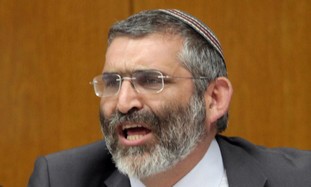
Michael Ben Ari, a National Union member of the Knesset responded by congratulating Eisner.

“Well done to the IDF officer who did what Bibi [Netanyahu] and [Yitzhak] Aharonovich [minister of internal security] have no brain or courage to do,” Ben Ari said. “Radical leftists must be handled with a heavy hand. There was a tangible threat to the lives of the soldiers and the officer had no other choice.”

Along with politicians, fellow soldiers have now voiced their support for Eisner. Ynet reports:

Eighty-three reservist officers and soldiers who served under the lieutenant colonel who was videotaped striking a Danish pro-Palestinian activist with an M-16 rifle, sent a letter addressed to IDF Chief of Staff Lt.-Gen. Benny Gantz and Defense Minister Ehud Barak in which they expressed “support and appreciation” for their “moral and ethical commander.”

Amidst so much sympathy for the lieutenant colonel, Ziv Lenchner, a Ynet columnist, expresses a deeper concern: that Eisner’s behavior accurately reflects Israel’s moral decline.

He writes:

The easiest thing we can do is jump to conclusions and make accusations before clarifying the circumstances of the incident where Lt. Colonel Shalom Eisner struck a leftist activist. Yet on second thought, this is not the easiest thing we can do.

The truly easiest thing is to hide behind the details that may emerge or the arguments that may be presented – a pacifist provocation, a difficult day in the area, warm weather that inflamed the spirits – in order to justify the epitome of brutality.

One regrettable fact will not be going anywhere: A thug wearing a lieutenant colonel uniform forcefully striking the jaw of a protestor using an IDF rifle. This is a moral nadir that a moral society cannot tolerate and certainly should not accept. It must not.

With one gesture, Lieutenant Colonel Eisner provided a new and appalling interpretation to the term “purity of arms.” The disturbing thought that won’t let go wonders how many such cases take place in our country and in the territories, right under our noses and not in front of our cameras.

Many sneers must accompany the above words, and this is no coincidence. An interesting historical study to be undertaken one of these days will aim to figure out when exactly did morality turn into “self-righteousness” and “being a bleeding heart” in Israel.

Most public responses to Eisner’s act, as expressed in the talkbacks among other things, are sympathetic to his actions. The reactions range from “the Danish scumbag deserved it” to “Eisner is a real man.” The prevalent argument among the handful of objectors has to do with the PR angle: How foolish it was for the senior officer to act this way in front of the cameras, thereby undermining Israel’s image (which is otherwise superior, as we know.)

There is no doubt that the images from the Jericho area will cause Israel PR damage, and rightfully so. Yet the fact this is the main issue that concerns Israel’s decent citizens is odd, not to mention twisted – not the fact that an IDF lieutenant colonel behaves like a Syrian thug in Homs, but rather, the fear that the world will see it on television and think bad things about us.

This is actually an excellent opportunity for us to think about ourselves. How did we reach a state where a protestor on a bicycle, even if he’s naïve, eccentric and annoying, is received by the Israel Defense Force with a bone-shattering gesture, and only a few of us view it as a crime?

This may be a natural development in a country that is so scared that it undertakes a mass deportation of foreign protestors instead of allowing them to demonstrate as much as they wish in the West Bank. After all, said the man at the top, we are the only democracy in the Middle East. Aren’t we?

The blow delivered by Lieutenant Colonel Eisner is particularly painful because it was delivered by a senior officer, rather than a young, inexperienced soldier who lost his head. It’s even more difficult and painful because of the target of the blow, and it wasn’t only the Danish protestor’s face. It was the face of all of us. Look in the mirror for a second and see what our face looks like this morning.

Facebooktwittermail

Lt. Col. Shalom Eisner represents the Israel Defense Forces

Haaretz reports: Prime Minister Benjamin Netanyahu on Sunday condemned the beating of a pro-Palestinian activist by a senior IDF officer, which was seen in a film posted on YouTube earlier Sunday.

“Such behavior does not characterize IDF soldiers and officers and has no place in the Israel Defense Forces and in the State of Israel,” Netanyahu said.

IDF Chief of Staff Benny Gantz also commented on the incident in which a senior officer was filmed hitting a leftist activist in the face with an M-16 rifle, saying he sees the incident as very grave.

“The incident does not reflect IDF principles and will be thoroughly investigated,” Gantz said.

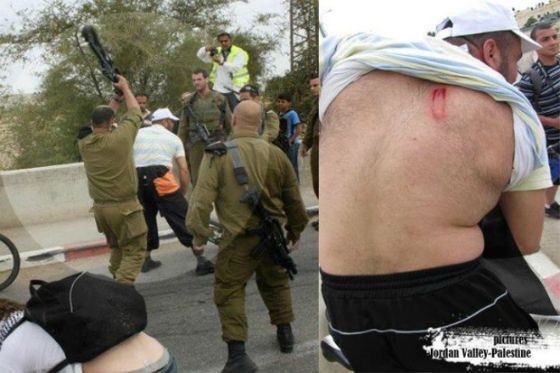
On Saturday, a group of some 250 activists, mostly Palestinian youths from the West Bank, went on a bike ride in the Jordan Valley in a silent protest. At a certain point, several dozens of IDF soldiers stopped the activists, and events quickly escalated into a confrontation. IDF soldiers hit the activists and threw their bikes over a tunnel across the road.

In the video, which was posted by the International Solidarity Movement on YouTube on Sunday, Lt.-Col. Shalom Eisner is seen beating youths who took part in a pro-Palestinian bike ride in the Jordan Valley.

One of the volunteers who organized the bike ride said that the soldiers were waiting for the activists and began clashing with them.

Lt.-Col. Eisner was filmed hitting one of the activists in the face with his M-16.

“We did not expect any harassment on the part of the Israeli soldiers, we just came for fun,” one of activists told Haaretz. “I tried to talk to them, to say that we only want to enjoy the beautiful road and the Jordan Valley in the springtime, but we were unsuccessful. The activists were beaten badly, and the officers just told us we couldn’t be in that area.”

Four activists who sustained wounds on their faces and backs were evacuated to a hospital in Jericho, while three more youths who were beaten refused to receive medical care.

Eisner recounted his version of events, and said that the youth that he beat had hit him beforehand, and even broke two of his fingers. He said that the incident lasted two hours, and that the activists were trying to block a road in the Jordan Valley.

Eisner claimed that he carried out his job after two hours of trying to stop lawbreakers.

Palestinian media reported on Saturday on the events that took place during the bike ride. After the video was posted Sunday and showed testimony of what transpired, GOC Central Command Nitzan Alon ordered the IDF to investigate the matter.

As Israel’s top officials try to portray Eisner’s assault as an aberration, it’s worth noting how the incident was treated on Nablus TV which first aired the footage on Saturday.

The attack was only shown midway through their report. For the Palestinian reporters this was just one more example of Israeli brutality that is far from exceptional.

As painful as it must have been for the young Danish activist to have an M-16 slammed in his face, this particular incident is unfortunately relatively minor in the history of the institutionalized violence which provides the foundation for Israel’s occupation of Palestinian land.

Facebooktwittermail

Unwelcome to Israel — operation barred foreigners for no reason

In the grip of hysteria and a desperate effort to prevent peaceful protesters setting foot in Israel, a no-fly list that was designed to thwart the Welcome to Palestine campaign included a French diplomat and his wife who were coming to find an apartment in Jerusalem, an Italian government official who had been scheduled to meet her Israeli counterparts, and a member of the board of directors of German pharmaceutical giant Merck which is making a significant investment in an Israeli research institute. Several Israelis were also blacklisted.

Haaretz reports: Forty percent of the non-Israeli citizens who were blacklisted and not permitted entry into Israel on Sunday were kept out even though the Shin Bet security service had no concrete information showing they were connected with so-called fly-in protest. This information comes from a high-ranking Israeli source with knowledge of the blacklist, who added that the Shin Bet also had no solid grounds for believing that 470 of the 1,200 people whom Israel labeled as “pro-Palestinian activists” intended to do anything illegal.

“We put people on the list who are as far removed from anti-Israel political activity as east is from west,” one Foreign Ministry official said. “We have insulted hundreds of foreign citizens because of suspicions, and have given the other side a victory on a silver platter.”

“Direct damage has been done to tourism and to Israel’s good name,” the official said.

Organizers said on Sunday that their “Welcome to Palestine” protest, in which hundreds of pro-Palestinian activists were planning to participate in demonstrations in the West Bank, was a success that still advanced the Palestinian narrative even though many of the protesters were forced to stay home.

“It doesn’t matter if eight people came or 800,” said Lubna Masarwa, one of the organizers of the event. “What’s clear is that there is a popular struggle that is gaining momentum and has the international support of thousands of activists. The Palestinians are not alone in their struggle.”

A 23-year-old French woman who made it into Israel to take part in the protest said about half her group of 50 was detained.

“The security forces in France and Israel treated us like criminals,” she said. “It’s very frustrating and surprising that the authorities cooperated with the Israeli claims and propaganda.”

The list of banned passengers was inflated over the weekend in what one Foreign Ministry official called “overexertion.”

“The net was spread too wide, bringing down innocent people,” he said.

That net did not spare holders of diplomatic passports, like a French diplomat and his wife who are due to begin working at the French consulate in Jerusalem this summer. They were planning to look for an apartment in Jerusalem, but the night before their flight they received an e-mail from their airline, Lufthansa, saying their tickets were canceled because they had been banned from entering Israel.

“The Population Registry people told us their flight route was suspicious because they were coming in on a connecting flight from Munich, not direct from Paris,” said a European diplomat who was trying to help the couple get into the country. “Only after we explained that the ticket from Munich was bought because it was cheaper did they take them off the list.”

Lufthansa was one of about 20 airlines, mostly European, that Israel threatened with sanctions if they did not cancel the tickets of the passengers who appeared on the lists Israel sent them. Other airlines that canceled tickets included Air France, Alitalia, Easyjet and Turkish Airlines.

Other passengers who appeared on the blacklist despite having no connection to the protest include an employee of Italy’s Communications Ministry who was supposed to meet with her Israeli counterparts here, and a Dutch member of the board of directors of German pharmaceutical giant Merck, who was part of a company delegation taking part in the dedication of a biotechnology hothouse at the Weizmann Institute of Science, in which Merck is investing 10 million euros.

Both were eventually allowed into the country.

It wasn’t only foreign citizens who were banned from entering Israel, though: An Israeli woman from Kfar Vradim was informed the night before her flight home that she wouldn’t be allowed to board the plane. There were other instances of Israelis being put on the blacklist.

The Shin Bet, which compiled the list along with the intelligence division of the Israel Police, did not respond to a request for comment. For its part, the Population Registry was also involved in keeping out certain passengers, but said it was following the Shin Bet’s orders.

The 730 people on the initial blacklist were all foreign citizens who were banned either because they were determined by Israeli intelligence to be flying in for the express purpose of taking part in the protest, or because they had arrived here for that purpose during a previous fly-in in July.

The 270 people who took part in the previous protest have been banned from entering the country for 10 years.

Police sources said many of the passengers on the list had been arrested for protests in the West Bank, or their names appeared online in connection with pro-Palestinian groups.

Facebooktwittermail

Lt. Col. Shalom Eisner and Israel’s image problem

As Israeli authorities detained the few pro-Palestinian activists on the ‘flytilla’ who got as far as Ben-Gurion International Airport, perhaps they should have claimed they were being prevented from visiting the West Bank for their own safety. Had they been allowed to complete their journey they would have been at risk of encountering thugs like Lt. Col. Shalom Eisner, the deputy commander of the Jordan Valley brigade, seen here slamming his American-made rifle into the face of a young Danish activist on Saturday.

Another image appears to show Eisner striking another activist with his rifle.

Ami Kaufman reports that praise for Eisner is flooding the Israeli social media and that this senior officer is in line for a promotion.

A source who approached me and wishes to remain anonymous at this point has informed me that Lt. Col. Eisner is set to be the next deputy commander of Bahad 1 – the IDF’s training base for all of its officers. This piece of info could not be confirmed.

The IDF spokesperson in response: “We do not discuss IDF appointments in the media until they are signed and sealed. When appointments are confirmed, the media is notified.”

Leading Bahad 1 is considered to be one of the most prestigious jobs in the IDF. Some of its former commanders were Shaul Mofaz, Giora Eyland, Matan Vilnai, Elazar Stern and others who later became high-ranking generals or Chiefs of Staff.

Haaretz reported:

National Union MK Michael Ben Ari issued a response to the incident and congratulated the IDF officer who hit the leftist activists.

“Well done to the IDF officer who did what Bibi [Benjamin Netanyahu] and [Yitzhak] Aharonovich [minister of internal security] have no brain or courage to do,” Ben Ari said. “Radical leftists must be handled with a heavy hand. There was a tangible threat to the lives of the soldiers and the officer had no other choice.”

Facebooktwittermail