Author Archives: Paul Woodward

Obama administration’s mixed message on regime change in Iran

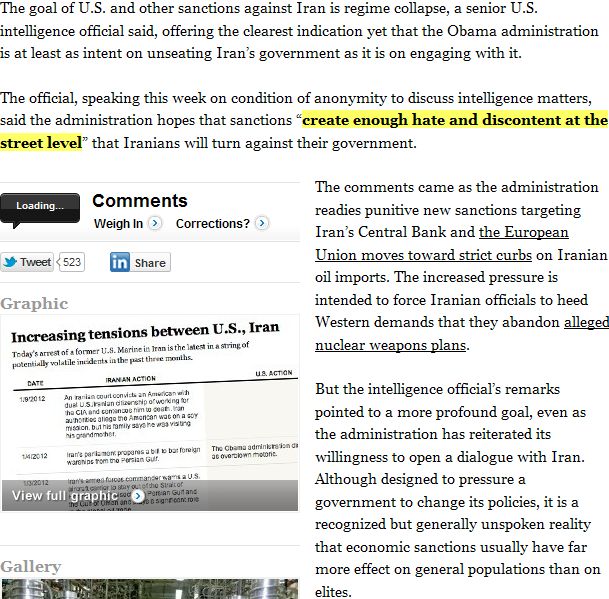
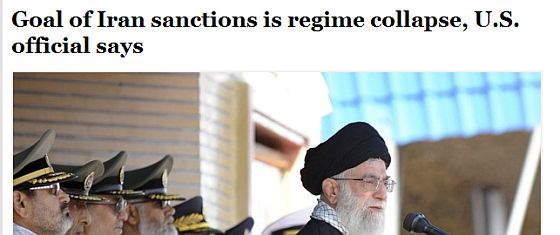
How does a senior U.S. intelligence official tell a Washington Post reporter that the administration’s goal in imposing sanctions on Iran is to bring about regime change, if that is not in fact the goal?

Washington Post -- By Karen DeYoung and Scott Wilson, Tuesday, January 10, 4:22 PM

The article (cached version) with this headline (which was later substantially re-written) begins:

The revised version of the article, under a revised headline, “Public ire one goal of Iran sanctions, U.S. official says”, begins:

The Obama administration sees economic sanctions against Iran as building public discontent that will help compel the government to abandon an alleged nuclear weapons program, according to a senior U.S. intelligence official.

In addition to influencing Iranian leaders directly, the official said, “another option here is that [sanctions] will create hate and discontent at the street level so that the Iranian leaders realize that they need to change their ways.”

The intelligence official’s remarks pointed to what has long been an unstated reality of sanctions: Although designed to pressure a government to change its policies, they often impose broad hardships on a population.

So who would this senior intelligence official be? CIA director David Petraeus? And was he misquoted? Or was he being too candid? Or is the Washington Post colluding with the administration in sending out a mixed message?

Facebooktwittermail

Syria, the ‘Zio-American plot’, and Conflicts Forum

On its website (which I created) Conflicts Forum is referred to as “an international movement which engages with Islamist movements” — a partially correct but somewhat misleading statement.

Conflicts Forum does indeed engage Islamist movements — principally Hezbollah and Hamas. It does have an international element — evident in its advisory board. But by no stretch of the imagination can it accurately be described as an international movement.

It is an operation so small it can barely be described as an organization, let alone a movement. It serves first and foremost as an institutional identity for the former senior British intelligence officer, Alastair Crooke.

In his decades-long service for the British government, Crooke was deeply engaged with resistance movements across the globe, opening up vital dialogue leading to peace deals for which politicians and prime ministers would later eagerly take credit.

That work was prematurely cut short in 2003 because of pressure from an administration in Washington that refused to recognize that governments, however powerful, must sooner or later learn how to talk to their enemies.

Having been pushed out of his official role, Crooke attempted to continue what had become a personal mission through the creation of Conflicts Forum. The problem was: how much value can dialogue yield if only one side is willing to engage?

The outcome — perhaps inevitable — was that Conflicts Forum would be unable to effectively serve as a bridge between Islamists and Western governments and instead become an informal advocate for those movements and for the Middle Eastern governments whose backing they still enjoy.

In the summer of 2009 after Iranians from across the social spectrum took to the streets en masse to reject the outcome of the presidential election, Crooke rejected the idea that this was a “genuine popular uprising“; as for the significance of the unrest he said, somewhat dismissively: “plainly for some in north Tehran it was very real”.

Two and a half years later, Crooke and his partner Aisling Byrne are engaged in a similar effort to portray unrest in Syria, not as a popular uprising but instead as the result of America’s covert war against Iran for whom Syria remains a vital ally. The people on the streets are supposedly just pawns serving a neoconservative agenda: regime change in Damascus and Tehran.

The Guardian’s Brian Whitaker justifiably pours scorn on Conflict Forum’s conspiratorial missives and those on the left who have become Assad and Ahmadinejad’s useful idiots.

Denying the authenticity of the Syrian uprising is a central plank of the Assad regime’s propaganda message – that the whole thing, as the official news agency put it recently, is a "Zio-American" plot.

To anyone who has been following events in Syria closely since last March, the regime’s conspiracy claims are not only ridiculous but terribly insulting to the thousands of protesters who have risked (and often lost) their lives in the struggle against dictatorship. Even so, there’s a small chorus of westerners who seem to be echoing the Assad line.

“Arguably, the most important component in this struggle,” Aisling Byrne wrote in an article last week, “has been the deliberate construction of a largely false narrative that pits unarmed democracy demonstrators being killed in their hundreds and thousands as they protest peacefully against an oppressive, violent regime, a ‘killing machine’ led by the ‘monster’ Assad.”

Arguably, my foot. Information about the protests has sometimes been wrong – as always happens in conflicts, especially when media access is so severely restricted – but to suggest that this has led to a “largely false narrative” is utter nonsense.

Byrne’s article has been doing the rounds on the internet – Counterpunch, the Asia Times and Countercurrents – as well as being touted enthusiastically inside Syria by the Assad regime. Running to more than 4,700 words, it’s probably the fullest exposition yet of the grand international conspiracy theory.

Of course, it’s true lots of countries have been reacting to the uprising in Syria and some are certainly trying to influence the outcome. Given Syria’s strategic importance, that is to be expected. Reacting to events, though, is not the same as orchestrating things according to some pre-conceived plan – which is what the Assad regime claims is happening, and what Byrne also seems to imply:

“What we are seeing in Syria is a deliberate and calculated campaign to bring down the Assad government so as to replace it with a regime ‘more compatible’ with US interests in the region.

“The blueprint for this project is essentially a report produced by the neo-conservative Brookings Institute for regime change in Iran in 2009.”

There’s no harm in discussing or criticising what foreign powers may be up to with regard to Syria, even if Byrne draws some rather fanciful conclusions. Any attempts to prevent the Syrian people from making their own choices ought to be resisted, too. The overall effect of such articles, though, is to delegitimise the popular struggle – which is unfair to the protesters and also plays into the hands of the regime.

But what of the article’s author, Aisling Byrne? She is projects co-ordinator for the Conflicts Forum, based in Beirut. Its director is Alastair Crooke, a former British intelligence officer who until a few years ago was heavily involved in British and European diplomacy relating to Israel/Palestine. Among many other things, he took part in clandestine meetings with Hamas.

Crooke left his government job and founded the Conflicts Forum in 2004 “to open a new relationship between the west and the Muslim world”, mainly through promoting dialogue with Islamist movements – something that western governments have often been reluctant to do. Members of the forum’s advisory board include Moazzam Begg, a former Guantanamo detainee, and Azzam Tamimi, regarded as an unofficial voice for Hamas in Britain.

“While facing increasingly intractable problems in Iraq, Afghanistan, Lebanon, Pakistan and elsewhere,” Conflicts Forum says on its website, “we [ie western governments] immobilise ourselves by turning away from the homegrown political forces that have the power to resolve these crises.”

Judging by Byrne’s article and another by Crooke himself in the Guardian last November, though, Conflicts Forum seems oddly reluctant to engage with the “homegrown political forces” in Syria.

There’s an inconsistency and selectivity here that is also apparent among sections of the more traditionalist left. Pro-western dictators like Ben Ali and Mubarak are considered fair game, but when it comes to toppling contrarian dictators like Gaddafi and Assad there’s lingering sympathy for them.

In Syria’s case this is further complicated by viewing the uprising through the prism of the Israeli-Palestinian conflict. For instance, a briefing paper on Conflicts Forum’s website examining Hizbullah’s continuing support for the Assad regime says:

“Just as Hizbullah viewed the 2009 protests in Iran as a ‘bid to destabilise the country’s Islamic regime’ by means of a US-orchestrated ‘velvet revolution’, the protests in Syria are branded a form of ‘collusion’ with outside powers who seek to replace Asad’s rule with ‘another regime similar to the moderate Arab regimes that are ready to sign any capitulation agreement with Israel’…

“Echoing Hizbullah’s stance on the Iran protests is Nasrallah’s characterisation of the US role in the Syrian uprising as an extension of the July War and the Gaza War. Since the resistance in Lebanon and Palestine had foiled the ‘New Middle East’ scheme in both these military aggressions, Washington was ‘trying to reintroduce [it] through other gates,’ such as Syria.

“With this in mind, attempts to overthrow the Assad regime are considered a ‘service’ to American and Israeli interests.”

Such views are not confined to Hizbullah, however. But how realistic are they? Many neocons hoped the invasion of Iraq would deliver a pro-Israel government there. It didn’t, and instead it strengthened Iran. 

Tunisia is no more favourably disposed towards Israel than it was under Ben Ali. Nor is Libya. Nor is Egypt – if anything, less so. And a democratic Syria would still have the same territorial issues with Israel – the occupied Golan Heights, etc – that it has now. In any case Israel seems an odd reason for denying Syrians a chance to determine their own future.

Facebooktwittermail

The evolutionary connection between Zionism and deceit

Robert Trivers

In The Folly of Fools, Robert Trivers — one of the world’s most influential evolutionary theorists — examines the roots of deceit and in a chapter on false historical narratives considers Zionism and the deceit upon which Israel was founded.

A key original Zionist falsehood was the slogan popularized in the 1880s that the Jewish people needed to settle in Palestine because it was ‘a land without people for a people without land.’ Alas, there were plenty of people in Palestine.

Further on he notes:

Jewish people have energetically sought and received compensation for property stolen by Nazis (or, say, their Swiss bankers) some sixty years later, but they fail to acknowledge any contradiction between this policy and the one they have taken when the shoe is on the other foot. They have the right to return to truly ancient land and the right to compensation for gross theft immediately prior to 1946, but Palestinians have no right of return to land stolen from them in 1948, land that they and their ancestors occupied for centuries. Nor do they have any right of compensation. To buttress both arguments, the Palestinians had to be stripped historically of ownership of their own land. This, as we have seen, was achieved both by denying their history and creating false versions of it.

Trivers notes that in any form of social injustice, those who benefit from the injustice likewise benefit from self-deception, whereas those who are the victims are best served by the truth.

He writes:

The principles we are describing are universal. Surely if Jews in Palestine practiced deceit and self-deception, then so did the Arabs, and surely if Zionists do it today, anti-Zionists do it as well. There are, however, two important variables that one overlooks at one’s peril: relative power and relative justice. If there is a growing difference in power, with the powerful more prone to self-deception, their unjust behavior requiring cover-up and rationalization, then there will be a positive association between power, injustice inflicted, and degree of self-deception. If you are the victim of injustice, simply telling the truth may be your best move.

Facebooktwittermail

Forging ties with democratic Egyptian government is like reaching out to the Soviet Union?

The New York Times reports: With the Muslim Brotherhood pulling within reach of an outright majority in Egypt’s new Parliament, the Obama administration has begun to reverse decades of mistrust and hostility as it seeks to forge closer ties with an organization once viewed as irreconcilably opposed to United States interests.

The administration’s overtures — including high-level meetings in recent weeks — constitute a historic shift in a foreign policy held by successive American administrations that steadfastly supported the autocratic government of President Hosni Mubarak in part out of concern for the Brotherhood’s Islamist ideology and historic ties to militants.

The shift is, on one level, an acknowledgment of the new political reality here, and indeed around the region, as Islamist groups come to power. Having won nearly half the seats contested in the first two rounds of the country’s legislative elections, the Brotherhood on Tuesday entered the third and final round with a chance to extend its lead to a clear majority as the vote moved into districts long considered strongholds.

The reversal also reflects the administration’s growing acceptance of the Brotherhood’s repeated assurances that its lawmakers want to build a modern democracy that will respect individual freedoms, free markets and international commitments, including Egypt’s treaty with Israel.

And at the same time it underscores Washington’s increasing frustration with Egypt’s military rulers, who have sought to carve out permanent political powers for themselves and used deadly force against protesters seeking an end to their rule.

The administration, however, has also sought to preserve its deep ties to the military rulers, who have held themselves up as potential guardians of their state’s secular character. The administration has never explicitly threatened to take away the $1.3 billion a year in American military aid to Egypt, though new Congressional restrictions could force cuts.

Nevertheless, as the Brotherhood moves toward an expected showdown with the military this month over who should control the interim government — the newly elected Parliament or the ruling military council — the administration’s public outreach to the Brotherhood could give the Islamic movement in Egypt important support. It could also confer greater international legitimacy on the Brotherhood.

It would be “totally impractical” not to engage with the Brotherhood “because of U.S. security and regional interests in Egypt,” a senior administration official involved in shaping the new policy said, speaking on the condition of anonymity to discuss diplomatic affairs.

“There doesn’t seem to me to be any other way to do it, except to engage with the party that won the election,” the official said, adding, “They’ve been very specific about conveying a moderate message — on regional security and domestic issues, and economic issues, as well.”

Some close to the administration have even called this emerging American relationship with the Brotherhood a first step toward a pattern that could take shape with the Islamist parties’ coming to power around the region in the aftermath of the uprisings of the Arab Spring. Islamists have taken important roles in Morocco, Libya, Tunisia and Egypt in less than a year.

“You’re certainly going to have to figure out how to deal with democratic governments that don’t espouse every policy or value you have,” said Senator John Kerry, the Massachusetts Democrat who is chairman of the Foreign Relations Committee and recently joined with the ambassador to Egypt, Anne W. Patterson, for a meeting with top leaders of the Brotherhood’s political party.

He compared the Obama administration’s outreach to President Ronald Reagan’s arms negotiations with the Soviet Union. “The United States needs to deal with the new reality,” Mr. Kerry said. “And it needs to step up its game.”

Kerry often serves as a kind of surrogate Secretary of State for the current administration — the one who presents policy that the administration struggles to articulate itself. So, especially during an election year, it’s hardly surprising that he is being called on to explain why Washington is now reaching out to the Muslim Brotherhood as the Islamist movement stands on the brink of gaining control of Egypt’s parliament.

But why liken this move to the realpolitik of dealing with the utterly undemocratic Soviet Union? The analogy is not only extreme but also offensive and unnecessarily antagonistic. The U.S. reached out to the Soviet Union at the same time as it hoped to witness its destruction. Is that the message that the U.S. now wants to send to the Middle East’s rising Islamists? That we have no choice but talk to them even while hoping for their demise?

Facebooktwittermail

Ron Paul reality check

Since I’ve posted a few items recently suggesting that Ron Paul’s participation in the 2012 presidential race has had a positive effect, I should also make it clear that I remain among those who also see him as a crackpot.

Mother Jones provides this old example of the Congressman’s isolationist paranoia letting rip:

Facebooktwittermail

Mossad chief: Nuclear armed Iran not an existential threat to Israel

A year ago Benjamin Netanyahu appointed Tamir Pardo as the director of Israel’s intelligence service, the Mossad. Pardo has spent his whole career in Mossad — an organization which in recent years has focused most of its attention on Iran. It is reasonable to assume that there is no one else inside Israel’s national security establishment who is in a better position to assess the threat Iran might pose to the Jewish state.

So, when Pardo addressed a meeting of 100 Israeli ambassadors who had returned home for their annual meeting this week, one might expect that Iran would have been the focus of his concerns, but apparently not.

For 20 minutes he spoke about the threat to Israel’s economy posed by the economic crisis in Europe. Israelis have good reason to be worried. Europe provides the market for a third of Israel’s exports.

As for Iran, Pardo covered the topic in just five minutes during which time he admonished those who use the term “existential threat” too freely.

If Iran obtains nuclear weapons, this will not mean the destruction of the State of Israel, Pardo says.

“Does Iran pose a threat to Israel? Absolutely. But if one said a nuclear bomb in Iranian hands was an existential threat, that would mean that we would have to close up shop and go home. That’s not the situation,” ambassadors present quoted Pardo as saying.

Haaretz reported:

The ambassadors said Pardo did not comment on the possibility of an Israeli military assault on Iran.

“But what was clearly implied by his remarks is that he doesn’t think a nuclear Iran is an existential threat to Israel,” one of the envoys said.

Did anyone in Washington hear that? Or is everyone too busy drumming up fear about “existential threats”?

Facebooktwittermail

The parasites in the belly of the beast of American capitalism

Robert Scheer writes: It is official now. The Ron Paul campaign, despite surging in the Iowa polls, is not worthy of serious consideration, according to a New York Times editorial; “Ron Paul long ago disqualified himself for the presidency by peddling claptrap proposals like abolishing the Federal Reserve, returning to the gold standard, cutting a third of the federal budget and all foreign aid and opposing the Civil Rights Act of 1964.”

That last item, along with the decade-old racist comments in the newsletters Paul published, is certainly worthy of criticism. But not as an alternative to seriously engaging the substance of Paul’s current campaign—his devastating critique of crony capitalism and his equally trenchant challenge to imperial wars and the assault on our civil liberties that they engender.

Paul is being denigrated as a presidential contender even though on the vital issues of the economy, war and peace, and civil liberties, he has made the most sense of the Republican candidates. And by what standard of logic is it “claptrap” for Paul to attempt to hold the Fed accountable for its destructive policies? That’s the giveaway reference to the raw nerve that his favorable prospects in the Iowa caucuses have exposed. Too much anti-Wall Street populism in the heartland can be a truly scary thing to the intellectual parasites residing in the belly of the beast that controls American capitalism.

It is hypocritical that Paul is now depicted as the archenemy of non-white minorities when it was his nemesis, the Federal Reserve, that enabled the banking swindle that wiped out 53 percent of the median wealth of African-Americans and 66 percent for Latinos, according to the Pew Research Center.

Why does the newspaper of the Establishment feel the need to knock down the Paul campaign?

Up until recently, the mainstream media treated Paul as the invisible candidate — a man supposedly so marginal that “serious” pundits could ignore him. But his growing popularity means he can no longer be dismissed and thus the Times editorial writers feel driven to try and swat this persistent irritant.

Even so, given that the Times will undoubtedly endorse Obama and given that the odds are at this point stacked quite heavily in the incumbent’s favor, why the need to attack Paul?

Because the New York Times thinks it is entitled not only to endorse its favored presidential candidate but also choose his opponent and that most likely would be Mitt Romney.

In a contest between Obama and Romney, the president can cast his opponent as the representative of Wall Street and present himself as a man of the people. And the newspaper that represents the status quo can disingenuously pose as an agent of change.

Paul has the power to upset that scenario and turn this into an election about issues instead of the usual beauty contest. The candidate who we are repeatedly told can’t be taken seriously threatens those whose vested interests are served by the trivialization of the electoral process.

This isn’t an endorsement for Ron Paul — simply a statement of what should be obvious: he has a positive role to play in 2012.

Facebooktwittermail

New York Times implies anti-Zionism is anti-Semitic

Rutenberg

When Jim Rutenberg and Serge Kovaleski refer to “books like The Invention of the Jewish People and March of the Titans: A History of the White Race,” should we assume that these are just ignorant journalists making a grossly inappropriate association, or are they purposefully trying to mislead their readers?

In their New York Times hatchet job on Ron Paul we are told that “white supremacists, survivalists and anti-Zionists who have rallied behind his candidacy have not exactly been warmly welcomed.”

White supremacists, survivalists and anti-Zionists? In the minds of these reporters, anyone who promotes the idea that Israel should become a state of all its citizens — Jews, Arabs and others — apparently looks like a political bedfellow of the likes of Stormfront or the Militia of Montana.

Kovaleski

The article reports on the appeal that Ron Paul has among some white supremacists and survivalists and yet says nothing on the anti-Zionist element. Rutenberg and Kovaleski were apparently content to merely insinuate that there is a link between criticism of Israel and racism.

The closest they come to providing evidence of such an association is the article’s opening sentence where the two books are linked.

March of the Titans: A History of the White Race is by Arthur Kemp, an advocate of white separatism and foreign affairs spokesman for the ultra-right and racist British National Party. Kemp is a Holocaust denier and was “linked to the murderer of the South African Communist party and ANC leader Chris Hani in 1993,” The Guardian reported in 2009.

The Invention of the Jewish People, first published in Hebrew in Israel with the title, Matai ve’ech humtza ha’am hayehudi?, is by Shlomo Sand, Professor of History at Tel Aviv University. The book was a bestseller in Israel for several months before being translated into French and English.

Tony Judt wrote: “Shlomo Sand has written a remarkable book. In cool, scholarly prose he has, quite simply, normalized Jewish history. In place of the implausible myth of a unique nation with a special destiny – expelled, isolated, wandering and finally restored to its rightful home – he has reconstructed the history of the Jews and convincingly reintegrated that history into the general story of humankind. The self-serving and mostly imaginary Jewish past that has done so much to provoke conflict in the present is revealed, like the past of so many other nations, to be largely an invention. Anyone interested in understanding the contemporary Middle East should read this book.”

Of course Rutenberg and Kovaleski would be unlikely to attach much weight to Judt’s assessment of Sand’s book — Judt was after all one of those dubious anti-Zionists.

The irony about linking anti-Zionists with anti-Semities is that Zionism is a philosophy that has obvious appeal to anti-Semites. Encourage all the Jews to move to Israel — why would the anti-Semites object?

Indeed, the emerging political convergence on the extreme right has been between anti-Semites and Zionists and that’s an unholy alliance that probably finds Ron Paul the least appealing among the GOP presidential hopefuls.

Facebooktwittermail

Drone warfare and the stress induced by premeditated murder

A recent study by the U.S. Air Force School of Aerospace Medicine assessed the level of stress involved in remote warfare being conducted by Air Force drone operators. The New York Times reports:

4 percent or less of operators were at high risk of developing post-traumatic stress disorder, the severe anxiety disorder that can include flashbacks, nightmares, anger, hypervigilance or avoidance of people, places or situations. In those cases, the authors suggested, the operators had seen close-up video of what the military calls collateral damage, casualties of women, children or other civilians. “Collateral damage is unnerving or unsettling to these guys,” Colonel McDonald said.

The percentage of troops returning from Iraq and Afghanistan at risk of developing post-traumatic stress disorder was 12 to 17 percent, the authors said.

In contrast to nearly half of drone operators’ reporting “high operational stress,” 36 percent of a control group of 600 Air Force members in logistics or support jobs reported stress. The Air Force did not compare the stress levels of the drone operators with military pilots who fly planes in the air.

The biggest sources of stress for drone operators remained long hours and frequent shift changes because of staff shortages.

Glenn Greenwald comments:

[A]t least some of these drone pilots have enough of a conscience to be seriously disturbed by the horrific results of these strikes. If only the general citizenry — who are typically kept blissfully unaware of the human devastation their government is causing — were as affected.

But to suggest that a measure of conscience is the way these pilots react to the unintended effects of their actions, doesn’t really say much about what is going on here.

In a recent edition of “The Stream” on Al Jazeera, former CentCom spokesman Josh Rushing, made these observations. (Watch the following video from 20min 22 sec till 21min 22sec.)

As unprecedented as it might seem for a killer to so closely study his target, this really isn’t new. Indeed, there is a commonly used term we associate with this kind of planning: premeditation.

Murder of the worst kind involves cold calculation and emotional detachment. The idea that a drone operator might end up with PTSD simply as a result of seeing innocent people get killed, ignores the effect of his spending hours or days anticipating an intentional killing.

The military precursor of the drone operator is the sniper and the non-military correlate of both is the hitman.

Randall Collins notes that inside the military, the sniper stands apart.

Snipers tend to be disliked even by their fellow soldiers, or at least regarded with uneasiness. A British sniper officer in World War I noted that infantrymen did not like to mingle with the snipers “for there was something about them that set them apart from ordinary men and made the soldiers uncomfortable”… World War II soldiers sometimes jeered at them. U.S. snipers in Vietnam were met with the comment: “Here comes Murder Incorporated.”

Josh Rushing notes that the Pentagon’s shift in favor of remote warfare is a reflection of a political reality: that if Americans are not taxed to support this country’s wars, and if wars can be fought without American soldiers getting killed, then Washington faces few political constraints in starting new wars about which the public will show little interest.

The Air Force is now recruiting more drone pilots than fighter and bomber pilots combined, but the continued success in recruitment requires that the job of these armchair pilots be glamorized and tied into a traditional warfighting culture. Hence the creation of commercials like this:

But note the irony: the stated target in this portrayal of 21st century warfare is the “enemy sniper” and the role of the drone pilot is to protect ordinary American soldiers.

In the battlefields that the Pentagon prefers however, there are no American soldiers, death comes by decree and those getting killed — however they might be labelled — are utterly defenseless.

Facebooktwittermail

Obama administration considers censoring Twitter

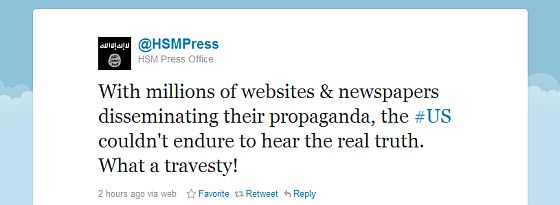
With millions of websites & newspapers disseminating their propaganda, the #US couldn't endure to hear the real truth. What a travesty!

Tweet from Harakat Al-Shabaab Al Mujahideen, Somalia's Islamist insurgent movement.

How dangerous can 140 characters be?

Apparently if those 140 characters are being fired onto the web through the Twitter account of al Shabib, Somalia’s militant jihadist movement, then the national security of the United States could be in jeopardy.

The New York Times reports:

American officials say they may have the legal authority to demand that Twitter close the Shabab’s account, @HSMPress, which had more than 4,600 followers as of Monday night.

The most immediate effect of the Obama administration’s threat appears to have been that @HSMPress (which has so far only made 114 tweets) has subsequently gained hundreds of new followers.

Is Twitter itself about to take a stand in defense of freedom of speech?

A company spokesman, Matt Graves, said [to a Times reporter] on Monday, “I appreciate your offer for Twitter to provide perspective for the story, but we are declining comment on this one.”

Last Wednesday, the New York Times reported from Nairobi in Kenya:

Somalia’s powerful Islamist insurgents, the Shabab, best known for chopping off hands and starving their own people, just opened a Twitter account, and in the past week they have been writing up a storm, bragging about recent attacks and taunting their enemies.

“Your inexperienced boys flee from confrontation & flinch in the face of death,” the Shabab wrote in a post to the Kenyan Army.

It is an odd, almost downright hypocritical move from brutal militants in one of world’s most broken-down countries, where millions of people do not have enough food to eat, let alone a laptop. The Shabab have vehemently rejected Western practices — banning Western music, movies, haircuts and bras, and even blocking Western aid for famine victims, all in the name of their brand of puritanical Islam — only to embrace Twitter, one of the icons of a modern, networked society.

On top of that, the Shabab clearly have their hands full right now, facing thousands of African Union peacekeepers, the Kenyan military, the Ethiopian military and the occasional American drone strike all at the same time.

But terrorism experts say that Twitter terrorism is part of an emerging trend and that several other Qaeda franchises — a few years ago the Shabab pledged allegiance to Al Qaeda — are increasingly using social media like Facebook, MySpace, YouTube and Twitter. The Qaeda branch in Yemen has proved especially adept at disseminating teachings and commentary through several different social media networks.

“Social media has helped terrorist groups recruit individuals, fund-raise and distribute propaganda more efficiently than they have in the past,” said Seth G. Jones, a political scientist at the RAND Corporation.

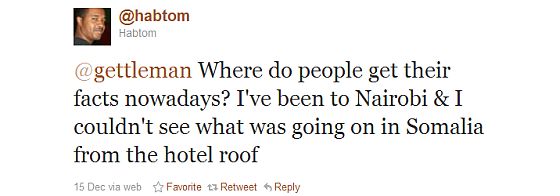
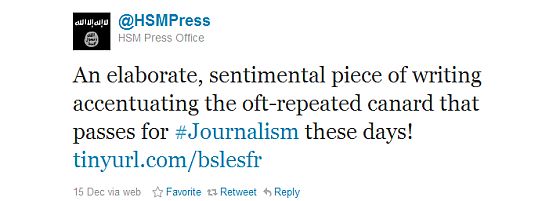
The Times reporter, Jeffrey Gettleman, sounds quite indignant that al Shabib should have the audacity to be using Twitter, so he can hardly have been surprised that his article prompted this exchange between @HSMPress and one of their followers:

@gettleman Where do people get their facts nowadays? I've been to Nairobi & I couldn't see what was going on in Somalia from the hotel roof
An elaborate, sentimental piece of writing accentuating the oft-repeated canard that passes for #Journalism these days!
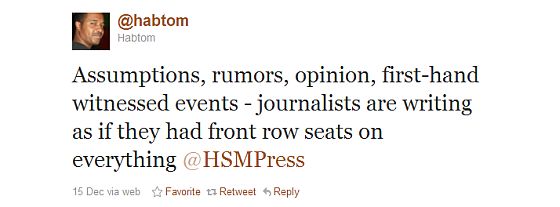
Assumptions, rumors, opinion, first-hand witnessed events - journalists are writing as if they had front row seats on everything @HSMPress
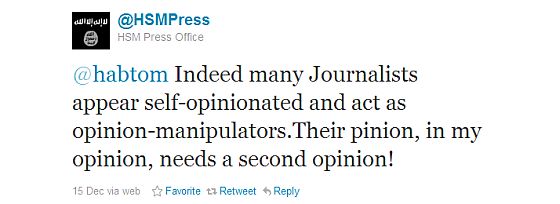
@habtom Indeed many Journalists appear self-opinionated and act as opinion-manipulators.Their pinion, in my opinion, needs a second opinion!
Somalia is not the only front in the new war on Twitter.

The Washington Post reports on Twitter battles in Afghanistan:

U.S. military officials assigned to the International Security Assistance Force, or ISAF, as the coalition is known, took the first shot in what has become a near-daily battle waged with broadsides that must be kept to 140 characters.

“How much longer will terrorists put innocent Afghans in harm’s way,” @isafmedia demanded of the Taliban spokesman on the second day of the embassy attack, in which militants lobbed rockets and sprayed gunfire from a building under construction.

“I dnt knw. U hve bn pttng thm n ‘harm’s way’ fr da pst 10 yrs. Razd whole vilgs n mrkts. n stil hv da nrve to tlk bout ‘harm’s way,’ ” responded Abdulqahar Balkhi, one of the Taliban’s Twitter warriors, who uses the handle ­@ABalkhi….

U.S. military officials say the dramatic assault on the diplomatic compound convinced them that they needed to seize the propaganda initiative — and that in Twitter, they had a tool at hand that could shape the narrative much more quickly than news releases or responses to individual queries.

“That was the day ISAF turned the page from being passive,” said Navy Lt. Cmdr. Brian Badura, a military spokesman, explaining how @isafmedia evolved after the attack. “It used to be a tool to regurgitate the company line. We’ve turned it into what it can be.”

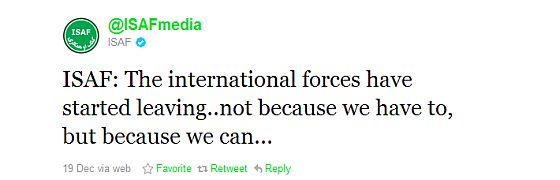
So how’s @isafmedia exploiting the power of Twitter? With tweets like this?

A we’re-winning-the-war tweet like this might sound good inside ISAF’s Twitter Command Center, but I don’t think it’s going to impress anyone else.

The problem the Obama administration is up against is not the threat posed by its adversaries on Twitter; it is that its own ventures into social media are predictably inept. Official tweets lack wit and tend to sound like the clumsy propaganda. But when losing an argument, the solution is not to look for ways to gag your opponent — that’s how dictators operate.

The Pentagon prides itself on its smart bombs. Can’t it come up with a few smart tweets?

Facebooktwittermail

Who cares about Israel?

There are two things that vex most American in equal degrees: the rise of anti-Semitism and the fate of Israel.

These two issues preoccupy ordinary people across this country in the same way — which is to say, very little.

Why would they? Jews are not a persecuted minority here — they seem to be doing fine. And Israel shares a common attribute with the rest of the world: it is not America.

Even during the best of times, the interests of Americans tend not to stray too far or long outside these borders. Most of the rest of the world is after all an ocean away.

And during these economically troubled times, that inward focus here has become even more entrenched, surpassing that in just about any other country.

In a recent Ipsos survey, 89 percent of Americans polled agreed that this country needs to focus less on the world, and more at home. Support for this sentiment was higher in the U.S. than in any of the other 23 countries surveyed.

Why then is it that the contestants for the GOP presidential primary nomination often seem like they are running for election to the Knesset?

There are competing theories.

Since 2008, Jewish support for Barack Obama has eroded and in swing states like Florida, a small shift in favor of the Republicans could be decisive. So the hunt is on for stray Jewish votes. But is that a hunt that should figure so prominently at a national level?

And then there’s a statistic Charles Krauthammer plucked — as far as I can tell — out of thin air: “98 percent of pro-Israeli Americans are gentile.”

Maybe he’s right — though a more interesting number is 41 percent. That’s the size of the minority of Americans of any faith who regard Israel as an ally of the United States.

Krauthammer’s point seems to be that Republican candidates have as much if not more interest in winning the Christian Zionist vote than in looking for support from the heavily Democratic Jewish community.

But there’s another factor here, a covert reason that American politicians of all political stripes see rewards in trumpeting their affection for the Jewish state — it is what might be called the 9/11 dividend.

Benjamin Netanyahu recognized the value of the 9/11 attacks when within hours of them taking place he said they were a “good thing” and they would “strengthen the bond between our two peoples, because we’ve experienced terror over so many decades, but the United States has now experienced a massive hemorrhaging of terror.”

In other words, Israel would in the minds of many Americans come to signify the antithesis of the Islamic threat. Support for Israel would become a coded way of expressing fear of Muslims and their religion.

Political correctness — which mostly serves as a finishing school for bigots — dictates that overt Islamophobia is reserved for those on the rabid right, like Pamela Geller, who have no shame in expressing bald hostility. But for those who harbor their fears more discreetly, the nemesis can be placed in the shadow of their declared affection.

To say how much one cares about Israel, says much more about how one views its neighbors. All this is about is cultivating solidarity and accumulating political capital through the promotion of fear.

Facebooktwittermail

When the dying wish they were already dead

Christopher Hitchens died last night.

The strange thing about death — especially the death of a public figure — is that it evokes in most onlookers the desire to revisit a life rather than view its conclusion.

Hitchens’ obituaries will perpetuate this death-denying ritual, but thankfully he offered his readers an opportunity to bravely look at a future from which most of us would rather turn away.

Having in recent years watched the wretched process of my mother’s death at a ripe 87 along with that of my brother-in-law with cancer at 48, I asked my doctor whether in his experience dying is usually so grim. His response: it depends what you believe. His claim (and arguably this may have been nothing more than his own belief) was that those with faith can die peacefully. Maybe.

What seems clear nevertheless, is that the “gift” of modern medicine has been too often to make slow-motion something that mercifully would be far more swift.

In his final piece for Vanity Fair, Hitchens relates his own experience to that of another famous atheist and explains why he no longer believes that whatever doesn’t kill you will make you stronger.

The late Professor Sidney Hook was a famous materialist and pragmatist, who wrote sophisticated treatises that synthesized the work of John Dewey and Karl Marx. He too was an unrelenting atheist. Toward the end of his long life he became seriously ill and began to reflect on the paradox that — based as he was in the medical mecca of Stanford, California — he was able to avail himself of a historically unprecedented level of care, while at the same time being exposed to a degree of suffering that previous generations might not have been able to afford. Reasoning on this after one especially horrible experience from which he had eventually recovered, he decided that he would after all rather have died:

I lay at the point of death. A congestive heart failure was treated for diagnostic purposes by an angiogram that triggered a stroke. Violent and painful hiccups, uninterrupted for several days and nights, prevented the ingestion of food. My left side and one of my vocal cords became paralyzed. Some form of pleurisy set in, and I felt I was drowning in a sea of slime. In one of my lucid intervals during those days of agony, I asked my physician to discontinue all life-supporting services or show me how to do it.

The physician denied this plea, rather loftily assuring Hook that “someday I would appreciate the unwisdom of my request.” But the stoic philosopher, from the vantage point of continued life, still insisted that he wished he had been permitted to expire. He gave three reasons. Another agonizing stroke could hit him, forcing him to suffer it all over again. His family was being put through a hellish experience. Medical resources were being pointlessly expended. In the course of his essay, he used a potent phrase to describe the position of others who suffer like this, referring to them as lying on “mattress graves.”

If being restored to life doesn’t count as something that doesn’t kill you, then what does? And yet there seems no meaningful sense in which it made Sidney Hook “stronger.” Indeed, if anything, it seems to have concentrated his attention on the way in which each debilitation builds on its predecessor and becomes one cumulative misery with only one possible outcome. After all, if it were otherwise, then each attack, each stroke, each vile hiccup, each slime assault, would collectively build one up and strengthen resistance. And this is plainly absurd. So we are left with something quite unusual in the annals of unsentimental approaches to extinction: not the wish to die with dignity but the desire to have died.

Facebooktwittermail

Hezbollah and the U.S. government — tangled ties to drug cartels

Make of this tangled web, what you will. All I can say is that the key words — ties and links — don’t have a lot of substance.

Lebanon is a small country inside which Hezbollah is the most powerful political organization. To identify a person or a business in Lebanon as having ties to Hezbollah doesn’t say a great deal.

A New York Times report alleges that an investigation of the books of the Lebanese Canadian Bank (LCB) “offer evidence of an intricate global money-laundering apparatus that, with the bank as its hub, appeared to let Hezbollah move huge sums of money into the legitimate financial system, despite sanctions aimed at cutting off its economic lifeblood.”

(The LCB was recently acquired by the Lebanese subsidiary of the major European bank, Societe Generale, which itself happens to have been the largest beneficiary of the U.S. government’s bailout of AIG, receiving $16.5 billion — but that’s a whole other banking story!)

The report says:

While law enforcement agencies around the world have long believed that Hezbollah is a passive beneficiary of contributions from loyalists abroad involved in drug trafficking and a grab bag of other criminal enterprises, intelligence from several countries points to the direct involvement of high-level Hezbollah officials in the South American cocaine trade.

One agent involved in the investigation compared Hezbollah to the Mafia, saying, “They operate like the Gambinos on steroids.”

But once the report goes into details, the substance of the ties to Hezbollah amounts to facts like these: one individual involved turns out to be “a relative of a former Hezbollah commander”; Shiite businessmen, “many of them known Hezbollah supporters,” are involved; and Ayman Joumaa, a Sunni Lebanese hotel owner at the center of the scheme possessed cell phones that “linked him to Shiites in Hezbollah strongholds in southern Lebanon.”

The evidence of the laundering scheme may be strong but the ties to Hezbollah seem a bit sketchy. Moreover, the desire of U.S. officials to tar the Shiite movement is quite explicit.

As the case traveled up the administration’s chain of command beginning in the fall of 2010, some officials proposed leaving the Hezbollah link unsaid. They argued that simply blacklisting the bank would disrupt the network while insulating the United States from suspicions of playing politics, especially amid American alarm about ebbing influence in the Middle East. But the prevailing view was that the case offered what one official called “a great opportunity to dirty up Hezbollah” by pointing out the hypocrisy of the “Party of God” profiting from criminal activity.

If Hezbollah is worried about protecting its reputation, it probably has less to fear from the U.S. government than it does from reactions to its response to the uprising in Syria.

Larbi Sadiki writes:

Faced with the Syrian people’s uprising against President Bashar al-Assad and a democratic tsunami sweeping the Middle East, Hezbollah’s alignment with Mr. Assad is destroying its reputation across the Arab world.

The Syrian masses who once worshiped the Hezbollah leader Hassan Nasrallah today curse him when they parade in public squares. The posters of Mr. Assad and Mr. Nasrallah that once adorned car windows and walls throughout Syria are now regularly torched.

Until recently, Mr. Nasrallah, a Shiite, was a pan-Arab icon. His standing as Hezbollah’s chairman and commander of the 2006 war against Israel elevated him to new heights of popularity among Shiites and Sunnis alike, reminiscent of the former Egyptian president Gamal Abdel Nasser’s political stardom following the nationalization of the Suez Canal in 1956.

Not only did Mr. Nasrallah fight Israel next door; he defied pro-American Arab states, trained and protected Hamas in Lebanon, backed Moktada al-Sadr’s Shiite militia as it killed Americans in Iraq, and showed absolute loyalty to Iran. His fans were in the millions. The Arab multitude from Casablanca to Mecca saw him as a genuine hero who talked the talk and fought the good fight.

But when such a wildly popular resistance movement abandons the ideal, much less the practice, of liberation in support of tyranny, it loses credibility with the public.

Fighting Israel as a Syrian proxy is one thing, but opposing the Syrian people’s desire for democratic change is something else entirely.

The Assads are mortals who are today burdened by a moribund political system. Mr. Assad, his brother Maher and their henchmen have managed to trap themselves in a macabre machine of oppression that has left the stench of death in its wake, from Homs to Hama.

Now, Mr. Nasrallah has reason to worry. In one speech, he defensively denied that his troops partake in repressing Syrian protesters. In another, he ignored the Syrian uprising altogether.

Syrians, in Mr. Nasrallah’s eyes, apparently, do not deserve democracy because that would mean the downfall of Hezbollah’s patron in Damascus, not to mention the destruction of the “axis of resistance” that reaches from southern Beirut to Syria and Iran.

Hezbollah’s fellow “resistance” movement, Hamas, has been more politically savvy. It has adapted to the new political landscape, navigating the uncharted territory of the Syrian uprising by impressing onlookers by what it didn’t do and say rather than what it did or said.

Thanassis Cambanis points out that in spite of the criticisms it currently faces, Hezbollah remains a strong force.

[It] boasts the most formidable militia in the Arab world and commands the undivided loyalty of its core supporters, even if the casual fans are drifting away. For the time being, the movement also can count on Iran’s funding, which is critical for them. Even in the year of the Arab uprisings, Nasrallah scored as the most popular Arab leader on the Annual Arab Public Opinion Survey [PDF] (although some non-Arabs did better; Nasrallah was tied with Iranian President Mahmoud Ahmedinejad and behind Turkey’s leader Recep Tayyip Erdogan).

So Hezbollah is unlikely in the short term to diminish as a player.

And Hezbollah’s unmasking of CIA agents in Lebanon serves as a stark reminder that the Party of God is a force with real tools in its arsenal, not just a rhetorically gifted leader who plays well on television. This week, Al Manar aired the name of a man it claims is the current CIA station chief in Beirut; the agency has replaced top officers in Pakistan twice in the last two years when their names were published.

However dim Hezbollah’s long-term prospects, it will remain a critical player in the short term. And if history is any indicator, it might just find a way to emerge from a self-induced crisis that threatens to consign it to irrelevance — once again — even stronger.

Meanwhile, when it comes to investigating ties to the Mexican drug cartels, the operations of the investigators themselves seem to warrant as much scrutiny as the subjects of their investigations.

Earlier this month, the New York Times reported:

Undercover American narcotics agents have laundered or smuggled millions of dollars in drug proceeds as part of Washington’s expanding role in Mexico’s fight against drug cartels, according to current and former federal law enforcement officials.

The agents, primarily with the Drug Enforcement Administration, have handled shipments of hundreds of thousands of dollars in illegal cash across borders, those officials said, to identify how criminal organizations move their money, where they keep their assets and, most important, who their leaders are.

They said agents had deposited the drug proceeds in accounts designated by traffickers, or in shell accounts set up by agents.

The officials said that while the D.E.A. conducted such operations in other countries, it began doing so in Mexico only in the past few years. The high-risk activities raise delicate questions about the agency’s effectiveness in bringing down drug kingpins, underscore diplomatic concerns about Mexican sovereignty, and blur the line between surveillance and facilitating crime. As it launders drug money, the agency often allows cartels to continue their operations over months or even years before making seizures or arrests.

Agency officials declined to publicly discuss details of their work, citing concerns about compromising their investigations. But Michael S. Vigil, a former senior agency official who is currently working for a private contracting company called Mission Essential Personnel, said, “We tried to make sure there was always close supervision of these operations so that we were accomplishing our objectives, and agents weren’t laundering money for the sake of laundering money.”

Another former agency official, who asked not to be identified speaking publicly about delicate operations, said, “My rule was that if we are going to launder money, we better show results. Otherwise, the D.E.A. could wind up being the largest money launderer in the business, and that money results in violence and deaths.”

Those are precisely the kinds of concerns members of Congress have raised about a gun-smuggling operation known as Fast and Furious, in which agents of the Bureau of Alcohol, Tobacco, Firearms and Explosives allowed people suspected of being low-level smugglers to buy and transport guns across the border in the hope that they would lead to higher-level operatives working for Mexican cartels. After the agency lost track of hundreds of weapons, some later turned up in Mexico; two were found on the United States side of the border where an American Border Patrol agent had been shot to death.

So, the DEA is laundering cartel money and the ATF is providing them with guns. What next? Drug kingpins on the CIA payroll? Oh, I guess that’s just old news.

The CIA — which seems to have been down on its luck recently with officers exposed in Beirut, operatives arrested in Iran and a stealth drone captured by Iran’s Revolutionary Guard — does indeed show up in the Times Lebanon story.

The trail began with a man known as Taliban, overheard on Colombian wiretaps of a Medellín cartel, La Oficina de Envigado. Actually, he was a Lebanese transplant, Chekri Mahmoud Harb, and in June 2007, he met in Bogotá with an undercover agent for the Drug Enforcement Administration and sketched out his route.

Cocaine was shipped by sea to Port Aqaba, Jordan, then smuggled into Syria. After Mr. Harb bragged that he could deliver 950 kilos into Lebanon within hours, the undercover agent casually remarked that he must have Hezbollah connections. Mr. Harb smiled and nodded, the agent reported.

A nod and a smile? This is the kind of detail that’s good for a new report, but it would hardly have any value in a trial. But then again, since this is a case that probably won’t ever reach trial, the political value of the indictment seems to figure more prominently than any likely legal outcome.

(Jordanian officials, after extensive surveillance, later told the D.E.A. that the Syrian leg of the shipment was coordinated by a Syrian intelligence officer assigned as a liaison to Hezbollah. From there, multiple sources reported, Hezbollah operatives charged a tax to guarantee shipments into Lebanon.)

Soon the cartel was giving the agent money to launder: $20 million in all. But before Mr. Harb could reveal the entire scheme and identify his Hezbollah contacts, the operation broke down: The C.I.A., initially skeptical of a Hezbollah link, now wanted in on the case. On the eve of a planned meeting in Jordan, it forced the undercover agent to postpone. His quarry spooked. In the end, Mr. Harb was convicted on federal drug trafficking and money-laundering charges, but the window into the organization’s heart had slammed shut.

Lastly, for a story in which Hezbollah figures so prominently, here’s perhaps the most curious detail about the legal case around which the story revolves: the indictment unveiled by the U.S. Attorney in the Eastern District of Virginia on Tuesday does not mention Hezbollah.

Facebooktwittermail

New evidence that Iran hijacked U.S. stealth drone — updated

Updated: I guess the egg’s on my face this time. Turns out the video the Iranians broadcast (see below) is not an RQ-170 — it’s a Lockheed Polecat on a test flight. (Thanks goes to reader “blowback” for pointing this out.)

As the story about Iran’s capture of an RQ-170 stealth drone continues to unfold, it is the credibility of American officials that keeps on getting shredded.

Here’s the latest from the Associated Press:

Officers in the Revolutionary Guard, Iran’s most powerful military force, have claimed the country’s armed forces brought down the surveillance aircraft with an electronic ambush, causing minimum damage to the drone.

American officials have said that U.S. intelligence assessments indicate that Iran neither shot the drone down, nor used electronic or cybertechnology to force it from the sky. They contend the drone malfunctioned.

Is this how a malfunctioning drone makes a perfect landing on an Iranian airstrip?

President Obama says the U.S. has asked for its drone back. But Iran has no intention of returning it and claims to be in the final stages of extracting data from it according to one lawmaker.

The Washington Post reports:

Parviz Sorouri, a key member of the parliament’s national security and foreign policy committee, told Iranian state television that the extracted information would be used to file a lawsuit against the United States over the “invasion” by the unmanned aircraft.

He asserted that Iran would “soon” start to reproduce the drone after a nearly finished process of reverse engineering was completed. “In the near future, we will be able to mass produce it. . . . Iranian engineers will soon build an aircraft superior to the American [drone] using reverse engineering,” he was quoted as saying.

Sorouri also said the country’s armed forces would soon conduct an exercise on closing the Strait of Hormuz, the narrow waterway between the Gulf of Oman and the oil-rich Persian Gulf.

Noting the strategic importance of the strait, Sorouri said, “We will hold a military maneuver on how to close the Strait of Hormuz soon,” the Iranian Students’ News Agency reported. “If the world wants to make the region insecure, we will make the world insecure.”

Facebooktwittermail

Gingrich favors rapid expansion of Israeli settlements in the West Bank — calls Palestinians ‘terrorists’

Having stirred outrage by calling Palestinians an “invented people,” in last night’s GOP presidential debate New Gingrich went even further by saying, “these people are terrorists.”

I guess if he becomes president, at least the United States will have to abandon the pretense that it has any role as a mediator between Israelis and Palestinians.

In a conference call organized by the National Council of Young Israel and broadcast on The Yeshiva World News on Friday, Gingrich took a question from Mort Klein, president of the Zionist Organization of America.

Klein is more forthright than some of Gingrich’s other Zionist friends might be — he unequivocally opposes a two-state solution.

Last year he said: “As much as we all want Israel to have peace with the Arabs, Israel can and will survive and thrive without it — as they have since 1948.”

Israel doesn’t need peace — this is the conviction that explains the Israeli intransigence that long ago turned the so-called peace process into a charade.

What those who don’t believe in peace do believe in, is the need for the United States to ensure that Israel maintains its “qualitative military edge” — a commitment that the Obama administration has supported even more strongly than its predecessors.

A nuclear-armed Iran would undermine Israel’s military hegemony in the Middle East and so many of Israel’s supporters are willing to back another war — usually on the pretext that it would prevent a second holocaust — rather than tolerate a significant shift in the regional balance of power.

In spite of the hysterical campaign propaganda that some American politicians are now using, “[f]ew in Netanyahu’s inner circle believe that Iran has any short-term plans to drop a nuclear weapon on Tel Aviv, should it find a means to deliver it,” according to Netanyahu confidant, Jeffery Goldberg.

Klein’s question for Gingrich was on the expansion of settlements, but the strategic perspective they share is that Israel can continue to exist and prosper in a permanent state of war. From that perspective, the two most important features of the relationship between Israel and the United States are that the U.S. continues to maintain a steady flow of military aid and it remains willing to engage in wars that Israel cannot fight alone. It comes down to blood and money.

Note too that a necessary condition that helps ensure that Americans will acquiesce in fulfilling this need is that we must also share the Zionist faith in the sustainability of permanent war.

The unshakable bond that unites Israel and the United States — a bond that in American politics has become an object of cultish devotion — is an absolute faith in war. Perhaps the only thing that will be able to shake that faith will be economic ruin.

Klein: What is your position about the right of Jews to live in Judea and Samaria [the West Bank] and the right of Jews to live in communities there at this present time?

Gingrich: Well, it depends on where exactly you define the boundaries. I do not oppose any development in the [Israeli occupied] areas, because I think that’s part of the negotiating process. To the degree that the Palestinians want to stop the developments they need to reach a deal in which they recognize the right of Israel to exist… As long as they are waging war on Israel, they are in no position to complain about developments. I think the whole peace process has been absurd and has created a psychologically almost impossible position for the average person because once you say there’s a peace process you wonder why the Israelis aren’t being more forthcoming. But if you say, look, we’re still in the middle of a war. They’re still trying to destroy the country — they’re still firing rockets, they still have terrorists coming in — then you all of a sudden understand what the real situation on the ground is, and in that setting, why would the Israelis slow down in maximizing their net bargaining advantage?

In other words, settlement expansion is a bargaining tool and thus the more Israelis there are living in the West Bank, the better Israel’s negotiating position.

As a Palestinian negotiator once said, this is like trying to divide a pizza with someone who is intent on eating the whole pie before it gets divided.

The Washington Post reports on responses to Gingrich’s claim that the Palestinians are an “invented people”:

Michigan Sen. Carl Levin sharply criticized Gingrich’s comments as cynical attempts to curry support with Jewish voters and unhelpful to the peace process.

“The vast majority of American Jews (including this one) and the Israeli Government itself are committed to a two-state solution in which Israelis and Palestinians live side-by-side as neighbors and in peace,” Levin said in a statement. “Gingrich offered no solutions — just a can of gasoline and a match.”

Reuters reports:

[Hanan] Ashrawi, a member of the Palestine Liberation Organisation Executive Committee, said Gingrich’s remarks harked back to days when the Palestinians’ existence as a people was denied by Israelis such as Golda Meir, prime minister from 1969 to 1974.

“It is certainly regressive,” she said. “This is certainly an invitation to further conflict rather than any contribution to peace.”

“This proves that in the hysterical atmosphere of American elections, people lose all touch with reality and make not just irresponsible and dangerous statements, but also very racist comments that betray not just their own ignorance but an unforgivable bias,” she said.

Fawzi Barhoum, a Hamas spokesman in Gaza, said the Gingrich remarks “were grave comments that represented an incitement for ethnic cleansing against the Palestinians.”

Facebooktwittermail

Who are they kidding? When Americans struggle to close the plausibility gap with Iran

After Iranian television broadcast film of a captured CIA RQ-170 stealth drone that landed in Iran a few days ago, the BBC’s security correspondent, Frank Gardner, wrote:

If, as was originally thought, the Sentinel had been shot down then there would have been little to put on display but a pile of twisted wreckage.

Instead, what was on show on Iranian TV was an immaculate gleaming white drone that looked straight off the production line.

Which tends to back up the claim by Iran that its forces brought down the drone through electronic warfare, in other words that it electronically hijacked the plane and steered it to the ground.

On Thursday, the Commander of Iran’s Islamic Revolutionary Guards Corps (IRGC) Aerospace Force Brig-Gen Amir Ali Hajizadeh said “through precise electronic monitoring it was known that this plane had the objective of penetrating the country’s skies for espionage purposes.

“After entering the country’s eastern space the plane was caught in an electronic ambush by the armed forces and it was brought down on the land with minimum damage.”

U.S. officials are now willing to concede what they must have known from day one: that the aircraft Iran captured is indeed an RQ-170.

But even after the release of close-up footage showing the drone in greater detail than it has ever been publicly viewed before, some U.S. officials remained skeptical.

ABC News’ Martha Raddatz reported:

Early Thursday, U.S. officials said, and ABC News reported, that the craft displayed did not appear to be the highly sensitive RQ-170 Sentinel and might be a model, in part because U.S. imagery indicated the Sentinel had not landed intact. Later, however, officials said it was possible that the Iranians had reconstructed the drone for display on television, but that the evidence was “inconclusive.”

An unnamed former senior Pentagon official “with extensive knowledge of unmanned aerial vehicles” also voiced skepticism to an AOL defense blogger:

Here’s what he said in an email after I sent a link to the Iranian footage. “Looks like a fake,” he wrote. “Does not look like the condition of an aircraft that lost control. Also wrong color, and they are not showing the landing gear or bottom of the aircraft… and the welds on the wing joints are hardly stealthy…” In order to avoid setting off radar, welds on stealthy aircraft must be very close to the surface of the structure and extremely smooth.

In both instances we get the same line of reasoning: those images of a captured RQ-170 can’t depict the real aircraft because we know the real one crashed and what we are being shown is intact.

That might sound plausible to a few people — especially those willing to believe anything a US government official says. But for the rest of us (and I’m inclined to think we’re in the majority), the reasoning is more likely to run like this: that thing doesn’t look like a model and it clearly didn’t crash, so any U.S. official who says that the lost RQ-170 crashed, either doesn’t know what he’s talking about, or he’s lying.

Most people will remain appropriately agnostic about the technical question of whether it would be feasible for an adversary to intercept and take control of such an aircraft.

As far as the issue of the weld joints on the wings go, it’s reasonable to make a couple of inferences.

Firstly, having recovered the aircraft, the first priority of the Iranians would have been to examine it thoroughly enough to make sure it wouldn’t self-destruct. The wings may well have been removed for that purpose and then later re-attached for public display.

Secondly, the Iranians clearly had an interest in giving U.S. officials and analysts plenty of time to make statements that could later be shown to be false. Given the difficulty that officials and experts have in uttering these simple words — I don’t know — it was predictable that the longer the Iranians kept quiet, the more often an American would say something stupid.

Loren Thompson at the Lexington Institute initially argued that the drone could be of no value to Iran because it was a “pile of wreckage.” He still insists, “whatever the insights that Iranians may glean from the RQ-170 Sentinel, the value of applying that knowledge in their ongoing war with America is likely to be modest.”

Others are less sanguine in their assessment.

Peter Singer of the Brookings Institution, author of “Wired for War: The Robotics Revolution and Conflict in the 21st Century,” said that while some of the mechanics of the aircraft are well known, some aspects — especially its sensors — would be important to countries like China.

“This is the jewel for them now,” Singer said. “It depends on what was on the plane on this mission, but one sensor it has carried in the past is an AESA radar. This is a very advanced radar that really is a difference maker for our next generation of planes, not just drones, but also manned ones like F-22s and F-35s.”

Maybe Iran won’t learn enough to clone drones for spying on America. But that’s irrelevant, firstly because the primary interest they have is in learning how to defend themselves from the U.S., and secondly, at a time when the U.S. is known to have been operating a fleet of RQ-170s over Iran for years and is suspected of involvement in a series of bombings, assassinations and acts of sabotage targeting Iran’s nuclear program, the evidence of an ongoing war is one being conducted by the United States (and Israel) against Iran — not the other way around.

What surprisingly few Americans still seem able to grasp is that countries like Iran, however malevolent their leadership might be, are much more preoccupied about defending themselves from the most heavily armed and aggressive nation on the planet, than they are in hatching plans to take over the world.

The more often Iran gets called the enemy of America, the more stupid we become.

Facebooktwittermail

Iran shows off captured RQ-170 Sentinel drone

After it became known a few days ago that Iran had captured a CIA RQ-170 surveillance drone, this was the assessment of one of Washington’s most frequently quoted defense technology experts:

Loren Thompson

“[W]hat the Iranians have is a pile of wreckage — many small and damaged pieces from which they could glean little in the way of technological insights,” said Loren Thompson, defense policy analyst for the Lexington Institute in Arlington, Virginia, earlier this week.

Even now that Iran has released video of the captured drone, the Los Angeles Times isn’t ready to assert that it’s the real thing. “Iran shows off alleged captured U.S. drone,” (my emphasis) says their headline.

Alleged? I think it’s already fair to assume that this is the real thing — and we’re getting a much closer view of it than the CIA ever wished.

U.S. officials (and journalists dutifully repeating what they have been told) have insisted that this unmanned aircraft “crashed”.

All I can say is this: however this thing came down it had a pretty soft landing. It doesn’t look like it was shot down — as Iran originally claimed. But neither does it look like it completely lost control.

Did it gently glide down onto the perfectly smooth surface of a conveniently located dry salt lake? Maybe. Or — even though all the experts insist this is highly improbable — did the Iranians somehow manage to conduct a remote hijacking?

Facebooktwittermail