Author Archives: Paul Woodward

Why it’s so difficult to be appalled — about anything

At Commentary (this may be the one and only time I link there), Jonathan Tubin writes:

In the immediate aftermath of the news about the appalling statements of Howard Gutman, the U.S. ambassador to Belgium, about Israel being to blame for anti-Semitism, there were those who assumed the envoy would soon be packing his bags for home. But a statement issued today by the State Department indicates that Gutman, who purchased his post by bundling more than half a million dollars in campaign contributions for President Obama, has nothing to worry about. State Department spokesman Mark Toner said Monday Gutman would remain in his post and asserted that although Gutman’s appearance was in his official capacity, the views he expressed were his own. He also declined to say if the administration disagreed with those views.

To grip the meaning of many a commonplace word, it’s often useful to look at its etymology.

The political arena is filled with people who say they are appalled about this and that and nothing generates appall more swiftly than a hint of antisemitism.

But did anyone faint yet? Because that’s what it means — to be appalled is to grow pale as one is about to faint.

Maybe at the next GOP presidential debate the moderator should be ready to pass around the sniffing salts just in case the name Gutman comes up and several of the candidates start to keel over.

The immediate audience that heard Gutman’s remarks in Belgium was apparently made of sterner stuff. None of them fainted but Ynet reports they were stunned.

The conference was attended by Jewish lawyers from across Europe. The legal experts at the event were visibly stunned by Gutman’s words, and the next speaker offered a scathing rebuttal to the envoy’s remarks.

“The modern Anti-Semite formally condemns Anti-Semitism and the Holocaust and expresses upmost sympathy with the Jewish people. He simply has created a new species, the “Anti-Zionist” or – even more sophisticated – the so-called ‘Israel critic,’” Germany attorney Nathan Gelbart said.

“The ‘Israel critic’ will never state ‘Jews go home’ but is questioning the legality of the incorporation of the State of Israel and therefore the right for the Jewish people to settle in their homeland. He will not say the Jews are the evil of the world but claim that the State of Israel is a major cause for instability and war in the region,” he said. “There is no other country, no other people on this planet the ‘Israel critic’ would dedicate so much time and devotion as to the case of Israel.”

“For no other country he would criticize or ask to boycott its goods or academics. And this for one simple reason: Because Israel is the state of the Jewish people, not more and not less,” Gelbart said.

I imagine a lot of people coming to this site would perceive me as an “Israel critic”, but apparently no such thing really exists. Israel critics, Gelbart and others insist, are really secret Jew haters.

If Gelbart is right and Israel provides the last remaining pretext for the perpetuation of antisemitism, then rational antisemites should really be defending Israel because if the hatred that dare not speak its name could not channel itself through animosity towards Israel, where would it be able to turn? I guess hatred by its nature is always irrational.

Of course there are quite a few thoroughly rational antisemites who say Israel is the only place on the planet in which Jews should live. What’s confusing to the rest of us is that this group of antisemites rarely get tarred with that name. Instead, they’re usually referred to as Zionists.

But returning to the ‘Israel critic’ for whom this identity is nothing more than a convenient disguise, are we to infer that Israel cannot in fact have any genuine critics and thus infer from that that any criticism of Israel is baseless?

Oh no! Israel’s defenders loudly protest. It’s OK to criticize Israel, but…

Really? Tell me the ways, because from those who claim it’s OK to criticize Israel I don’t actually hear any criticism of Israel. I hear the defense of a victimized little nation that has no other interest than to mind its own business; a victimized people who desire nothing more than to live at peace with their neighbors. I hear the tireless promotion of a model democracy with the most moral army in the world.

The nakba? How dare you use that word! Gaza under siege — no such thing. A whole population living under military rule — we just want peace.

Forever the return to the perfectly armored defense: they do not criticize us because of what we do; they attack us because of who we are.

And anyone convinced of that will forever remain deaf to their critics.

Facebooktwittermail

While Iran dismantles a prize stealth drone, Lockheed’s PR consultants cover up the damage

Lockheed Martin RQ-170 Sentinel spy drone

It’s always strange when the main thrust of a news story is the message that it really isn’t news. It’s as though the business of journalism is in part a form of mind control — identifying the things which we shouldn’t trouble ourselves to think about.

As soon as Iran proudly announced that they had captured a Lockheed RQ-170 Sentinel stealth drone that had flown from Afghanistan, a stream of reports followed about how this will be of little consequence. An unfortunate mishap. Once in a while the US loses a drone. What to do. Let’s just move on because there’s nothing worth paying attention to here.

“I don’t think this is a dagger pointed at the heart of democracy,” said Loren Thompson, defense policy analyst for the Lexington Institute in Arlington, Va. “A lot of information about this aircraft was already known by foreign military intelligence officials.”

Harper’s Ken Silverstein has called the Lexington Institute the “defense industry’s pay-to-play ad agency” so I guess Thompson’s statement to the Los Angeles Times is predictably reassuring — at least it might serve as little bit of damage control as Lockheed Martin and the Pentagon try to account for the RQ-170’s loss.

Apparently the drone should have had a fail-safe mechanism that would have enabled it to return home or self-destruct.

The most likely reason that the Sentinel didn’t self-destruct or safely return is that it was lost because of an onboard mechanical malfunction, said Thompson…

“That means what the Iranians have is a pile of wreckage — many small and damaged pieces from which they could glean little in the way of technological insights,” he said.

The question is: why is the Los Angeles Times even quoting Thompson when they have also spoken to a U.S. official with access to intelligence who says that Iran recovered the drone largely intact?

“It’s bad — they’ll have everything” in terms of the secret technology in the aircraft, the official said. “And the Chinese or the Russians will have it too.”

That sounds like the real story — or at least a major part of it.

So why fill the reporting with chaff pumped out by an expert like Thompson — who also just happens to work as a paid consultant for Lockheed Martin?

Facebooktwittermail

Nothing’s free

On the internet, “free” means someone else paid.

We live in economically challenging times and if like me you live close to or the wrong side of the poverty line, then I’m happy I can provide this service without charge. But if you can afford to eat in restaurants, take vacations, or buy the latest electronic gadgets, then please consider supporting this site.

You see the ads in the right sidebar? The revenue they bring in wouldn’t even pay for my breakfast. But consider this: if I was earning a very modest wage for the time I’ve devoted to running this site, I’d now be a quarter of a million dollars better off. Am I crazy? Maybe, but dangerous times push people in unusual directions. My choice when I started doing this in 2002 was to step out of the defense intelligence industry and put my time to better use.

War in Context, from its inception, has been an effort to apply critical intelligence in an arena where political judgment has repeatedly been twisted by blind emotions. It presupposes that a world out of balance will inevitably be a world in conflict.

If you value my work and can afford to help keep this operation going, please click the button below to make a secure payment through Paypal. Thank you for your support, Paul Woodward.

Facebooktwittermail

‘Israel could lose American Jewry’

The Israeli press is sloppy in all sorts of ways. The headline above comes a Ynet article by Yitzhak Benhorin in Washington. It could be a direct quote from The Atlantic‘s Jeffrey Goldberg and much of the content of the article could be drawn from recent conversation with Goldberg — the article doesn’t make this clear.

Benhorin bases much of his report on recent posts by Goldberg on the controversial Israeli government campaign appealing to Israelis to return home from the US, but some of the statements attributed to the influential columnist do not seem to be taken from his blog, specifically the following:

Goldberg believes that American Jews are trying to understand Israeli far more than Israelis try to understand them. He states that the average American Jew reads that women in Jerusalem sit on the back of the bus and thinks to himself that he has no connection whatsoever with this country.

He adds that young Israelis from Tel Aviv probably feel the same when they read that the right wing is making alliances with Evangelical Christians.

Goldberg notes that it is obvious that there is a rift, when 80% of American Jews are culturally politically and religion-wise like 25% of Israelis, Jews in Washington can identify with what’s happening in Tel Aviv but not Jerusalem or the settlements.

He adds that there is a large gap between most Jews in the US and most Jews in Israel; Jews in the US are becoming more universal in their outlook while Israeli Jews are becoming more and more tribal in theirs. If the trend continues, he says, American Jews will see Israel as a far off foreign country.

Goldberg also warned of the growing gulf between American Jews and their Israeli counterparts over issues related to democratic values. He said that the things happening in Israel today are like a mystery to the American Jews who scratch their heads and ask themselves what in the world is going on in Israel.

Goldberg also spoke of the recent right-wing legislation, the exclusion of women from the public domain and the harm to freedom of expression. He noted that as American Jews, they were taught that Israel is the only democracy in the Middle East and that sadly, the recent legislation causes concerns – should Israel lose its democratic values, it will lose American Jewry.

Facebooktwittermail

Iran captures ‘lost’ U.S. spy drone — the first remote hijacking?

Lockheed Martin RQ-170 Sentinel spy drone

The Los Angeles Times reports:

A drone that Iranian officials claimed to have shot down may be an unarmed U.S. reconnaissance aircraft that went missing over western Afghanistan late last week, according to U.S.-led forces in that country.

“The operators of the UAV [unmanned aerial vehicle] lost control of the aircraft and had been working to determine its status,” NATO’s International Security Assistance Force in Afghanistan said in a statement.

Iranian media reported Sunday that the country’s armed forces had shot down a U.S. drone that they said violated Iranian airspace along the eastern border. Iran borders Afghanistan and Pakistan in the east.

An Iranian military official quoted by the official Islamic Republic News Agency said the aircraft suffered minor damage and was in the possession of the armed forces. He identified the aircraft as an “RQ170” type drone and said Iranian forces were “fully ready to counter any aggression.”

When the existence of the RQ-170 first entered the public domain after it was photographed in Afghanistan, it quickly got dubbed the “Beast of Kandahar.”

As a highly classified stealth aircraft the question was: why would the US be flying a drone designed to evade radar when the Taliban have no radar? Speculation suggested that its areas of operation were more likely over Pakistan and perhaps spying on nuclear facilities in Iran.

In May this year the Washington Post reported that this aircraft had indeed been used to “fly dozens of secret missions deep into Pakistani airspace and monitor the compound where Osama bin Laden was killed.”

So how did the operators manage to lose such valuable piece of equipment last week? Someone fell asleep at the wheel? Very unlikely during such a critical intelligence operation. A technical malfunction? Maybe, but in such an event it would seem more likely that the aircraft would have crashed and been destroyed.

Another possibility is that “lost control” is another way of saying hijacked. In other words, U.S. remote pilots lost control as Iranians took control.

There maybe a connection with another drone story — this one about a drone that Israel lost.

Late last month, Richard Silverstein “revealed” that an Israeli drone brought down over Southern Lebanon by Hezbollah had been booby-trapped and later unwittingly taken to a weapons depot where it was remotely detonated. It was a story so implausible that it seemed like Israeli intelligence could only feed it to a scoop-hungry blogger since most journalists simply wouldn’t take it seriously.

If the story was indeed an Israeli fabrication then it was probably concocted in order to cover up a much more important story: that Hezbollah has managed to refine its tools of electronic warfare to a point that puts in jeopardy all of Israel’s drone missions over Lebanon.

If that was the case this would have serious consequences since it is widely assumed that in the event of an Israeli attack on Iran’s nuclear facilities, reprisal attacks on Israel from Lebanon would swiftly follow. In such a situation, Israel could not afford to have lost one of its most valuable intelligence gathering tools — the means on which it might depend to prevent missile strikes on Tel Aviv.

In other words, if Israel’s ability to defend itself from attacks from Lebanon has been significantly degraded, it might need to be a bit more cautious about threatening to attack Iran.

Israel is flying less sophisticated drones than the RQ-170, but even so, whatever skills Hezbollah has been acquiring in its counter-drone operations it has very likely been sharing with Iran’s Revolutionary Guard.

Might this provide part of the explanation about how the U.S. lost and Iran found a drone that supposedly went “missing”?

Facebooktwittermail

Why Afghans have come to hate Americans

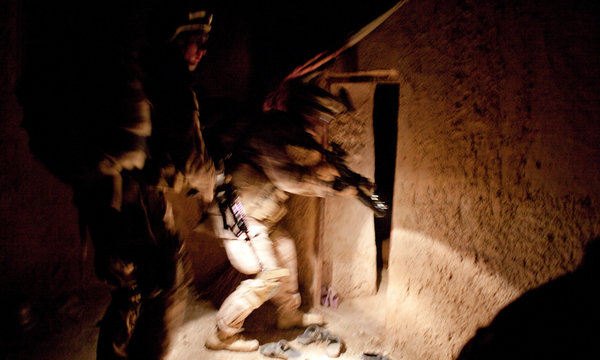
U.S. and Afghan government officials are struggling to reach a strategic long-term agreement — the sticking point is Afghan opposition to night raids which have surged under the Obama administration and now happen as often as 40 times a night.

NATO officials say they have modified how night raids are conducted in response to the Afghan government’s concerns.

“Ninety-five percent of all night operations at this stage are already partnered,” said Brig. Gen. Carsten Jacobson, the NATO spokesman in Afghanistan. “So basically the recommendation of the traditional loya jirga is already put into action.”

“It is in our combined interest that as soon as possible, Afghanization is accomplished,” he added, referring to an Afghan takeover of security responsibility.

Mr. Faizi was unimpressed by that argument. “According to reports from our officials in different provinces, the Afghan security forces are leaving with the American forces to go conduct night operations without being informed directly where they are going, which house they are searching and who is the target,” he said.

While General Jacobson said night raids averaged 10 a night now, a recent study of night raids by the Open Society Foundations, financed by George Soros, estimated that 19 a night were taking place during the first three months of 2011.

The American military is so enamored of the tactic that some generals have said that without night raids, the United States may as well go home.

General Jacobson said that 85 percent of night raids took place without a single shot fired, and that over all such operations accounted for less than one percent of all civilian casualties.

Statistics might calm the doubts of feeble-minded U.S. senators, but they will have little to no impact on the perceptions of Afghans whose homes are being violated. To live in a country where there is an ever-present risk of foreign soldiers breaking into your house in the middle of the night is to live in a state of oppression. This is the nature of occupation.

[Aimal Faizi, the spokesman for President Hamid Karzai,] said the raids were the biggest complaints that Mr. Karzai heard when visitors from the provinces met with him.

“If one of the messages of the United States is to win the hearts and minds of the Afghan people, then these night raids are totally against this,” he said. “People are becoming more and more against the international presence in Afghanistan.”

On the frontlines of southern Helmand Province, the governor of Sangin district, Mohammad Sharif, is a critic of the practice, even though his district has been the center of some of the toughest fighting of the war, with among the highest casualty rates for NATO forces. He said the Special Operations forces that carried out the raids often got the wrong people, including many pro-government people. “People are not happy, and they feel bad toward Americans,” he said.

A high-ranking official in Helmand Province saw the matter differently, although he did not want to be quoted by name endorsing night raids because of their unpopularity. “So many Taliban commanders have been killed or detained in night raids, and if it wasn’t for them, we would not have the peace we now have,” he said. “Taliban commanders are like snakes: it’s hard to catch them, and night raids are their charmers.”

He also noted that trying to arrest a Taliban commander during the day would inevitably mean a battle, which might well cause casualties among bystanders.

Mr. Faizi said the president was concerned that in many cases, Afghan families were forced to give food and shelter to insurgents, and then later were blamed for doing so and arrested. “We think that all these night raids, they bring the conflict directly to the homes of the Afghan people,” he said. “It has to be the opposite, the fight has to be fought somewhere else.”

Facebooktwittermail

Afghanistan — touch down in flight

This film is best viewed on full screen. Hit the play button and then the full-screen button on the right (between “HD” and “Vimeo”).

Afghanistan – touch down in flight from Augustin Pictures on Vimeo.

© by Lukas and Salome Augustin
All rights reserved. Published here with the filmmaker’s permission. “Feel free to watch it on Vimeo, to share on Facebook, Twitter etc. but please ask for embed permission and please don’t upload the video on Youtube or any other site. Thank you!”

Everyone lives at the center of the world.

But in a world where power and resources are so unevenly distributed, it’s easy for those of us who live in the domineering West, to place everyone and everywhere else out on the periphery.

As Americans who have for so long looked at the rest of the world through the prism of war, we rarely appreciate the people and places obscured by our imperial footprint.

Afghanistan is a country that most Americans knew nothing about before 2001 and ten years later it remains largely unknown as a country — it has become this generation’s Vietnam: a country reduced to the name of an American war.

Lukas and Salome Augustin are two young German photographers and filmmakers who have put together a stunning short portrait of the people of Afghanistan. Here we see the faces at the crossroads of Asia — a place that demographically truly is the center of the world, located as it is, in closest proximity to the whole of humanity [PDF]. And instead of images of violence and oppression, we see people peacefully attending to their lives and we see the beauty which is only revealed to those who slow down enough to appreciate it.

Facebooktwittermail

Israel’s insult to American Jews

Screenshot of the website for an Israeli government campaign encouraging expatriate Israelis to leave the US and return home.

American Jewish leaders sent a blunt message to Israel’s leaders this week: don’t bite the hand that feeds you.

Well, maybe it wasn’t quite that blunt, but it didn’t need to be since it’s well understood that an insult to the American Jewish community risks damaging ties between the United States to Israel — ties that ensure the continuation of vital military and financial support for the Jewish state.

Philip Weiss writes:

Is this the week that Israel, the longest running Jewish American TV show, “jumped the shark”? I wonder. Ruth Marcus getting vexed in the Washington Post that restrictions on women in Israel are a “national security” threat because they will alienate American Jews, on whom the country depends. Abe Foxman complaining about threats to civil liberties in the Knesset for the same reason. And now that stupid ad campaign warning Israelis in the U.S. not to marry Americans, but come back home. It disturbed Jeffrey Goldberg among others. Again because it makes their job, propagandizing, impossible.

The Netanyahu government has now cancelled the ad campaign, in embarrassment. The Washington Post rubs it in: “The Israeli government has canceled an ad campaign in which it suggested that Israeli expatriates will ‘lose their national identities’ if they marry Jewish Americans or celebrate Christmas. ”

Goldberg got the scoop, from Israeli ambassador Michael Oren, who said, “The Ministry of Immigrant Absorption’s campaign clearly did not take into account American Jewish sensibilities, and we regret any offense it caused.”

The funny thing is, even after this high level damage control, the Israeli ministry has only managed to remove one of the offending videos. Maybe the people running the campaign are still not sure what all the fuss is about. As the New York Times reports:

Some Israeli officials were mystified by the belatedness of the reaction; the campaign is a few months old. Attention increased after an item on it appeared on the Jewish Channel, a cable station, and a blog was posted this week by Jeffrey Goldberg, a writer for The Atlantic.

“The idea, communicated in these ads, that America is no place for a proper Jew, and that a Jew who is concerned about the Jewish future should live in Israel, is archaic, and also chutzpadik, if you don’t mind me resorting to the vernacular,” Mr. Goldberg said.

“The message is: Dear American Jews, thank you for lobbying for American defense aid (and what a great show you put on at the Aipac convention every year!) but, please, stay away from our sons and daughters.” Aipac stands for the American Israel Public Affairs Committee, a powerful lobby group.

On Thursday, the Jewish Federations of North America issued a memo that said: “While we recognize the motivations behind the ad campaign, we are strongly opposed to the messaging that American Jews do not understand Israel. We share the concerns many of you have expressed that this outrageous and insulting message could harm the Israel-Diaspora relationship.”

Steven Bayme, director of contemporary Jewish life at the American Jewish Committee, said that the campaign’s skepticism of Jewish life in the United States contributed to the angry reaction, particularly the message that Israelis should not marry American Jews. “We’re talking about one Jewish people, and certainly encouraging marriage within the Jewish people is something everyone would sign on to,” he said.

And who would be the “everyone” Bayme refers to?

Surveys of American Jews over the last four decades indicate that intermarriage (Jews marrying non-Jews) has steadily increased, rising from 13 percent before 1970 to about 50 percent or more currently. (The most recent National Jewish Population Survey was for 2000-01 [PDF] which measured the rate at 47 percent. It seems reasonable to assume that during the last decade the level of intermarriage has continued to increase.)

So, unless those American Jews who choose to marry non-Jews think that other Jews should be discouraged from following their example, it seems like the “everyone” Bayme is speaking for is probably just him and his fellow Jewish leaders.

Beyond this discord between Israel and the American Jewish community, there is another constituency that has reason to be insulted: the rest of us.

The Jewish need to defend the tribe seems like a given. If Jews don’t give birth to more Jews, then before long there will be no Jewish people. But take away the term “Jew” and what are we talking about here? What’s the difference between this notion of ethnic purity and perpetuation and any other?

In the mid-90s, America’s most prominent Jewish leaders issued a statement calling on American Jews to place five values at the heart of “Jewish continuity” efforts. The fourth of these is brith, which means covenant.

From the time of Abraham, Jews have seen themselves as bound to one another and to God through a covenant that distinguishes Jews from members of other peoples or faiths. This covenant serves to differentiate Jews from non-Jews and to ensure that Jews remain a people apart. American Jews, integrated into American society and full participants in its activities, are increasingly not a people apart. As boundaries blur, inclusivity runs the risk of degenerating into a vague universalism that is Jewishly incoherent; for example, non-Jews receiving aliyot. No matter how close the personal relationships between Jews and members of other faiths, Jewish continuity demands that strong, visible religious boundaries between Jews and non-Jews be maintained. Leadership roles within the Jewish community and in Jewish religious life must be reserved for those who accept the covenant — Jews alone.

America’s libertarian spirit embraces the idea that social isolation is a legitimate dimension of personal liberty. The Amish, for instance, are living the American way of life just as much as anyone else.

But just as isolation is a legitimate choice, it also incurs an inevitable price. Those who set themselves apart cannot so easily be embraced, indeed they signal that they do not want to be embraced.

Moreover, those who convey to society at large the message that they see its diversity as threat, should not be surprised if having set themselves apart, they become further isolated by being ostracized.

If most American Jews do not want to be a people apart, then it seems like it’s time Judaism came to terms with this reality. We live in a world that is too small for any tribe to put itself first or strive to set itself apart.

Facebooktwittermail

The undeclared war against Iran

Jeffrey Goldberg often sounds like he’s agitating for war on Iran, but even for impartial observers, there is as he notes, plenty of evidence that the war has already begun.

Following a (perhaps not-so-mysterious) explosion on a military base last month that took with it the life of Gen. Hassan Tehrani Moghaddam — one of the Iranian missile program’s most distinguished OGs — comes news of a second explosion in Isfahan this past Monday, which according to sources “struck the uranium enrichment facility there, despite denials by Tehran.”

Of course, accurate news out of Tehran is hard to come by, but if you want to take this a step further, one might consider Tuesday’s (perhaps not-so-spontaneous) storming of the British embassy by Iranian “students” to be quite an effective smokescreen in keeping news of this second explosion from making serious waves. If you’ve had a lot of coffee, it’s also worthy to note that on Monday evening, following the explosion in Iran, four missiles fired from southern Lebanon struck Israel–the first such incident in over two years.

I’m not entirely convinced, but it’s not unreasonable to group these recent explosions with the Stuxnet virus of last summer that haywired an uranium enrichment facility in Natanz; last October’s explosion at a Shahab missile factory; the killing of three Iranian nuclear scientists in the past two years, last November’s attempted assassination of Fereydoun Abbasi-Davan — a senior official in the nuclear program — and rumblings of a second supervirus deployed this month as proof that the West’s war on Iran’s nuclear program is getting less covert by the minute.

Greg Scoblete spells out why Washington has not and will not seek public support for this war.

If President Obama told the public that America was working with Israel to murder Iranian scientists and blow up Iranian buildings and sabotage Iranian infrastructure and that the Iranians might seek to retaliate in kind, it would implicitly cast Iranian motives as rational.

As we saw in the run up to the Iraq war, one of the key arguments advanced against Saddam Hussein is that he would do something irrational (hand over WMD to al-Qaeda) and hence couldn’t be trusted. Iranian irrationality and religious fanaticism is also a critical component in the case for taking military action against their nuclear program. A key to sustaining the aura of irrationality is to strip out any of the strategic context of Iranian actions.

This is how the Soviet Union handled political dissent: portray your political enemies as insane. Then you can refuse to listen to whatever they say and justify whatever sanction is deemed necessary for their restraint.

Facebooktwittermail

Will the U.S. get dragged into Israel’s next war?

Reuters reports: The top U.S. military officer told Reuters on Wednesday he did not know whether Israel would alert the United States ahead of time if it decided to take military action against Iran.

General Martin Dempsey, the chairman of the Joint Chiefs of Staff, also acknowledged differences in perspective between the United States and Israel over the best way to handle Iran and its nuclear program.

He said the United States was convinced that sanctions and diplomatic pressure was the right path to take on Iran, along with “the stated intent not to take any options off the table” – language that leaves open the possibility of future military action.

“I’m not sure the Israelis share our assessment of that. And because they don’t and because to them this is an existential threat, I think probably that it’s fair to say that our expectations are different right now,” Dempsey said in an interview as he flew to Washington from London.

Asked whether he was talking about the differences between Israeli and U.S. expectations over sanctions, or differences in perspective about the future course of events, Dempsey said: “All of the above.” He did not elaborate.

He also did not disclose whether he believed Israel was prepared to strike Iran.

Meanwhile, Israel’s Defense Minister Ehud Barak told Israel Radio on Thursday: “Israel is a sovereign state and it is the government of Israel, the Israeli army and security forces who are responsible for Israel’s security, future and survival.”

Ali Gharib notes:

Barak reportedly rebuffed U.S. Defense Secretary Leon Panetta last month when Panetta sought assurances that Israel would give the U.S. a heads up if it decided to attack Iran. Barak refused to “give any assurances that Israel would first seek Washington’s permission, or even inform the White House in advance” of an impending attack, according to an unnamed source in the U.K.’s Telegraph newspaper.

So here’s the question Panetta, Dempsey, President Obama, and all the GOP presidential candidates need to answer: In the event that without warning or contrary to U.S. advice, Israel preemptively attacks Iran, will the United States nevertheless be obliged to intervene on Israel’s behalf?

In other words, is the United States a pawn that Israel is free to move whenever it chooses?

Facebooktwittermail

Please help sustain this site

wic-supportDear Readers — I created War in Context in January 2002. Prior to that “The war in context” was just the subject line on emails I started sending out to colleagues and friends shortly after 9/11.

At a time when America had become seized by the mantra of “terrorism” there was a dearth of political analysis. While the mainstream media was propagating political slogans — that “the terrorists” “hate America” and want to “destroy our way of life” — I wanted to shed light on historical currents and political issues, providing context for what then seemed destined to become an era of unprecedented violence.

Then I was introduced to blogging — that was back when using Blogger, one of the first blogging platforms, meant logging on to a server in Evan Williams’ house in San Francisco.

Since then, after initially using Blogger, then switching over to WordPress in 2007, I have published over 25,000 posts.

What does that add up to? More than ten million words — the size of an encyclopedia!

Every so often I get a message addressed to the “folks” at War in Context, or someone makes reference to my “team.” No doubt there’s plenty of work goes into keeping this going, but there’s only one worker.

War in Context, from its inception, has been an effort to apply critical intelligence in an arena where political judgment gets repeatedly twisted by blind emotions and ideological inflexibility. It presupposes that a world out of balance will inevitably be a world in conflict.

If you value what I’m doing here, please help sustain this operation by becoming a subscriber or making a donation of any size. Just click either the “subscribe” or “donate” button below. This will take you to Paypal where you can make a secure payment.


If you’d prefer to make a donation by check, please email me: editor[at]warincontext.org

Thank you for your support! Paul Woodward

Facebooktwittermail

The rise of the Islamists

Mohamed Awad, director of the Alexandria and Mediterranean Research Center, describes to Patrick Martin from Toronto’s Globe and Mail, a scenario that many in Egypt’s liberal secular elite must now dread:

“My fear,” said Dr. Awad, whose office is surrounded by models of Alexandria’s prospective future waterfront, “is that the more extreme Islamists, the Salafists, may eventually come to power.”

That could happen, he explains, if the country’s economy collapses in the next few months. “In that event,” he says, “there will be another revolution, a revolution of the poor, and this one will be very violent.”

Is he describing the threat of Islamist rule or the threat of popular rule?

Early election results from Egypt make it clear that the new parliament will be dominated by Islamists — mostly from the Muslim Brotherhood but with the main Salafist party making a stronger than predicted showing, pushing the largest secular group into third place.

A recent poll showed that 41% of Egyptians hope Egypt will emulate Saudi Arabia, while 53% favor a democratic civil state. But what these polls obscure is the fact that whoever governs, one of their overriding concerns will be that they can govern successfully and thus ensure their continued power.

Who can offer Egypt’s newly empowered politicians the most useful tuition? The Saudis or Turkey’s AK Party? (That’s a rhetorical question.)

Atul Aneja reports: Early counting in Egypt’s parliamentary elections appears to confirm the region-wide trend of Islamists — moderate, hard-line and some who are yet to be fully tested — emerging as the most potent force in the aftermath of the Arab Spring.

Following the first phase of elections which ended on Tuesday, counting in Luxor, Cairo and elsewhere is showing that the Muslim Brotherhood’s Freedom and Justice Party (FJP) has solidly outpaced its rivals in many of the constituencies.

The ultra-conservative Al Nour party is also doing well in some districts. It is either leading over the other contenders or is in second place to the FJP.

Except in a few constituencies, non-religious parties are, so far, heavily trailing the Islamists, who are not contesting as a unified bloc. The FJP and Al Nour are not pre-poll allies, though the latter is open to participation in a coalition. The Al Nour comprises mainly Salafists, who seek to recreate a society based on pristine Islam.

The electoral picture, however hazy, that is emerging in Egypt, seems to amplify a political trend fast gathering momentum in West Asia and North Africa. Moderate Islamists have emerged as the most prominent political force in Tunisia and Morocco following recent elections. An Islamist assertion is also visible in Libya in the aftermath of the killing in October of Muammar Qadhafi. Some analysts say an Islamist political resurgence through the ballot can be traced to 2002, when the Justice and Development Party (AKP), the architect of the so-called “Turkish model” of new-age Islam, triumphed in Turkey.

Despite the AKP’s Islamist roots, Turkey remains secular and has deeply engaged with moderate Islamists in Tunisia and sections of the Muslim Brotherhood in Egypt.

Emile Nakhleh and Augustus R. Norton write: Misplaced fears about the implications of an Islamist sweep are often heard in Washington, where some media pundits have asked whether the Arab Spring is devolving into an Islamist Winter. But Tunisia’s election provides an instructive model on an alternative to that scenario. The election fostered a coalescence of Islamist and secular politicians. The victory of the Tunisian al-Nahda party, which won a 40-percent plurality, may be a harbinger for the coming of Arab political normalcy and the delegitimization of “Arab exceptionalism.’’ Al-Nahda’s leader, Rachid Ghannouchi, has begun reaching out to secular groups to form a coalition government, a move that would not have happened before the demise of authoritarian regimes in Tunisia, Egypt, and Libya.

The pragmatic behavior of Islamist parties in national legislatures should be the litmus test as to whether Western governments should engage them during transition to democracy. Their legislative performance, not ideological platforms or interpretations of the sacred text, should be the metric by which to judge their credibility as mainstream political actors.

Islamist parties that have been part of governments in Indonesia, Malaysia, Morocco, Turkey, and elsewhere have not threatened their countries’ national security and stability. On the contrary, they have been credible and legitimate defenders of good government and the rule of law, and strong proponents of tolerance and pluralism.

The lesson from the Tunisian elections should be equally clear to the remaining Arab authoritarian regimes. Dominating the political space, persecuting minorities, violating their peoples’ human and civil rights, and blaming foreign “agents and provocateurs” for anti-regime protests will no longer work. This regime narrative is no longer believable, whether in Syria, Bahrain, or Saudi Arabia.

What everyone in the West needs to remember is that when Egyptians or anyone else in the Middle East cast their votes for the Islamists, in most cases they are not making an ideological statement. They are doing what voters in all representative democracies do: picking out the candidates and parties with which they have the greatest affinity, which is to say, looking for representatives who appear to understand who they are meant to represent.

Facebooktwittermail

Israeli gov’t warns Israelis in U.S. not to marry Americans but come home

Philip Weiss found this: an Israeli government advertising campaign that’s sure to alienate a lot of American Jews.

The series of ads includes one that shows the look of dread on the faces of Israeli grandparents when they hear their grand daughter say she’ll be celebrating Christmas. I happen to live in a part of the U.S. where “We still celebrate Christmas” is a popular bumper sticker. No doubt the people who want to send out that message feel threatened by separation of Church and State and also the cultural threat they perceive from secularization. But I also imagine a lot of them would call themselves Christian Zionists, so I wonder how they’d react to the Israeli government portraying Christmas celebrations as a threat to Zionism.

Wow this is great reporting at the Jewish Channel. They focus on the ad campaign sponsored by the Israeli gov’t (which we mentioned last week) which is aimed at getting back all the Israelis who have moved to the United States–as many as 2 million!

Watch the ads from the Ministry of Immigrant Absorption, between :25 and 2:40 — they’re cute, mostly, and in Hebrew, so I’m counting on the Jewish Channel’s translation. In one a dad doesn’t wake up when is son says Daddy over and over again, then he does wake up when the kid says “Abba.” The Israeli gov’t’s message: “They will always remain Israelis. Their children will not. Help them to return to Israel.”

Then there’s another one in which Israeli grandparents’ faces fall when their grandchild says on Skype that she’s celebrating Christmas.

The third ad is the craziest/most interesting. It suggests, says the Jewish Channel’s anchor, that “marrying American Jews could make Israelis lose their sense of identity.”

Some of the commenters at Mondoweiss say TJC gets the interpretation wrong for the third video and say the message from Israel’s Ministry of Immigrant Absorption points to the threat to Israeli identity posed by non-Jews. Weiss thus hedges on that point by saying “Americans” in the headline.

Here are the videos whose message is fairly self evident even for those of us who don’t understand Hebrew. In the viewer comments under the dangers-of-marriage video, someone wrote (and this is just a paraphrase): American Jews need to be aware that in Israel, the Jewish connection only goes so far.

It appears that the Israeli ministry is busy keeping the comment threads “clean” since that particular comment has been removed.

Facebooktwittermail

Israel — still an embarrassment to its friends

Joe Klein writes: My friend and colleague, the great war photographer Lynsey Addario, has been through a lot this year — kidnapped by the Libyans, difficult assignments in Afghanistan, Somalia and Gaza, and a much less taxing three weeks hanging with me on my annual road trip, all while pregnant… and now she has been utterly humiliated at a checkpoint by the Israeli army while on assignment for the New York Times.

Lynsey asked not to pass through the x-ray machine at the border, since she is nearly 8 months pregnant — and obviously so — but she was forced to pass through the machine 3 times while being verbally abused and then strip-searched for good measure.

This is completely outrageous, of course. It is another indication that Israel has been brutalized by its occupation of Arab territories since 1967. For those of us who feel strongly about the need for Israel to exist–especially those of us who love the place, warts and all–this incident is yet another reason to fear for Israel’s future.

There’s something not quite right about Klein’s phrasing: “Israel has been brutalized by its occupation of Arab territories since 1967.”

Israel, the eternal victim, is now the victim of its own behavior.

I doubt that this was Klein’s intention. To be more blunt and precise he should have said, Israel has brutalized itself by its occupation of Arab territories since 1967.

What Klein and Israel’s other friends still refuse to acknowledge is that this institutional brutality did not begin in 1967 but was already fully evident in 1948. The ethnic cleansing of Palestine was no accident.

Meanwhile, the New York Times itself apparently regards Addario’s treatment by Israeli soldiers as an issue more appropriately dealt with through written correspondence with Israeli officials than by giving it the weight of a front page news item (or even any page in print), nor deeming it worthy of editorial comment. (This has been its only coverage so far.)

Is this out of deference to the Palestinians? An implicit acknowledgment that the occasional affronts that foreign journalists suffer at the hands of Israelis are everyday occurrences for the population that for 44 years has lived under Israeli military rule?

Unlikely. Much more likely is that the New York Times wants to minimize the embarrassment of its friends and staff reporters in Israel.

Facebooktwittermail

Israeli soldiers treat New York Times photographer like a Palestinian

After Lynsey Addario, a Pulitzer Prize-winning war photographer working for the New York Times, was forced by Israeli soldiers to pass through an X-ray machine three times in spite of her protests that it might harm her unborn child, Jerusalem bureau chief Ethan Bronner expresses shock:

The Times remains shocked at the treatment Lynsey Addario received and shocked at how long the investigation has taken since our complaint was lodged a month ago. The careless and mocking way in which she was handled should not be considered accepted security procedure.

What Bronner and everyone else knows is that there is nothing shocking about the brutal treatment Addario received — unless the shock is not at the treatment itself but the fact that it was dished out to a New York Times journalist. But Bronner makes it clear that that is not what he means. He goes on to say: “We welcome the announcement by the Defense Ministry of plans to hone that procedure.”

This is how the Times reported what happened:

In a letter to the Israeli ministry last month, Ms. Addario wrote that soldiers at the Erez Crossing in northern Gaza had treated her with “blatant cruelty” when she arrived there on Oct. 24 and asked not to have to pass through the X-ray machine. Because she was seven months pregnant at the time, she had been advised by her obstetrician to avoid exposure to radiation.

Ms. Addario had phoned an official at the border crossing in advance to make her request and had been assured that there would be no problem. When she arrived at checkpoint, however, she was told that if she did not pass through the X-ray machine, she would have to remove all of her clothes down to her underwear for a search. To “avoid the humiliation,” Ms. Addario decided to pass through the X-ray machine.

“As I passed through,” she wrote, “a handful of soldiers watched from the glass above the machine smiling triumphantly. They proceeded to say there was a ‘problem’ with the initial scan, and made me pass through two additional times as they watched and laughed from above. I expressed each time that I was concerned with the effect the radiation would have on my pregnancy.”

She added:

After three passes through the X-ray, I was then brought into a room where a woman proceeded to ask me to take off my pants. She lifted up my shirt to expose my entire body while I stood in my underwear. I asked if this was necessary after the three machine checks, and she told me it was “procedure” — which I am quite sure it is not. They were unprofessional for soldiers from any nation.

In an e-mail to The Times on Monday, the Defense Ministry wrote that, after “a deep and serious investigation into the matter of Ms. Addario’s security check last month,” it had concluded that her request to avoid the machine had not been passed on to the security officials at the checkpoint because of “faulty coordination between the parties involved.”

So it was a bureaucratic mix-up. It was a “mishap in coordination,” the ministry says and now it has “sharpened” its inspection procedures. And at the same time, a vacuous apology was offered, the Jerusalem Post reports:

“The Defense Ministry employs strict security measures in order to prevent attacks by terrorist groups. We expect people to understand this. Nevertheless, we have apologized to the New York Times and the photographer,” the statement read.

But maybe the apology should not have come from the Israeli Defense Ministry and instead should be made by the New York Times to its readers.

Why go in search of a worthless apology instead of using the incident as an opportunity to provide a graphic, first-hand report on the way Israeli soldiers abuse the civilians under their control? The Times reporters seem to have been busier writing letters to Israeli officials than doing their own jobs: reporting.

Facebooktwittermail

Afghanistan is a country — not a war

Everyone lives at the center of the world.

But in a world where power and resources are so unevenly distributed, it’s easy for those of us who live in the domineering West, to place everyone and everywhere else out on the periphery.

As Americans who have for so long looked at the rest of the world through the prism of war, we rarely appreciate the people and places obscured by our imperial footprint.

Afghanistan is a country that most Americans knew nothing about before 2001 and ten years later it remains largely unknown as a country — it has become this generation’s Vietnam: a country reduced to the name of an American war.

Lukas and Salome Augustin are two young German photographers and filmmakers who have put together a stunning short portrait of the people of Afghanistan. Here we see the faces at the crossroads of Asia — a place that demographically truly is the center of the world, located as it is, in closest proximity to the whole of humanity [PDF]. And instead of images of violence and oppression, we see people peacefully attending to their lives and we see the beauty which is only revealed to those who slow down enough to appreciate it.

Afghanistan – touch down in flight from Augustin Pictures on Vimeo.

© by Lukas and Salome Augustin
All rights reserved. Published here with the filmmaker’s permission. “Feel free to watch it on Vimeo, to share on Facebook, Twitter etc. but please ask for embed permission and please don’t upload the video on Youtube or any other site. Thank you!”

Facebooktwittermail

‘It’s time to stop the bully’: Adbusters editor Kalle Lasn on Occupy Wall Street, the Israel lobby and the New York Times

Mondoweiss interviews the founder of Adbusters: When the Occupy Wall Street protests began to attract attention in the fall, everyone wanted to know where the idea to set up a permanent protest at the heart of Manhattan’s financial district came from. The answer was the mind of Kalle Lasn, the co-editor (along with Micah White) of the anti-consumerist “culture jamming” magazine Adbusters. It was Adbusters, calling for an American “Tahrir moment,” that originally put out the call to occupy Wall Street on September 17.

But not all the attention Lasn and his magazine received was positive, though. It was the New York Times coverage of Adbusters and Lasn’s role in the Occupy movement that caused him the most grief by smearing them as anti-Semitic.

“For me, the New York Times is really important right now, because it was one of the most ugly experiences of my year, where they took a couple of quick swipes at my magazine and me personally,” Lasn told Mondoweiss in a recent phone interview. “I have such huge respect for the New York Times and I subscribe to it and I’ve been reading it every morning for the last ten years of my life.”

Now, Lasn is speaking out about the New York Times‘ refusal to print his response to two articles in the newspaper that alleged Adbusters was anti-Semitic. (Read more about the controversy here, and read this New Yorker article on the origins and future of Occupy Wall Street for more about Lasn and White.)

Mondoweiss recently caught up with Lasn for an extended interview with the sixty-nine year old activist to discuss Occupy Wall Street, Palestine, the Israel lobby and more. [Continue reading…]

The New York Times also features an article on Lasn today which includes this line: “In 2004, Adbusters published an article claiming that a large percentage of neoconservatives behind American foreign policy were Jewish.” This is a classic example of the way the New York Times subtly distorts the truth.

Lasn’s article did indeed make that claim, but to call it a claim is to suspend judgement on whether it has a factual basis. It is to say that Lasn made such an assertion but the journalist reporting it was in no position to verify or refute its validity. If there was a disputable claim it was that the 50 individuals Lasn named were indeed the most influential among the neoconservative — though Lasn himself attached the caveat that “neoconservative” is for some a badge of honor while for others an unwanted label and thus identifying who is and who is not a neoconservative is not that easy. But among those 50, Lasn pointed out that half of them are Jewish.

Now if he was pointing this out because he was conducting some kind of “Jew watch”, then he could reasonably be accused of being antisemtic. But far from doing that, he was instead asserting that the centrality that many neoconservatives give to Israel’s interests is not just coincidentally related to the fact that a disproportionate number of neoconservatives are Jews. The fact that he got attacked for pointing out a fairly obvious connection, rather than indicating that he must have had an insidious motive, much more strongly indicates how easily the neoconservatives feel threatened by anyone who highlights their ties to Israel.

Facebooktwittermail

The romance of remote warfare

The U.S. Air Force now recruits more pilots for drones than fighter and bomber pilots combined, says Air Force Maj. Gen. James Poss who helps oversee the Air Force’s surveillance programs.

In an interview with National Public Radio, Poss alludes to the fact that in the early years of remote warfare, piloting drones did not appeal to military recruits who saw themselves instead becoming battle-tested warriors. But as the commercial above makes clear, the Air Force is now working hard to incorporate Predators and their pilots into the combat ethos.

Unlike a person that deploys to combat, our remotely piloted aircraft force never leave combat and that’s got unique psychological stresses — you really don’t get a break. And even more jarring is you do leave your ground control station and drive home and you have to mow the lawn… The difference [with being a fighter pilot] is: you never leave the combat zone.

You sit in a reclining chair in an air-conditioned operations room in an air force base in Nevada, yet you never leave the combat zone. Why? Because combat is a state of mind?

The Pentagon always prefers sterile language — language that obscures the reality of war. Yet remote warfare really begs the question as to whether “combat” in which one combatant’s death is near certain while his opponent’s life is in no danger, is really combat at all.

In combat, each side is battling the other. Com- means together — not thousands of miles apart.

Remote extrajudicial execution would be a more accurate description for strikes that in their frequency have become “the cannon fire of this war” — though the Air Force might find it difficult recruiting executioners.

For the military, there appear to be no limits on their effort to promote the value of soldiers who can shoot without ever getting shot and can go overseas without ever leaving home.

We’ve got a predator pilot that hasn’t left the skies of South-West Asia for nine years… This captain has been sitting at Creech Air Force Base [in Nevada] flying over South-West Asia, eight to ten hours a day, five to six days a week, 52 weeks a year for the past nine years… If you want to go and talk to a world expert on Iraq or Afghanistan, maybe you don’t need to go to Iraq and Afghanistan — maybe you need to go talk to that young captain down at Creech, because they’ve been staring at that ground for the past nine years.

Thus we have a picture of the future of the U.S. military’s approach to (not) facing its adversaries: that it can learn all it needs to know through electronic imagery and it kill everyone it needs to kill without shedding a drop of blood or sweat. This will be America’s ignoble and blunt efficiency.

This vision of killing-without-combat resonates with the image of UC Davis police Lt. John Pike as he casually pepper-sprays student demonstrators. In each case the willingness to inflict suffering is directly related to the assailant’s own sense of impunity — his ability to fire without being fired upon.

There is nothing noble or brave in this approach to violence.

In Shakespeare’s Henry V, as the Battle of Agincourt is about to commence, the king addresses his men — “We few, we happy few, we band of brothers” — heavily outnumbered by the French and facing the risk of imminent slaughter.

Henry — a king who fights with his men and doesn’t simply issue commands — declares:

… he which hath no stomach to this fight,
Let him depart; his passport shall be made,
And crowns for convoy put into his purse;
We would not die in that man’s company
That fears his fellowship to die with us.

To the extent that there is a noble dimension to warfare it is this: that those willing to kill are also willing to die. Those taking the lives of others do so knowing that just as easily they could lose their own.

Facebooktwittermail