Author Archives: Paul Woodward

Iranian exile terrorist group has bipartisan support in Washington

The New York Times reports: At a time of partisan gridlock in the capital, one obscure cause has drawn a stellar list of supporters from both parties and the last two administrations, including a dozen former top national security officials.

That alone would be unusual. What makes it astonishing is the object of their attention: a fringe Iranian opposition group, long an ally of Saddam Hussein, that is designated as a terrorist organization under United States law and described by State Department officials as a repressive cult despised by most Iranians and Iraqis.

The extraordinary lobbying effort to reverse the terrorist designation of the group, the Mujahedeen Khalq, or People’s Mujahedeen, has won the support of two former C.I.A. directors, R. James Woolsey and Porter J. Goss; a former F.B.I. director, Louis J. Freeh; a former attorney general, Michael B. Mukasey; President George W. Bush’s first homeland security chief, Tom Ridge; President Obama’s first national security adviser, Gen. James L. Jones; big-name Republicans like the former New York mayor Rudolph W. Giuliani and Democrats like the former Vermont governor Howard Dean; and even the former top counterterrorism official of the State Department, Dell L. Dailey, who argued unsuccessfully for ending the terrorist label while in office.

The American advocates have been well paid, hired through their speaking agencies and collecting fees of $10,000 to $50,000 for speeches on behalf of the Iranian group. Some have been flown to Paris, Berlin and Brussels for appearances.

Tom Ridge expresses the sentiment and rationale shared by most of the MEK’s Washington supporters: the enemy of my enemy is my friend. No doubt the MEK itself used the same reasoning when aligning itself with Saddam Hussein (as did the U.S.). For the MEK’s current allies in Washington it apparently matters little that the organization actually has a long history of befriending America’s enemies and opposing America’s friends — but maybe that says more about the capricious nature of American friendship than it says about the MEK.

Maybe the solution is not the removal of the MEK from the State Department’s list of Foreign Terrorist Organizations. Instead, the U.S. government can simply start designating countries and organizations as “Enemies” and “Friends” and then at the beginning of the springtime awards season, before the Oscars, there can be a televised event where the president hands out awards and opprobrium to this year’s winners in each category.

As far as what might be the implications for Iran (apart from continuation of the current campaign of terrorism targeting Iranian scientists), there is one curious dimension to the support the MEK now enjoys in Washington: the defining event in modern US-Iranian relations — the 1979 takeover of the US embassy in Tehran — turns out not to have been so unforgivable as it is generally portrayed.

“MEK members participated in and supported the 1979 takeover of the U.S. Embassy in Tehran and … the MEK later argued against the early release the American hostages,” says the State Department. But let’s not dwell on the past, says Woolsey, Ridge et al.

On the other hand, for those who retain an interest in the past and the State Department’s description of the MEK’s activities, here it is:

The group’s worldwide campaign against the Iranian government uses propaganda and terrorism to achieve its objectives. During the 1970s, the MEK staged terrorist attacks inside Iran and killed several U.S. military personnel and civilians working on defense projects in Tehran. In 1972, the MEK set off bombs in Tehran at the U.S. Information Service office (part of the U.S. Embassy), the Iran-American Society, and the offices of several U.S. companies to protest the visit of President Nixon to Iran. In 1973, the MEK assassinated the deputy chief of the U.S. Military Mission in Tehran and bombed several businesses, including Shell Oil. In 1974, the MEK set off bombs in Tehran at the offices of U.S. companies to protest the visit of then U.S. Secretary of State Kissinger. In 1975, the MEK assassinated two U.S. military officers who were members of the U.S. Military Assistance Advisory Group in Tehran. In 1976, the MEK assassinated two U.S. citizens who were employees of Rockwell International in Tehran. In 1979, the group claimed responsibility for the murder of an American Texaco executive. Though denied by the MEK, analysis based on eyewitness accounts and MEK documents demonstrates that MEK members participated in and supported the 1979 takeover of the U.S. Embassy in Tehran and that the MEK later argued against the early release the American hostages. The MEK also provided personnel to guard and defend the site of the U.S. Embassy in Tehran, following the takeover of the Embassy.

In 1981, MEK leadership attempted to overthrow the newly installed Islamic regime; Iranian security forces subsequently initiated a crackdown on the group. The MEK instigated a bombing campaign, including an attack against the head office of the Islamic Republic Party and the Prime Minister’s office, which killed some 70 high-ranking Iranian officials, including Chief Justice Ayatollah Mohammad Beheshti, President Mohammad-Ali Rajaei, and Prime Minister Mohammad-Javad Bahonar. These attacks resulted in an expanded Iranian government crackdown that forced MEK leaders to flee to France. For five years, the MEK continued to wage its terrorist campaign from its Paris headquarters. Expelled by France in 1986, MEK leaders turned to Saddam Hussein’s regime for basing, financial support, and training. Near the end of the 1980-1988 Iran-Iraq War, Baghdad armed the MEK with heavy military equipment and deployed thousands of MEK fighters in suicidal, mass wave attacks against Iranian forces.

The MEK’s relationship with the former Iraqi regime continued through the 1990s. In 1991, the group reportedly assisted the Iraqi Republican Guard’s bloody crackdown on Iraqi Shia and Kurds who rose up against Saddam Hussein’s regime. In April 1992, the MEK conducted near-simultaneous attacks on Iranian embassies and consular missions in 13 countries, including against the Iranian mission to the United Nations in New York, demonstrating the group’s ability to mount large-scale operations overseas. In June 1998, the MEK was implicated in a series of bombing and mortar attacks in Iran that killed at least 15 and injured several others. The MEK also assassinated the former Iranian Minister of Prisons in 1998. In April 1999, the MEK targeted key Iranian military officers and assassinated the deputy chief of the Iranian Armed Forces General Staff, Brigadier General Ali Sayyaad Shirazi.

In April 2000, the MEK attempted to assassinate the commander of the Nasr Headquarters, Tehran’s interagency board responsible for coordinating policies on Iraq. The pace of anti-Iranian operations increased during “Operation Great Bahman” in February 2000, when the group launched a dozen attacks against Iran. One attack included a mortar attack against a major Iranian leadership complex in Tehran that housed the offices of the Supreme Leader and the President. The attack killed one person and injured six other individuals. In March 2000, the MEK launched mortars into a residential district in Tehran, injuring four people and damaging property. In 2000 and 2001, the MEK was involved in regular mortar attacks and hit-and-run raids against Iranian military and law enforcement personnel, as well as government buildings near the Iran-Iraq border. Following an initial Coalition bombardment of the MEK’s facilities in Iraq at the outset of Operation Iraqi Freedom, MEK leadership negotiated a cease-fire with Coalition Forces and surrendered their heavy-arms to Coalition control. Since 2003, roughly 3,400 MEK members have been encamped at Ashraf in Iraq.

In 2003, French authorities arrested 160 MEK members at operational bases they believed the MEK was using to coordinate financing and planning for terrorist attacks. Upon the arrest of MEK leader Maryam Rajavi, MEK members took to Paris’ streets and engaged in self-immolation. French authorities eventually released Rajavi.


Facebooktwittermail

A Thanksgiving message

As Brother David Steindl-Rast says, whether one is religious or secular, it’s hard to argue against gratefulness.

How much gratefulness we feel has little to do with whether life seems abundant or filled with hardship. On the contrary, it hinges on the degree to which we are prey to the delusion that we are self-made, or instead have discovered that life is a process in which we endlessly stumble into the unknown.

Let’s never forget what a wondrous planet we live on — a place where staggering beauty can suddenly sweep up from the horizon.

Murmuration from Sophie Windsor Clive on Vimeo.

Facebooktwittermail

Don’t let them destroy the revolution

An anonymous #OWS activist urges President Obama to break his silence on the bloodshed in Cairo where 24 people have already been killed. But let’s not forget that this is a man who in 2006 supported the carpet-bombing of Beirut, in 2008 remained mute while Israelis slaughtered Palestinians in Gaza, and in 2009 was slow to condemn the Iranian government as it crushed the Green Revolution. Obama is consistent in this respect: he displays an unswerving loyalty to power.

President Obama, where are you? Are you not watching the same images that the world is watching of the massacres in Tahrir? Are you too busy preparing for Thanksgiving to take a minute to make a strong statement about what’s happening in a country in which your government has invested so much money and support?

Are you not outraged at the brutal suppression of pro-democracy protesters by the military junta in Egypt? If so, why have you offered no meaningful condemnation of the attempt to crush a revolution that has so inspired millions of Americans? After all, their encouragement to Occupy Wall Street might actually wind up saving your presidency.

During the fateful 18 days in January and February when Egyptians took to the streets by the millions to topple Hosni Mubarak, you remained largely silent, refusing to call directly for democracy until it was clear that young Egyptians would not be denied their wish to be free of his three-decade-long rule.

In the months since then, as thousands of Egyptians have been attacked, imprisoned, sexually assaulted and murdered by their government, the United States has not merely remained silent, but has continued to provide crucial diplomatic, economic and military aid to the regime responsible for these crimes.

Now that the facade of a democratic transition has been ripped away and Egyptians are once again battling the military government in Tahrir Square for the future of the country, your administration remains as quiet as it was in the early days of the revolution. Such silence is both morally indefensible, and politically and strategically disastrous for the US. The march for freedom in Egypt cannot be stopped, and when Egyptians finally rid themselves of the military government and establish a democratic system, the US will have few friends in Egypt, or the Arab world more broadly, if it is seen as having supported the military rather than the people at this pivotal moment.

The tear gas being fired at demonstrators in Cairo is manufactured by the US company, Combined Systems.

Facebooktwittermail

UC Davis: The power of silence

After the UC Davis pepper spraying, a string of lies and vacuous declarations:

“The students had encircled the officers,” UC Davis Police Chief Annette Spicuzza said. “They needed to exit. They were looking to leave but were unable to get out.”

As the video above shows, police officers were able with perfect ease to step over the peacefully sitting demonstrators whenever they chose to do so.

“I spoke with students this weekend, and I feel their outrage. I have also heard from an overwhelming number of students, faculty, staff and alumni from around the country. I am deeply saddened that this happened on our campus, and as chancellor, I take full responsibility for the incident,” Linda P.B. Katehi.

I take full responsibility has been turned into a phrase whose meaning extends no further than its utterance.

There was a day these words would preface a tangible demonstration of their meaning: “I take full responsibility and have therefore tendered my resignation.”

Then comes Katehi’s boss’s declaration of deep concern:

“I am appalled by images of University of California students being doused with pepper spray and jabbed with police batons on our campuses.

“I intend to do everything in my power as president of this university to protect the rights of our students, faculty and staff to engage in non-violent protest.

“Chancellors at the UC Davis and UC Berkeley campuses already have initiated reviews of incidents that occurred on their campuses. I applaud this rapid response and eagerly await the results,” said University of California President Mark G. Yudof today.

Nothing is more predictable in the practice of damage control than the promise of an inquiry — bury the story in the mud of time and deadening bureaucratic detail.

“I will be asking the chancellors to forward to me at once all relevant protocols and policies already in place on their individual campuses, as well as those that apply to the engagement of non-campus police agencies through mutual aid agreements.

“Further, I already have taken steps to assemble experts and stakeholders to conduct a thorough, far-reaching and urgent assessment of campus police procedures involving use of force, including post-incident review processes.

“My intention is not to micromanage our campus police forces. The sworn officers who serve on our campuses are professionals dedicated to the protection of the UC community.

“Nor do I wish to micromanage the chancellors. They are the leaders of our campuses and they have my full trust and confidence.”

Yudof might trust Katehi but the students in her university do not.

After a news conference on Saturday she was presented with an instant report on the conduct of her administration. The text was scornful silence — a message from hundreds of students who sat and watched as Katehi retreated to her car..

“Corporate America is using our own police departments as hired thugs, and that’s a disgrace,” says Retired Captain Ray Lewis from the Philadelphia PD.

And if we need any further reminders that the police in the US have indeed become hired thugs, here’s another view of their assault on peaceful protesters in Berkeley.

Facebooktwittermail

Time to unplug the human microphone

As the Balinese Monkey Chant beautifully demonstrates, timing is everything.

Without timing, we not only lose the ability to dance and make music, but we even impair our ability to speak.

The human microphone had its moment — but it was brief.

Once it passed from being an ingenious adaptation to a prohibition on the use of bullhorns in Ziccotti Park and then became an inflexible emblem of collectivity, it had outlived its usefulness.

Two days ago, Arundhati Roy addressed the People’s University at Judson Memorial Church in New York. The hall was electrically illuminated and, as one would expect in any church, had its own built-in sound system. The podium at which Roy stood had positions for electrically-powered microphones. Even so, in honor of what has quickly become a seemingly sacrosanct form, Roy had to conform to the dictates of the movement and slice her speech into the bite size portions that the human microphone requires.

Roy: Thank you Judson Church, and thank you all for being here.
Audience: Thank you Judson Church, and thank you all for being here.

Roy: Yesterday morning the police cleared Zuccotti Park, but —
Audience: Yesterday morning the police cleared Zuccotti Park…

Roy: but today the people are back.
Audience: but today the people are back.

Roy: The police should know that this protest…
Audience: The police should know that this protest…

Roy: is not a battle for territory.
Audience: is not a battle for territory.

Roy: We are not fighting for the right to occupy a park here or there.
Audience: We are not fighting for the right to occupy a park here or there.

Roy: We are fighting for justice.
Audience: We are fighting for justice.

Roy: Justice, not just for the people of the United States, but —
Audience: Justice, not just for the people of the United States…

Roy: but for everybody.
Audience: but for everybody.

Roy: What you have achieved since September 17…
Audience: What you have achieved since September 17…

Roy: when the Occupy movement began in the U.S…
Audience: when the Occupy movement began in the U.S…

Roy: is to introduce a new imagination…
Audience: is to introduce a new imagination…

Roy: a new political language…
Audience: a new political language…

Roy: into the heart of empire.
Audience: into the heart of empire.

Roy: You have reintroduced…
Audience: You have reintroduced…

Roy: the right to dream…
Audience: the right to dream…

Roy: in a system that tried to turn everybody into zombies…
Audience: in a system that tried to turn everybody into zombies…

Roy: mesmerised into equating mindless consumerism…
Audience: mesmerised into equating mindless consumerism…

Roy: with happiness and fulfilment.
Audience: with happiness and fulfilment.

Roy: As a writer, let me tell you…
Audience: As a writer, let me tell you…

Roy: this is an immense achievement.
Audience: this is an immense achievement.

Roy: And I cannot thank you enough.
Audience: And I cannot thank you enough.

And that was just the introduction.

Just imagine if 48 years ago Martin Luther King Jr had found himself in front of a human microphone stretching down the National Mall in Washington DC. He could have been amplified through the voices of 200,000 people.

But in such repetition, where would the musicality, the cadence, the passion and the perfect timing have been, as his words got squeezed through the mangle of the human microphone?

We each have our own voice and what we utter are much more than strings of words. Our words have rhythm, pitch, and volume as with our tongue and breath we fashion time and express feeling. A carefully chosen pause, a deeply drawn breath, a rising voice — these are not mere embellishments to our words but the very things that make our language human.

Facebooktwittermail

The threat of solidarity — when power becomes afraid of the people

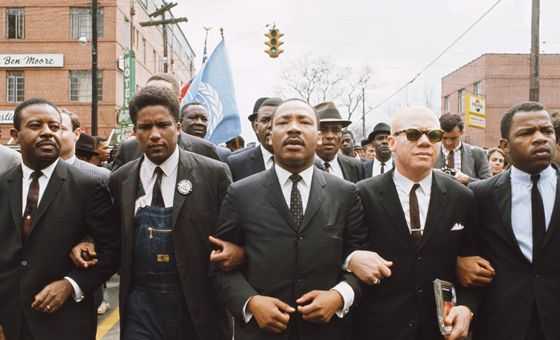
Martin Luther King Jr leading civil rights march from Selma to Montgomery, 1965

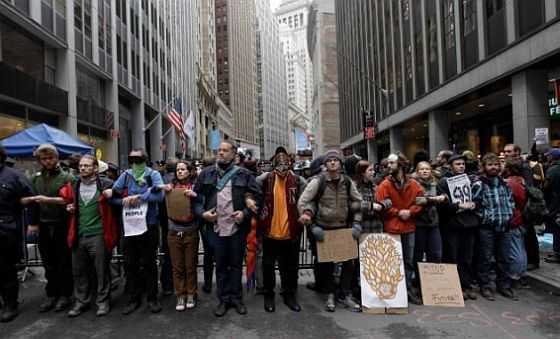
The 99% shut down Wall Street, November 17, 2011

Students lock arms before police assault, University of California at Berkeley, November 9, 2011

After a police assault (shown in the video above) on non-violent student protesters — whose only arms were the ones they interlocked — Robert Birgeneau, the chancellor at Berkeley, issued a statement saying:

It is unfortunate that some protesters chose to obstruct the police by linking arms and forming a human chain to prevent the police from gaining access to the tents. This is not non-violent civil disobedience. By contrast, some of the protesters chose to be arrested peacefully; they were told to leave their tents, informed that they would be arrested if they did not, and indicated their intention to be arrested. They did not resist arrest or try physically to obstruct the police officers’ efforts to remove the tent. These protesters were acting in the tradition of peaceful civil disobedience, and we honor them.

What Birgeneau objects to is resistance in any form and interlocking arms in defiance of an advancing line of police is indeed an act of resistance.

But more than that, it is an act of solidarity and nothing threatens institutional power more than unity among ordinary people.

When burly police officers thrust night sticks into the chests of young students, this is not simply what is euphemistically called a “show of force,” but instead seems to be a display of “forward panic.”

In the kind of police violence that sociologist Randall Collins has dubbed forward panic, a cauldron of pent up tension suddenly erupts. Among Collins’ insights is that because people (including police and soldiers) universally have high-threshold inhibitions that restrain them from becoming violent, when those inhibitions suddenly fall away, the targets of violence will most often be those who are perceived as weak, unwilling or incapable of hitting back. Fear targets the easiest opponent.

This is the micro-social context in which the police lash out, but at the same time there is a broader context that fuels the fear of those who have been invested with the power of the state.

In the face of mass resistance, the primary line of defense for the police is not their weapons or shields — it is an idea already under challenge: that the state is more powerful than the people. And once the fault-lines in that idea have been exposed, the power equation is in jeopardy of suddenly being reversed.

Over the last twelves months, in the Middle East, in Europe, and now in the United States, the seeds have already been planted which could grow into the most dangerous idea that ever swept the world: that we have a greater interest in uniting than we do in being set apart; that what we might gain together will far exceed what we can achieve alone.

Human solidarity — this is what now threatens governments, corporations and every concentration of power.

* * *

Protesters in New York today were joined by one former police officer who sees that it his duty to stand with the people: Retired Police Captain Raymond Lewis from Philadelphia.

This afternoon, Captain Lewis was marched away in cuffs after being arrested by the NYPD.

Facebooktwittermail

When government no longer prizes liberty, no one is safe

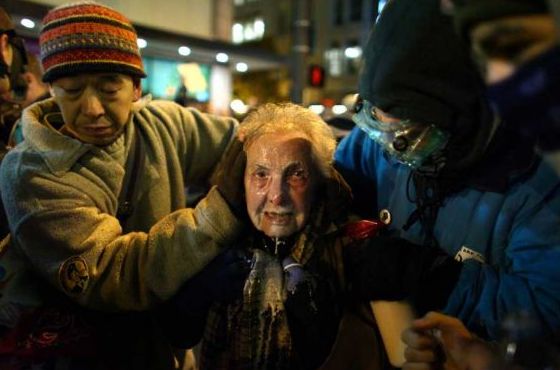
After 84-year-old Occupy Seattle participant Dorli Rainey was pepper sprayed by Seattle Police yesterday, she wrote: 'This is what democracy looks like. It certainly left an impression on the people who rode the No. 1 bus home with me. In the women's movement there were signs which said: Screw us and we multiply.'

When officials from 40 cities across America participated in conference calls on tackling the Occupy protests, they said their goal was to make the camps safe.

It sounds like the infamous attack on Ben Tre in the Vietnam War: “We had to destroy the village to save it.”

On a National Police Radio news bulletin yesterday afternoon, New York correspondent Robert Smith, reporting on the ongoing legal fight to reconstruct the camp at Ziccotti Park, said of the dispute: one person’s trash is another person’s free speech — overlooking the fact that what he referred to as “trash” were the personal belongings of others.

Likewise, when NPR reports on the destruction of camps, they happily parrot the police by using the term “dismantle” — as though officers take pains to find matching bags into which they can slip neatly folded sleeping bags, all the while making sure every item gets carefully tagged so later it can safely be returned to its owner.

In truth the camps have been dismantled in much the same way that Israeli soldiers “dismantle” Bedouin villages that the authorities deem illegal.

In many ways, the real clash is between those who cling to the anti-democratic powers that the state grabbed after 9/11, and those who dare to declare that we should no longer be governed by fear.

Tellingly, the authorities in New York planned the assault on Occupy Wall Street like a counterterrorism operation.

“From the beginning, I have said that the city had two principal goals: guaranteeing public health and safety, and guaranteeing the protesters’ first amendment rights. But when those two goals clash, the health and safety of the public and our first responders must be the priority,” Mayor Bloomberg said, asserting that “safety” is more important than liberty.

The New York Times reported:

[T]he police operation to clear Zuccotti Park of protesters unfolded after two weeks of planning and training. Officials had prepared by watching how occupations in other cities played out. A major disaster drill was held on Randalls Island, with an eye toward Zuccotti. Officials increased so-called disorder training — counterterrorism measures that involve moving large numbers of police officers quickly — to focus on Lower Manhattan.

The last training session was on Monday night, on the Manhattan side of the East River. The orders to move into the park came down at the “last minute,” said someone familiar with the orders, which referred to the assignment only as “an exercise.”

“The few cops that I know that were called into this thing, they were not told it was for going into Zuccotti Park,” said the person, who spoke on the condition of anonymity. “The only people who were aware of them going into Zuccotti Park were at the very highest levels of the department.”

Once the operation began, the area around the park was declared a “frozen zone”.

What gets frozen in a frozen zone? The U.S. Constitution — no more freedom of assembly, free speech, or free press.

The Associated Press reports on the spontaneously coordinated assault on Occupy camps across America:

As concerns over safety and sanitation grew at the encampments over the last month, officials from nearly 40 cities turned to each other on conference calls, sharing what worked and what hasn’t as they grappled with the leaderless movement.

In one case, the calls became group therapy sessions.

While riot police sweeping through tent cities in Portland, Ore., Oakland, Calif. and New York City over the last several days may suggest a coordinated effort, authorities and a group that organized the calls say they were a coincidence.

“It was completely spontaneous,” said Chuck Wexler, director of the Police Executive Research Forum, a national police group that organized calls on Oct. 11 and Nov. 4. Among the issues discussed: safety, traffic and the fierceness of demonstrations in each city.

“This was an attempt to get insight on what other departments were doing,” he said.

From Atlanta to Washington, D.C., officials talked about how authorities could make camps safe for protesters and the community.

Has the United States really become a country where we are supposed to be afraid of freedom and nervous about democracy?

Facebooktwittermail

UNESCO funding cut by U.S. puts millions of lives at risk — NYT science blogger blames the rest of the world

At his Dot Earth blog in the New York Times, Andrew Revkin points out the devastating consequences which may follow budget cuts at UNESCO, now that U.S. funding has been severed due to the U.N. agency’s acceptance of Palestine as a full member.

Revkin relays a report from Oakley Brooks, author of Tsunami Alert: Beating Asia’s Next Big One, who writes:

There are plenty of things that the multi-tentacled Unesco does, in its slow and bloated way, which the world really needs. One indispensable and thankless Unesco task is organizing tsunami warnings systems and pushing for tsunami education on risky shores around the world.

I have serious reservations about relying on warning systems near fault lines — they tend to make people complacent between events and confused during. But these systems are undeniable saviors for long-distance tsunamis, such as the one that traveled trans-Pacific, from Japan to the U.S. West Coast, last March.

It’s frustrating to think that the ever-widening collateral damage from American Holy Land politics would reach — like its own long-distance tsunami — into the essential work on tsunami science.

Since UNESCO’s loss of funding is due to a law passed by the US Congress back in 1990, before the Oslo Accords and before anyone in Washington professed their support for the creation of a Palestinian state, Oakley correctly attributes the source of the damage to American Holy Land politics.

Revkin, however, wants to locate the problem elsewhere:

To my mind, the 107 nations that voted for Palestine’s membership knew what the financial result would be, and were willing to put the agency’s operations at risk for the sake of making a geopolitical point. That seems unwise. But that’s a personal, not professional view, on my part.

Since the bulk of Revkin’s writing covers environmental issues, whatever views he might have about Israel and Palestine are hard to glean. But he certainly doesn’t lack an interest in politics. In the mid-90s he reported on multiple ways the Bush administration was interfering with science.

Perhaps he sees the UNESCO issue as just another example of politics intruding on the work of scientists. Yet he seems to assign a law passed by Congress with something like the immutable status of a law of physics and think that the political points are only being made at the U.N..

As Ian Williams notes:

The actual legislation [PDF] the state department invokes is a 1990 prohibition on funding “the United Nations or any specialised agency thereof which accords the Palestine Liberation Organisation the same standing as a member state”, and another in 1994 banning payments to “any affiliated organisation of the United Nations which grants full membership as a state to any organisation or group that does not have the internationally recognised attributes of statehood”.

Any president, as we have seen, has ways to get around congressional mandates like this. For example, there are questions about which manifestation of Palestine is applying: the PLO or the Palestinian Authority. The congressional legislation was passed before the Oslo accords – and before the US began funding the Palestinians directly, so an executive decision could have declared that events had overtaken the intent of the law, and, what is more, that it was not the PLO but the Palestinian state that had been admitted.

As for the second part, US diplomats will have fun explaining why the US maintains membership of the World Bank and IMF – which have admitted Kosovo, whose disputed territory and statehood, rightly or wrongly, has far less general recognition than Palestine’s.

Are there any other indications that Revkin may be subject to his own non-scientific slant when it comes to issues involving the Middle East?

Back in early February, when the Egyptian revolution was in full swing, Revkin was among those helping promote a fear that a wave of uprisings across the region might cause trouble for the United States if oil supplies were disrupted. At that moment, he and his interlocutor, Gal Luft, saw a beacon of hope being raised in Israel by Benjamin Netanyahu with an initiative aimed at ending global dependence on oil.

Revkin also sought council from leading neoconservative, James Woolsey. The former CIA director saw in Revkin’s inquiry an opportunity to preach about the fount of all peril: Iran.

The point is that this Iranian government will use any tool it can – religious and otherwise – to spread its influence. If we see demonstrations in Saudi Arabia or the Gulf States it will be highly likely that more is going on, with an Iranian hand behind it, than just impressionable folks watching television and imitating what they see. It will be about Iran moving to build its ability to call the shots.

Does all of this imply that Revkin has his own Middle East agenda? Kind of, but I don’t think it necessarily has anything to do with supporting Israel. It sounds more like a strain of environmentalist populism that wants to harness America’s isolationist and xenophobic trends as a means to break our dependence on oil.

The problem with reinforcing prejudice for the sake of a good cause is that the prejudice may end up being served better than the cause.

Facebooktwittermail

Why the Washington Post won’t fire Jennifer Rubin

Following a venomously anti-Palestinian blog post by Rachel Abrams that was promoted in a retweet by the Washington Post blogger Jennifer Rubin, Glenn Greenwald comments:

It’s the opposite of newsworthy that a rabid neocon like Abrams spews this sort of anti-Arab hate-mongering; that is basically the defining attribute of neoconservatism. But what is significant is that Jennifer Rubin promoted and endorsed it without any hesitation. Over the past 18 months, we’ve witnessed a series of journalists fired for far less virulent sentiments directed at Israelis and Jews (Rich Sanchez’ complaints about disproportionate Jewish media influence and Helen Thomas’ call for Jews to leave the region), and even for completely innocuous remarks whose only sin was offending neocons (Octavia Nasr’s mild eulogizing of a moderate Hezbollah cleric). Yet here we have a Post blogger who has endorsed this extreme hate-mongering, and does so with total impunity.

Is there any doubt whatsoever that had Rubin promoted a rant spewing these sorts of ugly caricatures about Jewish children and Israelis with accompanying calls for savage violence — rather than directed at Palestinians — that she would have instantly been fired, then castigated and attacked by all Serious precincts? As [Ali] Gharib reports today, that was the question posed by a Post reader via email to the Post‘s Ombudsman, Patrick Pexton. To his credit, Pexton had previously condemned Rubin on his Ombudsman blog, writing: “in agreeing with the sentiment, and in spreading it to her 7,000 Twitter followers who know her as a Washington Post blogger, Rubin did damage to The Post and the credibility that keeps it afloat.” After denouncing Abrams’ rant as “reprehensible,” Pexton added: “That a Post employee would retweet it is a huge disappointment to me.”

That’s all fine as far as it goes, but what about the question posed by the reader: wouldn’t Rubin have been fired for promoting this hate-mongering had it been directed at Jews and Israelis rather than Palestinians? Pexton’s email response, published by the reader who emailed him, was this:

Off the record, I think it’s quite possible. But the ombudsman does not hire or fire people here. I only comment.

Leave aside the bizarre belief of establishment journalists that they can unilaterally decree their statements to be “off the record” and then expect that to be honored in the absence of any agreement by the person to whom they’re making the statement. What is most striking here is Pexton’s highly revealing cowardice — probably well-grounded — in wanting his observation about this double standard to be kept private; shouldn’t an Ombudsman who believes this be eager to raise it in public? As the reader noted in reply to Pexton:

If, in your opinion, such a grave double standard exits, why do you comment off the record? Why not publicly state your opinion? Why self censor? Doesn’t that reinforce insidious limitations on free speech?

Think of the absurdity. You must stay cautiously silent about a perfectly reasonable opinion while Rubin and Abrams can let fly with genocidal remarks. With respect, your silence contributes significantly to the poisoning of public debate.

Please speak up.

What’s particularly remarkable is that Pexton is admitting (albeit wanting it kept secret) what any honest observer knows to be true: that there is a very high likelihood — I’d say absolute certainty — that Rubin would have been fired had she promoted a post like this about Jews and Israelis rather than Arabs and Palestinians.

But this is the insidious, pervasive bias that has long been obvious in a profession that relentlessly touts its own “objectivity.” Even the mildest criticism of Israelis and anything even hinting at criticisms of Jews is strictly prohibited — a prohibition enforced by summary, immediate dismissal and enduring stigma.

Indeed, the American media exhibits gross bias in favor of Israel and deference towards Jews– that hardly needs saying. The question is, why?

The easy answer is to say that this reflects the ruthless power of the Israel lobby. A riskier explanation which even though widely accepted is much less voiced would be to say that this reflects the wide reach of Jewish power in American society. But neither explanation really exposes the way the power dynamic functions.

In most accounts of the nefarious influence of concentrated power, too much attention is given to the role of the individuals or entities which supposedly possess great power and too little to the way others relate to that power.

Americans are by nature enslaved to the possibility of their own advancement and to advance is to rise through the structures of power; not to defy or attempt to transform those structures.

“I never met in America with any citizen so poor as not to cast a glance of hope and envy on the enjoyments of the rich, or whose imagination did not possess itself by anticipation of those good things which fate still obstinately withheld from him,” Alexis de Tocqueville wrote in 1840.

For those convinced that a shortage of luck may be their only impediment to a better life, then the greatest fear will be of the self-created obstacle — a poorly chosen alliance, an imprudently expressed opinion, or anything else that might alienate them from the sources of power towards which they gravitate.

Patrick Pexton may be the Washington Post‘s ombudsman today but that’s not a position anyone holds or would want to hold for life. He has an eye on his own future and no one gets ahead in Washington or elsewhere in the US media by creating the impression that they might have anything less than warm feelings for Israel.

This is a reality sustained by the collective ambitions of most journalists.

What the media especially lacks, are sufficient numbers of individuals who do not so diligently nurse their own ambitions. Taboo-breaking, defiance and the kind of fierce independence which are the things that make a free press free, can only be unleashed by those who are willing to say: to hell with success; save the Pulizers for the media slaves.

Facebooktwittermail

Visions of slaughter: Jennifer Rubin, Rachel Abrams and the Washington Post

Here’s the post that got this story rolling. It’s written by Rachel Abrams and appears on her blog, Bad Rachel, and is her bloodcurdling response to the release of the Israeli soldier, Gilad Shalit, on October 18:

GILAD!!!!!!!!!!

He’s free and he’s home in the bosom of his family and his country.

Celebrate, Israel, with all the joyous gratitude that fills your hearts, as we all do along with you.

Then round up his captors, the slaughtering, death-worshiping, innocent-butchering, child-sacrificing savages who dip their hands in blood and use women—those who aren’t strapping bombs to their own devils’ spawn and sending them out to meet their seventy-two virgins by taking the lives of the school-bus-riding, heart-drawing, Transformer-doodling, homework-losing children of Others—and their offspring—those who haven’t already been pimped out by their mothers to the murder god—as shields, hiding behind their burkas and cradles like the unmanned animals they are, and throw them not into your prisons, where they can bide until they’re traded by the thousands for another child of Israel, but into the sea, to float there, food for sharks, stargazers, and whatever other oceanic carnivores God has put there for the purpose.

And here’s how the Washington Post got involved: Their right wing, pro-Israel, blogger, Jennifer Rubin, gave Abrams the thumbs up when she retweeted a tweet in which Abrams was promoting her post.

The Post‘s ombudsman Patrick B. Pexton says “Rubin should not have retweeted Abrams’s tweet.”

He concludes: “Rubin is not responsible for the offensive words; Abrams is. But in agreeing with the sentiment, and in spreading it to her 7,000 Twitter followers who know her as a Washington Post blogger, Rubin did damage to The Post and the credibility that keeps it afloat.”

Pexton’s analysis of Abrams’ post is less than exact. He writes:

Abrams’s post is so full of dashes it’s hard to follow, but the subject of her run-on sentence does appear to be “captors” not Palestinians in general. The language is so over the top, though —“child-sacrificing savages,” “devil’s spawn,” “pimped out by their mothers,” “unmanned animals” — it’s easy to how some people might see it as an endorsement of genocide.

The mangled sentence is indeed difficult to decipher, but this call for vengeance is not simply directed at Shalit’s captors — it includes “their offspring.” Presumably Abrams shares the view of many right wing Zionists that the children of terrorists are baby terrorists and thus she hopes for their preemptive slaughter.

Having said all that, some observers may wonder why a blogger like Abrams could garner so much attention. Pexton merely identifies her as “an independent blogger and board member of the conservative Emergency Committee for Israel” — a group so extreme that it has drawn criticism from the pro-Israel American Jewish establishment.

The context the Post‘s ombudsman failed to provide was this:

Her spouse, Elliott Abrams is a veteran of both the Ronald Reagan and George W. Bush administrations who was convicted (and later pardoned) for his role in the Iran-Contra scandal; her mother, Midge Decter, is on the board of the Center for Security Policy and was a founding member of the Project for the New American Century and the Reagan-era Committee for the Free World, which she co-directed with Donald Rumsfeld; her step-father, Norman Podhoretz, is a former editor of the neoconservative flagship magazine Commentary and a widely recognized trailblazer of the neoconservative “tendency” (Norman’s son from another marriage, John Podhoretz, is currently editor of Commentary); and her sister, Ruthie Blum Leibowitz, is a columnist for the conservative Israeli daily, the Jerusalem Post.

Back in 2006, when Elliot Abrams backed an armed uprising in Gaza in an effort to overthrow the democratically elected government, what kind of encouragement was he getting from his wife? Was she also then sharing visions of mass slaughter with President Bush’s Deputy National Security Adviser who at that time was arguably the most influential Middle East policymaker inside the administration?

Facebooktwittermail

Sarkozy tells truth about Netanyahu but press decide it’s too sensitive to report

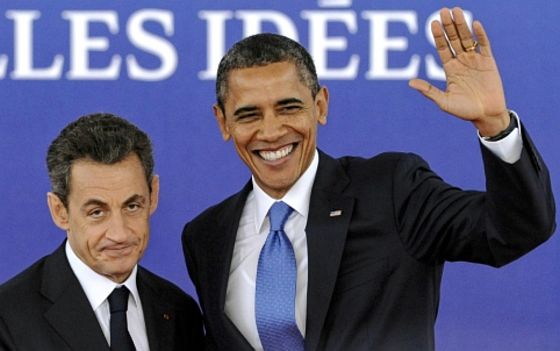
Sarkozy tells Obama, Netanyahu's a liar. Journalists blush.

“Who the fuck does he think he is? Who’s the fucking superpower here?” Bill Clinton said in exasperation about Benjamin Netanyahu after one of the Israeli prime minister’s characteristic displays of arrogance in 1996.

Now we learn that last Thursday at the G20 summit in Cannes, France’s President Nicolas Sarkozy privately described Netanyahu as a “liar” and said “I cannot stand him,” to which President Obama gave the fairly tepid response: “You’re fed up with him, but I have to deal with him every day!”

The exchange was picked up on an open microphone but the press in Cannes who overheard the presidential tête-à-tête agreed that it was too sensitive to report.

Are these journalists or presidential courtiers?

The surprising lack of coverage may be explained by a report alleging that journalists present at the event were requested to sign an agreement to keep mum on the embarrassing comments. A Reuters reporter was among the journalists present and can confirm the veracity of the comments.

A member of the media confirmed Monday that “there were discussions between journalists and they agreed not to publish the comments due to the sensitivity of the issue.”

He added that while it was annoying to have to refrain from publishing the information, the journalists are subject to precise rules of conduct.

Like when they are supposed to curtsy, make full bows, or discreetly look the other way?

Even now, now that the Sarkozy-Obama indiscretion has leaked out, there are several variations of translation of what Obama said.

“You may be sick of him, but me, I have to deal with him every day.” “You’ve had enough of him? I have to deal with him every day!”

These are different ways of translating “Tu en as marre de lui, mais moi, je dois traiter avec lui tous les jours !” That’s how Obama’s words were rendered on ArretSurImages.net.

So even though the press has broken its four day silence, instead of reporting the exact wording — words surely spoken in English — the press is merely repeating what has been reported on the French website — and even though the contents of that report have been confirmed by Reuters.

Watch out for the word sensitivity in any news report. Chances are, what it really refers to is complicity.

Facebooktwittermail

Why are we being readied for war with Iran?

If you want to start a war with Iran, apparently the lesson from Iraq is not that war is a dumb idea; it’s that the war charge cannot be led by the U.S. administration or a ragtag band of expatriates.

The pretext for war needs to be presented by an international body that is perceived as independent and objective. So, if you want to start a war with Iran, who could present a more compelling justification for war than the International Atomic Energy Agency?

But can the U.S. government rely on the IAEA to fulfill its covertly designated role?

Now that the irritatingly independent Mohamed ElBaradei is out of the way, we know — thanks to Wikileaks — that Washington is much more comfortable with the agency’s new director general, Yukiya Amano, who is “solidly in the U.S. court on every key strategic decision, from high-level personnel appointments to the handling of Iran’s alleged nuclear weapons program.”

The Obama administration, as well as being able to rely on the IAEA to align itself with U.S. goals, can of course always rely on the New York Times to fulfill its role as an informal ministry of information. Just as Izvestia functioned as the “delivered message” of the Soviet government, reporters like David Sanger gladly parrot their administration sources rather than question what they are being told.

[T]he Obama administration, acutely aware of how what happened in Iraq undercut American credibility, is deliberately taking a back seat, eager to make the conclusions entirely the I.A.E.A.’s, even as it continues to press for more international sanctions against Iran. When the director of the agency, Yukia Amano, came to the White House 11 days ago to meet top officials of the National Security Council about the coming report, the administration declined to even confirm he had ever walked into the building.

The final touches are still being put on the report and its critical annex, where some of the investigative details will be laid out, which may be released as early as Wednesday. But already Russia and China have sent a diplomatic protest to Mr. Amano, urging him to not to make details of the evidence public.

“Russia and China are of the opinion that such kind of report will only drive Iran into a corner,” they wrote in the note, which was obtained by The New York Times and is a rare instance of those countries commenting jointly.

Obtained by the New York Times — but from who?

Knowing how a piece of information enters the public domain can be as important as the information itself. If these reporters gave some indication about where the note came from, they would thereby provide a clearer indication about whose agenda is being served by its revelation.

Sources do of course often need to be concealed and over at Arms Control Wonk, Jeffrey Lewis obliges “an observer” by allowing him to remain nameless. Regular readers of ACW will know, however, that this is a blog not only with stellar contributors but also a highly informed readership. This observer writes:

For some reason, everyone and his cousin are suddenly seized the idea that there must be an urgent need to (at a minimum) contemplate whether to bomb Iran. No one can quite say why now, though. As Ari Shavit writes in Ha’aretz, with an impressive combination of eloquence and lack of substance:

For the past decade it has been clear that we are facing an Iranian deadline. Time after time the deadline has been put off. But it is real and it is imminent. Unless an international miracle, or an interior-Iranian miracle takes place, we will reach the crossroads.

‘When we stand at the crossroads we will have two options – prevention or deterrence. To launch a military offensive or to emerge from nuclear ambiguity. One way or another, all chaos will break loose in the Middle East. One way or another, all chaos will break loose in Israel. What was will be no more. A new era will begin.’

But just what technical or political fact has brought the deadline to the crossroads?

Why, exactly, is there an insistence that Iran is racing up to some undefined sharply defined point where its adversaries, Israel included, must either strike preventively or accept an uneasy relationship of mutual (nuclear) deterrence? If Iran is racing, so were Achilles and the Tortoise. It’s more like tiptoeing.

Shavit is now the umpty-teenth commentator, Israeli or otherwise, who apparently cannot imagine that nuclear opacity or ambiguity could apply to states other than Israel.

The drumbeat for war against Iran suggests that not only do Iran’s enemies regard the Islamic state’s acquisition of nuclear weapons as intolerable, but Tehran must be punished simply for its lack of transparency.

Facebooktwittermail

Israeli security websites crash after Anonymous threat

On Friday, Anonymous accused Israel of engaging in “piracy on the high seas” after the Israeli navy intercepted the latest flotilla heading for Gaza and warned that it would “strike back”.

Today the following Israeli government websites crashed: Shin Bet, Mossad, IDF, IDF Spokesperson’s Unit, Health Ministry, Justice Ministry, Construction and Housing Ministry, Science and Sport’s Ministry, the President’s Residence, Immigration Authority, the Israel Land Administration and Israel Atomic Energy Commission.

The Deputy Director of the Israeli government’s Information Technology Unit, Ziv Slater, said: “It has nothing to do with an attack, no threat and no hacking. It’s just a systems malfunction.”

“If you continue blocking humanitarian vessels to Gaza or repeat the dreadful actions of May 31st, 2010 against any Gaza Freedom Flotillas then you will leave us no choice but to strike back. Again and again, until you stop,” Anonymous has warned.

Is today’s “system’s malfunction” the first of what will become many?

Facebooktwittermail

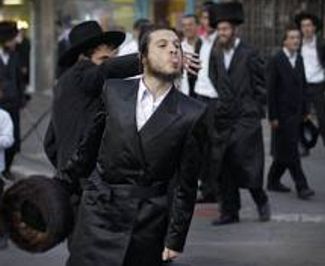
Being spat at remains part of life for Christians in Jerusalem

Haaretz reports: Ultra-Orthodox young men curse and spit at Christian clergymen in the streets of Jerusalem’s Old City as a matter of routine. In most cases the clergymen ignore the attacks, but sometimes they strike back. Last week the Jerusalem Magistrate’s Court quashed the indictment against an Armenian priesthood student who had punched the man who spat at him.

Johannes Martarsian was walking in the Old City in May 2008 when an young ultra-Orthodox Jew spat at him. Maratersian punched the spitter in the face, making him bleed, and was charged for assault. But Judge Dov Pollock, who unexpectedly annulled the indictment, wrote in his verdict that “putting the defendant on trial for a single blow at a man who spat at his face, after suffering the degradation of being spat on for years while walking around in his church robes is a fundamental contravention of the principles of justice and decency.”

“Needless to say, spitting toward the defendant when he was wearing the robe is a criminal offense,” the judge said.

In 2009, the Jerusalem Post reported: News stories about young Jewish bigots in the Old City spitting on Christian clergy – who make conspicuous targets in their long dark robes and crucifix symbols around their necks – surface in the media every few years or so. It’s natural, then, to conclude that such incidents are rare, but in fact they are habitual. Anti-Christian Orthodox Jews, overwhelmingly boys and young men, have been spitting with regularity on priests and nuns in the Old City for about 20 years, and the problem is only getting worse.

“My impression is that Christian clergymen are being spat at in the Old City virtually every day. This has been constantly increasing over the last decade,” said Daniel Rossing. An observant, kippa-wearing Jew, Rossing heads the Jerusalem Center for Jewish-Christian Relations and was liaison to Israel’s Christian communities for the Ministry of Religious Affairs in the ’70s and ’80s.

For Christian clergy in the Old City, being spat at by Jewish fanatics “is a part of life,” said the American Jewish Committee’s Rabbi David Rosen, Israel’s most prominent Jewish interfaith activist.

“I hate to say it, but we’ve grown accustomed to this. Jewish religious fanatics spitting at Christian priests and nuns has become a tradition,” said Roman Catholic Father Massimo Pazzini, sitting inside the Church of the Flagellation on the Via Dolorosa.

These are the very opposite of isolated incidents. Father Athanasius of the Christian Information Center called them a “phenomenon.” George Hintlian, the unofficial spokesman for the local Armenian community and former secretary of the Armenian Patriarchate, said it was “like a campaign.”

Christians in Israel are a small, weak community known for “turning the other cheek,” so these Jewish xenophobes feel free to spit on them; they don’t spit on Muslims in the Old City because they’re afraid to, the clerics noted.

In 2004, Eric J Greenberg, wrote in The Forward: It has been Jerusalem’s dirty little secret for decades: Orthodox yeshiva students and other Jewish residents vandalizing churches and spitting on Christian clergyman as they walk along the narrow, ancient stone streets of the Old City.

Now, however, following a highly publicized fracas last week between a yeshiva student and the archbishop of Jerusalem’s Armenian Church, the issue is generating unprecedented media attention in Israel. The fight started after a yeshiva student at the respected Har Hamor yeshiva spat on Archbishop Nourhan Manougian during a Christian holy procession in the Old City.

In the wake of the incident, a top Armenian Church official told the Forward that his church is calling on the Israeli government and on rabbis around the world to help put a stop to the offensive, decades-long abuse.

“These ultra-Orthodox Jews are the ones causing this scandal, those that live here in our neighborhood and the ones that come visit the Western Wall,” said the church official, Aris Shirvanian, in a phone interview Monday. He spoke from the patriarchate’s world headquarters in the Armenian Quarter, one of the famed four quarters of the Old City of Jerusalem.

“We would like to see the authorities… become more strict with the offenders,” said Shirvanian, director of ecumenical and foreign relations of the Armenian Patriarchate. “We would also ask rabbis to get involved in educating this one sector of the Jewish society.”

Har Hamor is one of the leading institutions of religious Zionism, Israel’s equivalent of Modern Orthodoxy. Most sources interviewed for this article suggested that the abusive practices were more common in the ultra-Orthodox or Haredi community, which is characterized by greater insularity… But sources told the Forward that the practice has recently been picked up by other segments of the Orthodox world, including visiting American yeshiva students.

The controversy comes as the Israeli government and Diaspora Jewish organizations have been attempting to focus international attention on what they describe as a surge in antisemitism across the globe. Beyond potentially undermining these efforts, the reports of anti-Christian harassment could weaken Israel’s claim to be an effective guardian of Christian and Muslim rights in Jerusalem.

“Protection of everything sacred to other religions is one of the justifications for Israel’s sovereignty in Jerusalem, whose legitimacy will be undermined if this spitting becomes prevalent,” said a former Israeli chief rabbi, Israel Meir Lau. Lau condemned the harassment, and warned that such incidents could fuel antisemitism outside of Israel.

Besides the Armenian rite, clergy of other Christian churches have been targeted, Shirvanian said. “This is not happening only to Armenian clergy, but also to the Catholics, Syrians, Romanians and Greek Orthodox.”

Following the incident involving Manougian, numerous Israeli government officials and Jewish religious and organizational leaders have stepped forward to condemn the acts.

Interior Minister Avraham Poraz called the yeshiva students’ behavior “intolerable,” and asked Internal Security Minister Gideon Ezra to “take all the necessary steps to prevent these incidents in the future.”

At the end of 2009, Beth Din Tzedek, the tribunal justice of the Orthodox Jewish community in Jerusalem, issued the following statement:

Recently, repeated complaints have been made by gentiles regarding recurring harassment and insults directed at them by irresponsible youths in various places in the city, especially in the vicinity of Shivtei Yisrael Street and adjacent to the grave of Shimon the Just.

Besides desecrating the Holy Name, which in itself represents a very grave sin, provoking gentiles, according to our sages — blessed be their holy and righteous memory — is forbidden and is liable to bring tragic consequences upon our own community, may God have mercy.

We hereby call upon anyone who has the power to end these shameful incidents through persuasion, to take action as soon as possible to remove these hazard, so that our community may live in peace.

The tribunal in issuing this appeal apparently did not see itself as possessing the power to reign in its own community. Neither did it see fit to offer an apology to Jerusalem’s Christians. It’s primary concern was what kind of backlash the behavior of its own youth might eventually provoke.

The robed Christian clergy are not the only gentiles who have been subjected to spitting attacks. A year ago, Anne Barker, Middle East correspondent for Australia’s ABC News, described the humiliation and degradation she experienced when a mob of angry Orthodox men spat on her while she was reporting on street protests in Jerusalem.

I was aware that earlier protests had erupted into violence on previous weekends — Orthodox Jews throwing rocks at police, or setting rubbish bins alight, even throwing dirty nappies or rotting rubbish at anyone they perceive to be desecrating the Shabbat.

But I never expected their anger would be directed at me.

I was mindful I would need to dress conservatively and keep out of harm’s way. But I made my mistake when I parked the car and started walking towards the protest, not fully sure which street was which.

By the time I realised I’d come up the wrong street it was too late.

I suddenly found myself in the thick of the protest – in the midst of hundreds of ultra-Orthodox Jews in their long coats and sable-fur hats.

They might be supremely religious, but their behaviour — to me — was far from charitable or benevolent.

As the protest became noisier and the crowd began yelling, I took my recorder and microphone out of my bag to record the sound.

Suddenly the crowd turned on me, screaming in my face. Dozens of angry men began spitting on me.

I found myself herded against a brick wall as they kept on spitting — on my face, my hair, my clothes, my arms.

It was like rain, coming at me from all directions — hitting my recorder, my bag, my shoes, even my glasses.

Big gobs of spit landed on me like heavy raindrops. I could even smell it as it fell on my face.

Somewhere behind me — I didn’t see him — a man on a stairway either kicked me in the head or knocked something heavy against me.

I wasn’t even sure why the mob was angry with me. Was it because I was a journalist? Or a woman? Because I wasn’t Jewish in an Orthodox area? Was I not dressed conservatively enough?

In fact, I was later told, it was because using a tape-recorder is itself a desecration of the Shabbat even though I’m not Jewish and don’t observe the Sabbath.

It was lucky that I don’t speak Yiddish. At least I was spared the knowledge of whatever filth they were screaming at me.

Facebooktwittermail

Why does the U.S. spend more on prisons than higher education?

If California emptied its prisons today and sent every inmate to a University of California college it would save $7 billion a year!

That’s one of the stunning statistics presented in the chart below, created by Joseph Staten, an info-graphic researcher with Public Administration (h/t Brian Resnick at the Atlantic.)

In the land of the free, we should be asking why the government invests more in locking up it citizens than in equipping them with the skills to make the most of their liberty and why the country that is only the sixth largest in the world is #1 in the rate of incarceration.

Facebooktwittermail

Goldstone’s latest act of atonement at the feet of the Zionists

“If this bloc of millions of ­Palestinians cannot vote, that will be an apartheid state.” Israel Defense Minister Ehud Barak, February, 2010.

In his latest act of atonement, Judge Richard Goldstone claims that those who assert Israel practices a form of apartheid, make this accusation in order to “retard rather than advance peace negotiations.” The discrimination that Palestinians face is neither intentional nor permanent, he says.

[In the West Bank] there is no intent to maintain “an institutionalized regime of systematic oppression and domination by one racial group.” This is a critical distinction, even if Israel acts oppressively toward Palestinians there. South Africa’s enforced racial separation was intended to permanently benefit the white minority, to the detriment of other races. By contrast, Israel has agreed in concept to the existence of a Palestinian state in Gaza and almost all of the West Bank, and is calling for the Palestinians to negotiate the parameters.

So, according to Goldstone’s way of thinking one could say that to the extent that Palestinians have to suffer living inside a system of Israeli oppression that looks like apartheid, it’s their own fault because they have so far failed to negotiate the terms for their own release. They’re like prisoners who keep on flunking in front of the parole board. (Let’s not raise the awkward question about what exactly they did in order to deserve being thrown in prison in the first place.)

Prof. Gerald Steinberg, president of NGO Monitor, is quick to use Goldstone’s rejection of the Israel-apartheid equation in order to advance his own organization’s agenda.

Those who invoke this false analogy to advance BDS, lawfare, and other forms of political warfare against Israel, have been named and shamed by the former South African judge who helped end apartheid and who was also critical of Israeli policies. This is a fatal blow to the BDS movement and the apartheid analogy.

I wonder whether NGO Monitor advisory board member, Alan Dershowitz, now shares Steinberg’s enthusiasm about Goldstone? Only last year Dershowitz compared Goldstone with the Nazi war criminal, Joseph Mengele.

Facebooktwittermail

Police state: Oakland looks more like Pearl Roundabout than Tahrir Square

If Tahrir Square inspires the Occupy movement, police forces across America appear to think the most useful lessons on handling popular unrest come from Pearl Roundabout, Bahrain. That means that when ordinary American citizens take a stand and symbolically proclaim: this is our land, the police will sooner or later respond with violence in order to assert the power of the state.

From that perspective, the lesson from Bahrain earlier this year was clear: all necessary force must be used in order to prevent protesters retaining their hold on an occupied public space.

This is being done in the name of public order, yet it appears to be a thinly veiled effort to crush political dissent — even while politicians voice sympathy with the concerns of the protesters. (Let’s not forget that the Bahraini royal family also knew how to make timely PR statements.)

Tools designed to quell riots and provide “non-lethal” means to rein in violent protests — tear gas, pepper spray, batons, and stun grenades — are now being used to suppress non-violent political protest.

This is how the Oakland police decided to assert state power yesterday afternoon and evening:

Tim at Occupy Oakland writes: Around 2am word spread that riot police were massing in around the area where Occupy Oakland has been for more than two weeks. Hundreds of people gathered and began to make non-violent barricades at all the entrances to the plaza.

At about 4:30am, riot police appeared on all corners of the encampment. There were roughly 500 to 700 riot police in total.

The entire plaza was completely barricaded on all sides, with palates, trash cans, chairs, a gigantic christmas wreath, police barricades from a neighboring street

Occupiers began chanting ‘go home’ as they always do when police show up at Occupy Oakland, but it quickly became clear that there was an overwhelming number of police from at least four different jurisdictions.

As people continued to chant and fell back within the barricade, off of the street, the police announced that we would be arrested within the encampment. They said [they’d use force to disperse demonstrators within] five minutes, and within a minute they fired the first rounds of flash-bang grenades and rubber bullets, and then tear gas into the camp, hitting and injuring multiple people. [Continue reading and see photos…]

San Francisco Chronicle reports: Police fired tear gas at least five times Tuesday night into a crowd of several hundred protesters backing the Occupy movement who unsuccessfully tried to retake an encampment outside Oakland City Hall that officers had cleared away more than 12 hours earlier.

Police gave repeated warnings to protesters to disperse from the entrance to Frank Ogawa Plaza at 14th Street and Broadway before firing several tear gas canisters into the crowd at about 7:45 p.m. Police had announced over a loudspeaker that those who refused to leave could be targeted by “chemical agents.”

Protesters scattered in both directions on Broadway as the tear gas canisters and several flash-bang grenades went off. Regrouping, protesters tried to help one another and offered each other eye drops.

One wounded woman, who others said had been hit by one of the canisters, was carried away by two protesters.

One protester, 35-year-old Jerry Smith, said a tear gas canister had rolled to his feet and sprayed him in the face.

“I got the feeling they meant business, but people were not going to be intimidated,” Smith said. “We can do this peacefully, but still not back down.”

Police forcibly dispersed the crowd with tear gas again about 9:30 p.m., when protesters began throwing objects at them. As protesters scattered, police closed off Broadway between 13th and 16th streets.

Minutes later, protesters regrouped at the 15th Street entrance to the plaza. Protesters began throwing objects again. Police responded by firing more tear gas canisters.

The protesters were trying to make good on a vow to retake an encampment that Occupy Oakland activists had inhabited for 15 days, until police evicted them early Tuesday.

The evening protest started around 5 p.m., when about 400 people began marching from the main library at 14th and Madison streets toward the plaza, which police had barricaded and city officials had declared would be closed for at least several days.

“We’re going to march and reclaim what was already ours, what we call Oscar Grant Plaza and what they call City Hall,” said protester Krystof Lopaur, referring to the unarmed man shot to death by a BART police officer in January 2009.

Facebooktwittermail

How Gaddafi died

Even before it has been conclusively established how Muammar Gaddafi died, a debate has begun about the implications of him having been killed by his captors. A bullet wound to his left temple seems to be widely regarded as conclusive evidence that he was swiftly and illegally executed.

There is however a more obvious explanation for what most likely turned out to be the fatal bullet wound: he shot himself.

The Guardian reports:

Among ordinary Libyans, there were few regrets about the bloody and preemptive manner of Gaddafi’s demise. Most worshippers at Friday prayers in the capital’s Martyrs Square said they were pleased Gaddafi had been killed. But one young woman said: “Some people do care about the rule of law and don’t think it’s right that he should have been assassinated.”

The NTC faces questions from international rights organisations. On Thursday, Jibril claimed that Gaddafi had been killed from a bullet to the head received in crossfire between rebel fighters and his supporters. He was dragged alive on to a truck, but died “when the car was moving”, Jibril said, citing forensic reports.

Gruesome mobile phone footage obtained by the Global Post undermines this account. It records the minutes after Gaddafi’s capture, when his convoy came under Nato and rebel attack. He is dragged out of a tunnel where he had been hiding. Blood is already pouring out of a wound on the left side of his head.

Gaddafi had already declared that he would die in Libya. As he lay in a drain and could hear approaching soldiers he knew the chase was over. At that point, was he simply going to wait to discover his own fate or determine it himself?

What he and most people probably wouldn’t know is that a bullet through the cerebral cortex is not necessarily going to result in instant death since this is not the part of the brain that controls the body’s vital functions.

In the minutes after Gaddafi’s capture, it’s certainly possible that he was shot, but there are two reasons to doubt this is what happened. In such a tight throng, anyone firing such a shot risked shooting someone else, and even though there is now a considerable amount of cell-phone footage showing the way he was man-handled there is, as far as I’m aware, none that actually shows him being shot.

Perhaps there was a momentary lull in all that chaos, everyone put their cell phones in their pockets and then he was shot. Maybe — but I doubt it. Indeed, in this age where there is a universal hunger to capture every historic moment on a cell phone, this seems like one moment that someone — had they the opportunity — was bound to record.

Facebooktwittermail