Author Archives: Paul Woodward

Why the rebels keep running back and forth in the accordion war

'And what kind of training did you get when you joined the rebels?' 'Training?' He laughed. 'Man, I just watched someone else and figured it out on my own.'

Ryan Calder is a PhD candidate from Berkeley, California, currently in Libya doing field research on the uprisings of the 2011 Arab Spring.

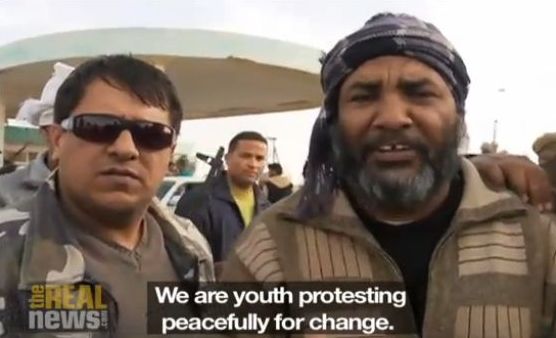
What caused the Libyan revolution of 2011? This is the “big question” that motivates my research. At one level, the answers are simple. The Qaddafi regime has been in power for four decades. Most Libyans are tired of its oppression, and of the way it channels economic resources and opportunities to Qaddafi loyalists. With Tunisia and Egypt as inspiration, young, Facebook-using Libyans organized peaceful demonstrations on February 17. After the regime responded with bullets, a revolution began.

That’s the straightforward narrative. It is, I believe, correct. But it doesn’t tell the full story. Many people around the world live under oppressive and corrupt governments, but most of them don’t launch revolutions. Moreover, it’s one thing to protest — as people are doing across the Arab world this year — but it’s quite another to mobilize an armed revolution against a government that has had an iron grip on power for 41 years, with tens of thousands putting their lives at risk.

Why has the Libyan revolution of 2011 has unfolded the way it has? Why now? What concerns do ordinary Libyans have? How do they see the world? Who are the people willing to put their lives on the line to get rid of Qaddafi? Why do some Libyans remain loyal to the Qaddafi government? And what factors might determine whether this revolt succeeds? To answer such questions, we need a textured understanding of Libyan society in 2011, and of the way revolutions happen in the age of Facebook, satellite TV, and mass media. That’s why I’m here.

In one of Ryan’s most recent posts, he describes what has made this an “accordion war” in which day by day, the front swings west and east as the small oil towns west of Benghazi have been repeatedly and quickly liberated by rebels and then just as quickly retaken by Gaddafi forces.

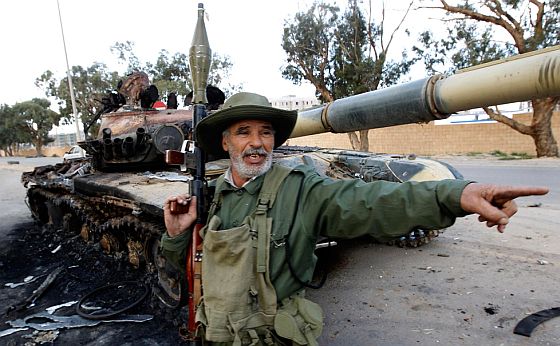
The fact that the young men in this revolution are now most often referred to as “rebels” obscures the fact that this was and remains a civilian uprising. Most of these men have probably had less experience handling and using weapons than the average gun-owning American. And some of these “rebels” don’t even have guns!

Although they contain a few well-trained military units such as Al-Sa’iqah (the special forces who joined the opposition in Benghazi), the vast majority of the rebels are civilians with no military training whatsoever. “I’d never fired a gun in my life before this revolution,” one 25-year-old fighter from Al-Marj told me. “If Gaddafi found you with so much as a bullet, he’d throw you in jail.”

Those rebels fighting at the front don’t even receive military training before they go. “How’d you learn to use that thing?” I asked one 38-year-old engineer I met in Ras Lanuf carrying a Kalashnikov. “And what kind of training did you get when you joined the rebels?”

“Training?” He laughed. “Man, I just watched someone else and figured it out on my own.”

Right now, there’s no military apparatus outside Tripoli with the organizational capacity to train the rebels anyway.

“And where did you go to enlist?” I asked.

He laughed again. “There’s no enlisting. You just find a weapon and show up at the front. If you don’t have one, you wait until another rebel dies and you take his. Or you get some off of Gaddafi’s dead soldiers.” Indeed, I’ve seen groups of rebels scouring the remains of Gaddafi’s bombed-out tanks and armored personnel carriers along the coastal highway, looking for usable weapons and ammunition.

Later, Khalid, a 39-year-old bakery owner from Benghazi who makes a mean bowl of bean soup, showed me his Russian-made Kalashnikov. It was made in 1976.

So what are the ragtag rebels and their outdated weaponry good for? In particular situations – such as street battles within Benghazi against Gaddafi’s Al-Fadil Brigade, or in occasional skirmishes with the Revolutionary Committees – these ragtag fighters have proven effective on an individual level. Many have demonstrated incredible courage, such as Mahdi Ziu, an overweight father of two who loaded his own car with propane and drove it into a heavily defended gate to save his comrades’ lives and help take the main military base in Benghazi. Everyone in Benghazi remembers Mahdi as a hero.

But I’ve seen rebels hightailing it too. A few days ago, at the front 20 km east of Brega, I was interviewing Faraj, a 19-year-old unemployed rebel who lives at home with his parents. He didn’t appear to be armed.

“Do you even have a gun?” I asked. “Yeah – well, you know how it is. There’s about one Kalashnikov for every four or five of us rebels,” he said. “Mine’s in the car.”

We heard one shell land several miles away. A column of black smoke rose slowly.

Faraj and his comrades jumped in their cars and fled, even before the gang of foreign photographers with me stopped clicking their shutters.

The rebels’ rapid retreat is not so much a function of cowardice, but of the fact that when Gaddafi’s shells begin falling, there’s not much they can do. Word on the street here is that even the best of the rebels’ artillery can travel only 20 km, whereas Gaddafi’s newer weaponry fires 40 km. In such situations, amateurs with machine guns and light anti-aircraft guns mounted on their pickup trucks, whether brave or not, have little to contribute.

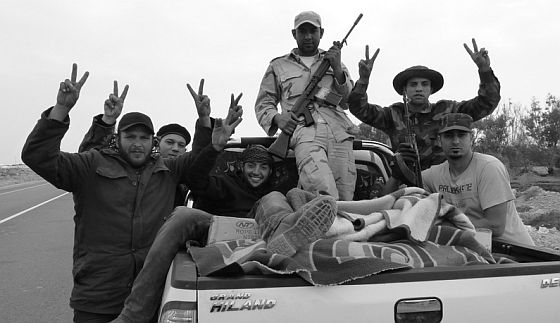
So when the rebels retreat in the face of enemy fire, they retreat fast. When shells start to land within earshot and Gaddafi’s forces appear to be advancing, a line of Toyota Hilux pickup trucks and ordinary passenger cars – Hyundais and Kias and Chevys and ancient Datsuns that barely putter along — pull U-turns and start streaming away from the front.

These are the ragtag rebels: groups of four or five buddies who carpool to the front in their own cars, high-school teachers and high-school dropouts, petroleum engineers and shepherds and bakery owners, packing their own lunches of macaroni and beans, wearing construction helmets and plastic safety goggles for protection, and carrying the Kalashnikovs they managed to buy on Benghazi’s streets.

When the shells start to land, most of these guys leave the fighting to the trained forces who are at the very front lines. There’s not much for them to do anyway. Those at the very front lines, like Al-Sa’iqah, are better equipped, better trained, under organized command, and know what to do in the face of enemy fire. Lacking training, weaponry, and command the ragtag rebels are mostly useless in these situations. There’s no point for them to stick around and risk getting blown up.

Hence the accordion war.

Facebooktwittermail

Libya offers lessons for both Washington and al Qaeda

It’s hard to observe Washington without concluding that it fosters a political culture in which stupidity — or at least feigned stupidity — is a prerequisite of success. Pity the politician who might be so naive as to imagine that the appearance of intelligence would boost his or her political fortunes.

It has thus been painfully predictable that as murmurs of an al Qaeda presence on the front lines in Libya have gained wider currency, the only response would be fear and caution. Thus the New York Times reports:

Secretary of State Hillary Rodham Clinton, who pushed the president to intervene in Libya, was described by an administration official on Thursday as supremely cautious about arming the rebels “because of the unknowns” about who they were and whether they might have links to Al Qaeda.

Ring all the alarm bells — links to al Qaeda — God forbid the political penalty for venturing anywhere near there!

But here’s a radical idea: what if links to al Qaeda in Libya turned out to be a good thing?

A report in the Wall Street Journal says that Abdel Hakim al-Hasady, an influential Islamic preacher and high-school teacher who spent five years at a training camp in eastern Afghanistan, now oversees the recruitment, training and deployment of about 300 rebel fighters from the eastern Libyan town of Darna.

Islamist leaders and their contingent of followers represent a relatively small minority within the rebel cause. They have served the rebels’ secular leadership with little friction. Their discipline and fighting experience is badly needed by the rebels’ ragtag army.

Among his followers, Mr. Hasady has the reputation of a trained warrior who stood fearlessly at the front ranks of young protesters during the first days of the uprising.

And his discourse has become dramatically more pro-American, now that he stands in alliance with the West in a battle against Col. Gadhafi.

“Our view is starting to change of the U.S.,” said Mr. Hasady. “If we hated the Americans 100%, today it is less than 50%. They have started to redeem themselves for their past mistakes by helping us to preserve the blood of our children.”

Mr. Hasady also offered a reconsideration of his past approach. “No Islamist revolution has ever succeeded. Only when the whole population was included did we succeed, and that means a more inclusive ideology.”

Facebooktwittermail

Getting Libya’s rebels wrong

When Tunisians rose up calling for the end of Zine El Abidine Ben Ali’s rule, beyond the fact that the revolution caught the rest of the world by surprise, no one seemed in much doubt about what the Tunisian people wanted. And shortly after that when Egyptians rose up demanding that Hosni Mubarak must go, the sentiment of the people was not hard to decipher. But when it comes to Libya, many Western observers seem willing to accept the analysis provided by Saif al-Islam Gaddafi who in February warned that Libya is not Tunisia or Egypt and that those challenging his father’s rule would be inviting civil war.

On Wednesday, Libyan officials took Western journalists on a trek 70 miles south of Tripoli to witness the carnage wrought by NATO airstrikes. After 10 days of attacks, Siraj Najib Mohamed Suessi, an 18-month old baby, was described by a New York Times reporter as “the first specific and credible civilian death” from allied airstrikes.

Beyond the earshot of Gaddafi government officials, relatives of the child were clear about who they blamed for his death:

“No, no, no, this is not from NATO,” one relative said, speaking quietly and on condition of anonymity for fear of retaliation. The Western planes had struck an ammunition depot at a military base nearby, he said, and the explosion had sent a tank shell flying into the bedroom of the baby, a boy, in a civilian’s home. “What NATO is doing is good,” he said, referring to the Western military alliance that is enforcing a no-fly zone in Libya.

[A]s government minders directed journalists to the house and the grave, several residents approached foreign correspondents to tell them surreptitiously of their hatred of Colonel Qaddafi.

“He is not a man. He is Dracula,” one said. “For 42 years, it has been dark. Anyone who speaks, he kills. But everyone here wants Qaddafi to go.”

Denunciations of this type have been reported from all over Libya — even now some people in Tripoli are willing to cautiously speak out.

The objective of Libya’s rebel fighters is not hard to decipher — they aim to get rid of Gaddafi — unless, that is, you are skeptical about the intentions of the foreign powers.

Steve Coll says: “It is not clear what the rebels are fighting for, other than survival and the possible opportunity to take power in a country loaded with oil.”

David Bromwich sees the hand of the CIA at work and echoes of the Bay of Pigs.

While the Obama administration itself is raising the specter of al Qaeda:

President Obama’s top two national security officials signaled on Thursday that the United States was unlikely to arm the Libyan rebels, raising the possibility that the French alone among the Western allies would provide weapons and training for the poorly organized forces fighting Col. Muammar el-Qaddafi’s government.

Defense Secretary Robert M. Gates made his views known for the first time on Thursday in a marathon day of testimony to members of Congress. He said the United States should stick to offering communications, surveillance and other support, but suggested that the administration had no problem with other countries sending weapons to help the rebels, who in recent days have been retreating under attack from pro-Qaddafi forces.

Secretary of State Hillary Rodham Clinton, who pushed the president to intervene in Libya, was described by an administration official on Thursday as supremely cautious about arming the rebels “because of the unknowns” about who they were and whether they might have links to Al Qaeda.

Najla Abdurrahman, a Libyan-American writer and activist, expresses her frustration about the confused image of the Libyan pro-democracy movement that is frequently being presented in the media.

The recent remarks by Adm. James Stavridis, NATO’s supreme allied commander for Europe, alleging “flickers in the intelligence of potential al Qaeda, Hezbollah” among Libyan rebels are indicative of a disturbing trend in much of the discussion — and reporting — on Libya over the past several weeks. Ambiguous statements linking Libya and al Qaeda have repeatedly been made in the media without clarifying or providing appropriate context to such remarks. In many instances, these claims have been distorted or exaggerated; at times they have simply been false.

The admiral’s comments — and the subsequent headlines they’ve engendered — represent a new level of irresponsibility, constructing false connections, through use of highly obscure and equivocal language, between al Qaeda and Libyan pro-democracy forces backed by the Transitional National Council. The latter is itself led by a group of well-known and respected Libyan professionals and technocrats. Even more far-fetched is the admiral’s mention of a Hezbollah connection, or “flicker” as he put it.

Statements of this type are troubling because of their tendency to create alarmist ripple effects. Such perceptions, once created, are nearly impossible to reverse and may do serious damage to the pro-democracy cause in Libya. The fact that Stavridis qualified his comments by stating that the opposition’s leadership appeared to be “responsible men and women” will almost certainly be overshadowed by the mention of al Qaeda in the same breath. One must wonder, then, what precisely was the purpose of the admiral’s vague and perplexing remarks.

There is a pressing need for officials and commentators to clarify connections drawn between Libya and al Qaeda and to provide more accurate and responsible analysis. And it’s not just Stavridis’s reference to al Qaeda that is problematic; two similar claims making the media rounds also demand careful scrutiny. One involves an anti-Qaddafi organization called the Libyan Islamic Fighting Group (LIFG) that confronted and was crushed by the regime in the 1990s. The second involves disturbing reports of the recruitment of Libyan youth by al Qaeda in Iraq, some of whom left their homes to take part in suicide missions in that country. Neither is connected to the current uprising, but both are frequently mentioned when discussing it.

Facebooktwittermail

Holy moly — here comes another 9/11. Fears of blowback from Libya

Reuters reports that the CIA is now on the ground in Libya and the Obama administration is considering arming Gaddafi’s opponents.

This is some of the reaction from Firedoglake‘s David Dayen:

I can just go back to the American track record of arming insurgencies and it’s not very good. Robert Gates knows well from his experience in the CIA that when he armed or helped to arm the Afghan rebels to try to get the Soviets out, that didn’t end well for us.

I just don’t think we know enough about this opposition which is, I think, substantly [sic] different than the opposition that was in peaceful protest throughout the Arab world, to make that assessment that we are going to provide armaments and then possibly trainers to deal with the situation.

Let’s unpack this statement because there’s an awful lot embedded in it that reveals widely held assumptions among those who view Libya as a special case and believe what is going on there can be viewed as intrinsically different from the wider Arab democratic revolution.

Dayen refers to Gaddafi’s opponents as “insurgents” — a term generally applied to armed opponents of a legitimate government. But anyone who doubts that the Gaddafi government has lost its legitimacy needs to explain why so many of Libya’s ambassadors have defected — now even Moussa Koussa, Libya’s foreign minister, has fled to the UK.

I doubt that Dayen’s purpose is to legitimize Gaddafi, but this kind of language certainly delegitimizes those who are fighting to free Libya from Gaddafi’s control. Moreover, to refer to the US’s track record in supporting insurgencies is another way of casting aspersions at the Libyans by invoking memories of the counter-revolutionary anti-Sandinista Contras in Nicaragua or the Mujahadeen out of whose ranks al Qaeda later emerged.

Dayen then makes the ambiguous assertion that on the one hand we don’t know enough about the Libyan opposition, yet apparently we do know enough about them to know that they are intrinsically different from the revolutionaries in Egypt and Tunisia.

Are we supposed to distrust any uprising in which Facebook doesn’t play a prominent role?

Or is the fundamental reason for mistrusting the Libyan rebels because they fairly swiftly armed themselves after hundreds of unarmed demonstrators had been killed?

What would have placated the fears of those in the West who now view with suspicion Libya’s rag-tag army of rebel fighters? That several thousand more would have been killed before the peaceful protest movement transitioned into an armed uprising?

The fact is that peaceful protest movements can be crushed. The partial successes in Tunisia and Egypt says less about the indomitable force of people power, than it says about the extent to which the autocratic leaders in each of those countries were constrained in how far they could go in violently suppressing their own people while still retaining Western support. The West’s support for tyrants is utterly cynical but it does have limits and thus the awkward maneuvering we have repeatedly witnessed as Washington sustains its ties to old autocratic allies while simultaneously coaxing them to institute enough reforms that they might guarantee their survival.

In spite of his relatively brief political rehabilitation, Gaddafi knew from the moment the uprising burst forth, that he wasn’t going to get any protection from the West and thus he did not fear condemnation for his brutality. That’s why he has shown no restraint in his fight for survival. It would be ironic if he now found he was being offered a lifeline by those who oppose Western intervention in Libya.

Facebooktwittermail

Assad sticks to the Mubarak survival plan

Israelis are quietly confident that Bashar al-Assad can survive the unrest in Syria but fear what might follow if he falls. Assad himself seems confident he can use the same tactics as Mubarak, but with the opposite outcome.

The Guardian reports from Damascus:

The Syrian president, Bashar al-Assad, has blamed foreign conspirators and satellite television channels for two weeks of widespread unrest that has challenged his regime, but in a highly anticipated speech he offered none of the reforms that protesters had hoped for.

The address to the Syrian parliament, which was seen as the most critical of his 11 years as president, left observers bemused and is unlikely to placate protesters who have taken to the streets across the country demanding democratic freedoms and more accountability from the government.

Assad said “conspirators” were pushing an “Israeli agenda”, but offered no further details. “There is chaos in the country under the pretext of reform,” he said.

He said changes to governance in Syria could be considered, but only after the country became more stable and economic conditions improved. However, he offered no timeframe for change, or specific details about what his government would offer.

“We tell those asking for reform that we were late in implementing it but we will start now. Priorities are stability and improving economic conditions,” he said.

Assad had been widely expected to revoke a four-decade-old emergency law, which was put in place by his father and used by security forces to crush dissent ever since. He was also thought to be preparing to lift restraints on the media, which are largely government-controlled.

On Wednesday morning the al-Watan newspaper, which is close to the regime, predicted Assad would “reassure all Syrians and draw clear features for the coming phase”.

Nicholas Blanford reports:

Looking relaxed and smiling and chuckling frequently, Assad delivered his hour-long address to the Syrian parliament in a customary conversational tone. His statements were interrupted every few minutes by parliamentarians standing up and offering individual messages of support and loyalty. He entered and exited to a standing ovation, and was frequently interrupted with coordinated applause.

“Only God, Syria, and Bashar!” chanted the parliamentarians.

“I am talking to you at an exceptional time. It is a test that happened to be repeated due to conspiracies against the country,” said Assad, who became president in 2000 on the death of his father, Hafez al-Assad. “God willing, we will overcome [this conspiracy].”

He acknowledged that reforms have been slow in coming, but he blamed the delay on traumatic distractions over the past decade, including the 2000-2005 Palestinian intifada, the September 2001 attacks, the invasions of Afghanistan and Iraq, and the Hezbollah-Israel war of 2006.

“We know we haven’t addressed many of the people’s aspirations,” he said, adding that not all those that have taken to the streets since March 15 were “conspirators.”

He said that Syria was heading toward “another phase” and admitted that proceeding without reforms “destroys the country.” He said that there would be new measures to combat corruption and “enhance national unity” and that the new government would announce them later. The previous government of Prime Minister Najib Ottari resigned Tuesday, and a new premier is yet to be named.

Patrick Seale writes:

By all accounts, the debate about how to deal with the growing protests has led to increasingly violent confrontations inside the regime between would-be reformers and hard-liners. The outcome of this internal contest remains uncertain.

What is certain, however, is that what happens in Syria is of great concern to the whole region. Together with its two principal allies, the Islamic Republic of Iran and the Lebanese Shiite resistance movement Hezbollah, Syria is viewed with great hostility by Israel and with wary suspicion by the United States. The Tehran-Damascus-Hezbollah axis — of which Syria is the linchpin — has long been seen by many leaders in the region as the lone bulwark against Israeli and American hegemony. With backing from Washington, Israel has sought to smash Hezbollah (notably through its 2006 invasion of Lebanon) and detach Syria from Iran, a country Israel views as its most dangerous regional rival. Neither objective has so far been realized. But now that Syria has been weakened by internal problems, the viability of the entire axis is in danger — which could encourage dangerous risk-taking behavior by its allies as they seek to counter perceived gains by the United States and Israel.

If the Syrian regime were to be severely weakened by popular dissent, if only for a short while, Iran’s influence in Arab affairs would almost certainly be reduced — in both Lebanon and the Palestinian territories. In Lebanon, it would appear that Hezbollah has already been thrown on the defensive. Although it remains the most powerful single movement, both politically and on account of its armed militia, its local enemies sense a turning of the tide in their favor. This might explain a violent speech delivered earlier this month by the Sunni Muslim leader and former prime minister Saad Hariri, in which he blatantly played the sectarian card.

Cheered by his jubilant supporters, he charged that Hezbollah’s weapons were not so much a threat to Israel as to Lebanon’s own freedom, independence, and sovereignty — at the hand of a foreign power, namely Iran. The Syrian uprisings may have already deepened the sectarian divide in Lebanon, raising once more the specter of civil war and making more difficult the task of forming a new government, a job President Michel Suleiman has entrusted to the Tripoli notable, Najib Mikati. If Syria were overrun with internal strife, Hezbollah would be deprived of a valuable ally — no doubt to Israel’s great satisfaction.

Meanwhile, Turkey is deeply concerned by the Syrian disturbances: Damascus has been the cornerstone of Ankara’s ambitious Arab policy. Turkey-Syria relations have flourished in recent years as Turkey-Israel relations have grown cold. Prime Minister Recep Tayyip Erdogan and his foreign minister, Ahmet Davutoglu, have actively sought to mediate local conflicts and bring much-needed stability to the region by forging close economic links. One of their bold projects is the creation of an economic bloc comprising Turkey, Syria, Lebanon, and Jordan — already something of a reality by the removal of visa requirements as well as by an injection of Turkish investment and technological know-how. A power struggle in Syria could set back this project; and regime change in Damascus would likely put a serious dent in further Turkish initiatives.

The Los Angeles Times reports:

As popular unrest threatens to topple another Arab neighbor, Israel finds itself again quietly rooting for the survival of an autocratic yet predictable regime, rather than face an untested new government in its place.

Syrian President Bashar Assad’s race to tamp down public unrest is stirring anxiety in Israel that is even higher than its hand-wringing over Egypt’s recent regime change. Unlike Israel and Egypt, Israel and Syria have no peace agreement, and Syria, with a large arsenal of sophisticated weapons, is one of Israel’s strongest enemies.

Though Israel has frequently criticized Assad for cozying up to Iran, arming Lebanon’s Hezbollah movement and sheltering leaders of the Palestinian militant group Hamas, many in Israel think their country might be better off if Assad keeps the reins of power.

“You want to work with the devil you know,” said Moshe Maoz, a former government advisor and Syria expert at Hebrew University’s Harry S. Truman Institute for the Advancement of Peace.

Several Israeli government and military officials declined to speak in depth about Assad, fearing any comments could backfire given the strong anti-Israel sentiments in the Arab world. That’s what happened when some Israeli officials attempted to bolster Egyptian President Hosni Mubarak before he resigned Feb. 11.

“Officially it’s better to avoid any reaction and watch the situation,” said Maj. Gen. Amos Gilad, the Defense Ministry’s policy director. He predicted Assad’s regime would survive the unrest.

David W. Lesch notes:

When I met with him during the Syrian presidential referendum in May 2007, he voiced an almost cathartic relief that the people really liked him. Indeed, the outpouring of support for Mr. Assad would have been impressive if he had not been the only one running, and if half of it wasn’t staged. As is typical for authoritarian leaders, he had begun to equate his well-being with that of his country, and the sycophants around him reinforced the notion. It was obvious that he was president for life.

Facebooktwittermail

The myth of tribal Libya

The Interim Transitional National Council has presented its “vision of a democratic Libya.”

Simon Tisdall offers a cynical review:

The two-page declaration, published to coincide with the international conference on Libya’s future hosted in London by David Cameron, aspires to all that is correct, admirable, and fashionable in the booming nation-building and nation-shaping business.

Key words such as “transparent”, “green”, “empowerment”, “tolerance” and “rights” litter its elegantly turned paragraphs. Wholesome sentiments about the social contract, civil society, political obligation, and the true awfulness of discrimination (in any shape or form) inform its ineffably do-gooding intent.

There will be those who see here further evidence that Libya’s rebels — or at least their self-appointed leaders — are politically suspect.

Libya, we have often been told, is different. It is not Tunisia or Egypt. It’s poster boys haven’t been Google executives, but youth brandishing AK-47s. If we know the name Shabaab — which just means youth — it’s most likely been in reference to Somalia.

If Egypt came to symbolize the good revolution, the Libya for those most disturbed by Western involvement has in many ways become the bad revolution — or no revolution at all, but a civil conflict whose roots are tribal.

Like warnings issued to nineteenth century European missionaries about the perils of advancing into darkest Africa, the word “tribal” is used to signal no-go territory and a cause that will inevitably turn sour.

Alaa al-Ameri,” a British-Libyan economist and writer, explains why this tribal analysis is an insult to the Libyan people.

In the last few weeks, the word “tribalism” has been used extensively in the context of the Libyan democratic uprising – a spectre looming over the country, embodying the devil we don’t know. This was first introduced into the public mind by Saif al-Islam Gaddafi during his address last month in which he threatened the bloodshed and destruction that his father’s regime has let loose on the Libyan people.

Disappointingly, this image of Libya as a backward tribal society with no real national identity has been picked up and amplified by many western pundits and politicians – often as part of their reasoning why military and material support for the Libyan revolution is a bad idea.

The regime has two main aims for this repeated yet baseless claim. First, people in western Libya are largely cut off from outside media and so the assertion that the Gaddafi regime has the allegiance of regional leaders is intended to crush the confidence of those wishing to rise up in their own cities. Second, it aims to confuse outsiders into believing that the Gaddafi regime is all that’s holding together a fractured and disunited people. Images of Iraq are the desired effect. Among some in the international press and anti-interventionist movements, Gaddafi’s aims seem to have been met without much resistance.

So what is the reality and importance of tribes in modern Libya? For much of Libyan history, tribal groupings were indeed a prevalent social phenomenon. However, when we refer to tribes in today’s Libya we are simply talking about a historical structuring of regional communities in a massive country. These are not the same as distinct sub-national groupings that supersede people’s national identity as Libyans – an identity defended at great cost against fascist Italy and postwar attempts by the British to divide the country.

Tribal leaders traditionally served more or less as local magistrates, arbitrating disputes over land and commerce and presiding over family law. Once Gaddafi came to power, he introduced the revolutionary councils, which he used as a means of incentivising splits between regions and even families. Whereas previously your tribal identity was unlikely to make you rich or powerful, it could now be used as a stepping stone to a position of national authority, wealth and power through election to a revolutionary council.

The big picture, therefore, is not one of long-established tribal conflict. Most recent instances of disputes based on tribal loyalty have been fomented and engineered by Gaddafi’s national policy of divide and conquer. As long as people squabbled among themselves, they were far less likely to unite against him. Well, now they have, and in a desperate attempt to survive, Gaddafi, his son and his close circle are repeatedly attempting to raise the ghost of a rejected system of patronage which they used to maintain power for decades.

Some of those opposed to the international military intervention seem to have unwittingly taken up this call as the defining characteristic of modern Libya. This handy bit of received wisdom, however, needs to be tested against actual events. If there is any genuine tribal separatism among the democratic movement, why are they still fighting to liberate the west of the country? They now have air cover, they control oil-producing areas and have an interim government with international recognition and support.

If tribalism were at the heart of this effort, why risk it all to liberate towns in the west? Why have towns such as Misrata, Zawiya and Zintan, all a short drive from Tripoli, chosen to join the National Transitional Council – a fledgling government on the other side of the country that has so far been powerless to support them or come to their aid?

Is this a tribal act or the brave statement of people taking a stand against a tyrant in solidarity with their fellow Libyans?

One must also remember who sparked this revolution – it was young people, mostly under 30 years of age, who’ve lived their entire lives in urban centres. How many Glaswegians under 30 know or care from which clan they originated? On what basis, other than cultural stereotyping, do commentators presume that the young people of Benghazi, Misrata and Tripoli are any different? Which tribal allegiance was Mohammad Nabbous – a citizen journalist who established the independent internet television station Libya Alhurra in the early days of the revolution – serving when he was shot dead by a sniper at the age of 28 while reporting on the bogus ceasefire cynically announced by the Gaddafi regime on 19 March?

I’d like to ask those who are regurgitating and magnifying the “tribal” propaganda of the Gaddafi regime through the international press – how many Libyans have you consulted about this? How many Libyans who are not members of the Gaddafi regime, not in the middle of a pro-Gaddafi rally in Green Square or some fortified suburb of Tripoli, not under the watchful eye of a pro-Gaddafi minder, have expressed the views you’re repeating in your articles and interviews? As we struggle to liberate ourselves from this horrific regime, you brand us with names hastily acquired from last-minute reading. Tripolitania and Cyrenaica – find me a Libyan who’s ever used those terms to describe their country.

By labelling us as “tribal” you effectively dismiss the notion that our uprising has anything to do with freedom, democracy or human dignity. Do you place narrow regional loyalties above these values? I’m sure you would reject any such characterisation, and naturally so. Please do us, as Libyans, the courtesy of allowing us the same human characteristics you attribute to yourselves.

Facebooktwittermail

Does the US have a strategic interest in the success of the Arab democratic revolution?

One of the most pernicious effects of the Bush era was that the neocons succeeded in turning so many progressives into realists.

Before Bush, “the national interest” was correctly viewed as the abiding concern of insular conservatives. It meant that Americans should be concerned with the rest of the world only in as much as anything going on out there could impact American interests — above all this meant American economic interests.

Now we have liberals and progressives who seem to have somehow discovered their William F Buckley Jr within — their preeminent concern has become the national interest. It’s all well and good to go and intervene in Libya, but does this serve United States’ national interests?

If realism was meant to be the antidote to neoconservatism, it’s definitely been overrated.

A neoconservative looks into a mirror and thinks he’s looking at the future. A realist looks into the future and can only see the past.

The neocon’s preeminent thinker, Robert Kagan, gave Obama this rave review after his speech on Libya last night:

With his speech tonight, President Obama placed himself in a great tradition of American presidents who have understood America’s special role in the world. He thoroughly rejected the so-called realist approach, extolled American exceptionalism, spoke of universal values and insisted that American power should be used, when appropriate, on behalf of those values. I was particularly pleased to see him place Libya in the context of the Arab Spring. This is the part of the equation that the self-described realists have missed. While in isolation acting to defend the people of Libya against Moammar Gaddafi might not seem imperative, it is in the broader context of the revolutionary moment in the Middle East that U.S. actions take on greater significance. Tonight the president began to place the United States on the right side of the unfolding history in the region.

The president also deserves credit for showing, once again, how bold and effective U.S. leadership can pave the way for multilateral efforts. He has been right to insist that others take their fair share of the burden, but he has also made clear that American leadership was essential, even indispensable.

This was a Kennedy-esque speech.

Meanwhile, Fred Kaplan at Slate was equally enthusiastic — but for different reasons:

President Barack Obama’s speech on Libya Monday night was about as shrewd and sensible as any such address could have been.

Some of his critics hoped he would outline a grand strategy on the use of force for humanitarian principles. Some demanded that he go so far as to declare what actions he would or would not take, and why, in Syria, Bahrain, and other nations where authoritarian rulers fire bullets at their own people. Still others urged him to spell out when the air war will stop, how we’ll exit, who will help the Libyan people rebuild their country after Qaddafi goes, and what we’ll do if he doesn’t go.

These are all interesting matters, but they evade the two main questions, which Obama confronted straight on. First, under the circumstances, did the United States really have any choice but to intervene militarily? Second, for all the initial hesitations and continuing misunderstandings, would the actions urged by his critics (on the left and right) have led to better results? For that matter, have any presidents of the last couple of decades dealt with similar crises more wisely?

The answers to all those questions: No.

Curiously, Obama left out any mention of the rebel fighters. They could be forgiven for now wondering whether this is mostly because Washington is reluctant to place itself alongside images of young (and not so young) men wearing keffiyehs, carrying AK-47s and RPGs.

The closest Obama came to clearly delineating the relationship between the US intervention and the Libyan revolution was here:

… America has an important strategic interest in preventing Gaddafi from overrunning those who oppose him. A massacre would have driven thousands of additional refugees across Libya’s borders, putting enormous strains on the peaceful – yet fragile – transitions in Egypt and Tunisia. The democratic impulses that are dawning across the region would be eclipsed by the darkest form of dictatorship, as repressive leaders concluded that violence is the best strategy to cling to power. The writ of the UN Security Council would have been shown to be little more than empty words, crippling its future credibility to uphold global peace and security. So while I will never minimize the costs involved in military action, I am convinced that a failure to act in Libya would have carried a far greater price for America.

Now, just as there are those who have argued against intervention in Libya, there are others who have suggested that we broaden our military mission beyond the task of protecting the Libyan people, and do whatever it takes to bring down Gaddafi and usher in a new government.

Of course, there is no question that Libya – and the world – will be better off with Gaddafi out of power. I, along with many other world leaders, have embraced that goal, and will actively pursue it through non-military means. But broadening our military mission to include regime change would be a mistake.

The US and its allies have taken sides in Libya, but holding back from making regime change the coalition’s military goal shouldn’t be seen as merely a PR gambit designed to protect the mission’s chosen branding: “humanitarian intervention”.

The rebels now have a fighting chance of winning, but the revolution itself cannot be completely outsourced to foreign powers.

As for the idea that the US has a strategic interest in the success of the wider revolution, I’m not about to claim that having previously displayed such a lack of interest in the rights of ordinary people across the region, the US has now been reborn as the indispensable champion of democracy that the neocons claim. But the emerging democracies across the Arab world will be keenly aware of the role that the US has had in advancing or obstructing this historic trend.

An effort to get on the right side of history has less to do with demonstrating America’s moral character than diminishing the depth of its untrustworthiness in the eyes of those it has long abused.

Facebooktwittermail

How soon before Gaddafi expels the foreign press?

For a couple of weeks now, Libyan authorities have clearly believed that a carefully chaperoned foreign press corps could be useful for presenting images to the world suggesting that, at least in Tripoli, Colonel Gaddafi does not lack popular support.

That hasn’t stopped reporters complaining about the restrictions that prevent them from real news-gathering and naturally the government’s blatant effort to control reporting has become a story itself. But an incident today inside the hotel where the press spends much of its time sequestered, has effectively ripped back the veil. It looks like it’s going to be just a matter of time before all the foreign press gets kicked out of Gaddafi-controlled Libya.

The New York Times reports:

A Libyan woman burst into the hotel housing the foreign press in Tripoli on Saturday morning in an attempt to tell journalists that she had been raped and beaten by members of Col. Muammar el-Qaddafi’s militia. After struggling for nearly an hour to resist removal by Colonel Qaddafi’s security forces, she was dragged away from the hotel screaming.

“They say that we are all Libyans and we are one people,” said the woman, who gave her name as Eman al-Obeidy, barging in during breakfast at the hotel dining room. “But look at what the Qaddafi men did to me.” She displayed a broad bruise on her face, a large scar on her upper thigh, several narrow and deep scratch marks lower on her leg, and marks that seemed to come from binding around her hands and feet.

She said she had been raped by 15 men. “I was tied up, and they defecated and urinated on me,” she said. “They violated my honor.”

She pleaded for friends she said were still in custody. “They are still there, they are still there,” she said. “As soon as I leave here, they are going to take me to jail.”

For the members of the foreign news media here at the invitation of the government of Colonel Qaddafi — and largely confined to the Rixos Hotel except for official outings — the episode was a reminder of the brutality of the Libyan government and the presence of its security forces even among the hotel staff. People in hotel uniforms, who just hours before had been serving coffee and clearing plates, grabbed table knives and rushed to physically restrain the woman and to hold back the journalists.

Ms. Obeidy said she was a native of the rebel stronghold of Benghazi who had been stopped by Qaddafi militia on the outskirts of Tripoli. After being held for about two days, she said, she had managed to escape. Wearing a black robe, a veil and slippers, she ran into the Rixos Hotel here, asking specifically to speak to the news service Reuters and The New York Times. “There is no media coverage outside,” she yelled at one point.

“They swore at me and they filmed me. I was alone. There was whiskey. I was tied up,” she told Michael Georgy of Reuters, the only journalist who was able to speak with her briefly. “I am not scared of anything. I will be locked up immediately after this.” She added: “Look at my face. Look at my back.” Her other comments were captured by television cameras.

A wild scuffle began as journalists tried to interview, photograph and protect her. Several journalists were punched, kicked and knocked on the floor by the security forces , working in tandem with people who until then had appeared to be members of the hotel staff. A television camera belonging to CNN was destroyed in the struggle, and security forces seized a device that a Financial Times reporter had used to record her testimony. A plainclothes security officer pulled out a revolver.

Two members of the hotel staff grabbed table knives to threaten both Ms. Obeidy and the journalists.

“Turn them around, turn them around,” a waiter shouted, trying to block the foreign news media from having access to Ms. Obeidy. A woman on the staff shouted: “Why are you doing this? You are a traitor!” and briefly put a coat over Ms. Obeidy’s head.

There was a prolonged standoff behind the hotel as the security officials apparently restrained themselves because of the presence of so many journalists, but Ms. Obeidy was ultimately forced into a white car and taken away.

“Leave me alone,” she shouted as one man tried to cover her mouth with his hand.

“They are taking me to jail,” she yelled, trying to resist the security guards, according to Reuters. “They are taking me to jail.”

Questioned about her treatment, Khalid Kaim, the deputy foreign minister, promised that she would be treated in accordance with the law. Musa Ibrahim, a government spokesman, said she appeared to be drunk and mentally ill. “Her safety of course is guaranteed,” he said, adding that the authorities were investigating the case, including the possibility that her reports of abuse were “fantasies.”

Charles Clover of The Financial Times, who had put himself in the way of the security forces trying to apprehend her, was put into a van and driven to the border shortly afterward. He said that the night before he had been told to leave because of what Libyan government officials said were inaccuracies in his reports.

Facebooktwittermail

What does social science tell us about intervention in Libya… or much else?

Stephen Walt writes:

Before France, Britain, and the United States stumbled into its current attempt to dislodge Muammar al-Qaddafi from power in Libya — and let’s not kid ourselves, that’s what they are trying to do — did anyone bother to ask what recent social science tells us about the likely results of our intervention?

I doubt it, because recent research suggests that we are likely to be disappointed by the outcome. A 2006 study by Jeffrey Pickering and Mark Peceny found that military intervention by liberal states (i.e., states like Britain, France and the United States) “has only very rarely played a role in democratization since 1945.” Similarly, George Downs, and Bruce Bueno de Mesquita of New York University found that U.S. interventions since World War II led to stable democracies within ten years less than 3 percent of the time, and a separate study by their NYU colleague William Easterly and several associates found that both U.S and Soviet interventions during the Cold War generally led to “significant declines in democracy.” Finally, a 2010 article by Goran Piec and Daniel Reiter examines forty-two “foreign imposed regime changes” since 1920 and finds that when interventions “damage state infrastructural power” they also increase the risk of subsequent civil war.

The best and most relevant study I have yet read on this question is an as-yet unpublished working paper by Alexander Downes of Duke University, which you can find on his website here. Using a more sophisticated research design, Downes examined 100 cases of “foreign imposed regime change” going all the way back to 1816. In particular, his analysis takes into account “selection effects” (i.e., the fact that foreign powers are more likely to intervene in states that already have lots of problems, so you would expect these states to have more problems afterwards too). He finds that foreign intervention tends to promote stability when the intervening powers are seeking to restore a previously deposed ruler. But when foreign interveners oust an existing ruler and impose a wholly new government (which is what we are trying to do in Libya), the likelihood of civil war more than triples.

It’s not as though Susan Rice and Samantha Power lack grounding in the social sciences, but if President Obama, when being pressed to authorize an urgent intervention in Libya, had responded by calling for a report to see what useful lessons social scientists had drawn from previous interventions, his request might have been greeted with an exclamation: “give me a break!” or at least a polite admonition: “we don’t have the time.” But even if the situation was not quite as urgent, how much could social science reveal about the situation in Libya?

The problem is, social science isn’t science. In real science, you can test theories by running multiple experiments, changing the variables and comparing the different outcomes. You can’t prove that something is true if there are no means by which it could be proved false. In this case, all a social scientist can do is posit a number of what are deemed to be parallel cases, pointing to the outcomes there and then and predict a similar outcome in Libya.

But whatever generalizations you want to make, it’s hard to dispute the Colonel Gaddafi is one of a kind and however important the lessons from history might be, they do no more than suggest a number of possible outcomes. Indeed, we do well to remember that only a matter of weeks ago scholarly opinion was quite confident in asserting that Egypt was not ripe for revolution. History is not a process of endless repetition and there are periods of change when it becomes foolish to predict with much conviction what is going to happen.

In real life we make choices and the nature of most major decisions is that they foreclose the possibility of backtracking and finding out the consequences of each alternative.

The US and its allies chose to intervene in Libya and now those who doubt the wisdom of that choice can second guess it and make all sorts of claims about how things would have worked out better if that choice had not been made. These are to a significant degree idle forms of speculation because they involve making unprovable claims. There is no parallel reality in which we can observe what would have happened had UN Res. 1973 not passed and the intervention thus not occurred. The only incontrovertable statements are of the kind, we wouldn’t be spending $300 million a week on an intervention in Libya if we hadn’t intervened in Libya. You don’t say?

Walt concludes, “these various scholarly studies suggest that the probability that our intervention will yield a stable democracy is low, and that our decision to intervene has increased the likelihood of civil war.”

Who claimed this intervention was going to lead to a stable democracy? At this point there has yet to be a clear consensus on what the operation’s aims are. I haven’t heard any grand predictions about the dawn of a new democracy. This sounds like another instance of the echoes of Iraq emerging out of silence.

As for the risks of civil war, many of the skeptics claim that a civil war had already started. That, I would dispute.

By the point at which Gaddafi’s power briefly appeared not to reach far out of Tripoli, the uprising had all the marks of being a popular and contagious rejection of his rule. Had he not already anticipated the need to guard his power by relying on foreign mercenaries, he would most likely already be gone.

And as for the danger of instability in a post-Gaddafi Libya, the truth is that in a revolutionary society, stability is just another name for oppression. It might look appealing to those of us outside for whom it has tangible benefits, like lower oil prices, but for the Libyans who have risen up to overthrow a tyrant, the prize of freedom they seek is all that they can now accept — even if the price is turmoil.

Does that sound like Rumsfeld’s view of the collapse of civil order in Baghdad? Superficially, but the rupture Iraq went through was triggered by an American invasion. This time around the outsiders have inserted themselves (though not literally stepped in) at a point at which a society was already being ripped apart. We didn’t make this happen.

Facebooktwittermail

Syrians have broken the fear barrier

Some observers of the Libyan uprising, particularly those who now most vehemently oppose intervention, insist that Libya is a special case, really a civil war rather than a revolution — the implication being that if Gaddafi were to crush his opponents, then the wider Arab revolution would not suffer a major setback.

Activists involved in the uprising that has now started in Syria indicate that, on the contrary, the fate of Libya has very much been in their minds. Fearing that a Gaddafi victory in Libya would make it more difficult to plead their case for revolution to the Syrian people, activists launched demonstrations this month, instead of allowing several more weeks for organization, as they had earlier intended.

David Hirst writes:

In whichever countries it has already broken out – from Yemen, whose President Saleh is suffering new, perhaps even terminal reverses, to Libya, where Colonel Gaddafi defies the military “crusaders” from the west – the Arab democratic revolution pursues its seemingly inexorable, if chequered, course. But is it yet another country’s turn now? Of all Arab regimes, none more resembles those of former presidents Mubarak and Ben Ali than President Assad and the ruling Ba’athists of Syria; and, after their fall, his 51-year-old “republican monarchy” looked the next most logically in line of candidates to succumb to the Arab uprising.

Yet Assad himself begged to differ. “We are not Egyptians or Tunisians,” he said; Syria might have “more difficult circumstances than most of the Arab countries” but it was “stable”. And outwardly it did remain an island of calm, even as pro-democracy turbulence rocked other Arab countries from the Atlantic to the Gulf. But last week things suddenly changed. A series of small-scale and isolated but audacious protests developed into much larger ones after Friday prayers in a string of Syrian cities.

One, in the southern city of Dera’a, was particularly serious. It had been triggered by the arrest of 15 schoolchildren accused of scrawling anti-government graffiti on city walls, among them that trademark slogan – “the people want the overthrow of the regime” – of the uprisings elsewhere. It was a peaceful gathering but the security services opened fire, killing three. The next day a much larger, angrier crowd – estimated to number as many as 20,000 – turned out for the burial of the previous days’ victims.

Bloomberg reports:

Syrian troops are forcing people to stay at home in the southern city of Daraa after six people were killed in renewed anti-government protests that have swept across the country, Amnesty International said.

“People are being asked through loudspeakers to remain at home or they will be shot,” Neil Sammonds, a researcher on Syria for the rights group, said today by telephone from London. Snipers are enforcing the orders and all the city’s entrances are being watched, he said. “The town is besieged.”

Seven people were also wounded when security forces opened fire earlier today during the funeral of two of those killed during the night in Daraa, according to an Agence France-Presse photographer who visited one of the local hospitals. President Bashar al-Assad sacked Faisal Kalthum, the governor of Daraa, state television reported today.

The rallies in Syria mark the latest extension of the political turmoil that has engulfed the region this year.

Ammar Abdulhamid, a Syrian dissident and democracy activist now living in exile in Washington, DC, writes:

What a difference six weeks make. Back in early February I was asked whether Syria would be next on the growing list of countries to witness a popular revolution. My answer, which came in the form of an article published on Comment is free, was, in essence, “not yet”.

The “day of anger” that exiled opposition figures called for on 5 February fizzled out largely because the networks that were being built on the grounds at the time were not ready to take up such a call. Activists needed time to ensure that they had networks of supporters all over the country and that clear communication strategies and methods were agreed, both within these networks and between them and their supporters in the country and across the world.

Formulating the right messages meant to address the concerns of certain segments within Syrian society, as well as those of the international community, especially with regards to the potential role Islamists would play in a future democratic Syria, was also something that required more time.

These points were being debated online through emails and on various Facebook groups; the main thrust of the debate was not whether a revolution could take place but when. Myself and others were on the side of waiting until mid-summer at least, to give in-country activists more time to organise their networks, while others worked on messaging.

Others were less patient, with some fearing a Gaddafi victory in Libya could make it more difficult to plead our case for revolution to the Syrian people; they pushed for a quicker move. Obviously, seeing that Syria has been caught in the midst of a revolutionary upheaval since the Ides of March, it was this latter side that won the debate.

Maher Arar, an engineer with dual Canadian and Syrian citizenship who was a victim of the Bush administration’s rendition program in 2002, writes:

At the time of his ascent to power in 2000, still only, the young president [Bashar al-Assad] promised major reforms were coming.

Popularly elected by 97% of all votes, Syrians of all stripes thought they finally had a glimpse of hope after the 30-year, iron-fist rule of his father.

Assad pledged he would fight corruption, would guarantee his people more freedom of expression, and would adopt a more liberal market policy. He may have partially succeeded on the latter point but it became clear a few years into his rule that he miserably failed on the first two, leading some Syrians to speculate that the new president was simply a puppet in the hands of his father’s old camp.

Furthermore, Syria’s human rights situation steadily deteriorated under the new ruler, especially after the unofficial alliance with the Unites States to fight al-Qaida, a historically common enemy. For instance, it became clear around 2001 that Syria was a preferred rendition destination for terror suspects. The cases of Hydar Zammar, Ahmed El-Maati, Abdullah El-Malki and my own are only a few examples . Bob Baer, a former CIA official, stated at the time: “If you want a serious interrogation, you send a prisoner to Jordan. If you want them to be tortured, you send them to Syria,” something to which I can personally attest.

Facebooktwittermail

For or against the war in Libya? Neither

The war in Libya did not begin on March 19.

That should not be forgotten because after 112 cruise missiles slammed into Libya’s air defense sites that day and the phrase “shock and awe” started getting tossed around once again, the implication for many observers was that Western intervention in Libya marked the beginning of another American-made war in the Arab world. It didn’t.

If I am asked, do you support the war? Or, do you support the intervention? Or, are you an interventionist? My response is: none of the above. They are all misleading questions.

By the week beginning March 13, the collapse of the Libyan revolution and the beginning of a major and very bloody assault on Benghazi were imminent. For anyone to believe in the likelihood of a massacre leading to thousands of deaths, did not depend on the political impact of dubiously sourced newspaper reports or how effectively highly questionable intelligence could be presented. Nor did it depend on ascribing to Muammar Gaddafi the intent to invade other countries or supply terrorists with weapons of mass destruction. Indeed, pretty much the only way one could avoid coming to the conclusion that Benghazi and its population of close to a million was in a position of immense danger would have been by avoiding reading the news.

Towns and cities along the Libyan coast that only days before had been liberated by a rag-tag army of protesters-turned-freedom-fighters, were being reclaimed by Gaddafi’s forces one by one as the rebels were pushed back towards Benghazi. The uprising had not been fully crushed, but it was in the process of rapid collapse.

When the members of the UN Security Council discussed the issue last week, debate did not revolve around whether the situation was urgent but on whether any consensus could be reached on how the international community could effectively respond to this emergency and prevent an assault on Benghazi. Since by that point there seemed no plausible way to protect the city other than by military force, the core issue became whether there was any validity to the claim that the fate of Benghazi had become an international responsibility.

In the end, no member of the Security Council was willing to assume a position which would effectively had said: what happens inside Libya’s borders is not our concern. Those who doubted that their concerns could be met through some form of military action, abstained.

In the wider arena of political debate, opposition to intervention in Libya has come primarily from those who are ideologically opposed to military intervention. Implicitly, their argument runs from the general to the particular.

Military intervention is always entered into with unrealistic optimism, inevitably has unintended consequences and will necessarily do more harm than good. Intervention in Libya will simply reaffirm what has universally already been shown to be true.

What about Benghazi?

The less said the better. Who knows, perhaps their plucky fighters would have been able to keep Gaddafi’s forces at bay. Perhaps Egypt would eventually have intervened.

What about the repeated appeals from the rebels?

From who? Who are these people? Is Libya really part of the wider Arab uprising or is this just a civil war in which the losing side wants our help?

“[W]e know nothing about the opposition. It ain’t Egypt,” declares Michael Ratner. As a hard-headed attorney, he says the only circumstance in which intervention in Libya could be justified would be “in response to genocide.”

It’s questionable whether a massacre of any size would cross that legal threshold, so Ratner’s message to the people there essentially amounts to this: sorry guys, you’re on your own.

And what about the impact the crushing of the Libyan uprising might have on the wider Arab revolution?

This for me is one of the most important questions. It’s clear that in Tunisia, Egypt, Yemen, Bahrain and Libya, everyone is fighting their own fight. It is also clear that there is a sense of solidarity that spans the Arab uprising — that the examples of Tunisia and then Egypt demonstrated to the region as a whole that ordinary people rising up en masse can in just a few weeks topple ruthless dictatorial regimes.

If Gaddafi stays in power he will demonstrate that popular support, enthusiasm, the use of social media, desperation and even the willingness to take up arms, will not necessarily be enough to bring down a dictator who is ruthless enough to set no limit on how much violence he is willing to use to crush his opponents.

This is a message that will disempower everyone now on the streets across the region, protesting to win their political rights. At the same time it will encourage every threatened regime and the security apparatus upon which each depends, to maintain their faith that violence can continue to sustain the status quo.

How intervention in Libya will ultimately impact the Arab democratic revolution we don’t know, but Gaddafi’s position is more vulnerable than it was a week ago. Success for Libya’s revolutionaries is far from guaranteed but they now have what is perhaps the most they can or should hope to derive from outside support — a fighting chance.

Facebooktwittermail

Leaving Gaddafi a way out

If Sarkozy, Cameron and Obama believe that Gaddafi’s demonization makes the war legitimate in the eyes of domestic audiences which might otherwise lack interest in the fate of Libya, the West will have needlessly restricted the range of acceptable outcomes to this war.

Even at this point, there should be some effort to open up as many exit methods possible both for the Libyan leader and those around him. If Gaddafi’s only options are to cling to power or be killed, he will without doubt fight to the finish. If he can be convinced he won’t win he also needs to be enticed by the credible possibility that there remains a way out — one that’s more appealing than facing trial in The Hague.

Gaddafi is too vain to be serious about martyrdom. I don’t believe he is ready to die, and if that is indeed the case then his desire to live should be seen as an advantage that his adversaries should exploit.

Simon Tisdall focuses on the implications of the expressions of personal animosity that the war’s Western leaders are directing at Muammar Gaddafi.

Now the missiles and B52s have begun their dreadful work, Gaddafi knows, if he didn’t already, that he’s in a fight to the finish – and for him, there may be no escape. His course of action in the coming days will be influenced by this realisation, and may be consequently more extreme and more aggressive than otherwise.

His defiant overnight statement, when he condemned the “crusader colonialism” afflicting his country, was clearly aimed at Arab and Muslim world opinion in particular, and the non-western world in general (major countries such as China, India, Brazil and Germany have not supported the intervention). Regime claims about mounting civilian deaths will play big there, Iraq-style. Gaddafi will press his propaganda advantage for all its worth.

The demonisation of Gaddafi has made it impossible for western leaders to countenance his continuation in power. But without the ground invasion they have pledged not to undertake, he could well survive as the overlord of western and southern Libya following a de facto partition, hostile, vengeful and highly dangerous.

This seems to be his plan. Far from giving up or drawing back, Gaddafi escalated the fighting around Benghazi at the weekend. Rather than abandon cities such as Zawiya, as Obama demanded, he is reportedly moving his troops into urban areas where they can less easily be targeted from the air. Meanwhile, his apparent willingness to use “human shields”, his threats of retaliation across the Mediterranean area, and his designation of the whole of north Africa as a “war zone” raises the spectre of possible terrorist attacks and an alarming regression to his old ways.

Gaddafi has personalised this war, too. And he is not going to go quietly. Military superiority in the air will count for nothing if pro-regime army and air force units, militia and security forces, and civilian and tribal supporters who have remained loyal refuse to turn on him or kick him out of Tripoli. By its determination to “get Gaddafi”, the west has made this a fight to the death – and death may be a long time in coming.

Chris McGreal reports:

Benghazi woke on Saturday morning to discover that its wild celebrations over the UN security council’s declaration and Gaddafi’s calling of a ceasefire on Friday were premature. Residents had imagined the city was saved by the west’s threat of air strikes unless Gaddafi halted his attacks on Libya’s rebellious towns.

But at dawn the dictator’s army was fighting its way into the country’s second-largest city of about 700,000 people using rockets and tanks.

As the shells fell, rattling nerves and buildings, a single question emerged time and again. On occasions it was delivered as a baffled plea by middle-aged men gathered on Benghazi’s seafront as they anxiously awaited the latest word on the fighting. At other times, the question was shouted in anger by young men manning the barricades and facing the threatened onslaught with Kalashnikovs and petrol bombs.

“Where are the air strikes? Why is the west waiting until it is too late?” asked Khalid el-Samad, a 27-year-old chemical engineer, who shook his finger in fury. “Sarkozy said it. Obama said it. Gaddafi must stop. So why do they do nothing? Is it just talk while we die?”

Benghazi reeled in shock as the rebels initially fell back and then fought hard to contain the assault while artillery fire rocked parts of the city for much of the day.

Dozens of people were killed, among them the civilians the UN resolution was pledged to protect, and hospitals treated an even larger number wounded. As the fighting intensified, thousands fled east towards the Egyptian border in cars, pick-up trucks and buses crammed with people and what was most precious or essential – bedding and cooking pots.

Alongside the angry questions over the lack of air strikes was bafflement that the western powers had apparently been duped into believing Gaddafi’s false promise of a ceasefire that bought him time to launch the assault on Benghazi by delaying military action French officials had suggested was imminent.

“In 42 years we learned never to trust Gaddafi,” said Hassan Khalafa, an accountant carrying a Kalashnikov at a checkpoint near the former court that serves as the revolutionary government’s headquarters. “He always lies. The only time he told the truth is when he said he will kill all of us in Benghazi. France and America and the UN have been fooled by him.”

As dusk settled, Gaddafi’s gamble appeared to have failed. In the face of rebel resistance, his army pulled back only to be hit a few hours later by the air strikes. But by then, it was clear that the people of Benghazi will not feel safe until the man who has controlled their country for 42 years is overthrown.

Gaddafi’s prophetic declaration? “All tryants fall under the feet of the people.”

Facebooktwittermail

Operation Odyssey Dawn

A few hours ago I had it mind to note that one of the distinctions of the attack on Libya was that even after it had begun, it had yet to receive a name. The fact that French jets were screeching across the sky above Benghazi, yet TV commentators could not with gravitas preface the announcement of their presence with a suitably grandiose title, did actually underline the fact that warfare is and should be a last resort — not something that can be carefully premeditated and branded as though it was a product for sale.

I guess I should have realized that the naming ceremony was being reserved for the Pentagon, with its compulsion to announce the unleashing of any fusillade of cruise missiles with the title of a summertime Hollywood blockbuster.

Perhaps the strangest and yet most telling piece of messaging is that the US attack would be launched while the commander in chief is on an overseas jaunt.

The message being? That it underlines that the United States is playing a strictly supporting role in this operation? That this is business as usual for America and if the president can enjoy a trip to Brazil while the bombs drop then so should the rest of the country continue with its own distractions? Or, that Obama is so ambivalent about his role that he is much more comfortable simply delegating responsibility to the next man in the chain of command, Secretary of Defense Robert Gates — who happened to make his objections to this operation quite transparent? And if the latter is the case, perhaps this does in a somewhat regal fashion underline that ultimately Obama is the decision maker, not just the deliberator.

Meanwhile, to those who remain spellbound by memories of 2003 I would suggest imagining this:

It’s March 2003, a month after the beginning of the spectacular Iraqi uprising that had begun once again in Basra. Caught by surprise, Saddam loyalists had been pushed back all the way to Baghdad and for a brief period it looked like the regime might collapse. Iraqis across the country were eager to claim their democratic rights, deeply inspired by the fact that to their west, the Saudi royal family had unceremoniously be evicted and to their east, a peaceful democracy movement had led Ayatollah Khamenei to rescind the ideology of vilayat-e faqih and transfer full constitutional power to an elected assembly. Yet although the uprising had swept the length and breadth of Iraq, the enthusiasm of ordinary people could not withstand Saddam’s brutality and his willingness to use all necessary means to reassert control over the country. For a few weeks, irregular forces had fought bravely to defend their gains, but now the Iraqi army was in the process of reclaiming territory, city by city.

George Bush, at that time a president who had not actually launched a war, suggested that America could at least provide a supporting role as, much to everyone’s surprise, Europe formed a coalition including Arab nations intent on preventing Saddam from strangling Iraqi democracy at its birth. Would there have been strong objections in the Middle East or the West?

Facebooktwittermail

Comments on War in Context

For much of the last year, I’ve been wondering whether it’s worth me devoting time to moderating and responding to reader comments. Initially, this issue arose because my coverage of Israel/Palestine was attracting the attention of increasing numbers of Zionist trolls.

In recent days it’s become clear that I’ve alienated a number of readers due to my support for an international military attack on the Gaddafi regime. I’m now getting enough questions and comments thrown at me — many of them perfectly legitimate challenges — that I could easily spend most of my time responding to comments. But if I did that the site would quickly grind to a halt.

One individual has manage to write over 7,000 words in comments in just the last three days! I would commend anyone with that much to say, to start their own blog rather than opt for the convenience of turning someone else’s site into a ready-made soap box.

It’s never been my purpose for War in Context to be some kind of ideological echo chamber where a certain political constituency would be served by the dubious form of satisfaction that comes from having their own opinions confirmed.

At least for now, I’m suspending commenting. I might reconsider my decision at some point in the future, but in the meantime anyone who wants to share with me what they think on any topic relevant to this site, is welcome to send me an email. I may well on occasions use such comments as the basis of a post, exercising my editorial privilege to the same extent as I do in the operation of this site as a whole.

Drop me a line at editor [at] warincontext.org

Facebooktwittermail

Libyans disappoint the anti-war movement and the anti-imperialists

The mere fact that Gaddafi has been served notice that continued military operations will bring reprisals has not been sufficient to persuade him to implement a unilateral ceasefire which he already promised. Benghazi is currently under attack.

Meanwhile, as missiles are coming down on the last refuge of the Libyan revolution, a strange message is going out to the people whose lives are still threatened by Gaddafi’s forces. Social activists and members of the anti-war movement want the revolutionaries to know that they feel betrayed and let down!

There are people in places like Montreal and Chicago who have dedicated their lives — or at least careers, or blogs, or speaking tours — to challenging the mighty forces of Western imperialism, and then the folks in Benghazi hand out an open invitation for NATO to come along and rescue them. Unforgivable!

Max Forte writes:

Elements of the rebel leadership have stained their own name, and stained their revolution. That is inescapable now. But what is damaging to all of us is the narrow, self-centered, provincialism of what is clearly a neo-colonial elite of former regime insiders serving as self-appointed “representatives of the Libyan people,” elites who like the neo-colonized, depend on aid from abroad as part of their self-fulfillment. Cheering for what will be a NATO-led operation, is a validation and legitimation of that organization, and in a time when budgets for education, health, public works, and programs for the poor are all being slashed across the West, they help to validate the need for maintaining heavy military spending. Nobody is out in the streets cheering universities and hospitals, but apparently they are out in the street cheering the bomb. Their provincialism was displayed in their lack of solidarity, or even passing concern, with social justice and anti-war activists in the West, in cases berating those of us who felt we should have a voice — these are, after all, our planes, our bombs, and our political leaders — because all we needed to know was that “Libyans” asked for this intervention. If that is a reflection of the kind of political work and solidarity-building they did at home, then no wonder they had to turn to artificial, prosthetic solutions. Not just the anti-war movement, and the anti-secrecy movement, will be damaged here, as the clock is turned back to 2003 — it is the very meaning of “revolutionary,” which can now be made to include those who would be clients of imperial patrons.

So, the current predicament of the Libyan revolution is not the result of the brutality of the regime and its oppressive rule, but because of its second-rate revolutionary leaders, their lack of political skill and their deficiencies in solidarity-building?

I guess the “fall” of the Libyans actually took place the first day they started shooting back and revealed that they lacked Gandhi’s commitment to non-violence. If only they had possessed the moral strength of their Western supporters-now-turned-critics and realized that Gaddafi could be toppled with pure love.

OK, I’ll dispense with the sarcasm. The fact is, I find it extraordinary, that anyone aligned with any kind of movement whose basis is human solidarity would not have enough empathy to recognize that people whose lives are under immediate threat, do not have the luxury of picking and choosing between possible sources of protection just for the sake of maintaining the ideological purity of their cause.

If revolutionaries in Tunisia and Egypt had been able to join forces with their counterparts in Libya and collectively bring down Gaddafi, that would have been the dream combination. But it couldn’t happen — or at least, it couldn’t happen soon enough.

And the idea that the Arab democratic revolution is now over because of Western intervention in Libya, conveniently skirts over the implications that Gaddafi’s victory might have for the wider revolution.

The Western intervention of the most dangerous and insidious form would be Western non-intervention as autocratic regimes, emboldened by Gaddafi’s success in crushing the Libyan revolution, followed in his footsteps and crushed revolts across the region while the US quietly took comfort in the restoration of “stability.”

Now that the Obama administration has veered off its previously steady and passive response to the region’s uprisings, the remaining regimes have become more — not less — vulnerable. Hence the Arab League’s support for Res. 1973. The Gulf states are desperate to demonstrate how supposedly different they are from Gaddafi because their inequities and centralization of power are so similar. Gaddafi might not indulge in the same level of gross opulence as his royal Arab counterparts, but he shares their fear of political freedom.

Maybe Benghazi is not populated by failed revolutionaries but the failure comes from the outside through a projection of revolutionary aspirations by those who are disappointed by the lack of revolutionary tendencies in their own societies.

The driving force behind the Arab democratic revolution in Libya and elsewhere is not a lofty desire to change the world — it’s simply a hunger among ordinary people to be able to control their own lives.

Facebooktwittermail

What next? How does this end?

How does this end?

The time at which this became a question whose answer could not be avoided was this beginning of this week. It was not in reference to a no-fly zone or any other form of international military action aimed at Libya. It was in reference to Muammar Gaddafi’s advance on Benghazi.

For those who want to draw parallels with Iraq, the equivalent question was: what happens if we don’t remove Saddam? The neocon answer, long before the war had been launched, was that Saddam possessed and was destined to use weapons of mass destruction. How does this end? If we don’t stop Saddam it could end with a mushroom cloud.

In the face of widespread skepticism, Colin Powell had to “prove” the case for WMD in front of the UN Security Council.

This time around, no one had to prove that an attack on Benghazi was imminent and very few were in doubt that if or when it happened there would be a massacre. One could debate how many lives would be lost, but it would have been hard politically or morally to say: here’s the threshold — this becomes a matter of international concern only if it’s reasonable to assume X number of casualties are likely.

As soon as it appeared highly probable that a massacre was a matter of days away, the international debate turned to the question of how this could be prevented.

The answer provided by UN Resolution 1973 is quite persuasive.

How does this end? By a massacre in Benghazi being prevented.

But now there are a flood of other questions — will this operation result in the removal of Gaddafi? What would a post-Gaddafi Libya look like? Which governments are contributing forces for enforcing the NFZ? How will the NFZ be implemented? How long will it take to put in place? What happens if Gaddafi respects a ceasefire but his opponents don’t?

When those who sought and secured the UN authorization to intervene in Libya were, just a few days ago, skeptical about intervention, it’s a bit unrealistic to believe that they now already have all the answers about how this is supposed to play out in theory, let alone predict what will actually happen.

This isn’t the culmination of a long campaign to reshape the Arab world hatched by a cabal of liberal interventionists. It is a chapter in a process that began on December 17 in Tunisia when Mohamed Bouazizi set himself on fire. Not a single person on the planet could have foreseen what that desperate act by a street vendor was going to trigger.

So to those who now vex about an intervention in Libya is going to play out, I would remind them that the drama we are now witnessing and have been following for the last three months has no script — but not only that — the fact that there’s no script is what’s good about it!

Facebooktwittermail

CIA killer gets “pardoned” in exchange for $2 million blood money

In order to make sure Hillary Clinton can enjoy cordial exchanges with her counterparts in Pakistan during her upcoming visit, CIA contractor Raymond Davis just got “pardoned” by the families of the men he killed in late January.

Dawn reports:

The US government did not pay any compensation to the families of two Pakistanis killed by Raymond Davis, US Secretary of State Hillary Clinton said on Wednesday.

She said the US did not pay to win Davis’s release, but she didn’t dispute that the men’s families were compensated.

The News reports:

The families of the murdered men, Fahim and Faizan, accepted the blood money of 2.34 million dollars (equal to Rs200 million) while, according to sources, four US visas were also part of the deal.
[…]
The counsel of the bereaved families, Manzoor Butt alleged that the families of Faizan and Fahim were forcibly brought from their homes to the court.

Lawyers for the families said they had been held on gun-point for four hours at the jail court where Davis was being tried on Wednesday, but had not been allowed to witness proceedings. They were also warned against uttering a word before the media, sources said.

Facebooktwittermail

Saudis move troops into Bahrain to crush pro-democracy movement

CNN opts for the anodyne and official phrasing “Gulf Cooperation Council security forces,” but the troops who just marched into Bahrain are Saudis.

When US Defense Secretary Gates visited Bahrain on Friday, I assume King Hamad bin Issa al-Khalifah gave the US advance warning that his Kingdom would shortly be under something resembling Saudi martial law — just to make sure Washington would voice no more than minimal objections to the latest effort to crush Bahrain’s strengthening democracy movement.

The New York Times reports:

The White House issued a statement on Sunday that said the United States strongly condemned violence that had occurred in Bahrain and Yemen, and added, “We urge the government of Bahrain to pursue a peaceful and meaningful dialogue with the opposition rather than resorting to the use of force.”

And as the Khalifa family and their Saudi overlords ignore this request, what will the White House do? Withdraw the US Fifth Fleet? Not likely!

The Bahrain Youth Society for Human Rights describes the Saudi military presence as “an overt occupation of the kingdom of Bahrain and a conspiracy against the unarmed people of Bahrain.” Even while the White House urges the Bahrain government to engage the opposition in dialogue, no doubt Washington will dismiss the suggestion that Bahrain is now under occupation.

Given that Bahrainis already face brutality from security services — the majority of whom are foreign — I don’t know whether they will find the Saudi presence any more intimidating.

To have an idea of what protesters have been up against in recent days, just watch this video showing an unarmed man being hit by tear gas cannisters shot at point blank range:

GCC and now Arab League support for a no-fly zone over Libya (which they most likely expect will not be imposed), has I suspect, less to do with any concern about the fate of Libya’s revolutionaries than it does in fostering a permissive climate in which the Gulf states’ autocratic rulers can offer each other mutual support in their own efforts to counter the political demands coming from their own subjects. Support for a NFZ provides these monarchies with an opportunity to posture as defenders of Arab freedom at the same time that they suppress Arab freedom. Likewise, by opposing Gaddafi, the Gulf rulers want to cast their dictatorships as benign in contrast to Gaddafi’s brutal rule.

Facebooktwittermail