Author Archives: Paul Woodward

Libya’s armed protest movement at the edge of an abyss

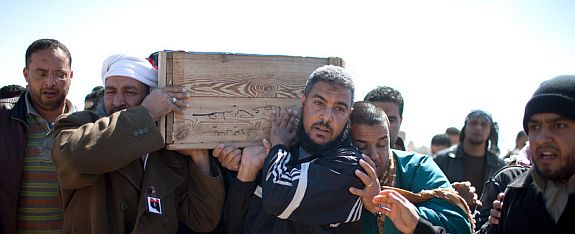
The coffin of Emad al-Giryani, a former petroleum engineer who fought for the opposition in Ras Lanuf. Some Obama administration officials have said privately that the level of violence in Libya would have to approach the scale of that in Rwanda or Bosnia in the 1990s before the United States would engage militarily. (New York Times)

As some commentators solemnly warn about the dangers of a backlash if the Arab democratic revolution was to become poisoned by American involvement in a no-fly zone over Libya, they fail to note a rising chorus inside Libya: anger towards the United States because of its reluctance to become involved.

There’s stunning paradox here. Three decades ago, America’s support of the Mujahadeen in Afghanistan sowed the seeds for a jihad against America. And now, America’s lack of support for a revolution in Libya may eventually have the same effect.

There are those who would on this basis jump to the conclusion that this demonstrates a visceral hatred of America across the Muslim world, but I would argue the exact opposite: that it demonstrates that attitudes towards America in a region in which it exerts so much influence are predominantly pragmatic and rooted in the present tense: they are a response to whatever the United States is doing or is not doing at any particular time.

Anthony Shadid in one of the finest pieces of reporting to come out of Libya since the fighting started, writes from Ras Lanuf:

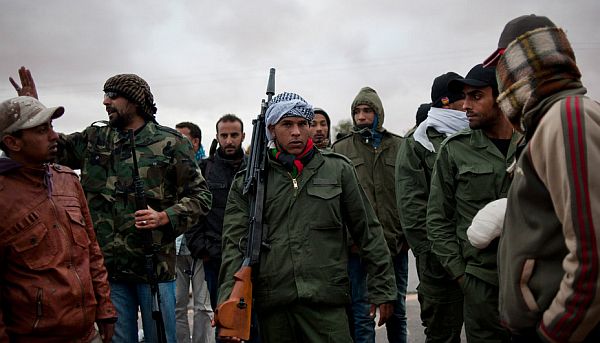
Everyone here seems to have a gun these days, in a lawlessness tempered only by revolutionary ebullience. Young men at the front parade with the swagger that a rocket-propelled grenade launcher grants but hint privately that they will try to emigrate if they fail. Anti-American sentiments build, as rebels complain of Western inaction. And the hint of radicalization — religious or something more nihilist — gathers as the momentum in the three-week conflict clearly shifts to the forces of one of the world’s most bizarre leaders.

“This better not go on any longer,” said Dr. Salem Langhi, a surgeon who was working around the clock at a hospital that was abandoned as Colonel Qaddafi’s forces rushed in. “It will only bring misery and hard feelings among people. Losing lives and limbs doesn’t make anyone optimistic.”

No one seems to know what to call this conflict — a revolution, a civil war or, in a translation of what some call it in Arabic, “the events,” a shorthand for confusing violence. It certainly looks like a war — the thud of shelling in the distance offers a cadence to occasional airstrikes, their targets smoking like oil fires that turn afternoon to dusk. The dead and dismembered are ferried in ambulances driven by medical students.

But especially for the rebels, there is an amateurishness to the fighting that began as a protest and became an armed uprising.

“We’re here because we want to be,” said one of the fighters, Mohammed Fawzi.

His sense of a spontaneous gathering offers a prism through which to understand the war: the front at Ras Lanuf is the most militarized version of Tahrir Square in Cairo, where hundreds of thousands wrote a script of opposition and street theater that brought down a strongman everyone thought would die in office. The fighting here feels less like combat in the conventional sense and more like another form of frustrated protest.

Some vehicles bear the inscription Joint Security Committee, but nothing is all that coordinated across a landscape that seems anarchic and lacking in leadership. Fighters don leather jackets from Turkey, Desert Fox-style goggles, ski masks, cowboy hats and World War II-era British waistcoats.

Slogans are scrawled in the street just miles from the fighting. “Muammar is a dog,” one reads. A man who bicycled for three days from Darnah, far to the east, became a local celebrity at the front. Free food is offered, as it was in the canteens in Tahrir, and fighters rummaged through donated clothes. “These are American jeans!” one shouted.

Young men revel in the novelty of having no one to tell them not to play with guns. “God is great!” rings out whenever a volley of bullets is fired into the air.

“Some guys consider this a lot of fun, and they’re hoping the war lasts a lot longer,” said Marwan Buhidma, a 21-year-old computer student who credited video games with helping him figure out how to operate a 14.5-millimeter antiaircraft battery.

An hour or so before Friday’s headlong retreat, a gaggle of young men in aviator sunglasses and knit caps danced on military hardware, thrusting weapons into the air.

“Where is the house of the guy with really bad hair?” they chanted, referring to Colonel Qaddafi, jumping on spent cartridges and empty milk cartons. “Let’s go down the road and see it!”

The protests across the Arab world have disparate demands — from power-sharing in Bahrain to the dismantling of the regime in Egypt. But the demographic shift they represent as a generation comes of age is their constant. It is no different in Libya, where the young look at their parents’ lives in disgust and vow that they will not live without dignity, a say in their future and a constitution — a catchall term for the rule of law.

Nearly 70 percent of Libya’s population is under the age of 34, virtually identical to Egypt’s, and a refrain at the front or faraway in the mountain town of Bayda is that a country blessed with the largest oil reserves in Africa should have better schools, hospitals, roads and housing across a land dominated by Soviet-era monotony.

“People here didn’t revolt because they were hungry, because they wanted power or for religious reasons or something,” said Abdel-Rahman al-Dihami, a young man from Benghazi who had spent days at the front. “They revolted because they deserve better.”

The seeming justice of that revolt has prompted moments of naïveté — time and again, young people express amazement that Colonel Qaddafi’s forces would deploy tanks and warplanes against them — with an incipient and unpredictable frustration over demands unmet.

The revolt remains amorphous, but already, religion has emerged as an axis around which to focus opposition to Colonel Qaddafi’s government, especially across a terrain where little unites it otherwise. The sermon at the front on Friday framed the revolt as a crusade against an infidel leader. “This guy is not a Muslim,” said Jawdeh al-Fakri, the prayer leader. “He has no faith.”

Deserting officers have offered what leadership there is, along with some men who call themselves veterans of fighting in Afghanistan or an Islamist insurgency in eastern Libya in the 1990s. The shift remains tentative — and far short of the accusations made by Colonel Qaddafi that he faces an insurgency led by Al Qaeda — but even the opposition acknowledges the threat of radicalization in a drawn-out conflict.

Dr. Langhi, the surgeon, said he scolded rebels who called themselves mujahedeen — a religious term for pious fighters. “This isn’t our situation,” he pleaded. “This is a revolution.”

Sitting on ammunition boxes, four young men from Benghazi debated the war, as they watched occasional volleys of antiaircraft guns fired at nothing. They promised victory but echoed the anger heard often these days at the United States and the West for failing to impose a no-flight zone, swelling a sense of abandonment.


Facebooktwittermail

Why Libya matters

A reader here comments:

I have great respect for you and your site but find myself dumbfounded by your enlisting Leon Wieseltier in your campaign to impose (or as you would say “respond to the rebels’ pleas”) a NFZ [no-fly zone] in Libya. The right or wrong of such a move is highly debatable. I for one feel no honest observer of the last twenty years of US/NATO interventions can see much wisdom or efficacy in such action even with the possibility (by no means assured) of it bringing about the desired outcome of rebel (who exactly?) success and the tyrant’s fall. Wieseltier, a deluded apologist for extreme violence (Iraq, Bosnia and where else?) shows his true “humanitarian intervention” colors by solemnly citing the awful Samantha Powers. Her “sad” (for reasons other than those he cites) book “A Problem From Hell” the much lauded whitewash of U.S. slaughter (by simply ignoring it) is the Bible used by the Humanitarian Interventionists to justify violence they -liberals- wish to unleash. One of several major lies Powers propagates is the fiction that the US “stood idly by” in Rwanda when in fact it was very much involved with Kagame and his invasion of Rwanda (to this day supporting his murderous rampages in DRC). If you’re going to insist that US/NATO –responsible for some of the most grievous violations of international law resulting in the deaths of millions of innocent civilians– bomb (see Sec Def Gates) Libya I would respectfully suggest you don’t let neo-con hacks like Wieseltier make your case for you.

I can’t see why you think the US would magically change its spots after decades of murderous policies and merely float above Libya like some guardian angel, do its NFZ thing, make things safe for Libyan democracy and then turn around and fly off into the sunset. Even if the US were to morph into an egalitarian and neutral police force devoid of its mighty imperial baggage the proposed NFZ would be fraught with unnecessary risk of disaster for the Libyan people themselves. No such use of power has ever been so clinically used without serious consequences in the form of entanglements and debts owed not to mention the usual unforeseen tangential horrors of war all highly probable and predictable even if it didn’t involve the players and history in this instance. Powerful state actors are not designed to do work free of charge. The idea that the US can use military force in Libya without further destabilizing the region seems ludicrous to me.

My response:

You refer to my “campaign to impose (or as you would say ‘respond to the rebels’ pleas’) a NFZ in Libya”.

Whether a no-fly zone is imposed disregarding the preference of rebels, or is enforced in response to rebel pleas, is an all-important distinction. I don’t support foreign intervention that would amount to the US or any other outside power simply trying to impose its will on Libya. Neither do I see any evidence that such a move is on the cards. The idea that the US is itching to involve itself in another imperial adventure implies that the US has learned nothing from Iraq.

When Obama says we are slowly tightening the noose on Gaddafi, the operative word is not “noose” — it’s “slowly”. However much he and other Western leaders might profess an interest in seeing Gaddafi ousted, their primary interest is in seeing him restrain his brutality just enough that the outside powers don’t get drawn in.

Note that Obama said the US would stand up for “defenseless civilians” in Libya. In other words, they can’t expect any help from the US unless they stop fighting. That’s not much of an offer to those fighters now retreating from Ras Lanuf. In fact, it’s an invitation for Gaddafi to retake Brenghazi. If its residents try to defend their stronghold, they won’t be defenseless civilians. But if they lay down their weapons, Gaddafi can reassert control without a fight.

Those who are now vehemently opposing a no-fly zone might stop to consider whether they are actually aiding and abetting in what might end up as an opened-ended process to isolate Gaddafi that ultimately causes more harm to the Libyan people than anyone else. For governments which like to structure foreign policies around easy-to-demonize enemies, Gaddafi is more useful remaining in power than in being overthrown.

Although there have been numerous reports in which rebel leaders and individual fighters are directly quoted appealing for swift implementation of a no-fly-zone, I have not seen a single statement in which rebels say they do not want a no-fly zone. There are plenty of statements saying they don’t want foreign troops on Libyan soil — I share their assumption that a no-fly zone will not be a precursor to an invasion simply because the US and NATO are indeed overstretched in Afghanistan. The Pentagon doesn’t want to trumpet its lack of capacity — it prefers to council caution.

If I cite Wieseltier or anyone else, that doesn’t mean I’m endorsing everything that individual has ever written. I trust that the readers here have enough critical intelligence to evaluate statements based on their substance and not the hallowed or hollow authority of the source.

Wieseltier says the White House is “so haunted by past Arab anger at American action in the Middle East that it cannot recognize present Arab anger at American inaction in the Middle East.” The validity of that statement doesn’t hinge on who wrote it. The frustration on the ground in Libya which Wieseltier references from a New York Times report is also evident in this statement from Salem Abdel Wahad, a 30-year-old Libyan rebel soldier:

We find one thing strange: the position of the United states. It’s impossible that the U.S. would not have imposed a no-fly zone, impossible, unless they have some agreement with Gaddafi against the Libyan people.

You say “The idea that the US can use military force in Libya without further destabilizing the region seems ludicrous”. Maybe. But as the Arab democratic revolution develops, we either accept and even dare I say celebrate the fact that this is a hugely destabilizing process, or we say that in the interests of regional stability, it would be much better if these angry Arabs temper their desire for political freedom.

The Arab democratic revolution is bad for America — at least in the short term. It’s pushing up gas prices and it’s harming the economy — and most Americans don’t really give a shit about whether Libyans or pretty much anyone else have democratic freedoms or live under oppression. The same kind of myopic self-interest applies to the US government. So, trying to build up public pressure in support of foreign assistance to Libya’s rebels is not about appealing to idealistic instincts where they are unlikely to be found. It’s about trying to enlist support for a just cause even if that support comes tainted with a bundle of dubious interests.

The fact that I support calls for a NFZ does not mean that I believe this would necessarily decisively tip the balance in the rebels’ favor, but if implemented fast enough it could place an urgently needed obstacle on Gaddafi’s path to victory and give the rebels some breathing space. This is and will remain their fight.

If Libyans could secure their freedom through non-violent protests, Gaddafi would already have been toppled. But since he chose to use violence to maintain his rule, those who had already risen up against him were left with a choice: be rounded up and executed or imprisoned, or to fight for their lives. I think they made the right choice and that their fight is worthy of support by anyone who opposes oppression. Those who believe that stability should be our overriding concern can continue watching and hoping that things quieten down soon. But have no doubt, if Gaddafi holds on, autocratic rulers across the region will have taken note that the West remains, as it has long been, a willing partner in rule by force — even as we profess our love of democracy.

Facebooktwittermail

Poorly informed Libyans make emotive appeal for no-fly zone

Phyllis Bennis writes:

While the Libyan revolt is playing out in vastly different ways, and with far greater bloodshed, it is part and parcel of the democratic revolutionary process rising across the Arab world and beyond. And just as in Egypt, Tunisia, Yemen, Bahrain, and elsewhere, there is no evidence that the Libyan population supports foreign military involvement.

To the contrary, although at least part of the anti-Qaddafi leadership is indeed calling for some kind of military intervention, there appears to be widespread public opposition to such a call. Certainly there is fear that such foreign involvement will give credibility to Qaddafi’s currently false claims that foreigners are responsible for the uprising. But beyond that, there is a powerful appeal in the recognition that the democracy movements sweeping the Middle East and North Africa are indigenous, authentic, independent mobilizations against decades-long U.S.- and Western-backed dictatorship and oppression.

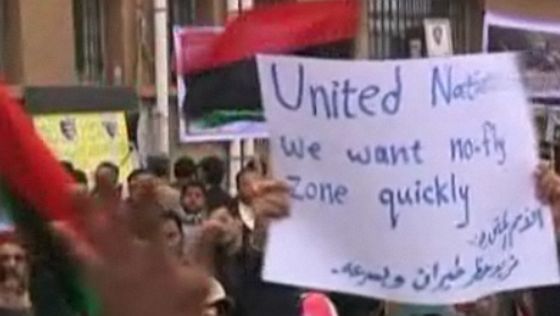
At a demonstration after a funeral for rebel fighters in Benghazi (shown in the video below) protesters can be seen holding up signs saying “Libyans Need No-Fly Zone” and “United Nations: we want no-fly zone quickly.”

Perhaps the signs were being held aloft by foreign agents, or maybe these particular Libyans have not been paying enough attention to Washington’s think tanks and don’t know how difficult a no-fly zone is to operate or what wider military involvement it might entail.
Or, maybe those outside Libya who refuse to make any distinction between a no-fly zone implemented in response to Libyan appeals and a no-fly zone imposed without consultation, simply don’t want to hear what Libyans are saying when it conflicts with the views to which so many non-interventionists seem so deeply attached.

Mustafa Abdul-Jalil, head of the Interim Transitional National Council based in Benghazi, in an interview with CNN reiterated his appeal for the international community to immediately impose a no-fly zone.

Is anyone listening?

There seems to be a highly questionable logic at work here among the opponents of a no-fly zone: if Gaddafi can effectively crush his opponents, then the uprising can’t have had enough popular support, but if there’s sufficient popular support, then no outside support is necessary.

In other words, the message to the revolution is this: if you’re going to win, you won’t need our help, but if you need our help, you probably won’t win. Good luck guys.

Does this have implications for the Palestinians?

Isn’t the Boycott, Divestment and Sanctions movement a form of foreign intervention?

If the Palestinians in the West Bank can’t muster the will or the force to kick out the Israeli occupiers, then maybe outsiders should not be making any effort to tip the balance of power.

Good revolutions, as the White House cynically says, grow organically. And believe me, contrary to all the anti-imperialist fear-mongering that’s going around right now, moderately tough-talk notwithstanding, Obama’s actually firmly on the side of the non-interventionists. The international community and especially the US and even more so the Pentagon, are loathe to get involved in this conflict.

So who do you want to align yourself with? US Defense Secretary No-No-Fly Zone Gates or Pro-No-Fly-Zone Mustafa Abdul-Jalil?

To those who argue that US involvement would undermine the credibility of the revolution, consider this observation by Salem Abdel Wahad, a 30-year-old Libyan rebel soldier:

We find one thing strange: the position of the United states. It’s impossible that the U.S. would not have imposed a no-fly zone, impossible, unless they have some agreement with Gaddafi against the Libyan people.

There is no neutrality in this war. If you don’t support the revolution, you are by default against it.

The debate for and against a no-fly zone is not closed, but it should at least be met on honest terms — without concealing the fact that Libyan appeals for a no-fly zone are only growing louder, and without claiming that a no-fly zone would inevitably lead to a full-blown Western intervention. Can a no-fly zone help or are there more effective alternatives?

Aviation Week spoke to two retired US Air Force generals who say that the difficulties in imposing a no-fly zone have been over-stated by the Pentagon.

Any attack, the two generals contend, would be far more limited in scope and greater in effect than critics have suggested.

“[Defense Secretary Robert] Gates has said that a no-fly zone can’t stop helicopters,” the first Gen. says “That’s wrong. There are only three places in Libya where helicopters can stage, fuel, rearm and re-equip – one in Tripoli, one in Benghazi and one in the eastern oil fields that are in the hands of the rebels. They are all near the coast. All the rest of Libya is barren.

“The U.S. Air Force has specialized in operations to take down integrated air defense, crater runways and destroy helicopter staging areas,” he says. “We know where they are. You can shoot down low-flying helicopter with Aim-9X Sidewinders. The suppression would take 24-48 hours with assets that aren’t being used for Iraq or Afghanistan.

Former US diplomat Peter Galbraith described the way a no-fly zone operates to Mark Colvin on Australia’s ABC News:

PETER GALBRAITH: Generally what happens is that once you’ve declared the no-fly zone, that the target air force is unwilling to fly its aircraft, of the pilots themselves individually are unwilling to fly and so by and large you don’t then need to have patrols to enforce it.

In the case of the no-fly zone that was over Iraq during the time that Saddam Hussein was in power, the Iraqis never actually challenged it, and so it was able to be enforced by a couple of planes patrolling every day.

MARK COLVIN: Do you first though have to take out their radar and other navigational aids?

PETER GALBRAITH: Not necessarily. Again if you declare it, there’s a good chance that the country will choose not to challenge it, or again that the pilots will stop to fly. But it’s also important to remember that in the case of Libya a significant purpose here is psychological. You have a country where a large segment of the population, including of the armed forces, has gone over to the rebellion.

The others may be sympathetic to the rebellion, or certainly are not necessarily committed to Gaddafi who are looking to say, to see how this is going to turn out. And once it’s clear, that Gaddafi is not going to remain in power, they are not going to defend him.

And so one of the purposes of declaring a no-fly zone is to send a signal that the international community is determined that he will not be able to put down the rebellion and this will perhaps hasten his departure or will make people, make it clear that he is not in fact going to succeed in putting down the rebellion.

Facebooktwittermail

Time to support the Libyan revolution

There are those, such as Stephen Kinzer, who regard this as “a highly obscure conflict” — as though we really don’t know enough to judge what’s going on.

When journalists are getting arrested, beaten up and tortured, it does indeed get hard to know what’s going on, but it’s not hard to take sides.

And for those of us simple-minded observers who see what is happening in Libya as just one current in the rising tide of the Arab democratic revolution and who see this trend as historic and inspiring, in spite of the fact that we do not know what it will lead to, it’s not hard to support the Libyan revolution — even though Libya after Gaddafi seems likely to involve a measure of chaos.

The alternative — that Gaddafi might succeed in crushing this popular uprising — would not only be bad for Libya, but bad for countless people across the Arab world who currently dream of the possibility of liberating themselves from the suffocating grip of autocratic power.

Anti-interventionists argue that Libyans can and must win this fight on their own. Self-appointed saviors from the West would indeed be unwelcome. But is that really what’s on the horizon? Is President Obama or anyone else currently recruiting support for a coalition of the willing, eager to liberate Libya and cast out the tyrant?

To intervene is “to interfere, usually through force or threat of force, in the affairs of another nation.”

Libya’s revolutionaries have made it clear that they don’t want a direct military intervention on Libyan soil. But that’s not a rejection of all outside support. Indeed, the Interim Transitional National Council in its founding statement said: “we request from the international community to fulfil its obligations to protect the Libyan people from any further genocide and crimes against humanity…”

How can that request be fulfilled? Would a no-fly zone help? If that is what is explicitly requested, then it does not constitute a form of interference. Assistance in response to an appeal for help is not an imposition.

Instead of pro- and anti-interventionists indulging in an ideological debate, what is called for right now is dialogue — not between these two camps but between representatives of the Libyan revolutionary movement and those national and international bodies which are ready to offer assistance.

Still, there are those who want to draw a sharp divide between military and non-military aid. Food for the hungry but no guns for the fighters. And what about medical assistance for those injured on the battlefield? Or intelligence information? Or jamming communications?

There are all sorts of ways of supporting the fight without dropping bombs, but first you have to take sides. If you’re not willing to take sides, the question about intervention is moot, but if you support the revolution, the only question is: how can Gaddafi be defeated?

Update: CNN now reports:

The head of the interim government in eastern Libya pleaded Wednesday for the international community to move quickly to impose a no-fly zone over Libya, declaring that any delay would result in more casualties.

“It has to be immediate action,” Mustafa Abdul-Jalil told CNN in an exclusive interview in this eastern opposition stronghold. “The longer the situation carries on, the more blood is shed. That’s the message that we want to send to the international community. They have to live up to their responsibility with regards to this.”

Anti-interventionists might prefer to turn a deaf ear to this appeal, or perhaps question Abdul-Jalil’s authority to speak for the revolution, but I’d say it’s time to set aside this outworn debate. It’s time to support the Libyan revolution.

Add your name to this appeal to the United Nations Security Council to impose a no-fly zone over Libya.

Facebooktwittermail

Is a no-fly zone what Libyans want?

Jerry Haber observes:

[L]iberal interventionists are highly selective in their moral outrage, and … suffer from a “Saving-Private-Ryan” complex – they will intervene to save people with whom they identify, people on their side. But if the civilians happen to be on other the side of their tribal divide, they become silent.

Indeed. None of those now calling for a no-fly zone over Libya have called for a no-fly zone over Gaza. The difference clearly hinges on whether one has a greater affiliation with those dropping the bombs or those getting bombed.

But does this shed any light on the question of whether a no-fly zone should be enforced over Libya? Not really.

If we reduce such questions to questions of affiliation then all we will ever do is look to see where “my people” stand. If enough progressives start calling for a no-fly zone, then suddenly it becomes the right thing. But if its advocates are all neocons or neo-liberals, then it can’t be right.

This isn’t analysis — it’s politics reduced to the expression of allegiance.

So, turning back to the question of a no-fly zone, let’s forget about whether Charles Krauthammer or Sarah Palin think it’s a good idea, and let’s at least expose the array of questions embedded in what is falsely being presented as a single question. The question is not simply, do you favor or oppose a no-fly zone being imposed over Libya?

The first question is: who, if anyone, has the capability to effectively impose a no-fly zone?

I can’t give an authoritative answer to that question, but I would assume that a combined NATO force would have the capacity — though I might be wrong, given the commitments in Afghanistan and Iraq. The Arab League now backs a no-fly zone. If some of its members also contributed forces, this might diminish the perception that a no-fly zone was strictly a Western intervention.

The second question is: would a no-fly zone have a desirable impact on the civil war?

So far, Gaddafi does not seem to have relied heavily on his ability to bomb or fire missiles on his opponents, so even if a no-fly zone was already in place, it’s not clear that it would have had much impact on the fight thus far. Even so, if Benghazi ends up getting flattened, no one will be served by the hindsight that a no-fly zone could have prevented that from happening.

The third question is: on whose authority could a no-fly zone be implemented?

This can be viewed as a legal question but it’s really a question of political legitimacy.

As with so many good intentions, there is a narcissistic current underlying many of the current calls for intervention:

  • the perceived need that “we must do something” even when it’s not clear that the proposed course of action can be implemented or will be effective
  • the need to promote the image of the United States as a force for good in the world
  • the need to show the world that the US is capable of limiting the power of tyrants
  • the need for prominent figures to assume a proactive political posture in order to sharpen the contrast with their political opponents

None of these serves well as a lens for focusing on the actual needs of the Libyan people.
In an editorial, The Guardian notes:

Some Libyan rebels have called for a no-fly zone, but until now – and this may change – the mood of the Libyan uprising is that this is their fight and their fight alone. Quite apart from the unwarranted legitimacy a bombing campaign would (once again) confer on the Libyan leader among his rump support in Tripoli and the damage it would do to attempts to split his camp, a major western military intervention could have unforeseen political consequences for the very forces it would be designed to support. A no-fly zone saved lives in Kurdish northern Iraq, but failed to protect the Shias in the south under Saddam Hussein. The moral strength of the Libyan rebels and their political claim to represent the true voice of the people both rest partly on the fact that, like the Egyptians and the Tunisians, they have come this far alone. The revolt is theirs, they are no one else’s proxy, and the struggle is about ending tyranny rather than searching for new masters. Even if Gaddafi’s forces succeed in checking the advance of rebel forces, and the civil war becomes protracted, it is the home-grown nature of this revolt that contains the ultimate seeds of the destruction of Gaddafi’s regime. Thus far, it is Gaddafi and his sons who have had to import hired guns from abroad.

The need to maintain a self-reliant revolution can be overstated. I doubt that any of the weaponry of any value that either side is using right now was manufactured in Libya. This is a fight engaging Libyan hands and hearts but using foreign arms. What those outside the fight must attend to above all else is the Libyan voice.

President Obama has already said that Muammar Gaddafi has lost his legitimacy as Libya’s leader, so an important and necessary precursor to the whole debate about providing military or non-military assistance to Libya’s revolutionaries, is formal recognition of their leadership: the Interim National Transitional Council in Benghazi.

The Council has formed an executive team headed by Dr Mahmoud Jebril Ibrahim El-Werfali and Dr Ali Aziz Al-Eisawi who will represent Libya’s foreign affairs and have been delegated the authority to negotiate and communicate with all members of the international community and to seek international recognition.

The Transitional Council’s third decree dated March 5, ends: “we request from the international community to fulfil its obligations to protect the Libyan people from any further genocide and crimes against humanity without any direct military intervention on Libyan soil.”

That seems to leave open the question about whether a no-fly zone is being sought.

If Obama want to show he’s a man of action, the most decisive thing he could do right now is recognize the Transitional Council and send an official US representative to Benghazi to find out exactly what forms of assistance the revolutionaries seek and see what kinds of assistance the US and its allies might be able to provide.

Facebooktwittermail

The fight for Libya

As a debate continues in Washington and other Western capitals on the necessity, advisability or feasibility of some kind of foreign intervention in Libya, Britain has demonstrated why Libyans of any persuasion have good reason to question the intentions of outsiders.

After a British “diplomatic team” made up of six SAS special forces soldiers and two MI6 intelligence officers was captured four days ago, Libyan revolutionary commanders reasonably asked how they were supposed to know that their captives represented the British government and were not in fact a group of Israeli spies.

According to Guardian sources, the British intelligence and special forces unit were caught near the al-Khadra Farm Company, 18 miles (30km) south-west of Benghazi. A senior member of Benghazi’s revolutionary council said: “They were carrying espionage equipment, reconnaissance equipment, multiple passports and weapons. This is no way to conduct yourself during an uprising.

“Gaddafi is bringing in thousands of mercenaries to kill us, most are using foreign passports and how do we know who these people are?

“They say they’re British nationals and some of the passports they have are British. But the Israelis used British passports to kill that man in Dubai last year.”

The Guardian reported:

The six SAS troops and two MI6 officers were seized by Libyan rebels in the eastern part of the country after arriving by helicopter four days ago. They left on HMS Cumberland, the frigate that had docked in Benghazi to evacuate British and other EU nationals as Libya lurched deeper into conflict. The diplomatic team’s departure marked a perfunctory end to a bizarre and botched venture.

“I can confirm that a small British diplomatic team has been in Benghazi,” said William Hague, the foreign secretary. “The team went to Libya to initiate contacts with the opposition. They experienced difficulties, which have now been satisfactorily resolved. They have now left Libya.”

Audio of a telephone conversation between the UK’s ambassador to Libya, Richard Northern, and a senior rebel leader was later leaked.

Northern suggested in the call that the SAS team had been detained due to a misunderstanding.

The rebel leader responded: “They made a big mistake, coming with a helicopter in an open area.”

Northern said: “I didn’t know how they were coming.”

Despite the failure of the mission, Hague indicated that Britain would continue to try to make contact with the opposition.

“We intend, in consultation with the opposition, to send a further team to strengthen our dialogue in due course,” he said. “This diplomatic effort is part of the UK’s wider work on Libya, including our ongoing humanitarian support. We continue to press for Gaddafi to step down and we will work with the international community to support the legitimate ambitions of the Libyan people.”

The Financial Times reports:

The oppositions’ volunteer forces have shown a willingness to go into battle, but lack the capacity to launch a big offensive. The fighting over the oil towns of Brega and Ras Lanuf has been over in hours and it has not been clear if regime forces tactically withdrew or were defeated. Col. Gaddafi’s forces have air superiority and are better equipped, but appear to be concentrated on regaining control of the western cities of Zawiya and Misurata, and there has been no major battle for cities in the east. The opposition has ruled out any negotiations and know that if they did give up their fight they would probably be the victims of a backlash from the regime.

What started as a popular uprising increasingly bears the hallmarks of a civil war and a country split between the opposition-controlled east and the regime’s strongholds of Tripoli, Sirte and Sabha in the south. Army, air force and navy units have defected and increasing numbers of civilians are donning looted military uniforms and taking up weapons to fight Col Gaddafi’s forces.

The opposition says that if the international community imposes a no-fly zone and launches air strikes against regime forces’ strongholds, they can win although they have repeatedly warned against the deployment of foreign ground troops, saying that would create another Iraq or Afghanistan. But Col Gaddafi has proved that he is willing to use all means to retain power and will not give up without a huge fight.

Reuters political risk correspondent, Peter Apps, reports:

Foreign powers hope threatening Libyan leader Muammar Gaddafi with a war crimes trial at The Hague will help drive him from office, but some worry such talk might instead leave him thinking he has no way out.

The United Nations Security Council voted unanimously to refer Libya to the International Criminal Court following its crackdown on protesters. ICC chief prosecutor Luis Moreno-Ocampo said on Monday attacks on civilians could be a crime against humanity and warranted a full investigation.

But — just as with previous ICC probes into Congolese warlords, Sudan’s president and Uganda’s Lord’s Resistance Army — there is the lingering worry that prosecutions will make compromise and finding a solution harder.

Part of the problem, experts say, is that there is simply no real way to know what impact the threat will have on Libya’s always somewhat erratic leader.

“It’s a difficult balancing act,” said Alia Brahimi, a research fellow on North Africa at the London School of Economics. “There is a risk that taking an absolute moral and legalistic approach and talking about war crimes charges simply reinforces Gaddafi’s idea that he has nowhere else to go and no option to step down. But on the flip side, it sends a strong message to those around him.”

Facebooktwittermail

Obama conspires with Mideast despots to slow the advance of democracy

“Everybody realized that Bahrain was just too important to fail,” said an Obama administration official. And what would cause failure? For the monarchy to be overthrown and replaced with a democracy.

From Washington’s perspective, the people in Bahrain, the other Gulf states and especially in Saudi Arabia cannot be trusted with the power to determine their own futures.

Saudi Arabia is preparing to launch a ruthless crackdown on dissent and when pro-democracy demonstrators get slaughtered, as they probably will, if President Obama has anything to say we can be sure he will go no further than issue one of his usual mealy-mouthed appeals for restraint. The House of Saud has already been given the green light to do whatever it must in the name of preserving “stability.”

The stability to which the Middle East’s rulers and their American friends now cling, is a stability whose foundation is built on graves and torture cells.

Robert Fisk writes:

Saudi Arabia was yesterday drafting up to 10,000 security personnel into its north-eastern Shia Muslim provinces, clogging the highways into Dammam and other cities with busloads of troops in fear of next week’s “day of rage” by what is now called the “Hunayn Revolution”.

Saudi Arabia’s worst nightmare – the arrival of the new Arab awakening of rebellion and insurrection in the kingdom – is now casting its long shadow over the House of Saud. Provoked by the Shia majority uprising in the neighbouring Sunni-dominated island of Bahrain, where protesters are calling for the overthrow of the ruling al-Khalifa family, King Abdullah of Saudi Arabia is widely reported to have told the Bahraini authorities that if they do not crush their Shia revolt, his own forces will.

The opposition is expecting at least 20,000 Saudis to gather in Riyadh and in the Shia Muslim provinces of the north-east of the country in six days, to demand an end to corruption and, if necessary, the overthrow of the House of Saud. Saudi security forces have deployed troops and armed police across the Qatif area – where most of Saudi Arabia’s Shia Muslims live – and yesterday would-be protesters circulated photographs of armoured vehicles and buses of the state-security police on a highway near the port city of Dammam.

Although desperate to avoid any outside news of the extent of the protests spreading, Saudi security officials have known for more than a month that the revolt of Shia Muslims in the tiny island of Bahrain was expected to spread to Saudi Arabia. Within the Saudi kingdom, thousands of emails and Facebook messages have encouraged Saudi Sunni Muslims to join the planned demonstrations across the “conservative” and highly corrupt kingdom. They suggest – and this idea is clearly co-ordinated – that during confrontations with armed police or the army next Friday, Saudi women should be placed among the front ranks of the protesters to dissuade the Saudi security forces from opening fire.

If the Saudi royal family decides to use maximum violence against demonstrators, US President Barack Obama will be confronted by one of the most sensitive Middle East decisions of his administration. In Egypt, he only supported the demonstrators after the police used unrestrained firepower against protesters. But in Saudi Arabia – supposedly a “key ally” of the US and one of the world’s principal oil producers – he will be loath to protect the innocent.

The Wall Street Journal reports:

After weeks of internal debate on how to respond to uprisings in the Arab world, the Obama administration is settling on a Middle East strategy: help keep longtime allies who are willing to reform in power, even if that means the full democratic demands of their newly emboldened citizens might have to wait.

Instead of pushing for immediate regime change—as it did to varying degrees in Egypt and now Libya—the U.S. is urging protesters from Bahrain to Morocco to work with existing rulers toward what some officials and diplomats are now calling “regime alteration.”

The approach has emerged amid furious lobbying of the administration by Arab governments, who were alarmed that President Barack Obama had abandoned Egyptian President Hosni Mubarak and worried that, if the U.S. did the same to the beleaguered king of Bahrain, a chain of revolts could sweep them from power, too, and further upend the region’s stability.

The strategy also comes in the face of domestic U.S. criticism that the administration sent mixed messages at first in Egypt, tentatively backing Mr. Mubarak before deciding to throw its full support behind the protesters demanding his ouster. Likewise in Bahrain, the U.S. decision to throw a lifeline to the ruling family came after sharp criticism of its handling of protests there. On Friday, the kingdom’s opposition mounted one of its largest rallies, underlining the challenge the administration faces selling a strategy of more gradual change to the population.

Administration officials say they have been consistent throughout, urging rulers to avoid violence and make democratic reforms that address the demands of their populations. Still, a senior administration official acknowledged the past month has been a learning process for policy makers. “What we have said throughout this is that there is a need for political, economic and social reform, but the particular approach will be country by country,” the official said.

A pivotal moment came in late February, in the tense hours after Mr. Obama publicly berated King Hamad bin Isa al-Khalifa for cracking down violently on antigovernment demonstrators in Bahrain’s capital. Envoys for the king and his Arab allies shuttled from the Pentagon to the State Department and the White House with a carefully coordinated message.

If the Obama administration did not reverse course and stand squarely behind the monarchy, they warned, Bahrain’s government could fall, costing America a critical ally and potentially moving the country toward Iran’s orbit. Adding to the sense of urgency was a scenario being watched by U.S. intelligence agencies: the possibility that Saudi Arabia might invade its tiny neighbor to silence the Shiite-led protesters, threatening decades-old partnerships and creating vast political and economic upheaval.

“We need the full support of the United States,” a top Bahraini diplomat beseeched the Americans, including Joint Chiefs of Staff Chairman Adm. Michael Mullen, Assistant Secretary of State Jeffery Feltman, Deputy National Security Adviser Denis McDonough, and other top policy makers.

Arab diplomats believe the push worked. Defense Secretary Robert Gates and Secretary of State Hillary Clinton emerged as leading voices inside the administration urging greater U.S. support for the Bahraini king coupled with a reform agenda that Washington insisted would be have to be credible to street protesters. Instead of backing cries for the king’s removal, Mr. Obama asked protesters to negotiate with the ruling family, which is promising major changes.

Israel was also making its voice heard. As Mr. Mubarak’s grip on power slipped away in Egypt, Israeli officials lobbied Washington to move cautiously and reassure Mideast allies that they were not being abandoned. Israeli leaders have made clear that they fear extremist forces could try to exploit new-found freedoms and undercut Israel’s security, diplomats said.

“Starting with Bahrain, the administration has moved a few notches toward emphasizing stability over majority rule,” said a U.S. official. “Everybody realized that Bahrain was just too important to fail.”

The BBC reports:

All protests and marches are to be banned in Saudi Arabia, the interior ministry has announced on state TV.

Its statement said security forces would use all measures to prevent any attempt to disrupt public order.

The announcement follows a series of protests by the kingdom’s Shia minority in the oil-producing eastern province.

Last month, King Abdullah unveiled a series of benefits in an apparent bid to protect the kingdom from the revolts spreading throughout many Arab states.

“Regulations in the kingdom forbid categorically all sorts of demonstrations, marches and sit-ins, as they contradict Islamic Sharia law and the values and traditions of Saudi society,” the Saudi interior ministry statement said.

It added that police were “authorised by law to take all measures needed against those who try to break the law”.

Facebooktwittermail

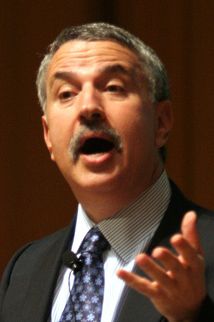
Tom Friedman getting high in Egypt

Muammar Gaddafi has several times claimed that he’s up against a rebellion in which his opponents are high on hallucinogenic drugs. I guess he never saw this or this. Tom Friedman, on the other hand, presents what can only be described as a hallucinogenic view of the revolution in Egypt — a psychedelic vision of young Egyptians inspired by Obama, Israeli democracy, Google Earth, the Beijing Olympics, and Palestinian so-called Prime Minister Salam Fayyad. The New York Times columnist is clearly high on something. Fortunately, Sarah Carr was able to catch up with him before the drug wore off and persuaded Friedman to reveal more.

Future historians will long puzzle over how I was given an international platform to freely pontificate on the Arab people and be remunerated handsomely for it. It is true that I am not the only person in the world who formulates dubious theories based on scant or no evidence which I then harangue people with. Other people do it. They are called taxi drivers. But they are not as rich as me and haven’t been awarded three Pulitizer Prizes.
Since I’ve been here in Egypt I’ve been putting together a list of “the-absolutely-irrelevant forces” that have captured the captive Arab mind and ignited the simmering coals of the instant garden BBQ that is the Middle East. You might ask why, since I am in Egypt, I don’t ask an Egyptian – possibly two Egyptians – about what inspired them to completely ignore my theories on the Arab peoples and take to the streets. The answer is this: I am Thomas Friedman and I write a column in the New York Times.

I started my last extremely important column with an introduction in which I listed tyranny, rising food prices, youth unemployment and social media as the “big causes”. Rather than just stop there, I did a Google “surprise me” search and chose five of the random results for my special “mix of forces” which inspired the Arab mass revolts. These included Barack Obama, Google Earth and the Beijing Olympics.

But there are other critical factors integral to an understanding of my bollocks theory on the Middle East. Here they are:

MY MOUSTACHE – Americans have never really appreciated what a radical thing I did in growing a moustache, long the symbol of Arab male virility. I’m convinced that when Arab men catch a glimpse of my moustache as they bring me my breakfast in my hotel they are inspired and say to themselves: “Hmmm. Let’s see. He’s middle-aged. I’m middle-aged. He’s slightly tanned. I’m roughly the same colour. His name is Thomas. My name is Hussein. He is a prick. I sometimes act like a prick. He is not president of the United States. I am not president of the United States. Lincoln is the capital of Nebraska. Water boils at 100 degrees centigrade. He has a moustache. I have a moustache. Both our moustaches have no voice in my future”. I’d put that in my special mix of hallucinogenic drugs and ingest it. [Continue reading…]

Facebooktwittermail

Rescuing the white people from Tripoli

Ben Plesser spoke to the CBS’s Early Show about the situation at Tripoli’s airport:

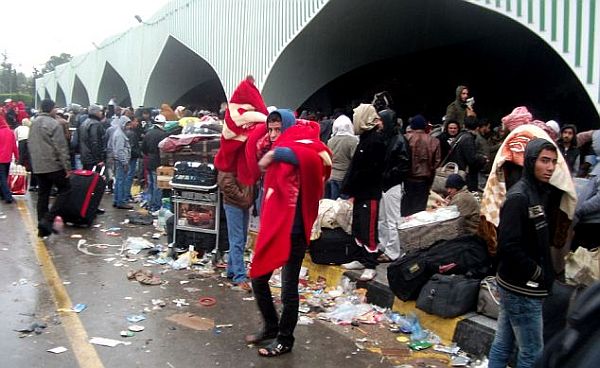
“There are thousands, maybe tens of thousands, of people packed into the terminal, mostly foreign workers. They’re Egyptians, they’re Turks, they’re from Southeast Asia. Every once in a while you see a western face.

“They are living on the floor, wrapped in dirty blankets, they’ve been there for days. And they’re the lucky ones, because they have a roof over their heads,” he said.

Plesser said airport workers were wearing face masks due to concerns about infectious diseases, because no one has had access to facilities or showers, and are living off of whatever scraps or trash they can find. “And these people are basically the lucky ones,” Plesser said.

“Outside the terminal, there are thousands more people trying to inch their way into the terminal. There are policemen with sticks and whips keeping them in line, keeping them away from the terminal doors. There are fights breaking out. They’re living in the trash from days of sitting outside the terminal, just waiting for an opportunity to get out of the country.”

Plesser notes the few “Western” faces in the airport — which, to be blunt, means white people. What else are we to suppose defines a Western face in a crowd of brown faces other than a pale complexion?

There are about 6,000 Americans in Libya, but most hold dual Libyan citizenship, so, according to State Department spokesman PJ Crowley, it’s up to the Gaddafi government whether they will be allowed to leave. Had any managed to reach the airport, Plesser’s snap survey would have overlooked those invisible Westerners.

The New York Times reported:

The scramble by foreigners to leave the country began several days ago, but the number of commercial flights could not keep up with demand. Many countries have been mobilizing military and chartered ships and planes.

After landing in Malta on a flight chartered by the British government, Sam Dewhirst from Leeds who had been teaching English in Libya, described the situation in the Tripoli airport as “hellish.”

While he and other Britons had been able to “jump the queue,” he said, scores of North Africans were still waiting to leave or had abandoned their suitcases on the tarmac in a mad scramble to get on flights. “It was heartbreaking,” he said.

No explanation on how these Britons were able to jump the queue.

And then there’s the inexplicable, inexcusable case of a Canadian flight that landed in Tripoli, found no Canadian’s waiting to get out and so returned to Jordan without a single passenger!

“There were no other citizens from like-minded countries who needed the flight,” said a Canadian government official.

The airport is full of like-minded people — everyone wants to get the hell out of Libya and probably wouldn’t be too choosy about their destination. What is this club of like-minded countries to which Canada belongs? The white club?

Facebooktwittermail

Christian-Muslim unity in Alexandria, Egypt

On Wednesday in Alexandria, a huge Egyptian flag was flown connecting the Coptic al-Qiddissin (Saints) Church to the adjacent mosque in a powerful display of religious and national unity.

On New Year’s Day, the church was the target of a bombing that killed 23 people. The attack was internationally condemned. The Interior Ministry blamed “foreign elements,” and the Alexandria governor accused al Qaida of being responsible, yet in a foretaste of the nationwide protests that were to erupt three weeks later Christians unleashed their rage at the authorities.

Former Interior Minister Habib el-Adly is now facing trial for his alleged role in organizing the bombing.

Facebooktwittermail

Gaddafi’s dialogue with death

Teenagers high on drugs, incited by Osama bin Laden — this is Muammar Gaddafi’s explanation gives for the current challenge to his rule.

What is happening now in Libya is not people’s power, it’s international terrorism led by al-Qaeda … All they want is to kill your kids, that’s what Bin Laden wants, he should be happy now, that’s what he wants.

The Guardian reports:

Rebels are increasing their hold on Muammar Gaddafi’s ailing regime, by shutting down oil exports and mobilising rebel groups in the west of the country as the revolution rapidly spreads. Gaddafi’s hold on power appears confined to parts of Tripoli and perhaps several regions in the centre of the country. Towns to the west of the capital have fallen or are being fought over. Gun battles are taking place between forces loyal to Gaddafi and his opponents in the town of Az-Zawiyah, 30 miles west of Tripoli, according to witnesses. Order is returning to the sacked second city of Benghazi after days of fierce fighting that saw the military defect en masse and virtually all government buildings razed and looted. Gaddafi was expected to make a statement at some point soon…

Nato says it will not intervene in Libya. Its secretary-general, Anders Fogh Rasmussen, says the alliance has received no such requests and that in any case any intervention must be based on a UN mandate. Rasmussen says the turmoil in Libya does not threaten any Nato members, but the conflict could spark a mass refugee crisis.

Gaddafi will commit suicide as Adolf Hitler did at the end of the Second World War rather than surrender or flee, according to a former Libyan cabinet minister.

The claim comes in an interview with former justice minister Mustafa Mohamed Abud Al Jeleil in the Swedish newspaper Expressen:

“Gaddafi’s days are numbered. He will do what Hitler did – he will take his own life.”

Al Jeleil earlier claimed that Gaddafi had ordered the Lockerbie bombing.

When Gaddafi said bin Laden must be happy now, he spoke with an air of resignation — much of his tone of defiance from yesterday having dissipated.

Denial, bargaining, anger, depression — most of the stages of dying are already evident. Al Jeleil may well be right and what we are witnessing now is a tyrant in dialogue with his own death. Acceptance comes as he pulls the trigger.

Facebooktwittermail

Libya uprising

The International Criminal Court has issued a statement that it cannot investigate war crimes occurring in Libya unless the issue is referred to the court by the UN Security Council. It seems unlikely that the UNSC will take this step unless it is also willing to take actions (not simply issue condemnations) in an effort to prevent more war crimes taking place.

Tom Malinowski from Human Rights Watch challenges the claim that the US and its allies lack the leverage required to halt Gaddafi.

There are numerous steps the United States and its allies can take today to affect the immediate calculations of the Qaddafi regime. Europe buys 85 percent of Libya’s oil, after all. And the West largely controls the international financial system through which the Libyan leadership moves its money — and could block transactions with one word from the Treasury Department or other finance ministries. And there’s more: Western governments could say today that they will seek international investigations and prosecutions of Libyan officials who murder their people. And they could offer to provide humanitarian assistance to parts of Libya that have fallen to the opposition.

Qaddafi may rail endlessly about foreign meddling, but the reaction of Western governments clearly matters to his regime. Why else would it have gone to such lengths to hide what it is doing by shutting down the Internet and communications with the outside world?

We should be under no illusion that Qaddafi himself will give in to international pressure at this point. As his brutal tactics show, he is fighting for his life. But Libya’s fate is not in Qaddafi’s hands; it is in the hands of those who must decide, today and tomorrow, whether to follow his orders. Every psychological blow to Qaddafi’s government — whether it is a Libyan official who defects to the opposition or a forceful repudiation of his government by the international community — gives them another reason to refuse to commit further outrages on their leader’s behalf, for which they may be held accountable when the crisis is over.

“Our leverage is limited” is a phrase diplomats use to absolve themselves from responsibility. It is both true — after all, U.S. influence is never unlimited — and utterly irrelevant. The only question the United States and other countries should be asking now is how to use the leverage they have to bring the calamity unfolding in Libya to an end.

Ranj Alaaldin argues in favor of the creation of a no-zone across Libya.

A no-fly zone will ensure Libyan helicopter gunships are not used to dreadful effect against indiscriminate targets like they were during the 1991 uprising in Iraq. It will deprive the regime of the ability to enforce extraordinarily brutal countermeasures from the air, like the bombardment of heavily populated residential areas and the destroying of homes.

As the regime becomes more and more desperate, so too will its response become more brutal. Can the international community depend and pin their hopes on further defections and pilots refusing to carry out such orders, like the two that yesterday sought asylum in Malta? Maybe. But the prudent person would argue that is a risk too grave to take and one that effectively gambles with the lives of thousands. The city of Benghazi, reportedly under the control of the regime’s opponents, has a population of 600,000. It will be the first to be hit and the international community will be unable to do anything but disgracefully watch.

Failure to prevent genocides and massacres around the world has put the international community on the wrong side of history. Yet, this is a chance to prevent another mass atrocity from taking place, a chance for us to take a responsible measure rather than a reactionary one that comes too late. The international community has the capacity to limit Gaddafi’s capacity for mass murder by keeping his bombers grounded.

Frank Gardner describes the “murky network of paramilitary brigades, ‘revolutionary committees’ of trusted followers, tribal leaders and imported foreign mercenaries, who are allowing Gaddafi to retain his grip on power.

Martin Chulov is the first foreign journalist to have reached Benghazi.

Libya’s second city, Benghazi, appears to have fallen beyond the control of Muammar Gaddafi, with the local military defying his regime and monarchy-era flags flying from government buildings.

As the first foreign news organisation to report from so-called Free Benghazi, the Guardian witnessed defecting troops pouring into the courtyard of a ransacked police station carrying tonnes of weaponry and ammunition looted from a military armoury to stop it being seized by forces loyal to the Libyan dictator.

Soldiers brought rockets and heavy weapons which had been used in an assault on citizens in central Benghazi on Saturday as Gaddafi tried to keep control of the city. Doctors in Benghazi said that at least 230 people were killed, with a further 30 critically injured.

There was also the clearest confirmation yet that Gaddafi’s regime used outside mercenaries to try to suppress the rebellion. Adjoining the police station a large crowd gathered in another courtyard. Upstairs, the Guardian saw a number of mercenaries, allegedly flown in the previous week, being interrogated by lawyers and army officials.

An air force officer, Major Rajib Faytouni, said he personally witnessed up to 4,000 mercenaries arrive on Libyan transport planes over a period of three days starting from 14 February. He said: “That’s why we turned against the government. That and the fact there was an order to use planes to attack the people.”

Facebooktwittermail

Israelis fear a peaceful intifada too large to crush

Officially, the main cause of concern the Egyptian revolution poses for Israel is that it might result in the end of the Israel-Egypt peace treaty. A much larger concern however, is that the Arab democratic revolution sweeping the region might inspire Palestinians in larger numbers than ever, to demand their political rights.

Israel’s military forces have had decades of practice containing and crushing uprisings on a smaller scale, but numbers matter. The rising spirit of people power is contagious and as we have witnessed in Tunisia, Egypt, Bahrain and now Libya, the brutality of an authoritarian state’s security apparatus is not enough to crush the desire for freedom in a population that has become fearless.

The Jerusalem Post reports:

Concerned by the prospect of the Palestinians replicating Egypt-style mass demonstrations with dozens of simultaneous marches and protests in the West Bank, the IDF is beginning to build rapid-response forces and to identify vantage points throughout the territories that could be used to contain such protests.

The IDF’s Central Command assesses that the Palestinians could resort to so-called nonviolent resistance, on a scale previously unknown to Israel, in the absence of peace negotiations.

While there is deemed to be some possibility that such demonstrations will take place in the near future in the spirit of Egypt, Tunisia and Iran, a senior officer said it was more likely that the Palestinian Authority would prevent this from happening until after elections in September.

One senior officer said commanders were discussing ways to counter and contain large demonstrations launched simultaneously in different parts of the West Bank.

“We are preparing different responses for different scenarios to think about what we will do if there are, for example, 30 marches of several thousand people each,” the officer said. “This is something we have yet to encounter.”

One step the IDF is taking is to set up rapid-response teams that can quickly maneuver throughout the West Bank and arrive at the scene of a demonstration in its early stages in an attempt to contain it. During the summer, the Border Police are expected to establish a new command in the West Bank after the Arava District is dismantled.

In addition, the IDF is locating strategic hilltops that can be used as vantage points from which the military could deploy reconnaissance and surveillance teams to track developments inside Palestinian towns and cities.

The concern is that in the event of multiple large-scale demonstrations, the IDF will not know how to effectively respond and contain the protests, which could lead to a high number of casualties. As a result, commanders have been instructed to prepare their soldiers mentally for how to respond in such scenarios.

Israel has been keeping a close eye on Palestinian cities in recent weeks since the revolution in Egypt, to ensure that the violence does not spread to the West Bank.

According to intelligence assessments, the Palestinians are currently interested in continuing with their plans to build up and reform the institutions they would require for statehood if they decided to make a unilateral declaration following elections in September.

Even after September, the IDF believes the PA will maintain its high-level and almost daily security coordination with the IDF. But, it is thought, the PA could, at the same time, allow and even possibly encourage civilians to launch so-called nonviolent resistance to delegitimize Israel.

Facebooktwittermail

UN Security Council mirrors White House’s inaction on Libya

The UN Security Council just issued a Presidential Statement on Libya — a collective act of hand-wringing that serves as a substitute for a course of action. With so much concern, so many calls and its limp-wristed urging, this statement could have been written by President Obama himself.

The members of the Security Council expressed grave concern at the situation in Libya. They condemned the violence and use of force against civilians, deplored the repression against peaceful demonstrators, and expressed deep regret at the deaths of hundreds of civilians. They called for an immediate end to the violence and for steps to address the legitimate demands of the population, including through national dialogue.

The members of the Security Council called on the Government of Libya to meet its responsibility to protect its population. They called upon the Libyan authorities to act with restraint, to respect human rights and international humanitarian law, and to allow immediate access for international human rights monitors and humanitarian agencies.

The members of the Security Council called for international humanitarian assistance to the people of Libya and expressed concern at the reports of shortages of medical supplies to treat the wounded. They strongly urged the Libyan authorities to ensure the safe passage of humanitarian and medical supplies and humanitarian workers into the country.

The members of the Security Council underlined the need for the government of Libya to respect the freedom of peaceful assembly and of expression, including freedom of the press. They called for the immediate lifting of restrictions on all forms of the media.

The members of the Security Council stressed the importance of accountability. They underscored the need to hold to account those responsible for attacks, including by forces under their control, on civilians.

The members of the Security Council expressed deep concern about the safety of foreign nationals in Libya. They urged the Libyan authorities and all relevant parties to ensure the safety of all foreign nationals and facilitate the departure of those wishing to leave the country. The members of the Security Council will continue to follow the situation closely.

Maybe a Resolution will come later this week, but even if it does, it’s hard to imagine it will have any immediate impact on the bloodshed in Libya.

A sterner message is coming from eastern Libya or “Free Libya” as it is now being called, where captured mercenaries are being executed.

While foreign governments are focused on evacuating their own nationals, they might consider offering free passage to any of the remaining mercenaries to head back to Chad, Darfur or wherever else they came from — the sooner they pack their bags and get out, the better for everyone.

There are reports in the Arabic press that Egyptian officials have notified Tripoli that Egypt could intervene to protect the estimated two million Egyptians resident in Libya.

One of the strongest calls for action coming out of Washington came from Senator John Kerry:

The Qadhafi government’s use of deadly force against its own people should mean the end of the regime itself. It’s beyond despicable, and I hope we are witnessing its last hours in power. Libyans should have the opportunity to choose leaders who respect their basic rights. The question now is what can be done to send that message clearly and effectively. While it’s true that America has less influence in Tripoli than elsewhere in the region, we’re not without options, particularly in partnership with the broader international community. World leaders must together put Colonel Qadhafi on notice that his cowardly actions will have consequences. First, while Qadhafi himself is irredeemable, his senior military commanders need to know that their acquiescence in atrocities could open them to future international war crimes charges. Second, all American and international oil companies should immediately cease operations in Libya until violence against civilians ceases. The Obama administration also should consider reimposing U.S. sanctions that were lifted during the Bush era. Third, United Nations leadership is on the line. Libya’s mission to the U.N. bravely condemned their own government. … Fourth, the Arab League and African Union have an opportunity to create a new precedent in response to the crisis in Libya.

The most pointed message so far, however, has come from the leading Sunni scholar and TV preacher Sheikh Yousuf al-Qaradawi, head of the International Union of Muslim Scholars. In an interview on Al Jazeera yesterday, he said:

The truth is that I do not want to say anything to Al-Gaddafi, because one should only address people who are reasonable. People who are not reasonable should not be addressed. That man is no longer reasonable. He has been crazy for a long time….

Therefore, I address the Libyan army, which is definitely endowed with faith, manliness, and honor. They must not attack their own people. Who would kill their own people?! Would you sacrifice an entire people for the sake of a madman?! . . .

I hereby issue a fatwa to the officers and soldiers who can kill Mu’ammar Al-Gaddafi: Whoever among them can fire a bullet at him, thus relieving the country and the people of him, should do so. This man wants to annihilate the people, so I am protecting the people.

I rule that whoever can fire a bullet, and relieve us, as well as Libya and its great people, of this man’s evil and danger, should do so.

Facebooktwittermail

Intervention in Libya

Marc Lynch writes:

The unfolding situation in Libya has been horrible to behold. No matter how many times we warn that dictators will do what they must to stay in power, it is still shocking to see the images of brutalized civilians which have been flooding al-Jazeera and circulating on the internet. We should not be fooled by Libya’s geographic proximity to Egypt and Tunisia, or guided by the debates over how the United States could best help a peaceful protest movement achieve democratic change. The appropriate comparison is Bosnia or Kosovo, or even Rwanda where a massacre is unfolding on live television and the world is challenged to act. It is time for the United States, NATO, the United Nations and the Arab League to act forcefully to try to prevent the already bloody situation from degenerating into something much worse.

By acting, I mean a response sufficiently forceful and direct to deter or prevent the Libyan regime from using its military resources to butcher its opponents. I have already seen reports that NATO has sternly warned Libya against further violence against its people. Making that credible could mean the declaration and enforcement of a no-fly zone over Libya, presumably by NATO, to prevent the use of military aircraft against the protestors. It could also mean a clear declaration that members of the regime and military will be held individually responsible for any future deaths. The U.S. should call for an urgent, immediate Security Council meeting and push for a strong resolution condeming Libya’s use of violence and authorizing targeted sanctions against the regime. Such steps could stand a chance of reversing the course of a rapidly deteriorating situation. An effective international response could not only save many Libyan lives, it might also send a powerful warning to other Arab leaders who might contemplate following suit against their own protest movements.

Mark Leon Goldberg responds:

There has been a sort-of coalescing around the idea that a No Fly Zone is useful way to intervene to stop the killing. I am not so sure. While it is true that some of the slaughter has been perpetrated by Libyan air force, air assets alone are not responsible for the killing. If Qaddafi and his inner circle are intent on violently suppressing this revolt, they will use their superior ground forces as well.

A No Fly Zone is a humanitarian half measure. It would let the international community say that it is doing something, but there is very little a No Fly Zone can actually do to stop ongoing slaughter. Using Lynch’s comparisons to slaughters of the 1990s, people need to ask themselves: would a no-fly zone have stopped the Machete wielding Interhamwe from perpetrating the Rwandan genocide? Definitely not. In Bosnia, there was an effective NATO enforced no fly zone over in 1995 when Srebrenica occurred. During the 1999 Kosovo air campaign, as NATO was bombing Serbia, Serb forces accelerated their ethnic cleansing in Kosovo. No Fly Zone’s may be good at enforcing a stalemate like interwar Iraq, but it is lousy at preventing slaughter.

This is not to say there is no utility in trying to enforce one over Libya—as Marc Lynch says, it could be one of several demonstrations of the resolve of the international community (along with multilateral sanctions and, perhaps, a Security Council referral to the ICC.) But we should not delude ourselves into thinking that a no-fly zone is an effective humanitarian response to a mass slaughter event. It is a gesture. Not a response.

If stopping a slaughter is our top priority, then a more robust response is probably required. That means not just preventing airplanes and attack helicopters from flying over Libya, but defeating the Libyan military infrastructure that is perpetrating the violence. The word for that is war.

At a moment of crisis — a moment when there are global expectations that an American president might act or at least speak out in a decisive way — Barack Obama goes missing.

At the height of Israel’s war on Gaza, when Iran’s Green Movement was being crushed, and when Mubarak’s thugs were attacking peaceful protesters in Egypt, what did Obama do? He monitored the situation. And at the darkest hour, he took cover and had nothing to say.

The Wall Street Journal reports:

The Obama administration expressed fears Libya could be headed for civil war, as a decade of U.S. diplomatic outreach to Col. Moammar Gadhafi still appeared to leave Washington with little influence in the north African country.

U.S. officials Monday appealed for end of violence in Libya, amid signs of splits inside Col. Gadhafi’s military and diplomatic corps. The State Department, meanwhile, ordered its embassy staff out of Tripoli.

“It’s a deteriorating situation, and you can’t rule out at this stage a civil war,” said a senior U.S. official briefed on Libya. “We don’t have significant influence over the events, given the regime seems willing to do anything to survive.”

Only yesterday, the administration was clinging onto the fanciful possibility that Saif al-Islam Gaddafi might be offering some kind of “meaningful reform.”

Now, as observers (and Libyans) start calling for intervention, it’s not clear whether there’s an effective form this could take and even less clear that an international consensus will emerge, least of all inside the UN Security Council.

Yet if Obama breaks his silence, he could say this: “Libya’s fate is in the hands of the Libyan people and I join with Yusuf al-Qaradawi in hoping this crisis reaches a swift and decisive conclusion.”

Facebooktwittermail

Libya uprising — updated

Update — Gadaffi’s insanely desperate and brutal effort to hold on to power has reached a new extreme: the Libyan air force is now reported to be bombing Tripoli!

Al Jazeera Arabic is speaking to a political activist in Tripoli, who tells us there are airstrikes “all over Tripoli”.

There is death, fear – and women are crying everywhere. The strikes are concentrated against areas that sent large number of protestors to the streets and there are cars full of foreign fighters firing on people.

He says at least 250 people were killed in the past 24 hours alone and is calling for international help. He tells us Tripoli is “under siege by foreign fighters” – that water and electricity have been cut and there is a shortage of food and medical supplies. “It is a genocide,” he says.

A rapidly growing succession of Libya’s ambassadors have resigned in protest against Gadaffi’s actions: UK (ambassador and embassy staff); India; Arab League; China (senior diplomat); Bangladesh; Indonesia; EU…

Original post follows:
In one of the latest developments, Reuters reports that Libya’s justice minister has resigned in protest at “excessive use of violence against protesters.” The best way to follow the rapidly changing events in Libya is through Twitter #Feb17 and #Libya.

The BBC reports:

On Monday, reports from Tripoli suggested the streets were mainly quiet, with government forces still patrolling Green Square after crushing protests in what witnesses called a “massacre”.

It followed a night of violence between supporters of Col Gaddafi and anti-government protesters.

Gunfire was heard into the early hours of the morning and firefighters struggled to contain a fire at a central government building, the People’s Hall, which was earlier set ablaze.

Libya’s envoy to the Arab League, Abdel Moneim al-Honi, announced he was “joining the revolution” and its ambassador to India, Ali al-Essawi, told the BBC he was resigning in protest against his government’s violent crackdown on demonstrators.

Mohamed Bayou, who until a month ago was chief spokesman for the Libyan government, said the leadership was wrong to threaten violence against its opponents.

“I hope that [Saif Gaddafi] will… change his speech to acknowledge the existence of an internal popular opposition, to enter into dialogue with them regarding thorough changes in the Libyan system,” Mr Bayou said in a statement obtained by the Reuters news agency that appeared to indicate disagreement within the ruling elite.

In another blow to Col Gaddafi’s rule, two tribes – including Libya’s largest tribe, the Warfla – have backed the protesters.

With Tripoli in ferment, the government has already lost control of much of the east of the country, says the BBC’s Jon Leyne in neighbouring Egypt.

It is beginning to look like just a matter of time before Col Gaddafi’s rule finally collapses, adds our correspondent. However Libyans are worried about how much more violence lies in store in the days ahead.

Mapping Violence Against Pro-Democracy Protests in Libya:

View Mapping Violence Against Pro-Democracy Protests in Libya in a larger map

Ian Black writes:

The crushing of protests in Benghazi and elsewhere bears the hallmark of [Muammar Gaddafi’s] instinctive brutality when faced with challenges to his rule, analysts say.

In the 1980s he sent hit squads to murder exiled “stray dogs” who challenged the revolution. Islamist rebels at home were crushed in the 1990s and in 1996 1,000 prisoners were gunned down in an infamous prison massacre.

“For Gaddafi it’s kill or be killed,” said opposition writer Ashour Shamis. “Now he’s gone straight for the kill.”

The uprisings in neighbouring countries do not appear to have shaken his resolve to stay in power. He sent messages of support to Tunisia’s Zine al-Abdine Ben Ali and to Egypt’s Hosni Mubarak before they stepped down.

Regime survival has marked Gaddafi’s moves in recent years – from the handover of the Lockerbie bombing suspects to the surrender of his WMD programme after the invasion of Iraq in 2003. No-one expects him to give up peacefully. He may make gestures such as promising closer consultation or boosting investment in housing and social services, but that seems unlikely to satisfy protesters after such brutality towards ordinary Libyans.

“Gaddafi will find it hard to make concessions in order to survive,” said Sir Richard Dalton, a former British ambassador to Libya. “The attitude of the regime is that it’s all or nothing.”

In a televised speech, Gaddafi’s son, Saif al-Islam Gaddafi said on Sunday evening: “We will keep fighting until the last man standing, even to the last woman standing.”

Saif al-Islam Gaddafi Addresses the Nation – Part One
Saif al-Islam Gaddafi Addresses the Nation – Part Two
Saif al-Islam Gaddafi Addresses the Nation – Part Three

“We are analyzing the speech of Saif al-Islam Gaddafi to see what possibilities it contains for meaningful reform,” a U.S. official said in Washington, Reuters reports.

In an indication that the Obama administration is poised to challenge Gaddafi with the toughest language it’s capable of deploying, after President Obama on Friday said he was “deeply concerned” by reports of violence from Libya and elsewhere in the region, the State Department now says it is “gravely concerned.”

How much further can US “concern” be ratcheted up?

Maybe Washington is preparing to move into a new and dangerous rhetorical dimension. Maybe Obama’s concern is about to escalate to the level of distress, or even deeply distressed.

Perhaps it’s time to warn the Libyan leader that if he doesn’t stop slaughtering his own people, then Obama will get very upset.

Facebooktwittermail

Revolutions televised and untelevised

As unrest spreads across Libya, The Guardian reports:

In fast-moving developments after midnight, demonstrators were reported to be in Tripoli’s Green Square and preparing to march on Gaddafi’s compound as rumours spread that the leader had fled to Venezuela. Other reports described protesters in the streets of Tripoli throwing stones at billboards of Muammar Gaddafi while police used teargas to try to disperse them.

“People are in the street chanting ‘Allahu Akbar’ (God is great) and throwing stones at photos of Gaddafi,”an expatriate worker told Reuters by telephone from Tripoli. “The police are firing teargas everywhere, it’s even getting into the houses.”

Libya’s extraordinary day overshadowed drama elsewhere in the region. Tensions eased in Bahrain after troops withdrew from a square in Manama occupied by Shia protesters. Thousands of security personnel were also deployed in the Iranian capital, Tehran, to forestall an opposition rally. Elsewhere in the region unrest hit Yemen, Morocco, Oman, Kuwait and Algeria.

But the eyes of the world were on Benghazi and elsewhere in eastern Libya where shocked witnesses spoke of “massacres” and described corpses shot in the head, chest or neck piling up in hospitals running short of blood and medicines.

According to a Reuters report, Libyan soldiers said they had defected and were joining the protests.

An intelligence source reported that 150 soldiers and officers who disobeyed orders and refused to shoot at protestors would be executed.

Estimates of the total number of fatalities over six days of unprecedented unrest ranged from 233 – the latest figure given by Human Rights Watch – to 285. But some opposition sources gave figures as high as 500.

In the last few hours Al Jazeera reported on its Libya live blog:

Libya’s ambassador to China, Hussein Sadiq al Musrati, has just resigned on air with Al Jazeera Arabic. He called on the army to intervene, and has called all diplomatic staff to resign.

He made claims about a gunfight between Gaddafi’s sons and also claimed that Gaddafi may have left Libya. Al Jazeera has no confirmation of these claims.

On Sunday afternoon, CNN reported:

Libya’s ambassador to the Arab League has resigned amid unrest in the country. Abdel Elhuni said he quit because he cannot be part of a regime that kills innocent people.

Al Jazeera reports:

Appearing on Libyan state television early on Monday morning, Seif al-Islam Gaddafi said his father is in the country and backed by the army. “We will fight to the last minute, until the last bullet.”

Seif al-Islam said his father was leading the fight, although he added that some military bases, tanks and weapons had been seized.

“We are not Tunisia and Egypt,” the younger Gaddafi said, referring to the successful uprisings that toppled longtime regimes in Libya’s neighbours

He acknowledged that the army made mistakes during protests because it was not trained to deal with demonstrators but added that the number of dead had been exaggerated, giving a death toll of 84.

Human Rights Watch put the number at 174 through Saturday, and doctors in the eastern city of Benghazi said more than 200 have died since the protests began.

BBC World News editor Jon Williams writes:

In recent years, from Burma, to Afghanistan and Zimbabwe – even in Iran and North Korea – my colleagues have been on the frontline, eyewitness to events making headlines around the globe. In Libya this weekend, we’ve been forced to rely on others’ eyewitness accounts. The geography of the country – much of it is barren desert – means it’s simply not practical for us to enter Libya “under-cover”. Add to that, the ruthlessness of the Libyan authorities, and the scale of violence, and you’ll understand why – just a week after covering Egypt’s own convulsions – Jon Leyne is reporting developments from Cairo.

When violence was last visited on Tripoli and Benghazi, the BBC was there to witness events. Famously, Norman Tebbit condemned Kate Adie’s reporting of the US airstrikes on Libya on April 1986. Twenty five years later, the protests – and the authorities’ response – are taking place with no international reporters present.

The BBC and other news organisations are relying on those on the ground to tell us what’s happening. Their phone accounts – often accompanied by the sound or gunfire and mortars – are vivid. However, inevitably, it means we cannot independently verify the accounts coming out of Libya. That’s why we don’t present such accounts as “fact” – they are “claims” or “allegations”.

It’s just two and a half years since Muammar Gaddafi was welcomed in from the cold in what was then heralded as a victory for real politik.

In September 2008, Time magazine reported:

There haven’t been too many opportunities to say this, but the Bush Administration scored an unqualified success in the Middle East on Friday. In the highest-level U.S. visit to Libya since John Foster Dulles held talks with King Idris Senussi in 1953, Secretary of State Condeleezza Rice arrived in Tripoli and met with the country’s revolutionary leader, Col. Muammar Gaddafi. The talks mark the final step in a remarkable rapprochement that offers an example of how violent disputes in the troubled region can be settled through diplomacy rather than war.

Facebooktwittermail