Given the fraught tone of the campaign, it’s no surprise that a poll from over the summer found that 81 percent of voters said they were afraid of one or both of the candidates winning.
For political candidates, why is it so effective to tap into voter fears? And what does the psychology research say about fear’s ability to influence behavior and decision-making?
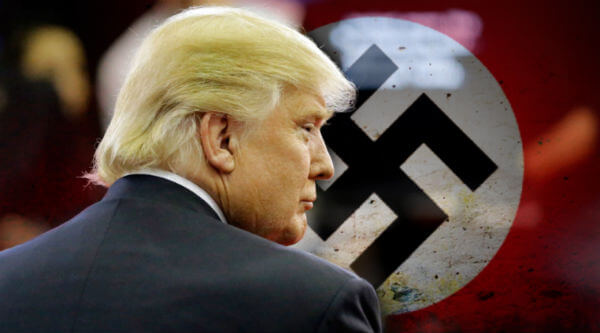
It’s commonplace to see Nazi swastika’s used to vilify public figures, but the image above was created by neo-Nazis themselves, adding the caption “May a 1,000-year Trumpenreich be inaugurated!”
Donald Trump and his surrogates have been playing footsie with American neo-Nazis for months: tweeting their memes, retweeting their messages, appearing on their radio shows. After an Oct. 13 speech in which Trump warned that Hillary Clinton “meets in secret with international banks to plot the destruction of U.S. sovereignty” and that “a global power structure” is conspiring against ordinary Americans, the Anti-Defamation League urged Trump to “avoid rhetoric and tropes that historically have been used against Jews.”
Well, Trump just gave his reply. On Friday, he released a closing ad for his campaign repeating offending lines from that speech, this time illustrated with images of prominent Jews: financier George Soros (accompanying the words “those who control the levers of power”), Fed Chair Janet Yellen (with the words “global special interests”) and Goldman Sachs CEO Lloyd Blankfein (following the “global power structure” quote). The ad shows Hillary Clinton and says she partners “with these people who don’t have your good in mind.”
Anti-Semitism is no longer an undertone of Trump’s campaign. It’s the melody.
For more than a year, I have condemned Trump in the harshest terms I could conjure as he went after Latinos, Muslims, immigrants, African Americans, women and the disabled. This is both because it was wrong in its own right and because, from my culture’s history, I know that when a demagogue begins to identify scapegoats, the Jews are never far behind. [Continue reading…]
MediaMatters reports: The Daily Stormer is a virulently anti-Semitic website that worships Adolf Hitler and Donald Trump. Site founder Andrew Anglin wrote in a November 7 piece headlined “Glorious Leader’s Closing Argument Blasts the Jew” that the ad is “absolutely fantastic” because Trump portrays Jews as “what they are: a virus eating away at the flesh of this once-great nation.” He continued that the “kikes at the Anti-Defamation League once again violated their 501(c)(3) tax-exempt status and attacked Trump over the ad.”
In a November 7 Daily Stormer piece headlined “Radical Jew Attacks New Nazi Trump Ad,” “Zeiger” attacked Josh Marshall for criticizing the ad and said it has imagery that “could be right at home on a William Pierce video.” Pierce was “America’s most important neo-Nazi for some three decades until his death in 2002” and the “leader of the National Alliance, a group whose members included terrorists, bank robbers and would-be bombers,” as the Southern Poverty Law Center (SPLC) noted.
Zeiger added that the video “felt pretty great. I don’t know who he has making these ads, but they obviously know what they’re doing. And Trump obviously approved them, so he’s in the loop as well.” An image accompanying the post portrayed Trump next to a swastika: [Continue reading…]
A former Moroccan cabinet minister told Michael Kirtley on Monday, he felt deep “sadness” that America was giving such a poor example of the democratic process, and that it would lessen the ability of the U.S. to preach our bedrock values elsewhere. “It doesn’t make me believe in democracy less,” he said. “But it makes me wonder if America can regain the high ground in representing democratic principles.”
Some in the Middle East are watching with cynical amusement. As one senior Saudi royal wrote to me, “Elections in America are a spectacle, very much like a Bollywood film on steroids, with tragedy and comedy, action and drama, dancing and music, treachery and romance.”
Another friend in Saudi Arabia, a humanist and a stubborn optimist, writes, “We cannot help but feel that the forces of openness and calm judgment that are embodied by Mrs. Clinton offer a more promising future both for the United States and for the world.”
But that sentiment is far from universal.
“There is no damage to the brand [of American democracy], because we never bought into it in the first place,” writes Amal Ghandour in Beirut. “The more serious harm is to your heft as a super power, one that dictates and lectures and cajoles the rest of us, not because of its democracy but because of the seriousness and strength of its system.
“That the U.S., with every possible contraption that democracy affords, would produce a presidential contender in the mold of our own ++Michel Aoun [just named president of Lebanon] is nothing short of astounding. We know — or we think we do — why we have idiots presiding over our dysfunctional states. What’s your excuse?” asks Ghandour.
“Believe it or not, quite a few among the Lebanese elite want Trump to win,” says Ghandour. “There’s a group that is relishing the humiliation to you and yours; another which thinks a Trump presidency will effectively translate to an even lighter footprint in the area; another which, like many Americans voting for him, thinks that the man has chutzpah, that he’s the real deal.”
What’s seen widely as President Barack Obama’s bungling of the Syrian war has damaged American credibility throughout the region, and those who have hopes for a Trump presidency see it as a chance to make, at least, a break with Obama’s policies — although what turns that break might take are far from clear.
“In Egypt we are optimistic that with your change, we’ll begin a new chapter in our relationship, which has witnessed a kind of Siberian storm for some time now,” writes a very well-connected friend in Cairo. “The question is: would Hillary be continuity rather than change, and will Trump be reaching out or confrontational? Our region has suffered much from the policy which led to the burning Arab spring that polluted the area and created an epidemic [of violence].” But nothing about these elections inspires confidence. “They seem in part like a heated comedy, and it reflects how far apart our thinking patterns are. We are all about traditions, respect, and discretion, and this election reveals your DNA, which we like to watch, but not follow or emulate.”
Egyptian politician and activist, Gameela Ismail, went to the United States over the summer to watch democracy in action and came away bitterly disappointed. “I felt like I came to witness the last few days or weeks of democracy,” she writes. “I never thought I would hear terms like ‘fascism’ and ‘treason.’”
Mona Makram Ebeid, a veteran Egyptian academic and politician, was even more blunt. “This whole campaign is debasing America,” she writes. [Continue reading…]
In an editorial, the Washington Post says: More than a third of American voters may have cast their ballots before Election Day under early-voting procedures, a heartening development in the face of aggressive Republican vote-suppression efforts in a number of states with GOP-controlled legislatures. While black turnout slipped by nearly 9 percent during the 17-day early-voting window in the critical swing state of North Carolina — a drop probably caused partly by Republican attempts to dampen turnout in areas with large black populations — an apparent surge in early voting elsewhere by Hispanics and other groups contributed to what is likely to be a record number of early voters: well over 40 million.
Notwithstanding the overall success of early voting, the peril of obstruction, intimidation and even violence at the polls remains, thanks mainly to Donald Trump’s explicit rhetoric and barely veiled messaging to his supporters. In repeatedly urging his partisans to intervene at polling places to thwart a “rigged” outcome, the Republican presidential nominee has invited confrontation and the possibility of chaos. By instructing nearly all-white crowds to scrutinize voting in “certain areas,” he has encouraged racial rancor.
Election monitors, including from the Justice Department’s Civil Rights Division, are key to ensuring that voting proceeds smoothly and that those who seek to impede it are held to account after the elections. If vigilantes from either party obstruct or discourage Americans from exercising their most basic democratic right, they should face legal consequences, on top of the punishment that will surely be meted out by voters with long memories for years to come.
What these voters may remember is that Republican legislatures in some states adopted a strategy intended to win by suppressing votes rather than attracting them, often targeting minorities, youths and other Democratic-leaning blocs. Measures have included new voting ID laws, shuttering some polling places and reducing hours for early voting. Other GOP shenanigans to reduce voting have been underway in the final days of the campaign. Twitter removed bogus ads using Clinton campaign imagery that urged her supporters to cast their vote by text.
The rise of voter ID laws and other laws intended to impede minority voting was enabled by the Supreme Court, which three years ago gutted the Voting Rights Act of 1965. The court’s ruling stripped the Justice Department of its power to screen voting laws in nine states, mostly in the South, with a history of racial discrimination. The result was a field day for GOP lawmakers, in North Carolina and elsewhere, bent on throwing up barriers to black turnout. While federal courts have disallowed some of the resulting laws, they have permitted others to stand.
It is critical to American democracy, and to the health of the two-party system, that one party’s efforts to gain electoral advantage by erecting obstacles to voting do not succeed. The alternative — two big-tent parties competing to expand their appeal to new constituencies — is the only way to restore some semblance of comity to a nation deeply riven by factionalism. [Continue reading…]
In recent weeks, Republican presidential candidate Donald Trump has repeatedly claimed that this year’s election is rigged and has predicted rampant voter fraud.
While it’s unprecedented to call an election “rigged” before voting has even taken place, there is a history of candidates and the media crying foul after suspicious results.
The most recent presidential election that had rumblings of rigging was 2004. Two years later, Robert Kennedy Jr. published an article in Rolling Stone claiming that Ohio election officials had made decisions that stole the election from Democratic candidate John Kerry. (If Kerry had won Ohio’s electoral votes, he would have defeated Republican president George W. Bush that year.) But while some Democrats parroted Kennedy’s allegations, Bush’s margin of victory in Ohio – over 100,000 votes – led many to dismiss them.
However, the most plausible claims of a rigged presidential election were made in 1876, 1888, 1960 and 2000. In each case, the losing candidate and party dealt with the disputed results differently.
If there’s a close or contested vote this year, perhaps the candidates could take a cue from the past.
Mother Jones reports: The climate didn’t get much attention in this year’s debates, but Tuesday’s election will still have major consequences for the fight against global warming. Donald Trump thinks climate change is a hoax; he’s pledged to withdraw from the historic Paris climate accord and to repeal President Barack Obama’s Clean Power Plan, which is intended to cut greenhouse gas emissions from coal plants. Hillary Clinton has said she will continue Obama’s climate legacy and has called for installing half a billion solar panels by the end of her first term.
The debate isn’t restricted to the top of the ticket; there are a number of state races that will play a key role in determining US climate policy, along with a handful of ballot initiatives covering everything from rooftop solar to a proposed carbon tax. The situation in each state is unique. Some races — New Hampshire’s Senate contest, for instance — feature two candidates who want to act on climate change. Others, such as West Virginia’s gubernatorial election, feature two candidates who are champions of the coal industry. The impacts of climate change also vary from state to state: Alaska faces wildfires and melting permafrost; Florida is confronting rising seas; Iowa could be hit with falling corn yields. And of course, the voters in each state are different, too. Coloradans overwhelmingly acknowledge that humans are warming the planet. Their neighbors in Utah: not so much. [Continue reading…]
There are only 30 remaining doctors in Aleppo, and they have been describing an unimaginable situation, some of which I have seen firsthand. They have to perform amputations on children on the floor of their rudimentary emergency rooms without anesthesia or proper sterilization. They are running short on blood products, intravenous fluid, antibiotics and pain medications.
The doctors have been struggling to provide health care for a traumatized population of 300,000, while their hospitals are bombed daily and their medical supplies and medications are depleted.
They have been working nonstop for the past three months, dealing with the influx of a large number of polytrauma and crush patients suffering from horrible injuries, pulled from under the rubble.
Hospitals are targeted frequently in Syria, especially in Aleppo, mostly by the Syrian government and lately by Russian jets. Physicians for Human Rights has recorded 382 attacks on medical facilities, of which 344 were carried out by the regime and Russia; they were also responsible for the deaths of 703 of the 757 medical personnel killed in the war so far. Most of Aleppo’s doctors have left.
My organization, the Syrian American Medical Society, reported that July was the worst month for attacks on health care since the beginning of the conflict. There were 43 attacks on health facilities in the month – more than one a day. By comparison, this number of attacks occurred over six months in 2015, with 47 attacks from January to May.
A few months ago, two of my colleagues and I made the dangerous trip from Chicago to Aleppo in order to volunteer in a medical mission with the Syrian American Medical Society. We worked in a hospital that was built 20 meters underground because it was targeted a dozen times in the past four years.
We worked, lived and slept in the hospital, while hearing the sounds of earth-shaking explosions nearby. The hospital was operated by a diesel-run generator and connected to the world through satellite internet and a tele-medicine unit.
Pew Research: [A recent Pew Research Center report found] Respondents who indicated they had changed their minds about Clinton were more than three times as likely to say that their opinion changed in a negative direction rather than a positive one (24% vs. 7%), and respondents who mentioned Trump were nearly five times as likely to say that their opinion became more negative as opposed to more positive (19% vs. 4%). [Continue reading…]
Michael T Flynn, the former Director of the Defense Intelligence Agency, a 33-year career military intelligence officer and currently a close adviser to Donald Trump, tweeted this following the FBI’s notification that its review of emails has been completed and its July conclusion remains unchanged:
IMPOSSIBLE: There R 691,200 seconds in 8 days. DIR Comey has thoroughly reviewed 650,000 emails in 8 days? An email / second? IMPOSSIBLE RT
This is the level of dismay one might expect from someone who is completely ignorant about information technology.
Perhaps this is how Flynn pictures the FBI’s email review process:
Or maybe not.
Flynn followed up with an indication he is aware some highfalutin “smart machines” could have been at work, but he remains skeptical about the lightning speed of the analysis:
It took 1 year to review 60K and 8 days to review 650K? Smart machines or not, something does not jive. Thoughts?
Let’s see… If it takes one year to review 60,000 emails it should take a decade to review 650,000 — is that what you’re thinking, general?
It turns out, the FBI has a whole division devoted to Operational Technology with stacks and stacks of smart machines at its headquarters in Quantico, Virginia. The bureau acknowledges, “While OTD’s work doesn’t typically make the news, the fruits of its labor are evident in the busted child pornography ring, the exposed computer hacker, the prevented bombing, the averted terrorist plot, and the prosecuted corrupt official.”
The Washington Post drills deep into the information retrieval technicalities of the latest investigation and confirms that it did indeed involve the use of “special software.” (Lead investigator to Comey: “How can we go through 650,000 emails fast enough?!” Comey: “You’ll need to use the special software.”)
We live in an era where roughly two billion people have access to Google. The content of about 50 billion web pages is continuously being indexed by the search giant and information from that index can be retrieved in a fraction of a second. Most people haven’t the faintest idea how search technology works, but everyone knows this: it’s super fast.
So Flynn is right: something doesn’t jive.
If 650,000 emails could be reviewed in 8 days, why did the FBI dawdle for a year over its analysis of 60,000 emails?
The first sweep was much more analytical and interpretative and clearly required more eyeballs and deliberation, considering both content and intent.
Nevertheless, what has become evident over the last ten days is that the FBI is a highly politicized government agency. It appears that among its ranks there are a significant number of individuals who believe they are entitled to use their considerable power to influence the outcome of a presidential election.
For that reason, it’s fair to ask now whether the investigation into Hillary Clinton’s private email server was dragged out for as long as possible precisely so that it could yield the greatest damage to her campaign — irrespective of the investigation’s findings.
If that was the intention, it seems likely this effort will ultimately fail. Instead, the FBI has profoundly damaged its own credibility as a politically impartial institution serving the interests of the American people.
Paul Krugman writes: It’s almost over. Will we heave a sigh of relief, or shriek in horror? Nobody knows for sure, although early indications clearly lean Clinton. Whatever happens, however, let’s be clear: this was, in fact, a rigged election.
The election was rigged by state governments that did all they could to prevent nonwhite Americans from voting: The spirit of Jim Crow is very much alive — or maybe translate that to Diego Cuervo, now that Latinos have joined African-Americans as targets. Voter ID laws, rationalized by demonstrably fake concerns about election fraud, were used to disenfranchise thousands; others were discouraged by a systematic effort to make voting hard, by closing polling places in areas with large minority populations.
The election was rigged by Russian intelligence, which was almost surely behind the hacking of Democratic emails, which WikiLeaks then released with great fanfare. Nothing truly scandalous emerged, but the Russians judged, correctly, that the news media would hype the revelation that major party figures are human beings, and that politicians engage in politics, as somehow damning.
The election was rigged by James Comey, the director of the F.B.I. His job is to police crime — but instead he used his position to spread innuendo and influence the election. Was he deliberately putting a thumb on the electoral scales, or was he simply bullied by Republican operatives? It doesn’t matter: He abused his office, shamefully.
The election was also rigged by people within the F.B.I. — people who clearly felt that under Mr. Comey they had a free hand to indulge their political preferences. In the final days of the campaign, pro-Trump agents have clearly been talking nonstop to Republicans like Rudy Giuliani and right-wing media, putting claims and allegations that may or may not have anything to do with reality into the air. The agency clearly needs a major housecleaning: Having an important part of our national security apparatus trying to subvert an election is deeply scary. Unfortunately, Mr. Comey is just the man not to do it. [Continue reading…]
Kurt Eichenwald writes: James Comey should not simply be fired as director of the Federal Bureau of Investigation. He must be barred forever from any form of public service.
In the last 10 days, Comey has whipsawed the election for president of the United States. Now we know he did it for no reason. When his agents found information that suggested there were emails on a laptop that might have relevance to the investigation of Hillary Clinton and her email servers, Comey did not wait until he knew even a scintilla of information before announcing it to the world. Reasonably, lots of voters assumed there must be a there there — who could imagine a person with the power of the FBI director would turn the election on its head for no particular reason, on the basis of nothing?
Then, Sunday, Comey handed down another missive from on high: Never mind. His agents had looked through the emails and decided they were piffle. His majesty, the FBI director, has not yet deigned to officially inform his subjects — the American people — whether the emails related to the Clinton case or what they were. (However, people involved in the case tell Newsweek that almost all of them were duplicates of what the bureau already had or were personal.) He just said “nothing to see here” and waived us on our way. [Continue reading…]
Simon Critchley writes: The mood of nausea at the world, a disgust at the entirety of existence, is familiar to those of us who cut our teeth reading existentialist fiction. Novels like Sartre’s 1938 “Nausea” captured a feeling of disgust with the world and disgust with ourselves for going along with a world so seemingly blissfully happy with itself for so long. For Sartre, the dreadful had already happened, with the rise of National Socialism in the early 1930s, and it was a question of learning to face up to our fate. This is the mood that I want to bring into focus by exploring the concept of Brexistentialism.
For I must admit that I’ve become a Brexistentialist of late, thinking back to that evening on June 23 when I watched the entirety — eight hours or more — of the BBC’s live coverage of the referendum on whether Britain would leave the European Union or choose to remain.
I was home in New York. As the coverage began, the pollsters, the experts and the markets seemed confident that the good people of Britain would act rationally and vote to remain. And then, with the news of early results from postindustrial northern cities like Sunderland and Newcastle (which are strikingly similar to cities in upstate New York, Ohio, Pennsylvania), one became slowly and dreadfully aware that something else was taking place, something was shifting before one’s eyes. By the early hours of the morning on June 24 that smug, smiling, awful face of Nigel Farage was declaring a new dawn, and a day of independence for Britain. The supposedly decent, honest, ordinary people of Britain had spoken. The unthinkable had happened.
Will the same thing happen across the Atlantic? No one knows, least of all me. But the parallels are evident and the anxiety is there, the same nameless dread, that the country that you thought you knew is actually something and somewhere else entirely. That one’s country has unraveled morally and spiritually in such a terribly painful, deeply divisive way. [Continue reading…]
Might I add that us Brits have perhaps an over-developed capacity for existential dread.
But fear that produces paralysis is no better than no fear at all.
My hope in the hours before polls close tomorrow evening is that a sense of dread in the face of a possible Trump presidency cripples no one. On the contrary, it should provide all the more compelling reason to vote.
This isn’t about saying who you like. If that was the basis for voting, the Oval Office would end up vacant. It’s about choosing the next president.
A vote for Jill Stein is a vote for Trump. A vote for Gary Johnson is a vote for Trump. A spoiled ballot is a vote for Trump. Staying home is a vote for Trump.
There is only one way of stopping Donald Trump becoming president: by electing Hillary Clinton.
James Miller writes: Between the summer of 2015 and the GOP convention a year later, a great many pundits were surprised by the rise of Donald Trump. Although polls consistently placed him ahead of his Republican peers, his style was so vulgar, his policy pronouncements so bizarre, that many pundits dismissed Trump’s chances. And still he kept winning.
Then came the drafting of the Republican Party platform by the Republican National Committee — a solemn 66-page document stating in a succinct 35,000 words the positions of the Grand Old Party. By all indications, Trump, who doesn’t care much for reading, was willing to let virtually all of it pass.
But there was one point in that mass of verbiage where the Trump team fought for a change. It wanted to remove a call for arming Ukraine against Russian-backed militants (and covert Russian troops) and softening language on Russia’s aggressive actions in Eastern Europe.
Despite the fact that multiple news agencies confirmed the original Washington Post story, Trump’s then-campaign manager Paul Manafort repeatedly denied any such thing happened, and witnesses to the change even accused the Republican leadership of trying to cover up the incident.
That was the tipping point on The Russia Connection where most of the press and public were concerned. [Continue reading…]
The 2016 American presidential campaign has renewed concerns about the specter of violence in American electoral politics. The campaign has been marked by tense – and occasionally violent – altercations between supporters and critics of Republican nominee Donald Trump.
Trump encouraged his supporters to “knock the crap” out of protesters, and even suggested he would pay the legal fees of followers who assaulted his critics.
By refusing to commit to accepting the results of the election, he has confirmed the doubts among his supporters about the integrity of American elections. Thereby, he has increased the risk of possibly violent resistance by hard-core Trumpists.
It would be comforting to conclude that the menace of violence surrounding the 2016 presidential election is unique. But my research on the history of voting rights in the United States suggests that this is far from the case. Indeed, the threat and execution of violence around elections has a long, sad history in American politics.
Somewhat like the 2016 election – which has revolved around issues of race and immigration – efforts by disadvantaged (and often nonwhite) citizens to secure greater political influence have been met with violent repression by those already enjoying power (usually more affluent whites) throughout American history.
Asli Aydintasbas writes: The speed of Turkey’s decline is mind-boggling, even when you live through its the day-to-day machinations.
This week started with the Turkish government announcing plans to reintroduce the death penalty at the urging of the country’s strongman, President Recep Tayyip Erdogan, in order to garner the support of ultra-nationalists in his bid to expand the powers of his presidency. Later in the week came the arrests of the editor-in-chief and columnists of Cumhuriyet, Turkey’s oldest paper and a symbol of its fast-eroding secularism, on trumped-up charges of terrorism. And finally, Thursday night brought the detentions of Selahattin Demirtas, the charismatic leader of the country’s pro-Kurdish party, and Figen Yuksekdag, the co-leader of the party. Ten other elected Kurdish deputies were also arrested.
As I write these lines, citizens cannot communicate to organize demonstrations — Twitter is down in Turkey, Facebook is unreachable, and social media applications such as WhatsApp remain blocked. The social media crackdown is an entirely unnecessary measure; who would go out and risk arrest when there is an emergency rule and a formal ban on protests? Protests happen in free and semi-free societies — or when people have the feeling that they have a chance to make an impact. There was a time when mass urban protests shook the country and pushed the government to announce a series of reforms. Today’s Turkey is a shell of itself. No such optimism remains [Continue reading…]
The Washington Post reports: In the seaside cafes of Beirut, the whole thing looks “like a bad joke.” To persecuted journalists in Burundi, it amounts to “a total loss of dignity.” The government-scripted press of Beijing diagnoses “an empire moving downhill.” And the spin doctors of the Kremlin see cause for pure and unambiguous delight.
The U.S. presidential election — America’s quadrennial chance to showcase for the world how democracy works in the most powerful nation on Earth — has become instead an object lesson in everything that ails a country long seen as a beacon of freedom and hope.
Debates devoid of issues and deep in the gutter of personal insult. Interference from foreign intelligence services. Endless leaked emails, and FBI investigations that could extend long beyond Tuesday.
Americans may cringe watching their own election at close range. But the world’s reaction has been, in a sense, even more poignant and foreboding. [Continue reading…]
Jonathan Blitzer writes: Ruth Ben-Ghiat, an American-born professor of Italian history at New York University, specializes in male menace. What interests her is the manufactured drama of world-historical strongmen — their mannerisms, speech patterns, stagecraft, and mythomania. Late last year, Ben-Ghiat had just published a book called “Italian Fascism’s Empire Cinema,” about the years of Benito Mussolini, when another spectacle wrested her attention. One of the candidates for the American Presidency was looking a lot like her principal academic subject. As President Obama put it, the United States now had its own “homegrown authoritarian.”
Earlier this week, Ben-Ghiat sat at a table in her office, at N.Y.U.’s Casa Italiana, on Twelfth Street, inspecting two signatures on the screen of her laptop. One of them belonged to Donald Trump, the other to Mussolini. The scrawls — loopy, cursive, steepled — looked so similar that they seemed to blur together. Ben-Ghiat, who wore a gray sweater and dark skirt, is gracefully soft-spoken, her manner reserved. “I’m interested in how their language and writing are a kind of emanation of their bodies,” she said.
When Mussolini was a Socialist, he wrote his name as “Benito Mussolini.” “Then he dropped the Benito,” Ben Ghiat said. “He even had his stage name, which was Il Duce.” Trump also likes talking about himself in the third person. “He’s selling his product, which is himself,” she said. It’s a cult of personality peddled as good business. During the primaries, he recited a loyalty pledge in which he led his supporters in a promise to vote for him. (“I do solemnly swear that I — no matter how I feel, no matter what the conditions, if there’s hurricanes or whatever — will vote . . . for Donald J. Trump for President.”) While administering the oath, he raised his arm before the crowds in a quasi-Fascist salute. (“I mean, we’re having such a good time,” Trump said later. “Sometimes we do it for fun, and they start screaming at me, ‘Do the swearing! Do the swearing!’ ”) [Continue reading…]
In June, they struck, hitting the Democratic Party, and by July its chairman was ousted in the fallout. Soon embarrassing emails were spilling from the computers of Hillary Clinton and her staff. Republican officials were hit, too. So was the National Security Agency. Now, hackers are meddling with the voting systems in several states, leaving local officials on high alert. Come Election Day, they’ll find out what, if anything, the cyberspies have in store.
This is an act of foreign interference in an American election on a scale we’ve never seen, yet on most days it has been the also-ran of media coverage, including at The New York Times.
The emails themselves — exposing the underside of the Democratic political machinery, and the conflicts, misjudgments and embarrassing communications of its top ranks — have received bountiful attention. What rarely makes the main narrative is the spy-versus-spy cyberwarfare: the tactics, the players and the government efforts to tame it. In a calamitous campaign unlike any in memory, it’s not surprising that other story lines get squeezed out. But one of the most chilling chapters of this election is the role of Russian intelligence and the growing threat of digital espionage. With days to go, readers have been shortchanged on this part of history. [Continue reading…]
This website or its third-party tools use cookies, which are necessary to its functioning. By closing this banner, you agree to the use of cookies.