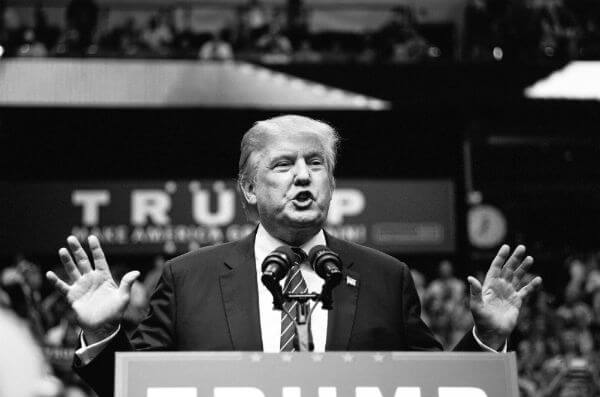
The Daily Beast reports: Donald Trump’s infatuation with Russia goes back more than 30 years, to the glasnost period of the Soviet Union when communism proved no impediment to get-rich-quick artists with loose scruples and gaudy tastes. In 1988 Trump was famously hoodwinked by Ronald Knapp, a Gorbachev impersonator, who stopped by Trump Tower and shook The Donald’s hand in what the latter clearly imagined was a rare moment in history, not to mention a wide enough slit in the Iron Curtain for capitalists on the make to wriggle through.
In 1986, Yuri Dubinin, Soviet ambassador to the United Nations, invited Trump to Moscow to discuss building a hotel that could stand as a symbol of the mogul’s international reach. Trump sought to erect his signature “Trump Tower” as an unmistakable totem to himself in the once-impenetrable capital of the world’s only other superpower.
And yet, not then, and no since, have we seen a gilded monstrosity rising in above the onion domes of Saint Basil’s Cathedral. Russia, it seems, has proven too elusive for Trump to establish his highly touted name-brand, even though he and his scions have boasted of the steady stream of rubles pouring their way. [Continue reading…]
Category Archives: Analysis
How Putin became the Che Guevara of the Right
Peter Pomerantsev writes: “He’s a Kremlin puppet!” has been a clarion call for those rallying to stop U.S. presidential hopeful Donald Trump.
But his public pro-Putin positions, and a few unfounded Kremlin links thrown in by his detractors, haven’t hurt Trump in the polls. And he’s not alone. Similar charges have been thrown at the successful campaign to leave the European Union and at right-wing movements gaining traction in Europe.
So is accusing your opponent of being Putin’s pal a good strategy? What if accusing someone of colluding with the Kremlin actually helps their cause?
Imagine, for a moment, you are the leader of an “anti-establishment” political movement. You thrill your followers by sticking it to the “liberal elites” and the “global order.” There’s nothing more “anti-establishment” than showing two fingers to such elite, aloof projects as NATO or the EU, and giving props to the man who wants to undermine them — Vladimir Putin.
What better way to milk the outrage of the “liberal” media than by siding with a Kremlin that has made attacking “liberal values” its motto? And wouldn’t you welcome attacks from liberal elites for associating you with the sort of disruption you wish to emulate?
For the “anti-establishment” Right, giving Putin the thumbs-up has become the equivalent of what pulling on a Che T-shirt has long meant for the Left. [Continue reading…]
Trump is a threat to the West as we know it, even if he loses

Anne Applebaum writes: They share ideas and ideology, friends and funders. They cross borders to appear at one another’s rallies. They have deep contacts in Russia — they often use Russian disinformation — as well as friends in other authoritarian states. They despise the West and seek to undermine Western institutions. They think of themselves as a revolutionary avant-garde just like, once upon a time, the Communist International, or Comintern, the Soviet-backed organization that linked communist parties around Europe and the world. Now, of course, they are not Soviet-backed, and they are not communist. But this loose group of parties and politicians — Austria’s Freedom Party, the Dutch Party for Freedom, the UK Independence Party, Hungary’s Fidesz, Poland’s Law and Justice, Donald Trump — have made themselves into a global movement of “anti-globalists.” Meet the “Populist International”: Whoever wins the U.S. election Tuesday, its influence is here to stay.
Although it is often described (by me and others searching for a shorthand) as “far-right,” the Populist International has little to do with the “right” that has thrived in Western countries since World War II. Continental European Christian Democracy arose out of a postwar desire to bring morality back to politics; Gaullism came out of a long French tradition of statism and secularism; Anglo-Saxon conservatives had a historic preference for free markets. Most of them shared a Burkean small-“c” conservatism: a dislike of radical change, skepticism of “progress,” a belief in the importance of conserving institutions and values. Most of them emerged out of particular local and historical traditions. All of them shared a devotion to representative democracy, religious tolerance, Western integration and the Western alliance.
By contrast, the parties that belong to the Populist International, and the media that support it, are not Burkean. They don’t want to conserve or preserve what exists. Instead, they want to radically overthrow the institutions of the present to bring back things that existed in the past — or that they believe existed in the past — by force. Their language takes different forms in different countries, but their revolutionary projects often include the expulsion of immigrants, or at least the return to all-white (or all-Dutch, or all-German) societies; the resurrection of protectionism; the reversal of women’s or minorities’ rights; the end of international institutions and cooperation of all kinds. They advocate violence: In 2014, Trump said that “you’ll have to have riots to go back to where we used to be, when America was great.” [Continue reading…]
If Donald Trump wins, it’ll be a new age of darkness
Jonathan Freedland writes: We are standing on the brink of the abyss. And, like anyone who’s ever peered into a chasm, we are experiencing a queasy, sinking feeling. All round the world, not just in the United States, people are contemplating the prospect that on Wednesday morning we will wake to hear of victory for Donald J Trump.
The mere imagining of that outcome is inducing anxiety in those far away from the action. I don’t just mean obsessives such as me, who spend the midnight hour checking the early voting returns from Washoe County, Nevada. Otherwise normal people also confess to being reduced to nervous wrecks by the thought that Trump might actually win. They chart their mood swings on social media, delighting in hopeful news – Hillary Clinton up in ABC News tracking poll! – or panicking at any sign the snake-oil salesman might pull it off, such as today’s Washington Post headline: “Donald Trump has never been closer to the presidency than he is at this moment”, I could feel my palms turn clammy.
In Britain we feel especially vulnerable. If you voted remain, the memory of a ballot going the wrong way is fresh. And not just any ballot, but one you believe will cause lasting, epochal damage. The thought that Tuesday might bring the second such moment in a year is one to dread. [Continue reading…]
Donald Trump’s unrequited love for Vladimir Putin
The Daily Beast reports: Donald Trump’s oft-stated admiration for Russian President Vladimir Putin isn’t just about macho admiration or authoritarian envy. It’s more in the spirit of a locker-room rivalry, a matter of camaraderie and competition — and to some extent deterrence. Searching for an analogy, one thinks of the way Russia-friendly U.S. Congressman Dana Rohrbacher once reportedly arm wrestled with Putin to decide who really won the Cold War. (One should note that Rohrbacher lost.)
Trump’s frenemy strategy — or ambivalence, it’s hard to know which — may account for why he went from asking aloud on Twitter in 2013 before the Miss Universe Pageant, will Putin “become my new best friend?” to saying during the candidates’ debate on Oct. 19, “I don’t know Putin. I have never met Putin. He is not my best friend”—prompting a lot of weepy Putin memes on social media.
While Trump’s business dealings with Russia and his foreign policy advisors’ ties to Russia have been intensely scrutinized by the media and now the FBI, evidence of direct Russian manipulation of Trump with the intent of affecting the U.S. election has been elusive.
The Russian leadership’s own statements and the Russian domestic media and English-language propaganda outlets have been easier to document. But even those organs are careful to keep at least a semblance of balanced reporting on the U.S. presidential campaign, while Putin and top officials have repeatedly stressed their neutrality. [Continue reading…]
Voter intimidation: What to do if someone tries to stop you from voting
U.S. News reports: Voter intimidation may seem to many a relic of America’s distant past, but even in the world’s foremost democracy, complaints persist about harassment and intimidation during the ballot-casting process.
U.S. News spoke with the Lawyers’ Committee for Civil Rights Under Law and the Campaign Legal Center about what is and what isn’t allowed at polling sites, what constitutes intimidation or suppression, and what to do if you see it or it happens to you.
Note that state rules vary. To check the voting laws and regulations in your state, visit www.866ourvote.org/state, which is maintained by the Lawyers’ Committee. [Continue reading…]
Reuters reports: A U.S. judge in Ohio ordered Republican presidential candidate Donald Trump’s campaign on Friday not to intimidate voters as voting-rights advocates scored a string of last-minute victories in several politically competitive states.
The ruling by U.S. District Court Judge James Gwin creates the possibility of fines or jail time for Trump allies who harass voters, a significant victory for Democrats who had worried the real-estate mogul was encouraging supporters to cause mayhem at the polls on Nov. 8.
The ruling also deals a blow to a Trump-aligned “exit poll” that seeks to mobilize thousands of supporters. [Continue reading…]
Trump receives praise from Ayatollah Khamenei
Masoud Kazemzadeh writes: Although for many Americans, [Supreme Leader Ayatollah Ali] Khamenei’s words [in a recent speech in which he described Donald Trump as a truth-teller] may appear as straightforward recitation of Trump’s words, they are perceived by the Iranian public as unusual words of praise of Trump. Khamenei usually uses terribly harsh words for the officials of the U.S. whom he regards as “the Great Satan.”
For example, in this very speech, Khamenei refers to American officials (e.g., Secretary John Kerry and President Obama) who are involved in negotiations with Iran in the following words: “The other side is a liar, is a deceiver, is a breaker of agreements, is a back stabber, while is shaking your hand with one hand, in their own words is holding bunch of stones in the other hand to hit the head of the other side.”
Why is Khamenei, who has been using terribly harsh words for President Obama, making such relatively complimentary remarks about Trump?
First, Khamenei hates Hillary Clinton. The ideology of the Islamic Republic and its constitution are explicitly and extremely misogynist. The fundamentalist constitution has enshrined de jure discrimination against women: top leadership positions are explicitly reserved for males only.
A female as the President of the sole super power, poses a terribly powerful threat to the ideological justifications of the fundamentalist regime. The fundamentalist regime already suffers from serious legitimation crises, particularly among women. A female president of the U.S., particularly one who has said “Women’s rights are human rights, human rights are women’s rights,” presents a serious threat.
Second, Hillary Clinton, while Secretary of State in 2009-2010, publically supported the pro-democracy Green Movement. This stood in stark contrast to the almost total silence of President Obama, who privileged his open and secret outreach to Khamenei to the democratic aspirations of the Iranian people. [Continue reading…]
The FBI looks like Trump’s America
Politico reports: The typical Federal Bureau of Investigation special agent is white, male, and middle-aged, often with a military background — in short, drawn from the segment of the U.S. population most likely to support GOP nominee Donald Trump.
That demographic reality explains much of the heat FBI Director James Comey is taking from his own work force at the moment for his handling of the Hillary Clinton email investigation and inquiries into the Clinton Foundation.
Days before the presidential election, FBI finds itself at the center of a political maelstrom, with Comey being sharply criticized by Democratic presidential nominee Hillary Clinton and even President Barack Obama, who’ve faulted the FBI director for going public with word of new evidence in the Clinton email probe.
That furor has exposed dissension in the FBI’s ranks, prompting a flurry of leaks about alleged efforts to impede the Clinton-related inquiries and exposing lingering anger among agents about Comey’s July decision not to recommend any charges in the email probe.
Incendiary, politically charged remarks from former FBI officials — with one prominent ex-FBI leader publicly calling the Clintons a “crime family” — are also endangering the law enforcement agency’s reputation for sober, nonpartisan investigation.
Largely overlooked in the imbroglio is how the fact that the FBI doesn’t look much like America is complicating Comey’s effort to extricate himself and his agency from the political firestorm.
According to numbers from August, 67 percent of FBI agents are white men. Fewer than 20 percent are women. The number of African-American agents hovers around 4.5 percent, with Asian-Americans about the same and Latinos at about 6.5 percent.
If Trump were running for president with an electorate that looked like that, he’d win in a landslide. [Continue reading…]
When Donald Trump was more anti-NATO than Vladimir Putin
Michael Weiss writes: Michael Morrell, a former acting director of the Central Intelligence Agency, broke dramatically with the protocol of most ex-spies when he used spook parlance to describe Republican nominee Donald Trump as “an unwitting agent of the Russian Federation,” albeit in the course of endorsing Hillary Clinton for president.
The colloquial term for the sort of person Morrell was talking about is “useful idiot,” someone enlisted in the Kremlin’s cause through sympathy, or shared interests, or, indeed, ignorance, without actually intending to be a pawn. But, as Putin certainly knows, the problem with useful idiots is that they tend to be insecure and erratic, whereas witting agents are tutored in how to be disciplined and self-controlled.
Trump is too illogical and self-contradictory to be of much use to a hostile foreign power except as a naturally occurring battering ram against the very institutions and beliefs that power would like to see weakened or destroyed. Trump’s opponent (whom Putin assuredly does not want to see inhabit the White House) and U.S. democracy at large are the truer objects of a Russian state-run information and cyber-espionage program. That Trump’s vulgar and demoralizing campaign is ripping apart America on the path to making it “great again” is simply an added bonus for the former KGB colonel.
Without dismissing the gravity of the Trump-Putin alignment, what our reporting makes clear is that the Republican does genuinely admire the Russian, but the feeling is not necessarily mutual. Putin has been discreet, if not cryptic, in his characterization of Trump. (See the next installation in this series for more.) One might say the relationship between the two is that of an amateur authoritarian taking cues from an aloof and bemused professional, but the performance delivered, to any outside observer, looks more like an oblivious farce than a credible imitation. [Continue reading…]
Trump just proposed ending all federal clean energy development
Joe Romm writes: In the last week, Republican presidential nominee Donald Trump has repeatedly vowed to zero out all federal spending on clean energy research and development. And the plan he released would also zero out all other spending on anything to do with climate change, including the government’s entire climate science effort.
You may have missed this bombshell because team Trump did not spell out these cuts overtly. In a campaign where the media has “utterly failed to convey the policy stakes in the election,” as Vox’s Matt Yglesias explained recently, it appears only Bloomberg BNA bothered to follow up with the campaign to get at the truth of Trump’s radical proposal.
Polling guru Nate Silver of fivethirtyeight.com fame gives Trump a one in three chance of becoming president. So I agree with Yglesias that we ought to seriously look at the implications of Trump’s proposals — especially since if Trump wins, he’s all but certain to have a GOP-controlled Congress to back him. [Continue reading…]
How divisions inside the FBI will persist after the election
The Washington Post reports: Deep divisions inside the FBI and the Justice Department over how to handle investigations dealing with Hillary Clinton will probably fester even after Tuesday’s presidential election and pose a significant test for James B. Comey’s leadership of the nation’s chief law enforcement agency.
The internal dissension has exploded into public view recently with leaks to reporters about a feud over the Clinton Foundation, an extraordinary airing of the agency’s infighting that comes as the bureau deals with an ongoing threat of terror at home and a newly aggressive posture from Russia.
Comey, meanwhile, has come under direct fire for his decision to tell Congress that agents were resuming their investigation of Clinton’s use of a private email server — a revelation that put him at odds with his Justice Department bosses and influenced the presidential campaign.
“He’s got to get control of the ship again,” said Robert Anderson, a former senior official in the FBI who considers Comey a friend. “There’s a lot of tension in the organization, and there’s a lot of tension in Congress and the Senate right now, and all that counts toward how much people trust the FBI.” [Continue reading…]
The moment when science went modern

Lorraine Daston writes: The history of science is punctuated by not one, not two, but three modernities: the first, in the seventeenth century, known as “the Scientific Revolution”; the second, circa 1800, often referred to as “the second Scientific Revolution”; and the third, in the first quarter of the twentieth century, when relativity theory and quantum mechanics not only overturned the achievements of Galileo and Newton but also challenged our deepest intuitions about space, time, and causation.
Each of these moments transformed science, both as a body of knowledge and as a social and political force. The first modernity of the seventeenth century displaced the Earth from the center of the cosmos, showered Europeans with new discoveries, from new continents to new planets, created new forms of inquiry such as field observation and the laboratory experiment, added prediction to explanation as an ideal toward which science should strive, and unified the physics of heaven and earth in Newton’s magisterial synthesis that served as the inspiration for the political reformers and revolutionaries of the Enlightenment. The second modernity of the early nineteenth century unified light, heat, electricity, magnetism, and gravitation into the single, fungible currency of energy, put that energy to work by creating the first science-based technologies to become gigantic industries (e.g., the manufacture of dyestuffs from coal tar derivatives), turned science into a salaried profession and allied it with state power in every realm, from combating epidemics to waging wars. The third modernity, of the early twentieth century, toppled the certainties of Newton and Kant, inspired the avant-garde in the arts, and paved the way for what were probably the two most politically consequential inventions of the last hundred years: the mass media and the atomic bomb.
The aftershocks of all three of these earthquakes of modernity are still reverberating today: in heated debates, from Saudi Arabia to Sri Lanka to Senegal, about the significance of the Enlightenment for human rights and intellectual freedom; in the assessment of how science-driven technology and industrialization may have altered the climate of the entire planet; in anxious negotiations about nuclear disarmament and utopian visions of a global polity linked by the worldwide Net. No one denies the world-shaking and world-making significance of any of these three moments of scientific modernity.
Yet from the perspective of the scientists themselves, the experience of modernity coincides with none of these seismic episodes. The most unsettling shift in scientific self-understanding — about what science was and where it was going — began in the middle decades of the nineteenth century, reaching its climax circa 1900. It was around that time that scientists began to wonder uneasily about whether scientific progress was compatible with scientific truth. If advances in knowledge were never-ending, could any scientific theory or empirical result count as real knowledge — true forever and always? Or was science, like the monarchies of Europe’s anciens régimes and the boundaries of its states and principalities, doomed to perpetual revision and revolution? [Continue reading…]
British high court rules parliament must vote on Brexit to trigger Article 50
Polly Toynbee writes: A momentous constitutional decision was taken by the high court of England and Wales this morning. A prime minister’s absolute power to do what they like, when they like, regardless of laws and treaties, was struck down. Theresa May cannot tear up our right to be EU citizens without the authority of parliament. Those rights were bestowed by parliamentary votes in a series of treaties. She can’t high-handedly abandon them and trigger our exit from the EU without parliament’s agreement.
Judges, wisely, do not generally want to usurp the power of elected governments to govern. Laws made by judges are a poor substitute for those made by elected MPs in parliament. But this is a matter of the profoundest constitutional importance, with deep implications, controversial whichever way they had decided. They rightly pronounced that parliament is sovereign – which is what the Brexiters claimed we were voting on, until it no longer suited them.
What now? The government will appeal to the supreme court in December, though some suggest May should dash to the Commons immediately for a quick vote, before an as-yet hazy coalition of cross-party remainers has time to organise and solidify. If the appeal fails, will MPs galvanise? Leaving it to the unelected Lords is no answer.
There are times when MPs need to rise above their party interests, their own interests and the views of their constituents. That may risk being voted out, but they may earn more respect by standing up for the national interest as best they can determine: that’s what representative democracy is for. In times of war or national crisis, defending the country from grave error, at whatever personal cost, is their duty. Brexit is the greatest threat to national wellbeing since the war, and this will test the mettle not just of individual MPs, but of the nature and purpose of a representative democratic system. [Continue reading…]
Donald Trump is America’s existential threat

Charles M Blow writes: Donald Trump is a lowlife degenerate with the temperament of a 10-year-old and the moral compass of a severely wayward teen.
There is no way to make a vote for him feel like an act of principle or responsibility. You can’t make it right. You can’t say yes to Trump and yes to common decency. Those two things do not together abide.
If you are voting for Trump, you are voting for coarseness, corruption and moral corrosion. Period. And if you are not actively voting against him, you are abetting his attempt to hijack American greatness and sink it with his egotism.
On Election Day, America faces a choice, and it’s not a tough one, but a stark one. It is the difference between tolerance and intolerance. It is the difference between respect and disrespect. It is the difference between a politician with some flaws and a flaw threatening our politics.
Donald Trump is America’s existential threat. On Tuesday, America has an opportunity to defend itself. [Continue reading…]
The crisis in the West’s liberal democracies is strengthening the Kremlin’s hand
Natalie Nougayrède writes: Lenin once said: “The capitalists will sell us the rope with which we will hang them.” Vladimir Putin is no Lenin, nor can his regime – run by an elite that enjoys offshore accounts and oligarchic privileges – quite be described as anti-capitalist. Yet in Russia’s new confrontation with the west, the Kremlin’s strategy is to exploit western weaknesses and confusion as much as it is geared towards showing a bellicose face, whether in Ukraine, Syria or cyberspace. Perhaps this is why the head of MI5 has warned of the need to fend off Russia’s hostile interference.
Lenin is not Putin’s ideological guru. Foreigners, whether public officials or investors, who have at length met with Putin sometimes point to his particular brand of pragmatism (even if Angela Merkel once said he “lives in another world”). If he senses strong pushback, he adapts. If he detects gaps, he strikes at the Achilles heel.
There is little doubt Russian power is on the offensive. Since 2014, when it deployed its troops in Ukraine and annexed territory there, and since its policies in Syria have been analysed as overtly hostile to western endeavours, “Russian aggressiveness” has become a mainstay of the west’s official political discourse. But beyond boasting about Russia’s nuclear forces, demonstrating its new conventional military capacities and activating an army of internet trollers (none of which should be minimised), Putin’s regime is banking on the hope that western democracies will falter and be unable to offer up genuine resistance.
He’s essentially waiting for that rope to be handed over. Brexit is one section of it, because in Russian eyes it has the potential to divide the west. The growth of national-populist movements in Europe and elsewhere is another, because it echoes the Kremlin’s illiberal narrative and produces useful allies. Radical leftwing anti-Americanism also fits handily into the picture, as it did decades ago when pacifists demonstrated in the west while missiles were being deployed by the eastern bloc during the cold war. [Continue reading…]
In Operation Libero the Swiss are building their ‘rebellion of the decent’
Nadette De Visser writes: In Europe as well as the United States the political arena has shifted to the fringes. Measured, moderate stands on issues of national and international importance are zapped by high-voltage soundbites, obliterated by incendiary one-liners.
Anger is the coveted political currency of the moment—anger fueled by fear of foreigners, by fears for the future — anger fueled by populist politicians at home and abroad. And even little Switzerland, the Continent’s hoary paradigm of democracy, has not been immune.
Until this year, in fact, it seemed all but certain that the right-wing populists of the SVP (the Schweizer Volkspartei) would push through a referendum calling for the expulsion of “immigrants,” even second or third generation Swiss born, if they were found guilty of a legal offense as minor as two parking tickets.
(Donald Trump has made essentially the same idea part of his 10-point immigration plan: “Zero tolerance for criminal aliens,” he proclaims. “We will issue detainers for all illegal immigrants who are arrested for any crime whatsoever, and they will be placed into immediate removal proceedings.”)
But in Switzerland, the SVP populists found themselves up against a new grass roots movement, Operation Libero, that seemed to come from nowhere. The SVP referendum lost badly, and all of a sudden all eyes turned to a political newcomer—26-year-old driven, committed, and comely Flavia Kleiner, the movement’s co-president. [Continue reading…]
The Glazyev Tapes: Getting to the root of the conflict in Ukraine
Andreas Umland writes: Russia watchers have been intrigued by the recent email leak of Vladislav Surkov – Russia’s adviser responsible for policies towards Ukraine and Russia’s satellite states in northern Georgia. The so-called “Surkov Leaks” have reinvigorated the discussion of Moscow’s involvement in the war in Ukraine and the emergence of “people’s republics” in the east of the country. The leaks confirm the Kremlin’s involvement in the armed conflict in the Donbas, and make clear that fueling the conflict in east Ukraine is just one part of Moscow’s broader policy for undermining the Ukrainian state.
But these leaks do not alter our understanding of the conflict. Rather, they confirm — with more empirical proof — what was already known and proven. However, two months earlier there was another leak. And this one did provide new evidence that challenges earlier interpretations concerning the roots of the so-called “Ukraine conflict” in 2014.
In August 2016, Ukraine’s General Procurator published a video tape of audio recordings of a number of telephone conversations between Sergey Glazyev — a Russian presidential advisor — and several Russian as well as Ukrainian pro-Kremlin activists in southern and eastern Ukraine in late February and early March 2014. The recordings vividly illustrate Moscow’s covert support for the still unarmed anti-government protests in Ukraine several weeks before the actual war started. Specifically, the tapes reveal the Russian state’s involvement in the coordination and financing of separatist meetings, demonstrations, pickets and similar actions in Crimea as well as in various regional capitals in Ukraine’s eastern and southern parts immediately after the victory of the Maidan revolution in early 2014.
Despite the importance of the tapes and their revelations, they have largely been ignored by Western media outlets and think-tanks. This may be due to suspicions that the published records were tampered with, or that they do not reveal the full story. It is, however, unlikely that these recordings are mere fakes. The published conversations are held between interlocutors whose voices can easily be identified through audio verification and cross-referencing.
If the Glazyev Tapes are indeed authentic, they should change our understanding of the origins and nature of the Russian-Ukrainian conflict. Until the publication of the Glazyev Tapes, many observers believed that Moscow intervened with paramilitary and later regular military forces into an ongoing civil conflict between pro-Kyiv and pro-Moscow Ukrainian citizens. Few serious analysts ever doubted the Kremlin’s crucial role in turning the winter confrontations on the streets of the east and south Ukrainian cities into a putatively civil war in spring. But the extent of Russian meddling in the unarmed protests before the military escalation was disputed. [Continue reading…]
Digging our own graves in deep time
By David Farrier, Aeon, October 31, 2016
Late one summer night in 1949, the British archaeologist Jacquetta Hawkes went out into her small back garden in north London, and lay down. She sensed the bedrock covered by its thin layer of soil, and felt the hard ground pressing her flesh against her bones. Shimmering through the leaves and out beyond the black lines of her neighbours’ chimney pots were the stars, beacons ‘whose light left them long before there were eyes on this planet to receive it’, as she put it in A Land (1951), her classic book of imaginative nature writing.
We are accustomed to the idea of geology and astronomy speaking the secrets of ‘deep time’, the immense arc of non-human history that shaped the world as we perceive it. Hawkes’s lyrical meditation mingles the intimate and the eternal, the biological and the inanimate, the domestic with a sense of deep time that is very much of its time. The state of the topsoil was a matter of genuine concern in a country wearied by wartime rationing, while land itself rises into focus just as Britain is rethinking its place in the world. But in lying down in her garden, Hawkes also lies on the far side of a fundamental boundary. A Land was written at the cusp of the Holocene; we, on the other hand, read it in the Anthropocene.
The Anthropocene, or era of the human, denotes how industrial civilisation has changed the Earth in ways that are comparable with deep-time processes. The planet’s carbon and nitrogen cycles, ocean chemistry and biodiversity – each one the product of millions of years of slow evolution – have been radically and permanently disrupted by human activity. The development of agriculture 10,000 years ago, and the Industrial Revolution in the middle of the 19th century, have both been proposed as start dates for the Anthropocene. But a consensus has gathered around the Great Acceleration – the sudden and dramatic jump in consumption that began around 1950, followed by a huge rise in global population, an explosion in the use of plastics, and the collapse of agricultural diversity.