Category Archives: Analysis

Angela Merkel and Marine Le Pen: One of them will shape Europe’s future

Natalie Nougayrède writes: Two very different women hold Europe’s future in their hands – and neither of them is Theresa May. The battle for Europe’s soul is being waged between Angela Merkel and Marine Le Pen. This is a clash of personalities and visions: Germany’s chancellor v the leader of France’s Front National, the largest far-right party in Europe. As Britain prepares to leave the EU, the Franco-German dimension of the continent’s destiny has arguably never been so important since the end of the cold war. What is at stake is momentous: whether Europe can survive as a project, and whether fundamental principles such as the rule of law, democracy and tolerance can be salvaged. The battle will play out nationally in 2017, in key elections in France and Germany, but it concerns all Europeans.

It may seem strange to reduce Europe’s existential crises to just one personal confrontation. Merkel has been in power since 2005 and is trying to remain there, while Le Pen may dream of being in office but has never approached it (last year her party failed to take control of a single French region in local elections). Some may ask: why would a French opposition figure count more than the man currently sitting in the Elysée Palace? But François Hollande has become so weak – even more so with this week’s resignation of his economics minister, Emmanuel Macron – and terrorism has transformed French politics to such a degree that Le Pen’s prospects now stand out as a key defining factor of where France, and Europe for that matter, may be heading.

It is only partly reassuring to say that Le Pen has little chance of becoming president next year (the French electoral system makes that difficult). The trouble is, in recent months, her brand of anti-Muslim, xenophobic and nationalistic politics has spread across the French mainstream right like wildfire. Le Pen is fast capitalising on this summer’s burkini episode and on the national trauma left by jihadi terrorism. It’s hard to see which French politician or movement can find the authority and strength to push back against her ideas, or counter their appeal among the French suburban middle classes as well as in rural areas. Nicolas Sarkozy hopes to win primaries in November, but his whole strategy hinges on imitating rather than disputing Le Pen’s line of thinking. [Continue reading…]


Facebooktwittermail

Putin vs. Putin

Brian Whitmore writes: The emperor is at war with his inner godfather. The autocrat is battling his inner kleptocrat. The commissar is struggling with his inner crime kingpin.

The most consequential political battle in Russia today is not another skirmish among the Kremlin clans; it’s not a showdown between the siloviki and the technocrats; and it’s not a standoff between the regime and the opposition.

No, the battle defining Russia’s next political season is one that appears to be going on between Vladimir Putin and Vladimir Putin.

As the Kremlin leader culls his inner circle, purges the elite, and tries to enforce some limits on the massive graft that pervades Russian politics, he’s also fighting with himself.

And that is because Putin is something of a hybrid.

As veteran Russia-watcher James Sherr has noted, genealogically Putin is a product of the KGB, but sociologically he is a product of the Darwinian chaos and gangster capitalism that marked Russia’s first post-Soviet decade.

Putin’s political DNA may have been formed in Lubyanka, in Yury Andropov’s KGB, where order, hierarchy, discipline, and Soviet great-power ideology were paramount.

But his political socialization took place as vice mayor of St. Petersburg in the 1990s, where, as Karen Dawisha notes in her book Putin’s Kleptocracy, one of his key roles was acting as a liaison between the political and criminal authorities. [Continue reading…]

Facebooktwittermail

Assad regime to besieged Aleppo: Surrender or starve

Roy Gutman reports:  Aleppo is under siege again. Once again, some 300,000 civilians in the rebel-held eastern part of the city must eke out their survival with no fresh produce and a dwindling food supply, in addition to the other perils of life for those in the Assad regime’s political opposition.

That means barrel bombs that destroy houses and bury their children, and missiles that destroy their schools, mosques, and hospitals.

The siege crept up almost without notice over the past 10 days, as the regime closed the Alramousa road, the sole supply route into the old town, first by intense bombing and then by targeted missile attacks just weeks after a surprise rebel offensive had opened it.

State television on August 27 showed a missile attack against vehicles traversing the road that it said were carrying “mercenaries and armed elements.” Two days later, rebel media activists reached the scene, where they found the body of driver Abdo Rawas splayed out on the road, alongside his destroyed truck and its cargo of fruits and vegetables. The activists couldn’t find the body of Adnan, Rawas’s 12-year-old son, who was driving with him. They fear he was incinerated in the attack, leaving no remains.

The siege of Aleppo, like any siege, will come to an end at some point, but the question is on what terms. If the other sieges against other rebel-held towns in Syria are any guide, the terms will be take it or leave it: Surrender or starve. [Continue reading…]

Facebooktwittermail

While Twitter chases ISIS accounts away, it allows homegrown extremists to thrive

Quartz reports: Twitter has earned a reputation for being a recruiting ground for the Islamic State, but the terror group only represents a fraction of the site’s extremist landscape.

White nationalists and self-identified Nazi supporters — who’ve been around much longer than ISIL — have grown their follower count more than six-fold over the last four years, according to a new study published by George Washington University’s Program on Extremism. With ISIL’s social media tactics gaining traction in 2014, other groups have mimicked its propaganda techniques to further their reach. Currently, the white extremist accounts post tweets more often than their ISIL counterparts.

The researchers first identified the most prominent white nationalist organizations and leaders, who had a strong offline presence too. Then, they downloaded accounts following these influencers — over 25,000 of them — and scraped the 200 most recent tweets from them. In 2012, the same technique had yielded only 3,500 accounts. [Continue reading…]

Facebooktwittermail

How Fox News women took down the most powerful, and predatory, man in media

Gabriel Sherman reports: It took 15 days to end the mighty 20-year reign of Roger Ailes at Fox News, one of the most storied runs in media and political history. Ailes built not just a conservative cable news channel but something like a fourth branch of government; a propaganda arm for the GOP; an organization that determined Republican presidential candidates, sold wars, and decided the issues of the day for 2 million viewers. That the place turned out to be rife with grotesque abuses of power has left even its liberal critics stunned. More than two dozen women have come forward to accuse Ailes of sexual harassment, and what they have exposed is both a culture of misogyny and one of corruption and surveillance, smear campaigns and hush money, with implications reaching far wider than one disturbed man at the top.

It began, of course, with a lawsuit. Of all the people who might have brought down Ailes, the former Fox & Friends anchor Gretchen Carlson was among the least likely. A 50-year-old former Miss America, she was the archetypal Fox anchor: blonde, right-wing, proudly anti-intellectual. A memorable Daily Show clip showed Carlson saying she needed to Google the words czar and ignoramus. But television is a deceptive medium. Off-camera, Carlson is a Stanford- and Oxford-educated feminist who chafed at the culture of Fox News. When Ailes made harassing comments to her about her legs and suggested she wear tight-fitting outfits after she joined the network in 2005, she tried to ignore him. But eventually he pushed her too far. When Carlson complained to her supervisor in 2009 about her co-host Steve Doocy, who she said condescended to her on and off the air, Ailes responded that she was “a man hater” and a “killer” who “needed to get along with the boys.” After this conversation, Carlson says, her role on the show diminished. In September 2013, Ailes demoted her from the morning show Fox & Friends to the lower-rated 2 p.m. time slot.

Carlson knew her situation was far from unique: It was common knowledge at Fox that Ailes frequently made inappropriate comments to women in private meetings and asked them to twirl around so he could examine their figures; and there were persistent rumors that Ailes propositioned female employees for sexual favors. The culture of fear at Fox was such that no one would dare come forward. Ailes was notoriously paranoid and secretive — he built a multiroom security bunker under his home and kept a gun in his Fox office, according to Vanity Fair — and he demanded absolute loyalty from those who worked for him. He was known for monitoring employee emails and phone conversations and hiring private investigators. “Watch out for the enemy within,” he told Fox’s staff during one companywide meeting. [Continue reading…]

Facebooktwittermail

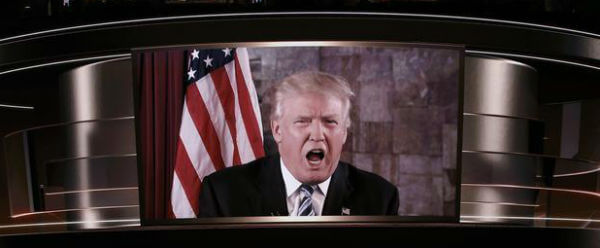
Donald Trump and the politics of fear

trump-purge

Molly Ball writes: “People are scared,” Donald Trump said recently, and he was not wrong.

Fear is in the air, and fear is surging. Americans are more afraid today than they have been in a long time: Polls show majorities of Americans worried about being victims of terrorism and crime, numbers that have surged over the past year to highs not seen for more than a decade. Every week seems to bring a new large- or small-scale terrorist attack, at home or abroad. Mass shootings form a constant drumbeat. Protests have shut down large cities repeatedly, and some have turned violent. Overall crime rates may be down, but a sense of disorder is constant.

Fear pervades Americans’ lives — and American politics. Trump is a master of fear, invoking it in concrete and abstract ways, summoning and validating it. More than most politicians, he grasps and channels the fear coursing through the electorate. And if Trump still stands a chance to win in November, fear could be the key.

Fear and anger are often cited in tandem as the sources of Trump’s particular political appeal, so frequently paired that they become a refrain: fear-and-anger, anger-and-fear. But fear is not the same as anger; it is a unique political force. Its ebbs and flows through American political history have pulled on elections, reordering and destabilizing the electoral landscape.

This week, Trump delivered a speech on immigration that depicted outsiders as a frightening threat. “Countless innocent American lives have been stolen because our politicians have failed in their duty to secure our borders,” he said. His acceptance speech at the Republican National Convention similarly made clear the extent to which his message revolves around fear. “The attacks on our police, and the terrorism in our cities, threaten our very way of life,” Trump thundered. “Any politician who does not grasp this danger is not fit to lead our country. Americans watching this address tonight have seen the recent images of violence in our streets and the chaos in our communities. Many have witnessed this violence personally; some have even been its victims.”

Notes of uplift were few and far between in the convention speech, and commentators were duly shocked by its dark tone. (The conservative writer Reed Galen called Trump’s convention “a fear-fueled acid trip.”) Trump summons fear in the conventional way, by describing in concrete terms the threats Americans face. But he also, in a more unusual maneuver, summons fear in the abstract: There’s something going on, folks. [Continue reading…]

Facebooktwittermail

Why did Peña Nieto invite Trump to Mexico?

Ioan Grillo writes: Mexico’s president, Enrique Peña Nieto, had already had a terrible summer. July was the most murderous month in Mexico since he took office in 2012. Second-quarter results showed negative economic growth for the first time in three years. A survey found his approval rating slipping to 23 percent. And a news report even alleged that he plagiarized nearly a third of his law degree thesis. How could he make it any worse? Only by inviting Donald J. Trump, one of the most hated men in Mexico — so hated that piñatas with his visage are brisk sellers across the country — to his presidential palace.

The curious thing about Mr. Peña Nieto’s latest debacle is how, unlike his other woes, it was totally self-inflicted. There is little tradition of sitting Mexican leaders meeting with American presidential hopefuls, so he was under no pressure to arrange the get-together. And it couldn’t have come at a worse time: the very day of Mr. Trump’s hard-hitting immigration speech, and the day before Mr. Peña Nieto’s state of the union address. Mr. Peña Nieto had even compared Mr. Trump to Hitler.

But in a stupefying decision, last week he sent invitations out to the Democratic hopeful Hillary Clinton and Mr. Trump to come to Mexico, and then conceded, reportedly under pressure from the Trump team, to meet its candidate first, on the fateful Aug. 31.

Mr. Peña Nieto insists that his nation won something from the encounter. “I was very clear — in public and private — in emphasizing that in Mexico we feel wounded and hurt by his announcements about Mexicans,” he wrote in an opinion piece in El Universal newspaper on Thursday. “I expressed that Mexicans deserve respect.”

But most politicians and pundits — and the public — read the scene differently. To them, Mr. Peña Nieto looked weak and submissive in front of a bully who is humiliating their nation. [Continue reading…]

Politico reports: Several major Latino surrogates for Donald Trump are reconsidering their support for him following the Republican nominee’s hardline speech on immigration Wednesday night.

Jacob Monty, a member of Trump’s National Hispanic Advisory Council, has resigned, and Alfonso Aguilar, the president of the Latino Partnership for Conservative Principles, said in an interview that he is “inclined” to pull his support.

“I was a strong supporter of Donald Trump when I believed he was going to address the immigration problem realistically and compassionately,” said Monty, a Houston attorney who has aggressively made the Latino case for Trump. “What I heard today was not realistic and not compassionate.” [Continue reading…]

Facebooktwittermail

The decay of the Syrian regime is much worse than you think

Tobias Schneider writes: … after five years of war, the regime’s force structure today is not entirely different from that of opposition militias. While much better supplied by the Syria Arab Army’s still-standing logistics skeleton, the government’s fighting force today consists of a dizzying array of hyper-local militias aligned with various factions, domestic and foreign sponsors, and local warlords. Aymenn al-Tamimi’s profiles of loyalist militias provide some insight into their diverse backgrounds. Among these groups, only a handful are still capable of anything close to offensive action. Much more so than sectarian or demographic limitations, this fragmentation is the direct result of the interaction between national and local economic and governance pressures. As the once totalitarian Syrian central state atrophies, its constituent parts — be they sectarian, rentierist, or simple brutes — have gained a stunning degree of political and economic independence from Damascus. Contrary to what others have claimed, Assad’s regime has not struck some grand bargain with a large section the Syria’s urban Sunni population. Instead, he has elevated to power the most brutish elements of the country and doubled down on the sectarian, tribal, and thuggish inclinations of its base.

Today, where briefing maps now show solid red across Syria’s western governorates, they ought to distinguish dozens and perhaps even hundreds of small fiefdoms only nominally loyal to Assad. Indeed, in much of the country, loyalist security forces function like a grand racketeering scheme: simultaneously a cause and consequence of state collapse at the local level. [Continue reading…]

Facebooktwittermail

Turkey’s intervention in Syria, with tacit Russian backing, has raised tensions with Washington

The Daily Beast reports: Russia and Iran have raised no serious objections to Turkey’s intervention. The Political Directorate of the Syrian Arab Army now speaks of the Kurdish guerrilla force [the YPG] as the “PKK.”

As Aron Lund of the Carnegie Endowment’s Middle East Center observes, “Over the past five years, Damascus has more often referred to the pro-PKK factions in Syria by simply using their official names (such as YPG, Asayish, and so on) or by some quaintly patriotic workaround, such as ‘loyal Kurdish citizens.’ It is rare for them to employ the ‘PKK’ term and even rarer to blast it across state media.” The shift is obviously meant as much for Turkish ears as for Syrian ones.

Also remarkable is how Russia’s English-language propaganda outlet Sputnik has unblinkingly about-faced on who’s who in this war.

This week, it took the unprecedented step of referring to the Turkish-supported Free Syrian Army as having “liberated” villages in Aleppo from “terrorists,” citing the Turkish General Staff’s press release. As for the terrorists, Sputnik left it an open question as to whether or not these were ISIS militants or the YPG.

Washington, meanwhile, appears to have been outflanked. The Wall Street Journal reported Tuesday that the U.S. and Turkey had been discussing a joint intervention in Syria but that President Obama had delayed approving Pentagon plans.[Continue reading…]

Facebooktwittermail

As Trump vs. Clinton captivates world, Netanyahu is unusually silent

The New York Times reports: For three hours, Prime Minister Benjamin Netanyahu of Israel held forth on all sorts of topics — on Israel and the Middle East, on his record and on his plans. One subject that Mr. Netanyahu studiously avoided in his expansive conversation with American visitors last weekend, though, was the United States election.

Much of the rest of the world is absorbed by the contest between Donald J. Trump and Hillary Clinton, but it is a topic Mr. Netanyahu will not touch. Four years after he was accused of meddling in the American election on behalf of President Obama’s opponent, the hardly bashful Israeli leader this time has taken a virtual vow of silence.

The unusual reluctance comes after years of toxic relations between him and Mr. Obama, culminating in an acrid public feud over the American-brokered nuclear agreement with Iran. With Mr. Netanyahu seemingly aligning himself during that fight with Mr. Obama’s Republican critics, some Israel backers feared the country was squandering its traditional bipartisan support. The prime minister now seems intent on extricating himself from the partisan tussle.

“Everybody understands here in Israel that the most important thing for us is to go back to where we were for the last 68 years, which is bipartisan,” said Yair Lapid, a centrist party leader who hopes to succeed Mr. Netanyahu. “This is why nobody will take sides in a presidential campaign.”

But if Israel is staying away from the American campaign, the campaign is staying away from Israel, too. While it was an occasional topic of questioning during primary debates, it has been all but absent from the discussion in the general election.

In part, that reflects a high-octane campaign of invective that has overlooked many policy questions. But it also underscores the plethora of other issues that have seized Washington’s attention, principally the rise of the Islamic State, the war in Syria and relations with Russia. The Israeli-Palestinian dispute, once a dominant part of any White House foreign policy, seems to be slipping to a second-tier issue. [Continue reading…]

Facebooktwittermail

Edward Snowden’s long, strange journey to Hollywood

Irina Aleksander writes: The summer light was fading to gold near Red Square as Oliver Stone maneuvered through the lobby bar of a five-star Moscow hotel last year. He walked past the marble staircase and the grand piano to a table in the back. A group of businessmen in suits lingered nearby. Stone grimaced.

“I think we should move,” he said. His producer, Moritz Borman, led the way to another corner. “How’s this?” Borman asked.

Stone didn’t answer. He eyed an older couple slurping soup and kept moving. A moment later, Stone finally settled in by a window, comfortably beyond earshot of the other patrons.

Such security precautions had become routine. Ever since Stone decided to make a biopic about Edward Snowden, the American whistle-­blower currently holed up in Moscow somewhere, the director — who became a Buddhist while making “Heaven & Earth” and sampled a buffet of psychedelic drugs for “The Doors” — had gone all method again. On “Snowden,” he and Borman became so preoccupied with American government surveillance that they had their Los Angeles offices swept for bugs more than once.

The director hadn’t been sleeping well. Principal photography wrapped a month earlier, and now Stone had come to Moscow to film Snowden for the movie’s grand finale. He ordered a decaf coffee and began to lay out the events that led him and Borman to be hanging out in Russian hotels, on the lookout for potential spies. “Last January, Moritz calls me,” Stone said. “He says: ‘You got a call from this fella who represents Mr. Snowden. You’re invited to Moscow.’ ”

The call had come from Anatoly Kucherena, Snowden’s Russian lawyer. In the course of his career, Kucherena has represented Russian oligarchs, film directors, a few pop singers and a state minister. In 2012, he campaigned for Vladimir V. Putin, and soon after Snowden landed in Moscow, Kucherena showed up at Sheremetyevo Airport and offered his services. Then Kucherena wrote a novel about his new client. Titled “Time of the Octopus,” it follows a National Security Agency leaker named Joshua Cold who is marooned in the airport and the Russian advocate who liberates him. In January 2014, months before the book was published, Kucherena called Borman to see if Stone might like to make it into a Hollywood movie.

“And I know you from working on, what, three films?” Stone said at the bar.

“Five,” Borman said.

At the time, Stone and Borman were barely speaking after a falling-­out during the making of “Savages,” a beachy Blake Lively thriller. “We’ve had our fights,” Stone said. “You know, he’s German; I’m American.” He didn’t elaborate.

“He calls, and I go: ‘Oh, [expletive]. Not again,’ ” Stone continued. It wasn’t just about Borman. Stone wanted nothing to do with another political docudrama. He spent two decades trying to get a biopic about the Rev. Dr. Martin Luther King Jr. off the ground, only to see “Selma” get made to critical acclaim. Then there was the My Lai massacre film. Merrill Lynch put up cash, Bruce Willis was set to star and Stone built an entire village in Thailand. As the economy collapsed in 2008, the financing evaporated. “You get these scars, and they don’t go away,” Stone said.

So Stone was skeptical. But this was Snowden, who single-­handedly exposed the colossal scale on which the United States had been surveilling its citizens. Plus, the director needed a hit. After early successes like “Platoon” and “Wall Street,” his more recent films didn’t receive the attention he hoped. The Snowden story had all the ingredients of an epic Stone picture: politics, government conspiracy and, at the center of it all, an American patriot who had lost faith. If it panned out, it could be Stone’s millennial follow-­up to “Born on the Fourth of July,” the Ron Kovic biopic that won him an Oscar in 1990.

But first Stone and Borman had to make sure Kucherena was for real. Borman asked the lawyer to send the book and two first-class tickets to Moscow. Both arrived the next day. In case they still had doubts, Kucherena’s office gave Borman a number to call. On the other end was an employee of the Russian consulate in San Francisco, who turned out to be a big fan of “The Life of David Gale,” a film Borman produced. They were issued visas that same week. (Kucherena denies buying first-class tickets for Stone and Borman or helping expedite their visas.)

“When that happened,” Borman said, “I thought, O.K., I guess Kucherena can pull the strings.” [Continue reading…]

Facebooktwittermail

Does anyone in Syria fear international law?

Ben Taub writes: The horror of Syria’s war is in the millions of pictures that are too gruesome to circulate—charred limbs stacked outside hospital wards, bloated bodies rotting in sniper alleys, a toddler plucked from the rubble without a head. It is in a group of relatives trying to carry the sixty-pound corpse of a man who died of hunger — the boiled grass he’d been living on could no longer sustain him — but struggling under his weight, because they, too, are starving to death. It is in a generation of orphans, of children who never learned to read but can tell you the difference between the sounds of shelling and those of air strikes. It is in the intentional bombing of hospitals and clinics, the targeted assassinations of medical workers, the forced displacements, the chemical-weapons attacks. It is in a death toll so high, and so impossible to verify, that the U.N. stopped counting two years ago.

Following the horrors of the First World War, a British lawyer named Hugh Bellot spent years beseeching the League of Nations to establish an international criminal court at The Hague, to prosecute war crimes and “all offenses committed contrary to the laws of humanity.” For Bellot, allowing the “outrages” committed during the war — which included the widespread use of chemical weapons — to go unaddressed was as “dangerous to humanity and civilization” as the atrocities themselves had been. Bellot’s efforts fell short; it took the Holocaust for the international community to set up the world’s first international war-crimes tribunal, and another half century of atrocities in South America, Asia, Africa, and Eastern Europe for his vision to be fully realized. In 1998, after the widespread killings in Rwanda and Bosnia, the United Nations convened a five-week assembly in Rome, to draft a treaty that would establish an international criminal court that could prosecute war crimes, genocide, and crimes against humanity. In theory, the U.N. believed, the very existence of such a court would give pause to dictators and warlords prone to brutality; perpetrators living anywhere in the world could be hunted until their dying breaths.

Nowhere has the supposed deterrent of eventual justice proved so visibly ineffective as in Syria. Like most countries, Syria signed the Rome Statute, which, according to U.N. rules, means that it is bound by the “obligation not to defeat the object and purpose of the treaty.” But, because Syria never actually ratified the document, the International Criminal Court has no independent authority to investigate or prosecute crimes that take place within Syrian territory. The U.N. Security Council does have the power to refer jurisdiction to the court, but international criminal justice is a relatively new and fragile endeavor, and, to a disturbing extent, its application is contingent on geopolitics. In 2014, when a measure to give the I.C.C. jurisdiction in Syria came before the council, Russia and China blocked it. Meanwhile, since 2011, not a minute has passed in which the Syrian government has not been committing multiple, simultaneous, widespread war crimes and crimes against humanity. The body of court-ready evidence against top officials within the Syrian government is more complete and damning than any that has ever previously been collected during an active conflict. And yet there is no clear path for prosecuting the highest-level offenders. [Continue reading…]

Facebooktwittermail

Former chief White House ethics lawyer: Clinton Foundation controversy is just a distraction from bigger issue

By Richard Painter, University of Minnesota

Hillary Clinton’s critics claim that federal ethics laws were broken when her subordinates at the State Department arranged meetings and other favors for donors to the Bill and Hillary Clinton Foundation.

Evidence is still surfacing as to who at the State Department did what and why. But as a former chief White House ethics lawyer in the Bush administration, I can tell you that allegations of favoritism for donors is nothing new. There were plenty such allegations during the Bill Clinton administration. If nothing changes, I believe it will be more of the same in a Hillary Clinton administration.

As I illustrate in my book, “Getting the Government America Deserves,” there was also favoritism for donors in the Reagan administration and both Bush administrations. Same for Congress over many years. The same is arguably true for the Obama administration. One case in point: access to staff in the White House and Department of Energy granted to investors in Solyndra Solar Energy Company. The Clinton Foundation may be a novel twist to an old problem, but donors get high-level access every day in Washington.

The Clinton Foundation is a marginally relevant side show in the gigantic multibillion dollar circus of American campaign finance. Almost all American politicians depend upon money to get elected, and almost all consciously or unconsciously do favors for their donors. Corruption is eating away at our republic. The media’s obsession with the indirect ways in which a single charitable foundation advances a single candidate’s career misses the point.

Clinton’s critics and the candidate herself should instead focus on what American voters of all political convictions really want: less influence for big money in American government.

Continue reading

Facebooktwittermail

How Russia often benefits when Julian Assange reveals the West’s secrets

The New York Times reports: Has WikiLeaks become a laundering machine for compromising material gathered by Russian spies? And more broadly, what precisely is the relationship between Mr. Assange and Mr. Putin’s Kremlin?

Those questions are made all the more pointed by Russia’s prominent place in the American presidential election campaign. Mr. Putin, who clashed repeatedly with Mrs. Clinton when she was secretary of state, has publicly praised Mr. Trump, who has returned the compliment, calling for closer ties to Russia and speaking favorably of Mr. Putin’s annexation of Crimea.

From the outset of WikiLeaks, Mr. Assange said he was motivated by a desire to use “cryptography to protect human rights,” and would focus on authoritarian governments like Russia’s.

But a New York Times examination of WikiLeaks’ activities during Mr. Assange’s years in exile found a different pattern: Whether by conviction, convenience or coincidence, WikiLeaks’ document releases, along with many of Mr. Assange’s statements, have often benefited Russia, at the expense of the West.

Among United States officials, the emerging consensus is that Mr. Assange and WikiLeaks probably have no direct ties to Russian intelligence services. But they say that, at least in the case of the Democrats’ emails, Moscow knew it had a sympathetic outlet in WikiLeaks, where intermediaries could drop pilfered documents in the group’s anonymized digital inbox. [Continue reading…]

Facebooktwittermail

In Putin’s Russia, the neo-Stalinist tipping point

Anna Nemtsova writes: For the first time in his adult life, Russian author and journalist Arkady Babchenko is planning to escape from his Moscow life, to take his family away from his home country to Europe.

Babchenko has been one of the sharpest, most irrepressible critics of Russian President Vladimir Putin’s politics. In 2012, prosecutors opened a criminal investigation over one of his articles, but Babchenko was not one to be intimidated. He is a journalist veteran of two Chechen wars. So it is not a threat to his own life that is pushing him out of his country today. Babchenko is terrified about the future of his 9-year-old daughter, his only child, if she stays in Russia.

“In two to three years, Russia is going to be like Iraq under Saddam Hussein,” Babchenko told The Daily Beast. “It will be full of miserable people, of children receiving poor education, facing street violence, and police at checkpoints—not a good place for my daughter,” the writer said.

A few months ago Babchenko was upset to see his daughter, a 3rd grader at a Moscow school, marching in a semi-military uniform and singing patriotic songs at a school event.

“We see examples of obscurantism all over the place: Communists running around with Stalin flags, Orthodox priests attending state events; but I still did not expect the appointment of an Orthodox fanatic and a Stalinist as the minister of education and science.” [Continue reading…]

Facebooktwittermail

The world may never know if Syria really destroyed all its chemical weapons

Colum Lynch reports: Twelve years ago, Syrian President Bashar al-Assad’s government embarked on a top-secret mission to produce large batches of mustard gas, a crude World War I-era blister agent that Syria manufactured as part of a broader chemical weapons deterrent against militarily superior enemies, including Israel.

Between 2004 and 2007, Syria made some 385 metric tons of sulfur mustard, enough to fill thousands of artillery shells. But Syria has admitted to building only 15 Scud missiles capable of delivering 5 to 6 metric tons of the chemical agent, leaving a yawning gap that has left weapons inspectors questioning whether Syria may have retained a stockpile of tactical chemical munitions it has never acknowledged. That’s the conclusion of a highly confidential, 75-page report by the Organisation for the Prohibition of Chemical Weapons (OPCW) reviewed exclusively by Foreign Policy.

Syria’s claims raised a number of red flags. The OPCW’s inspectors, as members of the watchdog’s Declarations Assessment Team (DAT), initially expressed skepticism over Syria’s claim that it only intended to fill Scud missiles with sulfur mustard; the blister agent “is most effectively delivered through small-caliber [tactical] munitions,” including artillery projectiles and battlefield rockets, they noted, not through medium-range missiles.

“The discrepancy between the amount of sulfur mustard produced and the capacity of its designated munitions could indicate that some munitions and/or delivery means for sulfur mustard have not been declared,” the DAT report stated.

The United States and its allies also expressed alarm over the potential for hidden Syrian stockpiles of forbidden weapons.

“Syria has engaged in a calculated campaign of intransigence and obfuscation, of deception, and of defiance,” Kenneth Ward, the U.S. representative to the OPCW, said at a meeting of the group’s executive council in July. “We … remain very concerned that [the chemical warfare agents] and associated munitions, subject to declaration and destruction, have been illicitly retained by Syria.”

The Assad regime claims it destroyed almost all the munitions. Syria said Branch 450, a secret military department responsible for filling chemical munitions, destroyed the vast majority of the stockpile — some 365 metric tons’ worth of sulfur mustard — in May 2012, about two months before Syria publicly acknowledged for the first time the existence of its chemical weapons program. The remaining 20 metric tons were disposed of under U.N. supervision after U.S. Secretary of State John Kerry and Russian Foreign Minister Sergei Lavrov brokered a deal in September 2013 to eliminate the country’s remaining chemical weapons. [Continue reading…]

Facebooktwittermail